


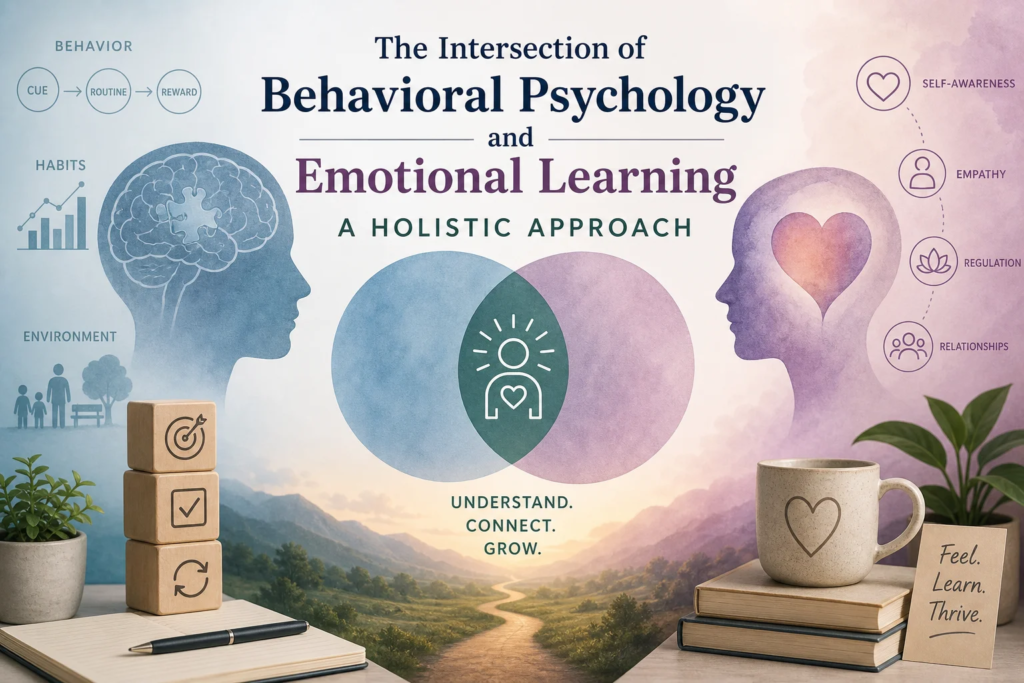
The Ultimate Guide to The Intersection of Behavioral Psychology and Emotional Learning: A Holistic Approach
Introduction: Why Behavior and Emotion Can No Longer Be Treated Separately
A child refuses to participate in class, not because they “don’t care,” but because embarrassment has trained their nervous system to avoid risk. A manager snaps at a team member, not because they are simply “difficult,” but because stress has shaped a reactive behavioral pattern. A teenager scrolls endlessly through social media, not just from lack of discipline, but because reward loops, belonging needs, and emotional regulation are deeply intertwined.
This is where The Intersection of Behavioral Psychology and Emotional Learning: A Holistic Approach becomes not only relevant, but essential.
For decades, behavioral psychology helped us understand how habits form, how reinforcement works, and why people repeat certain actions. Emotional learning, meanwhile, taught us that feelings are not distractions from learning or growth—they are central to them. When these two fields meet, we gain a more complete understanding of human development, motivation, resilience, and change.
In schools, workplaces, therapy rooms, parenting, coaching, leadership, and personal growth, the old model of “fix the behavior” is no longer enough. We need to ask: What emotional need is underneath the behavior? What learned associations are driving the response? What environment reinforces it? And how can we support both behavior change and emotional growth at the same time?
That is the promise of The Intersection of Behavioral Psychology and Emotional Learning: A Holistic Approach—a practical, human-centered framework for helping people not just act differently, but understand themselves more deeply.
Understanding Behavioral Psychology: The Science of Action
Behavioral psychology focuses on observable actions and the environmental conditions that influence them. It asks practical questions:
- What triggers a behavior?
- What reward or consequence maintains it?
- How can new behaviors be learned?
- How do habits become automatic?
- How does the environment shape responses?
At its core, behavioral psychology is built on the idea that behavior is learned through interaction with the world. Classical conditioning, operant conditioning, reinforcement, punishment, habit loops, modeling, and feedback all play key roles.
Key Behavioral Psychology Concepts
| Concept | Meaning | Example |
|---|---|---|
| Classical conditioning | Learning through association | A student feels anxious when hearing a school bell because it signals a stressful class |
| Operant conditioning | Behavior shaped by consequences | A child completes homework because praise follows |
| Positive reinforcement | Adding a reward to increase behavior | Praising effort after a difficult task |
| Negative reinforcement | Removing discomfort to increase behavior | Wearing headphones to reduce overstimulation |
| Punishment | Consequence that reduces behavior | Losing phone access after breaking a rule |
| Modeling | Learning by observing others | A child learns calm conflict resolution by watching a parent |
Behavioral psychology is powerful because it gives us tools for change. But when used alone, it can become too mechanical. If we focus only on what people do, we risk missing why they do it.
That is why The Intersection of Behavioral Psychology and Emotional Learning: A Holistic Approach matters so much. It reminds us that behavior is often the visible surface of invisible emotional experiences.
What Is Emotional Learning?
Emotional learning is the process of recognizing, understanding, expressing, regulating, and using emotions in constructive ways. It includes self-awareness, empathy, emotional vocabulary, stress management, social awareness, and relationship skills.
Emotional learning does not mean “feeling good all the time.” It means developing the ability to respond to emotions wisely rather than being controlled by them.
Core Components of Emotional Learning
| Emotional Learning Skill | Description | Real-Life Benefit |
|---|---|---|
| Self-awareness | Recognizing emotions and their causes | “I’m angry because I feel ignored” |
| Self-regulation | Managing emotional reactions | Taking a pause before responding |
| Empathy | Understanding others’ feelings | Responding with compassion instead of judgment |
| Emotional vocabulary | Naming feelings accurately | Distinguishing anxiety from frustration |
| Responsible decision-making | Choosing actions aligned with values | Apologizing after conflict |
| Relationship skills | Communicating and resolving conflict | Maintaining healthy friendships and teams |
When emotional learning is integrated with behavioral principles, people learn not only how to change actions, but how to build the emotional capacity needed to sustain those changes.
This is the heart of The Intersection of Behavioral Psychology and Emotional Learning: A Holistic Approach: lasting transformation happens when external habits and internal emotional skills develop together.
Why the Intersection Matters: Behavior Is Emotional, and Emotion Is Behavioral
We often talk about behavior and emotion as though they live in separate rooms. In reality, they are constantly influencing each other.
A feeling can trigger a behavior. A behavior can reinforce a feeling. An environment can intensify both. A memory can shape future reactions. A reward can strengthen emotional associations.
For example:
- A student feels ashamed after making mistakes, so they stop raising their hand.
- An employee feels unappreciated, so they disengage.
- A child feels overwhelmed, so they throw a tantrum.
- An adult feels lonely, so they overeat or overwork.
- A leader feels threatened, so they micromanage.
In each case, the behavior makes sense when we understand the emotional context.
The Intersection of Behavioral Psychology and Emotional Learning: A Holistic Approach gives us a map for seeing the full picture. It shows us that emotional responses are learned, repeated, reinforced, and changeable—just like behaviors.
The Holistic Model: Looking at the Whole Person
A holistic approach does not reduce people to symptoms, habits, or emotional labels. It considers the whole human being: thoughts, feelings, behavior, body, environment, relationships, history, and meaning.
The Holistic Behavior-Emotion Framework
| Dimension | Key Question | Example |
|---|---|---|
| Behavior | What is the person doing? | Avoiding group activities |
| Emotion | What is the person feeling? | Fear of judgment |
| Trigger | What activates the response? | Being asked to speak publicly |
| Reinforcement | What keeps the pattern going? | Relief after avoiding the activity |
| Environment | What external factors matter? | Competitive classroom culture |
| Skill gap | What ability needs strengthening? | Confidence, emotional regulation, communication |
| Support | What helps the person grow? | Gradual exposure, encouragement, coping tools |
This framework is central to The Intersection of Behavioral Psychology and Emotional Learning: A Holistic Approach because it prevents oversimplified solutions. Instead of saying, “Stop avoiding,” we ask, “What makes avoidance feel safer than participation?”
That shift changes everything.
The Brain Behind Behavior and Emotion
Modern neuroscience supports the integration of behavioral psychology and emotional learning. The brain does not separate emotional processing from learning; emotional experiences influence attention, memory, motivation, and decision-making.
Important Brain Systems
- Amygdala: Detects threat and activates emotional responses.
- Prefrontal cortex: Supports planning, impulse control, and decision-making.
- Hippocampus: Helps form memories and contextual learning.
- Reward system: Reinforces behaviors through dopamine pathways.
- Autonomic nervous system: Regulates stress responses such as fight, flight, freeze, or fawn.
When someone is emotionally overwhelmed, the prefrontal cortex becomes less effective. This means logic, reasoning, and self-control can be temporarily reduced. That is why telling someone to “calm down” rarely works.
A holistic behavioral and emotional learning approach teaches people to regulate before they reason. In other words, emotional safety makes behavioral change more possible.
This is another reason The Intersection of Behavioral Psychology and Emotional Learning: A Holistic Approach is so valuable in education, parenting, therapy, and leadership.
From Behavior Management to Emotional Skill Building
Traditional behavior management often relies on rewards, consequences, rules, and compliance. These tools can be useful, but they are incomplete if they ignore emotional development.
A child who receives a sticker for sitting quietly may comply, but they may not learn how to manage anxiety. An employee who receives a performance warning may change temporarily, but resentment may grow if emotional needs are ignored. A person who stops procrastinating through strict scheduling may still struggle if fear of failure remains unaddressed.
The goal is not to abandon behavioral strategies. The goal is to enrich them.
Traditional vs. Holistic Approach
| Traditional Behavior Management | Holistic Behavior-Emotion Approach |
|---|---|
| Focuses on visible behavior | Explores behavior and emotional drivers |
| Uses rewards and consequences | Uses reinforcement plus emotional skill-building |
| Asks “How do we stop this?” | Asks “What is this behavior communicating?” |
| Emphasizes compliance | Emphasizes growth, awareness, and agency |
| May produce short-term change | Supports long-term transformation |
This is the practical value of The Intersection of Behavioral Psychology and Emotional Learning: A Holistic Approach. It helps us move from control to connection, from correction to development.
Case Study 1: Emotional Learning in a Middle School Classroom
The Situation
A seventh-grade teacher noticed that several students were frequently disruptive during group work. The traditional response had been warnings, seating changes, and loss of privileges. These methods reduced disruption briefly, but the behavior always returned.
The school counselor introduced a program based on The Intersection of Behavioral Psychology and Emotional Learning: A Holistic Approach. Instead of focusing only on disruption, the team began tracking triggers, emotional states, peer dynamics, and reinforcement patterns.
Intervention
The teacher implemented:
- Emotion check-ins at the start of class
- Clear behavioral expectations
- Positive reinforcement for collaborative skills
- Short reflection sheets after conflict
- Role-play for disagreement and active listening
- Calm-down choices instead of immediate punishment
- Group rewards tied to respectful communication
Results
Within eight weeks, disruptions decreased. More importantly, students became better at identifying emotions such as embarrassment, frustration, jealousy, and anxiety. Group work improved because students had language and strategies for managing conflict.
Brief Analysis
This case illustrates The Intersection of Behavioral Psychology and Emotional Learning: A Holistic Approach in action. Behavioral tools created structure, while emotional learning gave students the inner skills to succeed within that structure. The change lasted because students were not merely controlled; they were taught.
Case Study 2: Workplace Burnout and Behavior Change
The Situation
A healthcare organization was struggling with staff burnout. Absenteeism increased, communication declined, and minor conflicts escalated quickly. Leadership initially considered stricter attendance policies and productivity monitoring.
Instead, the organization adopted a holistic behavioral and emotional learning strategy.
Intervention
The program included:
- Training managers to recognize stress behaviors
- Reinforcing healthy workload boundaries
- Peer support circles
- Emotional literacy workshops
- Micro-break routines
- Recognition systems for teamwork, not just output
- Coaching for difficult conversations
Results
After six months, employee engagement scores improved, sick days decreased, and team communication became more respectful. Managers reported that they were better able to distinguish between “performance problems” and stress-related coping behaviors.
Brief Analysis
This workplace case shows that The Intersection of Behavioral Psychology and Emotional Learning: A Holistic Approach is not limited to children or schools. Adults also operate through learned patterns, reinforcement systems, emotional triggers, and social environments. When emotional learning is normalized, behavioral change becomes less punitive and more sustainable.
Case Study 3: Parenting a Child with Emotional Outbursts
The Situation
A parent sought support because their six-year-old had intense meltdowns during bedtime. The parent had tried time-outs, sticker charts, and removing toys. Nothing worked consistently.
A closer look revealed that bedtime triggered separation anxiety. The child’s behavior—crying, yelling, refusing pajamas—was reinforced because it delayed separation and kept the parent nearby.
Intervention
Using The Intersection of Behavioral Psychology and Emotional Learning: A Holistic Approach, the parent created a new bedtime plan:
- Predictable routine with visual steps
- Emotion labeling: “Your body feels worried when it is time to sleep”
- Gradual separation practice
- Positive reinforcement for small steps
- A comfort object
- A brief parent check-in schedule
- Calm responses instead of escalating consequences
Results
Over several weeks, bedtime became smoother. The child still experienced worry, but learned to name it and use coping tools. The parent stopped viewing the behavior as defiance and began seeing it as anxiety expressed through behavior.
Brief Analysis
This case highlights why The Intersection of Behavioral Psychology and Emotional Learning: A Holistic Approach is especially useful in parenting. The parent did not ignore behavior, but they also did not punish fear. They shaped new habits while supporting emotional security.
Case Study 4: Therapy and Habit Transformation
The Situation
An adult client wanted to stop emotional eating. Previous attempts focused on calorie tracking and willpower. These strategies worked temporarily, then collapsed during stressful periods.
The therapist used a behavioral-emotional framework to identify the pattern:
- Trigger: Work stress and loneliness
- Emotion: Anxiety and emptiness
- Behavior: Eating sugary foods late at night
- Reinforcement: Temporary comfort and distraction
- Consequence: Shame and renewed stress
Intervention
The plan included:
- Tracking emotional triggers instead of only food intake
- Creating alternative soothing behaviors
- Practicing self-compassion after setbacks
- Building evening connection routines
- Reinforcing non-food coping strategies
- Developing tolerance for uncomfortable emotions
Results
The client reduced emotional eating episodes and reported less shame. They learned that the goal was not simply “stop eating,” but “learn how to respond to distress differently.”
Brief Analysis
This is a strong example of The Intersection of Behavioral Psychology and Emotional Learning: A Holistic Approach because it reveals the emotional function of a behavior. Once the client understood that eating was a learned regulation strategy, they could replace it with healthier emotional and behavioral patterns.
The Role of Reinforcement in Emotional Learning
Reinforcement is one of the most important bridges between behavioral psychology and emotional learning. People repeat behaviors that bring relief, reward, connection, identity, or safety.
Sometimes reinforcement is obvious. A child cleans their room and receives praise. Sometimes it is hidden. A teenager avoids a difficult conversation and feels immediate relief, so avoidance becomes stronger.
Common Reinforcement Patterns
| Behavior | Emotional Payoff | Long-Term Risk |
|---|---|---|
| Avoiding challenges | Relief from anxiety | Reduced confidence |
| People-pleasing | Approval and safety | Resentment, burnout |
| Anger outbursts | Sense of control | Damaged relationships |
| Procrastination | Temporary escape | Increased stress |
| Overworking | Validation | Exhaustion |
| Emotional withdrawal | Protection from vulnerability | Loneliness |
A holistic emotional learning and behavioral psychology model helps identify not only what reinforces behavior, but what emotional need the reinforcement satisfies.
This is why The Intersection of Behavioral Psychology and Emotional Learning: A Holistic Approach is so effective: it respects the intelligence of behavior. Even unhelpful behaviors often begin as attempts to cope.
Emotional Regulation: The Missing Link in Behavior Change
Many behavior plans fail because they assume people can make better choices while emotionally flooded. But emotional regulation is often the missing skill.
Emotional regulation includes the ability to:
- Pause before reacting
- Notice body signals
- Name emotions
- Use calming strategies
- Reframe thoughts
- Ask for help
- Recover after conflict
- Tolerate discomfort
Without regulation, behavioral expectations can feel impossible. With regulation, people gain the internal space needed to choose a different response.
Regulation Strategies That Support Behavior Change
| Strategy | How It Works | Best Used When |
|---|---|---|
| Deep breathing | Calms nervous system | Anxiety, anger, panic |
| Emotion naming | Reduces emotional intensity | Confusion, overwhelm |
| Movement break | Releases stress energy | Restlessness, frustration |
| Grounding | Reconnects attention to present | Dissociation, fear |
| Self-talk | Reframes internal narrative | Shame, discouragement |
| Co-regulation | Uses supportive presence | Children, high distress |
| Reflection | Builds insight after events | Repeated patterns |
At the center of The Intersection of Behavioral Psychology and Emotional Learning: A Holistic Approach is the belief that regulation is not a luxury—it is a foundation.
Applying the Approach in Education
Schools are one of the most important places to apply The Intersection of Behavioral Psychology and Emotional Learning: A Holistic Approach. Students are constantly learning not only academic content, but also how to handle frustration, comparison, uncertainty, feedback, peer pressure, and failure.
A classroom that integrates behavioral psychology and emotional learning might include:
- Predictable routines
- Clear expectations
- Emotion vocabulary
- Positive reinforcement
- Reflection after conflict
- Restorative conversations
- Modeling by adults
- Student choice
- Collaborative problem-solving
- Safe opportunities to make mistakes
Example: A Holistic Classroom Flow
| Time | Behavioral Element | Emotional Learning Element |
|---|---|---|
| Start of class | Routine entry task | Mood check-in |
| Instruction | Clear expectations | Normalize confusion and effort |
| Group work | Reinforced collaboration | Practice empathy and conflict skills |
| Challenge task | Step-by-step goals | Growth mindset and frustration tolerance |
| End of class | Reflection routine | Identify one emotion and one strategy used |
When students feel emotionally safe, they are more willing to take intellectual risks. When behavioral expectations are clear, emotional learning has structure. Together, they create a classroom culture where students can thrive.
Applying the Approach in Leadership and Organizations
The modern workplace is emotionally demanding. People navigate deadlines, ambiguity, performance pressure, interpersonal tension, and constant change. Leaders who ignore emotion often misread behavior.
For example:
- Silence in meetings may be fear, not disengagement.
- Resistance to change may be uncertainty, not laziness.
- Conflict may be unmet need, not hostility.
- Low productivity may be burnout, not incompetence.
A leader using The Intersection of Behavioral Psychology and Emotional Learning: A Holistic Approach looks beyond surface behavior and asks better questions.
Holistic Leadership Practices
| Practice | Behavioral Benefit | Emotional Benefit |
|---|---|---|
| Clear feedback | Improves performance | Reduces uncertainty |
| Recognition | Reinforces desired behavior | Builds belonging |
| Psychological safety | Encourages participation | Reduces fear |
| Consistent boundaries | Supports accountability | Prevents resentment |
| Emotional check-ins | Identifies stress early | Normalizes communication |
| Coaching conversations | Builds skill | Strengthens trust |
Leaders do not need to become therapists. But they do need emotional intelligence. When leaders understand behavior and emotion together, they build healthier and more effective teams.
Applying the Approach in Therapy and Coaching
Therapists and coaches often work with people who want to change habits, relationships, reactions, or self-beliefs. The Intersection of Behavioral Psychology and Emotional Learning: A Holistic Approach offers a practical way to connect insight with action.
A client may understand why they struggle, but still feel stuck. Behavioral strategies help turn insight into practice. At the same time, emotional learning prevents change from becoming rigid, shame-based, or superficial.
Common Therapeutic Applications
- Anxiety treatment
- Habit change
- Anger management
- Trauma-informed care
- Relationship coaching
- Addiction recovery
- Parenting support
- Executive coaching
- Self-esteem development
- Stress management
A holistic approach might combine behavior tracking, exposure practice, emotional labeling, cognitive reframing, values clarification, and reinforcement planning.
The result is not just behavior modification. It is emotional growth expressed through new behavior.
The Role of Environment: People Change Better in Supportive Systems
One of the most overlooked lessons from behavioral psychology is that environments matter. We often blame individuals for patterns that are being reinforced by their surroundings.
A student may struggle in a chaotic classroom. An employee may disengage in a culture of criticism. A child may act out in an unpredictable home environment. An adult may relapse into old habits when surrounded by constant stress.
Emotional learning also depends on environment. People learn emotional responses through relationships, modeling, safety, and repeated experience.
That means The Intersection of Behavioral Psychology and Emotional Learning: A Holistic Approach must include system design.
Supportive Environmental Design
| Environment | Helpful Behavioral Supports | Helpful Emotional Supports |
|---|---|---|
| Home | Routines, visual reminders, consistent expectations | Warmth, validation, calm repair |
| School | Clear rules, reinforcement, structured transitions | Belonging, emotional vocabulary, trusted adults |
| Workplace | Role clarity, feedback systems, realistic workloads | Psychological safety, empathy, recognition |
| Therapy | Goals, practice tasks, accountability | Trust, self-compassion, emotional processing |
| Community | Accessible resources, positive norms | Connection, inclusion, shared identity |
When environments reinforce healthy behavior and emotional safety, change becomes easier to maintain.
The Ethics of Behavioral and Emotional Intervention
Any approach that influences behavior and emotion must be used ethically. The goal should never be manipulation, forced compliance, or emotional suppression.
A responsible version of The Intersection of Behavioral Psychology and Emotional Learning: A Holistic Approach respects autonomy, dignity, culture, consent, and individual differences.
Ethical Principles
-
Respect the person behind the behavior.
Behavior communicates something, even when it is disruptive.
-
Avoid shame-based methods.
Shame may suppress behavior temporarily, but it damages emotional learning.
-
Use reinforcement thoughtfully.
Rewards should support growth, not control identity or worth.
-
Include the learner’s voice.
People are more invested when they help shape goals.
-
Consider trauma and neurodiversity.
Not all behaviors mean the same thing for every person.
- Prioritize skill-building over compliance.
The best outcome is self-awareness and self-direction.
A holistic behavioral psychology and emotional learning model is most powerful when it is compassionate.
Practical Framework: The B.E.L.O.N.G. Model
To make The Intersection of Behavioral Psychology and Emotional Learning: A Holistic Approach easier to apply, here is a practical framework: B.E.L.O.N.G.
| Step | Meaning | Key Question |
|---|---|---|
| B | Behavior | What observable action is occurring? |
| E | Emotion | What feeling may be driving or following it? |
| L | Learning history | Where might this pattern have been learned? |
| O | Outcome | What reward, relief, or consequence maintains it? |
| N | Need | What emotional or relational need is present? |
| G | Growth strategy | What skill, support, or environmental change can help? |
Example
A student refuses to present in class.
- Behavior: Avoids presentation
- Emotion: Anxiety, embarrassment
- Learning history: Was laughed at previously
- Outcome: Avoidance brings relief
- Need: Safety and confidence
- Growth strategy: Gradual exposure, supportive peer practice, positive reinforcement, emotion regulation tools
This model captures the essence of The Intersection of Behavioral Psychology and Emotional Learning: A Holistic Approach in a simple, usable way.
Long-Tail Keyword Variations for Contextual SEO
Here are natural long-tail variations related to The Intersection of Behavioral Psychology and Emotional Learning: A Holistic Approach that fit the topic well:
- behavioral psychology and emotional learning in education
- holistic approach to behavior and emotions
- emotional learning and behavior change strategies
- behavioral psychology for social emotional learning
- emotional regulation and behavioral psychology
- behavior management through emotional learning
- psychology-based emotional learning framework
- holistic emotional development and behavior change
- behavioral and emotional learning in classrooms
- emotional intelligence and behavioral psychology
- integrated approach to emotional and behavioral growth
- how emotions influence behavior and learning
- behavioral psychology and SEL strategies
- holistic behavioral intervention for children and adults
- emotional learning in workplace behavior change
These variations help support readability and SEO without forcing repetition. The key is to use them naturally, just as this article has done throughout its discussion of The Intersection of Behavioral Psychology and Emotional Learning: A Holistic Approach.
Common Mistakes to Avoid
Even well-intentioned educators, parents, leaders, and professionals can misunderstand the relationship between behavior and emotion.
Mistake 1: Treating Behavior as the Whole Problem
If a child yells, an employee withdraws, or a client procrastinates, the behavior is important—but it is not the whole story. Ask what emotion, need, trigger, or reinforcement is underneath.
Mistake 2: Overusing Rewards
Rewards can help shape behavior, but they should not replace intrinsic motivation, emotional understanding, or relational connection.
Mistake 3: Ignoring the Body
Emotion lives in the body. Sleep, hunger, sensory overload, chronic stress, and nervous system activation all influence behavior.
Mistake 4: Expecting Insight to Automatically Change Behavior
Knowing why we do something does not always mean we can stop. Behavioral practice is necessary.
Mistake 5: Expecting Behavior Change Without Emotional Safety
Fear-based compliance is fragile. People grow better when they feel safe enough to practice new responses.
Avoiding these mistakes helps preserve the integrity of The Intersection of Behavioral Psychology and Emotional Learning: A Holistic Approach.
How to Start Using This Approach Today
You do not need a complex program to begin applying The Intersection of Behavioral Psychology and Emotional Learning: A Holistic Approach. Start with small shifts.
1. Observe Before Reacting
Instead of immediately correcting behavior, pause and notice patterns. What happened before the behavior? What happened after? What emotion might be involved?
2. Name the Emotion
Use simple language: “It seems like you felt frustrated,” or “I wonder if that was embarrassing.” Naming emotions builds awareness.
3. Identify the Reinforcement
Ask what the behavior accomplishes. Does it bring attention, escape, relief, control, connection, or stimulation?
4. Teach a Replacement Skill
Do not just say, “Stop doing that.” Teach what to do instead. Replace yelling with asking for help. Replace avoidance with a small first step.
5. Reinforce Progress
Notice effort, not just success. Reinforcement strengthens new behavior, especially when change feels emotionally hard.
6. Create Safety and Structure
People need both warmth and boundaries. Emotional support without structure can feel chaotic. Structure without emotional support can feel harsh.
7. Reflect and Repair
After difficult moments, revisit them calmly. Reflection turns experience into learning.
These steps bring the holistic approach to behavior and emotions into everyday life.
The Future of Behavioral Psychology and Emotional Learning
The future of human development will likely become more integrated. Schools are already adopting social-emotional learning. Workplaces are investing in emotional intelligence and psychological safety. Therapists increasingly combine behavioral methods with trauma-informed and emotion-focused practices. Parents are moving away from punishment-only models toward connection-based discipline.
The next step is deeper integration.
The Intersection of Behavioral Psychology and Emotional Learning: A Holistic Approach offers a future where people are not reduced to performance metrics, classroom conduct, productivity scores, or symptoms. Instead, behavior is understood as meaningful, emotions are treated as teachable, and growth becomes both practical and compassionate.
This approach is not soft. It is sophisticated. It recognizes that human beings change through repeated experience, emotional safety, meaningful reinforcement, supportive relationships, and intentional practice.
Conclusion: A More Human Way to Understand Change
At its best, The Intersection of Behavioral Psychology and Emotional Learning: A Holistic Approach gives us a richer, kinder, and more effective way to support growth.
Behavioral psychology teaches us that actions are learned, reinforced, and shaped by environment. Emotional learning teaches us that feelings guide attention, memory, motivation, relationships, and decision-making. A holistic approach brings these truths together.
The result is powerful: we stop asking only, “How do we control this behavior?” and begin asking, “What is this behavior telling us, and what skills are needed for growth?”
Whether you are a teacher, parent, therapist, coach, leader, or someone working on your own habits, the message is the same: lasting change happens when behavior and emotion are addressed together.
Start small. Notice patterns. Name emotions. Reinforce progress. Build safety. Teach skills. Repair after mistakes.
Human growth is not about perfection. It is about learning new ways to respond—to ourselves, to others, and to the world around us.
That is the real promise of The Intersection of Behavioral Psychology and Emotional Learning: A Holistic Approach: not just better behavior, but deeper understanding, stronger relationships, and more resilient lives.
FAQs About The Intersection of Behavioral Psychology and Emotional Learning: A Holistic Approach
1. What does The Intersection of Behavioral Psychology and Emotional Learning: A Holistic Approach mean?
It means combining the science of behavior change with the development of emotional awareness, regulation, and social skills. Instead of focusing only on what people do, this approach also explores what they feel, what they need, and what patterns reinforce their actions.
2. Why is emotional learning important for behavior change?
Emotional learning is important because emotions often drive behavior. If someone does not know how to manage anxiety, anger, shame, or sadness, they may rely on avoidance, aggression, withdrawal, or unhealthy coping habits. Emotional learning gives people better tools for responding.
3. How can teachers use behavioral psychology and emotional learning together?
Teachers can combine clear expectations, routines, and positive reinforcement with emotion check-ins, conflict resolution, empathy practice, and self-regulation strategies. This supports both classroom behavior and emotional development.
4. Is this approach useful for adults?
Yes. The Intersection of Behavioral Psychology and Emotional Learning: A Holistic Approach applies to adults in workplaces, therapy, relationships, parenting, leadership, and personal development. Adults also have learned behaviors, emotional triggers, and reinforcement patterns.
5. Does a holistic approach mean ignoring consequences?
No. A holistic approach does not eliminate accountability. It makes accountability more effective by pairing consequences with emotional understanding, skill-building, and support. The goal is not permissiveness; it is growth.
6. How does this approach help with anxiety?
Behavioral psychology helps identify avoidance patterns and gradually build new responses. Emotional learning helps people recognize anxiety, regulate the nervous system, and tolerate discomfort. Together, they support more sustainable anxiety management.
7. Can rewards harm emotional learning?
Rewards are not harmful by themselves, but overusing them can reduce intrinsic motivation or create dependence on external approval. The best use of reinforcement is to support effort, skill development, and meaningful progress.
8. What is the first step in applying this holistic approach?
Start by observing behavior without immediate judgment. Ask: What triggered this? What emotion might be present? What does the behavior accomplish? What skill is missing? These questions open the door to more compassionate and effective change.

