


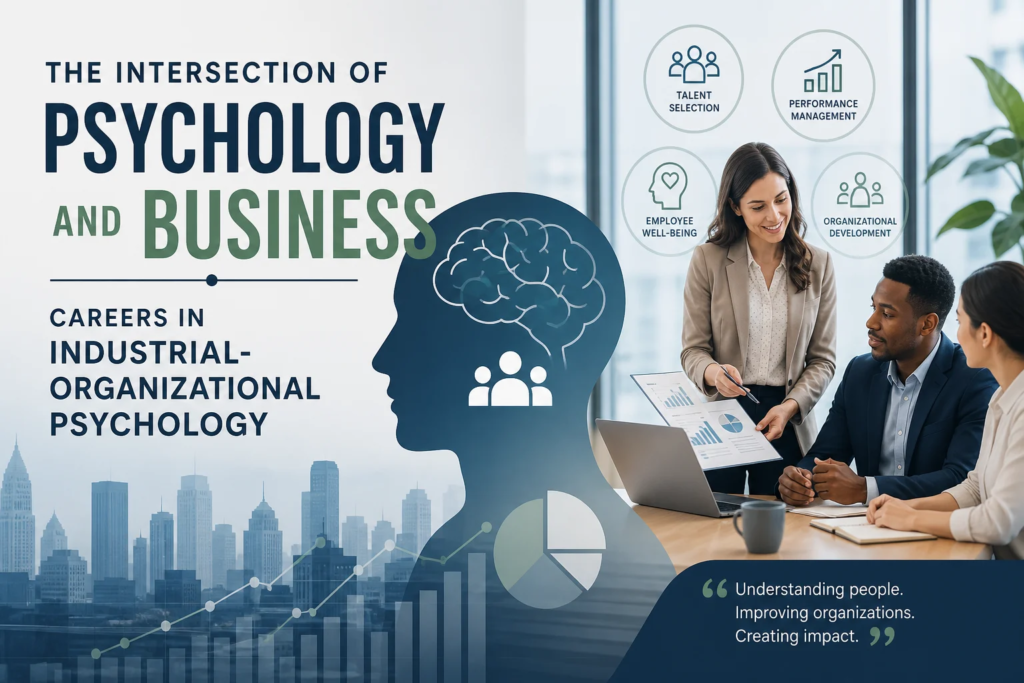
Introduction: Where Human Behavior Meets Business Performance
Every business problem is, at some level, a people problem.
A company may have world-class technology, a bold strategy, and a beautiful brand, but if employees are disengaged, leaders are ineffective, teams are misaligned, or hiring decisions are poor, performance suffers. This is exactly why The Intersection of Psychology and Business: Careers in Industrial-Organizational Psychology has become such a compelling and high-impact career area.
Industrial-organizational psychology—often called I-O psychology—uses psychological science to solve workplace challenges. It asks practical but powerful questions: How do we hire the right people? What makes employees thrive? Why do some teams outperform others? How can leaders motivate without burning people out? How do organizations build cultures where people and profits can grow together?
In other words, The Intersection of Psychology and Business: Careers in Industrial-Organizational Psychology is not just an academic topic. It is a real-world profession shaping how companies select talent, develop leaders, improve employee well-being, manage change, and make smarter decisions about people.
If you are fascinated by human behavior and also interested in business outcomes, careers in industrial-organizational psychology may offer the best of both worlds. This guide explores what I-O psychologists do, where they work, how they create value, what career paths exist, and how you can prepare for a meaningful future in this field.
What Is Industrial-Organizational Psychology?
Industrial-organizational psychology is the scientific study of human behavior in the workplace. It combines psychology, research methods, statistics, management, and organizational strategy to improve both employee experience and organizational effectiveness.
The “industrial” side traditionally focuses on individuals and jobs, including hiring, assessment, job analysis, training, and performance measurement. The “organizational” side focuses on broader workplace systems such as leadership, culture, motivation, engagement, communication, change management, and team dynamics.
Today, the two sides overlap constantly. That is why The Intersection of Psychology and Business: Careers in Industrial-Organizational Psychology is so relevant. Modern organizations need professionals who understand both human behavior and business systems.
An I-O psychologist might help a company reduce employee turnover, design a fair promotion process, assess leadership potential, improve psychological safety, analyze engagement data, or build a more inclusive workplace culture.
Unlike clinical psychologists, I-O psychologists typically do not provide therapy. Instead, they apply psychological principles to organizations, teams, and work environments.
Why The Intersection of Psychology and Business Matters More Than Ever
The workplace has changed dramatically. Remote work, hybrid teams, artificial intelligence, global talent markets, economic uncertainty, and rising employee expectations have transformed how organizations operate.
Businesses can no longer rely only on intuition when making people-related decisions. They need evidence. They need ethical data practices. They need professionals who can translate research into practical solutions. That is why The Intersection of Psychology and Business: Careers in Industrial-Organizational Psychology is gaining attention among students, HR professionals, executives, consultants, and career changers.
Here are a few reasons the field is especially important today:
| Workplace Challenge | How I-O Psychology Helps |
|---|---|
| High employee turnover | Identifies causes of attrition and designs retention strategies |
| Poor hiring decisions | Creates validated assessments and structured interviews |
| Burnout and disengagement | Measures well-being and redesigns work conditions |
| Weak leadership pipelines | Develops leadership assessments and coaching programs |
| Change fatigue | Applies change management and communication science |
| Diversity and inclusion gaps | Builds fairer systems for hiring, promotion, and development |
| Remote work struggles | Improves virtual collaboration, trust, and performance management |
The heart of The Intersection of Psychology and Business: Careers in Industrial-Organizational Psychology is this: organizations perform better when they understand people better.
The Core Work of I-O Psychologists
Careers in industrial-organizational psychology are diverse. Some professionals work inside companies. Others consult across multiple organizations. Some focus heavily on data and analytics, while others spend more time coaching leaders, facilitating workshops, or designing organizational interventions.
Still, most I-O psychology careers involve several core activities.
1. Talent Selection and Assessment
One major area within The Intersection of Psychology and Business: Careers in Industrial-Organizational Psychology is helping organizations hire better.
I-O psychologists conduct job analyses, identify competencies, design structured interviews, create assessment centers, and validate selection tools. The goal is not simply to “pick impressive candidates.” The goal is to predict job performance fairly and accurately.
For example, instead of relying on gut feelings in interviews, an I-O psychologist may help create behavioral interview questions tied directly to job requirements. This improves consistency, reduces bias, and increases the likelihood of hiring people who will succeed.
2. Employee Training and Development
Businesses invest heavily in training, but not all training works. I-O psychologists design learning experiences based on how adults acquire skills, retain information, and transfer learning back to the job.
They may evaluate whether a sales training program actually improves revenue, whether leadership development changes management behavior, or whether onboarding helps new hires become productive faster.
3. Leadership Development
Leadership is one of the most popular areas in industrial-organizational psychology career paths. I-O psychologists help identify leadership potential, design succession plans, coach executives, and improve decision-making.
They may use 360-degree feedback, personality assessments, simulations, interviews, and leadership competency models. Their work helps companies avoid promoting people based solely on technical skill while ignoring emotional intelligence, adaptability, or ethical judgment.
4. Organizational Culture and Employee Engagement
Another key part of The Intersection of Psychology and Business: Careers in Industrial-Organizational Psychology is understanding what makes employees feel committed, motivated, and connected to their work.
I-O psychologists design engagement surveys, analyze employee feedback, and help leaders turn insights into action. They also examine culture: the shared values, norms, behaviors, and expectations that shape everyday work.
5. Performance Management
Performance reviews are often disliked by employees and managers alike. I-O psychologists help organizations create performance systems that are more accurate, useful, and motivating.
This can include goal-setting frameworks, feedback training, rating scale design, coaching tools, and performance calibration processes.
6. Workplace Well-Being and Burnout Prevention
Employee well-being is no longer viewed as a “nice extra.” Burnout, stress, workload imbalance, and toxic management can damage both people and business results.
I-O psychologists study job demands, resources, motivation, resilience, work-life boundaries, and psychological safety. They help organizations design healthier work systems rather than placing all responsibility on individual employees.
Career Paths in Industrial-Organizational Psychology
One reason The Intersection of Psychology and Business: Careers in Industrial-Organizational Psychology is so attractive is the range of possible roles. You can work in corporate HR, consulting, people analytics, leadership development, academia, government, nonprofit organizations, or technology companies.
Below is a practical career map.
| Career Path | Typical Responsibilities | Best Fit For |
|---|---|---|
| I-O Psychologist | Applies psychological research to workplace challenges | People who enjoy research and business impact |
| Talent Assessment Consultant | Designs hiring tools, assessments, and interviews | Analytical thinkers interested in selection |
| People Analytics Specialist | Uses data to study turnover, engagement, performance, and workforce trends | Data-oriented professionals |
| Leadership Development Consultant | Builds leadership programs, coaching systems, and succession plans | People interested in leadership behavior |
| Organizational Development Specialist | Improves culture, change management, communication, and team effectiveness | Systems thinkers and facilitators |
| Employee Experience Researcher | Studies employee journeys, engagement, and workplace design | Research-minded professionals |
| HR Business Partner with I-O Expertise | Advises leaders using evidence-based people practices | Business-focused psychology graduates |
| Academic Researcher or Professor | Conducts studies and teaches I-O psychology | Those drawn to scholarship and education |
| DEI and Inclusion Strategist | Designs fair, inclusive systems and measures equity outcomes | Professionals passionate about justice and systems change |
These industrial-organizational psychology career paths show how flexible the field can be. Some roles require a master’s or doctoral degree in I-O psychology, while others may be accessible through related fields such as human resources, organizational development, data analytics, business psychology, or behavioral science.
Key Skills Needed for Careers in Industrial-Organizational Psychology
Success in The Intersection of Psychology and Business: Careers in Industrial-Organizational Psychology requires a rare blend of scientific thinking and practical communication.
You need to understand research, but you also need to explain insights to executives who may not care about academic terminology. You need statistical skills, but you also need empathy. You need to respect data while remembering that every data point represents a human being.
| Skill | Why It Matters |
|---|---|
| Research design | Helps evaluate what actually works |
| Statistics and data analysis | Supports evidence-based decision-making |
| Communication | Turns complex findings into clear recommendations |
| Business acumen | Connects people strategies to organizational goals |
| Ethical judgment | Protects fairness, privacy, and employee trust |
| Facilitation | Helps teams and leaders have productive conversations |
| Consulting skills | Clarifies problems and guides clients toward solutions |
| Change management | Supports implementation, not just diagnosis |
| Systems thinking | Reveals how culture, leadership, policies, and incentives interact |
The most effective I-O professionals are translators. They translate psychology into business value and business problems into researchable questions.
Case Study 1: Reducing Turnover in a Logistics Company
A fast-growing logistics company was struggling with high turnover among warehouse supervisors. Leaders assumed the problem was pay. Exit interviews, however, suggested a more complicated picture: supervisors felt overwhelmed, undertrained, and caught between senior management demands and frontline employee frustrations.
An I-O psychology consultant was brought in to conduct a job analysis, survey supervisors, interview managers, and review performance data. The findings showed that many supervisors had been promoted because they were strong individual performers, not because they had leadership skills. They received little preparation for conflict management, scheduling pressure, or coaching employees.
The consultant recommended a structured supervisor selection process, realistic job previews, a new onboarding program, and targeted leadership training. The company also redesigned workload expectations and created peer support groups for new supervisors.
Analysis: Why This Case Matters
This case illustrates The Intersection of Psychology and Business: Careers in Industrial-Organizational Psychology in action. The company initially viewed turnover as a compensation issue. The I-O approach uncovered deeper psychological and organizational factors: role ambiguity, skill gaps, stress, and poor promotion criteria.
The result was not a generic morale campaign. It was a business-focused, evidence-based intervention that improved retention, leadership readiness, and operational stability.
Case Study 2: Improving Hiring Fairness in a Financial Services Firm
A financial services firm wanted to improve diversity in its analyst hiring pipeline. Leaders were concerned that their existing interview process favored candidates who were confident, polished, and from elite universities, but not necessarily those with the best long-term potential.
An internal I-O psychology team reviewed the selection process. They found that interviewers used inconsistent questions, relied heavily on “culture fit,” and gave high scores to candidates who shared similar backgrounds with current employees.
The team conducted a job analysis to identify the competencies truly required for analyst success. They then created structured interviews, work sample exercises, scoring rubrics, and interviewer training. They also monitored selection outcomes to identify adverse impact and improve fairness.
Analysis: Why This Case Matters
This is a powerful example of careers in industrial-organizational psychology creating both ethical and business value. Fair hiring is not only about compliance. It is also about making better decisions.
The firm moved away from vague impressions and toward validated selection methods. This improved consistency, reduced bias, and expanded access to talented candidates who might previously have been overlooked. It also shows why The Intersection of Psychology and Business: Careers in Industrial-Organizational Psychology plays a critical role in modern diversity, equity, and inclusion work.
Case Study 3: Fighting Burnout in a Healthcare Organization
A regional healthcare organization noticed rising burnout among nurses and clinical staff. Leadership initially responded with wellness webinars and mindfulness resources. Participation was low, and burnout continued to rise.
An I-O psychologist helped the organization take a systems-level approach. Surveys and focus groups revealed that burnout was driven less by lack of resilience and more by chronic understaffing, unpredictable schedules, poor supervisor communication, and emotional exhaustion.
The organization introduced schedule redesign, manager training, peer debriefing sessions, workload monitoring, and clearer escalation processes. Leaders also began tracking burnout indicators alongside patient care metrics.
Analysis: Why This Case Matters
This case highlights an essential lesson in The Intersection of Psychology and Business: Careers in Industrial-Organizational Psychology: workplace well-being cannot be solved only by asking employees to cope better. Sometimes the work itself must change.
The I-O psychologist helped shift the conversation from individual weakness to organizational design. That shift improved trust and made interventions more credible.
Case Study 4: Building Better Leaders in a Technology Company
A mid-sized technology company was growing quickly, but many newly promoted managers were struggling. Engineers who had excelled technically were suddenly responsible for feedback, delegation, conflict resolution, and team motivation.
An I-O psychology consultant designed a leadership development program based on competencies such as coaching, psychological safety, inclusive decision-making, and strategic communication. Participants completed 360-degree feedback assessments, attended workshops, practiced difficult conversations, and received follow-up coaching.
The company also changed promotion criteria. Instead of promoting solely based on technical output, it began evaluating collaboration, mentoring, judgment, and people leadership potential.
Analysis: Why This Case Matters
This example shows how industrial-organizational psychology careers can directly influence business scalability. As companies grow, leadership quality becomes a multiplier. Poor managers can drive turnover and disengagement, while effective managers create clarity, trust, and performance.
This case also shows why The Intersection of Psychology and Business: Careers in Industrial-Organizational Psychology is valuable in fast-moving industries where technical talent alone is not enough.
The Role of Data in I-O Psychology
Modern I-O psychology is increasingly data-driven. Organizations collect information from engagement surveys, performance systems, learning platforms, applicant tracking systems, collaboration tools, and exit interviews.
But data alone is not insight. I-O psychologists help interpret data responsibly.
For example, if employee engagement scores drop, an inexperienced analyst might simply report the decline. An I-O psychologist asks deeper questions: Which groups are most affected? What changed in the work environment? Are survey items valid? Are leaders psychologically safe enough for employees to answer honestly? What interventions are supported by research?
This is where The Intersection of Psychology and Business: Careers in Industrial-Organizational Psychology becomes especially powerful. I-O professionals can combine statistical analysis with theory, ethics, and organizational context.
Common Data Sources in I-O Work
| Data Source | What It Can Reveal |
|---|---|
| Engagement surveys | Motivation, commitment, trust, satisfaction |
| Turnover data | Retention risks and patterns |
| Performance ratings | Productivity, goal achievement, manager evaluation patterns |
| Selection assessments | Candidate-job fit and hiring validity |
| Exit interviews | Reasons employees leave |
| 360-degree feedback | Leadership strengths and development areas |
| Training evaluations | Learning effectiveness and behavior change |
| Pulse surveys | Short-term reactions to change or events |
The challenge is not collecting more data. The challenge is asking better questions.
Ethics: The Backbone of Industrial-Organizational Psychology
Because I-O psychologists influence hiring, promotion, assessment, surveillance, leadership development, and workplace policy, ethics are central to the profession.
Poorly designed assessments can exclude qualified candidates. Misused employee data can violate privacy. Engagement surveys can become performative if leaders collect feedback and do nothing. AI-based hiring tools can amplify bias if not validated carefully.
Ethical I-O practice involves fairness, transparency, validity, confidentiality, informed consent, and respect for human dignity.
This is one reason The Intersection of Psychology and Business: Careers in Industrial-Organizational Psychology requires more than business enthusiasm. It requires professional responsibility.
An I-O psychologist must be willing to ask uncomfortable questions:
- Is this assessment actually measuring job-relevant skills?
- Could this process disadvantage certain groups?
- Are employees aware of how their data is being used?
- Are leaders prepared to act on survey findings?
- Does this intervention benefit employees as well as the organization?
The best I-O professionals understand that long-term business performance depends on trust.
Education and Training for I-O Psychology Careers
If you are interested in The Intersection of Psychology and Business: Careers in Industrial-Organizational Psychology, your educational path will depend on your goals.
A bachelor’s degree in psychology, business, human resources, sociology, economics, or a related field can provide a strong foundation. However, many specialized I-O psychology roles require graduate education.
Common Educational Paths
| Degree Level | Opportunities |
|---|---|
| Bachelor’s degree | HR assistant, recruiting coordinator, research assistant, training coordinator |
| Master’s in I-O Psychology | Consultant, people analyst, assessment specialist, OD specialist, HR strategist |
| Ph.D. in I-O Psychology | Senior researcher, professor, executive consultant, advanced assessment expert |
| MBA with behavioral science focus | HR leadership, organizational strategy, consulting |
| Related master’s degree | Organizational development, human capital analytics, leadership development |
A master’s degree is often considered the practical entry point for many careers in industrial-organizational psychology. A doctoral degree is especially useful for those who want to conduct advanced research, teach at universities, or lead complex consulting projects.
Important coursework often includes:
- Personnel selection
- Psychometrics
- Statistics
- Research methods
- Organizational behavior
- Motivation
- Leadership
- Training and development
- Performance management
- Work attitudes
- Occupational health psychology
- Diversity and inclusion
- People analytics
Internships, applied projects, and consulting experience are also extremely valuable.
Where I-O Psychologists Work
Careers in industrial-organizational psychology exist across nearly every sector.
Large corporations hire I-O psychologists for talent management, people analytics, assessment, leadership development, and organizational effectiveness. Consulting firms hire them to serve external clients. Government agencies use them for selection testing, workforce planning, and employee development. Healthcare systems, universities, nonprofits, and technology companies also rely on I-O expertise.
Common Work Settings
| Setting | Example Work |
|---|---|
| Corporate HR departments | Engagement surveys, leadership development, talent strategy |
| Consulting firms | Assessment design, change management, organizational diagnostics |
| Government agencies | Selection systems, training evaluation, workforce planning |
| Technology companies | People analytics, employee experience research, manager development |
| Healthcare organizations | Burnout prevention, team effectiveness, safety culture |
| Universities | Teaching, research, applied partnerships |
| Nonprofits | Culture building, volunteer engagement, leadership assessment |
This range is another reason The Intersection of Psychology and Business: Careers in Industrial-Organizational Psychology appeals to people with varied interests.
A Day in the Life of an I-O Psychologist
There is no single “typical day,” but imagine this:
You start the morning reviewing engagement survey results for a global company. One department shows a sharp decline in trust toward leadership. You dig deeper, comparing results by tenure, location, and manager group.
Later, you meet with HR leaders to discuss a new structured interview process. You explain why every candidate should be asked the same job-relevant questions and why scoring rubrics improve fairness.
After lunch, you facilitate a workshop for managers on giving effective feedback. The conversation gets real: managers admit they avoid difficult conversations because they fear damaging relationships. You help them practice language that is direct, respectful, and behavior-focused.
In the afternoon, you analyze whether a leadership development program improved participant behavior six months after completion. You prepare a short executive summary: what changed, what did not, and what should happen next.
That blend of research, data, strategy, and human interaction is what makes The Intersection of Psychology and Business: Careers in Industrial-Organizational Psychology so dynamic.
Business Impact: How I-O Psychology Creates Value
Executives often want to know: How does I-O psychology affect the bottom line?
The answer is simple but important: people systems shape business outcomes.
Better hiring reduces costly turnover. Stronger leadership improves productivity and engagement. Fair promotion systems retain high-potential employees. Healthier cultures reduce burnout and risk. Better training improves performance. More inclusive teams make stronger decisions.
I-O Psychology Value Chain
| I-O Intervention | Employee Impact | Business Impact |
|---|---|---|
| Structured hiring | Fairer candidate evaluation | Better performance and lower turnover |
| Leadership development | Better manager behavior | Higher engagement and productivity |
| Engagement analysis | Employees feel heard | Improved retention and trust |
| Training evaluation | More useful learning | Stronger skill transfer |
| Job redesign | Reduced stress and ambiguity | Better performance and well-being |
| DEI assessment | More equitable systems | Broader talent access and lower legal risk |
| Change management | Less confusion and resistance | Faster adoption of new strategies |
This is the promise of The Intersection of Psychology and Business: Careers in Industrial-Organizational Psychology: improving organizations by improving the way they understand, support, and develop people.
Emerging Trends in Industrial-Organizational Psychology Careers
The future of I-O psychology is evolving quickly. Several trends are reshaping the profession.
1. Artificial Intelligence in Hiring and Talent Management
AI tools are increasingly used in recruiting, assessment, performance analysis, and workforce planning. I-O psychologists are needed to evaluate whether these tools are valid, fair, explainable, and ethical.
This makes The Intersection of Psychology and Business: Careers in Industrial-Organizational Psychology especially important in the age of automation. Technology can scale decisions, but bad technology can scale bias.
2. People Analytics and Workforce Science
Organizations want predictive insight: Who is likely to leave? What drives performance? Which managers build the strongest teams? Which benefits matter most?
I-O psychologists with analytics skills are well-positioned to answer these questions responsibly.
3. Employee Well-Being and Mental Health at Work
Burnout, stress, psychological safety, and meaningful work are now boardroom issues. I-O psychologists help organizations address these concerns at the system level.
4. Hybrid and Remote Work
Remote work has changed communication, collaboration, onboarding, and culture. I-O psychologists help organizations design better hybrid systems instead of relying on guesswork.
5. Skills-Based Talent Systems
Many companies are moving away from rigid job titles and toward skills-based hiring, internal mobility, and continuous learning. This creates opportunities for I-O professionals who understand competency modeling and assessment.
Long-Tail Keyword Variations for Contextual SEO
For readers researching the field, useful long-tail variations related to The Intersection of Psychology and Business: Careers in Industrial-Organizational Psychology include:
- careers in industrial-organizational psychology
- industrial-organizational psychology career paths
- I-O psychology jobs in business
- how psychology is used in business
- business psychology careers
- organizational psychology careers
- industrial psychology in human resources
- people analytics and I-O psychology
- leadership development careers in I-O psychology
- workplace psychology career opportunities
- applied psychology careers in organizations
- I-O psychology consulting careers
- master’s in industrial-organizational psychology jobs
- psychology and business career options
These variations reflect the many ways people search for information about The Intersection of Psychology and Business: Careers in Industrial-Organizational Psychology and related professional opportunities.
How to Start a Career in Industrial-Organizational Psychology
If this field sounds exciting, you do not need to have everything figured out immediately. Start by building a foundation.
Step 1: Learn the Basics of Psychology and Business
Take courses in psychology, organizational behavior, statistics, research methods, management, and human resources. Read case studies about leadership, culture, hiring, and motivation.
Step 2: Build Data Skills
Even if you do not want to become a full-time analyst, data literacy is essential. Learn Excel, survey design, basic statistics, and eventually tools such as SPSS, R, Python, Tableau, or Power BI.
Step 3: Get Applied Experience
Look for internships in HR, recruiting, training, organizational development, employee engagement, or analytics. Volunteer to help with survey projects, onboarding programs, or training evaluations.
Step 4: Consider Graduate Education
If you want specialized roles in I-O psychology, a master’s program can be a strong investment. Look for programs with applied projects, internships, strong methods training, and connections to employers.
Step 5: Develop Consulting and Communication Skills
You may have brilliant insights, but they only matter if people understand and use them. Practice writing executive summaries, presenting findings, asking good questions, and influencing stakeholders.
Step 6: Stay Curious About Work
The best I-O psychologists are curious observers. They notice why meetings fail, why employees disengage, why managers avoid feedback, and why some teams seem energized while others feel stuck.
That curiosity is the beginning of expertise in The Intersection of Psychology and Business: Careers in Industrial-Organizational Psychology.
Common Misconceptions About I-O Psychology
Misconception 1: I-O Psychology Is Just HR
I-O psychology often overlaps with HR, but it is not the same thing. HR handles employment processes, policies, benefits, compliance, and employee relations. I-O psychology focuses more specifically on applying behavioral science, research, assessment, and data to workplace issues.
Misconception 2: I-O Psychologists Only Give Personality Tests
Assessments are part of the field, but careers in industrial-organizational psychology are much broader. They include culture, leadership, well-being, analytics, training, change management, and organizational strategy.
Misconception 3: Business and Employee Well-Being Are Opposites
The best organizations understand that performance and well-being are connected. Burned-out employees do not produce sustainable excellence. The Intersection of Psychology and Business: Careers in Industrial-Organizational Psychology helps organizations pursue both human and business outcomes.
Misconception 4: You Must Be a Math Genius
Strong research and statistics skills are important, but you do not need to be a mathematical prodigy. You do need to be comfortable with evidence, logic, measurement, and continuous learning.
Misconception 5: I-O Psychology Is Only for Large Corporations
Large companies hire many I-O professionals, but smaller businesses, nonprofits, healthcare organizations, public agencies, and startups can also benefit from workplace psychology.
The Human Side of Business Strategy
One of the most valuable insights from The Intersection of Psychology and Business: Careers in Industrial-Organizational Psychology is that strategy does not execute itself.
People execute strategy. People interpret change. People decide whether to trust leaders. People choose how much effort to invest. People collaborate, resist, innovate, withdraw, speak up, or stay silent.
This means organizational success depends on psychological conditions: clarity, fairness, motivation, belonging, competence, autonomy, feedback, and trust.
A business plan may describe where a company wants to go. I-O psychology helps explain whether the people inside the company are ready, willing, and able to get there.
FAQs About The Intersection of Psychology and Business: Careers in Industrial-Organizational Psychology
1. What can you do with a degree in industrial-organizational psychology?
You can work in talent assessment, people analytics, leadership development, organizational development, employee engagement, training, HR strategy, consulting, research, or academia. Many careers in industrial-organizational psychology focus on improving workplace performance, fairness, and employee experience.
2. Is industrial-organizational psychology a good career?
Yes, it can be an excellent career for people who enjoy psychology, data, problem-solving, and business. The Intersection of Psychology and Business: Careers in Industrial-Organizational Psychology is especially appealing because it offers meaningful work with measurable organizational impact.
3. Do I need a Ph.D. to become an I-O psychologist?
Not always. Many applied roles are available to people with a master’s degree in I-O psychology. A Ph.D. is more important for university teaching, advanced research, high-level consulting, or specialized assessment work.
4. How is I-O psychology different from human resources?
Human resources is a broad business function that manages employment processes and policies. I-O psychology is a scientific discipline that applies research, measurement, and behavioral theory to workplace challenges. The two often work closely together.
5. What skills are most important for I-O psychology careers?
Important skills include research methods, statistics, communication, consulting, business understanding, ethical judgment, survey design, assessment development, facilitation, and data interpretation.
6. Can I work in business with a psychology degree?
Yes. Psychology provides strong insight into motivation, decision-making, communication, and behavior. To move into business roles, it helps to add skills in analytics, HR, organizational behavior, consulting, or management. This is exactly why The Intersection of Psychology and Business: Careers in Industrial-Organizational Psychology is such a practical pathway.
7. Are I-O psychology jobs data-heavy?
Some are, especially people analytics, assessment, and research roles. Others are more focused on consulting, leadership development, facilitation, or organizational change. Most roles involve at least some data-informed decision-making.
8. What industries hire I-O psychologists?
Technology, healthcare, finance, government, consulting, education, manufacturing, retail, logistics, and nonprofit organizations all use I-O psychology. Any organization with people can benefit from understanding workplace behavior.
Conclusion: A Career Field Built for the Future of Work
The Intersection of Psychology and Business: Careers in Industrial-Organizational Psychology is more than a niche profession. It is a response to one of the biggest truths in modern work: organizations succeed when people systems work well.
I-O psychologists help companies hire fairly, lead wisely, develop talent, prevent burnout, improve culture, and use data ethically. They bring science into rooms where decisions about people are often made too quickly, too emotionally, or too vaguely.
For students, professionals, and career changers, careers in industrial-organizational psychology offer a rare opportunity to combine curiosity about human behavior with real business influence. You can help organizations become not only more productive, but also more humane.
If you are drawn to both psychology and strategy, both data and empathy, both research and real-world change, this field is worth serious consideration.
The future of work will not be shaped by technology alone. It will be shaped by people who understand people. And that is the enduring power of The Intersection of Psychology and Business: Careers in Industrial-Organizational Psychology.


The PsyForU Editorial Collective is the research and editorial team of PsyForU Research International. The collective prepares educational, psychological, mental-health-awareness, inclusion, neurodiversity, and research-methodology content for students, parents, educators, researchers, and general readers. PsyForU content is intended for awareness, education, and capacity-building and should not be treated as clinical diagnosis, therapy, medical advice, legal advice, or emergency mental-health support.