

Do old gender stereotypes shape our relationships and identities today? The ideas of masculinity and femininity are deeply rooted in our culture. They influence how we see what it means to be male or female.
The effects of these cultural gender roles on us and society are complex. As we explore gender roles psychology, we must think about how these stereotypes impact our lives and connections.
Key Takeaways
- Understanding the psychology behind gender stereotypes is key to breaking down barriers.
- Cultural gender roles greatly shape our identities and relationships.
- The ideas of masculinity and femininity are changing, but old stereotypes linger.
- Looking into gender roles psychology helps us understand human behavior better.
- Seeing the effects of gender stereotypes is the first step to a more inclusive world.
Understanding the Foundations of Gender Roles
Gender roles are complex and shaped by many factors. These include social norms, cultural expectations, and history. They affect how people see themselves and their role in society.
Defining Gender Roles vs. Biological Sex
It’s important to know the difference between gender roles and biological sex. Biological sex is about physical traits that make us male or female. Gender roles, on the other hand, are the behaviors and expectations tied to being male or female in society.
According to Satadeepa Som, a psychologist, “Gender roles are socially constructed. They can change a lot between different societies and cultures.”
The Social Construction of Gender
The way we see gender is shaped by society. It’s not just about biology. Cultural, social, and psychological factors play a big role too.
For example, traditional roles say men should be strong and assertive. Women are expected to be nurturing and submissive.
Historical Perspectives on Gender Divisions
Gender divisions have changed over time. They’ve been influenced by economics, religion, and society. In ancient times, men often went to war, while women took care of the home.
Knowing this history helps us understand how gender roles have evolved.
| Aspect | Biological Sex | Gender Roles |
|---|---|---|
| Definition | Physical characteristics defining humans as male or female | Behaviors, attitudes, and expectations associated with being male or female |
| Influence | Primarily biological | Socially constructed and influenced by cultural and historical contexts |
| Variability | Limited variability | High variability across different societies and cultures |


The Development of Gender Identity in Children
Children’s gender identity grows in a complex way. It’s shaped by how they learn from others and think about gender. As they get older, they start to understand what it means to be male or female.
Early Gender Awareness (Ages 2-4)
Between two and four, kids start to notice gender. They learn to see themselves and others as male or female. This early step is greatly influenced by their family and caregivers.
“Children as young as two years old can differentiate between males and females based on physical characteristics and begin to associate certain behaviors with each gender.”
Gender Constancy and Stability (Ages 5-7)
Between five and seven, kids grasp that gender is constant. They see that it doesn’t change, even if they do. This is key for forming a strong sense of gender.
The Role of Play in Gender Development
Play is very important for kids’ gender identity. Through play, they try out different roles. This helps them understand what it means to be male or female.
Gendered Toys and Their Impact
Toys can greatly affect kids’ gender development. Some toys are made for boys or girls, sending messages about gender. Playing with neutral toys can help kids see beyond traditional roles.
| Toy Type | Gender Association | Impact on Gender Development |
|---|---|---|
| Dolls | Feminine | Encourages nurturing behavior |
| Cars and Trucks | Masculine | Promotes active, competitive play |
| Building Blocks | Neutral | Develops spatial reasoning and creativity |
Peer Influence on Gender Behavior
Friends also shape kids’ gender behavior. They learn by watching and imitating their peers. Positive feedback from friends can make certain behaviors more likely, while negative feedback can discourage others.
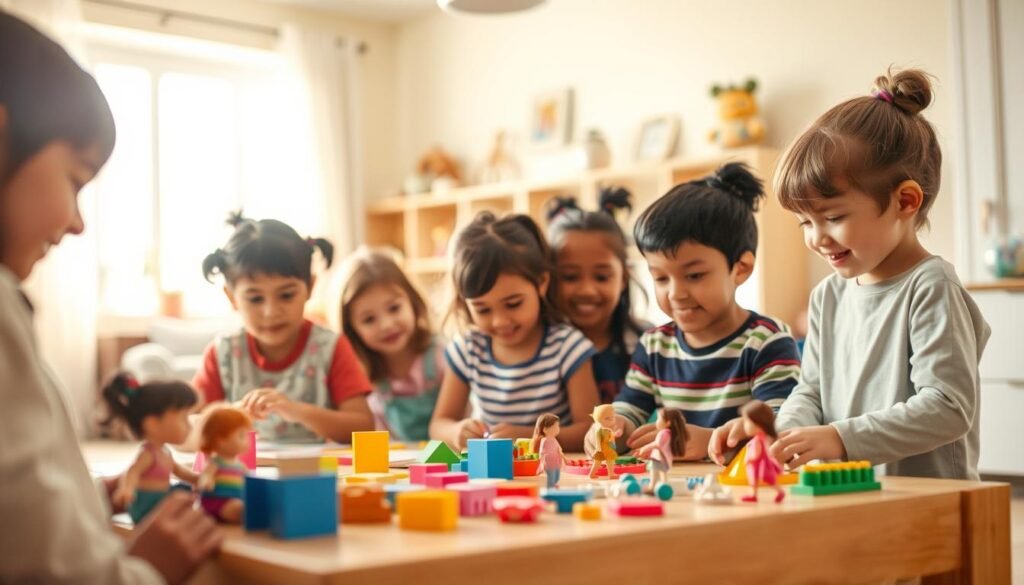
It’s vital to understand how kids develop their gender identity. This knowledge helps us create a supportive environment. By recognizing the factors that shape gender identity, we can help kids grow up without harmful stereotypes.
Core Theories in Gender Roles Psychology
The study of gender roles in psychology is complex. Many theories help us understand how people develop their gender identities. It’s important to know these theories to understand how gender is formed and maintained.
Social Learning Theory
Social Learning Theory says we learn gender roles by watching and imitating others. It shows that we pick up gender-related behaviors by seeing and copying others, like family members or celebrities. We learn what’s good for our gender by getting praise for it and being told off for not fitting in.
Cognitive-Developmental Theory
Cognitive-Developmental Theory, by Lawrence Kohlberg, explains how kids grow to understand gender. As they get older, they move from simple gender identity to more complex views. This theory highlights how kids actively build their own gender understanding.
Gender Schema Theory
Gender Schema Theory combines social learning and cognitive-developmental theories. It says we organize gender information into mental frameworks called schemas. These schemas help us see and act in gender-appropriate ways.
Psychoanalytic Perspectives
Psychoanalytic theories, based on Freud, believe early life and unconscious thoughts shape gender roles. They say the Oedipus complex plays a big part in forming gender identity. Kids often choose to be like the same-sex parent to deal with family conflicts.
These key theories in gender roles psychology give us a full picture of gender development. By looking into these theories, we can learn more about what shapes our gender identity and behavior.
The Neuroscience Behind Gender Differences
The study of gender differences in the brain is complex. It looks at how biology affects behavior and thinking in males and females. Research shows that brain structure and function, along with hormones, play big roles in these differences.
Brain Structure and Function
Studies have found brain region volume and activity differences between males and females. For example, males often have a bigger amygdala, which handles emotions. Females, on the other hand, have a larger hippocampus, key for memory and learning.
Hormonal Influences
Hormones like testosterone and estrogen shape the brain and influence gender differences. Testosterone is linked to masculine traits, while estrogen helps with feminine characteristics.
Debunking Neurological Determinism
It’s important to note that biological differences don’t mean males and females are destined to behave or think in certain ways. Biology and environment work together, shaping gender differences.
| Factor | Male | Female |
|---|---|---|
| Amygdala Volume | Larger | Smaller |
| Hippocampus Volume | Smaller | Larger |
| Hormonal Influence | Testosterone | Estrogen |
Cultural Variations in Gender Expectations
Cultural variations in gender expectations show how complex and diverse societies are. Different cultures have their own gender norms. These norms shape how people see themselves and their roles in society.
Western vs. Non-Western Gender Norms
Western societies focus on individualism and equality. This has led to more flexible gender roles. On the other hand, some non-Western cultures stick to traditional gender divisions. These are often shaped by religious or cultural practices.
Matriarchal vs. Patriarchal Societies
The structure of societies also shapes gender expectations. In matriarchal societies, women have a lot of power. This is different from patriarchal societies, where men usually hold more power.
Religious Influences on Gender Roles
Religion also plays a big role in gender expectations. Different religious teachings can either support traditional gender roles or push for equality. This depends on the context and the specific religious tradition.
It’s important to understand these cultural variations. They help us appreciate the diversity of human experience. By looking at how gender is viewed differently across cultures, we can learn more about the complex relationship between culture, society, and individual identity.
Media Representation and Gender Stereotyping
The way gender is shown in media is key to understanding stereotypes. It shapes our views of gender and affects how we see ourselves and others. Media often sticks to old stereotypes, which can harm us all.
Children’s Media and Gender Messages
Cartoons, movies, and TV shows for kids often show gender stereotypes. These messages can shape how kids see gender roles. For example, boys are often the heroes, while girls play smaller parts.
Advertising and Gender Imagery
Ads also play a big part in gender stereotypes. They show men and women in old roles, keeping gender norms alive. For instance, cleaning products are usually shown with women, while tech is for men.
Social Media’s Impact on Gender Perception
Social media shapes how we see gender too. It shows us many different views, some good, some bad. It’s a place where we can express ourselves but also see old stereotypes.
Content Analysis Techniques
Researchers use special methods to study media and gender. They look closely at how gender is shown in media to find patterns.
Media Literacy Strategies
Teaching people to think critically about media is important. It helps us spot and fight stereotypes. We learn to see media’s biases and think for ourselves.
| Media Type | Common Gender Stereotypes | Impact on Audience |
|---|---|---|
| Children’s Media | Portrayal of male protagonists, female characters in secondary roles | Influences children’s understanding of gender roles |
| Advertising | Men and women in traditional gender roles | Reinforces societal gender norms |
| Social Media | Varied portrayals, potentially both positive and negative | Complex impact on gender perception, opportunities for self-expression and stereotype reinforcement |
The Psychology of Masculinity
Understanding masculinity means looking at its many sides, like old norms and new challenges. It’s a mix of history, culture, and society that shapes how men act and what people expect of them.
Traditional Masculine Norms
Old ideas of masculinity focus on being strong, calm, and competitive. These ideas come from media and culture. For example, ads often show men as physically strong and in charge.
Following these norms can lead to problems, like not showing feelings and being toxic. We need new ways for men to show who they are that’s better for everyone.
Toxic Masculinity: Definition and Impact
Toxic masculinity is when these old norms hurt people and society. It’s about being aggressive, controlling, and not showing feelings. It affects violence and mental health.
Healthy Masculinity: Alternative Models
Healthy masculinity is different. It’s about being open with feelings, empathetic, and working together. It’s about changing what it means to be a man in a good way.
Emotional Expression in Men
Men not showing feelings is a big problem. It can lead to depression and anxiety. We need to help men feel okay about showing their emotions.
Redefining Male Success
We need to rethink what makes a man successful. It’s not just about work and money. Success should include happiness, good relationships, and feeling well emotionally.
| Traditional Masculine Norms | Healthy Masculinity |
|---|---|
| Stoicism | Emotional Expression |
| Aggression | Empathy |
| Dominance | Cooperation |
The Psychology of Femininity
Understanding femininity means looking at how old ideas and new realities mix. It’s about the qualities, actions, and roles linked to women in society.
Traditional Feminine Expectations
For a long time, society has set certain paths for women. These paths often focus on caring, home life, and being submissive. Studies show that sticking to these roles can both help and hurt women’s mental health.
The Beauty Standard Burden
The beauty standards for women are a big part of femininity. The need to meet these standards can make women feel bad about their bodies, hurt their self-esteem, and affect their mental health. This focus on looks can hide other important qualities and achievements of women.
Redefining Womanhood in Modern Society
Today, how we see womanhood is changing. There’s a push to make femininity more open and varied. This change includes things like career goals, personal choices, and leadership roles.
Career vs. Caregiving Pressures
Women face a big challenge: balancing work and family duties. Society often expects women to take care of the family first, which can clash with their career dreams. Finding a way to do both is key for women’s happiness and success.
Female Leadership Styles
Women’s leadership styles are being recognized for their unique strengths. Studies show that women often bring fresh views and teamwork to leadership, which can be very effective.
| Leadership Style | Description | Impact |
|---|---|---|
| Transformational | Inspires and motivates team members | High job satisfaction, improved performance |
| Collaborative | Fosters teamwork and cooperation | Enhanced creativity, better decision-making |
| Servant Leadership | Prioritizes team members’ needs | Increased employee engagement, loyalty |
The changing view of femininity is leading to a fairer society. By questioning old norms and celebrating diversity, we can help women succeed in many areas.
Gender Role Conflict and Mental Health
The link between gender role conflict and mental health is complex. It happens when people feel stressed or uncomfortable because of gender expectations. This can affect many parts of their well-being.
Psychological Stress from Gender Expectations
Gender expectations can cause a lot of psychological stress. When people don’t fit into traditional gender roles, they might feel not good enough or anxious. This stress is worse in places where gender roles are strict.
Depression, Anxiety, and Gender Norms
Studies show that gender role conflict is tied to more depression and anxiety. People who have trouble meeting gender expectations often feel more emotional pain. This pain can show up as depression or anxiety, hurting their mental health.
Therapeutic Approaches for Gender-Related Distress
There are several ways to help with gender-related distress. These include:
Cognitive Behavioral Techniques
Cognitive Behavioral Therapy (CBT) is very helpful. It helps people change negative thoughts about gender expectations. This leads to better ways of dealing with stress.
Mindfulness Practices
Mindfulness, like meditation and deep breathing, is also good. These practices lower stress and anxiety. They help people stay in the moment and accept things as they are.
| Therapeutic Approach | Description | Benefits |
|---|---|---|
| Cognitive Behavioral Therapy | Helps individuals challenge negative thought patterns | Reduces symptoms of depression and anxiety |
| Mindfulness Practices | Promotes present-moment awareness and acceptance | Decreases stress and enhances emotional regulation |
Understanding how gender role conflict affects mental health is key. Using the right therapy can help people deal with gender expectations better. This can improve their mental health and let them be more true to themselves.
Gender Roles in Relationships and Family Dynamics
Gender roles shape how we build relationships and families today. It’s important to grasp how these roles affect us in our personal lives.
Partner Selection and Gender Expectations
When picking a partner, we often think about traditional gender roles. This can shape our choices and what we expect from our relationship. Studies show these expectations can impact how happy we are in our relationships.
Division of Labor in Households
Who does the household chores is often influenced by gender roles. Traditionally, women do more domestic work, while men are seen as the main breadwinners.
Parenting and Gender Socialization
Parenting is also shaped by gender roles. Parents often teach their kids to fit into traditional gender norms. This can shape how kids see themselves and their place in society.
Communication Exercises for Couples
Good communication helps couples deal with gender expectations. Activities like active listening and switching roles can help couples understand each other better.
Family Role Assessment Tools
Understanding family roles can reveal how gender expectations affect us. Tools like genograms and family role inventories can help identify these areas.
| Aspect | Traditional Gender Roles | Modern Adaptations |
|---|---|---|
| Partner Selection | Based on traditional gender expectations | More flexible, considering individual qualities |
| Division of Labor | Women handle most domestic work; men are breadwinners | Shared tasks, with a more balanced distribution |
| Parenting Practices | Socialization into traditional gender norms | Encouraging diverse interests and roles |
Workplace Gender Dynamics
It’s key to understand workplace gender dynamics for a fair work place. Gender roles and work place culture affect career growth and job happiness.
Occupational Segregation
Occupational segregation is a big issue. It means some jobs are mostly for one gender. This limits choices and keeps stereotypes alive.
The Gender Pay Gap: Psychological Factors
The gender pay gap is a big problem. It’s caused by how people negotiate and see their worth. Women often get less because of biases in salary talks.
Leadership and Gender Stereotypes
Leadership is seen as a man’s job. This stops women from getting ahead. It also changes how women see themselves and lead.
Negotiation Strategies Across Genders
Men and women negotiate differently. Women face unique challenges in salary and promotion talks.
Creating Inclusive Work Environments
To make work places fair, we need to change things. We need policies that fight stereotypes. This includes training, mentorship, and flexible work.
| Strategy | Impact |
|---|---|
| Training Programs | Reduces bias and stereotypes |
| Mentorship Initiatives | Supports career advancement |
| Flexible Work Arrangements | Improves work-life balance |
By tackling these issues, companies can make work places better for everyone.
Breaking the Binary: Non-Binary and Transgender Perspectives
Gender is now seen as more than just male or female. This change comes from the growing recognition of non-binary and transgender people.
Gender as a Spectrum
Gender is viewed as a spectrum, not just male or female. Non-binary individuals might see themselves as neither or both. This shows gender is more complex than we thought.
Psychological Well-being in Trans and Non-Binary Individuals
The mental health of trans and non-binary people depends on how society accepts them. Studies show that social support helps counteract the harm of being left out.
Social Support and Acceptance
Support from family, friends, and the community is key for non-binary and transgender people. It’s important for their mental health.
Allyship Practices
Being an ally means understanding and valuing non-binary and transgender identities. This includes using inclusive language and pushing for policies that help these groups.
Inclusive Language Guidelines
Using the right names and pronouns is a basic way to support non-binary and transgender people. It shows respect and makes them feel seen.
| Inclusive Language Practices | Impact |
|---|---|
| Using preferred names and pronouns | Enhances feelings of validation and respect |
| Avoiding binary language | Creates a more inclusive environment |
Techniques for Recognizing Personal Gender Biases
Understanding and challenging our personal gender biases starts with self-awareness. It’s key for promoting gender equality and fighting stereotypes. By using specific techniques, we can better understand our biases and how they affect our views and actions.
Implicit Association Tests
Implicit Association Tests (IATs) help uncover unconscious gender biases. They measure how strongly we associate concepts with evaluations. For example, an IAT might show a bias towards linking certain jobs with one gender over the other.
Example of IAT: A study found many people associate men with careers and women with family. This bias can affect hiring and workplace interactions.
Self-Reflection Exercises
Self-reflection exercises are another good way to spot personal gender biases. They help us look at our thoughts, feelings, and actions towards gender. Regular self-reflection makes us more aware of our biases and their effects on our interactions.
- Identify situations where you felt uncomfortable or surprised by someone’s gender-related behavior.
- Reflect on how you react to gender stereotypes in media and advertising.
- Consider how your own gender biases might influence your decisions and interactions.
Journaling and Awareness Practices
Journaling and other awareness practices can also help us recognize and challenge gender biases. By writing down our thoughts and feelings, we can spot patterns and biases that might not be obvious.
Thought-Monitoring Worksheets
Thought-monitoring worksheets are a structured way to track and analyze our gender-related thoughts. They help us identify and change negative or biased thoughts for more balanced ones.
Bias-Interruption Techniques
Bias-interruption techniques involve strategies to challenge and change biased thoughts or behaviors as they happen. Techniques include pausing to reflect, seeking diverse views, or practicing mindfulness.
| Technique | Description | Benefit |
|---|---|---|
| Implicit Association Tests | Uncover unconscious biases through association tests | Reveals hidden biases |
| Self-Reflection Exercises | Examine thoughts, feelings, and behaviors related to gender | Increases self-awareness |
| Journaling and Awareness Practices | Record thoughts and feelings to identify patterns and biases | Enhances understanding of personal biases |
By using these techniques, we can better understand our personal gender biases. This helps us grow personally and contributes to a more inclusive and fair society.
Strategies for Challenging Gender Stereotypes
Challenging gender stereotypes requires a mix of educational approaches, workplace interventions, and parenting practices. This multi-faceted strategy helps create a more inclusive space. It promotes gender equality for everyone.
Educational Approaches
Education is key in shaping how we see gender. Using gender-sensitive curricula helps students question stereotypes. Also, showing diverse roles in school materials broadens their understanding of gender.
- Incorporating diverse perspectives in textbooks and educational resources
- Encouraging discussions on gender equality and stereotypes
- Providing training for educators on gender sensitivity
Workplace Interventions
The workplace is another area where we can fight gender stereotypes. Companies can support gender equality with policies like equal pay and flexible work. Training on bias and stereotypes is also important.
- Developing and enforcing anti-discrimination policies
- Promoting women’s leadership through mentorship programs
- Conducting regular audits to ensure pay equity
Parenting Practices That Reduce Stereotyping
Parenting shapes kids’ views on gender. Adopting gender-neutral parenting is key. This means using gender-neutral language and showing kids diverse role models.
Gender-Neutral Language
Using gender-neutral language helps break stereotypes. Parents and teachers can avoid language that assumes gender. This creates a more welcoming space for everyone.
Diverse Role Models
Seeing diverse role models helps kids understand gender is not fixed. Introducing kids to people who don’t fit traditional gender norms helps them see gender in a new light.
Conclusion: Moving Beyond Gender Constraints
Challenging traditional gender roles is key to achieving gender equality. We must understand the roots of gender roles and how society shapes them. This knowledge helps us break free from limits that hold us back.
To move beyond these constraints, we need a variety of strategies. Education, social support, and challenging norms are all important. By valuing diversity and inclusivity, we can build a fairer society. Here, everyone can reach their full capacity without gender limits.
The fight for gender equality never ends. We must keep talking openly, question our own biases, and support each other. This way, we can build a world that is just, welcoming, and free from gender constraints.
FAQ
What are gender roles, and how do they differ from biological sex?
How do children develop their gender identity?
What is the impact of media representation on gender stereotyping?
How do cultural variations influence gender expectations?
What is the relationship between gender role conflict and mental health?
How can we challenge and change gender stereotypes?
What is the significance of understanding non-binary and transgender perspectives?
How can we promote gender equality in the workplace?
What role do parents play in shaping their children’s understanding of gender?
How can we recognize and challenge our personal gender biases?


The PsyForU Editorial Collective is the research and editorial team of PsyForU Research International. The collective prepares educational, psychological, mental-health-awareness, inclusion, neurodiversity, and research-methodology content for students, parents, educators, researchers, and general readers. PsyForU content is intended for awareness, education, and capacity-building and should not be treated as clinical diagnosis, therapy, medical advice, legal advice, or emergency mental-health support.