

The secret to lasting change isn’t about willpower. It’s about the right strategy. BJ Fogg, from Stanford University, learned this the hard way. He struggled to floss every day until he tried something new.
He decided to floss just one tooth each day. It seemed too simple, but it worked. Over ten years, Fogg helped over 40,000 people. He proved that small steps can lead to big changes.
Fogg’s work led to the Fogg Behavioral Model: B=MAP. It shows that Motivation, Ability, and Prompt must come together for lasting habits. This idea challenges the idea that big changes are always better.
Small, daily changes are key to lasting change. It’s not about how hard you try. It’s about doing the same thing over and over. This builds strong habits that last.
Key Takeaways
- Traditional methods fail because they ask for too much too soon. They overwhelm us.
- The Fogg Behavioral Model (B=MAP) shows that motivation, ability, and prompt must meet at once for change.
- Starting with tiny actions, like flossing one tooth, helps us build momentum for bigger changes.
- It’s consistency, not how hard you try, that changes us. Repeated actions make habits automatic.
- Small changes add up over time. They can lead to amazing results, even better than big changes.
- Changing your environment and using prompts is more effective than just relying on willpower.
Why Small Changes Create Lasting Results
Small habits have a big impact because they are easy to start. They help us overcome big challenges. Studies show that we resist big changes more than small ones.
Big changes need a lot of mental effort to start. This effort makes us tired before we even begin. But small habits are easy to start and don’t make us think too much.
Every small habit we complete shows us we can do it. This builds our confidence. The more we do, the more confident we become, making it easier to keep going.
Small wins are a steady application of a small advantage. Once a small win has been accomplished, forces are set in motion that favor another small win.
Small improvements add up over time. A 1% improvement every day grows to 37 times more in a year. This is because small habits lead to more energy, focus, and motivation for more changes.


Our brains get stronger with small, repeated actions. It doesn’t matter if the actions are big or small. Consistency is key, not intensity.
Small habits last because they don’t drain our willpower. Big changes do. Small habits fit into our daily routines easily, making them last without much effort.
Behavior change psychology explains why small habits work:
- Friction reduction: Small habits don’t make us hesitate or give up
- Confidence compounding: Doing small things often builds our confidence
- Integration efficiency: Small habits fit into our routines easily, lasting without effort
Transforming our lives doesn’t need big efforts. Small, easy habits lead to lasting change. When habits feel natural, we stick to them without needing motivation.
The Science Behind Habit Formation
Habit formation is a brain function that makes life easier. It turns hard decisions into easy actions. This lets us do complex things without thinking much, freeing our minds for new challenges.
Understanding habit psychology shows why small habits last while big efforts don’t. It’s all about how our brains work.
The brain changes itself to make habits automatic. This is called neuroplasticity. Knowing how this works helps us change behaviors in smart ways.
How Your Brain Builds Neural Pathways
The brain has about 86 billion neurons, each making thousands of connections. When you do something new, your brain makes weak paths. This takes a lot of effort, making new actions feel hard.
But repetition changes things. Each time you do something, the paths get stronger. This is called myelination. It’s like upgrading a dirt road to a highway, making signals travel faster.
Studies show that repetition can make signals go up to 100 times faster. This makes hard actions feel easy. The basal ganglia, a part of the brain, plays a big role in this.
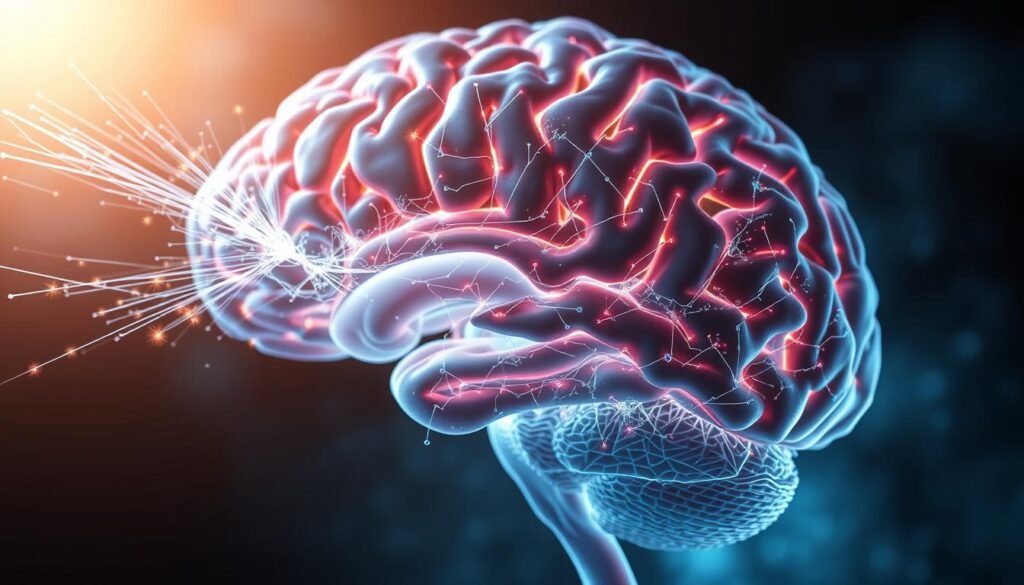
The basal ganglia is like the brain’s autopilot. It stores memories and helps recognize patterns. As habits form, the brain uses the basal ganglia more, making habits automatic.
Brain scans show this change. At first, new actions use a lot of brain power. But after practice, the basal ganglia takes over, making the action automatic.
The Cue-Routine-Reward Habit Loop
Habits follow a three-step cycle called the habit loop. It has a cue, a routine, and a reward. Knowing this helps us build good habits and break bad ones.
The cue starts the habit. It can be something you see or feel. The brain looks for these cues, making it easier to do habits.
The routine is the action you take. It can be physical, mental, or emotional. Routines can be simple or complex.
The reward is what makes the habit loop strong. It can be something you get or feel. Rewards make you want to do the habit again.
“Habits are formed through the creation of neurological cravings. When the brain begins to anticipate the reward, a craving emerges that drives the routine.”
The cue-routine-reward cycle gets stronger over time. At first, you get a dopamine rush when you get the reward. But soon, just seeing the cue makes you want to do the routine. This is why habits feel automatic.
This is why habit loops are so hard to break. Your brain learns to link cues with rewards, making habits automatic. Seeing your running shoes can make you want to run, without thinking.
Why Willpower Fails and Systems Succeed
Most people try to change habits with willpower. But this doesn’t work well. Willpower is like a limited resource that gets used up during the day.
Studies show that using willpower too much can make it harder to control yourself later. This is why evening plans often don’t work out.
Systems-based approaches work better because they use the brain’s natural ways. They make habits easy by using the same neural pathways as bad habits.
| Approach | Mechanism | Sustainability | Cognitive Load |
|---|---|---|---|
| Willpower-Based | Conscious self-control and decision-making | Low – depletes throughout day | High – requires constant mental effort |
| Systems-Based | Environmental design and automatic cues | High – operates independently of motivation | Low – bypasses conscious decision-making |
| Hybrid Approach | Initial willpower to establish systems | Very High – willpower builds the system | Medium initially, then minimal |
The brain likes efficiency, turning actions into habits. Systematic approaches use this to make habits easy. You use willpower to start, then let habits take over.
Trying to exercise hard is different from having workout clothes by your bed. The first needs willpower every day. The second makes exercising automatic.
Understanding habit psychology shows why small habits are powerful. They need little willpower but use the same brain mechanisms as big habits. Once a habit forms, it’s easy to do more.
The science is clear: changing habits comes from understanding how they form. Designing systems that match how our brains work makes habits easy.
The 30-Second Rule for Starting New Habits
Starting new habits is easier when they’re almost impossible to resist. This rule helps us understand why we often fail to start new habits. By making habits that take only thirty seconds, we overcome the hesitation that stops us.
The thirty-second rule is like a shortcut. It turns big goals into small, doable steps. This way, we avoid getting stuck in our heads and start doing things right away.
Starting is key to keeping going. Once we begin, we often find it easier to keep going without thinking too much. The thirty-second rule helps us get started and keeps us moving forward.
Breaking Down Big Habits into Tiny Actions
Breaking down big habits into small steps is essential. We start by finding the smallest action that moves us towards our goal. This action should be easy to do.
To break down habits, we first figure out why we want to change. Then, we think of all the ways we can start. We make these actions so simple that we can’t help but do them.
The journey of a thousand miles begins with a single step, but habit formation teaches us that the step itself can be reduced to merely shifting your weight forward.
Next, we create specific plans for each habit. These plans include a clear start signal. For example, “After [existing behavior], I will [tiny new behavior].”
It’s important to understand the difference between big goals and small steps. “Become a writer” means starting with “write one sentence.” “Achieve fitness” means “put on exercise shoes.” Each small step is a building block towards our goals.
Habits are made up of many small actions, not just one big one. By focusing on the first step, we create habits that are easy to start and grow from.
Real-World Examples of 30-Second Versions
There are many ways to apply the thirty-second rule in real life. Here are some examples that show how big goals can be broken down into simple actions. These examples prove that simplicity is key to success.
Exercise Habits That Start in 30 Seconds
Starting exercise can be hard because it takes time and effort. But, by making it a 30-second task, it becomes much easier. Here are some examples:
- Performing one pushup: This single pushup is a small step towards fitness that takes little time or effort.
- Stepping onto a yoga mat: Just stepping onto a yoga mat can start a full practice session.
- Walking to the end of the driveway: This simple walk can turn into a longer walk as you get moving.
- Putting on running shoes: Getting ready to run can be the first step towards a workout.
- Doing three jumping jacks: These quick exercises can get your heart rate up and keep you moving.
These examples show how starting small can lead to bigger things. Once you start, you often find yourself doing more without even thinking about it.
Reading and Learning Micro-Habits
Learning new things can be hard because it takes time and effort. But, by making it a 30-second task, it becomes much easier. Here are some examples:
- Opening a book to the bookmarked page: This simple action can lead to a lot of reading.
- Reading one paragraph: Reading just one paragraph can help you stay consistent.
- Reviewing a single flashcard: Learning a little bit at a time can help you remember more.
- Writing the date at the top of a journal page: This simple habit can help you reflect and learn.
- Listening to one minute of an educational podcast: Even a short listen can help you learn something new.
These examples show how small steps can lead to big learning. Starting with just one paragraph or a short podcast can make learning easier and more enjoyable.
Health and Wellness Tiny Versions
Improving our health can be hard because it takes time and effort. But, by making it a 30-second task, it becomes much easier. Here are some examples:
- Drinking one glass of water: Drinking just one glass of water can help you stay hydrated.
- Taking three deep breaths: These simple breaths can help you relax and focus.
- Consuming one serving of vegetables: Eating just one serving of veggies can help you stay healthy.
- Setting out your notebook and pen: Getting ready to write can help you reflect and learn.
- Setting tomorrow’s alarm: Setting your alarm can help you stay consistent with your sleep schedule.
These examples show how small actions can add up to big health benefits. By starting small, we can make lasting changes to our health and well-being.
The thirty-second rule is a powerful tool for changing our habits. By making habits easy to start, we overcome the hesitation that holds us back. This rule helps us build momentum and keep going, even when it’s hard.
Anchoring Habits to Existing Cues
Behavioral anchoring turns new habits into automatic actions by linking them to daily routines. It doesn’t rely on motivation or memory to start behaviors. Instead, it uses the brain’s pathways from routine actions.
The Tiny Habits method uses a simple formula: “After I do x (current solid habit), I will do y (desired new habit).” This method uses established routines as reliable triggers. It makes starting new habits easier by linking them to daily activities.
Think about brushing your teeth, a habit done without much thought. Adding a new habit right after brushing makes it a natural part of your routine. This makes starting new habits easier.
Identifying Your Daily Anchor Points
Finding good anchor points starts with looking at your daily routine. Not all behaviors are good anchors. You need to find stable patterns in your day.
Good anchors happen every day at the same time or place. They should end clearly, signaling it’s time for the next action. This makes starting new habits easier.
Watching your daily actions is key. You do many things without thinking, like starting your coffee maker or getting in your car. These can be great anchor points.
When picking anchors, look for these traits:
- Frequency: It happens every day, preferably at the same time
- Reliability: It happens no matter what, every day
- Completion clarity: It has a clear end, signaling the next step
- Location specificity: It happens in the same place, giving clear cues
- Minimal variation: It stays the same every day, no matter what
Personal care routines are great anchors because they meet all these criteria. Brushing teeth, showering, and getting dressed are daily habits that happen in specific places. They are so ingrained that they continue even when you’re not at home.
Creating Strong Trigger-Behavior-Reward Connections
Habits form through associative learning, linking actions together. When you do one action and then another, your brain gets better at predicting the next action. This is why cues are so powerful in starting habits.
Using implementation intentions helps create these connections. Studies show that setting specific triggers for actions leads to better follow-through. This makes abstract goals into concrete actions.
For example, instead of saying “meditate more,” say: “After I brush my teeth in the morning, I will sit on my meditation cushion and take three deep breaths.” This clear trigger makes meditation automatic.
Adding rewards to the mix strengthens the connection between the trigger and the action. At first, rewards might be external. But over time, the action itself becomes rewarding. This makes the brain anticipate the action without needing to think about it.
| Time of Day | Existing Anchor Behavior | New Tiny Habit Example | Trigger Reliability |
|---|---|---|---|
| Morning (6:30-7:00 AM) | Brushing teeth after waking | Do one pushup or take three deep breaths | Very High – occurs daily regardless of schedule |
| Morning (7:00-8:00 AM) | Starting coffee maker | Drink one glass of water while coffee brews | High – consistent weekday routine for coffee drinkers |
| Midday (12:00-1:00 PM) | Sitting down for lunch | Write one sentence of gratitude before eating | Moderate – timing varies but behavior is consistent |
| Evening (6:00-7:00 PM) | Arriving home from work | Change into exercise clothes immediately upon entry | High – location-based trigger with consistent timing |
| Night (10:00-11:00 PM) | Plugging in phone to charge | Place tomorrow’s clothes on chair beside bed | Very High – essential daily task with clear completion |
Using Visual Cues for Cue Recognition
Using visual cues can make habits stronger. These cues are reminders placed in your environment. They work with your routine to make habits easier.
For example, having dental floss next to your toothbrush makes flossing automatic. Putting out your exercise clothes or a book on your pillow can also help. These cues remind you to do the next action.
Good visual cues are clear and appear at the right time. They make starting new habits easy by reducing the need to remember. Your environment can help you remember, freeing up your mind for action.
Effective visual cues have certain qualities:
- Proximity to anchor behavior: Visual prompts next to the routine make transitions smooth
- Simplicity and clarity: Clear cues that need no thought make actions automatic
- Visibility at decision moments: Cues should appear when the action should happen, not before or after
- Minimal friction: Cues that also make actions easier are more effective
Combining routine-based anchoring with visual cues creates “choice architecture.” This makes habits easy by structuring your environment. When your environment guides you, consistency becomes effortless. It’s not about motivation, but about designing your environment for success.
Humans respond well to environmental cues, often doing actions because they’re obvious. By designing your environment to present the right cues, you can achieve your goals. This approach uses your natural tendencies to your advantage.
Habit Stacking: Building Chains of Consistent Action
Habit stacking is a way to change behavior by linking small actions together. It starts with one action, making it easier to do the next. This builds a chain of actions that changes daily routines.
This method uses momentum to keep going. Each action makes it easier to do the next. This is different from just doing one thing at a time.
The Habit Stacking Formula Explained
The formula for habit stacking is simple: “After I [CURRENT HABIT], I will [NEW TINY HABIT].” You can keep adding to this to make longer chains. This makes it clear when to do new things.
Building a good stack means following a logical order. Each action should be small to keep things easy. The whole stack should have a clear purpose.
For example, a morning routine might be: “After I turn off my alarm, I will drink the water on my nightstand. After I drink my water, I will open my bedroom curtains. After I open my curtains, I will do three deep breaths.” These small steps make a big difference in the morning.
Building Your Personal Habit Stack
To make your own habit stack, find natural parts of your day. These are like morning, lunch, or bedtime. Each part can have its own set of habits.
Start by testing and changing your stack. You might need to adjust it to fit your life better. This makes your stack work for you.
A good stack respects your energy and the place you’re in. It should also match your goals. This makes it more than just a list of habits.
Morning Routine Stacks for Consistent Behaviors
Morning stacks use the fresh start of waking up. They include things like getting ready, eating, and getting your mind ready for the day. This turns morning chaos into a series of intentional steps.
A morning stack could be: “After I sit up in bed, I will place my feet on the floor. After my feet touch the floor, I will stand up immediately. After I stand, I will make my bed by pulling up the covers. After I make my bed, I will go directly to the bathroom. After I finish in the bathroom, I will start my coffee maker. After I press the coffee button, I will write today’s date in my journal.”
Each step is easy, even on tough mornings. But together, they create a sense of accomplishment. This consistent action builds confidence every day.
Workday Transition Stacks
Transition stacks help you switch between work and home or between big tasks. They are useful because they help you stay focused. They give structure when you need it most.
For example, an end-of-workday stack might be: “After I close my laptop, I will write tomorrow’s top three priorities. After I write my priorities, I will clear my desk surface completely. After I clear my desk, I will put on my jacket. After I put on my jacket, I will take three deep breaths before leaving.” This helps you end your workday and get ready for the next day.
These stacks are great because they keep work and personal life separate. They act like psychological airlocks to help you switch gears.
Evening Wind-Down Stacks
Evening stacks help you relax, connect with others, and get ready for tomorrow. They are important because they affect your sleep and how ready you are for the next day. They create a positive cycle that improves your daily routines.
A practical evening stack might be: “After I clear the dinner table, I will set out my notebook and pen on the kitchen counter. After I set out my notebook, I will write one thing I’m grateful for today. After I write my gratitude, I will prepare tomorrow’s coffee maker. After I prepare the coffee, I will brush my teeth. After I brush my teeth, I will set my alarm for 6 a.m. After I set my alarm, I will plug my phone in across the room.”
These small steps prepare you for the next day. The last step, putting your phone across the room, shows how habit stacking can help you avoid bad habits.
| Routine Segment | Primary Purpose | Optimal Stack Length | Key Success Factor |
|---|---|---|---|
| Morning Activation | Energy generation and day preparation | 5-8 linked behaviors | Immediate action upon waking |
| Workday Transitions | Mental mode shifting between domains | 4-6 linked behaviors | Complete environmental reset |
| Evening Wind-Down | Relaxation and next-day preparation | 6-9 linked behaviors | Consistent timing relative to sleep |
| Meal Anchors | Nutrition support and transition marking | 3-5 linked behaviors | Natural pause points in existing routines |
Habit stacking is a powerful way to change your behavior. Instead of trying to change one thing at a time, you link them together. This turns personal development into a system of habits that support each other.
To succeed with habit stacking, keep each action small. If one action gets too big, it can break the whole chain. Keeping actions small helps you stay consistent, no matter what.
Reducing Friction to Make Habits Effortless
Making habits easy to follow changes how we form them. Studies show we prefer actions that need little effort. Removing obstacles helps us stick to habits more.
Friction stops us from acting. Willpower alone can’t overcome it. We need to make our environment support our habits, not hinder them.
Designing Your Environment for Automatic Success
Our surroundings shape our actions. Good design can make habits automatic. It’s about making the right choices easy.
For example, wearing workout clothes to bed makes mornings easier. Placing exercise gear in key spots helps too. It turns your space into a cue for action.
Healthy eating also benefits from smart design. Keep good food in sight, bad food out of reach. Prepping veggies in advance makes healthy eating simple.
Workspaces can also boost productivity. A dedicated writing area helps writers stay focused. Digital tools can do the same by opening apps automatically.
Being around people who share your goals helps too. It makes sticking to habits feel natural. These changes make good habits automatic, not forced.
The Two-Minute Preparation Strategy
Preparation during high-energy times helps later. The two-minute rule prepares you for habits when you’re not motivated. It’s about making habits easy to start.
Getting ready for morning exercise the night before is a great example. It turns a complex routine into a simple one. This saves mental energy for when you’re tired.
Meal prep is another example. Cooking meals on the weekend saves time and effort. It makes healthy eating easy and convenient.
Professionals can also benefit from quick prep. Writing tomorrow’s tasks at the end of the day sets a clear direction. It helps avoid the mental block of starting without a plan.
Digital habits work the same way. Blocking social media or setting meditation apps to start automatically saves time. It turns good habits into automatic actions.
Eliminating Decision Fatigue
Too many decisions wear us down. Each choice takes mental energy. This is why we need fewer decisions, not more willpower.
Having set routines helps. For example, exercising every morning eliminates the need to decide. It saves mental energy for more important things.
Wearing the same outfit every day is another example. It saves mental energy for more important decisions. This approach helps us stay consistent without feeling drained.
Meal planning is also key. Deciding what to eat in advance saves time and energy. It makes healthy eating automatic, not a constant decision.
Reducing decisions improves our daily lives. By making good habits automatic, we save mental energy. This approach works with our natural tendencies, not against them.
| Habit Category | High-Friction Scenario | Low-Friction Design | Consistency Impact |
|---|---|---|---|
| Morning Exercise | Locate clothing, find equipment, decide on workout type | Sleep in workout clothes, equipment positioned by bed, predetermined routine | 73% increase in weekly consistency |
| Healthy Eating | Decide what to cook, shop for ingredients, prepare from scratch daily | Pre-cut vegetables visible in fridge, batch-cooked meals portioned and ready | 89% reduction in unhealthy convenience choices |
| Daily Reading | Choose book from shelf, find comfortable location, eliminate distractions | Book open on bedside table, reading chair pre-arranged, phone in another room | 5.2x more pages read weekly |
| Meditation Practice | Remember to meditate, open app, find quiet space, select duration | App auto-launches at set time, dedicated cushion in prepared space, fixed duration | 68% streak completion rate vs. 23% without automation |
Reducing friction makes habits easier to keep. It’s not about willpower, but about smart design. By removing obstacles, we make good habits automatic. This approach respects our limits and helps us stay consistent over time.
Increasing Friction to Break Unwanted Patterns
To break free from unwanted patterns, we need to add obstacles. This makes us think before we act. It’s like adding friction to make things harder.
This idea comes from behavioral psychology. Most bad habits happen without us thinking. But, when we add friction, it stops them. This gives us a chance to make better choices.
Changing our environment helps a lot. We can make our surroundings less tempting. This way, we don’t need to always use willpower.
Adding Intentional Barriers
Introducing barriers works in many areas. For example, website blockers can stop digital distractions. Or, we can put our phones in hard-to-reach places.
For habits like eating too much, we can remove tempting foods. Or, we can make it harder to buy things we shouldn’t. Each step makes it harder to act on impulse.
Time delays are also helpful. Waiting a bit before doing something can help us think better. For example, waiting 10 minutes before checking social media.
This method works because it stops bad habits from happening automatically. It makes us think before acting.
| Unwanted Behavior Category | Barrier Strategy | Implementation Method | Psychological Mechanism |
|---|---|---|---|
| Digital Distraction | Access Removal | Delete apps, use website blockers, device placement in separate room | Physical distance interrupts automatic reach behavior |
| Consumption Habits | Availability Reduction | Remove items from home, lock storage, cancel subscriptions | Absence of cues prevents automatic consumption trigger |
| Impulse Purchases | Time Delays | 24-hour waiting period, leaving payment methods at home | Temporal gap allows emotional intensity to decrease |
| Evening Screen Time | Authentication Barriers | Log out after each use, complex passwords, two-factor authentication | Re-entry effort creates decision point for continued use |
Environmental Design for Breaking Bad Habits
Changing our environment is key to breaking bad habits. We need to understand what triggers these habits. Then, we can make changes to help us stay on track.
For example, removing TVs from bedrooms can help with screen time. Or, we can make our homes less tempting for bad habits. This makes it easier to choose better options.
Social situations also play a big role. We need to surround ourselves with positive influences. This helps us avoid bad habits.
The idea of coupling is very effective. It makes it harder to do bad things and easier to do good ones. For example, we can make healthy foods easy to get to and unhealthy foods hard to reach.
Changing our schedules can also help. We can avoid times when we tend to do bad things. Or, we can fill those times with better activities. This helps us stay on track.
Creating an environment that doesn’t support bad habits is powerful. It makes it harder to do bad things and easier to do good ones. This helps us make better choices.
It’s important to have a plan for when we slip up. We should see setbacks as chances to learn and improve. This helps us stay on track in the long run.
By making our environment support good habits, we can change for the better. This approach is more effective than relying on willpower alone. It helps us make lasting changes.
Identity-Based Habits: Becoming the Person You Want to Be
Traditional habits focus on what you want to achieve or do. But identity-based habits change who you are. They focus on becoming the person you want to be.
Changing who you are is key to lasting success. Wanting to lose weight focuses on the outcome. Exercising daily focuses on the process. But becoming athletic focuses on your identity. This approach creates a strong foundation for lasting change.
Behavioral psychology shows we act based on who we think we are. When actions match our identity, we need little motivation. But when they don’t, we must keep trying to change.
Therapy teaches us to be kind to ourselves. Psychologist Tara Brach talks about feeling unworthy. The Tiny Habits model is different. It focuses on being curious and kind, not on punishment.
Defining Your Desired Identity First
To start with identity-based habits, you need to know who you want to be. This requires looking inside yourself, not just following what others say. Many people follow what others expect, not their true desires.
Start by being clear about who you want to be. “Being healthier” is too vague. Saying “I want to be someone who values physical wellness” is more specific.
Describe your identity positively. Say “I want to be someone who protects their health” instead of “I don’t want to smoke.” Our brains work better with positive goals.
Make sure your identity matches your values. Habits based on deep values last longer. Ask yourself:
- What type of person do I want to become in five years?
- What values matter most to me, and what identity reflects those values?
- If I could describe my ideal self in three adjectives, what would they be?
- What behaviors would naturally flow from that identity?
This process helps you find habits that feel right. When your habits match who you are, they feel natural.
Using Small Wins to Cast Votes for Your Identity
James Clear says every action is a vote for who you want to be. Reading for ten minutes votes for being a reader. Meditating for two minutes votes for being mindful.
Small actions are powerful for changing who you are. Daily five-minute exercises give thirty votes a month for being athletic. Weekly intense workouts give four votes a month.
These votes add up. At first, you might have many votes against being athletic. But each small action adds to the evidence.
Eventually, the evidence tips in your favor. You start to believe in your new identity. This process takes time, but it’s worth it.
Every action you take is a vote for the type of person you wish to become. No single instance will transform your beliefs, but as the votes build up, so does the evidence of your new identity.
Small wins also make you feel good. They give you positive feelings that help you keep going. These feelings make your actions feel more natural.
Missing a workout doesn’t mean you’ve failed. It’s just a chance to try again. This view helps you stay motivated without feeling guilty.
The Power of Self-Perception in Behavior Change Psychology
Self-perception theory by Daryl Bem explains identity-based habits. It says we figure out who we are by what we do. We discover our identity through our actions.
This theory shows a two-way street between identity and behavior. Changing who you are changes your actions. And your actions change who you are. This creates a cycle of growth.
This theory changes how we think about changing behavior. Instead of changing beliefs first, change your actions. Your beliefs will follow.
Identity-based habits focus on action, not just thinking. Start small, like exercising a little each day. Your brain will adjust to match your actions.
This process happens without you even realizing it. You don’t think “I exercised, so I must be athletic.” But your brain notices the pattern and changes your self-image.
Research on cognitive dissonance supports this. We feel uncomfortable when our actions don’t match our beliefs. Changing our actions is easier than changing our beliefs.
This approach is kinder than traditional methods. It sees failures as chances to learn, not as personal flaws. This keeps you motivated and curious.
Combining self-compassion with experimentation makes lasting change possible. Identity-based habits are patient and kind. Each small action is a step towards becoming the best version of yourself.
Tracking Streaks to Build Momentum and Consistency
Measuring progress is key to making lasting changes in our behavior. It helps us see what we’re doing and what we need to work on. By tracking our habits, we become more aware of our actions and stay consistent.
Tracking our habits makes our goals feel real. Every time we do something we’ve set out to do, it reinforces the action. This makes us want to keep going because we can see our progress.
Tracking our daily habits helps us understand ourselves better. We learn what times and situations work best for us. This knowledge helps us make our habits work better for our lives.
What gets measured gets managed.
Selecting Appropriate Documentation Systems
Choosing the right way to track your habits is important. There are many options, and what works for one person might not work for another. The best method is one that feels easy to use and fits into your daily life.
Some people like using paper calendars or journals. These methods are easy to see and can be very motivating. Writing down your progress can make you feel a sense of accomplishment.
Paper calendars are simple and don’t distract you with technology. Wall charts can be placed in busy areas to remind you. Bullet journals let you customize your tracking to fit your needs.
Digital tools include apps and spreadsheets. They offer features like reminders and data analysis. Apps made for tracking habits can help you stay on track and connect with others who are doing the same.
Some habits are easy to measure, like steps taken or pages read. Others are harder to track, like whether you did something or not. Choose a method that fits the habit you’re trying to build without being too complicated.
| Tracking Method | Primary Advantages | Best Suited For | Potential Limitations |
|---|---|---|---|
| Paper Calendar | Tangible visibility, no technology required, satisfying physical marking | Single daily habits, visual learners, those seeking digital detox | Limited data analysis, no automated reminders, vulnerable to loss |
| Dedicated Apps | Automated tracking, streak visualization, reminder systems, data analytics | Multiple habits, technology-comfortable individuals, data-driven personalities | Requires device access, potentially distracting, learning curve |
| Bullet Journal | Complete customization, integration with life management, creative expression | Those with existing journaling practice, creative individuals, complex habit stacks | Time investment for setup, requires consistent journal access |
| Wearable Devices | Passive automatic tracking, real-time data, integration with health metrics | Physical activity habits, health-focused behaviors, quantifiable metrics | Limited to trackable behaviors, cost considerations, technology dependence |
Loss Aversion and Streak Preservation
Streaks have a powerful effect on our behavior because of how we feel about losing. The longer we keep a streak going, the more we want to keep it going. Breaking a streak feels worse than starting one.
This idea, known as the “Seinfeld strategy,” uses our natural tendencies to help us stay consistent. The streak itself becomes a reason to keep going, even when we don’t feel like it.
Seeing our streaks makes us want to keep them going. Each day we mark as complete adds to our streak. The longer our streak, the more we want to keep it going.
There are several reasons why we want to keep our streaks going. Identity reinforcement makes us see ourselves as someone who never misses. Sunk cost reasoning makes us not want to waste what we’ve already done. Pattern completion drives make us uncomfortable when we break a pattern.
Knowing how streaks work helps us use them to our advantage. Starting to track your habits early on helps you build momentum. Seeing your streaks grow can motivate you to keep going.
Strategic Responses to Inevitable Lapses
Even with the best plans, we all have days when we don’t do what we set out to do. It’s not about whether we miss days, but how we respond to them. People who stay consistent long-term often miss days too, but they get back on track quickly.
The never miss twice rule is a good way to stay consistent. Missing one day is okay, but missing twice can make you feel like giving up. This rule helps you stay accountable without being too hard on yourself.
When you miss a day, there are smart ways to get back on track. First, acknowledge without catastrophizing—see it as a chance to learn and improve. Second, analyze contextual factors—figure out what made you miss and how to avoid it next time.
Being kind to yourself when you slip up is more effective than being hard on yourself. Harsh self-criticism can make you want to give up. But being gentle with yourself keeps you engaged and helps you get back on track faster.
Some tracking systems let you take breaks without losing your streak. The “two-day rule” is one example. “Minimum viable habits” are smaller versions of your goal for tough days. This way, you can keep going even when it’s hard.
It’s important to note the difference between planned breaks and missing days because of lack of motivation. This helps you stay motivated and avoid feeling discouraged.
Remember, it’s not about being perfect. Doing something 90% of the time over a long period is more beneficial than doing it perfectly for a short time. It’s about making lasting changes in your life.
Celebrating Tiny Wins to Reinforce Neural Pathways
Most people don’t realize how powerful celebrating tiny wins can be. It’s not just about feeling good; it’s essential for building consistent habits. When we acknowledge our achievements, it helps our brains make new connections.
These connections are key to making habits automatic. It’s all about the timing. Right after we do something good, our brain locks in the connection between action and reward.
For decades, scientists have studied how rewards work. When we do something and then get a reward, we do it more. But if the reward comes too late, it doesn’t work as well.
So, celebrating our small wins is not just nice; it’s necessary. It helps our brain build strong habits. Each time we celebrate, our brain gets stronger at making that behavior automatic.
Building Effective Celebration Rituals
To celebrate well, we need to understand what makes it effective. Authentic celebrations make us feel good, even if it’s just a little. It’s important that the celebration feels real to us, not just something we do by habit.
The timing of our celebrations is also key. We need to celebrate right away, within seconds of doing something good. This is when our brain is most ready to make new connections.
Good celebrations have a few important qualities. They happen right away, feel real, take little time, and are personal. They also happen the same way every time, which helps our brain learn.
- Immediate execution: Celebrate right away, before moving on to other things
- Authentic emotional response: Feel genuine happiness, not just go through the motions
- Minimal time investment: Keep celebrations short to avoid interrupting your flow
- Personal relevance: Choose a celebration that feels meaningful to you
- Consistency of application: Celebrate the same way every time to create strong habits
What you do to celebrate is less important than doing it consistently and genuinely. Things like throwing your arms up or saying “Yes!” can be very effective. These actions help your brain remember the good feeling.
Verbal affirmations are also great for celebrating. Saying something like “I did it!” can be very powerful. It’s not what you say that matters, but how you feel when you say it.
Even celebrating to yourself can be powerful. A small smile or nod can be enough to reinforce a good behavior. What matters most is the positive feeling you get right after doing something good.
The Role of Immediate Feedback in Consistency
Immediate feedback is more than just feeling good; it’s essential for building habits. When we feel good right after doing something, our brain makes connections. This is how we learn to do things automatically.
Dopamine, a key brain chemical, plays a big role in this. It helps our brain remember which actions lead to good feelings. This is why celebrating right away is so important.
Over time, our brain starts to anticipate rewards. This anticipation is what makes habits feel automatic. It’s not just about feeling good; it’s about our brain learning to do things without thinking.
The anticipation of reward becomes more motivating than the reward itself, generating the automatic impulse that characterizes true habits.
This is why habits feel easy once they’re established. Our brain has learned to expect the reward, so it doesn’t need to think about it. This is why new behaviors are harder to start.
Delayed rewards don’t work as well because they don’t happen right away. For example, exercising now for health benefits later doesn’t help our brain make the connection. We need immediate feedback to build strong habits.
So, celebrating right after doing something good is key. It may not seem like much, but it’s what helps our brain learn and make habits automatic. Every small celebration is a step towards making good habits easier.
Keystone Habits That Create Cascading Changes
Some behaviors act as catalysts, creating ripple effects that extend far beyond their original purpose. These powerful actions, known as keystone habits, function as architectural supports that hold entire behavioral systems in place. The term borrows from architecture, where keystone blocks secure entire arches by distributing weight and maintaining structural integrity.
Research in organizational behavior and personal development reveals a striking pattern. Certain habits generate disproportionate returns relative to the effort invested. A single behavioral change can trigger transformations across seemingly unrelated life domains, creating momentum that naturally extends into areas never directly targeted.
Understanding which habits possess this multiplicative power allows strategic investment of habit-formation energy. Instead of trying to change everything at once, focusing on high-leverage keystone habits creates natural pathways for lifestyle transformation.
Recognizing High-Leverage Keystone Habits
Not all habits have the same transformative power. Keystone habits have unique characteristics that set them apart from ordinary habits. Knowing these features helps choose the right habits to start with.
The first hallmark is positive momentum generation. Keystone habits create energy that naturally extends into other areas without extra effort. When you start one strong habit, you often see improvements in other areas too.
Self-regulation and mindfulness practices are often keystone habits. These habits improve overall control and self-awareness. This helps in managing impulses and making better choices in different situations.
Where you place your habits matters a lot. Keystone habits often happen early in the day, setting the tone for the rest of it. Morning habits, in particular, have a big impact on how the day goes.
Small wins from keystone habits boost confidence and motivation. Each success strengthens your belief in your abilities. This builds the confidence needed for tackling more challenges.
These traits help identify keystone habits in your life. By recognizing them, you can focus your efforts on the most impactful habits.
Examples of Keystone Habits for Building Healthy Routines
Some behaviors have a big impact across different areas of life. Looking at examples shows how choosing the right habits can lead to big changes with less effort.
Physical Keystone Habits
Regular exercise is a key keystone habit for building healthy routines. Studies show that consistent exercise improves many areas of life. This includes better nutrition, productivity, and financial habits without direct effort.
Exercise improves your body and mind. It helps with sleep, energy, and hormones. Better sleep boosts your brain and energy, making it easier to do more.
Drinking water in the morning is another powerful habit. It makes you more aware of your body’s needs. This habit often leads to better nutrition and energy.
Getting enough sleep is a foundational habit. It supports all other habits. People who sleep well do better emotionally, mentally, and physically. Sleep affects willpower and decision-making.
Being outside, like in the morning, has many benefits. It helps regulate your body clock, boosts mood, and increases activity. A short walk in the morning combines exercise, sunlight, and routine.
Mental and Emotional Keystone Habits
Meditation improves emotional control, focus, and stress management. Regular meditation leads to better relationships, work, and health. It helps with self-awareness and impulse control.
Keeping a gratitude journal changes how you think positively. It only takes a few minutes a day. Studies show it improves relationships, exercise, sleep, and happiness.
Morning planning helps make better choices all day. It reduces decision fatigue and aligns actions with values. This habit supports all other habits.
Mental and emotional keystone habits work through several ways:
- Enhanced self-efficacy: Success in habits boosts confidence for more challenges
- Improved physiological states: Better emotional control improves health
- Temporal structure creation: Routines reduce cognitive load and decision paralysis
- Identity conception shifts: Regular meditation makes you “a person who takes care of themselves”
Starting with tiny habits in different areas can have a big impact. For health, starting with five minutes of stretching or a short walk can lead to bigger changes. These small habits often grow into bigger routines without needing more willpower.
For productivity, organizing your workspace or making daily to-do lists can improve focus and work quality. These simple habits help manage time and reduce procrastination.
In relationships, sending daily texts or giving compliments can strengthen bonds. These small actions build habits for maintaining relationships without taking up too much time.
Choosing the right habits to start with maximizes effort and leads to big changes. Focusing on keystone habits instead of many small changes creates a snowball effect for a better life.
Implementation Intentions: Planning for Consistent Habits
Many people struggle to turn good intentions into action. This is often because their plans are too vague. Saying “I want to exercise more” or “I should read daily” doesn’t give clear instructions for when and how to do it.
Implementation intentions change that. They make specific plans for when, where, and how to act. This approach is backed by research and helps people stick to their goals better than just setting outcomes.
Psychologist Peter Gollwitzer found that using implementation intentions can double or triple your success rate. It works by making your brain automatically recognize situations and respond with the right actions.
Writing Your Implementation Intentions
To make good implementation intentions, you need a clear plan. This plan should say what situation will trigger the action and what action to take. It’s like saying, “If [situation], then I will [action].”
Let’s look at two examples:
- Goal intention: “I intend to meditate more regularly.”
- Implementation intention: “If it’s 7:00 a.m. and I’ve made my coffee, then I’ll meditate for five minutes in my bedroom corner.”
The second example is more detailed. It tells you exactly when, where, and for how long to meditate.
Good implementation intentions have a few key features:
- Single, unambiguous trigger: Pick one clear cue, not many.
- Concrete behavioral description: Describe actions clearly, not vaguely.
- Personally controllable triggers: Choose cues you can control, not things outside your control.
- Positive framing: Tell yourself what to do, not what to avoid.
The “if-then” structure helps your brain link situations to actions. This makes it easier to act without thinking too much.
| Component | Weak Specification | Strong Specification | Impact on Success |
|---|---|---|---|
| Temporal Trigger | “In the morning” | “At 6:30 a.m. when my alarm sounds” | Eliminates ambiguity, increases automaticity |
| Spatial Context | “At home” | “At my kitchen counter next to the coffee maker” | Provides environmental cue for retrieval |
| Behavioral Action | “Work out” | “Complete 10 pushups on the mat” | Removes interpretation, clarifies completion |
| Connection to Routine | “Sometime after breakfast” | “Immediately after washing breakfast dishes” | Leverages existing trigger-behavior-reward patterns |
Handling Obstacles with If-Then Contingency Plans
Keeping habits going means planning for when things go wrong. Obstacle anticipation helps avoid giving up when things don’t go as planned.
Think about what might stop you from doing your habit. It could be travel, being sick, or unexpected events.
For each obstacle, make a plan for how to keep going:
- Primary intention: “If it’s Monday at 6:00 a.m., then I will go to the gym for my workout.”
- Travel contingency: “If I’m traveling and can’t get to a gym, then I’ll do a 15-minute bodyweight workout in my hotel room right after waking up.”
- Illness contingency: “If I’m not too sick to get out of bed, then I’ll do 5 minutes of gentle stretching instead of my full workout.”
- Schedule disruption: “If I have an early meeting that clashes with my gym time, then I’ll exercise during my lunch break at 12:30 p.m.”
These plans help keep your habits going, even when things get tough. They save mental energy by deciding what to do ahead of time.
The trigger-behavior-reward pattern stays the same, even with changes. This lets you adapt to new situations while keeping your habits strong.
Linking Time and Location to Behavior
Habits work best when tied to specific times and places. This makes them more consistent than vague plans. Specific plans turn implementation intentions into clear actions.
Being in a certain place can remind you to do something. Over time, this makes the action automatic. It’s why habits done in the same place need less effort over time.
Time-based triggers work best when tied to clock times or routines:
- Clock-based: “At 9:00 p.m., I will prepare tomorrow’s lunch.”
- Sequence-based: “After brushing my teeth at night, I will lay out my exercise clothes for morning.”
Adding location to your plans makes habits stronger. It creates automatic actions based on where you are.
Here’s how location helps different habits:
- Reading habit: “When I sit in the armchair by the window, I will read for 15 minutes” is stronger than “I will read somewhere in my house.”
- Work focus: “When I sit at my desk with my phone in the drawer, I will work on my priority project” uses location for focus.
- Relaxation routine: “When I enter my bedroom at 9:30 p.m., I will start my wind-down routine” uses location as a trigger.
Using specific times and places makes habits more consistent. Each variable you add makes it harder to stick to your habits.
Implementation intentions that are clear about when, where, and how to act are the best for making habits automatic. Over time, these habits need less effort, becoming second nature.
Building Sustainable Daily Routines
Sustainable daily routines come from combining small habits into structured plans. These plans help organize our days without feeling too strict. They show how habit formation works across different time blocks, not just as single actions.
Unlike strict schedules, these routines are flexible. They keep their shape even when life changes. They reduce the need to make decisions by setting up predictable sequences. Yet, they also allow for enough change to keep things interesting and adapt to our energy levels.
Creating daily routines is more than just planning out activities. It’s about understanding how different habits work together. It’s about knowing the best times for different tasks and arranging them in a way that builds momentum. When done right, routines become natural parts of our lives, not something we have to force.
Designing Morning Routines That Set Up Your Day
Morning routines are like a launchpad for the day. They get our bodies and minds ready before the day’s demands start. Studies show that starting the day with activities we choose helps us feel more in control and happy.
Good morning routines cover different areas of our lives. Physiological activation includes activities like drinking water, moving, and getting some sunlight. Mental preparation involves planning and setting intentions. Personal development activities like reading or learning give us a sense of accomplishment early on.
To stick to morning habits, prepare your environment the night before. This can be as simple as laying out your workout clothes or setting out breakfast ingredients. It helps save mental energy when we’re not at our best in the morning.
Even small versions of morning routines can help us stay consistent. For example, a full routine might include exercise, meditation, and reading. But even just doing a few push-ups, some breathing exercises, and reading one paragraph can be enough. This way, we avoid feeling like we have to do everything perfectly.
Morning routines give us a sense of control by letting us start the day on our terms. This proactive approach helps us build momentum that lasts beyond our routines. Starting small helps us build confidence in following through, no matter what.
Creating Evening Routines for Recovery and Planning
Evening routines help us unwind and prepare for the next day. They help our bodies get ready for sleep and our minds process the day’s events. This helps us avoid getting caught up in worries that can keep us awake.
Evening routines cover several important areas. Environmental reset activities like tidying up help us clear our space and prepare for tomorrow. Relationship connection through talking or sharing gratitude strengthens our bonds. Mental decompression activities like journaling or reading help us relax and let go of stress.
The timing and structure of our evening routines affect how well we sleep and how we feel the next day. Consistency in bedtime helps regulate our body’s internal clock. Avoiding screens and creating calming rituals signals to our bodies that it’s time to rest.
Evening planning is key to starting the next day on a strong note. Spending a few minutes reviewing tomorrow, setting priorities, and anticipating challenges can save us from morning overwhelm. This practice helps us feel mentally prepared and allows us to truly rest.
| Routine Component | Morning Focus | Evening Focus | Consistency Strategy |
|---|---|---|---|
| Physical Activity | Energizing movement, light exposure, hydration | Gentle stretching, tension release, preparation for rest | Maintain 2-minute minimum versions for both timeframes |
| Mental Preparation | Intention-setting, priority identification, mindset activation | Day review, gratitude practice, mental closure | Use simple prompts that work in 30 seconds |
| Environment Setup | Workspace organization, material preparation | Space tidying, next-day preparation, visual reset | Connect to existing anchors like meals or transitions |
| Personal Development | Learning, creative work, skill building | Reflective reading, journaling, relaxation practices | Pre-position materials to eliminate friction |
Building sustainable routines is about creating habits that are good for us. It’s about recognizing that we naturally seek comfort through certain patterns. By setting up positive routines in the evening, we avoid falling into less helpful habits when we’re stressed.
Adapting Routines to Changing Life Circumstances
Life is always changing, but good routines can stay consistent. The secret is to keep the core principles of your routines the same, even if the details change. This way, you can adapt to new situations without losing the structure that helps you.
Creating routines that can change with your life means having different versions for different times. The best routine works when everything is perfect, but the minimal routine keeps the core elements alive even when things get tough. Travel routines adjust to new places and schedules, keeping the essential structure while adapting to new environments.
Using Tiny Habits principles helps us build routines that can grow with us. Instead of giving up when things get hard, we scale back to keep the good habits alive. For example, if your morning routine includes a run, you can substitute a short walk when you’re traveling, keeping the habit alive.
Finding the right balance between making routines perfect and being flexible is key. It’s easy to get caught up in trying to optimize every detail, but that can lead to burnout. Instead, aim for a flexible persistence that keeps the core principles of your routines intact while adapting to new situations.
Embracing small, positive actions helps us stay resilient when life gets disrupted. Routines provide a sense of stability and control, even when everything else is changing. The key is to adjust your expectations, not to give up on your routines entirely.
Practical strategies for adapting routines include identifying what’s non-negotiable and what can change. For example, morning exercise might be a must, but whether it’s running, yoga, or walking can vary. Evening planning can be flexible too, depending on how much time you have. This approach helps us avoid getting too caught up in perfectionism.
Sustainable daily routines are not about following strict rules. They’re about applying flexible principles that can adapt to the ups and downs of life. This balance helps us stay structured without feeling trapped, making routines a foundation for lasting well-being.
Common Mistakes That Sabotage Habit Formation
Most people fail to build habits not because they lack desire but because of common mistakes. These errors happen to everyone, no matter their background or motivation. Knowing these mistakes makes building habits easier.
Success in changing habits comes from avoiding these mistakes. When we fail, it’s often because of how we try to change, not because we’re not trying hard enough. As one researcher said, if a habit doesn’t work, we blame the plan, not the person.
Here are the main mistakes that stop habits from becoming automatic. Each mistake follows a predictable path. We can spot, stop, and fix these mistakes with the right strategies.
Starting Too Big and Burning Out
The biggest mistake is starting too big. This comes from three main psychological traps that make us plan unrealistically.
The planning fallacy makes us think we can do more than we can. At the start of the pandemic, many thought they’d be super productive. But soon, they realized how hard it was.
One person said, “I was silly to think it would be easy. It’s much harder than I thought.” Big goals can be overwhelming, and fear of failure can stop us before we start.
False hope syndrome is another problem. It’s when we think this time will be different without changing our approach. We get excited but don’t follow through.
Being too ambitious can actually hurt our chances of success. Here’s why:
- It creates too much pressure, leading to avoidance
- It exhausts us early, causing us to give up
- It makes us think we have to do everything perfectly
- It uses up our willpower too quickly
To succeed, start small. Focus on being consistent, not intense. Make your habits easy to do at first. Then, gradually make them harder.
Relying on Self-Discipline Instead of Environmental Design
The second mistake is relying too much on willpower. Research shows this method doesn’t work for most people trying to change their habits.
Self-control is like a depletable resource that gets weaker as the day goes on. Morning is when we have the most willpower, but it fades fast. Stress and making too many decisions also reduce our self-control.
Trying to change habits with willpower alone is exhausting. Our brains prefer easy, automatic behaviors over hard ones. Fighting against our natural tendencies is hard.
Designing our environment to support our habits is a better way. This approach makes good behaviors easy and bad ones hard. It saves us from using too much willpower.
Here’s how these two approaches compare:
| Willpower-Based Approach | Environmental Design Approach | Long-Term Success Rate |
|---|---|---|
| Resisting temptation through mental effort | Removing temptation from environment | Environmental design: 65-80% |
| Remembering to perform behavior | Creating visual cues and triggers | Willpower alone: 15-25% |
| Forcing yourself despite difficulty | Reducing friction to make behavior easy | Combined approach: 85-90% |
Effective habit formation focuses on designing systems, not relying on willpower. This approach increases success rates and removes moral judgment from changing habits.
Missing Once and Abandoning Everything
Thinking one missed attempt means failure is a big mistake. This way of thinking can stop us from seeing the value of small steps towards change.
Three main thought patterns lead to this mistake. Dichotomous thinking sees success or failure, with no middle ground. Missing one day is seen as a total failure, not as part of a bigger success.
Overgeneralization makes one bad day seem like a permanent pattern. Missing a workout means you’re not an exerciser, ignoring the fact that it’s just one day.
Seeing lapses as personal failures is another problem. It makes us think we’re not good enough, not just that we need to improve our systems.
Here’s how to fix these mistakes:
- See missed days as data, not failures
- Use “never miss twice” strategies to recover
- Focus on monthly consistency, not daily
- Don’t let one slip-up define your identity
Success in habits comes from being consistent over time, not from being perfect. Doing something 90% of the time for months is better than being perfect for a short time and then giving up.
Tracking Too Many Habits Simultaneously
The final mistake is trying to change too many habits at once. This spreads our attention and energy too thin, making it hard to stick with any one habit.
Our brains can only handle so much when it comes to tracking habits. Adding more habits means we have less willpower and mental energy for each one. This creates competition for our limited resources.
Research shows that changing habits one at a time is better. Start with one habit, make it automatic, then add another. This approach leads to higher success rates over time.
The best way to do this is:
- Pick one habit to focus on first
- Stay focused until it becomes automatic (usually 4-8 weeks)
- Add a second habit only when the first is easy
- Build habits in a chain, one at a time
Trying to track five or more habits at once has a success rate below 20%. Focusing on one habit at a time can increase success rates to over 70%. Changing habits one at a time leads to more success in the long run.
Knowing these mistakes helps us design better systems for changing habits. Instead of trying to avoid failure, we focus on creating success by avoiding these common pitfalls.
Conclusion
Your transformation starts with small, consistent actions that take just seconds. Studies show that lasting change comes from making small, manageable changes. This is better than trying to change too much at once.
Designing your environment is more important than just trying harder. By making it easier to do good things and harder to do bad ones, you can stay consistent. Focusing on who you want to be, not just what you want to achieve, leads to lasting change.
Small habits add up over time. Being patient is key as your brain gets used to new habits. Keep going, even when you don’t see results right away. Every small step is a step towards your new self.
Start with one tiny habit that fits who you want to be. Make it easy to do by linking it to something you already do. Make your environment support your new habit. Keep track of your progress and celebrate every time you do it.
Real change doesn’t need to be huge or sudden. It starts with a small habit today.
FAQ
How long does it actually take to form a new habit?
FAQ
How long does it actually take to form a new habit?
FAQ
How long does it actually take to form a new habit?
What should I do if I miss a day of my habit?
FAQ
How long does it actually take to form a new habit?
FAQ
How long does it actually take to form a new habit?
FAQ
How long does it actually take to form a new habit?
Can I work on multiple tiny habits at the same time?
FAQ
How long does it actually take to form a new habit?
FAQ
How long does it actually take to form a new habit?
FAQ
How long does it actually take to form a new habit?
How tiny is too tiny for a habit to be effective?
FAQ
How long does it actually take to form a new habit?
FAQ
How long does it actually take to form a new habit?
FAQ
How long does it actually take to form a new habit?
What is the difference between a cue and a trigger in habit formation?
FAQ
How long does it actually take to form a new habit?
FAQ
How long does it actually take to form a new habit?
FAQ
How long does it actually take to form a new habit?
How do I choose which habit to start with?
FAQ
How long does it actually take to form a new habit?
FAQ
How long does it actually take to form a new habit?
FAQ
How long does it actually take to form a new habit?
Why do some habits feel automatic quickly while others never seem to stick?
FAQ
How long does it actually take to form a new habit?
FAQ
How long does it actually take to form a new habit?
FAQ
How long does it actually take to form a new habit?
Should I tell others about my new habits or keep them private?
FAQ
How long does it actually take to form a new habit?
FAQ
How long does it actually take to form a new habit?
FAQ
How long does it actually take to form a new habit?
Can tiny habits really lead to big changes, or will I be stuck doing tiny versions forever?
FAQ
How long does it actually take to form a new habit?
FAQ
How long does it actually take to form a new habit?
FAQ
How long does it actually take to form a new habit?
How do I maintain habits while traveling or during major life disruptions?
FAQ
How long does it actually take to form a new habit?
FAQ
How long does it actually take to form a new habit?
FAQ
How long does it actually take to form a new habit?
What is the role of motivation in building tiny habits?
FAQ
How long does it actually take to form a new habit?
FAQ
How long does it actually take to form a new habit?
FAQ
How long does it actually take to form a new habit?
How do I know if my habit has become truly automatic?
FAQ
How long does it actually take to form a new habit?
FAQ
How long does it actually take to form a new habit?
FAQ
How long does it actually take to form a new habit?
What is the connection between habits and neuroplasticity?
FAQ
How long does it actually take to form a new habit?
FAQ
How long does it actually take to form a new habit?
FAQ
How long does it actually take to form a new habit?
Can I use tiny habits to break bad habits or only to build new ones?
FAQ
How long does it actually take to form a new habit?
FAQ
How long does it actually take to form a new habit?
FAQ
How long does it actually take to form a new habit?

