


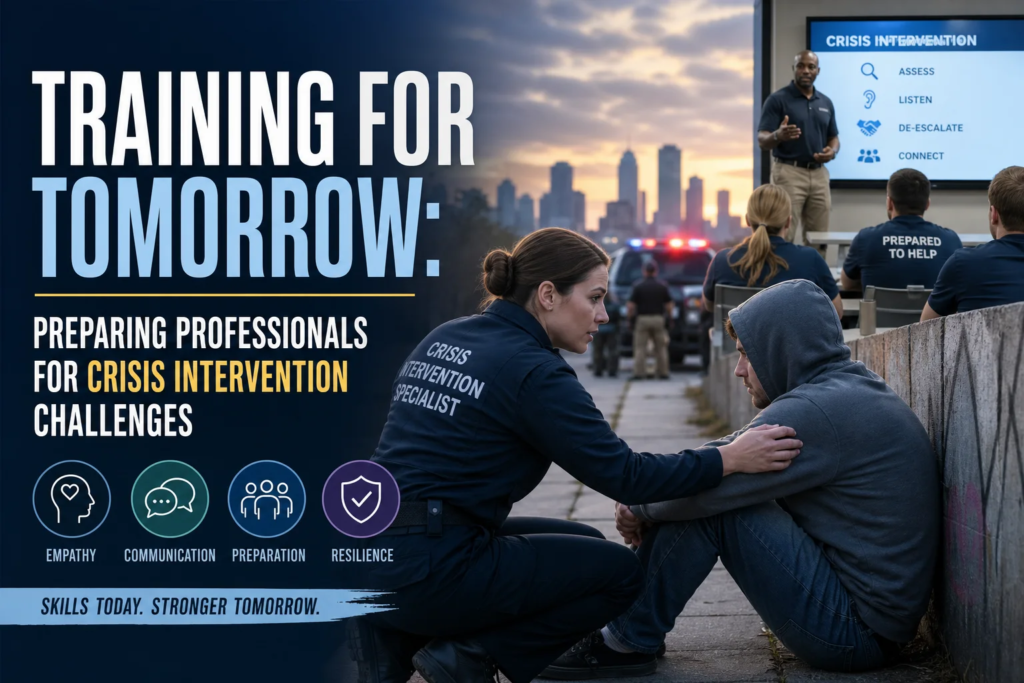
A crisis rarely arrives with a warning label. It may begin as a frantic call from a parent, a student spiraling after a traumatic event, a workplace threat, a domestic violence incident, a substance-related emergency, or a person in deep psychological distress standing at the edge of a decision that cannot be reversed. In those moments, professionals are asked to do more than respond. They must listen, assess, stabilize, protect, collaborate, document, and follow through—often under pressure, with incomplete information, and in environments charged with fear.
That is why Training for Tomorrow: Preparing Professionals for Crisis Intervention Challenges is no longer optional. It is essential.
The world has changed. Communities are facing rising mental health needs, public safety concerns, social fragmentation, climate-related disasters, workplace stress, school emergencies, and digital-age crises that unfold in real time. Crisis intervention professionals—counselors, social workers, law enforcement officers, healthcare workers, educators, emergency responders, peer support specialists, and community leaders—need preparation that matches the complexity of the moment.
This article explores what modern crisis intervention training must become: practical, trauma-informed, culturally responsive, technology-aware, and deeply human. More importantly, it explains how Training for Tomorrow: Preparing Professionals for Crisis Intervention Challenges can equip today’s professionals to respond with confidence, compassion, and competence when lives, safety, and trust are on the line.
Why Training for Tomorrow Matters More Than Ever
The phrase Training for Tomorrow: Preparing Professionals for Crisis Intervention Challenges captures a major shift in professional development. Crisis intervention is no longer limited to emergency response after something goes wrong. It now includes prevention, early recognition, emotional stabilization, collaborative care, risk assessment, community coordination, and long-term recovery support.
Professionals are increasingly expected to handle situations involving:
- Acute mental health distress
- Suicide risk and self-harm concerns
- Substance use crises
- Domestic and family violence
- School threats and student trauma
- Workplace conflict and violence prevention
- Homelessness and displacement
- Natural disasters and community-wide emergencies
- Grief, loss, and traumatic events
- Digital crises, including online harassment and social media escalation
Traditional training often emphasized protocols, compliance, and technical procedures. Those still matter. But tomorrow’s crisis intervention professional also needs emotional intelligence, cultural humility, ethical decision-making, nervous system awareness, and the ability to build trust quickly.
In other words, preparing professionals for crisis intervention challenges means preparing them for complexity—not just emergencies.
The Changing Landscape of Crisis Intervention
A decade ago, crisis response was often reactive. Someone called for help, professionals arrived, and intervention began. Today, crises unfold across multiple settings and platforms. A student may post a concerning message online before anyone notices behavior changes in person. A workplace conflict may intensify through emails and group chats. A community disaster may create waves of psychological distress long after the physical danger has passed.
This is why training for tomorrow in crisis intervention must address both visible emergencies and hidden vulnerabilities.
Key Trends Shaping Crisis Intervention
| Trend | What It Means for Professionals | Training Implication |
|---|---|---|
| Rising mental health acuity | More people are reaching crisis points before receiving care | Stronger assessment, de-escalation, and referral skills |
| Social media escalation | Crises can spread quickly and publicly | Training in digital risk recognition and communication |
| Workforce burnout | Professionals face chronic stress and compassion fatigue | Resilience, supervision, and peer support must be built in |
| Cultural complexity | One-size-fits-all responses can harm trust | Culturally responsive intervention is essential |
| Multi-agency response | Schools, hospitals, police, nonprofits, and families often overlap | Team-based coordination training is critical |
| Trauma awareness | Many crisis behaviors are trauma responses | Trauma-informed care should be foundational |
The best programs in Training for Tomorrow: Preparing Professionals for Crisis Intervention Challenges are built around these realities. They do not teach professionals to memorize scripts. They teach them to think clearly, communicate skillfully, and respond ethically in unpredictable situations.
Core Competencies for Tomorrow’s Crisis Intervention Professionals
Effective crisis intervention depends on a strong competency framework. Professionals must know what to do, how to do it, and why it matters.
1. Emotional Regulation Under Pressure
Before a professional can de-escalate someone else, they must manage their own nervous system. A calm presence is not a personality trait; it is a trainable skill.
Training should include:
- Breath and grounding techniques for responders
- Awareness of stress responses
- Voice tone and body language control
- Recognizing personal triggers
- Staying present during verbal aggression or distress
This is a central pillar of Training for Tomorrow: Preparing Professionals for Crisis Intervention Challenges because a dysregulated responder can unintentionally escalate a crisis.
2. Rapid Risk Assessment
Crisis professionals often need to assess risk quickly without rushing to judgment. This includes evaluating danger to self, danger to others, medical concerns, environmental risks, access to weapons, substance involvement, and protective factors.
Good assessment is both structured and relational. The professional must gather critical information while preserving dignity and trust.
3. Trauma-Informed Communication
A trauma-informed approach asks, “What happened to this person?” rather than “What is wrong with this person?” This shift changes the tone of the entire intervention.
Trauma-informed crisis communication includes:
- Offering choices when possible
- Explaining actions before taking them
- Avoiding unnecessary physical control
- Using non-shaming language
- Recognizing fear-based reactions
- Prioritizing emotional and physical safety
Any serious effort at preparing professionals for crisis intervention challenges must place trauma-informed care at the center.
4. Cultural Humility and Context Awareness
Crisis does not occur in a vacuum. A person’s response may be shaped by culture, language, disability, religion, immigration status, gender identity, prior experiences with systems, or historical trauma.
Cultural humility means professionals remain curious, respectful, and aware of power dynamics. It also means they avoid assuming that their interpretation of behavior is the only correct one.
5. Ethical Decision-Making
Crisis intervention often involves competing priorities: autonomy and safety, confidentiality and duty to warn, urgency and consent, individual rights and community protection. Training must give professionals a practical ethical framework, not just abstract rules.
6. Collaborative Response
No single professional can solve every crisis. Effective intervention often requires coordination among mental health providers, emergency medical services, schools, families, law enforcement, shelters, hospitals, and community organizations.
Tomorrow’s professionals need to know how to share information appropriately, make warm handoffs, and avoid fragmented care.
A Practical Competency Matrix for Crisis Intervention Training
The following matrix shows how Training for Tomorrow: Preparing Professionals for Crisis Intervention Challenges can be organized around measurable skills.
| Competency Area | Beginner Skill | Advanced Skill | Training Method |
|---|---|---|---|
| De-escalation | Uses calm tone and active listening | Adapts approach based on emotional state, culture, and risk | Role-play, simulation, coaching |
| Risk assessment | Identifies immediate safety concerns | Integrates risk, protective factors, and collateral information | Case scenarios, supervised practice |
| Trauma-informed care | Avoids blame and coercive language | Builds safety, choice, collaboration, and empowerment into response | Reflective exercises, scenario labs |
| Cultural responsiveness | Recognizes bias and avoids assumptions | Adjusts communication and referrals to cultural context | Community panels, lived-experience training |
| Legal/ethical practice | Understands reporting requirements | Navigates complex consent, confidentiality, and duty-to-protect issues | Ethics workshops, case consultation |
| Interagency coordination | Knows referral pathways | Leads coordinated response and follow-up planning | Tabletop exercises, cross-agency drills |
| Self-care and resilience | Recognizes stress symptoms | Uses supervision, peer support, and recovery practices proactively | Wellness planning, reflective supervision |
This type of matrix makes training for tomorrow in crisis intervention more practical because it gives organizations a way to measure growth instead of simply checking attendance.
Moving Beyond “One-and-Done” Workshops
Many organizations still rely on annual workshops to prepare staff for high-risk situations. While workshops can be helpful, they are not enough. Crisis intervention is a performance skill. It must be practiced, observed, coached, and refreshed.
Think about aviation, emergency medicine, or firefighting. Professionals in those fields do not simply read policies and hope they perform well under pressure. They train through simulations, drills, feedback loops, and repeated practice.
The same should be true for Training for Tomorrow: Preparing Professionals for Crisis Intervention Challenges.
What Effective Training Should Include
| Training Element | Why It Matters |
|---|---|
| Scenario-based learning | Builds decision-making under realistic pressure |
| Skills demonstration | Shows what effective intervention looks and sounds like |
| Practice with feedback | Turns theory into behavior |
| Interdisciplinary learning | Reduces confusion during multi-agency response |
| Lived-experience voices | Humanizes the crisis experience |
| Ongoing refreshers | Prevents skill decay |
| Reflective supervision | Supports ethical growth and emotional resilience |
| Outcome tracking | Shows whether training improves real-world performance |
A professional who attends a lecture may understand crisis intervention intellectually. A professional who practices in realistic scenarios is far more likely to act effectively when the stakes are high.
Case Study 1: A School Crisis Response After a Student Threat
Scenario
A high school student posted a vague but alarming message online late at night. By morning, screenshots had circulated among students and parents. Fear spread quickly. Some parents demanded immediate expulsion. Students were crying in hallways. Staff members were unsure whether the threat was credible.
The school crisis team included administrators, a school counselor, a school resource officer, a district mental health consultant, and a communications liaison. Because the district had invested in Training for Tomorrow: Preparing Professionals for Crisis Intervention Challenges, the team followed a structured response.
They:
- Secured immediate safety without publicly shaming the student.
- Conducted a behavioral threat assessment with trained personnel.
- Interviewed the student using calm, non-accusatory language.
- Contacted caregivers and connected the family with urgent mental health support.
- Communicated with parents in a clear, factual, non-inflammatory manner.
- Provided support spaces for anxious students.
- Created a re-entry and monitoring plan rather than relying solely on punishment.
Outcome
The investigation found that the student was experiencing intense emotional distress but had no immediate plan or access to weapons. The student received care, the school community was informed appropriately, and panic decreased.
Analysis
This case shows why preparing professionals for crisis intervention challenges requires more than discipline policies. Without training, the response could have become reactive, punitive, or chaotic. Instead, the team balanced safety, mental health, communication, and student dignity.
The key lesson: modern crisis intervention in schools must combine threat assessment, trauma-informed communication, family engagement, and community reassurance.
The Role of De-escalation in Modern Crisis Intervention
De-escalation is often misunderstood. It is not simply “being nice,” nor is it about letting unsafe behavior continue. De-escalation is the disciplined use of communication, environment, timing, and presence to reduce emotional intensity and increase safety.
Strong de-escalation training includes:
- Approaching slowly and respectfully
- Maintaining a safe physical distance
- Using short, clear sentences
- Listening more than talking
- Naming emotions without judgment
- Offering realistic choices
- Avoiding power struggles
- Knowing when to pause
- Calling for support before the situation becomes unmanageable
In Training for Tomorrow: Preparing Professionals for Crisis Intervention Challenges, de-escalation must be practiced repeatedly. Professionals need to hear themselves speak under pressure, receive coaching, and learn how their body language affects the person in crisis.
A simple but powerful de-escalation model is:
| Step | Professional Action | Goal |
|---|---|---|
| Connect | Use calm introduction and respectful tone | Build initial trust |
| Assess | Observe risk, emotions, environment, and needs | Understand what is happening |
| Stabilize | Reduce stimulation, validate feelings, offer choices | Lower emotional intensity |
| Plan | Identify next steps and supports | Create movement toward safety |
| Follow Up | Ensure continuity and documentation | Prevent recurrence or abandonment |
This model supports training for tomorrow in crisis intervention because it is flexible enough for healthcare, education, public safety, social services, and workplace settings.
Case Study 2: Hospital Emergency Department Behavioral Health Crisis
Scenario
A hospital emergency department received a patient brought in by family members after several days of escalating paranoia, insomnia, and agitation. The waiting room was crowded. Staff were busy. The patient became fearful and began shouting that people were trying to harm him.
In the past, the hospital’s response might have involved immediate security presence, physical control, or rapid medication. However, the hospital had recently redesigned its behavioral emergency training around Training for Tomorrow: Preparing Professionals for Crisis Intervention Challenges.
The team used a different approach:
- A nurse trained in behavioral crisis response approached calmly.
- Security remained nearby but out of the patient’s direct line of sight.
- The nurse used simple language and asked permission before moving closer.
- Staff reduced noise and moved bystanders away.
- A family member helped identify calming strategies.
- The patient was offered water, a quieter room, and a clear explanation of what would happen next.
- Medical and psychiatric assessment followed once the patient was calmer.
Outcome
The patient accepted evaluation without physical restraint. Staff reported feeling safer and more confident. The family expressed relief that their loved one was treated with dignity.
Analysis
This case demonstrates that Training for Tomorrow: Preparing Professionals for Crisis Intervention Challenges can reduce unnecessary escalation in healthcare settings. It also shows the importance of environment. Noise, crowding, rushed communication, and visible security can intensify fear. Training helped staff coordinate roles, protect safety, and preserve patient dignity.
The relevance is clear: healthcare crisis response must be clinically sound, trauma-informed, and operationally realistic.
Technology and the Future of Crisis Intervention Training
Technology is reshaping both crises and training. Professionals now encounter digital warning signs, telehealth emergencies, online harassment, livestreamed distress, and misinformation that can inflame public fear. At the same time, technology offers new ways to train, simulate, and support responders.
Technology Tools Supporting Crisis Training
| Tool | Use in Training | Benefit |
|---|---|---|
| Virtual reality simulations | Practice high-stress scenarios safely | Builds confidence and muscle memory |
| Online learning platforms | Deliver foundational content consistently | Scales training across organizations |
| AI-supported scenario branching | Allows learners to make decisions and see consequences | Improves critical thinking |
| Digital risk dashboards | Track trends and incident patterns | Supports prevention and planning |
| Telehealth simulation | Prepares professionals for remote crisis assessment | Builds digital communication skills |
| Body-worn or scenario video review | Provides feedback on tone, posture, and timing | Enhances self-awareness |
However, technology should never replace human judgment. The purpose of technology in Training for Tomorrow: Preparing Professionals for Crisis Intervention Challenges is to enhance preparation, not automate compassion.
Professionals must also be trained in digital ethics: privacy, consent, documentation, secure communication, and the limits of remote intervention.
Case Study 3: Workplace Crisis and Violence Prevention
Scenario
A mid-sized company noticed concerning changes in an employee’s behavior. The employee had become isolated, angry during meetings, and increasingly fixated on perceived mistreatment. After a tense confrontation with a supervisor, coworkers reported feeling unsafe.
Instead of ignoring the situation or immediately terminating the employee, the organization activated its workplace threat management team. The team had completed training for tomorrow in crisis intervention with a focus on early intervention, behavioral warning signs, and respectful engagement.
Actions included:
- Gathering objective observations rather than rumors.
- Consulting HR, legal counsel, security, and an external behavioral health advisor.
- Meeting with the employee in a private, respectful setting.
- Offering support resources and clarifying workplace expectations.
- Creating a safety plan for supervisors and coworkers.
- Monitoring changes and documenting follow-up.
- Adjusting workload temporarily while the employee accessed care.
Outcome
The employee accepted support through an employee assistance program. The conflict did not escalate into violence. Team members reported greater confidence in addressing concerning behavior early.
Analysis
This case highlights an often-overlooked dimension of Preparing Professionals for Crisis Intervention Challenges: prevention. Crisis intervention is not only what happens during the peak of danger. It includes recognizing patterns, interrupting escalation, and responding before harm occurs.
The key lesson is that workplaces need trained multidisciplinary teams, not improvised reactions.
The Human Side: Building Trust in the First 60 Seconds
In crisis intervention, the first minute matters. People in distress are often scanning for danger. They notice tone, posture, facial expression, distance, and whether the professional seems rushed or judgmental.
A professional may say all the “right” words, but if their presence communicates irritation or fear, the person in crisis may respond defensively.
This is why Training for Tomorrow: Preparing Professionals for Crisis Intervention Challenges should include micro-skills such as:
- Introducing oneself clearly
- Asking, “What would help you feel a little safer right now?”
- Using the person’s name respectfully
- Avoiding rapid-fire questions
- Reflecting emotion before problem-solving
- Explaining limits honestly
- Acknowledging uncertainty when appropriate
- Following through on small promises
Trust is not built through speeches. It is built through small signals of respect.
Preparing Professionals for Crisis Intervention Challenges Across Fields
Crisis intervention is not limited to mental health clinicians. Many professionals become first points of contact.
Educators
Teachers and school staff often notice early warning signs: withdrawal, aggression, panic, grief, or concerning statements. They need training in recognition, referral, classroom stabilization, and post-crisis support.
Law Enforcement and Public Safety
Officers may encounter people in mental health crisis, substance-related distress, domestic conflict, or homelessness-related emergencies. Crisis intervention training can improve communication, reduce use-of-force risks, and strengthen collaboration with behavioral health teams.
Healthcare Workers
Nurses, physicians, paramedics, and emergency department staff need skills in behavioral crisis management, suicide risk screening, trauma-informed care, and family communication.
Social Workers and Counselors
Clinical professionals need advanced assessment, safety planning, ethical decision-making, and secondary trauma prevention.
Human Resources Professionals
HR teams increasingly handle workplace threats, employee distress, harassment, grief, and conflict escalation. They need structured protocols and referral pathways.
Community and Faith Leaders
Many people turn first to trusted community figures. These leaders need basic crisis recognition, supportive listening skills, and clear referral networks.
The broad relevance of Training for Tomorrow: Preparing Professionals for Crisis Intervention Challenges reflects a simple truth: crisis response is everyone’s business, but it must be done within appropriate roles and boundaries.
Building a Crisis-Ready Organization
Individual training is important, but organizational culture determines whether skills are used effectively. A well-trained professional can still struggle inside a system that lacks clear protocols, staffing support, leadership buy-in, or referral resources.
Organizations serious about Training for Tomorrow: Preparing Professionals for Crisis Intervention Challenges should focus on five levels of readiness.
1. Policy Readiness
Policies should clearly explain roles, reporting pathways, documentation expectations, confidentiality limits, emergency procedures, and follow-up requirements.
2. Skill Readiness
Staff should receive role-specific training. Not everyone needs the same depth, but everyone should know what to do when they encounter a crisis.
3. Team Readiness
Crisis response often requires coordination. Teams should practice together before real incidents occur.
4. Resource Readiness
Organizations need updated contact lists, referral partners, emergency resources, translation services, and after-hours procedures.
5. Recovery Readiness
After a crisis, people need debriefing, communication, emotional support, and systems review. Recovery is part of intervention.
Crisis-Ready Organization Checklist
| Readiness Area | Key Question |
|---|---|
| Leadership | Do leaders actively support crisis training and response planning? |
| Protocols | Are procedures clear, current, and accessible? |
| Training | Are staff trained by role and refreshed regularly? |
| Communication | Is there a plan for internal and external messaging? |
| Partnerships | Are community and clinical referral pathways established? |
| Documentation | Are incidents recorded accurately and ethically? |
| Staff support | Are responders offered debriefing and wellness resources? |
| Evaluation | Are outcomes reviewed for continuous improvement? |
This checklist turns preparing professionals for crisis intervention challenges into an organization-wide commitment rather than a one-time training event.
The Importance of Simulation and Scenario-Based Practice
People do not rise to the level of their intentions in a crisis; they often fall to the level of their training. That is why simulation matters.
Scenario-based learning allows professionals to practice difficult conversations before they face them in real life. It also reveals gaps that lectures cannot expose.
For example, a professional may understand active listening conceptually but interrupt repeatedly during a role-play. Another may know the policy for suicide risk but struggle to ask direct, compassionate questions. A team may believe it has a clear response plan until a tabletop exercise reveals confusion over who contacts family, who documents, and who coordinates follow-up.
Effective simulation for Training for Tomorrow: Preparing Professionals for Crisis Intervention Challenges should include:
- Realistic emotional intensity
- Clear learning objectives
- Trained facilitators
- Psychological safety for learners
- Debriefing focused on growth
- Repetition with increasing complexity
- Inclusion of cultural and contextual variables
- Interprofessional participation when possible
The goal is not to embarrass learners. The goal is to build readiness before the real moment arrives.
Addressing Burnout and Secondary Trauma
Crisis professionals absorb intense human pain. Over time, repeated exposure can lead to burnout, compassion fatigue, moral distress, and secondary traumatic stress.
A major mistake in traditional training is focusing only on the person in crisis while ignoring the responder. But exhausted professionals are more likely to make mistakes, become emotionally detached, overreact, or leave the field entirely.
That is why Training for Tomorrow: Preparing Professionals for Crisis Intervention Challenges must include responder wellness.
Warning Signs of Crisis Responder Burnout
| Area | Possible Signs |
|---|---|
| Emotional | Irritability, numbness, cynicism, anxiety |
| Physical | Fatigue, headaches, sleep disruption |
| Cognitive | Difficulty concentrating, intrusive thoughts |
| Behavioral | Withdrawal, overworking, increased substance use |
| Professional | Reduced empathy, dread before shifts, poor documentation |
Protective Practices
- Regular supervision
- Peer support teams
- Post-incident debriefing
- Reasonable workloads
- Time off after intense events
- Access to counseling
- Mindfulness or grounding practices
- Clear boundaries
- Recognition from leadership
Preparing professionals for crisis intervention challenges means preparing them to stay healthy enough to keep helping.
Ethical and Legal Considerations in Crisis Intervention
Crisis intervention can involve serious decisions. Professionals may need to determine when to break confidentiality, when to contact emergency services, when to involve caregivers, when to report abuse, or when to initiate involuntary evaluation according to local law.
Training should never reduce these issues to fear-based compliance. Instead, professionals need decision-making tools.
Practical Ethical Questions to Teach
- What is the least restrictive safe option?
- What information must be shared, and with whom?
- Has the person been included in planning as much as possible?
- Are cultural and disability-related needs being respected?
- Is documentation factual, timely, and nonjudgmental?
- Are legal requirements being followed?
- Has consultation been sought when appropriate?
Ethical clarity is one of the strongest outcomes of Training for Tomorrow: Preparing Professionals for Crisis Intervention Challenges. In high-pressure moments, professionals need more than instinct. They need principles they can apply quickly.
Measuring Whether Crisis Intervention Training Works
A training program may receive positive evaluations because participants liked the presenter. But liking a workshop does not prove readiness. Organizations need better measures.
Useful Evaluation Metrics
| Metric | What It Shows |
|---|---|
| Pre/post knowledge checks | Whether participants learned key concepts |
| Skills observation | Whether participants can demonstrate techniques |
| Scenario performance | Whether participants can apply judgment under pressure |
| Incident outcomes | Whether crises are resolved more safely |
| Use-of-force or restraint data | Whether restrictive interventions decrease |
| Referral follow-through | Whether people receive continued support |
| Staff confidence surveys | Whether professionals feel prepared |
| Burnout indicators | Whether responder wellness is protected |
| Community feedback | Whether interventions feel respectful and effective |
Good evaluation helps refine training for tomorrow in crisis intervention over time. The question is not, “Did we train people?” The better question is, “Are people safer, better supported, and more confident because of the training?”
Common Mistakes Organizations Make
Even well-intentioned organizations can undermine crisis readiness. Here are common pitfalls.
Mistake 1: Waiting Until a Crisis Happens
Reactive training after a serious incident may be necessary, but it should not be the starting point. Preparation must happen before the emergency.
Mistake 2: Training Only Specialists
Specialists matter, but receptionists, teachers, supervisors, nurses, and frontline staff may be the first to notice a crisis. Basic awareness should be widespread.
Mistake 3: Ignoring Culture and Identity
Responses that fail to consider language, disability, race, gender, religion, or trauma history can deepen harm and reduce cooperation.
Mistake 4: Over-Relying on Scripts
Scripts can help beginners, but crisis intervention requires adaptation. Professionals need principles, not robotic lines.
Mistake 5: Forgetting Follow-Up
A crisis is not over when the scene is calm. Follow-up prevents recurrence, supports recovery, and rebuilds trust.
Avoiding these mistakes is central to Training for Tomorrow: Preparing Professionals for Crisis Intervention Challenges.
A Roadmap for Implementing Training for Tomorrow
Organizations do not need to transform everything overnight. A phased approach works best.
Phase 1: Assess Current Readiness
Review policies, incident data, staff confidence, community feedback, and training gaps.
Phase 2: Define Role-Specific Competencies
Clarify what each group needs to know. A receptionist, clinician, police officer, teacher, and executive leader all need different training depths.
Phase 3: Build a Training Curriculum
Include foundational knowledge, practical skills, simulations, ethics, cultural responsiveness, and wellness.
Phase 4: Practice Across Teams
Use tabletop exercises and live simulations to test coordination.
Phase 5: Create Feedback Loops
Collect data, debrief incidents, update protocols, and refresh training regularly.
Phase 6: Sustain the Culture
Recognize good practice, support staff wellness, and keep crisis readiness visible in leadership priorities.
This roadmap makes Training for Tomorrow: Preparing Professionals for Crisis Intervention Challenges achievable, measurable, and sustainable.
The Future: What Tomorrow’s Crisis Professionals Will Need Next
The next generation of crisis intervention will require even broader skills. Professionals will need to navigate climate-related displacement, AI-generated misinformation, virtual communities, loneliness epidemics, polarized public environments, and complex behavioral health needs.
Future-ready training will likely include:
- Advanced tele-crisis intervention
- Cross-cultural mediation
- Community violence interruption
- Disaster behavioral health
- Digital threat assessment
- Peer-led crisis support models
- Mobile crisis team collaboration
- Restorative post-crisis practices
- Data-informed prevention
- Responder resilience science
The heart of Training for Tomorrow: Preparing Professionals for Crisis Intervention Challenges will remain unchanged: people helping people through the hardest moments of their lives. But the tools, settings, and expectations will keep evolving.
Professionals who train continuously will be better equipped not only to respond to crisis, but to reduce harm before crisis peaks.
Conclusion: Preparing for Crisis Is an Act of Hope
Crisis intervention is demanding work. It asks professionals to enter moments of fear, confusion, anger, grief, and danger with steadiness and skill. But it is also profoundly hopeful work. Every effective intervention says, “This moment does not have to end in harm. There is still a path toward safety.”
Training for Tomorrow: Preparing Professionals for Crisis Intervention Challenges is about building that path before it is urgently needed. It means giving professionals the tools to listen deeply, assess wisely, de-escalate safely, collaborate effectively, and care for themselves along the way.
The most successful organizations will not treat crisis training as a checkbox. They will treat it as a living commitment—to safety, dignity, equity, and human connection.
Whether you work in healthcare, education, public safety, social services, business, or community leadership, the takeaway is clear: start now. Review your protocols. Practice the conversations. Strengthen partnerships. Invest in your people. Build systems that support calm, compassionate, competent action.
Tomorrow’s crises will not wait for us to feel ready. But with the right preparation, tomorrow’s professionals can meet them with courage, clarity, and care.
1. What is the main goal of crisis intervention training?
The main goal is to help professionals respond safely and effectively to people in acute distress. Strong crisis intervention training teaches de-escalation, risk assessment, trauma-informed communication, ethical decision-making, referral planning, and follow-up support.
2. Who needs Training for Tomorrow: Preparing Professionals for Crisis Intervention Challenges?
This training is valuable for mental health professionals, educators, healthcare workers, law enforcement officers, social workers, HR professionals, emergency responders, community leaders, and anyone likely to encounter people in crisis. Different roles require different levels of training.
3. How often should crisis intervention training be refreshed?
At minimum, organizations should refresh core crisis intervention skills annually. High-risk roles may need quarterly practice, scenario drills, or supervision. Skills like de-escalation and risk assessment can fade without repetition.
4. What makes modern crisis intervention training different from older models?
Modern training emphasizes trauma-informed care, cultural responsiveness, collaboration, prevention, digital awareness, and responder wellness. Older models often focused mainly on control, compliance, or emergency procedures.
5. Can crisis intervention training prevent violence or self-harm?
Training cannot prevent every tragedy, but it can reduce risk. Professionals who recognize warning signs, communicate effectively, assess danger, and connect people to support are better positioned to interrupt escalation and promote safety.
6. Why is simulation important in preparing professionals for crisis intervention challenges?
Simulation helps professionals practice realistic scenarios in a safe learning environment. It builds confidence, reveals gaps, and improves decision-making under stress. Crisis intervention is a skill that must be practiced, not just studied.
7. How does responder wellness fit into crisis intervention training?
Responder wellness is essential. Professionals exposed to repeated crises can experience burnout or secondary trauma. Training should include self-regulation, peer support, supervision, debriefing, and recovery strategies.
8. What is the first step for an organization that wants to improve crisis readiness?
Start with a readiness assessment. Review current policies, staff training, incident history, referral pathways, and communication plans. From there, build role-specific training and practice through scenarios and team exercises.


The PsyForU Editorial Collective is the research and editorial team of PsyForU Research International. The collective prepares educational, psychological, mental-health-awareness, inclusion, neurodiversity, and research-methodology content for students, parents, educators, researchers, and general readers. PsyForU content is intended for awareness, education, and capacity-building and should not be treated as clinical diagnosis, therapy, medical advice, legal advice, or emergency mental-health support.