


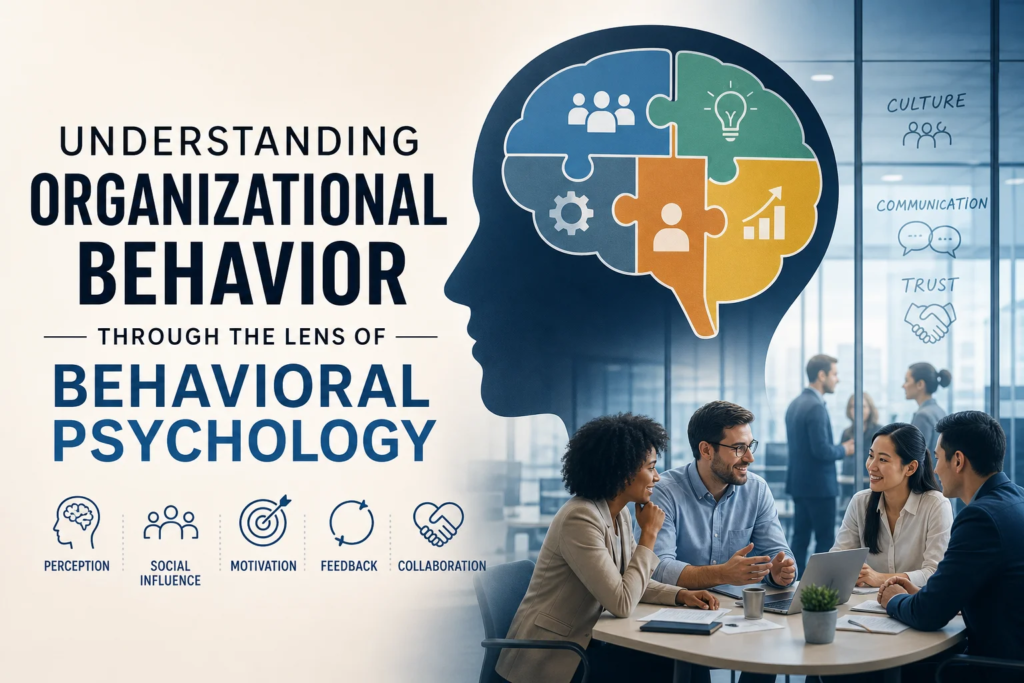
The Ultimate Guide to Understanding Organizational Behavior Through the Lens of Behavioral Psychology
Introduction: Why People at Work Behave the Way They Do
Every organization has a hidden operating system.
It is not the official org chart. It is not the strategy deck. It is not the values painted on the wall near reception.
It is the daily pattern of human behavior: who speaks up in meetings, who stays silent, who takes initiative, who avoids risk, who shares knowledge, who protects turf, who burns out, who leads with trust, and who manages through fear.
That is why Understanding Organizational Behavior Through the Lens of Behavioral Psychology is so powerful. It helps leaders, managers, HR professionals, consultants, and employees move beyond vague explanations like “bad culture,” “poor attitude,” or “lack of motivation” and instead ask a better question:
What conditions are shaping this behavior?
Behavioral psychology gives us practical tools for understanding why people do what they do in workplace settings. It examines the relationship between triggers, rewards, consequences, habits, social norms, perception, motivation, and decision-making. When applied to organizations, it reveals how small environmental signals can create large behavioral patterns.
In other words, Understanding Organizational Behavior Through the Lens of Behavioral Psychology helps us see the workplace not as a collection of personalities, but as a system of incentives, cues, feedback loops, and learned responses.
This article explores how behavioral psychology explains organizational behavior, how leaders can use it ethically, and how real companies have applied these principles to improve performance, culture, collaboration, safety, and innovation.
What Is Organizational Behavior?
Organizational behavior is the study of how individuals and groups act within organizations. It looks at topics such as leadership, motivation, communication, conflict, decision-making, team dynamics, culture, change, and performance.
At its core, organizational behavior asks:
- Why do employees behave differently in different environments?
- What makes teams perform well or poorly?
- How do leaders influence employee motivation?
- Why do some cultures encourage innovation while others create fear?
- How do incentives shape workplace decisions?
- Why do change initiatives often fail?
Traditional organizational behavior draws from psychology, sociology, management theory, economics, and anthropology. But Understanding Organizational Behavior Through the Lens of Behavioral Psychology adds something especially practical: it focuses on observable behavior and the conditions that reinforce or discourage it.
Instead of simply asking, “What do employees believe?” behavioral psychology asks, “What behaviors are being rewarded, punished, ignored, or modeled?”
That distinction matters.
An organization may say it values teamwork, but if promotions go only to individual high performers, employees quickly learn that collaboration is optional and self-promotion is smart. A company may say it encourages innovation, but if failed experiments are publicly criticized, employees learn to play safe.
This is why Understanding Organizational Behavior Through the Lens of Behavioral Psychology is essential for designing healthier and more effective workplaces.
What Is Behavioral Psychology?
Behavioral psychology, sometimes called behaviorism, is a branch of psychology focused on how behavior is learned, shaped, and changed through interaction with the environment.
Classic behavioral psychology emphasizes concepts such as:
- Stimulus and response
- Reinforcement
- Punishment
- Conditioning
- Habit formation
- Feedback
- Environmental cues
- Behavioral consequences
Modern behavioral psychology also overlaps with cognitive psychology, behavioral economics, neuroscience, and social psychology. It recognizes that human behavior is influenced not only by rewards and punishments, but also by perception, bias, identity, emotion, social norms, and mental shortcuts.
When we apply these ideas to organizations, we begin to understand why workplace behavior often follows predictable patterns.
For example:
- Employees repeat behaviors that are recognized or rewarded.
- Teams avoid behaviors that previously led to embarrassment or punishment.
- Managers continue habits that helped them succeed earlier, even if those habits no longer work.
- People conform to visible social norms, even when official policies say otherwise.
- Employees resist change when the old behavior is easier, safer, or more familiar.
This is the foundation of Understanding Organizational Behavior Through the Lens of Behavioral Psychology.
Why Understanding Organizational Behavior Through the Lens of Behavioral Psychology Matters
Many workplace problems are mistakenly treated as personality issues.
A manager says, “My team is lazy.”
An executive says, “Employees resist change.”
A supervisor says, “People just do not care about quality.”
An HR leader says, “Our managers are not giving feedback.”
But behavioral psychology encourages a more useful interpretation.
Maybe the team is not lazy; maybe effort is not visibly connected to meaningful outcomes.
Maybe employees do not resist change; maybe the change process threatens their competence or status.
Maybe people do care about quality, but speed is rewarded more consistently than accuracy.
Maybe managers avoid feedback because previous difficult conversations created conflict without support.
Understanding Organizational Behavior Through the Lens of Behavioral Psychology helps leaders stop blaming individuals too quickly and start examining the behavioral system.
The workplace is full of behavioral signals:
- Who gets promoted?
- What gets praised?
- What gets ignored?
- What gets punished?
- Who has power?
- What behaviors create safety?
- What behaviors create risk?
- What do leaders do under pressure?
- What stories get repeated?
These signals teach people how to behave.
A company’s culture is not just what it says. Culture is what people learn is safe, rewarded, expected, and normal.
The Behavioral Psychology Framework for Organizational Behavior
One of the simplest and most useful tools for Understanding Organizational Behavior Through the Lens of Behavioral Psychology is the ABC model:
| Element | Meaning | Workplace Example |
|---|---|---|
| A: Antecedent | What happens before the behavior; the cue or trigger | A manager asks for weekly sales updates |
| B: Behavior | The observable action | Employees submit reports |
| C: Consequence | What happens after the behavior | The manager gives recognition or ignores the report |
The ABC model shows that behavior does not happen in isolation. It is shaped by what comes before and after it.
Example: Why Employees Stop Sharing Ideas
| ABC Component | Workplace Reality |
|---|---|
| Antecedent | A leader asks for creative suggestions in a meeting |
| Behavior | An employee shares a new idea |
| Consequence | The leader dismisses it quickly or makes a sarcastic comment |
| Learned Pattern | Employees stop offering ideas |
In this case, the leader may still say, “I want innovation.” But the behavioral system teaches silence.
This is a core insight in Understanding Organizational Behavior Through the Lens of Behavioral Psychology: employees often respond more to consequences than slogans.
Key Behavioral Psychology Concepts That Explain Workplace Behavior
The following table summarizes important behavioral psychology concepts and how they apply to organizations.
| Behavioral Psychology Concept | Meaning | Organizational Application |
|---|---|---|
| Positive reinforcement | Adding a desirable consequence after behavior | Recognizing employees for collaboration |
| Negative reinforcement | Removing an unpleasant condition after behavior | Reducing micromanagement when teams show reliability |
| Punishment | Applying an unpleasant consequence to reduce behavior | Disciplining policy violations |
| Extinction | Behavior decreases when reinforcement stops | Employees stop using a system when no one reviews the data |
| Modeling | People imitate observed behavior | Employees copy how leaders handle conflict |
| Social proof | People follow what others appear to be doing | New hires adopt team norms quickly |
| Habit loops | Cue-routine-reward patterns become automatic | Checking email every few minutes for quick relief |
| Cognitive bias | Mental shortcuts distort judgment | Managers favor employees who resemble them |
| Loss aversion | Losses feel more powerful than gains | Employees resist change due to fear of losing status |
| Feedback loops | Information changes future behavior | Real-time dashboards improve performance awareness |
These concepts make Understanding Organizational Behavior Through the Lens of Behavioral Psychology more than an academic exercise. They give leaders a practical language for diagnosing problems and designing better systems.
Motivation: Why Rewards Alone Are Not Enough
Many organizations try to motivate people with money, bonuses, targets, and performance ratings. These tools can work, but they are incomplete.
Behavioral psychology shows that motivation is shaped by consequences, but modern workplace motivation also depends on meaning, autonomy, identity, fairness, and belonging.
For example, salespeople may respond to commission plans, but if the plan rewards short-term deals over long-term customer trust, employees may learn to chase quick wins. Customer service teams may hit call-time targets, but if speed is rewarded over empathy, customer experience may suffer.
Understanding Organizational Behavior Through the Lens of Behavioral Psychology helps leaders ask not only, “What are we rewarding?” but also, “What unintended behavior are we reinforcing?”
Common Motivation Mistakes
| Mistake | Behavioral Result | Better Approach |
|---|---|---|
| Rewarding only individual output | Competition increases; collaboration drops | Reward both individual and team contribution |
| Praising heroics | Employees create avoidable crises to look valuable | Recognize prevention, planning, and reliability |
| Measuring only speed | Quality and care decline | Balance speed with accuracy and customer outcomes |
| Using fear as motivation | Short-term compliance, long-term disengagement | Use clarity, accountability, and psychological safety |
| Ignoring effort and progress | Employees feel unseen | Reinforce learning behaviors and improvement |
The best organizations design motivation systems that reinforce both performance and healthy behavior.
Reinforcement: The Workplace Behaviors You Reward Are the Behaviors You Grow
One of the most important ideas in Understanding Organizational Behavior Through the Lens of Behavioral Psychology is reinforcement.
Reinforcement is anything that increases the likelihood of a behavior happening again.
In organizations, reinforcement can be formal or informal.
Formal Reinforcement
- Salary increases
- Bonuses
- Promotions
- Awards
- Performance ratings
- Career opportunities
Informal Reinforcement
- Praise
- Attention
- Trust
- Inclusion
- Interesting assignments
- Public visibility
- Leader approval
Often, informal reinforcement is more powerful than leaders realize.
If a CEO praises leaders who “do whatever it takes” to hit quarterly numbers, managers may sacrifice employee well-being. If senior leaders reward people who challenge assumptions respectfully, employees may become more honest and innovative.
Understanding Organizational Behavior Through the Lens of Behavioral Psychology reveals that organizations are always teaching. Every meeting, promotion, decision, and reaction teaches people what matters.
Punishment, Fear, and the Hidden Cost of Compliance
Punishment can reduce unwanted behavior. But in organizations, overreliance on punishment often creates hidden costs.
Employees may comply outwardly while hiding mistakes, avoiding risk, withholding information, or blaming others.
This is especially dangerous in high-stakes environments such as healthcare, aviation, manufacturing, finance, and cybersecurity. If people fear punishment for reporting errors, leaders lose the chance to prevent future failures.
A fear-based culture can produce short-term discipline but long-term fragility.
What Fear Teaches Employees
| Leader Behavior | Employee Learning |
|---|---|
| Publicly shaming mistakes | Hide errors |
| Punishing bad news | Delay reporting problems |
| Ignoring concerns | Stay silent |
| Rewarding only certainty | Avoid experimentation |
| Blaming individuals for system problems | Protect yourself first |
This is why Understanding Organizational Behavior Through the Lens of Behavioral Psychology is critical for building psychological safety. Employees must believe that honesty, learning, and responsible risk-taking will not lead to humiliation or retaliation.
Accountability still matters. But accountability works best when paired with fairness, clarity, coaching, and system improvement.
Social Learning: Employees Watch Leaders More Than They Listen to Them
People learn by observing others. In organizations, this means leadership behavior is contagious.
If leaders interrupt people, employees learn interruption is acceptable.
If leaders admit mistakes, employees learn humility is safe.
If leaders hoard information, teams do the same.
If leaders collaborate across departments, silos weaken.
This principle is central to Understanding Organizational Behavior Through the Lens of Behavioral Psychology because it explains why culture change cannot succeed through posters, emails, or training alone.
People copy what powerful people do.
A leader’s behavior becomes a social signal. The higher the leader’s status, the stronger the signal.
Leadership Modeling Chart
| Leader Models | Employees Often Copy |
|---|---|
| Curiosity | Asking better questions |
| Defensiveness | Avoiding honest feedback |
| Calm under pressure | Emotional regulation |
| Blame | Self-protection |
| Learning from failure | Experimentation |
| Respectful disagreement | Productive conflict |
For leaders, the lesson is simple: your behavior is not private. It is instructional.
Habits and Routines: The Invisible Architecture of Work
Organizations run on habits.
Meetings happen a certain way. Emails follow certain patterns. Approvals move through familiar channels. Employees check dashboards, respond to Slack messages, escalate issues, or avoid certain conversations almost automatically.
A habit usually follows a loop:
- Cue: Something triggers the behavior.
- Routine: The behavior occurs.
- Reward: The person receives a benefit or relief.
For example:
| Cue | Routine | Reward |
|---|---|---|
| Phone notification | Check message immediately | Relief from uncertainty |
| Difficult conversation needed | Delay the conversation | Temporary comfort |
| Monthly performance review | Prepare defensive explanations | Protection from criticism |
| Team problem appears | Manager solves it personally | Feeling useful and in control |
Understanding Organizational Behavior Through the Lens of Behavioral Psychology helps organizations redesign habits rather than simply demand better outcomes.
If leaders want fewer unnecessary meetings, they must change cues and rewards. If they want managers to coach instead of rescue, they must make coaching easier, visible, and reinforced.
Behavior change becomes more realistic when leaders design the environment around the desired habit.
Cognitive Biases: Why Smart People Make Predictable Mistakes
Behavioral psychology and behavioral economics show that human decision-making is not perfectly rational. People rely on mental shortcuts, especially under pressure.
In organizations, cognitive biases influence hiring, performance reviews, strategy, innovation, and risk management.
Common Workplace Biases
| Bias | Description | Workplace Impact |
|---|---|---|
| Confirmation bias | Seeking information that confirms existing beliefs | Leaders ignore warning signs |
| Halo effect | One positive trait influences overall judgment | Charismatic employees get inflated ratings |
| Recency bias | Recent events weigh too heavily | Performance reviews overlook long-term contribution |
| Status quo bias | Preference for current state | Teams resist better processes |
| Authority bias | Overvaluing opinions from powerful people | Bad ideas go unchallenged |
| Groupthink | Desire for harmony overrides critical thinking | Teams make risky decisions |
| Fundamental attribution error | Blaming personality instead of context | Managers label employees “difficult” without examining workload or incentives |
A major benefit of Understanding Organizational Behavior Through the Lens of Behavioral Psychology is that it encourages humility. It reminds us that behavior is shaped by context, perception, and social pressure—not just character.
Better organizations design decision processes that reduce bias. They use structured interviews, diverse review panels, pre-mortems, anonymous feedback, and data-informed performance systems.
Psychological Safety: The Behavioral Foundation of High-Performing Teams
Psychological safety means people feel able to speak up, ask questions, admit mistakes, and challenge ideas without fear of humiliation or punishment.
It is one of the most important concepts in modern organizational behavior.
From a behavioral psychology perspective, psychological safety is learned through repeated consequences.
If speaking up leads to appreciation, curiosity, or constructive discussion, people speak up more often. If speaking up leads to embarrassment, anger, or career risk, people stay quiet.
This is another practical example of Understanding Organizational Behavior Through the Lens of Behavioral Psychology.
Psychological safety is not created by telling people, “Be honest.” It is created when honesty is consistently met with respect.
Behaviors That Build Psychological Safety
- Leaders ask questions before giving answers.
- Mistakes are discussed as learning opportunities.
- Employees receive credit for raising risks early.
- Dissent is welcomed, not punished.
- Teams separate person from problem.
- Managers respond calmly to bad news.
- People are thanked for speaking up.
Psychological safety does not mean avoiding accountability. In fact, the strongest teams combine psychological safety with high standards. People feel safe enough to be honest and responsible enough to improve.
Culture as Learned Behavior
Culture is often described as “how we do things around here.” Behavioral psychology makes that definition more precise:
Culture is the pattern of behavior people have learned is expected, reinforced, and socially accepted.
This makes Understanding Organizational Behavior Through the Lens of Behavioral Psychology especially useful for culture change.
Many organizations try to change culture by rewriting values. But values do not change behavior unless they are connected to consequences.
If a company says it values inclusion, but meetings are dominated by the same three voices, inclusion is not yet a behavioral norm. If a company says it values customer obsession, but internal politics consume more energy than customer problems, the culture is teaching a different lesson.
Culture Alignment Table
| Stated Value | Required Behavior | Reinforcement Needed |
|---|---|---|
| Innovation | Share experiments and lessons learned | Recognize intelligent risk-taking |
| Inclusion | Invite diverse voices into decisions | Reward inclusive leadership |
| Accountability | Own mistakes and follow through | Promote transparent problem-solvers |
| Collaboration | Share information across teams | Evaluate cross-functional contribution |
| Customer focus | Prioritize customer outcomes | Celebrate customer-impact stories |
Culture change becomes possible when leaders translate values into visible behaviors and reinforce those behaviors consistently.
Case Study 1: Google’s Project Aristotle and Psychological Safety
Google launched Project Aristotle to study what made teams effective. The company examined many variables, including team composition, personality, skills, and management style. One of the strongest findings was that high-performing teams had psychological safety.
Team members felt safe to take risks, ask questions, and speak honestly.
Behavioral Psychology Analysis
This case is highly relevant to Understanding Organizational Behavior Through the Lens of Behavioral Psychology because it shows that team performance is shaped by interaction patterns, not just individual talent.
The key behavioral lesson is this: people contribute more fully when the consequences of speaking up are safe and constructive.
Google’s findings challenged the assumption that the best teams are simply collections of the smartest people. Instead, the research highlighted group norms: conversational turn-taking, empathy, and respectful response patterns.
In behavioral terms, Google discovered that high-performing teams reinforce participation.
Practical Takeaway
If organizations want better teamwork, they should measure and reinforce behaviors such as listening, inclusion, curiosity, and constructive dissent.
Case Study 2: Toyota Production System and Continuous Improvement
Toyota is widely known for its production system, which emphasizes continuous improvement, respect for people, and frontline problem-solving. One famous practice is the andon cord, which allows workers to stop the production line when they notice a problem.
At first glance, stopping production seems costly. But Toyota understood that early problem detection prevents larger failures.
Behavioral Psychology Analysis
Toyota’s system is a powerful example of Understanding Organizational Behavior Through the Lens of Behavioral Psychology because it reinforces problem reporting instead of punishing it.
In many organizations, employees hide problems because problems trigger blame. Toyota designed a system where identifying an issue is treated as responsible behavior.
The antecedent is a visible defect or concern.
The behavior is pulling the andon cord or escalating the issue.
The consequence is support, investigation, and improvement—not shame.
This creates a learning culture.
Practical Takeaway
If leaders want transparency, they must reward early reporting. Problems should become signals for system improvement, not opportunities for blame.
Case Study 3: Microsoft’s Growth Mindset Culture Shift
Under Satya Nadella’s leadership, Microsoft moved from a highly competitive internal culture toward a more collaborative, learning-oriented culture. The company emphasized a growth mindset, encouraging employees to become “learn-it-alls” rather than “know-it-alls.”
This cultural shift supported innovation, collaboration, and renewed business performance.
Behavioral Psychology Analysis
This case demonstrates Understanding Organizational Behavior Through the Lens of Behavioral Psychology because it shows how language, leadership modeling, and reinforcement can reshape workplace identity.
A growth mindset culture reinforces learning behaviors:
- Asking questions
- Sharing knowledge
- Admitting gaps
- Experimenting
- Collaborating
- Seeking feedback
When leaders model curiosity and reward learning, employees begin to associate growth behaviors with status and success.
Practical Takeaway
To build a learning culture, organizations must promote people who learn, collaborate, and adapt—not only those who appear certain or individually brilliant.
Case Study 4: Hospital Hand Hygiene and Behavioral Nudges
Hospitals around the world have struggled with hand hygiene compliance. Training alone often fails because healthcare workers operate under stress, time pressure, fatigue, and competing demands.
Some hospitals improved compliance by using behavioral nudges such as visible sanitizer placement, reminder signs, peer accountability, performance feedback, and unit-level compliance dashboards.
Behavioral Psychology Analysis
This case is a clear example of Understanding Organizational Behavior Through the Lens of Behavioral Psychology in a high-stakes environment.
The desired behavior is simple: clean hands before and after patient contact. But behavior is affected by cues, convenience, norms, feedback, and reinforcement.
When sanitizer is placed directly in the workflow, the desired behavior becomes easier. When compliance data is visible, social norms become clearer. When leaders model hand hygiene, staff are more likely to follow.
Practical Takeaway
Training is rarely enough. To change behavior, make the desired action easy, visible, timely, and socially reinforced.
Case Study 5: Netflix and Freedom with Responsibility
Netflix became known for its culture of “freedom and responsibility.” Rather than relying on excessive rules, the company emphasized talent density, context, autonomy, and accountability.
Employees were expected to make sound decisions, act in the company’s best interest, and take ownership of outcomes.
Behavioral Psychology Analysis
Netflix provides a nuanced example of Understanding Organizational Behavior Through the Lens of Behavioral Psychology because it shows how autonomy can shape behavior when paired with clear expectations and strong feedback.
Autonomy can increase motivation, but only when employees understand the context and consequences of their decisions. Netflix reinforced responsible independence by selecting high-performing employees, communicating openly, and maintaining high standards.
The behavioral system rewarded judgment, ownership, and candor.
Practical Takeaway
Autonomy works best when employees have clarity, competence, trust, and accountability. Freedom without behavioral expectations becomes confusion; freedom with responsibility can become high performance.
How Leaders Can Apply Behavioral Psychology Ethically
Behavioral psychology is powerful, which means it must be used responsibly.
The goal of Understanding Organizational Behavior Through the Lens of Behavioral Psychology should not be manipulation. It should be creating environments where people can do their best work.
Ethical application requires transparency, respect, and mutual benefit.
Ethical Principles for Behavioral Design
| Principle | Meaning |
|---|---|
| Respect autonomy | Do not trick employees into behavior that harms them |
| Create mutual value | Align behavior change with employee and organizational well-being |
| Be transparent | Explain why changes are being made |
| Avoid coercion | Do not rely on fear or hidden pressure |
| Measure unintended effects | Watch for burnout, gaming, or unfair outcomes |
| Include employee voice | Let people help design behavior systems |
A behavioral approach to organizational behavior should make work more humane, not more controlling.
A Practical Model for Diagnosing Workplace Behavior
When a workplace behavior is not happening—or an unwanted behavior keeps repeating—leaders can use this diagnostic model.
Behavioral Diagnosis Table
| Question | Why It Matters |
|---|---|
| What exact behavior do we want? | Vague goals create vague action |
| What currently triggers the behavior? | Cues shape action |
| Is the desired behavior easy or difficult? | Friction reduces follow-through |
| What happens immediately after the behavior? | Consequences shape repetition |
| Who models the behavior? | People copy high-status examples |
| What social norms support or block it? | Group expectations influence choices |
| What incentives are involved? | Rewards may reinforce the wrong behavior |
| What fears or losses are attached? | People avoid perceived threats |
| How is feedback delivered? | Timely feedback improves learning |
| How will we measure progress? | Measurement keeps change visible |
This model supports Understanding Organizational Behavior Through the Lens of Behavioral Psychology by turning abstract workplace problems into observable patterns.
Applying Behavioral Psychology to Common Organizational Challenges
1. Improving Employee Engagement
Engagement is not created by annual surveys alone. It grows when employees experience meaningful work, recognition, autonomy, fairness, and progress.
Behavioral strategies include:
- Recognize specific behaviors, not vague traits.
- Give employees more control over how work is done.
- Provide frequent feedback.
- Remove unnecessary barriers.
- Celebrate progress, not just final outcomes.
Through Understanding Organizational Behavior Through the Lens of Behavioral Psychology, engagement becomes less mysterious. People engage when the environment reinforces contribution and belonging.
2. Reducing Resistance to Change
Employees often resist change because it threatens familiar routines, status, competence, or identity.
Leaders can reduce resistance by:
- Explaining the reason for change clearly.
- Involving employees early.
- Making new behaviors easy to practice.
- Reinforcing small wins.
- Addressing loss honestly.
- Modeling the change consistently.
A behavioral psychology approach to organizational behavior recognizes that change is not just communication. It is habit replacement.
3. Building Better Managers
Many managers struggle not because they lack intelligence, but because they have learned ineffective habits.
They may avoid feedback because conflict feels uncomfortable. They may micromanage because it gives them a sense of control. They may solve every problem because being needed feels rewarding.
Understanding Organizational Behavior Through the Lens of Behavioral Psychology helps organizations train managers around observable behaviors:
- Ask before advising.
- Give timely feedback.
- Reinforce ownership.
- Listen without interrupting.
- Clarify expectations.
- Coach instead of rescue.
Better management emerges when good leadership behaviors are practiced, observed, reinforced, and measured.
4. Strengthening Diversity, Equity, and Inclusion
DEI initiatives often fail when they remain at the level of statements and training. Behavioral psychology helps translate inclusion into daily actions.
Inclusive behaviors include:
- Inviting quieter voices into discussion.
- Rotating meeting roles.
- Using structured hiring interviews.
- Reviewing promotion decisions for bias.
- Giving equal access to high-visibility assignments.
- Challenging disrespectful behavior immediately.
Organizational behavior through behavioral psychology shows that inclusion is not an attitude alone. It is a set of repeated behaviors supported by systems.
5. Improving Performance Without Burnout
High performance can become destructive when organizations reinforce overwork, constant availability, and crisis heroics.
A healthier behavioral design reinforces:
- Prioritization
- Recovery
- Sustainable pace
- Focused work
- Delegation
- Prevention
- Learning from mistakes
Understanding Organizational Behavior Through the Lens of Behavioral Psychology helps leaders distinguish productive effort from performative busyness.
If employees are praised for sending midnight emails, midnight emails will multiply. If employees are praised for clear priorities and sustainable execution, healthier performance becomes normal.
Behavioral Design: How to Shape Better Workplace Behavior
Behavioral design means intentionally shaping the environment to encourage desired behavior.
Here is a simple framework.
| Step | Action | Example |
|---|---|---|
| 1. Define the behavior | Make it observable | “Managers give weekly coaching feedback” |
| 2. Identify cues | Find triggers | Add coaching prompts to one-on-one agendas |
| 3. Reduce friction | Make it easier | Provide simple feedback templates |
| 4. Reinforce quickly | Reward the behavior | Recognize managers who coach effectively |
| 5. Model visibly | Leaders demonstrate it | Senior leaders ask for feedback publicly |
| 6. Measure progress | Track behavior and outcomes | Pulse surveys and team performance data |
| 7. Adjust system | Improve based on learning | Remove barriers managers report |
This is the practical heart of Understanding Organizational Behavior Through the Lens of Behavioral Psychology: behavior changes when systems change.
The Role of Feedback Loops
Feedback is one of the most important tools in behavioral psychology. But not all feedback works equally well.
Effective feedback is:
- Timely
- Specific
- Behavior-focused
- Actionable
- Balanced
- Respectful
- Connected to goals
Poor feedback is vague, delayed, personal, or emotionally reactive.
Feedback Comparison Table
| Weak Feedback | Strong Behavioral Feedback |
|---|---|
| “You need to be more professional.” | “In yesterday’s client meeting, interrupting twice made it harder for the client to finish their concern. Next time, let them complete their thought before responding.” |
| “Good job.” | “Your summary helped the team align quickly because you clarified the decision, owner, and deadline.” |
| “You are not leadership material.” | “To prepare for leadership, focus on delegating decisions rather than solving every issue yourself.” |
Feedback is central to Understanding Organizational Behavior Through the Lens of Behavioral Psychology because it connects behavior to consequences and learning.
Measuring Organizational Behavior
If organizations want to improve behavior, they must measure it carefully. But measurement should not become surveillance or bureaucracy.
Good measurement focuses on meaningful patterns.
| Behavior Area | Possible Metrics |
|---|---|
| Psychological safety | Pulse survey scores, speaking-up frequency, error reporting |
| Collaboration | Cross-functional project outcomes, peer feedback |
| Inclusion | Meeting participation, promotion equity, assignment access |
| Leadership | Feedback frequency, retention, team engagement |
| Learning culture | Experiment count, lessons shared, training application |
| Customer focus | Customer satisfaction, complaint resolution, repeat business |
| Change adoption | Usage data, process compliance, employee confidence |
Measurement supports Understanding Organizational Behavior Through the Lens of Behavioral Psychology because it reveals whether desired behaviors are actually increasing.
However, leaders must be careful. People adapt to what is measured. If the metric is poorly designed, employees may game it.
Measure what matters, but also examine how measurement changes behavior.
The Dark Side: When Behavioral Systems Go Wrong
Not all behavioral reinforcement is healthy.
Some organizations unintentionally reward harmful behavior:
- Aggressive leaders get promoted because they deliver short-term results.
- Employees hide bad news because messengers are punished.
- Teams compete destructively because rankings create scarcity.
- People overwork because burnout is mistaken for commitment.
- Managers avoid difficult conversations because avoidance brings temporary relief.
- Employees prioritize internal politics because visibility matters more than impact.
This is why Understanding Organizational Behavior Through the Lens of Behavioral Psychology must include ethical reflection.
Every organization gets more of the behavior it tolerates, rewards, and models.
If toxic behavior produces success, toxicity spreads. If learning behavior produces success, learning spreads.
Long-Tail Keyword Variations for Contextual SEO
Relevant long-tail variations of Understanding Organizational Behavior Through the Lens of Behavioral Psychology include:
- behavioral psychology approach to organizational behavior
- applying behavioral psychology in the workplace
- organizational behavior through behavioral psychology
- how behavioral psychology explains workplace culture
- behavioral psychology and employee motivation
- understanding employee behavior in organizations
- behavioral science in organizational leadership
- workplace behavior and reinforcement theory
- behavioral psychology principles for managers
- using behavioral psychology to improve organizational culture
These variations can help frame the broader conversation while keeping the article focused on Understanding Organizational Behavior Through the Lens of Behavioral Psychology.
Action Plan: How to Start Applying These Ideas Today
You do not need to redesign your entire organization overnight. Start small.
Step 1: Pick One Behavior
Choose one specific behavior that would improve your team.
Examples:
- Start meetings on time.
- Share risks earlier.
- Give more frequent feedback.
- Ask customers better questions.
- Reduce unnecessary approvals.
- Invite quieter employees to contribute.
Step 2: Map the Current ABC Pattern
Ask:
- What triggers the current behavior?
- What exactly do people do?
- What consequence keeps it going?
Step 3: Redesign the Environment
Make the desired behavior easier and more rewarding.
Examples:
- Add prompts to meeting agendas.
- Publicly thank people who raise concerns early.
- Create a checklist for better handoffs.
- Give managers coaching scripts.
- Remove approvals that slow action.
Step 4: Model the Behavior
Leaders must demonstrate the change first.
If leaders do not model it, employees will treat it as optional.
Step 5: Reinforce Progress
Recognize improvement quickly and specifically.
Say, “Thank you for raising that risk early. That helped us prevent a bigger issue,” not just, “Good work.”
Step 6: Measure and Adjust
Track whether the behavior is increasing. Ask employees what makes it easier or harder. Improve the system.
This action plan turns Understanding Organizational Behavior Through the Lens of Behavioral Psychology into daily leadership practice.
Conclusion: Better Behavior Begins with Better Systems
Organizations are not changed by slogans. They are changed by behavior.
And behavior is shaped every day by cues, consequences, habits, incentives, feedback, leadership modeling, social norms, and perceived safety.
That is the central message of Understanding Organizational Behavior Through the Lens of Behavioral Psychology.
When leaders understand behavioral psychology, they stop asking, “What is wrong with these people?” and start asking, “What is this system teaching people to do?”
That shift is transformative.
It creates more humane workplaces because it reduces blame and increases curiosity. It creates stronger cultures because values become visible behaviors. It improves performance because people receive clearer signals about what matters. It supports innovation because employees feel safer to experiment, speak up, and learn.
The most successful organizations do not leave behavior to chance. They design environments where the right actions are easier, safer, and more rewarding.
So start with one behavior. Observe it carefully. Understand what reinforces it. Change the conditions. Model the standard. Reward progress.
Because when you change what the workplace teaches, you change what people do. And when you change what people do consistently, you change the organization.
FAQs About Understanding Organizational Behavior Through the Lens of Behavioral Psychology
1. What does Understanding Organizational Behavior Through the Lens of Behavioral Psychology mean?
Understanding Organizational Behavior Through the Lens of Behavioral Psychology means examining workplace behavior by looking at the cues, rewards, consequences, habits, social norms, and environmental conditions that shape how people act. It focuses on observable behavior rather than assumptions about personality or attitude.
2. How can behavioral psychology improve workplace culture?
Behavioral psychology improves workplace culture by helping leaders identify which behaviors are being reinforced. If collaboration, honesty, inclusion, and learning are consistently rewarded, those behaviors become cultural norms. If blame, silence, and competition are rewarded, they become part of the culture too.
3. Is using behavioral psychology at work manipulative?
It can be manipulative if used secretly or only to benefit the organization at employees’ expense. However, ethical use of behavioral psychology is transparent, respectful, and mutually beneficial. The goal should be to design healthier systems that help employees succeed while improving organizational outcomes.
4. What is the ABC model in organizational behavior?
The ABC model stands for Antecedent, Behavior, and Consequence. An antecedent is what happens before a behavior, the behavior is the observable action, and the consequence is what happens afterward. This model helps leaders understand why workplace behaviors repeat or disappear.
5. How does behavioral psychology explain employee motivation?
Behavioral psychology explains motivation by showing how rewards, recognition, feedback, autonomy, social approval, and consequences influence behavior. Employees are more likely to repeat actions that lead to positive outcomes and less likely to repeat actions that are ignored, punished, or made unnecessarily difficult.
6. Can behavioral psychology help with change management?
Yes. Change management is largely behavior change. A behavioral psychology approach helps leaders reduce resistance by making new behaviors easier, reinforcing early progress, modeling desired actions, and addressing the fears or losses employees may associate with change.
7. Why do employees sometimes ignore company values?
Employees ignore company values when daily workplace consequences contradict those values. For example, if a company says it values teamwork but rewards only individual achievement, employees learn that individual success matters more than collaboration. Values must be translated into reinforced behaviors.
8. What is the biggest lesson for leaders?
The biggest lesson is that leaders are always shaping behavior, whether intentionally or not. Their reactions, decisions, rewards, and habits teach employees what is safe, valued, and expected. Leaders who understand this can design better systems and build stronger organizations.

