


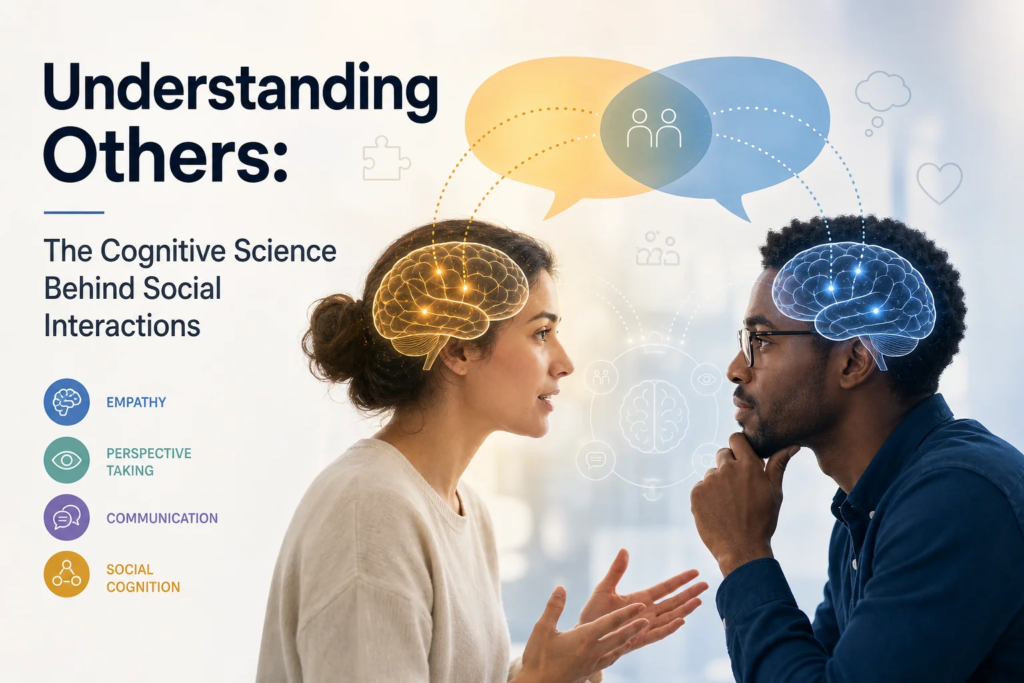
Introduction: Why Understanding Others Is the Skill Behind Almost Every Skill
A colleague goes quiet in a meeting. A friend replies with “I’m fine,” but their face says otherwise. A child melts down in a grocery store aisle. A patient hesitates before accepting treatment. A customer leaves a harsh review. A partner says, “You never listen.”
In each moment, something important is happening beneath the surface: one human mind is trying to make sense of another.
That is why Understanding Others: The Cognitive Science Behind Social Interactions is not just an academic topic. It is the foundation of leadership, friendship, parenting, teamwork, healthcare, negotiation, education, and everyday kindness. When we understand others more accurately, we communicate better, make wiser decisions, reduce conflict, and build trust.
But here is the surprising part: understanding people is not simply about being “nice” or “intuitive.” It is a complex cognitive process involving attention, memory, emotion, prediction, empathy, language, culture, body signals, and social experience.
The science of Understanding Others: The Cognitive Science Behind Social Interactions reveals that our brains are constantly building models of other people. We infer what they know, feel, want, fear, intend, and believe. Sometimes we get it right. Often, we get it partially wrong. And occasionally, our assumptions fail spectacularly.
This article explores how social understanding works, why it matters, where it breaks down, and how we can improve it in practical, evidence-informed ways.
What Does “Understanding Others” Really Mean?
At first glance, understanding another person seems simple. They speak, we listen. They act, we interpret. They smile, we assume happiness. They frown, we assume displeasure.
But real social understanding is much deeper.
Understanding Others: The Cognitive Science Behind Social Interactions involves at least five overlapping abilities:
-
Perceiving social cues
Reading facial expressions, tone of voice, posture, gestures, eye gaze, and timing. -
Inferring mental states
Estimating what someone thinks, believes, wants, expects, or intends. -
Sharing or recognizing emotions
Feeling with someone emotionally or identifying their emotional state accurately. -
Using context
Interpreting behavior based on culture, history, power dynamics, environment, and relationship. - Responding appropriately
Choosing words or actions that fit the person, situation, and shared goal.
In everyday life, these processes happen quickly. If someone slams a door, we may instantly wonder, “Are they angry at me?” If a manager pauses before answering, an employee may think, “Did I say something wrong?” If a child avoids eye contact, a teacher may ask, “Are they anxious, distracted, or hiding something?”
The cognitive science of social interactions helps explain these fast interpretations—and why they are sometimes mistaken.
The Brain as a Social Prediction Machine
Human beings are not passive observers. We are prediction machines.
The brain constantly predicts what will happen next: where a ball will land, what a sentence means, whether food is safe, and how another person is likely to behave. Social life is full of uncertainty, so the brain uses shortcuts, prior experiences, emotional signals, and contextual clues to make fast judgments.
In Understanding Others: The Cognitive Science Behind Social Interactions, this predictive process is central. We do not merely see behavior; we interpret behavior through expectations.
For example:
- If your best friend sends a short text, you may assume they are busy.
- If a difficult coworker sends the same text, you may assume they are annoyed.
- If a stranger sends it, you may feel uncertain.
The behavior is identical. The interpretation changes because your brain uses relationship history to predict meaning.
This is useful. Without prediction, social life would be unbearably slow. But prediction also creates bias. We may see what we expect to see rather than what is actually present.
Key Brain Systems Involved in Understanding Others
There is no single “empathy center” in the brain. Instead, social understanding depends on networks working together. Researchers often discuss several systems involved in social cognition.
| Brain System or Region | Social Function | Everyday Example |
|---|---|---|
| Medial prefrontal cortex | Thinking about self and others’ mental states | Wondering why a friend acted distant |
| Temporoparietal junction | Perspective-taking and belief tracking | Realizing someone has information you do not |
| Superior temporal sulcus | Reading biological motion and gaze | Noticing where someone is looking |
| Amygdala | Detecting emotional significance and threat | Sensing fear or anger in a face |
| Anterior insula | Interoception and emotional awareness | Feeling discomfort when someone else is in pain |
| Anterior cingulate cortex | Conflict monitoring and social pain | Feeling hurt after rejection |
| Mirror neuron-related systems | Mapping observed actions onto one’s own motor system | Wincing when someone stubs their toe |
These systems do not operate in isolation. They interact with memory, language, culture, personality, and bodily states.
A central lesson of Understanding Others: The Cognitive Science Behind Social Interactions is that social perception is embodied. We do not understand people only with abstract thought. We also use facial mimicry, heart rate, gut feelings, muscle tension, and emotional resonance.
Theory of Mind: Imagining What Others Know, Believe, and Intend
One of the most important concepts in social cognition is theory of mind.
Theory of mind is the ability to understand that other people have minds different from our own. They may hold beliefs we know are false. They may want things we do not want. They may interpret the same event differently.
A classic example is the “false belief task.” A child sees Sally place a toy in a basket and leave the room. Anne moves the toy to a box. When Sally returns, the child is asked where Sally will look for the toy. To answer correctly, the child must understand that Sally has a false belief: she thinks the toy is still in the basket.
This ability usually develops in early childhood, though it continues to become more sophisticated across life.
In adult life, theory of mind appears constantly:
- A lawyer anticipates how a jury will interpret evidence.
- A teacher notices that students misunderstood a concept.
- A negotiator considers what the other side values most.
- A spouse realizes their partner needs reassurance, not advice.
- A doctor checks whether a patient truly understood the diagnosis.
The phrase Understanding Others: The Cognitive Science Behind Social Interactions captures this beautifully because social life requires us to model invisible states inside visible behavior.
Empathy: Feeling With, Not Just Thinking About
Empathy is often used as a broad term, but cognitive scientists usually distinguish between different forms.
| Type of Empathy | What It Means | Strength | Potential Risk |
|---|---|---|---|
| Emotional empathy | Sharing or resonating with another’s emotion | Builds connection and compassion | Can lead to emotional overload |
| Cognitive empathy | Understanding another’s perspective or mental state | Supports communication and negotiation | Can be used manipulatively |
| Compassionate empathy | Understanding and caring enough to help | Encourages prosocial action | May require boundaries to avoid burnout |
A nurse who feels a patient’s distress has emotional empathy. A therapist who understands why a client avoids vulnerability uses cognitive empathy. A neighbor who brings food after a loss shows compassionate empathy.
In Understanding Others: The Cognitive Science Behind Social Interactions, empathy is not simply one trait. It is a set of abilities that can be shaped by attention, training, stress, fatigue, culture, and motivation.
Importantly, empathy is not always accurate. We may feel what we would feel in someone else’s situation rather than what they actually feel. This is called the empathy projection problem.
For instance, one person may assume public speaking is terrifying for everyone because they personally fear it. Another may assume solitude is lonely because they dislike being alone. True understanding requires curiosity, not just emotional resonance.
The Role of Emotion in Social Interpretation
Emotions are not interruptions to rational thought. They are part of how the brain evaluates meaning.
When someone’s voice tightens, your body may notice before your conscious mind does. When a room feels tense, you may adjust your behavior without knowing exactly why. Emotion guides attention toward what matters socially.
However, emotion also distorts perception.
If you are anxious, you may interpret neutral faces as judgmental. If you are angry, you may see others’ mistakes as intentional. If you feel rejected, you may become hyper-alert to signs of exclusion.
This matters deeply for Understanding Others: The Cognitive Science Behind Social Interactions because we never interpret people from a perfectly neutral position. Our own emotional state becomes part of the lens.
Common Emotional Filters
| Emotional State | Likely Social Interpretation Bias |
|---|---|
| Anxiety | “They are judging me.” |
| Anger | “They did that on purpose.” |
| Shame | “They think I’m inadequate.” |
| Sadness | “No one really cares.” |
| Fear | “This person may harm or reject me.” |
| Joy | “People are more trustworthy and friendly.” |
| Stress | “I need quick answers; nuance is exhausting.” |
One practical insight: before assuming you understand someone else, ask, “What emotional state am I bringing into this interpretation?”
That one question can prevent many unnecessary conflicts.
Attention: The Gatekeeper of Social Understanding
We cannot understand what we do not notice.
Attention determines which cues enter awareness. In social interactions, attention may focus on words, tone, facial expression, status, threat, similarity, difference, or self-conscious thoughts.
Imagine two people listening to the same presentation:
- One focuses on the speaker’s ideas.
- One focuses on whether the speaker seems confident.
- One focuses on how the audience is reacting.
- One focuses on their own anxiety about asking a question.
They are technically in the same interaction but experiencing different social realities.
The cognitive science behind social interactions shows that attention is selective. This is why active listening is so powerful. It deliberately redirects attention from internal reaction to external understanding.
A person practicing Understanding Others: The Cognitive Science Behind Social Interactions might ask:
- What is this person saying?
- What are they not saying?
- What emotion seems present?
- What context might explain this?
- What assumption am I making?
- What would I ask if I were genuinely curious?
Attention is not just noticing more. It is noticing differently.
Language: The Bridge and the Barrier
Language allows us to share thoughts across minds. But language is imperfect.
Words carry personal, cultural, and emotional meanings. A phrase that sounds direct to one person may sound rude to another. A joke that seems harmless to one group may feel dismissive to another. A request that seems obvious to the speaker may be vague to the listener.
In Understanding Others: The Cognitive Science Behind Social Interactions, language is both a tool for connection and a source of misunderstanding.
Consider the phrase: “We should talk.”
Depending on relationship history and tone, it could mean:
- “I want to reconnect.”
- “There is a problem.”
- “I need support.”
- “You are in trouble.”
- “I have important news.”
- “I am ending this relationship.”
The words alone are not enough. The brain combines language with context, memory, facial expression, timing, and expectation.
This is why good communicators do not simply choose clear words. They check for shared meaning.
Useful phrases include:
- “When you say that, do you mean…?”
- “I want to make sure I’m understanding you.”
- “Can you tell me what that felt like from your side?”
- “Here is what I heard. Is that accurate?”
- “I may be misreading this, but it seems like…”
These small language habits turn social prediction into social collaboration.
Culture: The Invisible Operating System of Social Life
Culture shapes how people express emotion, manage conflict, show respect, make eye contact, use silence, disagree, apologize, and define the self.
In some cultures, direct disagreement signals honesty. In others, it may seem disrespectful. In some contexts, silence means thoughtfulness. In others, it suggests discomfort or opposition.
Any serious discussion of Understanding Others: The Cognitive Science Behind Social Interactions must include culture because the brain learns social meaning from repeated experience.
Cultural Differences That Affect Social Interpretation
| Social Cue | Possible Meaning in One Context | Possible Meaning in Another Context |
|---|---|---|
| Direct eye contact | Confidence, honesty | Disrespect, aggression |
| Silence | Agreement, reflection | Discomfort, disagreement |
| Fast speech | Enthusiasm, competence | Impatience, dominance |
| Indirect request | Politeness | Lack of clarity |
| Public praise | Motivation | Embarrassment |
| Emotional restraint | Maturity, respect | Coldness, disengagement |
This does not mean we should stereotype. Culture is not a script that determines every person’s behavior. But culture offers a background framework that influences expectations.
The practical rule is simple: when behavior seems confusing, widen the context before judging the person.
Social Bias: Why We Misread People
Human social cognition is powerful, but it is not perfectly fair. The brain uses shortcuts to save energy. These shortcuts can produce bias.
Common Biases in Understanding Others
| Bias | Description | Example |
|---|---|---|
| Fundamental attribution error | Overestimating personality and underestimating situation | “He is rude” instead of “He is under pressure.” |
| Confirmation bias | Noticing evidence that supports existing beliefs | Seeing only examples that prove a coworker is careless |
| In-group bias | Favoring people seen as part of one’s group | Trusting someone more because they share your background |
| Halo effect | Letting one positive trait shape overall judgment | Assuming a charismatic person is also ethical |
| Horn effect | Letting one negative trait dominate judgment | Assuming a quiet person lacks ideas |
| Projection bias | Assuming others think or feel as you do | Believing everyone wants direct feedback |
| Negativity bias | Giving more weight to negative cues | Remembering one criticism more than ten compliments |
This is where Understanding Others: The Cognitive Science Behind Social Interactions becomes ethically important. Misunderstanding is not always harmless. It can affect hiring, education, policing, healthcare, leadership, and justice.
Better social understanding requires humility: “My first interpretation may be incomplete.”
Case Study 1: Healthcare Communication and Patient Trust
The Situation
A patient with diabetes repeatedly misses appointments and does not follow the recommended treatment plan. The physician initially assumes the patient is unmotivated or careless.
After a more patient-centered conversation, the physician learns that the patient works two jobs, lacks reliable transportation, fears medication side effects, and feels ashamed about previous “failures” to manage their health.
The care team adjusts the plan: flexible appointments, clearer medication education, community support resources, and nonjudgmental follow-up.
The Outcome
The patient becomes more engaged, attends appointments more consistently, and reports feeling respected rather than blamed.
Analysis
This case illustrates Understanding Others: The Cognitive Science Behind Social Interactions in a high-stakes setting. The physician’s first interpretation focused on personality: “noncompliant.” A deeper understanding included context, emotion, constraints, and beliefs.
Healthcare outcomes often depend not only on medical expertise but on social cognition. Patients are more likely to trust providers who listen, validate concerns, and explain clearly. Understanding others can literally improve health.
Case Study 2: Google’s Project Aristotle and Team Psychological Safety
The Situation
Google studied what made some teams more effective than others. Researchers expected that team success might depend primarily on individual talent, technical skill, or seniority.
Instead, one of the strongest factors was psychological safety: the shared belief that team members can speak up, ask questions, admit mistakes, and challenge ideas without humiliation or punishment.
Teams with psychological safety showed better collaboration, creativity, and problem-solving.
The Outcome
The findings influenced how leaders think about meetings, inclusion, feedback, and team norms.
Analysis
Project Aristotle is a powerful example of Understanding Others: The Cognitive Science Behind Social Interactions in organizations. People do their best thinking when they do not have to spend all their cognitive energy managing social threat.
When team members feel judged or ignored, their brains become protective. They withhold ideas. They avoid risk. They stay silent. When people feel respected, the social brain can shift from defense to collaboration.
This is why understanding others is not a “soft skill.” It is a performance multiplier.
Case Study 3: The “Double Empathy Problem” and Autism
The Situation
For many years, autistic people were often described as having deficits in empathy or social understanding. More recent research and autistic self-advocacy have challenged this one-sided view.
The “double empathy problem,” associated with researcher Damian Milton, suggests that social misunderstanding between autistic and non-autistic people is mutual. Autistic people may struggle to read non-autistic communication, but non-autistic people also frequently misread autistic communication.
For example, avoiding eye contact may be interpreted as dishonesty or disinterest, when it may actually reduce sensory overload and help the person concentrate.
The Outcome
This perspective has influenced education, therapy, workplace inclusion, and neurodiversity conversations.
Analysis
This case is essential to Understanding Others: The Cognitive Science Behind Social Interactions because it reveals a common mistake: assuming the majority communication style is the correct one.
Understanding others does not mean forcing everyone into one social template. It means recognizing diverse ways of communicating, processing emotion, managing sensory input, and showing care.
The double empathy problem teaches us that misunderstanding is relational, not merely individual.
Case Study 4: Conflict Resolution in Community Policing
The Situation
In some community policing programs, officers receive training in procedural justice, de-escalation, active listening, and implicit bias awareness. Instead of immediately interpreting agitation as defiance, officers are trained to consider fear, trauma, confusion, mental health issues, or previous negative experiences with authority.
A person shouting during an encounter may be escalated, but the reason matters. Are they threatening harm? Are they panicking? Are they intoxicated? Are they terrified? Are they reacting to perceived disrespect?
The Outcome
Programs vary in effectiveness, but many de-escalation models emphasize communication, tone, distance, time, and dignity. When applied well, these strategies can reduce unnecessary escalation and improve community trust.
Analysis
This example shows how Understanding Others: The Cognitive Science Behind Social Interactions can affect public safety. Social interpretation under stress is difficult. Threat perception narrows attention and increases reliance on quick assumptions.
Training that slows interpretation and expands context can help professionals respond more skillfully. The key is not naïve trust; it is accurate assessment.
Case Study 5: A Classroom Shift From “Defiance” to Regulation
The Situation
A teacher has a student who regularly interrupts, refuses assignments, and leaves their seat. The behavior is labeled “defiant.”
After consultation with a school psychologist, the teacher begins tracking patterns. The student’s disruptions increase during reading tasks and after noisy transitions. Further assessment reveals reading difficulties and sensory sensitivity.
The teacher introduces structured transitions, private reading support, movement breaks, and non-shaming prompts.
The Outcome
The student’s disruptive behavior decreases. The relationship improves. The student begins participating more.
Analysis
This is a practical example of Understanding Others: The Cognitive Science Behind Social Interactions in education. Behavior is communication, but it is not always obvious communication.
When adults interpret struggling children as “bad,” they may respond with punishment. When they ask what the behavior is doing for the child—escape, attention, sensory relief, emotional regulation—they can respond with support and structure.
Understanding others changes intervention.
The Social Brain Under Stress
Stress makes understanding others harder.
When the brain detects threat, it prioritizes survival. Attention narrows. The body prepares for action. Ambiguous cues may be interpreted negatively. The prefrontal systems involved in reflection and impulse control may become less effective.
This matters for Understanding Others: The Cognitive Science Behind Social Interactions because many important conversations happen under stress:
- Performance reviews
- Medical diagnoses
- Family arguments
- Public criticism
- Police encounters
- Negotiations
- Parenting conflicts
- Crisis leadership
Under stress, people may sound harsher than intended. They may miss nuance. They may become defensive. They may stop listening and start preparing counterarguments.
Stress Effects on Social Understanding
| Stress Response | Effect on Social Interaction |
|---|---|
| Fight | Increased anger, blame, verbal aggression |
| Flight | Avoidance, withdrawal, silence |
| Freeze | Difficulty speaking or deciding |
| Fawn | Over-agreeing to avoid conflict |
| Hypervigilance | Over-reading threat in neutral cues |
One actionable insight: if a conversation becomes emotionally flooded, more words may not help. A pause, breath, walk, or reset can restore the cognitive capacity needed for understanding.
Why Listening Is a Cognitive Skill, Not Just a Courtesy
People often think listening means waiting quietly while someone else speaks. But real listening is active mental work.
It requires:
- Holding back immediate judgment
- Tracking meaning
- Noticing emotion
- Remembering key details
- Separating facts from interpretations
- Asking clarifying questions
- Updating your mental model
In Understanding Others: The Cognitive Science Behind Social Interactions, listening is one of the most practical tools for improving social accuracy.
Levels of Listening
| Level | Description | Typical Result |
|---|---|---|
| Self-focused listening | “How does this affect me?” | Defensive or distracted responses |
| Content listening | “What information is being said?” | Basic understanding |
| Emotional listening | “What feeling is underneath?” | Greater empathy |
| Contextual listening | “What background factors matter?” | More accurate interpretation |
| Reflective listening | “Can I confirm what I heard?” | Trust and clarity |
A simple reflective listening formula:
“It sounds like you felt because , and what you needed was ___. Did I get that right?”
This does not mean you agree with everything. It means you are committed to understanding before responding.
The Difference Between Understanding and Agreeing
One of the biggest barriers to understanding others is the fear that understanding equals approval.
It does not.
You can understand why someone is angry without agreeing with how they expressed it. You can understand why someone holds a belief without accepting the belief as true. You can understand a harmful behavior without excusing it.
This distinction is crucial in Understanding Others: The Cognitive Science Behind Social Interactions.
Understanding is about accurate perception. Agreement is about evaluation. Compassion is about humane response. Boundaries are about protection and integrity.
Healthy social interaction often requires all four:
- Understand what is happening.
- Evaluate whether it is fair, true, or acceptable.
- Respond with respect where possible.
- Set boundaries where necessary.
For example:
“I understand that you felt ignored in the meeting. I want to hear more about that. I also need us to talk without insults.”
That is understanding with boundaries.
Digital Communication: Why We Misread Texts, Emails, and Posts
Digital communication removes many social cues. We lose facial expression, tone, timing, posture, and immediate feedback. The brain fills in the gaps.
This is why a simple message like “Okay.” can feel cold, angry, neutral, or efficient depending on the reader’s mood and relationship with the sender.
In the digital age, Understanding Others: The Cognitive Science Behind Social Interactions is more important than ever. We are interpreting more human behavior through fewer cues.
Digital Misunderstanding Triggers
| Digital Feature | Risk |
|---|---|
| Short replies | May be read as anger or disinterest |
| Delayed response | May be read as rejection |
| No punctuation | May seem careless or abrupt |
| Too much punctuation | May seem intense or sarcastic |
| Emojis | May clarify tone or create ambiguity |
| Public comments | May increase defensiveness |
| Algorithmic feeds | May amplify outrage and tribal thinking |
Better Digital Habits
- Assume ambiguity before hostility.
- Use tone markers when needed.
- Do not have highly emotional conversations only by text.
- Ask for clarification before reacting.
- Read your message from the other person’s likely perspective.
- If conflict escalates, move to voice or face-to-face conversation.
A useful rule: the less trust exists, the more context your message needs.
How Children Learn to Understand Others
Children are not born with adult-level social understanding. They develop it through interaction, attachment, play, language, conflict, storytelling, and guidance.
Early caregiving matters because responsive adults help children connect internal states with words:
- “You’re sad because the toy broke.”
- “She’s crying because that hurt.”
- “You wanted a turn, but grabbing scared him.”
- “He thought you were still playing.”
This kind of language helps children build mental-state understanding.
Pretend play also supports theory of mind. When children pretend a banana is a phone or imagine being a doctor, they practice holding multiple realities in mind. Storytelling helps too, because stories invite children to track motives, beliefs, secrets, misunderstandings, and emotions.
In terms of Understanding Others: The Cognitive Science Behind Social Interactions, childhood is the training ground where the social brain learns patterns.
Parents and teachers can support this by asking:
- “How do you think she felt?”
- “What did he believe was happening?”
- “What could you do to repair it?”
- “What else might be true?”
- “How would you feel if that happened to you?”
The goal is not to make children socially perfect. It is to help them become curious, reflective, and compassionate.
The Workplace: Understanding Others as a Leadership Advantage
Leadership is often described in terms of strategy, execution, and decision-making. But leaders also manage attention, emotion, meaning, trust, and identity.
A leader who misunderstands people may misread resistance as laziness, silence as agreement, confidence as competence, disagreement as disloyalty, or burnout as poor attitude.
A leader skilled in Understanding Others: The Cognitive Science Behind Social Interactions asks better questions:
- What pressures are people facing?
- Who is not speaking, and why?
- What incentives shape this behavior?
- What fears might be unspoken?
- How is power affecting honesty?
- Do people understand the “why” behind the work?
- Where might I be creating confusion?
Workplace Applications
| Challenge | Social-Cognitive Insight | Better Response |
|---|---|---|
| Employee disengagement | May reflect burnout, lack of meaning, or low safety | Hold listening sessions and clarify priorities |
| Meeting silence | May reflect hierarchy or fear of judgment | Invite input in multiple formats |
| Conflict between teams | May reflect competing incentives | Align goals and create shared context |
| Resistance to change | May reflect uncertainty and loss | Explain rationale and acknowledge concerns |
| Poor feedback culture | May reflect threat sensitivity | Normalize feedback and model humility |
The best leaders do not assume they already know what people need. They create systems that make honest information easier to share.
Relationships: The Everyday Laboratory of Social Cognition
Close relationships are where understanding others becomes both most rewarding and most difficult.
Why difficult? Because emotional stakes are high. History accumulates. Old wounds shape new interpretations. We stop asking questions because we think we already know the person.
A partner sighs, and suddenly it means every sigh from the past. A parent gives advice, and an adult child hears criticism. A friend cancels plans, and the mind jumps to abandonment.
In relationships, Understanding Others: The Cognitive Science Behind Social Interactions often requires slowing down familiar interpretations.
Try replacing certainty with curiosity:
- Instead of “You don’t care,” try “I felt unimportant when that happened. What was going on for you?”
- Instead of “You’re overreacting,” try “This seems really important to you. Help me understand why.”
- Instead of “You always do this,” try “I’m noticing a pattern, and I want to talk about it.”
- Instead of “I know what you mean,” try “Tell me more.”
One of the strongest relationship skills is the ability to repair after misunderstanding. Repair builds trust because it says, “Our connection matters more than my ego.”
Practical Framework: The S.O.C.I.A.L. Method for Understanding Others
To make the science practical, use the S.O.C.I.A.L. framework.
| Step | Meaning | Question to Ask |
|---|---|---|
| S | Slow down | “Am I reacting too quickly?” |
| O | Observe cues | “What am I actually seeing and hearing?” |
| C | Consider context | “What situation, history, or pressure matters?” |
| I | Identify assumptions | “What story am I adding?” |
| A | Ask and adjust | “Can I check my interpretation?” |
| L | Listen for layers | “What facts, feelings, needs, and values are present?” |
This method embodies Understanding Others: The Cognitive Science Behind Social Interactions because it respects how the brain works. We naturally predict and interpret. The goal is not to stop doing that. The goal is to update our predictions with better information.
Micro-Skills That Improve Social Understanding
You do not need a neuroscience degree to become better at understanding people. Small habits make a major difference.
1. Name the Difference Between Observation and Interpretation
Observation: “You looked away when I asked that question.”
Interpretation: “You are hiding something.”
Observation: “You have been quiet today.”
Interpretation: “You are mad at me.”
This distinction prevents unnecessary conflict.
2. Use Tentative Language
Instead of “You’re upset,” try “I’m wondering if you’re upset.”
Instead of “You don’t respect me,” try “I interpreted that as disrespectful, but I may be missing something.”
Tentative language keeps the conversation open.
3. Ask Better Questions
Good questions invite depth without interrogation:
- “What was that like for you?”
- “What mattered most in that moment?”
- “What do you wish people understood?”
- “What would feel supportive right now?”
- “What am I missing?”
4. Reflect Before Advising
Many people offer solutions too quickly. But people often need understanding before advice.
Try:
“That sounds exhausting. Do you want me to help problem-solve, or do you mostly need me to listen?”
5. Track Patterns, Not Isolated Moments
One behavior can mislead. Patterns are more informative.
Someone being short once may mean they are tired. Being dismissive repeatedly may indicate a deeper issue.
6. Learn Individual Communication Styles
Some people process out loud. Others need time. Some show care through words. Others show care through actions. Some need directness. Others need emotional cushioning.
Understanding others means learning the person, not just applying a formula.
When Understanding Others Becomes Difficult
Even well-intentioned people struggle to understand others in certain conditions.
1. High Conflict
When identity, values, or safety feel threatened, people become less flexible. They listen to defend, not to learn.
2. Power Differences
People with less power may hide honest feelings. People with more power may underestimate how intimidating they are.
3. Trauma
Trauma can sensitize people to threat cues. A neutral tone may feel dangerous if it resembles past harm.
4. Burnout
Burnout reduces empathy and patience. People become emotionally depleted.
5. Ideological Polarization
When groups see each other as enemies, they often dehumanize, caricature, or dismiss one another.
6. Overconfidence
The belief “I’m a great judge of character” can prevent correction.
A core lesson of Understanding Others: The Cognitive Science Behind Social Interactions is that humility improves accuracy. The more complex the situation, the more careful our interpretations should be.
The Ethics of Understanding Others
Understanding people is powerful. Like any power, it can be used well or badly.
Cognitive empathy can help a therapist support a client. It can also help a manipulator exploit someone’s vulnerabilities. Persuasion, marketing, politics, interrogation, and negotiation all involve modeling other minds.
That is why Understanding Others: The Cognitive Science Behind Social Interactions should be paired with ethics.
Ethical understanding asks:
- Am I respecting this person’s dignity?
- Am I using insight to connect or control?
- Am I listening for their good, not only my advantage?
- Am I allowing them to define their own experience?
- Am I balancing empathy with accountability?
The highest form of understanding does not reduce people to predictable machines. It recognizes complexity, agency, and humanity.
A Simple Chart: From Misunderstanding to Connection
| Stage | Common Reaction | Better Practice | Result |
|---|---|---|---|
| Ambiguous behavior | Assume intent | Ask what happened | Less blame |
| Emotional discomfort | Defend yourself | Name the feeling | More honesty |
| Disagreement | Prove your point | Explore values | Deeper dialogue |
| Conflict | Attack or withdraw | Slow down and clarify | Better repair |
| Repeated tension | Label the person | Identify patterns and needs | Practical change |
| Cultural difference | Judge as wrong | Learn the meaning | Respectful adaptation |
This chart summarizes a major theme in Understanding Others: The Cognitive Science Behind Social Interactions: connection improves when we move from automatic judgment to informed curiosity.
The Future of Understanding Others: AI, Neuroscience, and Social Technology
Emerging technologies are changing how we study and practice social understanding.
Neuroscience tools allow researchers to examine how brains respond during real social interaction, not just isolated tasks. Hyperscanning studies, for example, measure brain activity from two or more people interacting at the same time. This helps scientists explore coordination, communication, and shared attention.
Artificial intelligence is also entering the social world. AI systems can detect patterns in language, facial expression, sentiment, and behavior. These tools may support mental health screening, education, accessibility, and communication coaching.
But there are risks. Human emotion is context-dependent. A facial expression does not always reveal a feeling. A language pattern does not always reveal intent. Overreliance on automated interpretation can create new forms of misunderstanding or surveillance.
The future of Understanding Others: The Cognitive Science Behind Social Interactions should combine scientific insight with human wisdom. Technology may help us notice patterns, but it cannot replace humility, consent, compassion, and lived context.
Action Plan: How to Practice Understanding Others This Week
Here is a simple seven-day challenge.
| Day | Practice |
|---|---|
| Day 1 | In one conversation, focus entirely on understanding before responding. |
| Day 2 | Notice one assumption you made about someone and test it gently. |
| Day 3 | Ask someone, “What do you wish more people understood about this?” |
| Day 4 | Separate observation from interpretation in a tense moment. |
| Day 5 | Practice reflective listening: “What I’m hearing is…” |
| Day 6 | Learn one cultural or personal communication preference from someone. |
| Day 7 | Repair one small misunderstanding with honesty and humility. |
You do not become socially wise by never misreading people. You become socially wise by noticing, correcting, and learning.
Conclusion: Understanding Others Is a Lifelong Human Practice
Understanding Others: The Cognitive Science Behind Social Interactions shows us that every conversation is more than an exchange of words. It is a meeting of nervous systems, histories, expectations, emotions, cultures, and hidden mental worlds.
We understand others through prediction, empathy, attention, memory, language, and context. We misunderstand them through bias, stress, fear, projection, and overconfidence. But we can improve.
The most practical lesson is also the most human: slow down. Look again. Ask better questions. Listen for what is beneath the words. Check your assumptions. Let people surprise you.
In a world full of quick judgments and loud reactions, the ability to understand others is quietly revolutionary. It helps teams work, families heal, communities trust, leaders serve, and individuals feel seen.
The science is clear: we are wired for social connection. The choice is whether we use that wiring automatically—or wisely.
If you remember one thing from Understanding Others: The Cognitive Science Behind Social Interactions, let it be this:
Every person you meet is carrying an inner world you cannot fully see. Curiosity is how you knock. Listening is how you enter respectfully. Compassion is how you leave the room better than you found it.
1. What is the main idea behind Understanding Others: The Cognitive Science Behind Social Interactions?
The main idea is that understanding people involves complex mental processes, including empathy, theory of mind, attention, emotional regulation, memory, language, and cultural learning. We interpret others by combining visible behavior with invisible assumptions about thoughts, feelings, and intentions.
2. Can empathy be learned, or is it something people are born with?
Empathy has both natural and learned components. Some people may be more emotionally sensitive by temperament, but empathy can be strengthened through active listening, perspective-taking, reading fiction, diverse relationships, reflective practice, and emotional awareness.
3. Why do people misunderstand each other so often?
People misunderstand each other because the brain relies on shortcuts. We interpret behavior through our own emotions, past experiences, cultural expectations, and biases. Stress, digital communication, power differences, and unclear language can also increase misunderstanding.
4. How does theory of mind help in social interactions?
Theory of mind helps us recognize that other people have beliefs, desires, knowledge, and emotions different from our own. It allows us to predict behavior, explain misunderstandings, communicate clearly, and respond more appropriately.
5. What is the difference between cognitive empathy and emotional empathy?
Cognitive empathy is understanding what another person may be thinking or feeling. Emotional empathy is sharing or resonating with another person’s emotion. Both can be useful, but compassionate empathy—understanding combined with care and helpful action—is often the most constructive.
6. How can I get better at understanding others in difficult conversations?
Slow down, regulate your emotions, listen actively, ask clarifying questions, and separate observations from interpretations. Use phrases like, “I may be misunderstanding, but…” or “Can you help me understand what that meant to you?” These habits reduce defensiveness and improve accuracy.
7. Does understanding someone mean agreeing with them?
No. Understanding is not the same as agreement. You can understand why someone feels or believes something while still disagreeing, setting boundaries, or holding them accountable. In fact, accurate understanding often makes disagreement more respectful and productive.
8. Why is Understanding Others: The Cognitive Science Behind Social Interactions important at work?
Workplaces depend on communication, trust, leadership, collaboration, feedback, and conflict resolution. When people understand one another better, teams make fewer assumptions, share information more honestly, solve problems faster, and create healthier cultures.
9. How does culture affect understanding others?
Culture shapes how people express emotion, show respect, communicate disagreement, use silence, make eye contact, and interpret social roles. Understanding others requires sensitivity to cultural context without reducing individuals to stereotypes.
10. What is one simple habit I can start today?
Before reacting to someone’s behavior, ask yourself: “What else might be true?” This question interrupts automatic judgment and opens the door to curiosity, context, and better social understanding.


The PsyForU Editorial Collective is the research and editorial team of PsyForU Research International. The collective prepares educational, psychological, mental-health-awareness, inclusion, neurodiversity, and research-methodology content for students, parents, educators, researchers, and general readers. PsyForU content is intended for awareness, education, and capacity-building and should not be treated as clinical diagnosis, therapy, medical advice, legal advice, or emergency mental-health support.