


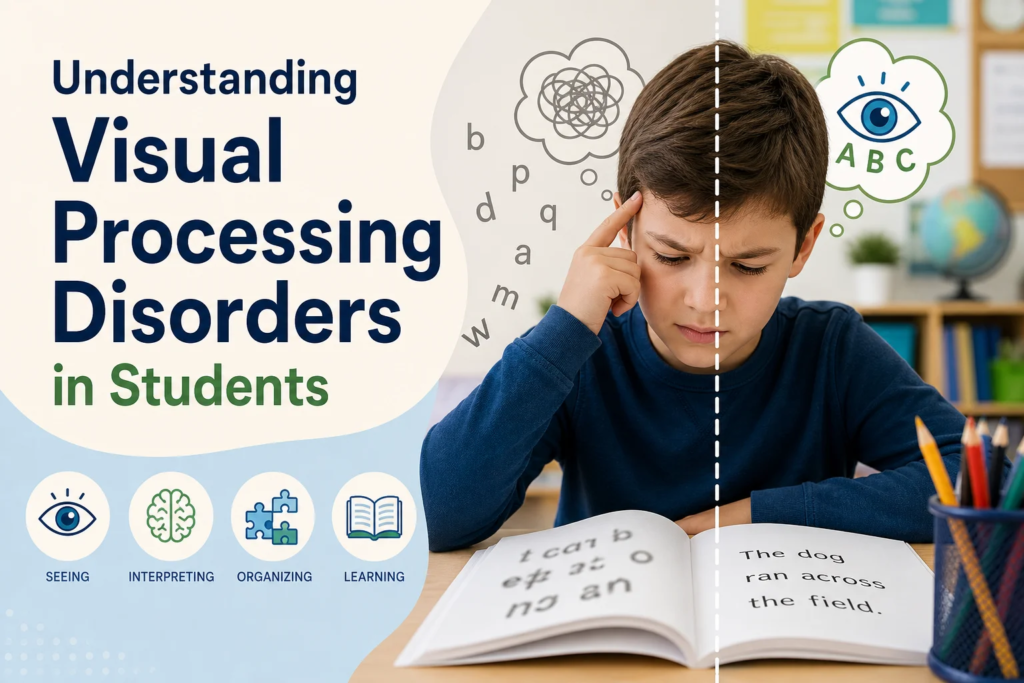
The Essential Guide to Understanding Visual Processing Disorders in Students: Proven Strategies for Support and Success
Introduction: When “Try Harder” Is the Wrong Answer
A student stares at a worksheet for ten minutes and completes only two problems. Another skips words while reading, reverses letters, or loses their place on the page. A third understands a lesson perfectly when it’s explained aloud but falls apart when asked to copy from the board.
To an adult, these behaviors may look like carelessness, inattention, or lack of motivation. But for many children, the real issue is not effort—it is how the brain interprets visual information.
That is why Understanding Visual Processing Disorders in Students matters so deeply. These challenges can affect reading, writing, math, organization, sports, confidence, and classroom behavior. A student may have healthy eyesight and still struggle to make sense of what they see.
Visual processing is not simply “seeing clearly.” It is the brain’s ability to recognize, organize, remember, and respond to visual information. When this system is inefficient, school can become exhausting.
This article offers a practical, research-informed, and compassionate guide to Understanding Visual Processing Disorders in Students—what they are, how they show up, how they are assessed, and what educators, parents, and support teams can do to help.
What Are Visual Processing Disorders?
A visual processing disorder is a difficulty with the way the brain interprets visual information. The eyes may capture images correctly, but the brain may struggle to organize or understand what those images mean.
In other words, a student may pass a standard eye exam and still have a visual processing difficulty.
This distinction is central to Understanding Visual Processing Disorders in Students. Vision involves both the eyes and the brain. Eye health and visual acuity answer questions like:
- Can the student see the letters clearly?
- Do they need glasses?
- Are both eyes working together efficiently?
Visual processing asks different questions:
- Can the student tell similar letters apart?
- Can they remember what they just saw?
- Can they find information on a cluttered page?
- Can they copy accurately from the board?
- Can they judge spacing, direction, and position?
A child with visual processing challenges may see the word was clearly but read it as saw. They may know how to solve a math problem but line up numbers incorrectly. They may understand a story when it is read aloud but struggle to decode it independently.
Why Understanding Visual Processing Disorders in Students Is So Important
Visual processing issues can quietly affect nearly every part of school life. Students rely on visual information constantly—reading textbooks, copying notes, interpreting graphs, navigating hallways, solving math problems, reading facial expressions, organizing materials, and completing written assignments.
Without proper support, students may be mislabeled as:
- Lazy
- Distracted
- Defiant
- Disorganized
- Slow
- Unmotivated
- Careless
But these labels miss the root cause.
Understanding Visual Processing Disorders in Students helps adults shift from blame to problem-solving. Instead of asking, “Why won’t this student pay attention?” we begin asking, “What visual demands are making this task harder than it appears?”
That shift can change everything.
Visual Processing vs. Vision Problems: What’s the Difference?
Many families are surprised to learn that a child can have 20/20 vision and still struggle visually in the classroom. A standard vision screening usually checks distance acuity—whether the student can see letters on a chart. It does not fully assess how the brain processes visual information.
| Area | Vision/Eyesight Issue | Visual Processing Issue |
|---|---|---|
| Main concern | How clearly the eyes see | How the brain interprets what is seen |
| Example | Blurry distance vision | Confusing similar letters or shapes |
| Common test | Eye chart, eye health exam | Psychoeducational, occupational therapy, neuropsychological, or vision-related assessments |
| Student may say | “I can’t see the board.” | “The words move,” “I lose my place,” or “I can’t find it.” |
| Support | Glasses, medical eye care | Classroom accommodations, targeted interventions, assistive tools |
This difference is foundational to Understanding Visual Processing Disorders in Students. A student’s eyes may be working, but the visual information may not be processed efficiently.
Common Types of Visual Processing Difficulties
Visual processing is not one single skill. It is a network of abilities that help students interpret the world around them. A student may struggle in one area or several.
1. Visual Discrimination
Visual discrimination is the ability to notice differences and similarities between objects, letters, numbers, shapes, and symbols.
A student with weak visual discrimination may confuse:
- b and d
- p and q
- 6 and 9
- was and saw
-
- and ×
- similar-looking words such as then and them
This can affect reading accuracy, spelling, math, and copying.
2. Visual Figure-Ground
Visual figure-ground is the ability to find important information in a busy visual field.
A student may struggle to:
- Find a specific word on a page
- Locate an item in a messy desk
- Read worksheets with crowded formatting
- Pick out information from charts or maps
- Follow along in a textbook
This is a key area in Understanding Visual Processing Disorders in Students because classrooms are often visually overwhelming.
3. Visual Memory
Visual memory is the ability to remember what has been seen.
Students with visual memory difficulties may:
- Forget sight words
- Struggle to remember spelling patterns
- Have trouble recalling math symbols
- Need to look back repeatedly when copying
- Forget what a diagram showed moments earlier
They may understand something in the moment but fail to retain the visual details.
4. Visual Sequential Memory
Visual sequential memory is the ability to remember visual information in the correct order.
This affects:
- Spelling
- Reading fluency
- Copying sentences
- Remembering multi-step visual directions
- Solving math problems in sequence
A student might remember the letters in a word but put them in the wrong order.
5. Visual-Spatial Processing
Visual-spatial processing helps students understand where objects are in space.
Difficulties may appear as:
- Poor spacing between words
- Trouble aligning math problems
- Difficulty reading maps or graphs
- Confusion with left and right
- Trouble organizing work on a page
- Bumping into objects or people
Visual-spatial challenges are especially noticeable in geometry, handwriting, sports, and classroom organization.
6. Visual Closure
Visual closure is the ability to recognize an object, letter, or word when only part of it is visible.
Students with visual closure challenges may struggle to:
- Recognize partially covered words
- Read quickly
- Identify familiar words in different fonts
- Complete puzzles
- Interpret incomplete images or diagrams
This can slow reading and increase fatigue.
7. Form Constancy
Form constancy is the ability to recognize that a shape, letter, or object is the same even when it changes size, color, position, or font.
A student may know the letter “a” in one font but not recognize it in another. They may struggle with worksheets, digital platforms, or books that use varied formatting.
8. Visual-Motor Integration
Visual-motor integration is the coordination between what the eyes see and how the hands respond.
Students may have difficulty with:
- Handwriting
- Cutting
- Drawing
- Copying from the board
- Lining up math problems
- Completing art projects
- Taking notes quickly
Although visual-motor integration overlaps with motor skills, it is highly relevant when Understanding Visual Processing Disorders in Students because schoolwork often requires seeing and doing at the same time.
Signs of Visual Processing Disorders in the Classroom
Visual processing disorders can look different depending on the student’s age, academic demands, and coping strategies. Some children become frustrated and act out. Others become quiet and avoid tasks.
Common Academic Signs
- Slow reading speed
- Frequent skipping of words or lines
- Difficulty copying from the board
- Poor handwriting or inconsistent spacing
- Trouble organizing math problems
- Confusing similar letters, numbers, or words
- Difficulty reading graphs, charts, or maps
- Poor spelling despite practice
- Trouble completing worksheets
- Needing extra time for visually demanding tasks
Behavioral and Emotional Signs
- Avoidance of reading or writing
- Complaints of headaches or tired eyes
- Frustration during homework
- Low confidence
- Frequent “I don’t know” responses
- Resistance to independent work
- Losing materials often
- Becoming overwhelmed by cluttered pages
Physical or Functional Signs
- Losing place while reading
- Covering one eye
- Holding papers very close
- Rubbing eyes
- Poor hand-eye coordination
- Difficulty with puzzles or building tasks
- Trouble navigating crowded spaces
These signs do not automatically mean a student has a visual processing disorder. However, they signal the need for closer observation and possibly further evaluation.
How Visual Processing Disorders Affect Reading
Reading is one of the most visually demanding school tasks. Students must recognize letters, track lines of text, distinguish word patterns, remember sight words, and process symbols in sequence.
A child with visual processing difficulties may decode slowly, misread words, reverse letters, or lose their place. Even when phonics skills are strong, visual processing weaknesses can interfere with fluency and comprehension.
For example, a student may spend so much mental energy identifying words that little energy remains for understanding the meaning. This is why Understanding Visual Processing Disorders in Students is vital when supporting struggling readers.
Reading Challenges by Visual Processing Area
| Visual Processing Area | Possible Reading Impact |
|---|---|
| Visual discrimination | Confuses similar letters or words |
| Visual memory | Struggles to remember sight words |
| Visual sequential memory | Mixes up letter order in words |
| Figure-ground | Loses place on busy pages |
| Visual closure | Reads slowly because words are not recognized automatically |
| Form constancy | Struggles with different fonts or formats |
Reading problems are not always caused by visual processing disorders. Dyslexia, language difficulties, attention challenges, and other factors may also play a role. However, visual processing should be considered when students show persistent visual confusion despite instruction.
How Visual Processing Disorders Affect Writing and Handwriting
Writing requires students to convert thoughts into language, remember spelling, form letters, space words, organize sentences, and coordinate hand movements. For students with visual processing issues, this can be overwhelming.
They may know what they want to say but struggle to get it onto paper.
Common writing difficulties include:
- Uneven letter size
- Poor spacing
- Writing above or below the line
- Frequent erasing
- Reversals
- Slow copying
- Difficulty proofreading
- Disorganized written work
- Poor alignment in notebooks
In Understanding Visual Processing Disorders in Students, it is important to recognize that messy handwriting is not always laziness. It may reflect a genuine difficulty integrating visual information with motor output.
How Visual Processing Disorders Affect Math
Math is filled with visual information: symbols, columns, graphs, place value, geometric shapes, number lines, and multi-step layouts.
Students with visual processing challenges may:
- Misread operation signs
- Line up numbers incorrectly
- Confuse decimal placement
- Struggle with geometry
- Have difficulty interpreting graphs
- Skip steps in multi-step problems
- Reverse numbers
- Lose track of columns
A student may understand mathematical concepts verbally but make repeated visual errors on paper. This is a common reason why Understanding Visual Processing Disorders in Students can improve math support.
Visual Processing Disorders and Attention: Why They Are Often Confused
Visual processing difficulties can look like attention problems. A student who loses their place, avoids reading, or stares out the window may appear inattentive. But the behavior may be a response to visual overload.
At the same time, attention disorders and visual processing disorders can co-exist. A student with ADHD may also have visual processing weaknesses, and each can intensify the other.
| Behavior | Could Be Attention-Related | Could Be Visual Processing-Related |
|---|---|---|
| Avoids worksheets | Low task persistence | Page is visually overwhelming |
| Makes careless errors | Impulsivity | Misreads symbols or skips lines |
| Doesn’t copy notes | Distractibility | Cannot track from board to paper |
| Loses place reading | Poor focus | Difficulty with tracking or figure-ground |
| Appears slow | Inattention | Extra processing time needed |
This is why careful assessment matters. Understanding Visual Processing Disorders in Students prevents adults from assuming that every off-task behavior is willful or attention-based.
Case Study 1: Maya, the “Careless” Reader
Maya was a bright third-grade student who loved listening to stories but hated reading aloud. Her teacher noticed that she skipped small words, confused similar-looking words, and often lost her place.
At first, Maya was described as careless. But her reading intervention teacher noticed a pattern: Maya did better with enlarged text and when using a reading guide strip. She struggled most with crowded worksheets and long paragraphs.
After evaluation, Maya showed weaknesses in visual discrimination and figure-ground processing. Her eyesight was normal.
Supports Used
- Larger font and increased spacing
- Reading windows and guide strips
- Reduced visual clutter on worksheets
- Audiobooks paired with text
- Explicit instruction in visual scanning strategies
- Shorter reading chunks with breaks
Outcome
Maya’s confidence improved. Her reading became more accurate, and she began volunteering to read short passages.
Analysis
Maya’s case highlights the importance of Understanding Visual Processing Disorders in Students before labeling a child as careless. Her difficulty was not motivation; it was visual interpretation. Once the visual load was reduced, her true abilities became more visible.
Case Study 2: Jordan, the Student Who “Couldn’t Do Math”
Jordan, a sixth-grade student, understood math concepts during class discussions but performed poorly on written assignments. His teacher noticed that he often copied problems incorrectly and lined up digits in the wrong columns.
When problems were read aloud and written one at a time, Jordan solved many correctly. But on worksheets with multiple problems, his accuracy dropped sharply.
An occupational therapy screening and educational evaluation suggested visual-spatial and visual-motor integration weaknesses.
Supports Used
- Graph paper for math alignment
- Fewer problems per page
- Highlighted operation signs
- Step-by-step checklists
- Permission to use digital math tools
- Teacher-provided notes instead of copying long examples
Outcome
Jordan’s math grades improved because his errors no longer masked his conceptual understanding.
Analysis
Jordan’s story shows why Understanding Visual Processing Disorders in Students is essential in math. His difficulty was not mathematical reasoning—it was the visual organization of mathematical information.
Case Study 3: Elena, the Quiet High School Student
Elena was a ninth-grade student who rarely asked for help. She completed homework late, avoided science diagrams, and struggled with note-taking. Teachers thought she was disengaged.
During a conference, Elena admitted that copying from slides was exhausting. She often lost her place when looking from the board to her notebook. She also had trouble reading dense textbook pages.
A school support team reviewed her performance and recommended evaluation. Results showed visual memory and visual sequential memory weaknesses, along with slow processing speed.
Supports Used
- Access to teacher slides before class
- Digital notes with screen-reader support
- Chunked reading assignments
- Graphic organizers
- Extended time
- Reduced copying demands
- Study guides with key visuals explained verbally
Outcome
Elena became more engaged in class discussions and submitted assignments more consistently.
Analysis
Elena’s case illustrates that older students may hide their struggles. Understanding Visual Processing Disorders in Students is not only for early elementary classrooms. Visual processing challenges can become more noticeable as academic materials become denser and faster-paced.
Common Misconceptions About Visual Processing Disorders
Misunderstandings often delay support. Here are some of the most common myths.
| Myth | Reality |
|---|---|
| “If the student has 20/20 vision, vision is not the issue.” | Visual acuity and visual processing are different. |
| “They are just not trying.” | Many students are working harder than peers but producing less. |
| “They will grow out of it.” | Some skills improve, but many students need explicit support. |
| “This only affects reading.” | It can affect writing, math, organization, sports, and confidence. |
| “Colored overlays fix everything.” | They may help some students, but they are not a universal solution. |
| “Visual processing disorders mean low intelligence.” | These challenges are unrelated to intelligence. |
Clearing up these myths is a major part of Understanding Visual Processing Disorders in Students in a practical, respectful way.
How Visual Processing Disorders Are Identified
There is no single universal test that identifies every visual processing issue. Assessment usually involves gathering information from multiple sources.
Step 1: Rule Out Eye Health or Acuity Problems
A comprehensive eye exam is often an important first step. This may include checking visual acuity, eye teaming, focusing, and eye health.
Step 2: Collect Classroom Observations
Teachers can document patterns such as:
- When errors occur
- Which tasks are hardest
- Whether clutter increases mistakes
- Whether oral responses are stronger than written ones
- Whether enlarged or simplified materials help
Step 3: Review Academic Performance
Work samples can reveal patterns:
- Letter reversals
- Poor spacing
- Skipped problems
- Misaligned numbers
- Copying errors
- Inconsistent spelling
- Difficulty interpreting visuals
Step 4: Consider Formal Evaluation
Depending on the concern, evaluation may involve:
- School psychologist
- Occupational therapist
- Neuropsychologist
- Developmental optometrist
- Educational specialist
- Speech-language pathologist, if language is also a concern
Step 5: Look at the Whole Child
Visual processing issues may overlap with dyslexia, dysgraphia, ADHD, developmental coordination disorder, or language-based learning disabilities. A complete picture matters.
This comprehensive approach is central to Understanding Visual Processing Disorders in Students because one isolated score rarely explains the full classroom experience.
Classroom Accommodations That Can Help
Accommodations reduce unnecessary barriers without lowering expectations. They allow students to access learning more effectively.
Helpful Visual Supports
- Use larger fonts
- Increase spacing between lines
- Reduce clutter on worksheets
- Provide one problem or section at a time
- Use bold headings and clear organization
- Highlight key information
- Avoid overly decorative fonts
- Use consistent formatting
- Provide visual models with verbal explanations
Reading Supports
- Reading guide strips
- Audiobooks
- Text-to-speech tools
- Enlarged text
- Shorter reading chunks
- Preview of vocabulary
- Option to listen and follow along
Writing Supports
- Graphic organizers
- Wide-ruled or raised-line paper
- Keyboarding options
- Speech-to-text tools
- Reduced copying
- Teacher-provided notes
- Sentence starters
Math Supports
- Graph paper
- Color-coded columns
- Highlighted operation signs
- Step-by-step checklists
- Fewer problems per page
- Digital equation tools
- Manipulatives
Environmental Supports
- Seat near instruction
- Minimize visual distractions
- Keep board layout clean
- Provide copies of notes
- Allow extra time
- Use predictable routines
When applying accommodations, teams should monitor whether they actually improve performance. Understanding Visual Processing Disorders in Students requires ongoing adjustment, not a one-size-fits-all checklist.
Instructional Strategies for Teachers
Good accommodations help students access the work. Good instruction helps them build skills and independence.
1. Teach Visual Scanning Explicitly
Do not assume students know how to scan a page, chart, or diagram. Model it.
Example:
“First, look at the title. Then move your eyes to the labels. Now look at the key. Finally, read the question.”
2. Pair Visual Information With Verbal Explanation
Students with visual processing challenges often benefit when visual information is explained aloud.
Instead of saying, “Look at this chart,” say:
“This chart compares rainfall in four cities. The blue bars show January. The green bars show February.”
3. Use Consistent Page Layouts
Predictable formatting reduces processing demands. Keep directions, examples, and answer spaces in consistent locations.
4. Reduce Copying When Copying Is Not the Goal
If the learning objective is science content, copying three paragraphs from the board may create an unnecessary barrier. Provide notes so students can focus on understanding.
5. Build in Checkpoints
Students with visual processing difficulties may make errors early and carry them through an assignment. Quick check-ins prevent frustration.
6. Encourage Self-Advocacy
Teach students to say:
- “Can I have fewer items on the page?”
- “Can you enlarge this?”
- “Can I use graph paper?”
- “Can I listen while I read?”
- “Can I have the notes before class?”
Self-advocacy is one of the most powerful outcomes of Understanding Visual Processing Disorders in Students.
Home Strategies for Parents and Caregivers
Parents often see the emotional side of visual processing struggles—homework battles, tears, avoidance, and fatigue. Support at home should reduce stress while building confidence.
Practical Home Supports
- Create a clutter-free homework space
- Use a reading ruler or index card
- Break assignments into small chunks
- Offer oral practice before written work
- Use audiobooks for longer texts
- Encourage keyboarding when appropriate
- Practice visual memory with games
- Use puzzles, matching games, and building activities
- Keep routines predictable
- Celebrate effort and strategy use
What Parents Should Avoid
- Calling the child lazy
- Forcing long homework sessions without breaks
- Assuming glasses will solve everything
- Comparing siblings
- Taking over the assignment entirely
- Ignoring repeated complaints of visual fatigue
Parents play a crucial role in Understanding Visual Processing Disorders in Students because they can notice patterns across school, homework, sports, and daily life.
Assistive Technology for Visual Processing Challenges
Technology can be a lifeline for students who struggle with visual demands. It does not replace instruction, but it can improve access.
| Tool | How It Helps |
|---|---|
| Text-to-speech | Reads digital text aloud |
| Speech-to-text | Reduces writing and copying demands |
| Audiobooks | Supports comprehension and stamina |
| Digital highlighters | Helps focus on key information |
| Screen masking tools | Reduces visual clutter |
| Enlarged text | Improves readability |
| Note-taking apps | Organizes information |
| Graphic organizer software | Supports planning and visual structure |
| Math formatting tools | Helps align numbers and symbols |
Technology should be matched to the student’s needs. A student with visual memory challenges may need different tools than a student with visual-spatial difficulties.
Visual Processing Disorders, IEPs, and 504 Plans
Students with significant visual processing challenges may qualify for support through an Individualized Education Program, commonly called an IEP, or a 504 Plan, depending on how the difficulty affects learning.
Possible IEP or 504 Accommodations
- Extended time
- Preferential seating
- Reduced visual clutter
- Enlarged print
- Audiobooks
- Text-to-speech
- Teacher-provided notes
- Alternative response formats
- Graph paper for math
- Reduced copying
- Chunked assignments
- Occupational therapy support, when appropriate
Eligibility depends on evaluation data, educational impact, and local regulations. Families and educators should work collaboratively and document how visual processing challenges affect school performance.
Understanding Visual Processing Disorders in Students can help teams write supports that are specific, measurable, and meaningful.
Emotional Impact: The Hidden Cost of Visual Processing Struggles
One of the most overlooked parts of visual processing disorders is emotional fatigue.
Imagine working twice as hard as your classmates but finishing half as much. Imagine being told to “pay attention” when the page feels visually chaotic. Imagine knowing the answer but losing points because numbers drift out of alignment.
Over time, students may develop:
- Anxiety
- Low self-esteem
- School avoidance
- Perfectionism
- Learned helplessness
- Frustration
- Shame
This is why Understanding Visual Processing Disorders in Students must include emotional support. Students need to hear:
“You are not lazy. Your brain is working hard. We can find strategies that help.”
Confidence grows when students understand their learning profile and experience success.
A Practical Checklist for Educators
Use this checklist when a student shows signs of visual processing difficulty.
| Question | Yes/No/Notes |
|---|---|
| Does the student perform better orally than in writing? | |
| Does the student lose place while reading? | |
| Are errors more common on cluttered pages? | |
| Does the student struggle copying from the board? | |
| Are math problems misaligned? | |
| Does enlarged text or extra spacing help? | |
| Does the student confuse similar letters, numbers, or words? | |
| Does the student avoid visually demanding tasks? | |
| Have eye health and visual acuity been checked? | |
| Has the team reviewed work samples for patterns? |
This checklist is not a diagnosis. It is a starting point for conversation and observation.
Building a Supportive School Culture
A school that understands visual processing differences does more than provide accommodations. It designs learning environments that are clearer for everyone.
Universal supports can include:
- Clean slide design
- Clear fonts
- Consistent worksheet layouts
- Verbal explanations of visuals
- Reduced unnecessary copying
- Multiple ways to show knowledge
- Organized classroom spaces
- Accessible digital materials
These practices benefit students with visual processing disorders, English learners, students with attention challenges, and many others.
In this sense, Understanding Visual Processing Disorders in Students is not only about individual intervention. It is about creating classrooms where visual access is treated as part of good teaching.
Long-Tail Keyword Variations for Contextual SEO Use
For natural search optimization, related phrases can include:
- Understanding visual processing disorders in students
- Visual processing disorders in students
- Signs of visual processing difficulties in children
- How visual processing affects learning
- Visual processing challenges in the classroom
- Classroom accommodations for visual processing disorders
- Visual discrimination difficulties in students
- Visual-spatial processing problems in school
- Helping students with visual processing issues
- Visual processing disorder strategies for teachers
- Visual processing problems and reading difficulties
- Supporting students with visual processing challenges
These variations can help readers find reliable information while keeping the content natural and useful.
Conclusion: Seeing the Student Behind the Struggle
Understanding Visual Processing Disorders in Students begins with a simple but powerful idea: seeing clearly and processing clearly are not the same thing.
A student may have strong ideas, good reasoning, and real curiosity, yet struggle with reading, writing, math, or organization because visual information is difficult to interpret. When adults recognize this, support becomes more compassionate and effective.
The most important takeaways are:
- Visual processing disorders involve the brain’s interpretation of visual information.
- Students may pass an eye exam and still struggle in visually demanding tasks.
- Difficulties can affect reading, writing, math, copying, organization, and confidence.
- Assessment should look at patterns across settings and tasks.
- Accommodations such as reduced clutter, enlarged text, graph paper, audiobooks, and assistive technology can make a major difference.
- Emotional support is just as important as academic support.
The goal is not to lower expectations. The goal is to remove unnecessary barriers so students can show what they know.
When families, teachers, and specialists work together, students with visual processing challenges can become more confident, independent, and successful. That is the heart of Understanding Visual Processing Disorders in Students: not just identifying difficulties, but opening doors.
FAQs About Understanding Visual Processing Disorders in Students
1. What is a visual processing disorder in students?
A visual processing disorder is a difficulty with how the brain interprets visual information. The student may see clearly but struggle to recognize, organize, remember, or respond to what they see.
2. Can a student have 20/20 vision and still have visual processing problems?
Yes. This is one of the most important points in Understanding Visual Processing Disorders in Students. Visual acuity measures clarity of sight, while visual processing involves how the brain makes sense of visual information.
3. Are visual processing disorders the same as dyslexia?
No. They are not the same, although some signs may overlap. Dyslexia is primarily a language-based reading disorder. Visual processing difficulties involve interpreting visual information. Some students may have both.
4. How do visual processing disorders affect reading?
They can cause students to confuse letters or words, lose their place, read slowly, struggle with sight words, or become overwhelmed by dense text. These challenges can reduce fluency and comprehension.
5. What classroom accommodations help students with visual processing challenges?
Helpful accommodations may include enlarged text, reduced visual clutter, reading guides, graph paper, highlighted key information, audiobooks, text-to-speech, teacher-provided notes, and extra time.
6. Who can evaluate visual processing difficulties?
Evaluation may involve a school psychologist, occupational therapist, neuropsychologist, developmental optometrist, educational specialist, or other qualified professional. The best approach depends on the student’s specific concerns.
7. Can visual processing disorders improve over time?
Some skills may improve with development, practice, intervention, and effective supports. However, many students continue to benefit from accommodations and strategies throughout school.
8. How can parents help at home?
Parents can reduce visual clutter, break homework into smaller parts, use audiobooks, provide reading guides, encourage breaks, support keyboarding, and communicate patterns to the school team.
9. Are visual processing disorders related to intelligence?
No. Visual processing difficulties are not a sign of low intelligence. Many students with these challenges are bright, creative, and capable but need different supports to access learning.
10. Why is early identification important?
Early identification prevents years of frustration and misunderstanding. When adults focus on Understanding Visual Processing Disorders in Students, they can provide targeted support before students lose confidence or fall further behind.

