



Can a child’s future academic success be predicted by their early math skills? Research shows that early childhood development is key to a child’s cognitive abilities and future success.
The UCMAS abacus learning program boosts math skills and cognitive development in kids. It uses a structured learning approach. This helps children build a strong foundation for their future studies.
The early years are vital for a child’s future learning and growth. Understanding what influences cognitive development helps parents and teachers. Together, they can help a child reach their full abilities.
Key Takeaways
- Early childhood development significantly impacts future academic success.
- The UCMAS abacus learning program enhances math skills and cognitive abilities.
- A structured approach to learning is key for a strong foundation.
- Cognitive development is influenced by various factors, including early math skills.
- Parents and educators play a vital role in unlocking a child’s full capacity.
Understanding Cognitive Development in Children
Cognitive development is how kids learn, think, and see their world. It includes skills like solving problems, remembering things, and using language. These skills are key for kids to grow and do well in school.
Cognitive abilities grow a lot in early childhood. Kids move from simple understanding to more complex thinking. Studies show that early skills predict later school success. This shows why it’s vital to support kids’ cognitive growth.
Theoretical Frameworks of Cognitive Development
Many theories try to explain how kids develop cognitively. Jean Piaget said kids go through stages of thinking, from basic to advanced. Lev Vygotsky’s sociocultural theory points out how social interactions and culture shape thinking.
These theories help us understand how kids grow cognitively. They guide parents and teachers in supporting kids’ development.
Key Milestones in Early Childhood
Early childhood is full of big cognitive milestones. Kids start to count and recognize numbers, then move to more complex math. Language skills grow fast, too, as kids learn to talk and follow instructions.
They also get better at solving problems and remembering things. These skills are important for a strong start in school.
Importance of Cognitive Skills
Cognitive skills are critical for kids’ school journey. Good thinking skills help kids understand and use information better. They also help with solving problems and thinking critically in life.
Knowing how important cognitive skills are, parents and teachers can help kids improve. This sets them up for success in the long run.
Factors That Influence Cognitive Development
It’s important to know what affects brain growth in kids. Cognitive development is how kids learn, process, and use information. It’s shaped by genetics, environment, diet, and physical activity.
These factors work together to help kids grow mentally. For example, genetics set the stage, but education and social status also play big roles.
Genetics vs. Environment
The debate on genetics vs. environment in brain development is ongoing. Studies show both are key. Genetics set the brain’s starting point, while environment shapes skills.
Let’s say a kid might be smart genetically, but without learning chances, they won’t reach their full brain power. On the other hand, a good learning environment can help overcome some genetic hurdles.
The Impact of Nutrition
Nutrition is vital for brain health and thinking skills. Foods rich in omega-3s, iron, and vitamins are essential. They help keep the brain working well.
Eating right boosts memory, focus, and more. Omega-3s, for example, are good for kids’ brains and thinking.
| Nutrient | Role in Cognitive Development | Food Sources |
|---|---|---|
| Omega-3 Fatty Acids | Supports brain health and cognitive function | Salmon, walnuts, chia seeds |
| Iron | Essential for healthy brain development | Red meat, spinach, fortified cereals |
| Vitamin D | Important for overall brain health | Fatty fish, fortified dairy products, sunlight exposure |
Role of Physical Activity
Physical activity is key for brain growth. Exercise boosts blood flow, grows new brain connections, and makes brain chemicals.
Activities that challenge coordination and balance sharpen problem-solving and focus. Exercise also helps kids do better in school.
By understanding these factors, we can help kids grow mentally healthy.
Play-Based Learning and Cognitive Growth
Play is more than just fun for kids; it’s key to their brain growth. Through play, they explore, try new things, and learn how to get along with others. These are all important for their cognitive skills.
Benefits of Play for Cognitive Skills
Play boosts many cognitive abilities in kids. It helps them solve problems, think creatively, and remember things better. Play also helps them make choices, think deeply, and analyze information.
Key cognitive benefits of play include:
- Enhanced problem-solving skills
- Improved memory and concentration
- Fostered creativity and imagination
- Development of critical thinking skills
Different Types of Play
There are many kinds of play that help kids grow mentally. Symbolic play, socio-dramatic play, and games with rules are all good. Each type has its own benefits and fits different ages and stages of development.
Incorporating Educational Games
Educational games make learning fun and part of play. They can focus on specific cognitive skills. By playing these games, kids can learn in a fun and structured way.
| Type of Play | Cognitive Benefits | Examples |
|---|---|---|
| Symbolic Play | Enhances creativity, improves problem-solving skills | Using objects to represent other objects (e.g., using a stick as a sword) |
| Socio-Dramatic Play | Fosters social skills, encourages role-taking and empathy | Playing house, acting out stories or scenarios |
| Games with Rules | Develops critical thinking, improves strategic planning | Board games, card games, sports |
Knowing about different play types and their benefits helps parents and teachers. They can create a play environment that supports kids’ cognitive development.
Importance of Language in Cognitive Development
Language plays a huge role in cognitive development. It’s the base for thinking and solving problems. It’s not just for talking; it shapes how kids see and understand the world.
Language and cognitive development go hand in hand. As kids learn to speak, they get better at thinking and solving problems. Good language skills are key for thinking. They help kids share their thoughts, understand others, and tackle complex ideas.
How Language Affects Thinking
Language greatly influences how kids think and process info. It’s through language that they learn to group things, grasp abstract ideas, and solve problems. The way language is structured and the words used shape thinking. It affects how kids see and understand their world.
Studies show language is vital for thought processes. For example, using complex sentences and understanding detailed words boosts a child’s thinking skills. Here are some ways language impacts thinking:
- It improves problem-solving by letting kids share their ideas and explore options.
- It helps grasp abstract ideas with descriptive language.
- It aids in memory by making it easier to remember and recall info.
Strategies to Enhance Language Skills
Boosting language skills is key for kids’ cognitive growth. Parents and teachers can use several methods to help:
- Read Together: Reading books exposes kids to new words, sentence types, and storytelling.
- Encourage Conversation: Talking with kids helps them improve their language skills through interaction.
- Use Descriptive Language: Talking in detail with kids expands their vocabulary and understanding.
By using these methods, we can help kids improve their language skills. This boosts their thinking abilities and overall growth.
Technology and Cognitive Development
Technology in early childhood education is a topic of debate. It’s important to look at both the good and bad sides of technology for young kids.
Educational apps are a big part of this discussion. They offer fun and learning ways to improve thinking skills. These apps can be simple games or more challenging puzzles.
The Role of Educational Apps
Educational apps can help kids learn in a fun way. They can improve memory, problem-solving, and more. For example, apps that teach languages or help with memory games are great.
Some top apps include:
- Apps like Lumosity that offer personalized brain games
- Duolingo, which teaches languages through interactive exercises
- Endless Learning, an app that provides a complete curriculum for young children
But, it’s important to pick apps that are both fun and educational. They should match the child’s age and learning level.

Screen Time Guidelines for Children
It’s key to manage screen time well. The American Academy of Pediatrics says kids aged 2 to 5 should watch only 1 hour of educational shows a day.
| Age Group | Recommended Screen Time |
|---|---|
| 2-5 years | 1 hour/day |
| 6 and above | Consistent limits, ensuring it doesn’t interfere with physical activity and sleep |
Balancing Technology Use
It’s important to balance technology with other parts of a child’s life. This means making sure they get enough time for play, socializing, and being active. Parents should watch and guide how kids use technology to make sure it’s good for them.
“Children need to develop a range of skills, including social, emotional, and physical skills, alongside cognitive skills. Technology should be used in a way that supports this holistic development.”
By using technology wisely and choosing good educational apps, we can help kids grow and learn well.
Social Interactions and Cognitive Skills
Social interactions are key for kids’ brain growth. Kids learn important skills by interacting with their world and people. These skills help them learn and succeed later on.
Collaborative Learning Experiences
Working together is vital for kids’ brain development. When kids team up, they share ideas and learn from each other. This teamwork boosts their thinking and problem-solving skills.
Effective collaboration enhances cognitive abilities by making kids see things from different angles.
Experts say, “Collaborative learning is more than just reaching a goal. It’s about the journey where kids learn important social and thinking skills.” This journey is key to a strong brain foundation.
How Solitary Play Affects Development
Solitary play is also important for kids’ brains. It lets them explore at their own speed, promoting independence. Solitary play encourages kids to think outside the box and solve problems on their own.
But, it’s important to balance solitary play with social time for a well-rounded brain.
Importance of Family Interaction
Family time is also vital for kids’ brain growth. Positive family interactions give kids emotional support and help them feel confident. Family involvement in learning activities boosts kids’ learning and strengthens their brain skills.
“The family is the first and most important environment for a child’s cognitive development, where they learn to interact, communicate, and understand the world around them.”
By understanding the role of social interactions, teamwork, solo play, and family time, we can help kids grow their brains. This sets them up for a lifetime of learning and success.
Recognizing Signs of Cognitive Delays
Spotting cognitive delays early can greatly help a child’s growth. These delays can show in many ways. They can affect how a child learns, interacts, and reaches important milestones.
Common Warning Signs to Look For
There are several signs that might mean a child is experiencing cognitive delays. These include:
- Delays in reaching developmental milestones, such as sitting, standing, or walking
- Difficulty with problem-solving and learning new skills
- Struggling to follow directions or understand simple instructions
- Limited vocabulary or difficulty with communication
- Trouble with social interactions and forming relationships with peers
When to Consult a Professional
If you see any of these signs, it’s time to talk to a professional. Getting help early can really help a child’s brain development. Doctors, psychologists, and special education teachers can check a child’s brain skills. They can also suggest the best ways to help.
| Signs of Cognitive Delays | Age Range | Potential Interventions |
|---|---|---|
| Delays in sitting, standing, or walking | 6-12 months | Physical therapy, developmental therapy |
| Difficulty with problem-solving | 1-3 years | Cognitive training, educational programs |
| Limited vocabulary or communication difficulties | 1-3 years | Speech therapy, language development programs |
Knowing the signs of cognitive delays and getting help when needed is key. Parents and caregivers are very important in supporting a child’s brain growth.
Encouraging Critical Thinking Skills
Critical thinking skills are key for a child’s cognitive development. Parents and teachers can boost these skills. This helps kids solve problems, analyze info, and make smart choices.
To boost critical thinking, kids need to do activities that help them solve problems. These can be simple puzzles or more complex challenges that need deep thinking.
Activities to Foster Problem-Solving
Getting kids to solve problems is a great way to improve their cognitive skills. Here are some good ways to do this:
- Give them puzzles and brain teasers to solve
- Play strategy games like chess or checkers with them
- Do science experiments that need them to test hypotheses
These activities help kids solve problems better. They also make them think creatively and come up with new ideas.
The Role of Questions in Learning
Asking open-ended questions is a great way to help kids think better. It makes them think deeply and answer thoughtfully. This helps them develop their critical thinking skills.
Here are some tips for using questions well:
- Ask questions that make kids think deeply about a topic
- Encourage them to ask their own questions and explore
- Use follow-up questions to keep them thinking and analyzing
By using these strategies every day, adults can help kids grow their cognitive development. This prepares them for success in school and life.
Supporting Cognitive Development Through Reading
Reading early is key for growing a child’s mind. It boosts their reading skills and helps with thinking. Books help kids use their imagination, remember things, and focus better. This sets them up for success in school.
Benefits of Early Literacy
Learning to read early is vital for kids’ brains. Studies show kids who read early do well in school and speak better. Reading to them makes their brains grow, helping them understand words and meanings.
“Reading is to the mind what exercise is to the body.” – Joseph Addison
Early reading brings many benefits. These include:
- Improved language skills
- Better understanding and focus
- Higher grades in school
- More creativity and imagination
Choosing the Right Books
Picking the right books is important for keeping kids interested in reading. Books with fun stories and bright pictures grab their attention, making them want to read more.
| Age Group | Recommended Book Types |
|---|---|
| 0-3 years | Board books with simple images |
| 4-6 years | Picture books with engaging stories |
| 7-10 years | Early chapter books with illustrations |
Creating a Reading Routine
Having a regular reading time is great for kids’ brains. It makes reading a part of their daily routine. This habit shows how important reading is.
- Set a regular reading time each day
- Create a comfortable reading environment
- Encourage children to read aloud and discuss the content
Encouragement Through Positive Reinforcement
Positive reinforcement is key in boosting cognitive abilities. It’s a powerful tool that motivates kids to do their best. It encourages them to achieve and grow.
How Praise Influences Development
Praise is a big deal for kids’ minds. When they get real, specific praise, it makes them feel good. It makes them want to keep learning and growing.
Good praise should highlight the effort, not just the result. For example, praising a child for trying hard to solve a puzzle. This shows them the value of the journey, not just the end.
Techniques for Giving Effective Feedback
Effective feedback is also super important. It should be helpful and focus on what the child did right. This helps them see their strengths and areas to get better at. It helps them grow and learn more.
- Be specific: Clearly state what the child did well.
- Focus on the process: Emphasize the effort, strategy, or persistence.
- Provide guidance: Offer suggestions for improvement.
- Be timely: Deliver feedback as soon as possible after the event.
Using these methods in daily life helps kids grow. Positive reinforcement, like praise and feedback, is essential. It shapes their cognitive development in a big way.
The Role of Montessori and Alternative Education
Alternative education, like Montessori, gives new views on how kids grow cognitively. These methods focus on kids learning by themselves and through doing things with their hands. They offer a fresh look at how kids develop.
Principles of Montessori Education
Montessori education believes kids are naturally curious and want to learn. It lets kids explore and learn about their world through real, hands-on activities.
Key Components of Montessori Education:
- Self-directed learning
- Hands-on activity
- Uninterrupted work periods
- Specially designed materials
Comparing Traditional vs. Alternative Approaches
Traditional and alternative education are very different. Knowing these differences helps us see how they affect kids’ minds.
| Aspect | Traditional Education | Alternative Education (Montessori) |
|---|---|---|
| Learning Approach | Teacher-led instruction | Self-directed learning |
| Activity Type | Primarily theoretical | Hands-on activities |
| Assessment Method | Standardized testing | Observational assessment |
Looking at traditional and alternative education shows how kids can grow in different ways. By knowing these differences, teachers and parents can choose the best learning methods for kids.
Cultural Influences on Cognitive Development
It’s key to grasp how culture affects a child’s growth. Cultural elements greatly shape cognitive development. This includes parenting styles and cultural backgrounds.
Parenting Styles Across Cultures
Parenting styles vary worldwide, impacting kids’ minds. Some cultures push for independence, while others stress community ties. These styles shape problem-solving and thinking flexibility.
Table: Parenting Styles and Cognitive Development
| Cultural Context | Parenting Style | Impact on Cognitive Development |
|---|---|---|
| Individualistic Cultures | Emphasis on independence | Enhanced self-reliance and problem-solving skills |
| Collectivist Cultures | Focus on interdependence | Stronger social skills and community awareness |
Impact of Cultural Background
A child’s culture deeply influences their mind growth. Cultural practices and values guide learning. For instance, some cultures value education highly, while others focus on practical skills.
“The way we learn is deeply rooted in our cultural context, influencing not just what we learn, but how we learn it.” – Dr. Jane Smith, Educational Psychologist
Cultural impacts on cognitive growth are complex. Knowing these can help parents and teachers support kids better.
Monitoring Progress in Cognitive Development
Monitoring cognitive development is a detailed process. It’s important for parents and teachers to know that kids grow at their own pace. Effective monitoring helps spot where a child is strong and where they need help.
When we talk about tracking cognitive growth, the right tools are key. This is where assessment tools play a big role.
Tools for Assessment
There are many tools to check how kids are doing. These include tests, checklists, and screening tools. Standardized tests compare a child’s skills to what’s expected for their age. Checklists let teachers see how a child’s skills change over time.
- Developmental screening tools spot delays early.
- Observational checklists track specific skills.
- Standardized tests measure performance against age-based norms.
As noted by educational psychologist
“Assessment is not just about identifying delays; it’s about understanding the child’s overall developmental trajectory.”
Setting Realistic Expectations
It’s vital to have realistic goals when tracking cognitive growth. Parents and teachers must remember that every child grows differently. Unrealistic expectations can cause stress and lead to wrong help.
To set realistic goals, look at the child’s whole development. This includes their thinking, social, and emotional skills. A complete view helps set goals that match the child’s abilities.
| Developmental Aspect | Typical Milestones | Indicators of Delay |
|---|---|---|
| Cognitive Skills | Problem-solving, memory, and attention | Lack of improvement in problem-solving tasks |
| Social-Emotional Development | Cooperation, empathy, and self-control | Difficulty in interacting with peers |
Community Resources and Programs
Early childhood cognitive development can be supported by community programs and resources. These tools help parents improve their child’s learning abilities.
Local Workshops and Classes
Local workshops and classes are great for parents wanting to help their child grow. They offer activities that boost problem-solving, creativity, and critical thinking. For example, many centers have STEM, arts, and crafts classes that help kids learn.
Some examples of local resources include:
- Parent-child interactive classes
- STEM-focused workshops
- Art and craft classes
- Music and movement programs
These programs give kids fun activities and help parents meet other families. They also share insights on child development.
| Program Type | Description | Benefits |
|---|---|---|
| Parent-Child Classes | Interactive sessions for parents and children | Enhances bonding and cognitive development |
| STEM Workshops | Hands-on science, technology, engineering, and math activities | Promotes problem-solving and critical thinking |
| Art and Craft Classes | Creative activities using various materials | Fosters creativity and fine motor skills |
Online Resources for Parents
There are also many online resources for cognitive development. Websites, apps, and courses offer activities for different ages and needs.
“The key to unlocking a child’s full potentia lies in providing them with a supportive and stimulating environment.”
Some recommended online resources include:
- Educational websites with interactive learning materials
- Mobile apps designed for cognitive development
- Online forums and support groups for parents
By using both local and online resources, parents can build a strong support system. This helps their child’s cognitive development.
Future Implications of Early Cognitive Development
Cognitive development in early childhood is key for future learning and success. As kids grow, the skills they develop are vital for facing new educational challenges.
Strong cognitive skills are the base for academic success. They help kids process info, solve problems, and think critically.
Long-term Benefits of Strong Cognitive Skills
Children with strong cognitive skills usually do well in school. They tend to:
- Excel in subjects like math and reading
- Find effective ways to learn
- Adjust to new teaching methods and tech
Also, these skills help with social and emotional growth. They improve a child’s emotional understanding and social interactions.
Preparing for Educational Challenges
Getting ready for future school challenges is more than just book smarts. It’s about loving to learn, solving problems, and staying curious.
Educational programs that boost cognitive skills can greatly help. These programs should be fun, interactive, and match the child’s age and needs.
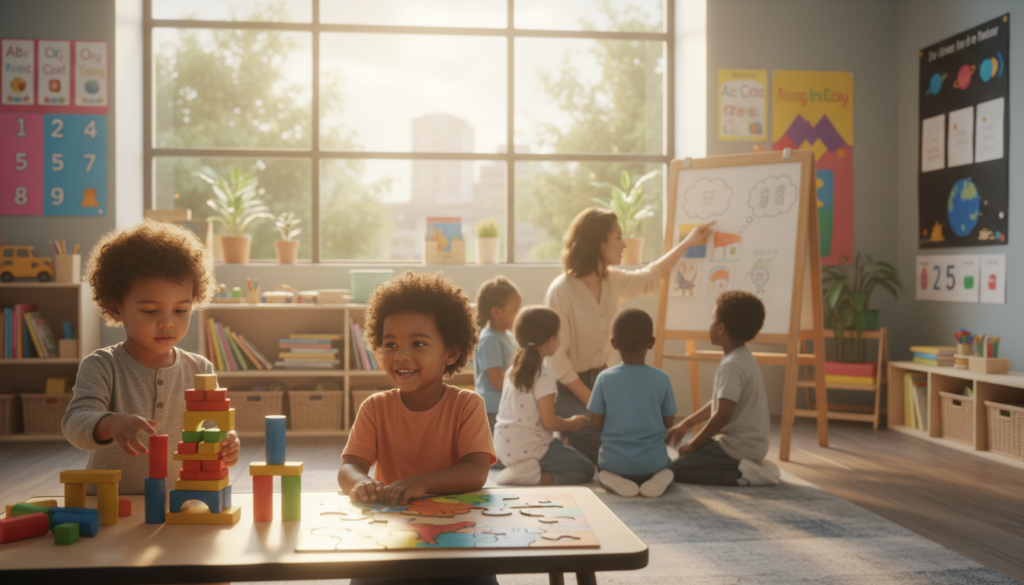
By focusing on cognitive development, we equip kids to tackle future school challenges with confidence.
Conclusion: Building a Foundation for Lifelong Learning
Building a foundation for lifelong learning is a team effort. Parents, educators, and the child all play a part. Early childhood cognitive development is key for future success and well-being.
Key Takeaways for Supporting Cognitive Growth
We’ve looked at ways to boost cognitive development. This includes play-based learning, the value of language, and technology’s role. Knowing what affects cognitive growth helps parents and educators create a supportive learning environment.
Parental Involvement: A Critical Component
Parental involvement is vital for early childhood development. By spending time with children, giving positive feedback, and making learning fun, parents greatly influence their child’s growth. A strong start in cognitive development prepares kids for school and life’s challenges.
FAQ
What is cognitive development, and why is it important in children?
How do cognitive skills develop over time?
What role does play-based learning have in promoting cognitive growth?
How does language impact cognitive development?
What are the benefits of reading for cognitive development?
How can parents encourage critical thinking skills in their children?
What are the signs of cognitive delays, and when should parents seek professional help?
How can technology be used to support cognitive development?
What is the impact of cultural background on cognitive development?
How can parents monitor their child’s cognitive development?
What community resources are available to support cognitive development?

