


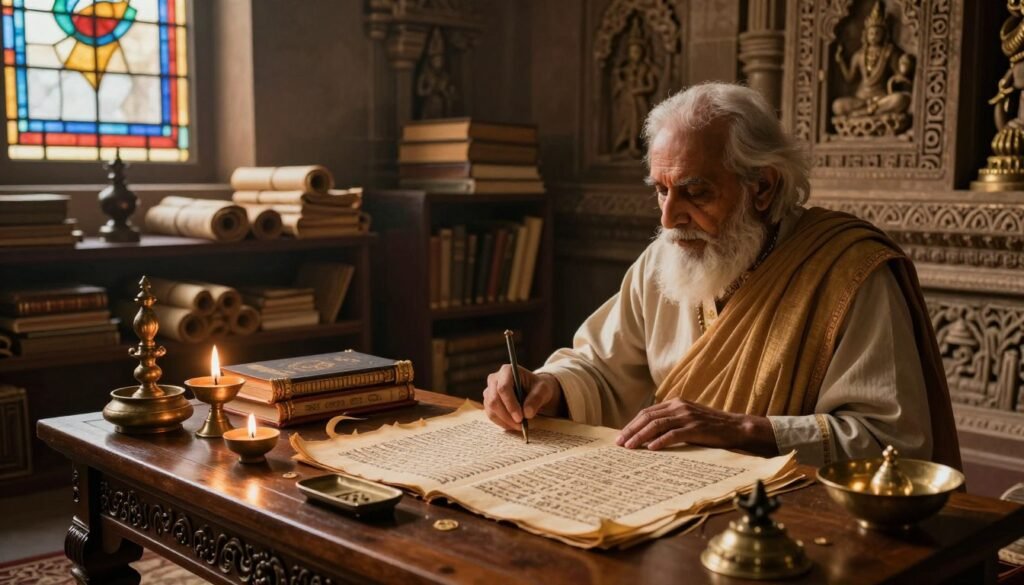
Imagine standing in a library that has existed for over four thousand years. The shelves are filled with more than just stories or poems. They hold a complete system for understanding the world. This library is the collection of Vedas and Upanishads.
These texts are some of humanity’s oldest recorded wisdom. They form the foundation of what scholars call Indic Knowledge Systems.
The Vedas and Upanishads as Knowledge Traditions stand apart in human history. They were not written by single authors or created at one moment in time. Instead, they developed over centuries through careful observation and deep reflection.
The word Veda comes from the Sanskrit root “Vid,” which means knowledge or wisdom. This single word captures the purpose of these entire traditions.
What makes these texts remarkable is their scope. Ancient knowledge traditions often focused on one area of human life. The Vedas and Upanishads covered everything. They addressed practical concerns like agriculture and health. They also explored the deepest questions about existence and consciousness.
This combination made them unique among world’s ancient texts.
Today, we study these traditions as systematic bodies of knowledge. They shaped philosophy, science, ethics, and spirituality across centuries. Understanding them requires looking beyond simple religious interpretation. These are living intellectual systems that continue to influence modern thought. From physics to psychology, their ideas remain relevant.
This exploration begins with a fundamental recognition. The Vedas and Upanishads as Knowledge Traditions represent an integrated system. In these texts, observation, logic, and insight work together. They address the nature of reality itself. By examining them carefully, we unlock understanding that shaped civilizations and continues to shape our world today.
Key Takeaways
- The Vedas derive from the Sanskrit root “Vid,” meaning knowledge and wisdom, representing humanity’s oldest recorded information systems.
- The four Vedas—Rigveda, Samaveda, Yajurveda, and Atharvaveda—date back approximately 2500 BCE and form the foundation of Indic Knowledge Systems.
- Vedas and Upanishads as Knowledge Traditions encompass practical wisdom, philosophical inquiry, and spiritual understanding in one integrated system.
- The 108 Upanishads, with 13 considered major texts, represent the philosophical culmination of Vedic thought and explore Brahman and Atman concepts.
- Ancient knowledge traditions preserve methods of transmission through oral recitation and teacher-student relationships that remain relevant today.
- These texts function as complete frameworks addressing human development across intellectual, ethical, and spiritual dimensions.
- Understanding Vedic and Upanishadic literature requires moving beyond religious categorization to recognize their status as living intellectual traditions.
Introduction to Vedas and Upanishads
The Vedas and Upanishads are key achievements in human history. They are the roots of Hindu philosophy and have shaped spiritual texts worldwide. Knowing their origins and importance helps us see how they influenced ancient civilizations.
We look at how these texts were created and their role in ancient Indian life. This understanding is vital for appreciating their lasting impact.
Historical Context of Vedic Literature
Vedic literature was written from 2500 BCE to 500 BCE. This was the Vedic Period. During this time, wise men wrote texts that shaped Indian culture for centuries.
They used Vedic Sanskrit, a language developed over thousands of years. This language was perfect for expressing deep ideas.
At first, there were no written texts. Scholars used oral traditions to pass down knowledge. They used memory and rhythm to keep the texts accurate over time.
Vedic Sanskrit became the base for many languages. It allowed for clear and precise expression of complex ideas. This was key for sharing deep thoughts.
The Role of Vedas in Ancient Indian Society
The Vedas were more than just religious texts. They guided every part of life:
- Spiritual guidance and philosophical frameworks
- Legal and ethical principles for conduct
- Astronomical knowledge for agricultural planning
- Social organization through structured systems
- Scientific inquiry and natural philosophy
Ancient Indians saw knowledge as the greatest wealth. Education focused on personal growth, self-control, and understanding society.
The Vedas were the backbone of ancient Indian society. They provided a framework similar to modern documents and codes. This shows they covered all aspects of life and society.
Overview of the Vedas
The four Vedas are the oldest known religious texts in Hindu scriptures. They are the foundation of Vedic philosophy. For thousands of years, they have guided spiritual seekers.
Understanding the Vedas helps us see how ancient Indian civilization passed down knowledge. This knowledge has been preserved and shared across generations.
Structure and Composition of the Vedas
The four Vedas have a special four-part structure. This structure mirrors a journey from external practice to inner wisdom. It shows a deliberate strategy to guide practitioners deeper into spiritual understanding.
The structure includes:
- Vedic Samhitas – The foundational hymns and mantras that form the core spiritual texts
- Brahmanas – Detailed explanations of ritual procedures and their symbolic meanings
- Aranyakas – Forest teachings suited for contemplatives seeking solitude and reflection
- Upanishads – Philosophical teachings that transcend ritual and explore ultimate reality
This structure guides seekers from action-based practices to knowledge-based understanding. It’s an intellectual ascent.
Major Vedic Texts and Their Significance
The four Vedas each have a unique purpose in Hindu scriptures. They offer different knowledge and ways to understand reality.
| Veda | Primary Focus | Key Features | Main Contribution |
|---|---|---|---|
| Rigveda | Cosmology and Hymns | 1,028 hymns in ten books; honors deities like Indra, Agni, and Vishnu; contains the Gayatri Mantra | Oldest Veda; foundational cosmological insights and early philosophical speculation |
| Yajurveda | Ritual Procedures | Divided into Krishna (dark) and Shukla (bright) sections; provides priestly manuals | Precise ritual formulations for performing yagya (sacred sacrifice) |
| Samaveda | Musical Spirituality | Mantras and tunes sung during ceremonies; smallest of the four Vedas | Integration of music, melody, and spiritual practice in worship |
| Atharvaveda | Practical Knowledge | Magical sutras; addresses everyday prayers, healing, and practical concerns | Bridges spiritual knowledge with practical life applications and wellness |
Vedic Philosophy and Spiritual Insights
Vedic philosophy is about understanding reality and guiding human existence. It’s the foundation for Indian philosophy.
Key concepts include:
- Rita – The cosmic order that maintains universal harmony and balance
- Mantra Power – The transformative and creative force of sacred sound and utterance
- Divine Manifestations – Multiple expressions of ultimate reality through various deities
- Karma and Dharma – Early formulations of action, duty, and consequence that shape individual and cosmic destiny
- Microcosm and Macrocosm – The correspondence between individual consciousness and universal reality
These teachings help us understand human purpose, ethics, and spiritual growth. They continue to influence spiritual seekers and philosophy worldwide. Ancient Vedic wisdom remains relevant today.
The Upanishads: A Deeper Dive
The Upanishads mark a big shift in Indian philosophy. They move from focusing on rituals to exploring the inner self. These texts are the heart of the Vedic tradition, introducing deep ideas that shape spiritual teachings globally. They dive into the biggest questions about existence, consciousness, and reality.
These texts go beyond the rituals of earlier Vedic texts. They encourage self-discovery through meditation and thinking. They show Indian philosophy as a quest for truth and personal growth.
Key Themes in Upanishadic Thought
The Upanishads tackle big questions with great depth. They explore ultimate reality, the link between individual and universal consciousness, and how to overcome suffering.
Major Upanishads cover several key themes:
- They question the value of rituals, favoring direct experience.
- They talk about karma and rebirth as natural laws.
- They recognize different levels of reality and consciousness.
- They say self-inquiry is the best way to find ultimate truth.
- They see the world as an illusion, called Maya.
- They believe in liberation, or Moksha, through knowledge.
These themes are connected, forming a complete view of reality and consciousness. The Upanishads value both personal experience and thinking.
The Concept of Brahman and Atman
The Upanishads focus on Brahman and Atman. Brahman is the infinite, unchanging reality that is everything. Atman is the true self or consciousness in each person.
The Upanishads teach that Brahman and Atman are the same. This idea is shown in famous statements like “Tat Tvam Asi” from the Chandogya Upanishad:
“Tat Tvam Asi” — That Thou Art
This statement is the core of Indian philosophy. It says our individual consciousness and universal consciousness are the same. Different Upanishads explain this idea in different ways.
| Teaching Method | Purpose | Example Approach |
|---|---|---|
| Logical Argumentation | Establish truth through reason | Using deductive reasoning to prove non-duality |
| Metaphorical Illustration | Make abstract concepts relatable | Comparing Atman to space within a pot |
| Meditative Instruction | Guide direct experience | Techniques for inner contemplation and awareness |
| Negation (Neti Neti) | Point beyond conceptual thinking | Stating “not this, not this” to transcend limitations |
Each method is a way to understand the deep ideas of the Upanishads.
Mysticism and Philosophy in Upanishads
The Upanishads mix mystical insight with deep thinking. This mix sets them apart from other traditions. They say truth needs both reason and direct experience.
This approach values different ways of knowing:
- Direct experience through senses
- Reasoning through logic
- Learning from trusted sources
- Direct insight through meditation
The Upanishads respect thinking but go beyond it. They don’t ask for blind faith. Instead, they encourage exploring one’s own consciousness.
This mix of mysticism and philosophy makes the Upanishads timeless. They offer insights into reality, the self, and freedom. These ideas inspire seekers and scholars all over the world.
The Relationship between Vedas and Upanishads
The Vedas and Upanishads are key parts of human history. They show how ancient Indian thought evolved over thousands of years. The Upanishads are called Vedanta, meaning “the end of the Vedas,” showing their deep wisdom.
The Vedas started with rituals and external practices. This was the karma-kanda period. But, the Upanishads focused on self-knowledge and meditation. This was a deeper understanding of the Vedas.
Transition from Ritual to Philosophy
The shift to jnana-kanda, or knowledge pursuit, was a big change. Early Vedas talked about rituals and how to get rewards. The Upanishads looked at these practices in a new way.
They turned external sacrifices into inner disciplines. The fire altar became the heart. This showed how sacred texts can grow and change.
This change was not a throwaway of old knowledge. It was finding new meaning in old practices. Rituals became meditations on universal truths. This kept tradition alive while moving forward.
Influence of Vedas on Upanishadic Thought
The Vedas shaped Upanishadic philosophy in many ways. The idea of Brahman came from Vedic hymns. Concepts like Rita and Satya deepened Vedic ideas.
Meditation in Upanishads built on ritual practices. Ethical values from the Vedas became clear teachings. This shows how ancient wisdom can evolve.
| Element | Early Vedic Focus | Upanishadic Development |
|---|---|---|
| Primary Goal | Worldly prosperity and divine favor | Self-realization and spiritual liberation |
| Method of Practice | External rituals and sacrifices | Internal meditation and self-inquiry |
| Understanding of Reality | Multiple gods and natural forces | Brahman as ultimate unified reality |
| Knowledge Transmission | Memorization of ritual procedures | Direct teacher-student relationship |
| View of Self | Individual performing duties | Atman identical with Brahman |
The Vedas and Upanishads show that growth doesn’t mean forgetting the past. The Upanishads matured Vedic insights. This shows how traditions can evolve and deepen over time.
Vedic Knowledge Traditions
The preservation of Vedic wisdom for thousands of years is a remarkable achievement. Unlike written texts, Vedic philosophy was kept safe through oral transmission. This method ensured that sacred knowledge stayed pure and was passed on to each new generation.
Ancient Indian scholars knew how to use human memory to keep information safe. They developed techniques that made oral transmission a strength, not a weakness.
Preservation of Oral Traditions
The Guru-Shishya tradition was key to keeping Vedic knowledge alive. Students lived with their gurus in Gurukuls. The teacher taught directly, ensuring every word was understood and pronounced correctly.
Many mnemonic techniques helped in this process:
- Pada-patha: Reciting words one by one
- Krama-patha: Reciting in a sequence
- Jata-patha: Reciting words in a special sequence
- Ghana-patha: Reciting with complex word arrangements
These methods had built-in checks. Any mistake was quickly spotted by comparing different recitations. Students memorized long passages while understanding their meaning deeply.
Different Vedic schools, or Shakhas, focused on specific versions of the texts. They kept the core message the same while having their own versions. The Vedangas, like phonetics and grammar, helped in accurate transmission and interpretation over time.
Modern Interpretations of Vedic Texts
Today, scholars study Vedic philosophy in many ways. They use historical and critical methods, along with traditional commentaries. This approach helps understand the texts in a modern context.
Modern uses of Vedic philosophy include:
- Psychology and mental wellness programs
- Environmental studies
- Educational curricula
- Management and organizational practices
The challenge is to connect ancient wisdom with today’s understanding. Scholars aim to translate Sanskrit concepts into clear language. This way, they honor the preservation methods and answer modern questions.
“The Vedas were not merely texts to be read; they were living knowledge transmitted from teacher to student, heart to heart, generation to generation.”
Today, we benefit from centuries of careful preservation. The ancient methods show deep insights into learning and memory. By combining traditional and modern views, we appreciate Vedic philosophy’s ongoing impact.
Upanishadic Knowledge Traditions
The Upanishadic teachings offer a unique way of learning spiritual wisdom. They use methods that focus on direct experience, not just knowing facts. This approach looks at whether the student is ready to receive deep knowledge.
These teachings have been passed down for centuries. They shape spiritual practices today, all over the world.
Methods of Transmitting Upanishadic Wisdom
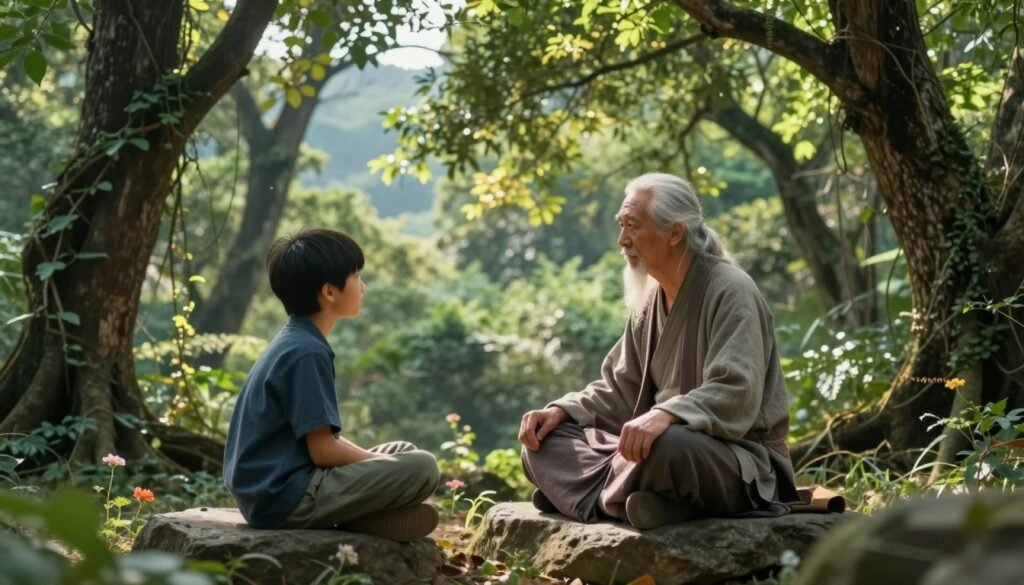
Learning from the Upanishads happens in quiet places, away from distractions. It’s about asking questions and talking, not just listening. The learning process has several steps:
- Shravana (hearing): Students listen to teachings from wise teachers
- Manana (reflection): Seekers think deeply and ask questions
- Nididhyasana (deep meditation): They meditate to understand the wisdom
Many Upanishads are like conversations between teachers and students. These talks show how to clear up misunderstandings. The Kena Upanishad, Chandogya Upanishad, and Katha Upanishad are examples.
Teachers use many ways to teach, like explaining directly or using examples. They check if students are ready for deep learning. This makes sure the teachings lead to real change, not just knowledge.
Upanishads in Contemporary Spiritual Practices
Upanishadic wisdom affects many today, across different cultures and beliefs. Modern meditation uses Upanishadic ideas like being present and observing oneself. Mindfulness programs also use these ancient teachings.
| Contemporary Application | Upanishadic Foundation | Modern Context |
|---|---|---|
| Meditation and Mindfulness | Nididhyasana and Atman-inquiry practices | Wellness programs and stress reduction |
| Transpersonal Psychology | Exploration of consciousness beyond individual ego | Clinical and research applications in psychology |
| Interfaith Dialogue | Universal spiritual principles transcending dogma | Comparative religion and philosophical discourse |
| Holistic Well-being | Integration of body, mind, and spirit | Health and wellness coaching methodologies |
Upanishadic teachings focus on direct experience, appealing to today’s seekers. They value both thinking and spiritual truth. This is different from beliefs that ask for blind faith.
Upanishadic ideas about being connected to everything help with living sustainably. The idea of self-realization is also important today, in books about finding meaning and living authentically.
Comparative Analysis of Vedas and Upanishads
The Vedas and Upanishads are key to understanding ancient Indian scriptures. They are both part of Shruti literature, seen as divine knowledge. Yet, they show different stages in human understanding’s growth. The comparison between them reveals a deepening of spiritual insight over time.
Seeing how these texts differ and connect helps us understand ancient Indian philosophy fully. We notice a shift from external rituals to internal wisdom. This shows how ancient Indian knowledge systems evolved to meet deeper spiritual needs.
Philosophical Differences and Similarities
The Vedas focus on hymns, rituals, and maintaining cosmic order. The Upanishads, on the other hand, dive into philosophical inquiry and self-knowledge. These represent different yet complementary views within ancient Indian philosophy.
Key differences include:
- The Vedas present multiple gods with unique powers and characteristics
- The Upanishads focus on one ultimate reality called Brahman
- Vedic texts aim for salvation through rituals
- Upanishadic texts seek liberation through self-realization
- The Vedas use poetic hymns and rituals
- The Upanishads use philosophical dialogue
Despite these differences, there are significant connections. Both texts recognize multiple levels of reality and knowledge. Both value the teacher-student relationship. Both aim at understanding humanity’s place in the universe and seeking spiritual growth.
The Evolution of Knowledge in Ancient Texts
The Vedic evolution shows a journey from early hymns to philosophical inquiry. Early Vedas focus on external rituals. Later parts explore the meaning behind these practices.
This journey shows:
- A shift from external action to internal reflection
- A move from many gods to one ultimate reality
- A transition from ritualistic religion to philosophical spirituality
- A shift from seeking divine favor to realizing divine identity
“The Upanishads represent not a rejection of the Vedas, but their fulfillment—a maturation of insight that honors ritual while transcending it through wisdom.”
This development did not discard earlier teachings. Instead, it built upon them, providing deeper understanding. Ancient Indian scriptures show a respect for ritual while opening paths to direct spiritual realization through inquiry and meditation.
Importance of Vedas and Upanishads in Today’s World
The Vedas and Upanishads are key sources of wisdom for today’s problems. They offer insights that go beyond religious teachings. They help us understand how to live, treat others, and care for our planet.
Modern society faces big challenges like ethics, social issues, and environmental damage. These ancient texts provide guidance on solving these problems.
What makes these texts relevant today is their focus on universal principles. They talk about human nature, consciousness, and right conduct in ways that everyone can understand. Scholars and professionals from many fields see the value in these ideas.
These ideas help us tackle timeless human challenges with deep thinking.
Ethical Teachings and Their Relevance
The ethical principles in Vedic texts guide us in modern life. They teach us important values that are relevant today:
- Dharma (righteous conduct): Teaches us to act right in different situations
- Ahimsa (non-violence): Goes beyond physical harm to include mental, economic, and environmental harm
- Satya (truthfulness): Helps us deal with lies and honesty in today’s world
- Aparigraha (non-possessiveness): Challenges our love for too much stuff and waste
- Vasudhaiva Kutumbakam (the world as one family): Encourages us to work together and understand each other
These principles have many uses today. Environmentalists use them to care for nature. Business leaders apply them to run companies ethically. Teachers use them to teach about character.
These principles are not old rules but living wisdom for today.
Impact on Modern Philosophy and Spirituality
Vedic and Upanishadic thought has greatly influenced today’s thinking. It has shaped many fields, even those not directly related to spirituality:
| Field of Study | Vedic and Upanishadic Influence | Modern Application |
|---|---|---|
| Psychology and Neuroscience | Exploring consciousness and self-awareness | Using meditation and mindfulness in therapy |
| Philosophy of Mind | Understanding the connection between consciousness and reality | Dealing with the “hard problem” of consciousness |
| Environmental Philosophy | Seeing all living things as connected | Creating deep ecology and sustainable development plans |
| Western Philosophy | Offering metaphysical and epistemological insights | Comparing different philosophies and traditions |
| Management and Leadership | Teaching balance and dharma | Creating ethical and sustainable business practices |
The spiritual teachings from ancient India have changed how we think about wellbeing. Meditation and mindfulness are now used in hospitals, schools, and offices. Western thinkers like Ralph Waldo Emerson and Henry David Thoreau were inspired by these ideas.
Scientists are exploring links between quantum physics and Vedic ideas about reality.
These teachings are deeply psychological. They show us that humans seek more than just material success. They say we should pay attention to our consciousness. Modern psychology is starting to see the value in what these traditions have taught for centuries.
These ancient traditions are evolving in today’s world. Schools teach Vedic philosophy. Healthcare uses meditation from Upanishadic teachings. Environmental movements use the idea of interconnectedness from these texts. The wisdom and ethics from these traditions are essential for a better, more compassionate world.
Global Influence of Vedic and Upanishadic Texts
Hindu scriptures have spread far beyond India. Vedic and Upanishadic texts have shaped thought and spirituality worldwide. They were introduced to the West in the late 18th century. This exchange changed how people see consciousness, reality, and purpose.
Early European scholars were key in sharing these traditions. Sir William Jones, Max Müller, and Paul Deussen translated Hindu texts for Western readers. They opened a door for Western philosophy to explore new ideas.
Adoption in Western Philosophy
Western thinkers found Vedic and Upanishadic ideas very relevant. Arthur Schopenhauer called the Upanishads “the consolation of my life,” using their ideas in his philosophy. American Transcendentalists like Ralph Waldo Emerson and Henry David Thoreau were also influenced.
Emerson’s essays and Thoreau’s Walden show Upanishadic themes. These include self-reliance, nature mysticism, and unity.
Modern science also saw the influence of Vedic ideas. Physicists like Robert Oppenheimer and Werner Heisenberg found parallels between Vedic cosmology and quantum mechanics. They saw descriptions of reality in Hindu scriptures that matched their discoveries.
Vedic Influence in New Age Spirituality
Today, spiritual movements use Vedic concepts. Practices include:
- Yoga and meditation from ancient Vedic traditions
- Karma and reincarnation in Western spirituality
- Chakra systems in alternative healing
- Non-dualism in modern spiritual teachings
This exchange shows the appeal of Vedic wisdom. But, simplification can lead to losing the original context. Vedic practices can become commercialized or misunderstood.
It’s important to understand both the benefits and challenges of this influence. This helps us see how ancient wisdom remains relevant today. It also keeps us honest about cultural transmission.
Critiques and Challenges in Interpretation
Understanding Vedic and Upanishadic texts is tough. The gap between ancient times and today makes it hard for scholars and students. Language, culture, and philosophy all add to the challenge.
Textual interpretation has become more complex. Scholars know that translating these texts is not enough. They must understand the context, symbols, and deep meanings behind the words. This has led to important discussions on how to study and teach these texts.
Misinterpretations of Vedic and Upanishadic Texts
Many mistakes happen when trying to understand these ancient texts. One big issue is when readers apply later ideas to earlier texts. This anachronistic approach is called the “reading forward” problem.
Another problem is using Western ideas to explain Indian concepts. This can make Brahman seem like a single god or karma as just cause and effect. It also leads to selective quoting that can be misleading.
- Ignoring symbolic and metaphorical language in poetic passages
- Romanticizing ancient Indian civilization while overlooking historical complexities
- Oversimplifying sophisticated metaphysical teachings
- Extracting passages without considering their textual placement
- Adopting appealing concepts while rejecting challenging aspects
Contemporary Scholarly Debates
Today, scholars are debating many questions about these texts. They argue about when and who wrote the Vedic compositions. The Aryan migration theory is also a big topic of discussion.
There’s a lot of debate about Vedic religion and its connection to Hinduism. Feminist critiques focus on gender representation. Questions about caste and social structure are also common. Scholars disagree on the best way to study these texts.
| Debate Topic | Key Questions | Scholarly Perspectives |
|---|---|---|
| Chronological Dating | When were Vedic texts composed and in what sequence? | Ranges from 1500 BCE to 1200 BCE for earliest Vedas |
| Social Implications | What do texts reveal about caste and gender roles? | Interpretations vary between historical and ideological readings |
| Methodological Approach | Should scholars use traditional or critical methods? | Debate between insider and outsider perspectives continues |
| Religious Development | How did Vedic religion evolve into modern Hinduism? | Scholars propose different models of transformation and continuity |
Political use of Vedic heritage is another concern. Scholars must balance their work with respect for living traditions. The field of Indian philosophy is aware of how interpretations affect culture and society.
Understanding these texts requires humility and careful attention to evidence. We learn more from Vedic and Upanishadic traditions when we recognize their complexity. Scholars are working to improve how we engage with these texts.
The Role of Vedas and Upanishads in Education
Ancient Vedic education was all about learning in a full way. It aimed to build physical strength, mental sharpness, good morals, and spiritual insight. Students didn’t just learn facts; they learned how to live well.
Today, teachers see the value of the Vedas and Upanishads in schools. The challenge is to mix these old ideas with new learning methods. This must respect both learning standards and different beliefs.
Learning in Vedic traditions is about the bond between teacher and student. It’s about talking, thinking, and experiencing things firsthand. This is different from just listening to lectures. Modern schools are finding that these methods make students more involved in learning.
Vedic education also focused on growing a person’s character. This balance is something many schools today want to bring back.
Integrating Vedic Knowledge into Modern Curricula
Bringing ancient wisdom into schools is a smart move. Universities now teach Indian philosophy alongside Western ideas. Sanskrit classes help students learn a language and access ancient texts.
Schools also use Vedic practices like meditation to help students relax and focus better.
Several ways are working to make Vedic education fit today’s schools:
- Teaching Indian philosophy as a real academic subject
- Adding meditation and mindfulness to daily routines
- Teaching Sanskrit for cultural and intellectual growth
- Adding Vedic sciences like math and astronomy to history classes
- Creating programs that link ancient wisdom with modern studies like ecology
These efforts mix old wisdom with new science. Students get to see many different ways of thinking. Teachers teach these subjects in a way that encourages critical thinking.
Case Studies of Educational Institutions
Real examples show how Vedic knowledge can be part of modern education. Gurukuls and Vedic schools mix old learning methods with new subjects. They create a place where old and new knowledge meet.
| Institution Type | Approach to Vedic Education | Key Benefits |
|---|---|---|
| University Departments of Indian Philosophy | Rigorous academic study of sacred texts and philosophical traditions | Scholarly credibility and student access to original sources |
| Gurukul Schools | Traditional guru-student relationships with integrated modern subjects | Holistic development and cultural continuity |
| Contemplative Education Programs | Meditation, yoga, and self-inquiry practices in school settings | Reduced stress, improved focus, emotional regulation |
| Research Organizations | Structured programs teaching Indic Knowledge Systems | Preservation and accessibility of ancient wisdom for contemporary students |
Groups focused on Indic Knowledge Systems offer programs that make ancient wisdom relevant. These places help connect old scholarship with today’s learning needs. Their work shows that Vedic education can improve learning while respecting cultural heritage.
Adding sacred texts to education needs careful planning. Teachers must keep learning standards high while respecting different beliefs. When done right, it lets students explore deep ideas that have shaped us for centuries.
Conclusion: Vedas and Upanishads as Eternal Knowledge Traditions
The Vedas and Upanishads are more than just religious texts. They are living traditions that shape Indian philosophy and culture. These ancient texts offer insights into modern challenges in psychology, ethics, education, and environmental science.
They connect past wisdom with today’s concerns, showing that knowledge evolves. This makes them relevant for all time.
Future research into these texts needs a balanced approach. Scholars and students must respect traditional views while using critical methods. This balance helps us understand these texts better.
Universities like Harvard and the University of California are teaching Vedic texts. Digital projects make these texts easy to access online. Studies link Vedic philosophy with modern fields like physics and ecology.
Linguistic analysis helps us understand Vedic Sanskrit better. Applied research shows how Vedic principles can help in healthcare and education.
The wisdom in these texts answers big questions about consciousness and reality. They offer a holistic view of human development. Their ecological insights are vital for today’s environmental challenges.
These texts focus on self-knowledge, which is key in today’s world. They show that ancient wisdom is not outdated. Instead, it’s a living source of insight.
By linking ancient wisdom with modern understanding, these traditions guide us. They help us grow and understand the world in every era.

