


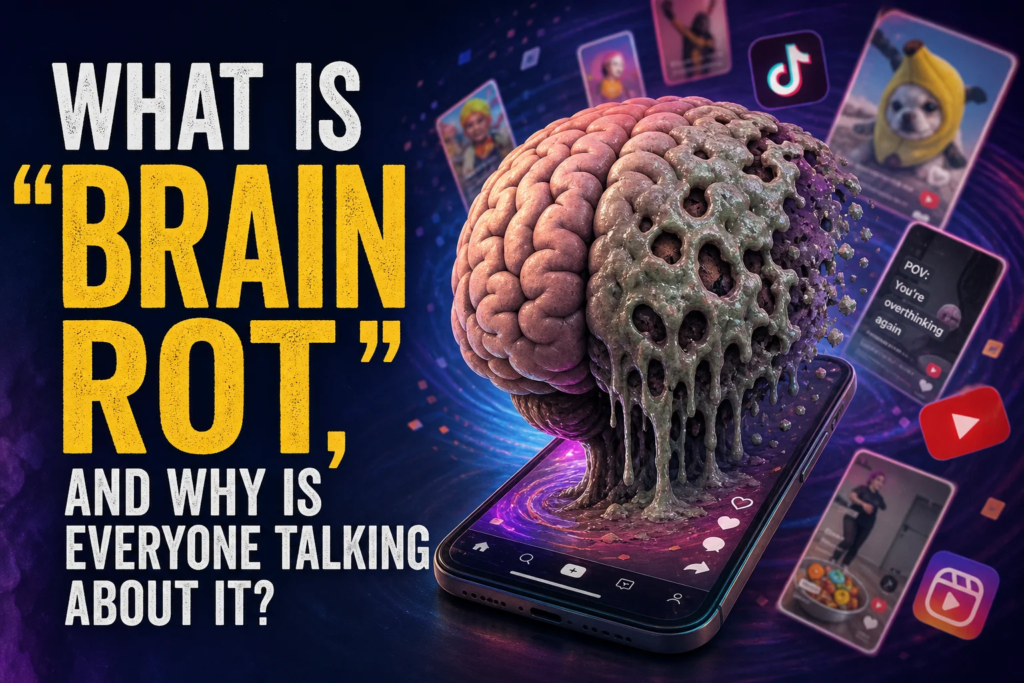
You open your phone to check one message. Twenty-seven minutes later, you’re watching a raccoon steal cat food, a stranger rank “unhinged” celebrity interviews, and a teenager explain a meme you only half understand. You laugh, scroll again, forget why you picked up your phone, and feel oddly foggy afterward.
That fog has a name now: brain rot.
So, What Is “Brain Rot,” and Why Is Everyone Talking About It? In the simplest terms, “brain rot” is a popular phrase people use to describe the mental dullness, attention fatigue, overstimulation, and low-quality thinking that can follow too much passive digital consumption—especially endless scrolling through short-form videos, memes, rage posts, livestream clips, and algorithm-driven content.
But the phrase is bigger than a joke. It captures a very real anxiety of the modern internet age: Are our feeds making us less focused, less patient, less creative, and less emotionally grounded?
This article breaks down what “brain rot” means, why everyone is talking about brain rot, how it shows up in everyday life, what science says about attention and digital overload, and what you can do to protect your mind without becoming anti-technology.
What Is “Brain Rot,” and Why Is Everyone Talking About It? A Simple Definition
Let’s start with the core question: What Is “Brain Rot,” and Why Is Everyone Talking About It?
“Brain rot” is internet slang for the feeling that your brain has become overstimulated, distracted, lazy, or numbed by consuming too much low-effort online content. It often refers to hours spent scrolling TikTok, Instagram Reels, YouTube Shorts, X/Twitter threads, meme pages, gaming clips, reaction videos, or controversy-driven content.
Importantly, brain rot is not a medical diagnosis. You won’t find it listed as a formal disorder in clinical manuals. Instead, it’s a cultural term—one that people use to describe a mix of mental fatigue, digital addiction, attention fragmentation, and content overload.
People ask, “What Is ‘Brain Rot,’ and Why Is Everyone Talking About It?” because the phrase names something many of us have felt but struggled to describe.
It’s the sensation of:
- Reading three paragraphs and realizing you absorbed nothing
- Feeling bored unless something is fast, loud, funny, or shocking
- Reaching for your phone every time your mind gets quiet
- Knowing dozens of memes but struggling to finish a book
- Feeling mentally “fried” after scrolling
- Losing track of time in algorithmic feeds
- Using internet phrases so often they start replacing normal conversation
In short, brain rot is the modern mind’s way of saying: “I’ve had too much content and not enough nourishment.”
Why Is Everyone Talking About Brain Rot Right Now?
The question “What Is ‘Brain Rot,’ and Why Is Everyone Talking About It?” exploded because the phrase sits at the intersection of humor, fear, and self-awareness.
People joke about having brain rot when they quote memes all day or can’t stop watching chaotic videos. But underneath the joke is a serious concern: many people feel their attention spans are shrinking.
Several cultural forces pushed “brain rot” into mainstream conversation.
1. Short-form video became the default entertainment format
TikTok, Reels, Shorts, and other platforms trained millions of people to consume content in rapid bursts. Videos often last 10 to 60 seconds, with fast edits, captions, sound effects, and emotional hooks.
This creates a high-stimulation environment where boredom rarely has room to exist.
2. Algorithms became extremely good at holding attention
Modern feeds are not random. They are optimized to keep you engaged. If you pause on a cooking video, the algorithm notices. If you rewatch a clip, it notices. If you hate-watch a political rant, it notices that too.
Brain rot enters the conversation because many people now realize their feeds are not neutral—they are engineered environments.
3. Internet language spread into everyday speech
Words like “rizz,” “skibidi,” “delulu,” “NPC,” “gyatt,” “sigma,” and “girl dinner” travel quickly through online culture. For some, this is playful. For others, it feels like evidence that internet humor is reshaping communication.
That’s one reason people keep asking, What Is “Brain Rot,” and Why Is Everyone Talking About It? The phrase is often used to describe content that feels absurd, repetitive, or detached from traditional meaning.
4. Burnout made people more vulnerable to passive scrolling
After work, school, caregiving, or stress, people often don’t have the energy for deep reading, hobbies, or social connection. Passive content is easy. It asks almost nothing from you.
But low-effort entertainment can become the default, and over time, people may feel mentally stagnant.
5. People are worried about children and teens
Parents, teachers, and mental health professionals are paying attention because young people are growing up inside algorithmic entertainment systems. The concern isn’t just screen time—it’s what kind of screen time and how it shapes attention, emotional regulation, and learning habits.
Brain Rot at a Glance: Meaning, Causes, and Signs
Here’s a quick overview to clarify the concept.
| Category | What It Means | Everyday Example |
|---|---|---|
| Definition | A slang term for mental fog, overstimulation, or attention fatigue from excessive low-quality content | Feeling “fried” after two hours of scrolling |
| Common Triggers | Short-form videos, memes, doomscrolling, gossip, rage content, algorithmic feeds | Opening TikTok for five minutes and losing an hour |
| Mental Signs | Poor focus, restlessness, shallow thinking, boredom intolerance | Struggling to read a long article |
| Emotional Signs | Irritability, anxiety, numbness, low motivation | Feeling worse after consuming “funny” content |
| Social Signs | Repeating memes constantly, avoiding deeper conversations | Communicating mostly through references |
| Key Point | Not a diagnosis, but a useful cultural warning | A signal to rebalance your digital habits |
This table helps answer What Is “Brain Rot,” and Why Is Everyone Talking About It? in practical terms: it is both a meme and a mirror.
Is Brain Rot Real or Just Internet Slang?
Brain rot is slang, but the experiences behind it are real.
When people ask, “What Is ‘Brain Rot,’ and Why Is Everyone Talking About It?”, they are often asking whether there is scientific truth beneath the trend.
The answer is: partly, yes.
No researcher is likely to diagnose you with “brain rot,” but many well-studied concepts overlap with it:
- Attention residue: When your mind keeps traces of one task while trying to switch to another
- Dopamine-driven reward loops: Repeatedly seeking quick hits of novelty and pleasure
- Cognitive overload: Too much information competing for mental resources
- Media multitasking: Switching between apps, tabs, videos, and messages
- Reduced deep work capacity: Difficulty sustaining attention on complex tasks
- Doomscrolling: Compulsively consuming negative news or distressing content
Brain rot is basically the internet’s shorthand for these overlapping effects.
It’s not that your brain is literally rotting. The human brain is adaptable. But habits shape attention, and attention shapes experience. If your daily mental diet is mostly fast, fragmented, emotional content, your mind can become accustomed to that pace.
Then slower activities—reading, studying, listening deeply, creating, reflecting—may feel strangely uncomfortable.
The Brain Rot Loop: How It Happens
Brain rot usually doesn’t happen all at once. It develops through a loop.
| Step | What Happens | Why It Matters |
|---|---|---|
| 1. Trigger | You feel bored, stressed, lonely, or tired | The phone becomes emotional relief |
| 2. Quick reward | You open an app and get novelty instantly | Your brain receives stimulation with little effort |
| 3. Algorithmic pull | The feed serves increasingly engaging content | Stopping becomes harder |
| 4. Time distortion | Minutes become an hour | You lose control of attention |
| 5. Mental fog | You feel drained or unfocused | The content entertained but did not restore you |
| 6. Avoidance | Hard tasks feel even harder | You return to easy stimulation |
| 7. Habit reinforcement | The cycle repeats | The brain learns scrolling as the default escape |
This cycle explains why brain rot and digital overstimulation are such powerful topics. The problem isn’t simply “phones are bad.” The problem is that many platforms are designed around habits our brains find difficult to resist.
Why Short-Form Content Feels So Addictive
To understand What Is “Brain Rot,” and Why Is Everyone Talking About It?, we have to look at the structure of short-form content.
Short videos are often designed with:
- Immediate hooks
- Fast pacing
- Emotional triggers
- Looping endings
- Captions for silent viewing
- Trending sounds
- Sudden cuts
- Visual novelty
- Social validation signals
Each swipe offers the possibility of something funnier, weirder, hotter, angrier, or more surprising than the last. That uncertainty is powerful. It resembles a slot-machine effect: you don’t know what reward is coming next, so you keep pulling the lever.
This is why someone can feel bored by a 20-minute educational video but watch 80 short clips in a row.
It’s not because they are lazy or unintelligent. It’s because the environment is optimized for frictionless stimulation.
Common Symptoms People Describe as Brain Rot
When people search What Is “Brain Rot,” and Why Is Everyone Talking About It?, they often want to know whether they have it.
Again, it’s not a clinical condition. But these are common signs that your digital habits may be affecting your mental clarity.
Cognitive signs
- You struggle to concentrate for more than a few minutes
- You reread the same sentence repeatedly
- You forget why you opened an app
- You find quiet moments uncomfortable
- You feel unable to finish long-form content
- You jump between tasks without completing them
Emotional signs
- You feel anxious after scrolling
- You compare yourself to others constantly
- You feel irritated when interrupted online
- You feel numb, bored, or restless offline
- You laugh at content but don’t feel truly happy
Behavioral signs
- You scroll first thing in the morning
- You check your phone during conversations
- You watch content while eating, walking, or using the bathroom
- You stay up late despite being tired
- You use memes or online phrases as your main mode of expression
- You avoid difficult tasks with “just five minutes” of scrolling
If several of these sound familiar, the point isn’t shame. The point is awareness.
Brain Rot vs. Relaxation: What’s the Difference?
Not all online entertainment is bad. Watching funny videos, sharing memes, gaming, or enjoying pop culture can be relaxing and socially meaningful.
The difference between relaxation and brain rot is usually how you feel afterward.
| Healthy Digital Relaxation | Brain Rot Pattern |
|---|---|
| You choose it intentionally | You fall into it automatically |
| You feel refreshed afterward | You feel foggy, guilty, or drained |
| You can stop when you want | You keep scrolling despite wanting to stop |
| It fits into your life | It displaces sleep, work, study, or relationships |
| It adds joy or connection | It becomes avoidance or numbness |
This distinction matters. The goal is not to eliminate fun. The goal is to stop low-quality content from becoming your main mental diet.
Case Study 1: The Student Who Couldn’t Study Without Scrolling
The situation
Maya, a 19-year-old college student, noticed she couldn’t study for more than ten minutes without checking her phone. She told herself she was taking “quick breaks,” but those breaks often turned into 45-minute TikTok sessions.
Her grades slipped. Reading assignments felt unbearable. She described her mind as “mushy,” and when a friend asked, “What Is ‘Brain Rot,’ and Why Is Everyone Talking About It?”, Maya joked, “It’s me. I’m brain rot.”
What changed
Maya didn’t delete every app. Instead, she created a study routine:
- Phone in another room during 45-minute study blocks
- App timers for social media
- Printed readings when possible
- Ten-minute walks as breaks instead of scrolling
- Long-form video or music only after completing assignments
Result
After three weeks, she reported better focus and less anxiety before studying. Her attention didn’t magically become perfect, but she no longer felt controlled by short-form content.
Analysis
Maya’s case shows that brain rot from social media often thrives on automatic behavior. By adding friction—placing the phone away, using timers, and replacing scrolling with physical movement—she weakened the loop. The lesson is simple: attention improves when your environment supports it.
Case Study 2: The Workplace “Micro-Break” Trap
The situation
A marketing team at a mid-sized company noticed productivity dips in the afternoon. Employees weren’t lazy; they were exhausted by constant Slack messages, email alerts, meetings, and social media “micro-breaks.”
Many workers used short videos between tasks, believing they were refreshing themselves. But after these breaks, they often felt less focused. The phrase “brain rot at work” became an inside joke.
What changed
The team experimented with a digital reset:
- No-meeting blocks twice a week
- Slack notifications paused during deep work
- Break areas without screens
- Optional 15-minute walking breaks
- A shared norm: “Breaks should restore, not hijack”
Result
After a month, employees reported fewer attention crashes. Team members also became more aware of the difference between a restorative pause and an algorithmic rabbit hole.
Analysis
This case highlights why What Is “Brain Rot,” and Why Is Everyone Talking About It? is not only a teen or student issue. Adults experience it too, especially in notification-heavy workplaces. Brain rot can emerge when work stress and digital reward loops feed each other.
Case Study 3: Parents, Kids, and the Battle Over “Skibidi” Culture
The situation
A group of parents became concerned when their elementary-school children constantly repeated phrases from viral videos. The kids weren’t just watching content; they were recreating it, quoting it, and becoming upset when screens were taken away.
Parents searched online for what brain rot means for kids and found heated debates. Some adults dismissed the content as harmless nonsense. Others worried it reflected overstimulation and reduced imaginative play.
What changed
Instead of banning screens completely, the parents tried a family media plan:
- Co-viewing some content to understand it
- Setting screen-free mornings
- Encouraging outdoor play before entertainment apps
- Keeping devices out of bedrooms
- Asking children to explain what they watched
- Balancing short videos with books, art, and physical games
Result
The children still enjoyed online humor, but screen conflicts decreased. Parents also became less reactive because they better understood the content ecosystem.
Analysis
This case is important because brain rot in kids is often less about one silly meme and more about repetition, intensity, and displacement. The question is not “Did my child see weird content?” The better question is: “Is this replacing sleep, play, curiosity, reading, movement, or real-world connection?”
The Role of Algorithms in Brain Rot
If we’re answering What Is “Brain Rot,” and Why Is Everyone Talking About It?, we can’t ignore algorithms.
Algorithms decide what you see next. They learn from your behavior and prioritize engagement. That can be useful—you find content you like faster. But it can also create traps.
How algorithms intensify brain rot
- They reward extreme content because it triggers reactions
- They personalize feeds so well that leaving becomes harder
- They reduce boredom by constantly offering novelty
- They promote repetition of trends until they dominate attention
- They blur the line between entertainment, advertising, and identity
The issue isn’t only personal willpower. Digital environments are intentionally persuasive. That doesn’t mean you are helpless, but it does mean you need strategies stronger than “I’ll just scroll less.”
Brain Rot and Doomscrolling: Close Cousins
Brain rot is often associated with silly or low-effort content, but doomscrolling is another major form.
Doomscrolling means compulsively consuming negative news, disasters, political outrage, conflict, or social drama. It can feel responsible—like staying informed—but it often leaves people anxious and powerless.
The brain rot effect here is different. Instead of feeling goofy and foggy, you may feel tense, cynical, and emotionally exhausted.
A person asking “What Is ‘Brain Rot,’ and Why Is Everyone Talking About It?” may not be watching memes at all. They may be refreshing news feeds, reading arguments, or consuming crisis content late at night.
The mental result can be similar: overstimulation, reduced focus, and emotional depletion.
The Hidden Cost: Losing the Ability to Be Bored
One of the most underrated parts of the brain rot conversation is boredom.
Boredom is not useless. It creates space for reflection, imagination, planning, and creativity. Many good ideas emerge when the mind is not being constantly fed.
But if you reach for your phone at the first hint of discomfort, boredom never has time to become creativity.
This is why brain rot and attention span are linked. Attention isn’t just the ability to focus when something is exciting. It’s the ability to stay present when something is slow, complex, or not immediately rewarding.
A brain trained only on instant stimulation may struggle with:
- Reading books
- Practicing instruments
- Learning difficult skills
- Having patient conversations
- Solving complex problems
- Sitting with emotions
- Making art
- Thinking independently
That’s the real concern behind What Is “Brain Rot,” and Why Is Everyone Talking About It? It’s not just about silly videos. It’s about whether we are losing our tolerance for depth.
Is Internet Humor Really Making Us Dumber?
This question comes up often in discussions of brain rot culture.
The honest answer: not necessarily.
Absurd internet humor can be creative, socially bonding, and even intellectually playful. Memes often rely on context, irony, remixing, and cultural literacy. Young people are not automatically “dumber” because they enjoy strange jokes.
However, problems can arise when a person’s entire media diet becomes:
- Fragmented
- Repetitive
- Hyper-ironic
- Emotionally reactive
- Disconnected from real-world experience
- Lacking depth or challenge
In other words, the issue is not one meme. It’s imbalance.
A candy bar won’t ruin your health. A diet made entirely of candy probably will. Brain rot works the same way: the occasional chaotic video is fine, but an endless stream of low-nutrition content can affect how you think and feel.
The Mental Diet Framework
A useful way to understand What Is “Brain Rot,” and Why Is Everyone Talking About It? is to think of content as a mental diet.
Just as food affects physical energy, content affects mental energy. Some content nourishes you. Some entertains you. Some drains you. Some is fine occasionally but harmful in excess.
| Content Type | Example | Mental Nutrition Level | Best Use |
|---|---|---|---|
| Deep learning | Books, courses, documentaries | High | Growth and skill-building |
| Creative content | Music, art, essays, thoughtful videos | High | Inspiration |
| Social connection | Meaningful messages, group chats, calls | Medium to high | Belonging |
| Light entertainment | Comedy clips, memes, casual gaming | Medium | Relaxation |
| Junk content | Rage bait, endless drama, repetitive clips | Low | Occasional amusement only |
| Doom content | Crisis feeds, outrage loops | Low to harmful | Limit and contextualize |
This framework avoids moral panic. The question is not “Is this content bad?” The question is “What role is it playing in my life?”
How to Tell If Your Brain Needs a Reset
If you’re wondering whether you’re experiencing brain rot from too much scrolling, try asking yourself these questions:
- Do I feel better or worse after using my favorite apps?
- Can I sit quietly for five minutes without reaching for my phone?
- Do I avoid important tasks through digital entertainment?
- Has my sleep suffered because of scrolling?
- Do I struggle to focus on long-form reading or work?
- Do I feel anxious when I can’t check notifications?
- Is my online life replacing hobbies, relationships, or exercise?
- Am I consuming content I don’t even enjoy?
If you answered yes to several, you may benefit from a digital reset.
How to Reverse Brain Rot: Practical Strategies That Actually Help
The good news: if brain rot is habit-shaped, it can be habit-reversed.
Here are practical ways to reclaim your attention.
1. Create friction before opening apps
Make mindless scrolling less automatic.
Try:
- Moving social apps off your home screen
- Logging out after each use
- Turning your phone grayscale
- Disabling nonessential notifications
- Keeping your phone outside the bedroom
- Using website blockers during work or study
Friction gives your conscious mind a chance to choose.
2. Replace scrolling breaks with real breaks
Many people don’t need fewer breaks. They need better breaks.
Instead of scrolling, try:
- Walking outside
- Stretching
- Drinking water
- Looking out a window
- Breathing exercises
- Journaling for three minutes
- Talking to someone nearby
A real break restores attention. A fake break steals it.
3. Practice “single-tasking”
Brain rot thrives on constant switching. Rebuild focus by doing one thing at a time.
Start small:
- Read for 10 minutes without checking your phone
- Eat one meal without a screen
- Work for 25 minutes on one task
- Watch one full video instead of 30 clips
- Listen to an album without skipping
Attention is trainable.
4. Upgrade your content diet
You don’t have to quit the internet. You can improve what you consume.
Follow accounts that make you:
- Smarter
- Calmer
- More creative
- More skilled
- More compassionate
- More connected to real life
Unfollow accounts that consistently make you angry, insecure, numb, or compulsive.
5. Build boredom back into your life
Let your mind wander sometimes.
Try:
- Showering without audio
- Walking without headphones
- Waiting in line without your phone
- Sitting outside for five minutes
- Doing chores without a video playing
At first, it may feel uncomfortable. That discomfort is part of the reset.
6. Set “content closing rituals”
The hardest part of scrolling is stopping. Create a ritual.
For example:
- “After five saved videos, I close the app.”
- “When the timer ends, I put the phone on the table.”
- “At 9:30 p.m., apps close and the charger stays outside my room.”
- “If I start watching content I don’t enjoy, I stop.”
A closing ritual turns vague intention into action.
A 7-Day Brain Rot Reset Plan
Here’s a simple plan for anyone concerned about brain rot and social media habits.
| Day | Goal | Action |
|---|---|---|
| Day 1 | Awareness | Track your screen time without judging it |
| Day 2 | Reduce triggers | Turn off nonessential notifications |
| Day 3 | Add friction | Move addictive apps off your home screen |
| Day 4 | Restore focus | Do one 25-minute phone-free work/study block |
| Day 5 | Improve breaks | Replace one scrolling break with a walk |
| Day 6 | Upgrade inputs | Unfollow 10 low-value accounts |
| Day 7 | Reclaim depth | Spend 30 minutes reading, creating, or learning |
The goal is not perfection. The goal is proof: you can still direct your own attention.
Why the Brain Rot Conversation Is Actually Healthy
It’s easy to dismiss What Is “Brain Rot,” and Why Is Everyone Talking About It? as just another internet trend. But the conversation is valuable because it signals collective self-awareness.
People are noticing that endless content has consequences. They are naming the feeling of being mentally overfed but undernourished. They are questioning whether convenience is always good for the mind.
That matters.
Every generation worries about new media. Novels, radio, television, video games, and smartphones have all triggered moral panic. Some fears were exaggerated. But some concerns were valid.
The best response is not panic. It’s literacy.
Digital literacy today means more than knowing how to use technology. It means knowing how technology uses you—your attention, emotions, impulses, and time.
What Is “Brain Rot,” and Why Is Everyone Talking About It? The Bigger Cultural Meaning
At a deeper level, What Is “Brain Rot,” and Why Is Everyone Talking About It? is a question about control.
Who controls your attention?
You? Your friends? Your goals? Your values? Or an algorithm optimized to keep you watching one more thing?
Brain rot is popular as a phrase because it feels funny and dramatic, but it points to a serious modern challenge: protecting mental space in an attention economy.
We live in a world where distraction is profitable. Your focus is valuable. Your emotions are valuable. Your time is valuable. If you don’t decide how to spend them, someone else will.
That’s why everyone is talking about brain rot. Not because everyone hates the internet—but because many people are trying to build a healthier relationship with it.
Conclusion: Your Brain Isn’t Rotten—It’s Asking for Better Fuel
So, What Is “Brain Rot,” and Why Is Everyone Talking About It?
Brain rot is a slang term for the foggy, overstimulated, distracted feeling that can come from too much low-quality digital content. It’s not a medical diagnosis, but it captures something real: the way endless scrolling, short-form videos, doomscrolling, and algorithmic feeds can reshape our attention and mood.
The good news is that your brain is not broken. It is adaptable. If constant scrolling trained your mind to crave quick stimulation, intentional habits can train it back toward focus, patience, creativity, and calm.
Start small. Turn off a few notifications. Take one walk without your phone. Read ten pages. Create before you consume. Replace one fake break with a real one. Let yourself be bored long enough for your thoughts to return.
The internet can be funny, useful, inspiring, and connecting. But it should be a tool—not the place where your attention disappears.
Your mind deserves better than endless noise. Feed it accordingly.
1. What is “brain rot” in simple terms?
Brain rot is internet slang for feeling mentally foggy, distracted, overstimulated, or less able to focus after consuming too much low-quality online content, especially short-form videos, memes, and endless social media feeds.
2. Is brain rot a real medical condition?
No. Brain rot is not a formal medical diagnosis. However, the experiences people describe—attention fatigue, doomscrolling, digital overload, and compulsive scrolling—are connected to real psychological and behavioral patterns.
3. Why is everyone talking about brain rot now?
Everyone is talking about brain rot because short-form content, viral slang, algorithmic feeds, and screen-time concerns have become part of daily life. The phrase gives people a humorous but useful way to describe feeling mentally drained by the internet.
4. Can TikTok, Reels, or YouTube Shorts cause brain rot?
They don’t literally rot your brain, but excessive use can contribute to attention problems, procrastination, sleep disruption, and overstimulation. The risk is higher when short-form content replaces deep work, reading, sleep, exercise, or real social connection.
5. How do I know if I have brain rot?
You might be experiencing brain rot-like effects if you struggle to focus, constantly reach for your phone, feel bored without stimulation, lose hours to scrolling, avoid responsibilities, or feel foggy and drained after using social media.
6. How can I fix brain rot?
Start by reducing automatic scrolling. Turn off notifications, move addictive apps off your home screen, set app limits, take screen-free breaks, read or create daily, and keep your phone away during sleep, meals, study, and focused work.
7. Is all internet culture brain rot?
No. Internet culture can be creative, funny, educational, and socially meaningful. Brain rot usually refers to imbalance—when low-quality, repetitive, or overstimulating content dominates your attention and crowds out healthier activities.
8. What is the best way to prevent brain rot in kids?
The best approach is balance. Set screen boundaries, avoid devices in bedrooms, encourage outdoor play and reading, co-view content when possible, discuss what children watch, and make sure screens don’t replace sleep, schoolwork, creativity, or family connection.

