


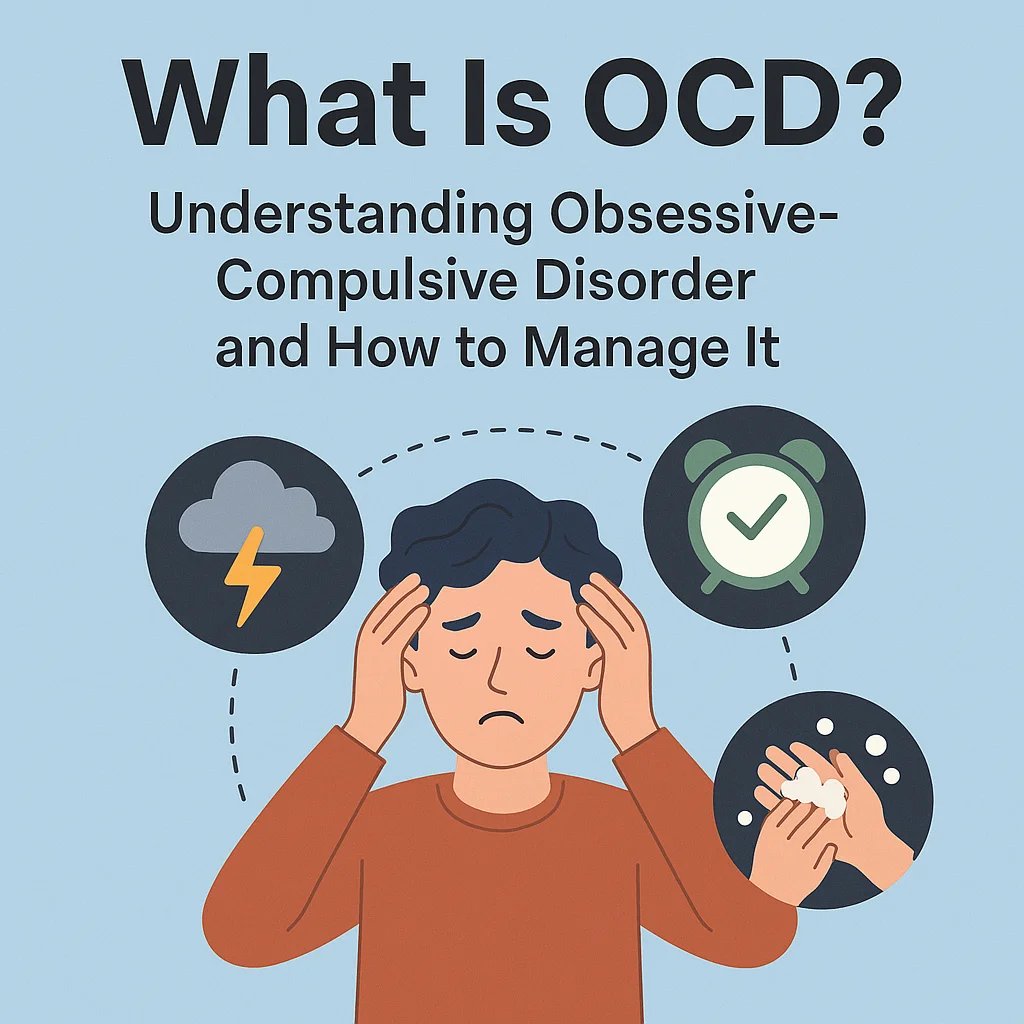
The Essential Guide: What Is OCD? Understanding Obsessive-Compulsive Disorder and How to Manage It
Imagine being stuck in a mental alarm system that keeps blaring even when there is no real danger. You lock the door, but your mind whispers, What if it is still unlocked? You wash your hands, but the feeling of contamination creeps back seconds later. You love your family deeply, yet a disturbing thought flashes through your mind and leaves you terrified: What if I hurt someone?
This is the exhausting reality many people with obsessive-compulsive disorder face every day.
What Is OCD? Understanding Obsessive-Compulsive Disorder and How to Manage It is more than a clinical question. It is a question about fear, control, uncertainty, shame, resilience, and recovery. OCD is often misunderstood as a personality quirk, a love of neatness, or a preference for order. In reality, obsessive-compulsive disorder is a serious but treatable mental health condition that can affect thoughts, emotions, behavior, relationships, work, school, spirituality, parenting, and self-worth.
The good news is powerful: OCD can be managed. People can learn to respond differently to intrusive thoughts, reduce compulsions, rebuild confidence, and live meaningful lives even when uncertainty is present.
This in-depth guide explores what OCD is, how obsessive-compulsive disorder works, what causes it, how it shows up, and how to manage it effectively using evidence-based strategies.
Important note: This article is for educational purposes and is not a substitute for professional diagnosis or treatment. If symptoms are severe, worsening, or connected to self-harm, seek support from a qualified mental health professional or emergency service.
What Is OCD? Understanding Obsessive-Compulsive Disorder and How to Manage It
So, what is OCD? Understanding obsessive-compulsive disorder and how to manage it begins with one core idea: OCD is a cycle of intrusive thoughts and repetitive attempts to reduce anxiety.
OCD involves two main parts:
- Obsessions — unwanted, intrusive thoughts, images, sensations, urges, or doubts that cause distress.
- Compulsions — repetitive behaviors or mental rituals performed to reduce distress, prevent feared outcomes, or feel “certain enough.”
A person with OCD does not simply “worry too much.” The obsessive thoughts feel urgent, sticky, and threatening. The compulsions may bring short-term relief, but they usually strengthen OCD over time.
For example:
- Obsession: “What if I left the stove on and the house burns down?”
- Compulsion: Checking the stove repeatedly.
- Temporary relief: “Okay, it is off.”
- OCD rebound: “But what if I checked wrong?”
- More checking follows.
This is the OCD loop.
Understanding obsessive-compulsive disorder means recognizing that compulsions are not random habits. They are attempts to escape discomfort, uncertainty, guilt, disgust, or fear. Unfortunately, the more a person performs compulsions, the more the brain learns that the obsession was dangerous and required action.
OCD Is Not Just Being Neat or Organized
One of the biggest misconceptions about OCD is that it simply means being tidy, perfectionistic, or particular.
People often say things like:
- “I’m so OCD about my desk.”
- “My OCD makes me color-code everything.”
- “I like things clean, so I must have OCD.”
But liking order is not the same as having obsessive-compulsive disorder.
A person can be highly organized without having OCD. A person with OCD may be messy, disorganized, or uninterested in cleanliness. OCD is not defined by neatness. It is defined by distressing obsessions and compulsive responses.
OCD vs. Common Preferences
| Common Preference | OCD Pattern |
|---|---|
| “I like my room clean because it feels nice.” | “I must clean my room repeatedly or something terrible may happen.” |
| “I double-check my email before sending it.” | “I reread the email 30 times because I cannot tolerate the fear I made a harmful mistake.” |
| “I prefer symmetry.” | “I feel intense distress unless objects feel exactly right.” |
| “I wash my hands before eating.” | “I wash my hands until they crack because I feel contaminated.” |
| “I enjoy planning.” | “I spend hours mentally reviewing choices because I fear making the wrong one.” |
When asking What Is OCD? Understanding Obsessive-Compulsive Disorder and How to Manage It, it is essential to move beyond stereotypes. OCD can be invisible. Some people have obvious rituals, while others suffer mainly through mental compulsions that no one else sees.
The OCD Cycle: How Obsessions and Compulsions Keep Each Other Alive
The OCD cycle is one of the most important concepts in understanding obsessive-compulsive disorder.
Here is a simplified version:
| Stage | What Happens | Example |
|---|---|---|
| Trigger | Something sparks anxiety or doubt | Touching a public door handle |
| Obsession | Intrusive thought appears | “What if I get sick and infect my family?” |
| Anxiety or distress | Fear, guilt, disgust, or uncertainty rises | Racing heart, nausea, panic |
| Compulsion | Ritual is performed to feel safer | Washing hands repeatedly |
| Temporary relief | Anxiety drops briefly | “Now I feel clean.” |
| Reinforcement | Brain learns ritual was necessary | More fear next time |
This cycle explains why compulsions are so tempting. They work in the short term. But they backfire in the long term.
The brain begins to believe:
- “I only stayed safe because I checked.”
- “I only avoided harm because I prayed the right way.”
- “I only protected my family because I washed.”
- “I only prevented disaster because I repeated the phrase.”
Over time, the person’s world can shrink. More triggers appear. More rituals are needed. More time is lost.
That is why how to manage OCD usually involves learning to interrupt the cycle, not by proving the obsession wrong, but by changing the response to it.
Common Obsessions in OCD
Obsessions can involve almost any topic. The content varies widely, but the pattern is similar: unwanted thoughts create distress, and the person feels driven to neutralize them.
Common OCD Obsession Themes
| Theme | Examples of Intrusive Thoughts |
|---|---|
| Contamination | “What if I touched germs, chemicals, bodily fluids, or toxins?” |
| Harm | “What if I hurt someone accidentally or intentionally?” |
| Checking and responsibility | “What if I caused a fire, accident, or mistake?” |
| Religious or moral scrupulosity | “What if I sinned, offended God, or am morally bad?” |
| Sexual intrusive thoughts | “What if this unwanted thought means something about me?” |
| Relationship OCD | “What if I do not really love my partner?” |
| Symmetry and “just right” feelings | “Something feels wrong until it is perfectly aligned.” |
| Health anxiety overlap | “What if this sensation means I have a serious illness?” |
| Existential OCD | “What if reality is not real? What if life has no meaning?” |
| Perfectionism-related OCD | “What if I make an irreversible mistake?” |
A key point: intrusive thoughts are not the same as desires.
Many people with OCD are deeply distressed precisely because the thoughts conflict with their values. A loving parent may have harm-related intrusive thoughts. A devoted religious person may have blasphemous thoughts. A caring professional may obsess about accidentally harming a client.
Understanding obsessive-compulsive disorder means understanding that the content of OCD often attacks what people care about most.
Common Compulsions in OCD
Compulsions can be physical or mental. Some are easy to see. Others happen silently inside the mind.
Examples of Compulsions
| Type of Compulsion | Examples |
|---|---|
| Checking | Locks, stove, appliances, emails, body sensations |
| Washing and cleaning | Handwashing, showering, disinfecting, laundry rituals |
| Repeating | Repeating movements, phrases, prayers, or actions |
| Counting | Counting steps, objects, words, or numbers to feel safe |
| Reassurance seeking | Asking others, “Are you sure everything is okay?” |
| Mental reviewing | Replaying events to check for mistakes or guilt |
| Confessing | Repeatedly telling others about thoughts or doubts |
| Avoidance | Avoiding knives, public places, children, loved ones, decisions |
| Researching | Excessive online searching for certainty |
| Neutralizing thoughts | Replacing “bad” thoughts with “good” thoughts |
Compulsions are not always logical. A person may know their ritual does not make sense but still feel unable to stop.
This is why “just stop doing it” is not helpful advice. OCD is not a lack of willpower. It is a learned anxiety cycle reinforced by distress intolerance, uncertainty, and temporary relief.
Symptoms of OCD: What to Look For
When people search for What Is OCD? Understanding Obsessive-Compulsive Disorder and How to Manage It, they often want to know whether their experiences “count” as OCD.
OCD symptoms can include:
- Intrusive thoughts that feel repetitive, unwanted, or disturbing
- Strong urges to check, wash, repeat, count, ask, confess, or avoid
- Anxiety when rituals are delayed or resisted
- Excessive need for certainty
- Fear of causing harm or being responsible for harm
- Time-consuming routines
- Difficulty concentrating because of intrusive thoughts
- Avoidance of people, places, objects, or decisions
- Shame about thoughts or behaviors
- Distress when things feel unfinished, contaminated, unsafe, or “not right”
- Family conflict due to rituals or reassurance seeking
Clinically, OCD is often considered when obsessions or compulsions are time-consuming, cause significant distress, or interfere with daily functioning. Many diagnostic guidelines use “more than one hour per day” as one marker, but even less frequent symptoms can be serious if they cause major impairment.
What Causes OCD?
There is no single cause of OCD. Obsessive-compulsive disorder usually develops from a combination of biological, psychological, and environmental factors.
Factors That May Contribute to OCD
| Factor | How It May Play a Role |
|---|---|
| Genetics | OCD can run in families, suggesting inherited vulnerability. |
| Brain circuitry | Differences in cortico-striato-thalamo-cortical circuits are associated with OCD. |
| Learning patterns | Compulsions reduce anxiety temporarily, reinforcing the cycle. |
| Temperament | High sensitivity to threat, guilt, uncertainty, or disgust may contribute. |
| Stress | Major transitions, trauma, illness, or chronic stress can trigger or worsen symptoms. |
| Family accommodation | Loved ones may unintentionally reinforce rituals by participating in them. |
| Cognitive patterns | Overestimating threat, inflated responsibility, and perfectionism may maintain OCD. |
OCD is not caused by weakness, bad character, lack of faith, or poor parenting. Parents do not “create” OCD by being imperfect. Partners do not cause OCD by failing to reassure enough. OCD is a treatable condition with complex roots.
How OCD Affects the Brain and Body
OCD is often described as a disorder of doubt, threat detection, and compulsive relief-seeking. The brain acts as though a false alarm must be solved immediately.
Several brain processes may be involved:
- Overactive error detection: The brain keeps signaling, “Something is wrong.”
- Difficulty tolerating uncertainty: The person feels pressure to reach absolute certainty.
- Habit learning: Rituals become automatic responses to discomfort.
- Threat sensitivity: Ordinary triggers feel unusually dangerous.
- Emotional reasoning: “I feel anxious, so there must be danger.”
The body can also become involved. OCD-related anxiety may cause:
- Muscle tension
- Racing heart
- Sweating
- Nausea
- Fatigue
- Headaches
- Sleep problems
- Skin damage from washing
- Difficulty relaxing
Understanding obsessive-compulsive disorder requires compassion for the whole person. OCD is not “all in your head” in the dismissive sense. It affects cognition, emotion, behavior, physiology, relationships, and identity.
OCD Subtypes: Helpful Labels, Not Separate Disorders
People often talk about OCD “subtypes.” These are not always official diagnoses, but they can help describe common themes.
Common OCD Subtypes
| OCD Theme | Main Fear | Common Compulsions |
|---|---|---|
| Contamination OCD | Germs, illness, toxins, disgust | Washing, avoiding, cleaning |
| Checking OCD | Harm, mistakes, responsibility | Rechecking, reassurance, reviewing |
| Harm OCD | Hurting self or others | Avoidance, mental checking, reassurance |
| Scrupulosity OCD | Sin, morality, spiritual failure | Prayer rituals, confession, reassurance |
| Relationship OCD | Wrong relationship, lack of love | Comparing, testing feelings, researching |
| Sexual orientation OCD | Unwanted doubts about attraction or identity | Checking arousal, reviewing, reassurance |
| “Just right” OCD | Incompleteness, wrongness | Repeating, arranging, touching |
| Existential OCD | Reality, meaning, consciousness doubts | Rumination, researching, mental analysis |
| Health-related OCD | Illness or body sensations | Checking, medical reassurance, searching |
These themes can shift over time. Someone may start with contamination fears and later develop relationship OCD. Another person may cycle between health anxiety, moral fears, and checking.
The content changes, but the mechanism remains similar: intrusive thought, distress, compulsion, temporary relief, renewed doubt.
Case Study 1: Contamination OCD and the Washing Trap
Profile: Maya, 29, works in marketing. After a severe flu season, she became increasingly afraid of germs. At first, she washed her hands more often. Within months, she avoided public transportation, wiped groceries for hours, and showered immediately after work.
Her hands became cracked and painful. She knew her cleaning routines were excessive, but stopping felt impossible. Her mind said, “If you do not wash correctly, your parents could get sick, and it will be your fault.”
What Helped
Maya began exposure and response prevention therapy. She created a gradual exposure plan with her therapist:
- Touch her purse after being outside without sanitizing.
- Wait 5 minutes before washing.
- Increase the delay to 15, then 30 minutes.
- Touch a public door handle and eat a snack without washing beyond normal hygiene.
- Visit her parents without completing a full decontamination routine.
Her therapist helped her practice saying, “Maybe there are germs. Maybe I could get sick. I am choosing not to do the ritual.”
Analysis
Maya’s story illustrates a central point in What Is OCD? Understanding Obsessive-Compulsive Disorder and How to Manage It: compulsions feel protective but often expand fear. Her recovery did not come from proving all germs were harmless. It came from learning to tolerate uncertainty and reduce compulsive washing.
Case Study 2: Harm OCD and the Fear of Being Dangerous
Profile: Daniel, 36, became terrified after an intrusive image of pushing someone onto train tracks. He was horrified by the thought and began avoiding train platforms. Later, he avoided kitchen knives, driving, and being alone with his children.
Daniel repeatedly asked his wife, “You know I would never hurt anyone, right?” He searched online for signs of being violent and mentally reviewed his past for evidence of danger.
What Helped
Daniel learned that unwanted harm thoughts are a common OCD theme. His therapist helped him distinguish between intrusive thoughts and intentions. Through ERP, Daniel gradually:
- Held a kitchen knife while making dinner.
- Stood near train platforms without moving away.
- Played with his children without seeking reassurance afterward.
- Practiced allowing scary thoughts to exist without analyzing them.
He also stopped Googling and reduced reassurance-seeking.
Analysis
Daniel’s case shows why understanding obsessive-compulsive disorder is so important. Without accurate education, people with harm OCD may believe their intrusive thoughts reveal character. In reality, the distress often comes from the fact that the thoughts violate deeply held values.
Case Study 3: Relationship OCD and the Search for Certainty
Profile: Alina, 32, loved her partner but constantly questioned whether he was “the one.” She compared him to other people, tested her feelings, read relationship articles for hours, and asked friends whether her doubts were normal.
Whenever she felt warmth toward her partner, she relaxed. Whenever she felt neutral, irritated, or distracted, panic returned: “If I do not feel in love right now, maybe I am lying to him.”
What Helped
Alina’s treatment focused on reducing compulsive checking. She practiced:
- Not testing her feelings during dates.
- Not comparing her relationship to romantic movies or social media couples.
- Allowing uncertainty about the future.
- Choosing values-based actions rather than feeling-based certainty.
- Limiting reassurance conversations with friends.
Analysis
Relationship OCD shows that OCD can attach to love, commitment, and identity. How to manage OCD in this context means accepting that relationships naturally include changing feelings, imperfect certainty, and ordinary irritation. Recovery involves choosing presence over constant analysis.
Case Study 4: Scrupulosity OCD and Moral Fear
Profile: Thomas, 41, was deeply religious. Over time, his faith became entangled with fear. He repeated prayers until they felt “pure,” confessed minor thoughts repeatedly, and feared he had offended God if a distracting image entered his mind during worship.
He spent hours trying to determine whether he had sinned. Spiritual practices that once brought comfort became exhausting rituals.
What Helped
Thomas worked with a therapist familiar with scrupulosity and, with permission, collaborated with a trusted faith leader. His plan included:
- Praying once rather than repeating until it felt perfect.
- Resisting compulsive confession.
- Allowing unwanted thoughts during worship without neutralizing them.
- Practicing faith as trust rather than certainty-seeking.
- Differentiating values-based devotion from OCD-driven ritual.
Analysis
This case highlights an important part of What Is OCD? Understanding Obsessive-Compulsive Disorder and How to Manage It: treatment should respect a person’s values. ERP does not ask someone to abandon faith, morality, love, or responsibility. It helps them stop using rituals to chase impossible certainty.
OCD in Children and Teenagers
OCD can begin in childhood or adolescence. Young people may not always explain their symptoms clearly. They may say:
- “It just feels wrong.”
- “I have to do it again.”
- “I can’t stop thinking about it.”
- “I need you to promise nothing bad will happen.”
- “I feel dirty.”
- “My brain says I have to.”
Signs of OCD in Children
| Possible Sign | What Parents Might Notice |
|---|---|
| Repeated questions | “Are you sure?” “Will I be okay?” |
| Long routines | Bedtime, homework, bathroom, dressing rituals |
| Avoidance | Refusing school, certain clothes, foods, or rooms |
| Irritability | Meltdowns when rituals are interrupted |
| Excessive erasing | Homework takes unusually long |
| Confessing | Repeatedly reporting “bad thoughts” |
| Family involvement | Asking parents to check, clean, repeat, or answer |
Children may involve family members in rituals. This is called family accommodation. Parents usually participate because they want to reduce the child’s distress. But accommodation can unintentionally keep OCD strong.
Helpful parenting often includes warmth plus boundaries: “I know this feels scary. I love you. I am not going to answer that OCD question again. Let’s use your coping plan.”
OCD and Other Conditions
OCD can overlap with or resemble other mental health conditions. A professional evaluation can help clarify what is happening.
OCD Compared With Similar Conditions
| Condition | Similarity to OCD | Key Difference |
|---|---|---|
| Generalized anxiety disorder | Excessive worry | Worries are often real-life concerns rather than intrusive obsessions with rituals. |
| Panic disorder | Fear and body symptoms | Panic centers on panic attacks and sensations, not compulsions. |
| Depression | Rumination, guilt | Depression rumination is often mood-based rather than ritualized neutralizing. |
| Body dysmorphic disorder | Repetitive checking | Focus is perceived flaws in appearance. |
| Hoarding disorder | Difficulty discarding | Hoarding may not involve classic intrusive obsessions. |
| Tic disorders | Repetitive behaviors | Tics are often sensory/neurological urges rather than fear-driven rituals. |
| Psychosis | Unusual beliefs | OCD usually involves some level of insight, though insight can vary. |
| Autism spectrum disorder | Repetitive behaviors | Repetition may be soothing/preferred rather than performed to neutralize obsessional fear. |
OCD can also occur alongside ADHD, eating disorders, PTSD, substance use issues, and depression. Treatment may need to address more than one condition.
Evidence-Based Treatment for OCD
The strongest treatments for obsessive-compulsive disorder include specialized psychotherapy, medication, or both.
Main Treatment Options
| Treatment | What It Involves | Evidence Level |
|---|---|---|
| Exposure and Response Prevention | Facing triggers while resisting compulsions | Strong evidence; gold-standard therapy |
| Cognitive Behavioral Therapy | Identifying and changing OCD-maintaining beliefs and behaviors | Strong evidence, especially with ERP |
| SSRIs | Medications such as fluoxetine, sertraline, fluvoxamine, paroxetine, escitalopram | Strong evidence |
| Clomipramine | Older serotonin-focused medication | Strong evidence; side effects require monitoring |
| ACT-informed approaches | Accepting thoughts and acting by values | Helpful adjunct |
| Family-based CBT | Reducing accommodation and supporting exposure | Strong for children and families |
| Intensive outpatient/residential programs | Higher level of care for severe OCD | Useful for significant impairment |
| Deep TMS/neuromodulation | Brain stimulation for treatment-resistant OCD | Emerging/approved in some settings |
| DBS | Surgical option for severe, treatment-resistant cases | Reserved for extreme cases |
When discussing What Is OCD? Understanding Obsessive-Compulsive Disorder and How to Manage It, exposure and response prevention deserves special attention.
Exposure and Response Prevention: The Gold Standard
Exposure and Response Prevention, often called ERP, is a specialized form of cognitive behavioral therapy.
ERP has two key parts:
- Exposure: Gradually facing triggers, thoughts, images, situations, or sensations that provoke OCD distress.
- Response prevention: Resisting the compulsion that usually follows.
ERP is not about flooding someone recklessly or forcing them into unbearable situations. Good ERP is collaborative, planned, ethical, and paced appropriately.
Example ERP Plan
| OCD Fear | Exposure | Response Prevention |
|---|---|---|
| Door is unlocked | Lock once and walk away | No rechecking |
| Hands are contaminated | Touch a doorknob | Delay washing or wash normally only once |
| Email contains mistake | Send after one review | No rereading sent email |
| Harm thought means danger | Hold kitchen knife while cooking | No reassurance seeking |
| Bad thought during prayer | Continue prayer once | No restarting |
| Relationship doubt | Spend time with partner | No checking feelings |
ERP teaches the brain: “I can feel uncertainty and distress without performing a ritual.”
Over time, anxiety may decrease. But the deeper goal is not simply to feel calm. The goal is freedom: the ability to live according to values rather than OCD rules.
Medication for OCD
Medication can be very helpful for many people with OCD, especially when symptoms are moderate to severe.
Commonly used medications include selective serotonin reuptake inhibitors, or SSRIs. These may include:
- Fluoxetine
- Sertraline
- Fluvoxamine
- Paroxetine
- Escitalopram
- Citalopram
Clomipramine, a tricyclic antidepressant, is also effective for OCD but may have more side effects and requires careful medical monitoring.
Medication does not erase personality or make someone “weak.” It can reduce symptom intensity enough for a person to participate more effectively in therapy and daily life.
Important medication points:
- OCD often requires higher SSRI doses than depression, under medical supervision.
- Benefits can take 8–12 weeks or longer.
- Stopping suddenly can cause withdrawal symptoms or relapse.
- Medication decisions should be made with a qualified prescriber.
- Side effects should be discussed openly.
Medication plus ERP is often more effective than either approach alone for many people.
How to Manage OCD Day to Day
Professional treatment is important, but daily habits also matter. Managing obsessive-compulsive disorder means building a lifestyle that supports recovery rather than feeding the OCD cycle.
Practical OCD Management Strategies
| Strategy | Why It Helps |
|---|---|
| Name the OCD cycle | Creates distance from the obsession |
| Delay compulsions | Weakens automatic ritual patterns |
| Reduce reassurance seeking | Builds tolerance for uncertainty |
| Practice uncertainty statements | Stops endless debate with OCD |
| Maintain routines | Protects sleep, meals, work, and relationships |
| Limit compulsive research | Prevents internet reassurance loops |
| Use values-based action | Focuses on life, not fear |
| Track triggers and rituals | Reveals patterns |
| Involve loved ones wisely | Reduces accommodation |
| Continue ERP practice | Keeps progress strong |
Helpful phrases for OCD moments
- “This might be OCD.”
- “I do not need certainty right now.”
- “Maybe, maybe not.”
- “I can feel anxious and still move forward.”
- “This thought is uncomfortable, not an emergency.”
- “I am choosing values over rituals.”
- “Compulsions promise relief but steal freedom.”
These phrases are not meant to become new rituals. They are reminders to stop wrestling with the obsession.
The Role of Uncertainty in OCD
OCD hates uncertainty.
It wants guarantees:
- “Are you absolutely sure the door is locked?”
- “Are you absolutely sure you are not sick?”
- “Are you absolutely sure you love your partner?”
- “Are you absolutely sure you are a good person?”
- “Are you absolutely sure that thought means nothing?”
But life does not offer absolute certainty. Most people live with reasonable uncertainty every day. OCD demands impossible certainty, and compulsions are attempts to obtain it.
A major part of understanding obsessive-compulsive disorder and how to manage it is learning this truth:
You do not beat OCD by answering every doubt. You beat OCD by changing your relationship with doubt.
That may sound simple, but it takes practice. The goal is not to like uncertainty. The goal is to become willing to carry it while living your life.
Reassurance Seeking: Why It Backfires
Reassurance seeking is one of the most common compulsions.
It may sound like:
- “Do you think I’m a bad person?”
- “Are you sure I didn’t hit someone while driving?”
- “Do you think this mole is cancer?”
- “Do you still love me?”
- “Was that thought normal?”
- “Did I clean this enough?”
- “Can you promise nothing bad will happen?”
Loved ones naturally want to help. They answer. The person feels relief. But soon the doubt returns.
Why?
Because reassurance answers the obsession at the surface level but strengthens the deeper fear: “I cannot handle uncertainty unless someone reassures me.”
Better Alternatives to Reassurance
| Instead of Saying | Try Saying |
|---|---|
| “You are definitely fine.” | “I know this feels hard. What does your OCD plan say?” |
| “Nothing bad will happen.” | “We cannot have total certainty, but you can handle this feeling.” |
| “You are not a bad person.” | “I care about you, and I do not want to feed OCD.” |
| “Let me check for you.” | “I believe you can practice not checking.” |
This approach can feel uncomfortable at first. But reducing reassurance helps build long-term confidence.
Avoidance: The Quiet Compulsion
Avoidance often looks like self-protection, but in OCD it can become a hidden compulsion.
Examples include:
- Avoiding knives because of harm thoughts
- Avoiding public bathrooms due to contamination fears
- Avoiding children because of intrusive sexual thoughts
- Avoiding prayer because of blasphemous thoughts
- Avoiding commitment because of relationship doubts
- Avoiding driving because of hit-and-run fears
- Avoiding emails because of fear of mistakes
Avoidance teaches the brain that the avoided situation is dangerous. Over time, life becomes smaller.
A major goal in managing OCD is reclaiming avoided spaces step by step.
How Family and Friends Can Help
Loved ones play a powerful role in OCD recovery.
Support does not mean obeying OCD. It means standing with the person against OCD.
Helpful Support
- Learn about OCD.
- Encourage professional treatment.
- Avoid criticism or shame.
- Do not mock intrusive thoughts.
- Set compassionate boundaries around reassurance.
- Celebrate effort, not perfection.
- Participate in family therapy if needed.
- Ask: “How can I support your recovery without feeding OCD?”
Less Helpful Support
- Saying “just stop”
- Giving endless reassurance
- Participating in rituals
- Taking over responsibilities unnecessarily
- Becoming angry when symptoms appear
- Treating intrusive thoughts as dangerous confessions
- Assuming OCD is just a personality trait
OCD recovery often works best when the household learns a shared language: “That sounds like OCD asking for certainty. How can we respond differently?”
Workplace and School Challenges
OCD can significantly affect performance, even when a person is intelligent, capable, and motivated.
Common workplace or school difficulties include:
- Taking too long on tasks
- Rechecking work repeatedly
- Avoiding assignments
- Fear of sending emails
- Excessive concern about mistakes
- Difficulty focusing due to intrusive thoughts
- Needing extra time because of rituals
- Avoiding shared spaces
- Arriving late due to routines
Reasonable accommodations may help, depending on the situation. These might include flexible scheduling for therapy, reduced reassurance-based checking systems, or structured deadlines. However, accommodations should support functioning without reinforcing OCD rituals.
For example, giving someone unlimited time to check work may worsen OCD. A better accommodation may be a clear review limit and support in tolerating uncertainty.
Self-Help Tools for OCD
Self-help can support recovery, especially when paired with professional treatment.
A Simple OCD Tracking Template
| Trigger | Obsession | Compulsion Urge | Response Chosen | Distress Before/After |
|---|---|---|---|---|
| Sent work email | “What if I made a harmful error?” | Reread 10 times | Reread once, then stopped | 8/10 → 5/10 |
| Touched elevator button | “What if I’m contaminated?” | Wash immediately | Waited 20 minutes | 7/10 → 4/10 |
| Intrusive harm image | “What if I’m dangerous?” | Ask partner reassurance | Labeled OCD, no asking | 9/10 → 6/10 |
Tracking should not become obsessive itself. Keep it brief and practical.
Building an Exposure Ladder
An exposure ladder ranks feared situations from easier to harder.
| Level | Exposure | Distress Rating |
|---|---|---|
| 1 | Touch bedroom doorknob, wait 5 minutes to wash | 3/10 |
| 2 | Touch front door handle, wait 10 minutes | 4/10 |
| 3 | Touch public railing, no sanitizer | 6/10 |
| 4 | Use public restroom, wash once normally | 8/10 |
| 5 | Ride public transportation, eat snack afterward | 9/10 |
The goal is not to eliminate distress instantly. The goal is to practice not doing compulsions.
Mindfulness and OCD: Helpful When Used Correctly
Mindfulness can help people notice thoughts without reacting to them. However, mindfulness can become compulsive if used to “make thoughts go away.”
Helpful mindfulness says:
- “There is an intrusive thought.”
- “There is anxiety in my body.”
- “I can allow this moment.”
- “I do not need to solve this right now.”
Unhelpful mindfulness says:
- “I must breathe until I feel certain.”
- “I must meditate perfectly to remove the thought.”
- “If I still feel anxious, I failed.”
Mindfulness supports OCD recovery when it increases willingness, not control.
Lifestyle Habits That Support OCD Recovery
Lifestyle changes do not cure OCD by themselves, but they can improve emotional resilience.
Supportive Habits
| Habit | Benefit |
|---|---|
| Consistent sleep | Reduces anxiety sensitivity |
| Regular movement | Supports mood and stress regulation |
| Balanced meals | Stabilizes energy and concentration |
| Reduced alcohol/drug use | Prevents rebound anxiety |
| Limited caffeine if sensitive | Reduces physical anxiety symptoms |
| Social connection | Counters isolation and shame |
| Meaningful hobbies | Rebuilds identity beyond OCD |
| Scheduled worry/ERP time | Prevents OCD from taking the whole day |
The aim is not perfection. In fact, perfectionism can feed OCD. The aim is a steady foundation.
What Not to Do When Managing OCD
Some responses seem helpful but often make OCD worse.
Common Traps
-
Arguing with obsessions
OCD can always produce another “what if.”
-
Seeking perfect certainty
Certainty is OCD’s favorite bait.
-
Confessing every intrusive thought
This may become a compulsion.
-
Replacing one ritual with another
Example: stopping handwashing but starting mental checking.
-
Avoiding all triggers
Avoidance shrinks life and reinforces fear.
-
Using logic as a ritual
Reasoning can be helpful, but endless debate becomes compulsion.
-
Waiting to feel ready
Recovery often starts before confidence appears.
- Judging yourself for symptoms
Shame fuels secrecy and isolation.
Recovery Is Not Linear
People often expect OCD recovery to look like a straight line. It usually does not.
There may be:
- Good weeks and difficult weeks
- Old themes returning
- New themes appearing
- Stress-related flare-ups
- Moments of doubt about treatment
- Times when compulsions happen again
A lapse is not failure. It is information.
The question is not, “Did I have an intrusive thought?” Everyone has intrusive thoughts. The question is, “How did I respond?”
Recovery means building the ability to return to helpful responses again and again.
When to Seek Professional Help
Consider seeking help if:
- Intrusive thoughts cause significant distress
- Rituals take up substantial time
- OCD interferes with work, school, relationships, parenting, or sleep
- You avoid important parts of life
- Loved ones are heavily involved in rituals
- You feel ashamed, hopeless, or depressed
- You have thoughts of self-harm
- Symptoms are worsening
Look for a therapist trained in OCD treatment, especially ERP. Not every therapist specializes in OCD, and some well-meaning approaches can accidentally reinforce compulsions if they focus too heavily on reassurance or thought analysis.
You might ask a potential therapist:
- “Do you treat OCD regularly?”
- “Do you use exposure and response prevention?”
- “How do you handle reassurance seeking?”
- “Do you help with mental compulsions?”
- “Can family members be included if needed?”
Long-Tail Keyword Variations Related to What Is OCD? Understanding Obsessive-Compulsive Disorder and How to Manage It
For readers researching this topic, here are natural long-tail variations connected to What Is OCD? Understanding Obsessive-Compulsive Disorder and How to Manage It:
| Keyword Variation | Search Intent |
|---|---|
| What is OCD and how does it work? | Basic education |
| Understanding obsessive-compulsive disorder symptoms | Symptom awareness |
| How to manage OCD without compulsions | Practical coping |
| OCD symptoms and treatment options | Treatment research |
| What causes obsessive-compulsive disorder? | Causes and risk factors |
| How to stop OCD reassurance seeking | Behavioral strategy |
| Exposure and response prevention for OCD | Therapy information |
| Living with obsessive-compulsive disorder | Daily management |
| How to help someone with OCD | Family support |
| Is OCD treatable? | Hope and recovery |
| OCD intrusive thoughts explained | Psychoeducation |
| Managing OCD at work or school | Functioning support |
| Difference between OCD and anxiety | Diagnostic clarification |
| Relationship OCD management strategies | Subtype-specific help |
| Contamination OCD treatment and coping | Subtype-specific help |
These variations all support the broader topic: What Is OCD? Understanding Obsessive-Compulsive Disorder and How to Manage It.
Practical Action Plan: How to Start Managing OCD Today
If you suspect OCD is affecting your life, start small and start compassionately.
Step 1: Identify the Pattern
Ask:
- What triggers me?
- What intrusive thought shows up?
- What feeling follows?
- What compulsion do I perform?
- What do I avoid?
- What reassurance do I seek?
Step 2: Name It
Try saying: “This looks like OCD.”
You do not need to be 100% sure. In fact, demanding certainty about whether it is OCD can become another OCD loop.
Step 3: Choose One Small Ritual to Delay
Pick something manageable.
Examples:
- Wait 2 minutes before checking.
- Wash once instead of three times.
- Ask for reassurance one fewer time.
- Send an email after one review.
- Let an intrusive thought remain without analyzing it for 30 seconds.
Step 4: Practice “Maybe, Maybe Not”
This phrase helps reduce debate.
- “Maybe the door is unlocked, maybe not.”
- “Maybe I made a mistake, maybe not.”
- “Maybe this feeling means something, maybe not.”
- “Maybe I will never know for sure.”
The point is not to be careless. The point is to stop performing rituals for impossible certainty.
Step 5: Reconnect With Values
Ask:
- What would I do right now if OCD were not making the rules?
- What kind of partner, parent, friend, student, worker, or person do I want to be?
- What has OCD taken from me that I want to reclaim?
Values give recovery direction.
Step 6: Seek Specialized Support
If symptoms are persistent, find an OCD-informed therapist. ERP can be challenging, but it is one of the most effective tools available.
FAQs About OCD
1. What is OCD?
OCD, or obsessive-compulsive disorder, is a mental health condition involving unwanted intrusive thoughts, images, urges, or doubts called obsessions, and repetitive behaviors or mental rituals called compulsions. Compulsions are done to reduce distress or prevent feared outcomes, but they usually keep the OCD cycle going.
2. Is OCD just about cleaning?
No. OCD can involve contamination fears, but it can also focus on harm, relationships, religion, morality, sexuality, health, symmetry, mistakes, or existential questions. Many people with OCD do not have cleaning rituals at all.
3. Can OCD be cured?
OCD is highly treatable, though “cure” can mean different things. Many people experience major symptom reduction and regain fulfilling lives through ERP therapy, medication, lifestyle support, and ongoing practice. Some may have occasional flare-ups, but they can learn to manage them effectively.
4. What is the best therapy for OCD?
Exposure and Response Prevention, or ERP, is considered the gold-standard psychotherapy for OCD. It helps people face triggers while resisting compulsions, teaching the brain that anxiety and uncertainty can be tolerated without rituals.
5. Are intrusive thoughts dangerous?
Intrusive thoughts are common and not the same as intentions. People with OCD are often distressed by thoughts precisely because they do not want them. If thoughts involve actual intent or risk of harm, seek immediate professional support. But unwanted intrusive thoughts themselves are a common OCD symptom.
6. Should family members reassure someone with OCD?
Occasional emotional support is normal, but repeated reassurance often becomes a compulsion. A better approach is compassionate support without feeding OCD, such as: “I know this feels scary, and I believe you can use your tools.”
7. Can medication help OCD?
Yes. SSRIs and clomipramine can help reduce OCD symptoms for many people. Medication is often most effective when combined with ERP therapy. A qualified medical professional can help determine the right option.
8. How do I know if I have OCD or normal anxiety?
OCD usually involves intrusive obsessions and compulsions, including mental rituals, checking, reassurance seeking, avoidance, or repeated behaviors. Normal anxiety may involve worry, but it does not typically create the same ritualized cycle. A mental health professional can provide an accurate assessment.
Conclusion: OCD Is Treatable, and Your Life Can Get Bigger Again
What Is OCD? Understanding Obsessive-Compulsive Disorder and How to Manage It ultimately comes down to this: OCD is not a personality flaw, a joke about being tidy, or a sign that someone is dangerous, broken, or weak. It is a real mental health condition built around intrusive thoughts, distress, compulsions, and the pursuit of certainty.
But OCD is also manageable.
With the right knowledge, people can learn to recognize the cycle. With ERP, they can practice facing fear without rituals. With medication when appropriate, symptoms can become less overwhelming. With family support, shame can decrease. With values-based action, life can expand again.
Recovery does not mean never having another intrusive thought. It means no longer letting intrusive thoughts dictate your choices.
You are allowed to live a full life without answering every “what if.” You are allowed to move forward while uncertain. You are allowed to choose courage over compulsions, one small step at a time.

