


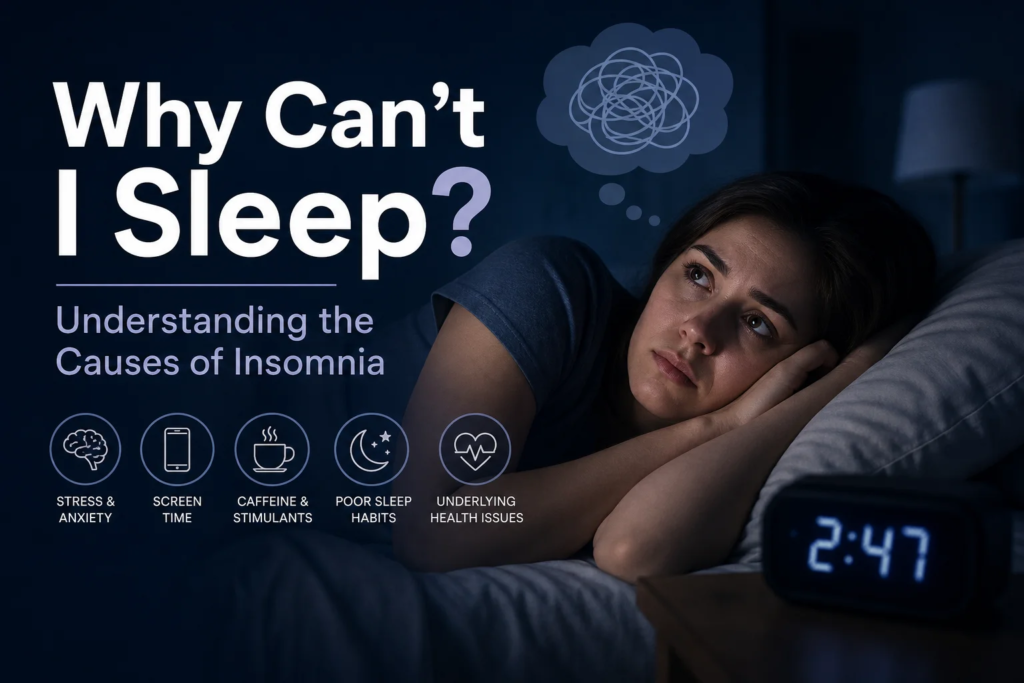
You’re exhausted. Your body feels heavy, your eyes burn, and all you want is sleep. But the moment your head hits the pillow, your mind turns into a late-night talk show: unfinished emails, awkward conversations from three years ago, tomorrow’s responsibilities, that random noise in the hallway. Minutes stretch into hours. You check the clock—again—and the panic begins: If I fall asleep right now, I’ll still only get five hours.
If this sounds familiar, you’re not alone. The question “Why can’t I sleep?” is one of the most common and frustrating health concerns people face. Insomnia can feel mysterious because it often isn’t caused by just one thing. It can be physical, emotional, behavioral, environmental, medical—or all of the above.
This in-depth guide, Why Can’t I Sleep? Understanding the Causes of Insomnia, breaks down the real reasons sleep becomes difficult, why insomnia can persist even after the original trigger disappears, and what you can do to start rebuilding healthier sleep patterns.
Important note: This article is educational and not a substitute for medical advice. If insomnia is severe, long-lasting, or linked with breathing problems, depression, pain, medication side effects, or safety concerns, speak with a qualified healthcare professional.
What Is Insomnia, Really?
Insomnia is more than “not sleeping enough.” It is a sleep disorder involving difficulty falling asleep, staying asleep, waking too early, or having poor-quality sleep despite having the opportunity to sleep.
People often describe insomnia in different ways:
- “I’m tired but wired.”
- “I fall asleep but wake up at 3 a.m.”
- “My brain won’t shut off.”
- “I sleep eight hours but still feel exhausted.”
- “I dread bedtime because I know I’ll be awake.”
When exploring Why Can’t I Sleep? Understanding the Causes of Insomnia, it helps to separate occasional sleep disruption from chronic insomnia.
| Type of Sleep Problem | What It Looks Like | Common Triggers |
|---|---|---|
| Short-term insomnia | Lasts days or weeks | Stress, travel, illness, grief, work pressure |
| Chronic insomnia | Occurs at least 3 nights per week for 3+ months | Anxiety, learned sleep patterns, medical issues, circadian disruption |
| Sleep-onset insomnia | Trouble falling asleep | Racing thoughts, caffeine, screen use, delayed body clock |
| Sleep-maintenance insomnia | Waking during the night | Stress, alcohol, pain, sleep apnea, hormones |
| Early-morning awakening | Waking too early and unable to return to sleep | Depression, anxiety, aging, circadian rhythm changes |
The key point: insomnia is not simply a lack of willpower. You cannot force sleep by trying harder. In fact, trying harder often makes insomnia worse.
Why Can’t I Sleep? Understanding the Causes of Insomnia Starts With Hyperarousal
One of the biggest concepts in insomnia science is hyperarousal. This means your brain and body are in a heightened state of alertness when they should be powering down.
Think of sleep like a dimmer switch. For restful sleep, your nervous system needs to gradually shift from “active mode” to “rest mode.” But when you’re stressed, overstimulated, worried, or physically uncomfortable, the switch gets stuck halfway.
Hyperarousal may show up as:
- Racing thoughts
- Muscle tension
- Elevated heart rate
- Shallow breathing
- Worry about not sleeping
- Sensitivity to sounds
- Feeling sleepy on the couch but alert in bed
This is why the question “why can’t I sleep at night?” is often connected to the question “why can’t I relax at night?”
Your bed may even become associated with wakefulness. After enough nights of tossing and turning, your brain begins to treat bedtime as a stressful event instead of a safe routine. This is one reason chronic insomnia can continue even after the original stressor improves.
The 3P Model: A Proven Way to Understand Insomnia
A helpful framework for Why Can’t I Sleep? Understanding the Causes of Insomnia is the 3P model: predisposing, precipitating, and perpetuating factors.
| Factor Type | Meaning | Examples |
|---|---|---|
| Predisposing factors | Traits or vulnerabilities that make insomnia more likely | Anxiety-prone temperament, family history, sensitive nervous system |
| Precipitating factors | Events that trigger insomnia | Job loss, breakup, illness, new baby, exam stress |
| Perpetuating factors | Habits or beliefs that keep insomnia going | Napping too long, clock-watching, irregular sleep schedule, spending hours awake in bed |
Here’s why this matters: many people focus only on the trigger. They say, “I started sleeping badly after my work stress increased.” But months later, the work stress may be gone while insomnia remains.
That happens because the perpetuating factors have taken over. The body has learned a new pattern.
So if you’re asking “Why can’t I sleep even when I’m tired?”, the answer may be that your sleep system has become conditioned to stay alert.
Stress and Anxiety: The Most Common Sleep Thieves
Stress is one of the most common causes of insomnia. It doesn’t need to be dramatic stress, either. Everyday pressure can be enough: deadlines, caregiving, finances, relationship tension, health worries, or the constant feeling that you’re behind.
Anxiety can make sleep especially difficult because it thrives in quiet moments. During the day, tasks distract you. At night, there is less noise, less movement, and fewer interruptions—so anxious thoughts get louder.
Common anxiety-related sleep patterns include:
- Replaying conversations
- Imagining worst-case scenarios
- Making mental to-do lists
- Worrying about sleep itself
- Feeling a jolt of panic when drifting off
- Waking in the middle of the night with dread
This is central to Why Can’t I Sleep? Understanding the Causes of Insomnia because insomnia often becomes a feedback loop:
- You have a stressful day.
- You sleep poorly.
- You feel tired and less resilient.
- Stress feels harder to manage.
- You worry about sleeping again.
- Sleep becomes even harder.
Breaking that cycle often requires calming the nervous system before bed, but also changing your relationship with wakefulness.
Depression and Insomnia: A Two-Way Street
Depression and insomnia often travel together. Sometimes insomnia appears first; sometimes mood symptoms come first. Either way, poor sleep can worsen emotional regulation, concentration, motivation, and physical energy.
Depression-related sleep problems may include:
- Waking very early
- Sleeping too much but still feeling tired
- Restless or fragmented sleep
- Difficulty getting out of bed
- Nighttime rumination
- Loss of routine
If you’re wondering “why can’t I sleep and why do I feel emotionally drained?”, mood may be part of the answer.
Insomnia can also increase the risk of developing depression, especially when it becomes chronic. That doesn’t mean everyone with insomnia is depressed. But persistent sleep disruption is a signal worth taking seriously.
Seek professional support if insomnia is accompanied by hopelessness, loss of interest, significant appetite changes, persistent sadness, or thoughts of self-harm.
Caffeine, Alcohol, and Nicotine: Substances That Quietly Disrupt Sleep
Many people underestimate how strongly substances affect sleep. When examining Why Can’t I Sleep? Understanding the Causes of Insomnia, caffeine is an obvious place to start—but alcohol and nicotine matter too.
Caffeine
Caffeine blocks adenosine, a chemical that builds sleep pressure throughout the day. Even if caffeine doesn’t make you feel “wired,” it can still reduce sleep depth.
Common caffeine sources include:
- Coffee
- Tea
- Energy drinks
- Cola
- Chocolate
- Pre-workout supplements
- Some headache medications
Caffeine sensitivity varies. Some people can drink espresso after dinner and sleep fine. Others struggle if they drink coffee after noon.
Alcohol
Alcohol may help you fall asleep faster, but it commonly disrupts the second half of the night. It can increase awakenings, reduce REM sleep, worsen snoring, and contribute to dehydration.
That “3 a.m. wake-up” after drinking? Very common.
Nicotine
Nicotine is a stimulant. It can make falling asleep harder and may cause nighttime withdrawal symptoms that fragment sleep.
| Substance | May Help You Feel | What It Can Do to Sleep |
|---|---|---|
| Caffeine | Alert, focused | Delays sleep, reduces deep sleep |
| Alcohol | Relaxed, drowsy | Fragments sleep, worsens early waking |
| Nicotine | Stimulated, calm temporarily | Increases alertness, causes nighttime waking |
If you’re asking “why can’t I sleep after drinking coffee or alcohol?”, your body chemistry may be giving you the answer.
Screens, Light, and the Modern Sleep Problem
Modern life is not built for sleep. We flood our evenings with bright lights, glowing screens, notifications, streaming platforms, online shopping, breaking news, and work messages.
Your brain uses light as a time signal. Bright light in the evening can delay melatonin release and push your body clock later. But the problem is not only blue light. It’s also mental stimulation.
A phone in bed can mean:
- One more email
- One more video
- One more headline
- One more message
- One more comparison
- One more emotional reaction
The result? Your brain stops seeing the bed as a sleep cue and starts seeing it as an entertainment, work, and worry zone.
In the context of Why Can’t I Sleep? Understanding the Causes of Insomnia, screens are a major perpetuating factor. They don’t always start insomnia, but they often help maintain it.
A realistic approach is better than perfection:
- Dim lights one hour before bed.
- Use night mode if needed.
- Avoid emotionally intense content late at night.
- Charge your phone outside the bed area.
- Replace scrolling with a low-stimulation wind-down routine.
Your Circadian Rhythm May Be Out of Sync
Your circadian rhythm is your internal 24-hour clock. It influences sleepiness, alertness, digestion, hormone release, and body temperature.
If your body clock is delayed, you may not feel sleepy until very late—even if you need to wake early. This is common in teenagers, young adults, night owls, remote workers, and people with inconsistent schedules.
Signs of circadian rhythm disruption include:
- Feeling wide awake late at night
- Struggling to wake in the morning
- Sleeping better on weekends
- Feeling jet-lagged without traveling
- Needing alarms but still feeling exhausted
- Falling asleep easily at the “wrong” time
This is another core part of Why Can’t I Sleep? Understanding the Causes of Insomnia. Sometimes the problem is not that you can’t sleep at all—it’s that your body wants to sleep on a different schedule.
Circadian Rhythm Reset Basics
| Strategy | Why It Helps |
|---|---|
| Morning sunlight | Anchors your body clock earlier |
| Consistent wake time | Stabilizes sleep timing |
| Dim evening light | Allows melatonin to rise naturally |
| Regular meals | Gives the body predictable time cues |
| Exercise earlier in the day | Supports sleep pressure and rhythm |
| Avoid long naps | Preserves nighttime sleep drive |
If your sleep schedule is severely delayed, a clinician may suggest timed light exposure or carefully timed melatonin. Timing matters, so professional guidance is helpful.
Medical Conditions That Can Cause Insomnia
Sometimes insomnia is a symptom of an underlying health issue. If sleep problems are persistent, sudden, or worsening, it’s important to consider medical causes.
Common medical contributors include:
- Chronic pain
- Acid reflux
- Asthma or breathing problems
- Thyroid disorders
- Menopause symptoms
- Pregnancy discomfort
- Frequent urination
- Neurological conditions
- Heart disease
- Allergies or sinus congestion
Pain is especially disruptive. Even mild discomfort can trigger micro-awakenings and prevent deep sleep. Acid reflux may worsen when lying down. Hormonal changes can cause night sweats and early waking.
When people search “Why Can’t I Sleep? Understanding the Causes of Insomnia,” they often expect psychological answers, but physical health deserves equal attention.
If you wake gasping, snore loudly, have morning headaches, or feel extremely sleepy during the day despite enough time in bed, ask a healthcare provider about sleep apnea.
Sleep Apnea: The Hidden Cause Many People Miss
Sleep apnea is a condition where breathing repeatedly pauses or becomes shallow during sleep. These interruptions can cause the brain to briefly wake the body to restore breathing, often without the person remembering it.
Signs of possible sleep apnea include:
- Loud snoring
- Gasping or choking during sleep
- Morning headaches
- Dry mouth on waking
- High blood pressure
- Daytime sleepiness
- Trouble concentrating
- Waking frequently at night
Sleep apnea can look like insomnia. Some people don’t complain of sleepiness; they complain that they can’t stay asleep.
That’s why Why Can’t I Sleep? Understanding the Causes of Insomnia must include sleep-disordered breathing. Treating insomnia without recognizing sleep apnea may leave the root problem untouched.
Restless Legs Syndrome and Movement Disorders
Restless legs syndrome, or RLS, causes uncomfortable sensations in the legs and an urge to move them, especially in the evening or at night. People describe it as crawling, tingling, pulling, aching, or electric sensations.
RLS can make falling asleep incredibly difficult.
Clues include:
- Symptoms worsen at rest
- Movement provides temporary relief
- Symptoms are worse at night
- There may be periodic leg movements during sleep
Low iron levels, pregnancy, kidney disease, certain medications, and genetics can contribute. If you regularly feel like your legs “won’t settle,” this may be part of understanding the causes of insomnia in your situation.
Medications and Supplements That May Interfere With Sleep
Some medications can affect sleep, even when taken for unrelated conditions. Never stop medication without speaking to your healthcare provider, but do ask whether timing, dosage, or alternatives could help.
Possible sleep-disrupting medications may include:
- Some antidepressants
- Stimulants for ADHD
- Steroids
- Decongestants
- Certain blood pressure medications
- Some asthma medications
- Thyroid medication if dose is too high
- Diuretics taken late in the day
Even supplements can matter. Some “energy,” weight-loss, or fitness supplements contain stimulants. If you’ve recently added something new and started wondering “why can’t I sleep anymore?”, review the timing and ingredients.
Hormones, Life Stages, and Sleep Changes
Sleep is not static across life. Hormonal shifts can strongly influence sleep quality.
Menstrual Cycle
Some people sleep worse before their period due to changes in progesterone, body temperature, mood, and discomfort.
Pregnancy
Pregnancy can bring nausea, reflux, back pain, frequent urination, anxiety, and restless legs.
Postpartum
Newborn care, fragmented sleep, hormonal shifts, and emotional stress can create intense sleep disruption.
Perimenopause and Menopause
Night sweats, hot flashes, mood changes, and early waking are common.
Aging
Older adults may experience lighter sleep, earlier wake times, more medical conditions, and medication-related sleep disruption.
For many readers, Why Can’t I Sleep? Understanding the Causes of Insomnia becomes personal during a major life transition. Sleep changes are real—not imagined—and they deserve practical support.
The Bedroom Environment: Small Details, Big Impact
Your bedroom can either support sleep or quietly sabotage it. You don’t need a luxury sleep setup, but you do need a space that signals safety, comfort, and darkness.
Key environmental factors:
- Temperature
- Noise
- Light
- Mattress comfort
- Pillow support
- Partner movement
- Pets in bed
- Clutter
- Air quality
The ideal sleep environment is usually cool, dark, quiet, and comfortable. But personal preference matters. Some people sleep better with white noise. Others need silence. Some need blackout curtains. Others need a slightly open window.
| Sleep Barrier | Possible Solution |
|---|---|
| Room too warm | Lower thermostat, use breathable bedding |
| Noise | Earplugs, fan, white noise machine |
| Light | Blackout curtains, eye mask |
| Partner disturbance | Separate blankets, mattress adjustment |
| Pets waking you | Create a separate pet sleep area |
| Clutter or work items | Keep the bed area simple and restful |
If you’re wondering “why can’t I sleep in my own bedroom?”, your environment may be sending the wrong signals.
The Role of Napping: Helpful or Harmful?
Naps can be restorative, but they can also reduce nighttime sleep pressure. Whether napping helps depends on timing, length, and the reason you’re napping.
A short nap of 10–20 minutes early in the afternoon may help some people. But long naps, late naps, or “crash naps” after work can make bedtime harder.
If you have chronic insomnia, frequent napping may perpetuate the cycle:
- Poor sleep at night
- Long nap during the day
- Less sleep pressure at bedtime
- More nighttime wakefulness
- More fatigue tomorrow
This doesn’t mean naps are always bad. Shift workers, new parents, and people recovering from illness may need them. But if your main question is “Why Can’t I Sleep? Understanding the Causes of Insomnia,” your daytime sleep habits are worth examining.
Case Study 1: The High-Achieving Professional Who Couldn’t Switch Off
Profile: Nadia, 38, marketing director
Sleep problem: Trouble falling asleep for 2–3 hours
Main complaint: “I’m exhausted, but my brain starts working the second I lie down.”
Nadia had a demanding job and often worked until 10 p.m. She answered emails from bed and used her phone as her alarm. During the day, she drank coffee to compensate for fatigue. At night, she worried about not sleeping, which made her more alert.
Her insomnia began during a product launch but continued months afterward.
What Was Happening
Nadia’s insomnia started with work stress but was maintained by hyperarousal, caffeine use, screen exposure, and a bed-work association.
Changes That Helped
- Set a firm work shutdown ritual at 8:30 p.m.
- Moved phone charging station across the room
- Reduced caffeine after lunch
- Used a “worry list” one hour before bed
- Got out of bed after prolonged wakefulness instead of forcing sleep
Analysis
Nadia’s story shows why Why Can’t I Sleep? Understanding the Causes of Insomnia must include learned associations. Her bed had become an office, planning center, and worry chamber. Rebuilding the bed as a sleep cue was essential.
Case Study 2: The Shift Worker With a Confused Body Clock
Profile: Marcus, 44, emergency department nurse
Sleep problem: Fragmented daytime sleep after night shifts
Main complaint: “My body doesn’t know when it’s supposed to sleep.”
Marcus worked rotating shifts. Some weeks he worked nights; other weeks he switched to mornings. He drank energy drinks during night shifts and tried to sleep during the day in a bright apartment. On days off, he attempted to return to a normal family schedule.
What Was Happening
Marcus’s main issue was circadian misalignment. His internal clock never had time to stabilize.
Changes That Helped
- Used blackout curtains and a sleep mask
- Wore sunglasses on the commute home after night shifts
- Created a post-shift wind-down routine
- Limited caffeine in the final half of his shift
- Used consistent sleep blocks whenever possible
Analysis
Marcus’s case highlights a crucial part of understanding insomnia causes: sometimes sleep trouble is not anxiety or poor discipline. It is a biological timing problem. His body was receiving conflicting signals about when to be awake and when to sleep.
Case Study 3: The New Parent With Fragmented Sleep and Rising Anxiety
Profile: Elena, 32, first-time parent
Sleep problem: Unable to fall back asleep after nighttime baby care
Main complaint: “The baby goes back to sleep, but I don’t.”
Elena expected interrupted sleep with a newborn, but she didn’t expect to lie awake for hours after feedings. She began anticipating the next wake-up and felt tense even when the baby slept. She checked the monitor repeatedly and became afraid of missing something important.
What Was Happening
Elena’s sleep was fragmented by caregiving, but anxiety and hypervigilance kept her awake afterward.
Changes That Helped
- Shared nighttime duties where possible
- Practiced a brief relaxation technique after feedings
- Stopped checking the clock during the night
- Took short restorative rests earlier in the day
- Spoke with her provider about postpartum anxiety symptoms
Analysis
Elena’s experience shows that Why Can’t I Sleep? Understanding the Causes of Insomnia is not always about getting an uninterrupted eight hours. Sometimes the goal is protecting recovery, reducing fear, and creating realistic support during demanding life stages.
Common Insomnia Triggers and What They May Mean
Here is a practical chart to connect symptoms with possible causes.
| Your Sleep Pattern | Possible Contributors | What to Consider |
|---|---|---|
| Can’t fall asleep | Stress, caffeine, delayed circadian rhythm, screen use | Evening routine, caffeine timing, morning light |
| Wake at 2–4 a.m. | Alcohol, anxiety, depression, blood sugar shifts, hormones | Alcohol intake, mood symptoms, night sweats |
| Wake gasping or snoring | Sleep apnea | Medical evaluation |
| Legs feel restless | Restless legs syndrome | Iron levels, medication review |
| Sleep worse on work nights | Performance anxiety, stress conditioning | Bedtime pressure, work boundaries |
| Sleep better away from home | Bedroom environment, relationship stress, conditioned arousal | Environmental changes |
| Exhausted but wired | Hyperarousal, chronic stress | Nervous system regulation |
| Sleep schedule keeps drifting later | Circadian rhythm delay | Consistent wake time, morning light |
This kind of pattern recognition is essential for Why Can’t I Sleep? Understanding the Causes of Insomnia because insomnia is not one-size-fits-all.
When Sleep Anxiety Becomes the Problem
One of the cruelest parts of insomnia is that sleep itself becomes a performance.
You start calculating:
- “If I fall asleep now, I’ll get six hours.”
- “If I don’t sleep, tomorrow will be ruined.”
- “What if this never gets better?”
- “Why can everyone else sleep except me?”
This mental pressure activates the nervous system. The harder you chase sleep, the more awake you become.
Sleep anxiety can lead to behaviors that seem logical but backfire:
| Behavior | Why It Seems Helpful | How It Can Backfire |
|---|---|---|
| Going to bed very early | More time to sleep | More time awake in bed |
| Sleeping in late | Catching up | Weakens sleep rhythm |
| Long naps | Reduces exhaustion | Lowers nighttime sleep pressure |
| Clock-watching | Tracking the situation | Increases panic |
| Staying in bed for hours awake | Resting at least | Trains bed = awake |
A key insight in Why Can’t I Sleep? Understanding the Causes of Insomnia is that sleep cannot be forced. You can create the conditions for sleep, but you cannot command it.
CBT-I: The Gold-Standard Approach for Chronic Insomnia
Cognitive Behavioral Therapy for Insomnia, known as CBT-I, is widely considered a first-line treatment for chronic insomnia. It addresses the thoughts and behaviors that keep insomnia going.
CBT-I may include:
- Sleep scheduling
- Stimulus control
- Sleep restriction or sleep compression
- Cognitive restructuring
- Relaxation techniques
- Education about sleep biology
Stimulus Control
This approach helps your brain reconnect the bed with sleep. Common instructions may include:
- Use the bed only for sleep and intimacy.
- Go to bed when sleepy, not just tired.
- If awake for a long time, get up and do something quiet until sleepy.
- Wake at the same time daily.
- Avoid long daytime naps.
Sleep Restriction or Compression
This method limits time in bed to better match actual sleep time, then gradually expands it as sleep becomes more efficient. It should be done carefully, especially for people with certain medical conditions, bipolar disorder, seizure disorders, or high-risk jobs.
CBT-I is relevant to Why Can’t I Sleep? Understanding the Causes of Insomnia because chronic insomnia often continues due to conditioning—not because the body has forgotten how to sleep forever.
What You Can Do Tonight: Practical First Steps
If you’re reading this late at night, you probably want something useful now. Here are realistic steps that don’t require a complete lifestyle overhaul.
1. Stop Fighting the Night
If you’ve been awake for a while, try shifting from “I must sleep” to “I’m going to rest and reduce pressure.” This lowers arousal.
2. Get Out of Bed if You’re Wide Awake
If you’re alert, frustrated, or spiraling, leave the bed briefly. Sit somewhere dim and quiet. Read something calm. Return when sleepy.
3. Don’t Check the Clock
Clock-watching turns wakefulness into a countdown. Turn the clock away or cover it.
4. Do a Brain Dump
Write tomorrow’s tasks, worries, and reminders on paper. Tell your brain: “This is stored. I don’t need to solve it at 2 a.m.”
5. Lower the Stimulation
Dim lights. Avoid news, email, intense shows, and arguments close to bedtime.
6. Keep the Morning Anchor
Even after a bad night, wake at a consistent time as much as possible. This helps rebuild sleep pressure for the next night.
These steps won’t solve every cause, but they support the foundation of Why Can’t I Sleep? Understanding the Causes of Insomnia: reduce arousal, strengthen rhythm, and retrain the bed-sleep connection.
When to Seek Professional Help
Occasional insomnia is common. But you should consider professional support if:
- Insomnia lasts longer than three months
- You can’t function during the day
- You feel depressed, anxious, or hopeless
- You snore loudly or wake gasping
- You have restless legs symptoms
- Pain, reflux, or medical symptoms wake you
- Medication may be involved
- You rely on alcohol or sedatives to sleep
- You feel unsafe driving due to sleepiness
A healthcare provider may recommend sleep testing, medication review, CBT-I, mental health support, or treatment for underlying conditions.
Searching “Why Can’t I Sleep? Understanding the Causes of Insomnia” is a strong first step—but persistent insomnia deserves individualized care.
The Emotional Side of Insomnia: You Are Not Broken
Insomnia can feel deeply personal. It may make you feel weak, unhealthy, anxious, or out of control. But sleep difficulty is not a character flaw.
Your body is trying to protect you. Hyperarousal is a survival mechanism. Your brain stays alert when it senses threat, pressure, pain, uncertainty, or disruption. The problem is that modern life can keep that alarm system turned on long after danger has passed.
Understanding the causes of insomnia helps replace shame with strategy.
Instead of asking, “What’s wrong with me?” try asking:
- What is my nervous system responding to?
- What signals am I giving my body at night?
- Is my sleep schedule consistent?
- Could a medical issue be involved?
- Am I spending too much time awake in bed?
- What support do I need?
That shift is powerful. It turns insomnia from an enemy into information.
Conclusion: Better Sleep Begins With Understanding
So, why can’t I sleep? The answer may involve stress, anxiety, depression, caffeine, alcohol, screens, circadian rhythm disruption, pain, hormones, medications, sleep apnea, restless legs, or learned patterns that keep the brain alert in bed.
The heart of Why Can’t I Sleep? Understanding the Causes of Insomnia is this: insomnia is usually not random. It has patterns. And once you understand those patterns, you can begin changing them.
Start small. Protect your mornings. Reduce evening stimulation. Stop turning bedtime into a battle. Pay attention to substances, medical symptoms, and emotional stress. If insomnia persists, seek help—especially CBT-I or medical evaluation when appropriate.
You are not broken. Your sleep system can recover. With patience, consistency, and the right support, restful nights can become possible again.
1. Why can’t I sleep even though I’m exhausted?
You may be experiencing hyperarousal. This happens when your body is tired but your nervous system remains alert due to stress, anxiety, caffeine, pain, screen stimulation, or worry about sleep. Being exhausted does not always mean your brain is ready to sleep.
2. What is the most common cause of insomnia?
Stress is one of the most common triggers, but chronic insomnia often continues because of habits and thought patterns that maintain wakefulness, such as irregular sleep schedules, long naps, clock-watching, and spending too much time awake in bed.
3. Can insomnia be caused by a medical condition?
Yes. Pain, acid reflux, thyroid problems, asthma, menopause symptoms, frequent urination, sleep apnea, and restless legs syndrome can all contribute to insomnia. If symptoms are persistent or unusual, consult a healthcare professional.
4. Is it bad to stay in bed when I can’t sleep?
If you are relaxed, resting in bed is fine. But if you are frustrated, anxious, or wide awake for a long time, getting up briefly may help. This prevents your brain from associating the bed with stress and wakefulness.
5. Does alcohol help insomnia?
Alcohol may make you feel drowsy, but it often worsens sleep quality. It can fragment sleep, reduce REM sleep, increase early-morning waking, and worsen snoring or sleep apnea.
6. How long does insomnia usually last?
Short-term insomnia may last a few days or weeks, especially during stress. Chronic insomnia lasts at least three nights per week for three months or longer. Chronic insomnia is treatable, especially with CBT-I.
7. When should I see a doctor about insomnia?
Seek help if insomnia lasts more than a few weeks, affects daily functioning, comes with mood symptoms, involves loud snoring or gasping, includes restless legs, or may be related to medication or a medical condition.
8. What is the best first step to improve sleep?
Choose one consistent morning wake time and get morning light exposure. This helps regulate your circadian rhythm. Then reduce evening stimulation and avoid spending long periods awake in bed. These basics can make a meaningful difference over time.

