


You open your phone to check one message. Five minutes later, you’re watching a stranger’s vacation vlog, reading heated comments under a political post, comparing your lunch to someone’s “clean eating” meal prep, and wondering why your thumb is still moving.
Sound familiar?
That tiny moment—when a quick check becomes a 45-minute scroll—is not simply a failure of discipline. It is the result of carefully engineered platforms colliding with ancient human needs: connection, curiosity, validation, novelty, belonging, and status.
Understanding Why We Can’t Stop Scrolling: The Psychology Behind Social Media Addiction matters because social media is no longer just entertainment. It shapes how we work, date, shop, learn, argue, relax, and see ourselves. For many people, the problem is not that they use social media. The problem is that social media starts using them.
This article explores Why We Can’t Stop Scrolling: The Psychology Behind Social Media Addiction through psychology, neuroscience, real-world examples, behavioral design, and practical recovery strategies. The goal is not to shame your screen time. It is to help you understand it—and regain choice.
What Do We Really Mean by “Social Media Addiction”?
Before diving into Why We Can’t Stop Scrolling: The Psychology Behind Social Media Addiction, it is important to clarify the word “addiction.”
Not everyone who uses social media often is addicted. Many people spend hours online for work, education, creativity, activism, or maintaining relationships. The issue becomes more serious when use feels compulsive, difficult to control, emotionally necessary, or damaging to daily life.
A healthier term some researchers use is “problematic social media use.” Still, the phrase “social media addiction” captures something many people recognize: the feeling of wanting to stop but continuing anyway.
Common Signs of Problematic Social Media Use
| Sign | What It Looks Like in Real Life |
|---|---|
| Loss of control | You plan to scroll for 10 minutes and lose an hour |
| Emotional dependence | You feel anxious, empty, or irritable when you cannot check your phone |
| Neglect of responsibilities | Sleep, school, work, exercise, or relationships suffer |
| Tolerance | You need more scrolling to feel entertained or soothed |
| Withdrawal-like feelings | Restlessness, boredom, or FOMO when offline |
| Failed attempts to cut back | You delete an app and reinstall it the same day |
The key is not just time spent. It is the relationship you have with the behavior.
That is the central question behind Why We Can’t Stop Scrolling: The Psychology Behind Social Media Addiction: what makes social platforms so hard to leave, even when part of us wants to?
The Dopamine Loop: Why Your Brain Loves the Scroll
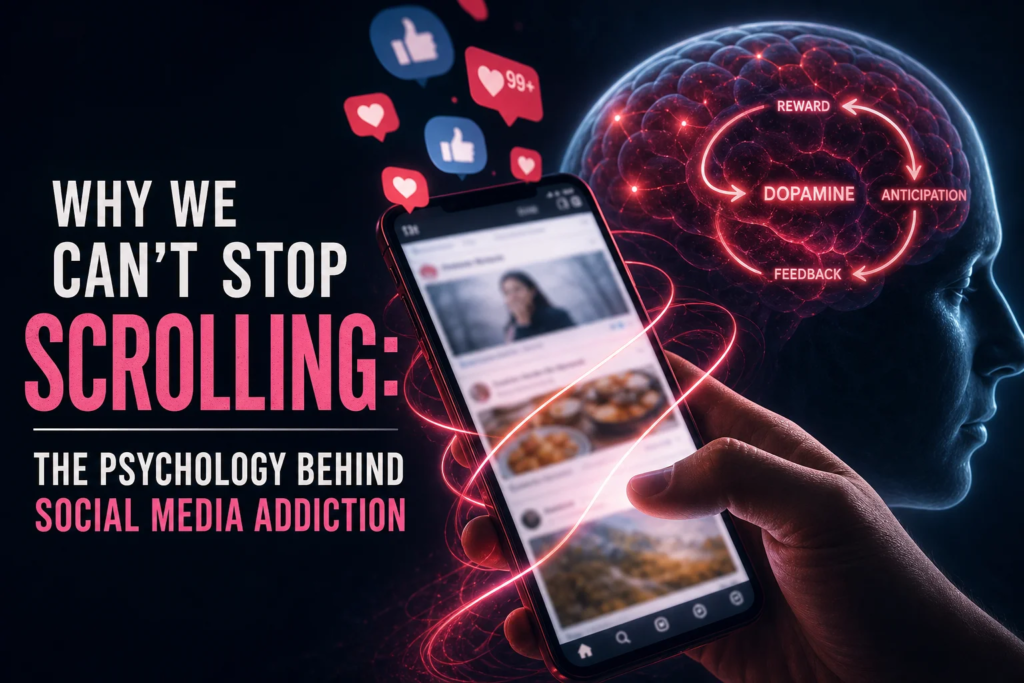
One of the biggest explanations for Why We Can’t Stop Scrolling: The Psychology Behind Social Media Addiction is the brain’s reward system.
Dopamine is often called the “pleasure chemical,” but that is only partly true. Dopamine is more accurately linked to motivation, anticipation, and seeking. It pushes us toward things that might be rewarding.
Social media is packed with potential rewards:
- A new like
- A funny video
- A message from someone important
- A shocking headline
- A flattering comment
- A viral trend
- A notification that makes you feel noticed
The crucial word is “potential.” You do not know exactly what you will get when you refresh your feed. That uncertainty is powerful.
The Habit Loop Behind Scrolling
| Stage | Social Media Example | Psychological Effect |
|---|---|---|
| Cue | You feel bored, lonely, stressed, or hear a notification | |
| Craving | You anticipate relief, entertainment, or validation | |
| Response | You open the app and scroll | |
| Reward | You find something funny, emotional, interesting, or affirming | |
| Reinforcement | Your brain learns: “When I feel this way, scrolling helps” |
This loop explains a major part of why we can’t stop scrolling. The behavior becomes automatic. You are not consciously deciding every time. Your brain is following a learned pathway.
The Slot Machine Effect
Social media feeds work a lot like slot machines. You pull down to refresh, swipe up, or tap an icon. Sometimes you get nothing interesting. Sometimes you get something great. That unpredictable reward pattern is called variable reinforcement.
Variable rewards are especially habit-forming because the brain keeps thinking, “Maybe the next one will be good.”
This is one reason the psychology behind social media addiction is so closely tied to gambling psychology. Both systems use uncertainty, anticipation, and intermittent reward to keep people engaged.
Infinite Scroll: The Design Feature That Removed the Stopping Point
Once upon a time, websites had pages. You reached the bottom. You made a choice: click “next” or leave.
Infinite scroll changed that.
Now there is no natural endpoint. The feed continues as long as your attention does. This small design choice is central to Why We Can’t Stop Scrolling: The Psychology Behind Social Media Addiction.
When there is no stopping cue, the brain has to create one. But tired, stressed, overstimulated brains are not great at self-regulation. So the thumb keeps moving.
Old Internet vs. Social Media Feed Design
| Feature | Older Web Experience | Modern Social Media Feed |
|---|---|---|
| Ending point | Clear page bottom | Endless content |
| User control | Search-based | Algorithm-driven |
| Pace | Slower browsing | Rapid-fire novelty |
| Feedback | Delayed or minimal | Instant likes, comments, shares |
| Social comparison | Less constant | Continuous exposure |
| Emotional triggers | Occasional | Constantly optimized |
Infinite scroll does not force anyone to stay. But it removes friction. And when friction disappears, habits become easier to repeat.
That is a recurring theme in Why We Can’t Stop Scrolling: The Psychology Behind Social Media Addiction: platforms do not need to control your mind. They simply need to make the next action effortless.
Algorithms Know What Keeps You Watching
Another major part of Why We Can’t Stop Scrolling: The Psychology Behind Social Media Addiction is personalization.
Your feed is not random. It is shaped by your behavior:
- What you pause on
- What you like
- What you share
- What you comment on
- What you rewatch
- What makes you angry
- What makes you laugh
- What keeps you from closing the app
Algorithms learn from attention. If you stop on relationship drama, you may get more relationship drama. If you watch fitness transformations, you may get more bodies to compare yourself to. If outrage keeps you engaged, outrage may keep appearing.
This does not mean algorithms are evil. Recommendation systems can help people discover useful information, niche communities, educational content, and creative inspiration. But their primary business goal is usually engagement.
And engagement often rewards intensity.
Why Emotional Content Spreads Fast
| Emotion | Why It Hooks Attention |
|---|---|
| Anger | Creates urgency and moral reaction |
| Fear | Triggers threat monitoring |
| Envy | Activates comparison and self-evaluation |
| Awe | Encourages sharing and wonder |
| Humor | Provides quick reward and social bonding |
| Desire | Sparks aspiration, fantasy, or craving |
This is another layer of the psychology behind social media addiction: we are not addicted only to pleasure. We can also become hooked on outrage, anxiety, drama, and comparison.
FOMO: The Fear of Missing Out
FOMO is one of the most relatable reasons why we can’t stop scrolling.
Humans are social creatures. For most of history, being excluded from the group could mean danger. Our brains evolved to monitor social belonging closely.
Social media turns that instinct into a 24/7 alert system.
You might fear missing:
- A friend’s announcement
- A trending joke
- A breaking news story
- A professional opportunity
- A group chat decision
- A party you were not invited to
- A cultural moment everyone will discuss tomorrow
FOMO makes checking feel responsible. You are not “wasting time”; you are staying updated. But the stream never ends. There is always another update, another trend, another conversation.
That endless social monitoring is central to Why We Can’t Stop Scrolling: The Psychology Behind Social Media Addiction. The platforms tap into a deep need: “Am I still included?”
Social Validation: Likes, Comments, and the Need to Be Seen
One of the most powerful aspects of Why We Can’t Stop Scrolling: The Psychology Behind Social Media Addiction is validation.
A like is small, but it carries meaning. It can feel like:
- Approval
- Recognition
- Agreement
- Attraction
- Belonging
- Social proof
- Evidence that you matter
For creators, professionals, and young people especially, metrics can become emotional mirrors. A post does well, and you feel valuable. A post flops, and you wonder what you did wrong.
The problem is that social media turns human connection into numbers.
The Emotional Impact of Metrics
| Platform Signal | Possible Emotional Interpretation |
|---|---|
| Likes | “People approve of me” |
| Comments | “People care enough to respond” |
| Shares | “My thoughts are worth spreading” |
| Followers | “I am important or interesting” |
| Views | “People are paying attention” |
| No response | “Maybe I am invisible” |
This is why the psychology behind social media addiction is not just about entertainment. It is about identity. The platforms become places where people test their worth in public.
And that can be exhausting.
Social Comparison: The Highlight Reel Trap
You know people post curated versions of their lives. You know the vacation photo does not show the credit card bill, the argument, the loneliness, or the 72 attempts to get the perfect angle.
Still, comparison happens.
That is because social comparison is automatic. We evaluate ourselves in relation to others. Social media intensifies this by exposing us to endless images of beauty, success, romance, wealth, fitness, parenting, travel, productivity, and happiness.
This is a major factor in Why We Can’t Stop Scrolling: The Psychology Behind Social Media Addiction: the feed creates both pain and fascination.
You may feel worse while scrolling, but you continue because you are trying to answer questions like:
- Am I attractive enough?
- Am I successful enough?
- Am I falling behind?
- Is everyone happier than me?
- What should my life look like?
The trap is that comparison rarely resolves insecurity. It feeds it.
Case Study 1: The Student Who Couldn’t Log Off
Background:
Maya, a 19-year-old college student, began using social media heavily during her first semester away from home. At first, it helped her stay connected. But soon, she found herself scrolling late into the night, comparing herself to classmates who seemed more social, stylish, and successful.
Behavior pattern:
She checked Instagram and TikTok between classes, during meals, while studying, and before sleep. Her grades slipped. She felt anxious when she posted and did not receive quick responses.
Turning point:
After noticing she slept only five hours most nights, Maya started tracking not just screen time, but emotional triggers. She realized she opened apps most often when she felt lonely or academically overwhelmed.
Intervention:
She replaced late-night scrolling with scheduled video calls, joined a campus club, removed social apps from her phone during study hours, and followed accounts focused on learning rather than lifestyle comparison.
Analysis:
Maya’s case highlights Why We Can’t Stop Scrolling: The Psychology Behind Social Media Addiction in a young adult context. Her behavior was not simply about entertainment. It was driven by loneliness, social comparison, validation-seeking, and stress relief. Once she identified the emotional function of scrolling, change became more realistic.
Boredom Has Become Uncomfortable
Another overlooked reason why we can’t stop scrolling is that boredom now feels almost intolerable.
Waiting in line? Scroll.
Elevator ride? Scroll.
Awkward silence? Scroll.
Commercial break? Scroll.
Feeling a difficult emotion? Scroll.
The problem is not that boredom is bad. Boredom can be useful. It creates space for reflection, creativity, planning, and emotional processing.
But social media offers instant escape. It fills every quiet moment with novelty.
Over time, the brain may become less practiced at simply being still. This is one reason the psychology behind social media addiction is deeply connected to attention training. What we repeatedly do, we get better at. If we repeatedly avoid boredom, boredom becomes harder to tolerate.
The Role of Stress, Anxiety, and Emotional Regulation
Many people use social media as a coping mechanism. After a stressful meeting, a fight, a lonely evening, or a wave of anxiety, scrolling provides quick distraction.
This helps explain Why We Can’t Stop Scrolling: The Psychology Behind Social Media Addiction: the behavior often works in the short term.
It can:
- Numb discomfort
- Delay difficult tasks
- Provide companionship
- Offer humor
- Distract from worry
- Create a sense of control
- Give the brain something predictable to do
But short-term relief can create long-term dependency. If scrolling becomes the main way to regulate emotions, the person may not develop other coping tools.
Healthy vs. Unhealthy Emotional Regulation
| Need | Scrolling May Provide | Healthier Alternative |
|---|---|---|
| Stress relief | Distraction | Walk, breathing exercise, journaling |
| Loneliness relief | Parasocial connection | Call a friend, join a group |
| Boredom relief | Novelty | Read, create, learn, rest |
| Anxiety relief | Avoidance | Grounding techniques, therapy, planning |
| Validation | Likes and comments | Real conversation, self-compassion |
| Escape | Temporary numbing | Problem-solving, boundaries, support |
This does not mean you should never scroll to relax. The issue is whether it is one tool among many—or the only tool you reach for.
Parasocial Relationships: Feeling Close to People We Don’t Know
Social media allows us to follow influencers, creators, celebrities, experts, streamers, and everyday people with unusual intimacy. We see their homes, meals, children, routines, struggles, jokes, and opinions.
Over time, we may feel like we know them.
These one-sided emotional bonds are called parasocial relationships. They can be harmless, comforting, and even inspiring. But they can also make platforms harder to leave.
This is another subtle part of Why We Can’t Stop Scrolling: The Psychology Behind Social Media Addiction. You are not just consuming content. You are keeping up with “people” your brain experiences as socially meaningful.
You may wonder:
- Did she post an update about her breakup?
- Did that creator respond to the controversy?
- What did my favorite streamer say today?
- How is that family’s baby doing?
Social media turns strangers into familiar figures. The result is emotional investment—and more scrolling.
The Business Model of Attention
To understand Why We Can’t Stop Scrolling: The Psychology Behind Social Media Addiction, we must talk about money.
Most major social platforms profit from attention. The longer you stay, the more ads you see, the more data you generate, and the more accurately content can be targeted.
This does not mean every designer, engineer, or company leader wants users to suffer. Many people inside tech companies care deeply about user well-being. Still, the incentive structure matters.
If a platform makes money when people spend more time on it, it will naturally optimize for time, frequency, and engagement.
Attention Economy in Simple Terms
| Platform Goal | Design Strategy | User Experience |
|---|---|---|
| Increase time spent | Infinite scroll, autoplay | “Just one more” feeling |
| Increase return visits | Notifications, streaks | Fear of missing out |
| Increase engagement | Likes, comments, shares | Social validation loop |
| Improve targeting | Data tracking | Personalized feed |
| Boost emotional response | Controversial or intense content | Outrage, fascination, anxiety |
The attention economy is not the whole answer to the psychology behind social media addiction, but it is a major force. Human vulnerabilities become business opportunities.
Case Study 2: The Professional Trapped by “Productive” Scrolling
Background:
Daniel, a 34-year-old marketing consultant, justified heavy social media use as professional research. He followed industry leaders, monitored trends, and posted regularly to build his personal brand.
Behavior pattern:
His workday became fragmented. He checked LinkedIn, X, Instagram, and TikTok every 15 to 20 minutes. He called it networking, but much of the time was spent reading arguments, comparing competitors, and refreshing analytics.
Consequences:
Daniel felt constantly behind. He struggled with deep work, postponed client projects, and became preoccupied with whether his posts performed well.
Turning point:
A client deadline was missed after a morning disappeared into “research.” Daniel reviewed his browser history and realized only 20% of his platform use was directly work-related.
Intervention:
He created two windows for social media work: 30 minutes in the morning and 30 minutes in the afternoon. He used a separate app for scheduling posts, turned off analytics notifications, and wrote down a purpose before opening any platform.
Analysis:
Daniel’s case shows why Why We Can’t Stop Scrolling: The Psychology Behind Social Media Addiction applies beyond teenagers or casual users. Social media can disguise compulsive checking as ambition, research, branding, or productivity. The solution was not total abstinence; it was intentional structure.
Short-Form Video and the Acceleration of Reward
Short-form video has intensified Why We Can’t Stop Scrolling: The Psychology Behind Social Media Addiction.
TikTok, Instagram Reels, YouTube Shorts, and similar formats deliver rapid novelty. Each swipe brings a new emotional world: comedy, outrage, beauty, advice, confession, music, drama, education, or shock.
Short videos are especially compelling because they require little effort. You do not have to choose what to watch. The feed decides. If you dislike something, swipe. If you love something, stay. The algorithm learns.
Why Short-Form Video Is So Sticky
| Feature | Psychological Effect |
|---|---|
| Fast pacing | Keeps attention stimulated |
| Autoplay | Reduces decision-making |
| Personalization | Increases relevance |
| Music and faces | Heightens emotional connection |
| Quick payoff | Rewards the brain rapidly |
| Endless feed | Removes stopping cues |
This creates a high-speed reward environment. After that, slower activities—reading a book, studying, having a quiet conversation—can feel less stimulating.
That is one of the deeper concerns in the psychology behind social media addiction: it may change what level of stimulation feels normal.
The Myth of Willpower
Many people blame themselves for scrolling too much. They say:
- “I’m lazy.”
- “I have no discipline.”
- “I just need more willpower.”
- “Everyone else handles it better.”
But Why We Can’t Stop Scrolling: The Psychology Behind Social Media Addiction shows that willpower is only part of the story.
You are using tools designed by teams of experts who understand behavioral psychology, data science, design, and habit formation. These platforms are tested and optimized at massive scale.
That does not remove personal responsibility. But it changes the question.
Instead of asking, “Why am I so weak?” ask:
- What cue triggers my scrolling?
- What reward am I seeking?
- What design features keep me engaged?
- What emotional need is the app meeting?
- How can I add friction?
- What healthier reward can replace it?
This shift is empowering. Shame says, “I am the problem.” Psychology says, “There is a pattern I can understand.”
Case Study 3: The Teen Athlete and the Sleep Spiral
Background:
Jordan, a 16-year-old athlete, began watching short videos at night to relax after practice and homework. His parents noticed he was tired, irritable, and less focused during games.
Behavior pattern:
Jordan told himself he would watch videos for 15 minutes before bed. Most nights, he scrolled for more than an hour. The content was not always negative; much of it was sports highlights, comedy, and training advice.
Consequences:
His sleep dropped from eight hours to six. His reaction time and mood worsened. He became more reliant on scrolling because he felt too tired to do anything else.
Turning point:
His coach discussed recovery and performance. Jordan connected poor sleep with lower athletic performance and agreed to experiment with a phone charging station outside his bedroom.
Intervention:
He set a nightly cutoff, used an alarm clock instead of his phone, and created a post-practice wind-down routine with stretching and music.
Analysis:
Jordan’s story demonstrates Why We Can’t Stop Scrolling: The Psychology Behind Social Media Addiction through the sleep cycle. The content itself was not obviously harmful. The problem was timing, compulsion, and lost recovery. For teens especially, sleep protection is one of the most important interventions.
Social Media, Sleep, and the Late-Night Scroll
Sleep is one of the biggest casualties of problematic social media use.
Late-night scrolling is harmful for several reasons:
- Time displacement: You simply go to bed later.
- Mental stimulation: Emotional content wakes up the brain.
- Blue light exposure: Screens can interfere with natural sleep signals, especially when used close to bedtime.
- Social activation: Messages, comments, and posts make the mind socially alert.
- Autoplay and infinite scroll: There is no clear ending point.
This is a practical reason Why We Can’t Stop Scrolling: The Psychology Behind Social Media Addiction should be taken seriously. Sleep affects mood, attention, immunity, learning, impulse control, and mental health.
Poor sleep also weakens self-control the next day, making compulsive scrolling more likely. It becomes a loop.
The Sleep-Scroll Cycle
| Step | What Happens |
|---|---|
| 1 | You scroll late to relax |
| 2 | You sleep less or sleep poorly |
| 3 | You wake tired and unfocused |
| 4 | Your brain seeks easy stimulation |
| 5 | You scroll more throughout the day |
| 6 | You feel stressed and repeat the cycle |
Breaking this cycle often produces fast benefits. Many people notice improved mood and focus within days of moving the phone away from the bed.
Why Quitting Completely Usually Doesn’t Work
When people become frustrated, they often decide to delete everything.
Sometimes that works. For some, a full digital detox is necessary and helpful. But for many people, total quitting fails because social media serves real functions:
- Work visibility
- Friendship maintenance
- Community support
- News awareness
- Creative expression
- Business marketing
- Entertainment
- Learning
A better approach is intentional use.
Understanding Why We Can’t Stop Scrolling: The Psychology Behind Social Media Addiction helps us move beyond all-or-nothing thinking. The goal is not necessarily to erase social media. The goal is to stop using it automatically.
Ask yourself: “Am I choosing this, or am I being pulled?”
That question alone can change your relationship with the feed.
Practical Strategies to Stop Compulsive Scrolling
Now that we have explored Why We Can’t Stop Scrolling: The Psychology Behind Social Media Addiction, let’s turn insight into action.
1. Identify Your Scrolling Triggers
For three days, write down when you reach for your phone.
Track:
- Time of day
- Emotion
- Location
- App opened
- How long you stayed
- How you felt afterward
Patterns will appear. Maybe you scroll when you are anxious, bored, rejected, tired, or avoiding a task.
Awareness is the first step toward control.
2. Add Friction
If an app is one tap away, habit wins.
Add friction by:
- Removing apps from your home screen
- Logging out after each use
- Turning your phone grayscale
- Using app blockers
- Setting downtime schedules
- Keeping your phone outside the bedroom
- Disabling nonessential notifications
The goal is not punishment. It is to create a pause.
3. Replace the Reward
You cannot simply remove a habit and leave an empty space. If scrolling gives you stress relief, you need another stress reliever. If it gives connection, you need another form of connection.
Try replacing:
| Scrolling Need | Replacement |
|---|---|
| Quick relaxation | Two-minute breathing exercise |
| Boredom | Book, puzzle, music, walk |
| Connection | Voice message or real conversation |
| Validation | Share with one trusted friend |
| News | Scheduled news briefing |
| Inspiration | Saved articles or long-form content |
| Escape | Exercise, shower, journaling |
4. Create “No-Scroll Zones”
Choose specific places or times where social media is off-limits:
- First 30 minutes after waking
- Last hour before bed
- During meals
- In the bathroom
- During work blocks
- While walking
- When talking with someone in person
Clear rules reduce decision fatigue.
5. Use Social Media With a Purpose
Before opening an app, say what you are there to do:
- “I’m replying to three messages.”
- “I’m posting my work update.”
- “I’m checking event details.”
- “I’m watching saved recipes for 10 minutes.”
When the purpose is complete, leave.
This is a powerful antidote to Why We Can’t Stop Scrolling: The Psychology Behind Social Media Addiction because it restores agency.
6. Curate Aggressively
Your feed shapes your mind. Treat it like a mental environment.
Unfollow or mute accounts that regularly trigger:
- Envy
- Anger
- Shame
- Doom
- Insecurity
- Compulsive checking
Follow accounts that support:
- Learning
- Humor
- Creativity
- Realistic wellness
- Community
- Professional growth
- Joy
Curation is not avoidance. It is digital hygiene.
7. Protect Deep Work
If you use social media for work, separate creation from consumption.
Try:
- Posting through scheduling tools
- Checking comments at set times
- Using website blockers during focus blocks
- Keeping analytics hidden except once daily or weekly
- Separating “research” from “scrolling” with a timer
This is especially important for professionals who understand the psychology behind social media addiction but still get pulled in under the banner of productivity.
A Simple 7-Day Reset Plan
If you want a practical starting point, use this one-week reset.
| Day | Focus | Action |
|---|---|---|
| Day 1 | Awareness | Track every social media session |
| Day 2 | Notifications | Turn off all nonessential alerts |
| Day 3 | Environment | Remove apps from home screen |
| Day 4 | Sleep | Charge phone outside bedroom |
| Day 5 | Replacement | Choose three non-phone coping tools |
| Day 6 | Curation | Unfollow/mute 20 draining accounts |
| Day 7 | Boundaries | Set two daily social media windows |
This reset is not about perfection. It is about seeing how much of your attention you can reclaim with small changes.
When to Seek Professional Help
Sometimes self-help strategies are not enough. Consider speaking with a mental health professional if social media use is causing serious problems such as:
- Persistent anxiety or depression
- Severe sleep disruption
- Academic or work failure
- Relationship conflict
- Isolation
- Inability to cut back despite repeated attempts
- Using social media to escape trauma, grief, or intense emotional pain
Understanding Why We Can’t Stop Scrolling: The Psychology Behind Social Media Addiction can be helpful, but professional support may be needed when the behavior is tied to deeper issues.
Therapies such as cognitive behavioral therapy, acceptance and commitment therapy, mindfulness-based approaches, and treatment for underlying anxiety, ADHD, depression, or loneliness may help.
The Future: Can Social Media Become Healthier?
The conversation around Why We Can’t Stop Scrolling: The Psychology Behind Social Media Addiction is not only personal. It is cultural and technological.
Healthier platforms could include:
- Optional stopping points
- Better time-use dashboards
- Less intrusive notifications
- Stronger teen protections
- Transparent recommendation settings
- Chronological feeds
- Built-in reflection prompts
- Reduced emphasis on public metrics
- Ethical design standards
Users can make changes, but companies and policymakers also play a role. The burden should not fall entirely on individuals to resist systems designed to capture attention.
Still, personal agency matters. You do not have to wait for the internet to become healthier before improving your own relationship with it.
Conclusion: Reclaiming Your Attention
So, Why We Can’t Stop Scrolling: The Psychology Behind Social Media Addiction comes down to a powerful mix of brain chemistry, emotional needs, social validation, algorithmic personalization, infinite design, FOMO, and the attention economy.
We scroll because it works—at least briefly. It entertains us, soothes us, informs us, validates us, distracts us, and connects us. But when scrolling becomes automatic, it can quietly steal sleep, focus, confidence, time, and presence.
The answer is not shame. The answer is awareness plus design.
Notice your triggers. Add friction. Replace the reward. Protect sleep. Curate your feed. Use platforms with purpose. Seek help if the behavior feels unmanageable.
The most important takeaway from Why We Can’t Stop Scrolling: The Psychology Behind Social Media Addiction is this: your attention is not a small thing. It is your life, moment by moment.
Every time you pause before opening an app, every time you choose a real conversation over a reflexive scroll, every time you go to bed without taking the feed with you—you are rebuilding the muscle of choice.
And choice is where freedom begins.
1. Is social media addiction real?
Social media addiction is not always classified the same way as substance addiction, but problematic social media use is very real. Many people experience compulsive checking, loss of control, emotional dependence, and negative effects on sleep, work, school, or relationships. The phrase Why We Can’t Stop Scrolling: The Psychology Behind Social Media Addiction describes the psychological mechanisms that make these platforms habit-forming.
2. Why do I keep scrolling even when I’m not enjoying it?
You may be caught in a reward loop. Social media uses variable rewards, meaning something interesting might appear at any moment. Your brain keeps seeking the next payoff, even if much of the experience feels boring, stressful, or unsatisfying. This is central to why we can’t stop scrolling.
3. How many hours of social media per day is too much?
There is no universal number. The better question is whether social media is harming your sleep, mood, productivity, relationships, or self-esteem. Two hours of intentional use may be healthier than 45 minutes of compulsive, anxiety-driven checking.
4. Are teenagers more vulnerable to social media addiction?
Teenagers can be especially vulnerable because their brains are still developing impulse control, identity, and emotional regulation. Social approval also feels particularly important during adolescence. That makes the psychology behind social media addiction especially relevant for parents, educators, and teens themselves.
5. Can I have a healthy relationship with social media?
Yes. Healthy use is intentional, limited, and aligned with your values. You can use social media for learning, connection, creativity, and work without letting it dominate your attention. Boundaries, notification control, feed curation, and no-phone routines can help.
6. What is the fastest way to reduce compulsive scrolling?
Start by turning off nonessential notifications and removing social apps from your home screen. Then create phone-free times, especially before bed and after waking. These simple changes add friction and interrupt automatic behavior.
7. Should I delete all my social media accounts?
Not necessarily. Some people benefit from deleting accounts, especially if use feels severely compulsive. Others do better with structured limits. The goal is not always total abstinence; it is regaining control.
8. Why is short-form video so addictive?
Short-form video delivers rapid novelty, emotional stimulation, personalization, and effortless consumption. Each swipe offers a new possible reward. This makes it one of the clearest examples of Why We Can’t Stop Scrolling: The Psychology Behind Social Media Addiction in modern platform design.

