


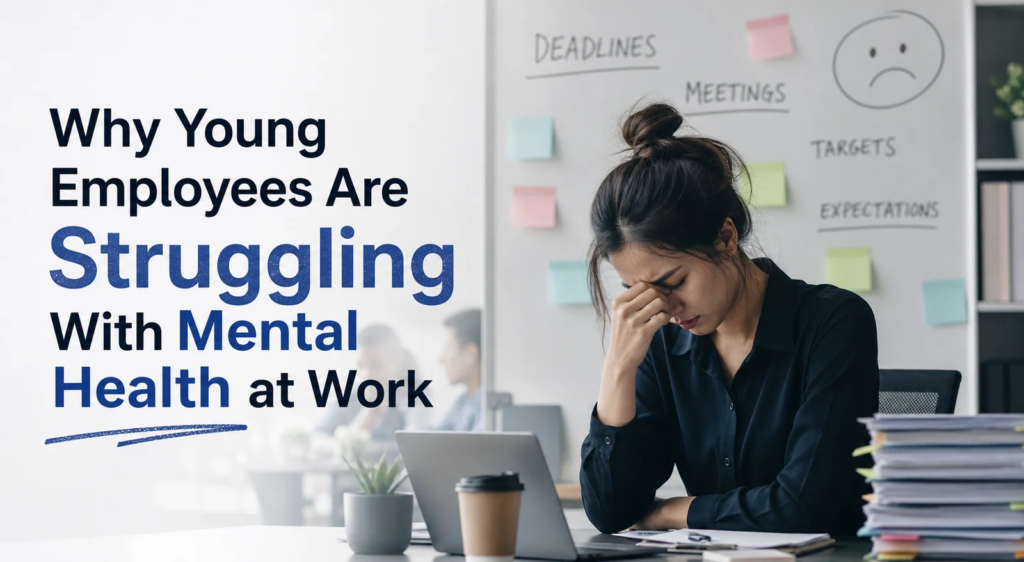
A young employee sits in a Monday morning meeting, camera on, face composed, nodding at the right moments. On paper, everything looks fine: they have a job, a degree, digital skills, ambition, and access to workplace tools previous generations never had. But underneath the surface, they may be exhausted, anxious, financially stretched, lonely, and quietly wondering whether they can keep going at the current pace.
That is the hidden reality behind Why Young Employees Are Struggling With Mental Health at Work.
This is not simply a story about “fragile” younger workers or a generation that needs to toughen up. That explanation is too easy—and deeply inaccurate. The real issue is more complex. Young employees are entering work during a period of economic uncertainty, digital overload, blurred boundaries, social comparison, climate anxiety, unstable career paths, and rising expectations around productivity and self-optimization.
In other words, Why Young Employees Are Struggling With Mental Health at Work has less to do with weakness and more to do with the changing nature of work itself.
Young professionals are often told they should feel grateful to have opportunities. Yet many are navigating workplaces that reward constant availability, celebrate hustle, and provide limited psychological safety. They are expected to build careers, manage debt, save money, adapt to new technologies, maintain a personal brand, and stay emotionally resilient—all at once.
So the better question is not, “What is wrong with young employees?” The better question is: Why Young Employees Are Struggling With Mental Health at Work, and what can organizations do to create healthier, more human workplaces?
The Big Picture: Why Young Employees Are Struggling With Mental Health at Work
To understand Why Young Employees Are Struggling With Mental Health at Work, we need to look beyond individual stress and examine the ecosystem around them.
Mental health at work is shaped by more than personal coping skills. It is influenced by workload, management style, workplace culture, job security, pay, career development, social connection, autonomy, technology, and whether people feel safe being honest about what they need.
Young employees are often early in their careers, which means they may have less bargaining power, less savings, fewer established professional relationships, and a stronger fear of making mistakes. They may also feel pressure to prove themselves quickly.
At the same time, they are working in an era where the boundary between “professional life” and “personal life” has become increasingly thin. Notifications follow them home. Performance metrics are always visible. LinkedIn turns career growth into a public scoreboard. Remote work can offer flexibility, but it can also intensify isolation.
That is why Why Young Employees Are Struggling With Mental Health at Work is one of the most urgent workplace questions of our time.
Key Factors Behind Young Employees’ Mental Health Struggles
The following table summarizes some of the most common drivers affecting young workers today.
| Factor | How It Affects Young Employees | Mental Health Impact |
|---|---|---|
| Financial pressure | Student debt, rent, inflation, low entry-level wages | Anxiety, burnout, reduced focus |
| Job insecurity | Layoffs, contract roles, unstable industries | Fear, hypervigilance, stress |
| Digital overload | Constant emails, messages, meetings, notifications | Exhaustion, distraction, sleep issues |
| Lack of boundaries | Work follows employees after hours | Burnout, resentment, emotional fatigue |
| Social isolation | Remote or hybrid work reduces connection | Loneliness, disengagement |
| Poor management | Micromanagement, unclear expectations | Anxiety, low confidence |
| Career uncertainty | Unclear promotion paths and rapid change | Confusion, hopelessness |
| Stigma | Fear of being judged for speaking up | Silence, worsening symptoms |
| Identity pressure | Desire to find meaningful work quickly | Disappointment, self-doubt |
| Comparison culture | Social media and professional platforms | Inadequacy, perfectionism |
This table helps explain Why Young Employees Are Struggling With Mental Health at Work: the issue is not one single pressure point, but a pile-up of many pressures happening at the same time.
1. Financial Stress Is Following Young Employees Into the Workplace
One major reason behind Why Young Employees Are Struggling With Mental Health at Work is financial strain.
Many younger workers are trying to build their lives while carrying student loans, paying high rent, managing rising food and transportation costs, and trying to save for a future that feels increasingly expensive. Even when they are employed full-time, some still feel financially insecure.
This matters because financial stress does not stay outside the office. It shows up in concentration, sleep, motivation, emotional regulation, and decision-making.
A young employee who is worried about rent may find it harder to focus during a strategic planning meeting. Someone who is underpaid may feel resentful when asked to “go above and beyond.” A new hire who lacks emergency savings may tolerate unhealthy workplace conditions because they feel they cannot afford to leave.
Financial pressure is a silent but powerful part of Why Young Employees Are Struggling With Mental Health at Work.
What employers often miss
Many companies talk about wellness while ignoring compensation. Meditation apps and mental health webinars can be helpful, but they do not solve the stress of being unable to afford basic living costs.
A workplace cannot fully support mental health if employees are financially unstable.
2. Young Workers Are Entering Careers During an Era of Uncertainty
Another core reason behind Why Young Employees Are Struggling With Mental Health at Work is uncertainty.
The traditional career ladder has changed. Many young employees no longer expect to stay at one company for decades. Industries shift quickly. Skills become outdated faster. Artificial intelligence is changing job roles. Layoffs can happen suddenly, even in companies that appear successful.
This uncertainty creates a low-level sense of threat.
Young employees may wonder:
- Will my job exist in five years?
- Am I learning the right skills?
- Should I switch industries?
- Am I falling behind my peers?
- What if I make the wrong career move?
- Is loyalty to one employer still worth it?
This constant questioning contributes to Why Young Employees Are Struggling With Mental Health at Work because uncertainty drains mental energy. When employees feel they are always preparing for the next disruption, it becomes difficult to feel grounded.
The emotional cost of “always be ready”
Young workers are often told to be adaptable, agile, and resilient. Those are useful qualities. But when adaptability becomes a permanent survival mode, it can turn into chronic stress.
A person cannot thrive if they always feel one unexpected email away from instability.
3. Digital Overload Is Creating a New Kind of Burnout
One of the clearest explanations for Why Young Employees Are Struggling With Mental Health at Work is digital overload.
Young employees may be digitally fluent, but that does not mean they are immune to digital exhaustion. In fact, because younger workers are often expected to be highly responsive across multiple platforms, they may be especially vulnerable.
A typical workday might include:
- Slack or Teams messages
- Video meetings
- Project management dashboards
- Shared documents
- Calendar notifications
- Performance tracking tools
- Customer platforms
- Internal announcements
- Personal phone alerts
The result is constant context switching.
Every ping demands attention. Every unread message creates a tiny pressure point. Every meeting interrupts deeper work. Over time, this produces mental fatigue.
Digital overload is a modern reason Why Young Employees Are Struggling With Mental Health at Work, especially when workplace culture treats immediate response as a sign of commitment.
The myth of digital natives
Calling young workers “digital natives” can be misleading. Yes, they may understand technology quickly. But that does not mean constant connectivity is healthy for them.
Being good at using tools is not the same as being protected from the psychological cost of overusing them.
4. Blurred Work-Life Boundaries Are Taking a Heavy Toll
A major factor in Why Young Employees Are Struggling With Mental Health at Work is the collapse of boundaries.
Remote and hybrid work have benefits. They can reduce commuting time, improve flexibility, and support people with caregiving responsibilities or health needs. But they can also make work feel endless.
For many young employees, especially those living in small apartments or shared housing, the bedroom becomes the office. The kitchen table becomes the meeting room. The phone becomes the workplace.
When work has no clear ending, recovery becomes harder.
Young employees may feel guilty logging off. They may answer messages late at night to prove they are dedicated. They may skip breaks because no one around them is visibly taking one. They may struggle to transition from professional mode to personal mode.
This boundary erosion is central to Why Young Employees Are Struggling With Mental Health at Work.
Boundary problems often come from culture, not location
The issue is not remote work itself. The issue is unclear expectations.
If managers send late-night messages, praise overwork, or reward constant availability, employees learn that boundaries are risky. Young workers, especially those new to the company, may not feel confident enough to push back.
Healthy boundaries require leadership permission, not just individual discipline.
5. Young Employees Often Lack Psychological Safety
Psychological safety means employees feel safe speaking up, asking questions, admitting mistakes, sharing concerns, and being honest without fear of humiliation or punishment.
A lack of psychological safety is a powerful reason Why Young Employees Are Struggling With Mental Health at Work.
Young employees may hesitate to say:
- “I’m overwhelmed.”
- “I need clearer priorities.”
- “I don’t understand this task.”
- “I made a mistake.”
- “I need time off.”
- “This deadline is unrealistic.”
- “I’m struggling with my mental health.”
Instead, they stay quiet. They pretend they are fine. They work late to compensate. They avoid asking for support because they do not want to be seen as incapable.
This silence can be dangerous.
When people cannot speak openly about workload, stress, or confusion, small issues become major problems. Anxiety grows. Mistakes multiply. Confidence declines.
That is another reason Why Young Employees Are Struggling With Mental Health at Work: many are suffering in workplaces where honesty feels professionally risky.
6. The Pressure to Find “Meaningful Work” Can Backfire
Previous generations often discussed work in terms of stability, income, and advancement. Many younger employees still care about those things, but they are also encouraged to seek purpose, passion, alignment, and meaning.
That sounds positive. Meaningful work can improve motivation and well-being. But the pressure to find meaning early in a career can also create distress.
Young workers may ask:
- Is this job meaningful enough?
- Am I wasting my potential?
- Should my career reflect my values perfectly?
- Why do I feel empty even though I got the job I wanted?
- What if I chose the wrong path?
This purpose pressure contributes to Why Young Employees Are Struggling With Mental Health at Work.
When work is expected to provide identity, community, financial security, self-expression, moral alignment, and personal fulfillment, the job becomes emotionally overloaded. No workplace can satisfy every human need.
The hidden trap of passion culture
“Do what you love” can inspire people, but it can also make normal workplace frustrations feel like personal failure.
A young employee may think, “If I’m stressed, maybe I chose wrong.” In reality, every career includes boredom, conflict, uncertainty, and difficult days.
Purpose matters—but it should not become another impossible standard.
7. Social Comparison Is Intensifying Career Anxiety
Social media is another part of Why Young Employees Are Struggling With Mental Health at Work.
Young professionals are not only building careers; they are watching everyone else build theirs in public. Promotions, job changes, conference photos, side hustles, business launches, productivity routines, and success stories are constantly visible.
Platforms like LinkedIn can be useful for networking and learning. But they can also fuel comparison.
A 24-year-old may see a former classmate announce a promotion and immediately feel behind. A young employee may compare their ordinary Tuesday to someone else’s highlight reel. Someone who is quietly struggling may feel isolated because everyone online appears confident and successful.
This creates emotional pressure.
Social comparison strengthens the feeling that everyone else is advancing faster, earning more, doing better, and coping more easily. That perception is often false, but it still affects mental health.
This is a deeply modern reason Why Young Employees Are Struggling With Mental Health at Work.
8. Managers Are Often Unprepared to Support Mental Health
Managers play a major role in employee well-being. A supportive manager can reduce stress, clarify priorities, and create safety. A poor manager can make even a good job feel unbearable.
Unfortunately, many managers are promoted because they are strong individual contributors, not because they are trained in people leadership.
This gap helps explain Why Young Employees Are Struggling With Mental Health at Work.
Young employees often need:
- Clear expectations
- Regular feedback
- Coaching
- Prioritization support
- Permission to ask questions
- Encouragement to take breaks
- Respect for boundaries
- Fair workload distribution
But instead, they may experience:
- Micromanagement
- Vague instructions
- Inconsistent feedback
- Last-minute requests
- Public criticism
- Unrealistic deadlines
- Emotional unavailability
- Lack of recognition
A young employee who is still learning professional norms may internalize poor management as personal inadequacy. They may think, “I’m bad at this,” when the real issue is unclear leadership.
That is why any serious conversation about Why Young Employees Are Struggling With Mental Health at Work must include manager training.
Case Study 1: The High-Performing Graduate Who Burned Out Quietly
Background:
Maya, a 23-year-old marketing associate, joined a fast-growing company after graduation. She was excited, ambitious, and eager to prove herself. Her manager praised her early work, so Maya began taking on more tasks.
Within six months, she was managing social campaigns, writing reports, coordinating events, responding to client messages, and supporting senior staff. She often worked late but did not mention it because she wanted to be seen as reliable.
Eventually, Maya began experiencing headaches, insomnia, irritability, and panic before meetings. Her performance slipped. She felt ashamed and assumed she was not cut out for the role.
What happened:
Maya’s workload had expanded without a clear conversation about priorities. Her manager assumed she was coping because she always said yes. Maya assumed saying no would damage her reputation.
Analysis:
This case reflects Why Young Employees Are Struggling With Mental Health at Work: young workers often feel pressure to prove themselves, lack confidence to set limits, and may interpret overload as personal failure. The organization saw Maya as capable but failed to create systems that protected her capacity.
Key lesson:
High performance should not be mistaken for sustainability. Managers need to check workload before burnout becomes visible.
9. Workplace Loneliness Is More Common Than Many Leaders Realize
Another important factor in Why Young Employees Are Struggling With Mental Health at Work is loneliness.
Young employees may be surrounded by digital communication but still lack meaningful connection. Remote work, hybrid schedules, large organizations, and transactional communication can make it difficult to build relationships.
This matters because early-career employees often learn through informal interactions:
- Listening to how experienced colleagues handle problems
- Asking quick questions
- Receiving reassurance
- Observing workplace norms
- Building trust over time
- Finding mentors
When these interactions disappear, young workers can feel disconnected and unsupported.
Loneliness can make ordinary work stress feel heavier. A difficult email is easier to handle when you have someone to talk to. A confusing assignment feels less threatening when you know who can help. A mistake feels less catastrophic when you trust your team.
Social connection is not a “nice extra.” It is part of workplace mental health.
That is why loneliness belongs in every discussion of Why Young Employees Are Struggling With Mental Health at Work.
10. Young Employees Face Stigma Even When Companies Promote Wellness
Many organizations now talk openly about mental health. They host awareness campaigns, offer employee assistance programs, and encourage self-care. But young workers may still fear consequences if they disclose mental health struggles.
This contradiction is central to Why Young Employees Are Struggling With Mental Health at Work.
A company may say, “It’s okay not to be okay,” while managers still reward overwork. A leader may mention mental health during a town hall, while employees privately worry that asking for help will affect promotions. An organization may offer therapy benefits, but workloads remain unmanageable.
Young employees notice these contradictions.
They may wonder:
- Will I be seen as unreliable?
- Will my manager trust me less?
- Will I lose opportunities?
- Will colleagues judge me?
- Will this follow me professionally?
Stigma does not disappear because a company posts about well-being. It disappears when employees see real examples of people being supported without penalty.
11. Identity, Diversity, and Belonging Affect Mental Health
We cannot fully explain Why Young Employees Are Struggling With Mental Health at Work without discussing identity and belonging.
Young employees from marginalized backgrounds may face additional emotional labor. This can include code-switching, bias, microaggressions, lack of representation, unequal access to mentorship, and pressure to prove competence.
For example:
- A young woman in a male-dominated field may feel she must be perfect to be taken seriously.
- A first-generation professional may struggle to understand unspoken workplace rules.
- A young employee of color may feel isolated if leadership lacks diversity.
- LGBTQ+ employees may worry about whether it is safe to be open.
- Neurodivergent employees may experience workplace norms that drain their energy.
These experiences can increase anxiety and exhaustion.
Belonging is not just about being invited to meetings. It is about feeling respected, understood, and able to participate without hiding essential parts of yourself.
This is another vital dimension of Why Young Employees Are Struggling With Mental Health at Work.
Case Study 2: The Remote New Hire Who Felt Invisible
Background:
Daniel, 25, started his first corporate job remotely. His onboarding consisted of video calls, recorded training modules, and a list of documents to review. His team was friendly but busy. Most communication happened through short messages.
Daniel was unsure when to ask questions. He worried about seeming incompetent. Because he had never worked in an office, he did not know whether his confusion was normal. After three months, he felt isolated and anxious. He began avoiding meetings because he feared being called on.
What happened:
Daniel did not lack motivation. He lacked connection, context, and psychological safety.
Analysis:
This case shows Why Young Employees Are Struggling With Mental Health at Work in remote environments. Flexibility alone is not enough. Early-career workers need structured support, informal access to colleagues, and reassurance that learning takes time.
Key lesson:
Remote onboarding must be intentionally human. New employees need more than information—they need relationships.
12. The Productivity Obsession Is Making Rest Feel Like Failure
A major cultural force behind Why Young Employees Are Struggling With Mental Health at Work is productivity obsession.
Young workers are surrounded by messages about optimization: wake up earlier, build a side hustle, track habits, improve focus, network more, learn faster, earn more, become better. Even rest is sometimes framed as a productivity tool: recover so you can perform.
This creates a dangerous mindset: your worth equals your output.
When employees internalize that belief, slowing down feels like failure. Taking a break feels lazy. Saying no feels selfish. Being tired feels shameful.
But humans are not machines. Mental health requires cycles of effort and recovery.
Workplaces that constantly push for more without respecting limits contribute directly to Why Young Employees Are Struggling With Mental Health at Work.
Healthy productivity vs. toxic productivity
| Healthy Productivity | Toxic Productivity |
|---|---|
| Prioritizes meaningful work | Treats all tasks as urgent |
| Includes rest and recovery | Glorifies exhaustion |
| Allows realistic timelines | Rewards constant speed |
| Respects boundaries | Praises always-on behavior |
| Measures outcomes | Measures visible busyness |
| Supports sustainable performance | Burns people out |
The goal is not to lower standards. The goal is to make high performance sustainable.
13. Career Development Gaps Create Anxiety and Disengagement
Young employees often want to grow, but many do not receive clear guidance on how to advance.
This is another reason Why Young Employees Are Struggling With Mental Health at Work.
When career paths are vague, employees may feel stuck. They may not know what skills to build, how promotion decisions are made, or whether their work is valued. This uncertainty can lead to anxiety and disengagement.
A lack of development can also create resentment. Young workers may be told to be patient while seeing external job-hopping rewarded with higher salaries.
Organizations sometimes misinterpret young employees’ desire for growth as entitlement. But often, it is a desire for clarity.
Young employees are not necessarily demanding instant promotion. Many are asking:
- What does success look like here?
- How can I improve?
- What skills matter most?
- What opportunities are available?
- How do I build a future in this organization?
Clear development pathways can reduce stress and increase commitment.
14. Mental Health Benefits Are Helpful—but Not Enough
Many companies respond to Why Young Employees Are Struggling With Mental Health at Work by expanding benefits. That is valuable. Therapy coverage, mental health days, employee assistance programs, wellness stipends, and coaching can all help.
But benefits alone cannot compensate for a harmful work environment.
If employees have access to counseling but face impossible workloads, the root cause remains. If they receive meditation app subscriptions but have a manager who shames them for taking breaks, the benefit becomes superficial. If mental health days exist but employees fear using them, the policy is weak.
The best organizations address both individual support and workplace design.
Individual support vs. organizational change
| Individual Support | Organizational Change |
|---|---|
| Therapy benefits | Realistic workloads |
| Wellness apps | Healthy staffing levels |
| Mental health days | Respect for time off |
| Stress management workshops | Better manager training |
| Resilience training | Psychological safety |
| Mindfulness sessions | Clear priorities |
| Employee assistance programs | Fair pay and career clarity |
To truly address Why Young Employees Are Struggling With Mental Health at Work, companies must move beyond “help employees cope” and ask, “What are we asking them to cope with?”
Case Study 3: The Company That Reduced Burnout by Redesigning Work
Background:
A mid-sized technology company noticed rising turnover among employees under 30. Exit interviews mentioned burnout, unclear priorities, and lack of manager support. Leadership initially considered adding more wellness benefits.
Instead, the company conducted listening sessions with early-career employees.
What they found:
- Employees had too many competing priorities.
- Managers were inconsistent about after-hours communication.
- New hires felt unsupported.
- Employees did not understand promotion criteria.
- Many were afraid to admit they were overwhelmed.
What changed:
- Teams began using workload reviews every two weeks.
- Managers received training on psychological safety.
- The company created “quiet hours” for focused work.
- After-hours messages were discouraged unless urgent.
- Promotion criteria became more transparent.
- New hires were paired with peer mentors.
Analysis:
This example directly addresses Why Young Employees Are Struggling With Mental Health at Work by changing the system, not just offering individual coping tools. The organization recognized that burnout was not merely a personal wellness problem; it was a work design problem.
Key lesson:
Mental health improves when companies redesign expectations, communication, and leadership habits.
What Young Employees Can Do to Protect Their Mental Health
Although organizations carry significant responsibility, young employees can also take practical steps to protect their well-being. Understanding Why Young Employees Are Struggling With Mental Health at Work can help individuals respond with more self-compassion and strategy.
1. Name the problem clearly
Instead of saying, “I’m bad at my job,” try asking:
- Is my workload realistic?
- Are expectations clear?
- Am I getting enough support?
- Do I have recovery time?
- Is this stress temporary or ongoing?
Naming the real issue reduces shame.
2. Track workload patterns
Keep a simple record of tasks, deadlines, and hours worked. This makes it easier to talk with a manager using facts rather than emotion alone.
3. Practice professional boundary-setting
You might say:
- “I can take this on, but I’ll need to move another priority.”
- “What should I deprioritize to meet this deadline?”
- “I’m offline after 6 p.m., but I’ll respond in the morning.”
- “I need clarification before I can move forward.”
Boundaries are not rude. They are a tool for sustainable work.
4. Build support before crisis
Find trusted peers, mentors, employee resource groups, or professional communities. Connection can protect against isolation.
5. Use benefits early
If therapy, counseling, mental health days, or employee assistance programs are available, use them before you reach a breaking point.
6. Separate your worth from your output
Your performance matters, but it is not your identity. A difficult week does not mean you are failing as a person.
What Managers Can Do Right Now
Managers are one of the strongest influences on Why Young Employees Are Struggling With Mental Health at Work—and also one of the strongest solutions.
Here are practical actions managers can take.
1. Clarify expectations
Do not assume young employees know what “good” looks like. Define priorities, deadlines, quality standards, and decision-making authority.
2. Check workload regularly
Ask:
- “What feels manageable?”
- “What feels unclear?”
- “What is taking more time than expected?”
- “What should we deprioritize?”
3. Normalize asking for help
Say explicitly: “I expect questions. Asking early prevents bigger problems later.”
4. Model boundaries
If managers send late-night emails, employees notice. If leaders take vacation and truly disconnect, employees notice that too.
5. Recognize effort and growth
Young workers need feedback. Recognition builds confidence and reduces anxiety.
6. Avoid diagnosing or becoming a therapist
Managers should support, listen, and connect employees to resources—not attempt to provide clinical care.
7. Create psychological safety
Respond calmly to mistakes. Invite input. Thank people for honesty. Follow through when concerns are raised.
These behaviors directly address Why Young Employees Are Struggling With Mental Health at Work at the team level.
What Organizations Must Change
To seriously address Why Young Employees Are Struggling With Mental Health at Work, organizations need structural change.
1. Make mental health part of business strategy
Mental health is not separate from performance. Burned-out employees cannot innovate, serve customers well, or stay engaged long-term.
2. Train managers properly
Manager training should include communication, workload planning, feedback, psychological safety, inclusion, and mental health awareness.
3. Audit workloads
If teams are consistently overloaded, the issue is not resilience. It is capacity.
4. Improve pay transparency and fairness
Financial stress affects mental health. Fair compensation is a wellness issue.
5. Design healthier communication norms
Organizations should define expectations around response times, meetings, focus time, and after-hours messages.
6. Build real career pathways
Transparent development reduces anxiety and increases retention.
7. Listen to young employees without dismissing them
Avoid labeling young workers as entitled or overly sensitive. Their concerns often reveal problems that affect everyone.
8. Measure what matters
Track burnout risk, engagement, psychological safety, turnover, manager effectiveness, and benefit usage patterns.
The organizations that understand Why Young Employees Are Struggling With Mental Health at Work will be better positioned to attract and retain talent.
A Practical Framework: The 5C Model for Supporting Young Employees
Here is a simple framework organizations can use.
| The 5C Element | What It Means | How It Helps |
|---|---|---|
| Clarity | Clear goals, roles, priorities, and expectations | Reduces anxiety and confusion |
| Capacity | Realistic workloads and staffing | Prevents burnout |
| Connection | Mentorship, belonging, team trust | Reduces loneliness |
| Control | Autonomy and flexibility where possible | Improves motivation and resilience |
| Care | Benefits, manager support, psychological safety | Encourages early help-seeking |
This framework captures much of Why Young Employees Are Struggling With Mental Health at Work and turns it into an actionable strategy.
Long-Tail Keyword Variations for Contextual SEO
To naturally support the focus keyword Why Young Employees Are Struggling With Mental Health at Work, related long-tail variations include:
- why young workers are experiencing burnout at work
- mental health challenges among Gen Z employees
- reasons young professionals feel stressed at work
- workplace anxiety in young employees
- how employers can support young workers’ mental health
- why early-career employees feel overwhelmed
- mental health problems in modern workplaces
- young employee burnout causes and solutions
- workplace stress among younger generations
- how managers can help young employees with mental health
These variations reflect the broader search intent behind Why Young Employees Are Struggling With Mental Health at Work while keeping the article natural and reader-friendly.
Conclusion: A Healthier Future of Work Is Possible
The question of Why Young Employees Are Struggling With Mental Health at Work is not a passing trend. It is a signal.
Young employees are revealing the pressure points of modern work: unrealistic workloads, weak boundaries, financial stress, social isolation, poor management, unclear career paths, digital overload, and cultures that reward exhaustion.
But this story does not have to end in burnout.
Workplaces can change. Managers can lead differently. Young employees can learn to set healthier boundaries. Organizations can redesign work so that ambition and well-being are not treated as enemies.
The most forward-thinking companies will not ask young workers to simply become more resilient in broken systems. They will build systems that make resilience easier.
The future of work belongs to organizations that understand people are not resources to be drained. They are human beings with energy, ideas, limits, and potential.
When companies take Why Young Employees Are Struggling With Mental Health at Work seriously, they do more than reduce stress. They create workplaces where young talent can grow, contribute, and thrive.
And that is not just good for employees.
It is essential for the future of business.
1. Why are young employees more open about mental health than older generations?
Young employees grew up in a time when mental health was discussed more publicly in schools, media, and online communities. They may have more language for anxiety, depression, burnout, and stress. This does not necessarily mean they are weaker; it often means they are more willing to name what previous generations may have hidden.
2. Is remote work causing young employees’ mental health struggles?
Remote work is not the only cause, but it can contribute. It may increase isolation, reduce informal learning, and blur boundaries between work and personal life. However, remote work can also support mental health when companies provide structure, connection, flexibility, and clear expectations.
3. What is the biggest reason young employees feel burned out?
There is rarely one single reason. Common causes include heavy workloads, unclear expectations, financial pressure, lack of manager support, constant digital communication, and fear of job insecurity. Together, these factors explain much of Why Young Employees Are Struggling With Mental Health at Work.
4. How can managers tell if a young employee is struggling?
Signs may include withdrawal, missed deadlines, irritability, reduced quality of work, frequent fatigue, lack of participation, or sudden changes in behavior. Managers should not diagnose employees, but they can check in privately, express concern, ask what support is needed, and connect them to appropriate resources.
5. Are mental health benefits enough to solve the problem?
No. Benefits are important, but they are not enough if the workplace itself is unhealthy. Therapy, wellness apps, and mental health days help individuals cope, but organizations must also address workload, culture, management practices, compensation, and psychological safety.
6. What can young employees do if they are afraid to speak up?
They can start by documenting workload concerns, identifying specific support needed, and having a focused conversation with a manager. If that feels unsafe, they may speak with HR, a mentor, an employee resource group, or a trusted senior colleague. If mental health symptoms are serious, professional support is important.
7. How can companies retain young employees without encouraging burnout?
Companies can retain young talent by offering fair pay, growth opportunities, supportive managers, flexibility, meaningful feedback, realistic workloads, and a culture where boundaries are respected. Retention improves when employees can see a future without sacrificing their health.

