


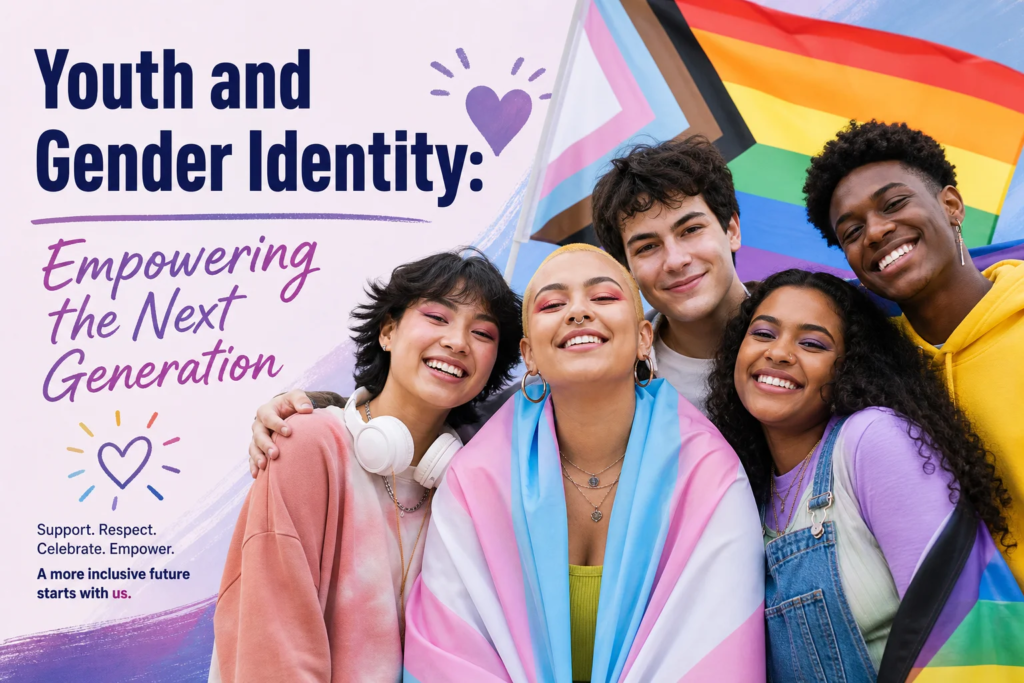
Introduction: Why This Conversation Matters Now
A young person walks into a classroom, a clinic, a faith community, a family dinner, or an online space carrying a question that may feel simple, complicated, joyful, frightening—or all of those at once: Who am I allowed to be?
That question sits at the heart of Youth and Gender Identity: Empowering the Next Generation. For many young people, gender identity is not a trend, a phase, or a debate topic. It is part of their lived experience. It shapes how they understand themselves, how they relate to others, and whether they feel safe enough to participate fully in school, friendships, family life, and community.
Today’s youth are growing up in a world where language around gender has expanded, social media has made identity conversations more visible, and families and institutions are being asked to respond with more thoughtfulness than ever before. Some adults feel prepared. Others feel overwhelmed. Many genuinely want to support young people but fear saying the wrong thing.
That is why Youth and Gender Identity: Empowering the Next Generation is not just a social issue. It is a human issue. It is about mental health, belonging, education, family connection, dignity, and future possibility.
This in-depth guide explores what gender identity means for young people, why affirmation and support matter, how families and schools can respond constructively, and what real-world examples teach us about creating safer environments. Whether you are a parent, educator, youth worker, healthcare provider, policymaker, or young person yourself, this article offers practical insights for building a world where the next generation can grow with courage and authenticity.
Understanding Gender Identity: A Foundation for Empowerment
Before discussing solutions, it helps to clarify what gender identity means.
Gender identity refers to a person’s internal sense of their gender. For some people, that identity aligns with the sex they were assigned at birth. For others, it does not. Some youth identify as transgender, nonbinary, gender-fluid, agender, questioning, or use other language that feels more accurate to them.
At its core, Youth and Gender Identity: Empowering the Next Generation begins with listening. Young people often know far more about their inner experiences than adults realize. They may not always have the vocabulary at first, but they can usually describe what feels comfortable, uncomfortable, affirming, or distressing.
Key Terms to Know
| Term | Meaning | Why It Matters |
|---|---|---|
| Gender identity | A person’s internal sense of their gender | Helps us understand how someone experiences themselves |
| Gender expression | How someone presents gender through clothing, hairstyle, voice, behavior, etc. | Expression may or may not match identity |
| Cisgender | A person whose gender identity aligns with sex assigned at birth | Useful for describing one common experience of gender |
| Transgender | A person whose gender identity differs from sex assigned at birth | An umbrella term for many gender-diverse experiences |
| Nonbinary | A gender identity outside or beyond strictly male/female categories | Recognizes that gender is not always binary |
| Gender-fluid | A gender identity that may shift over time | Helps validate changing or flexible experiences |
| Questioning | Exploring one’s gender identity | Normal for many youth and deserving of patience |
| Affirmation | Respecting and supporting someone’s stated identity | Linked to improved emotional well-being |
Understanding these terms is not about memorizing a script. It is about gaining the tools to communicate with respect. In the larger conversation about Youth and Gender Identity: Empowering the Next Generation, shared language reduces confusion and builds trust.
Why Youth Gender Identity Deserves Serious Attention
Some adults ask, “Why are young people talking about gender so much now?” A better question might be, “Why are young people finally feeling able to talk about gender openly?”
There have always been youth who questioned gender norms or felt disconnected from expectations placed upon them. What has changed is visibility. Young people today have more access to language, communities, and stories that help them name their experiences.
This visibility can be empowering, but it can also bring conflict. Youth may face bullying, rejection, misinformation, political hostility, or pressure to prove themselves. That is why Youth and Gender Identity: Empowering the Next Generation must involve more than celebration. It must include protection, education, and practical support.
The Stakes Are Real
When young people feel rejected, dismissed, or unsafe, their mental health can suffer. When they are supported, believed, and included, they are more likely to thrive.
Support does not mean adults must have every answer immediately. It means they are willing to stay connected, remain curious, and avoid responding with shame or panic.
In simple terms, the goal of Youth and Gender Identity: Empowering the Next Generation is not to push young people toward any particular identity. It is to create conditions where they can explore honestly, safely, and with guidance.
The Developmental Lens: Identity Exploration Is Part of Growing Up
Adolescence is a time of identity formation. Young people explore values, beliefs, friendships, style, culture, spirituality, sexuality, career dreams, and personal boundaries. Gender identity can be part of that broader developmental journey.
For some youth, gender identity is clear from early childhood. For others, understanding develops during puberty, adolescence, or young adulthood. Some young people try different names, pronouns, clothing, or labels before finding what fits. Others may choose not to label themselves at all.
This process can be unsettling for adults who prefer certainty. But growth often happens through exploration.
A Helpful Framework: From Awareness to Confidence
| Stage | What It May Look Like | Supportive Adult Response |
|---|---|---|
| Awareness | “Something feels different.” | Listen without judgment |
| Exploration | Trying new language, clothing, pronouns, or presentation | Allow safe, low-pressure exploration |
| Disclosure | Telling a friend, parent, teacher, or counselor | Respond with calm respect |
| Social affirmation | Using chosen name/pronouns, adjusting expression | Support dignity and safety |
| Integration | Identity becomes one part of a full life | Treat the youth as a whole person |
This framework is not a rigid path. Some youth move back and forth. Some skip stages. Some change language over time. Youth and Gender Identity: Empowering the Next Generation requires patience because young people are not projects to be managed; they are people becoming themselves.
Listening First: The Most Powerful Tool Adults Have
The first response a young person receives after sharing something about gender identity can shape whether they continue seeking support or retreat into silence.
A supportive response does not need to be perfect. It can be as simple as:
- “Thank you for trusting me.”
- “I’m here with you.”
- “Can you tell me what kind of support you want right now?”
- “I may need to learn more, but I care about you.”
- “What name or pronouns would you like me to use?”
These statements signal safety. They keep connection open.
By contrast, responses like “You’re too young to know,” “This is just attention-seeking,” or “Where did you learn this?” can shut down communication. Even if adults have questions, the first priority should be emotional safety.
In the practical work of Youth and Gender Identity: Empowering the Next Generation, listening is not passive. It is an active form of care. It gives youth space to be honest before adults rush to correct, debate, or diagnose.
Family Support: The First Circle of Empowerment
Families play a major role in how young people experience gender identity. A supportive home can serve as a protective anchor in a world that may not always be kind.
Support does not mean every family member immediately understands everything. It means they choose love over fear and connection over control.
What Family Support Can Look Like
| Supportive Action | Why It Helps |
|---|---|
| Using a young person’s chosen name | Communicates respect and recognition |
| Practicing correct pronouns | Shows willingness to learn |
| Asking open-ended questions | Encourages honest communication |
| Setting boundaries with disrespectful relatives | Protects the youth’s emotional safety |
| Learning from credible sources | Reduces fear and misinformation |
| Seeking family counseling when needed | Helps families process change together |
| Celebrating the whole child | Prevents gender identity from becoming the only focus |
A family does not need to be perfect to be powerful. Repair matters. If a parent uses the wrong name or pronoun, a simple correction is better than a dramatic apology that puts emotional labor back on the young person.
For example: “She—sorry, they—will be joining us later.” Then move on.
That small act supports the larger mission of Youth and Gender Identity: Empowering the Next Generation by normalizing respect without turning every mistake into a crisis.
Case Study 1: A Family Learns to Choose Connection
Background:
“Marisol,” age 15, told her parents she was nonbinary and wanted to use they/them pronouns. Her mother responded with confusion and worry. Her father initially avoided the conversation, hoping it would “settle down.” Marisol became quieter at home and spent more time online.
Intervention:
The family began meeting with a counselor experienced in adolescent identity development. The counselor helped the parents separate their fears from Marisol’s needs. Instead of debating whether Marisol was “certain,” the family focused on practical support: using their chosen name at home, asking how school felt, and creating a plan for talking with relatives.
Outcome:
Within months, Marisol became more communicative. Their parents still had questions, but the home felt less tense. The family learned that support did not require instant certainty; it required ongoing trust.
Analysis:
This case illustrates a central truth of Youth and Gender Identity: Empowering the Next Generation: connection is more protective than control. When families remain engaged, youth are more likely to feel safe discussing challenges, doubts, hopes, and decisions.
Schools as Crucial Spaces for Belonging
Young people spend a large part of their lives in school. That makes schools one of the most important settings for supporting gender-diverse youth.
A school can either become a place of anxiety or a place of belonging. The difference often comes down to policies, staff training, peer culture, and daily interactions.
Key School Practices That Empower Youth
| Practice | Impact |
|---|---|
| Respecting chosen names and pronouns | Reduces daily stress and increases belonging |
| Clear anti-bullying policies | Creates accountability |
| Inclusive curriculum | Helps students see diverse lives represented |
| Staff training | Reduces harmful mistakes and improves response |
| Safe restroom and locker room access | Supports dignity and participation |
| Gender-inclusive dress codes | Prevents unequal enforcement |
| Confidentiality protocols | Protects youth from unwanted disclosure |
The goal is not special treatment. It is equal access to learning.
In conversations about Youth and Gender Identity: Empowering the Next Generation, schools sometimes worry about “getting political.” But respecting students’ identities is not a partisan act. It is a student well-being practice.
Case Study 2: A School Builds a Culture of Respect
Background:
At “Riverside Middle School,” several students reported being teased for gender expression. Teachers were unsure how to intervene. Some students used chosen names informally, but official systems displayed legal names, causing embarrassment during attendance and substitute teaching days.
Intervention:
The school formed a student support team including counselors, administrators, teachers, and family representatives. They updated internal systems to include chosen names where legally possible, trained staff on respectful language, revised the bullying response protocol, and created a student-led belonging committee.
Outcome:
Teachers reported feeling more confident. Students said they felt safer correcting peers and asking for help. Incidents did not disappear, but responses became faster and more consistent.
Analysis:
This case shows that Youth and Gender Identity: Empowering the Next Generation works best when support is systemic, not dependent on one kind teacher. Schools need structures that make respect predictable.
The Role of Mental Health Support
Gender-diverse youth are not inherently distressed because of who they are. Much of the distress they experience comes from rejection, bullying, isolation, discrimination, or fear.
Mental health professionals can play a valuable role by helping youth explore identity, cope with stress, communicate with family, and build resilience. The best support is neither dismissive nor directive. It does not pressure youth toward a specific identity, nor does it shame them for exploring.
Healthy Mental Health Support Should Be:
- Respectful of the young person’s stated experience
- Developmentally appropriate
- Family-inclusive when safe and helpful
- Trauma-informed
- Culturally aware
- Focused on well-being, not “fixing” identity
- Honest about uncertainty and complexity
When medical questions arise, families should consult qualified healthcare professionals who follow established standards of care and consider the young person’s age, needs, mental health, family context, and informed consent requirements.
In the broader landscape of Youth and Gender Identity: Empowering the Next Generation, mental health care should create space for clarity, not pressure.
Myth vs. Reality: Clearing Up Common Misunderstandings
Misinformation can make conversations about gender identity harder than they need to be. Clear facts help families and communities respond with less fear.
| Myth | Reality |
|---|---|
| “Talking about gender makes kids transgender.” | Talking gives youth language. It does not create identity. |
| “Support means rushing into irreversible decisions.” | Support often begins with listening, names, pronouns, clothing, and safety planning. |
| “Young people are too young to understand anything about gender.” | Children and teens often have meaningful awareness of comfort, discomfort, and identity. |
| “Using a chosen name is harmful if the youth changes their mind.” | Respecting someone’s current identity builds trust, even if language evolves. |
| “Gender-diverse youth all have the same needs.” | Needs vary widely by age, culture, family, community, and personal experience. |
| “Neutrality is safest.” | Silence or avoidance can feel like rejection. Compassionate engagement is safer. |
A major part of Youth and Gender Identity: Empowering the Next Generation is replacing panic with perspective. Adults do not have to understand everything immediately, but they do need to avoid causing harm through misinformation.
Peer Support: Why Friendship Can Be Life-Changing
Peers matter deeply during adolescence. A single supportive friend can make school feel survivable. A group of affirming peers can help a young person feel seen.
Peer support can happen through:
- Gender and sexuality alliances
- Youth leadership groups
- Online moderated communities
- Arts programs
- Mentorship networks
- Community centers
- School clubs
- Sports or activity groups with inclusive norms
However, peer spaces need thoughtful adult support. Young people should not be expected to handle bullying, harassment, or crisis situations alone.
The best peer programs combine youth leadership with adult accountability. That balance is essential to Youth and Gender Identity: Empowering the Next Generation because empowerment should not mean abandoning youth to figure everything out by themselves.
Case Study 3: A Community Center Creates a Youth Leadership Program
Background:
A local community center noticed that gender-diverse teens were attending drop-in hours but not participating in broader youth programs. Some said they felt tolerated but not truly included.
Intervention:
The center created a youth advisory board with transgender, nonbinary, cisgender, and questioning teens. The board reviewed program language, suggested inclusive activities, developed peer welcome guidelines, and helped train adult volunteers.
Outcome:
Participation increased across programs. Youth reported that the center felt less like a service “for” them and more like a community built “with” them.
Analysis:
This example highlights an important principle of Youth and Gender Identity: Empowering the Next Generation: youth should not only receive support; they should help shape it. Empowerment grows when young people have voice, agency, and leadership.
Culture, Race, Faith, and Gender Identity: Avoiding One-Size-Fits-All Support
Gender identity does not exist in isolation. A young person may also be navigating race, ethnicity, immigration status, disability, religion, language, poverty, or family expectations.
For example, a transgender teen in a rural area may face different challenges than a nonbinary teen in a large city. A young person from a faith community may fear spiritual rejection. A Black or Indigenous gender-diverse youth may encounter racism alongside gender-based discrimination. A disabled youth may struggle to have their identity taken seriously because adults wrongly assume they cannot understand themselves.
That is why Youth and Gender Identity: Empowering the Next Generation must be intersectional. Support must account for the whole person.
Questions Adults Can Ask Themselves
- What cultural values shape this young person’s experience?
- Are we assuming all gender-diverse youth need the same support?
- Are language barriers affecting family understanding?
- Is the young person facing racism, ableism, poverty, or religious rejection?
- Who are trusted adults within the young person’s cultural or community network?
- How can we support identity without isolating the youth from important relationships?
Empowerment is strongest when it respects complexity.
Digital Life: Opportunity, Risk, and Connection
For many young people, the internet is where they first find language for their gender identity. Online spaces can offer education, friendship, creativity, and relief from isolation.
But digital spaces can also expose youth to harassment, misinformation, comparison, pressure, and privacy risks.
A balanced approach is better than panic. Adults should not assume every online influence is harmful. At the same time, youth need guidance on digital safety.
Healthy Digital Support Strategies
| Strategy | Why It Helps |
|---|---|
| Ask what online spaces feel supportive | Shows curiosity instead of surveillance |
| Discuss privacy and screenshots | Protects against unwanted outing |
| Encourage moderated communities | Reduces exposure to harassment |
| Teach media literacy | Helps youth evaluate information |
| Watch for sudden distress after online conflict | Supports early intervention |
| Balance online and offline support | Builds a stronger safety net |
Digital connection is now part of Youth and Gender Identity: Empowering the Next Generation. The task is not to remove young people from the internet, but to help them use it wisely and safely.
Healthcare and Gender Identity: Compassion, Caution, and Care
Healthcare conversations around gender-diverse youth can be emotionally charged. Families may feel anxious, and young people may fear being dismissed. Good healthcare should reduce fear by offering accurate information, careful assessment, and compassionate guidance.
Not every gender-diverse young person seeks medical care related to gender. Some only want social affirmation. Others may have questions about puberty, mental health, body discomfort, or future options.
Healthcare providers should:
- Use respectful names and pronouns
- Explain confidentiality clearly
- Screen for mental health concerns without blaming identity
- Involve parents or guardians appropriately and safely
- Provide evidence-informed care
- Avoid shaming or rushing
- Support informed decision-making
- Recognize when referrals are needed
In the context of Youth and Gender Identity: Empowering the Next Generation, healthcare should be neither alarmist nor careless. It should be thoughtful, individualized, and centered on the young person’s well-being.
Building Resilience: Moving Beyond Survival
Supporting gender-diverse youth should not only be about preventing harm. It should also be about helping young people build joyful, meaningful lives.
Resilience grows when youth have:
- At least one trusted adult
- Supportive friendships
- Safe spaces to express themselves
- Skills for handling conflict
- Access to affirming healthcare and counseling
- Opportunities for leadership
- Representation in books, media, and curriculum
- Hope for the future
Too often, conversations about gender-diverse youth focus only on risk. Risk matters, but it is not the whole story. Many young people are creative, insightful, funny, determined, and deeply compassionate because of what they have learned through self-discovery.
The heart of Youth and Gender Identity: Empowering the Next Generation is not merely reducing pain. It is expanding possibility.
A Practical Empowerment Roadmap for Families, Schools, and Communities
Empowerment becomes real when values turn into action. The following roadmap can help adults move from good intentions to meaningful support.
Empowerment Roadmap
| Step | Families | Schools | Communities |
|---|---|---|---|
| Listen | Let youth share at their pace | Create trusted reporting channels | Hold youth listening sessions |
| Learn | Read credible resources | Train staff regularly | Invite expert facilitators |
| Affirm | Use names/pronouns | Update records where possible | Use inclusive language |
| Protect | Address family disrespect | Enforce anti-bullying policies | Build safe program guidelines |
| Include | Celebrate the whole child | Review curriculum and activities | Ensure access to all programs |
| Partner | Work with counselors if needed | Engage families respectfully | Collaborate with local services |
| Empower | Support youth decision-making | Create student leadership roles | Fund youth-led initiatives |
This roadmap reflects the practical side of Youth and Gender Identity: Empowering the Next Generation. Real support is not a slogan; it is a pattern of choices.
The Power of Language: Small Words, Big Impact
Language shapes belonging. A name can be a lifeline. A pronoun can be a signal of respect. A careless joke can make a young person feel unsafe.
Adults sometimes worry that language is changing too quickly. It is true that vocabulary evolves. But the deeper principle is timeless: call people what they ask to be called.
Simple Language Shifts
| Instead of Saying | Try Saying |
|---|---|
| “Preferred name” | “Chosen name” or simply “name” |
| “Real name” | “Legal name” when necessary |
| “Both genders” | “All genders” |
| “Boys and girls” | “Students,” “everyone,” or “team” |
| “What are you?” | “What language do you use for yourself?” |
| “I don’t get it” | “I’m learning—thank you for being patient” |
Language alone will not solve every challenge, but it can open the door to trust. In Youth and Gender Identity: Empowering the Next Generation, words are not everything—but they are often the first thing.
Case Study 4: A Coach Makes Team Participation Safer
Background:
“Jordan,” a transgender student, wanted to continue participating in athletics but feared locker room harassment and misgendering by teammates. The coach wanted to help but lacked training.
Intervention:
The school athletic director worked with the counselor, Jordan’s family, and the coach to create a participation plan. The plan included privacy options, expectations for respectful language, a process for reporting harassment, and team-wide reminders about dignity and sportsmanship without singling Jordan out.
Outcome:
Jordan remained on the team. A few teammates needed correction, but the coach responded quickly and consistently. Over time, the team culture improved.
Analysis:
This case demonstrates that Youth and Gender Identity: Empowering the Next Generation requires practical planning. Inclusion is not abstract. It shows up in locker rooms, attendance sheets, uniforms, travel forms, and adult follow-through.
What Young People Need Most from Adults
If there is one message adults should remember, it is this: young people do not need adults to be flawless. They need adults to be safe, steady, and willing to learn.
Youth Often Need Adults To:
- Believe them enough to listen seriously
- Avoid turning identity into a crisis
- Protect them from bullying and humiliation
- Respect privacy and confidentiality
- Support family connection when possible
- Help them access reliable information
- See their talents, dreams, and personality beyond gender
- Stand up for them when it matters
The goal of Youth and Gender Identity: Empowering the Next Generation is not to make gender identity the center of every conversation. It is to ensure that gender identity is never a reason a young person is denied safety, respect, or opportunity.
Policy and Leadership: Creating Systems That Last
Individual kindness matters, but systems determine whether support is consistent.
A student should not have to hope they get the “right” teacher. A young person should not have to retell painful experiences to every new staff member. A family should not have to invent support plans from scratch.
Policies can help by clarifying expectations around:
- Bullying and harassment
- Chosen names and pronouns
- Student records
- Privacy and disclosure
- Restroom and facility access
- Dress codes
- Field trips and overnight travel
- Staff training
- Complaint procedures
Strong policies are not about removing judgment from adults; they are about guiding judgment toward fairness and safety.
In this way, Youth and Gender Identity: Empowering the Next Generation becomes sustainable. It does not depend only on personal goodwill. It becomes part of how institutions operate.
Measuring Progress: How Do We Know Support Is Working?
Good intentions are not enough. Families, schools, and organizations need ways to evaluate whether gender-diverse youth actually feel safer and more included.
Signs of Progress
| Area | Positive Indicators |
|---|---|
| Emotional safety | Youth are willing to ask for help |
| School climate | Fewer unchecked incidents of bullying |
| Staff confidence | Adults respond consistently and calmly |
| Family communication | Conversations become less reactive |
| Participation | Youth join activities without fear |
| Policy implementation | Procedures are clear and used fairly |
| Youth leadership | Young people help shape programs |
A useful question is: Would a gender-diverse young person know exactly where to go for support here?
If the answer is no, there is work to do. Youth and Gender Identity: Empowering the Next Generation requires not only care, but accountability.
Long-Tail Keyword Variations for Contextual Understanding
For readers, advocates, and content creators, the focus keyword Youth and Gender Identity: Empowering the Next Generation can be naturally supported by related long-tail phrases such as:
- empowering youth through gender identity support
- supporting transgender and nonbinary youth
- helping young people explore gender identity safely
- gender identity education for parents and teachers
- creating inclusive schools for gender-diverse youth
- youth gender identity and mental health support
- affirming care for gender-diverse young people
- building safe communities for LGBTQ+ youth
- how families can support gender-questioning teens
- next generation gender identity empowerment
These variations help expand the conversation while keeping the central theme clear: Youth and Gender Identity: Empowering the Next Generation is about safety, dignity, and opportunity.
Common Mistakes Adults Make—and How to Repair Them
Even caring adults make mistakes. What matters is whether they repair harm and keep learning.
Mistake 1: Making the Conversation About Adult Feelings
It is normal for parents or teachers to feel surprised, confused, or worried. But young people should not have to comfort adults through every reaction.
Repair:
“I realize I made that about my fear. I’m sorry. I want to understand what you need.”
Mistake 2: Demanding Certainty
Identity exploration can involve uncertainty. Pressuring youth to prove themselves often increases stress.
Repair:
“You don’t have to have every answer right now. I’m here as you figure things out.”
Mistake 3: Outing a Young Person Without Consent
Sharing someone’s gender identity without permission can expose them to harm.
Repair:
“I should have asked before sharing that. I’m sorry. I’ll check with you first from now on.”
Mistake 4: Treating Gender as the Only Important Thing
A young person is more than their gender identity.
Repair:
Ask about friends, music, goals, school, hobbies, humor, and dreams.
Mistake 5: Waiting Until Crisis to Offer Support
Support should not begin only when a young person is struggling.
Repair:
Build everyday trust before emergencies happen.
Learning from mistakes is part of Youth and Gender Identity: Empowering the Next Generation. Repair teaches young people that relationships can survive discomfort and grow stronger.
The Bigger Vision: A World Where Youth Can Become Whole
Imagine a generation of young people who do not have to choose between authenticity and belonging.
Imagine classrooms where students are not mocked for their names, homes where questions are met with patience, clinics where youth feel respected, sports teams where dignity is expected, and communities where identity is not treated as a threat.
That is the vision behind Youth and Gender Identity: Empowering the Next Generation.
It is not about forcing agreement on every complex question. It is about committing to the basic idea that young people deserve safety while they grow. They deserve adults who respond with wisdom instead of fear. They deserve institutions that protect learning, health, and dignity. They deserve room to become.
Conclusion: Empowerment Begins with Courageous Care
Youth and Gender Identity: Empowering the Next Generation is more than a keyword or a topic. It is a call to action.
Young people are telling us that identity, belonging, and respect matter. The question is whether adults and institutions will listen with enough humility to respond well.
The path forward is not mysterious. Listen first. Learn continuously. Use respectful language. Protect privacy. Address bullying. Support families. Train educators. Build inclusive policies. Create youth leadership opportunities. Seek qualified care when needed. Most of all, keep connection at the center.
Empowering the next generation does not mean removing every challenge from their lives. It means making sure they do not face those challenges alone.
When youth are supported in understanding and expressing who they are, they are freer to learn, create, lead, and love. That is the promise of Youth and Gender Identity: Empowering the Next Generation—a future where every young person has the chance to grow not in fear, but in dignity and hope.
1. What does gender identity mean for young people?
Gender identity is a young person’s internal sense of their gender. It may align with the sex they were assigned at birth, or it may not. Some youth identify as transgender, nonbinary, gender-fluid, questioning, or use other terms. Youth and Gender Identity: Empowering the Next Generation means giving young people respectful space to understand and communicate who they are.
2. How can parents support a child who is questioning their gender?
Parents can start by listening calmly, thanking the child for trusting them, using the name or pronouns requested, and asking what support would feel helpful. Parents do not need to have every answer immediately. The most important first step is keeping the relationship safe and open.
3. Does affirming a young person’s gender identity mean rushing into medical decisions?
No. Affirmation often begins with social and emotional support, such as listening, respecting names and pronouns, allowing safe self-expression, and addressing bullying. Any medical questions should be discussed with qualified healthcare professionals using careful, individualized assessment.
4. What role should schools play in supporting gender-diverse youth?
Schools should provide safe learning environments for all students. This includes anti-bullying policies, respectful language, confidentiality, staff training, inclusive practices, and clear support systems. In the context of Youth and Gender Identity: Empowering the Next Generation, schools are essential because they shape daily belonging.
5. What if a young person changes labels or pronouns over time?
That can happen, and it does not mean the young person was lying or confused in a harmful way. Identity exploration can be part of growing up. Respecting a young person’s current language builds trust and keeps communication open.
6. How can adults respond if they make a mistake with a name or pronoun?
Correct yourself briefly and move on. For example: “He—sorry, they—will be here soon.” Avoid over-apologizing in a way that makes the young person responsible for comforting you. Consistent effort matters more than perfection.
7. Why is privacy so important for gender-diverse youth?
Not every young person is safe being open in every setting. Sharing someone’s gender identity without consent can expose them to bullying, family conflict, or emotional harm. Empowerment includes respecting a young person’s right to decide who knows and when.
8. What is the most important takeaway from Youth and Gender Identity: Empowering the Next Generation?
The most important takeaway is that supportive relationships save dignity, protect well-being, and create possibility. Young people need adults who listen, learn, protect, and stay connected. Empowerment begins when youth know they are not alone.


The PsyForU Editorial Collective is the research and editorial team of PsyForU Research International. The collective prepares educational, psychological, mental-health-awareness, inclusion, neurodiversity, and research-methodology content for students, parents, educators, researchers, and general readers. PsyForU content is intended for awareness, education, and capacity-building and should not be treated as clinical diagnosis, therapy, medical advice, legal advice, or emergency mental-health support.