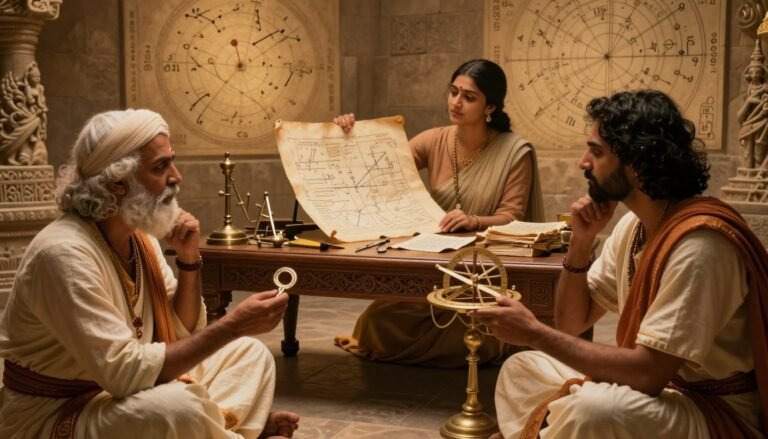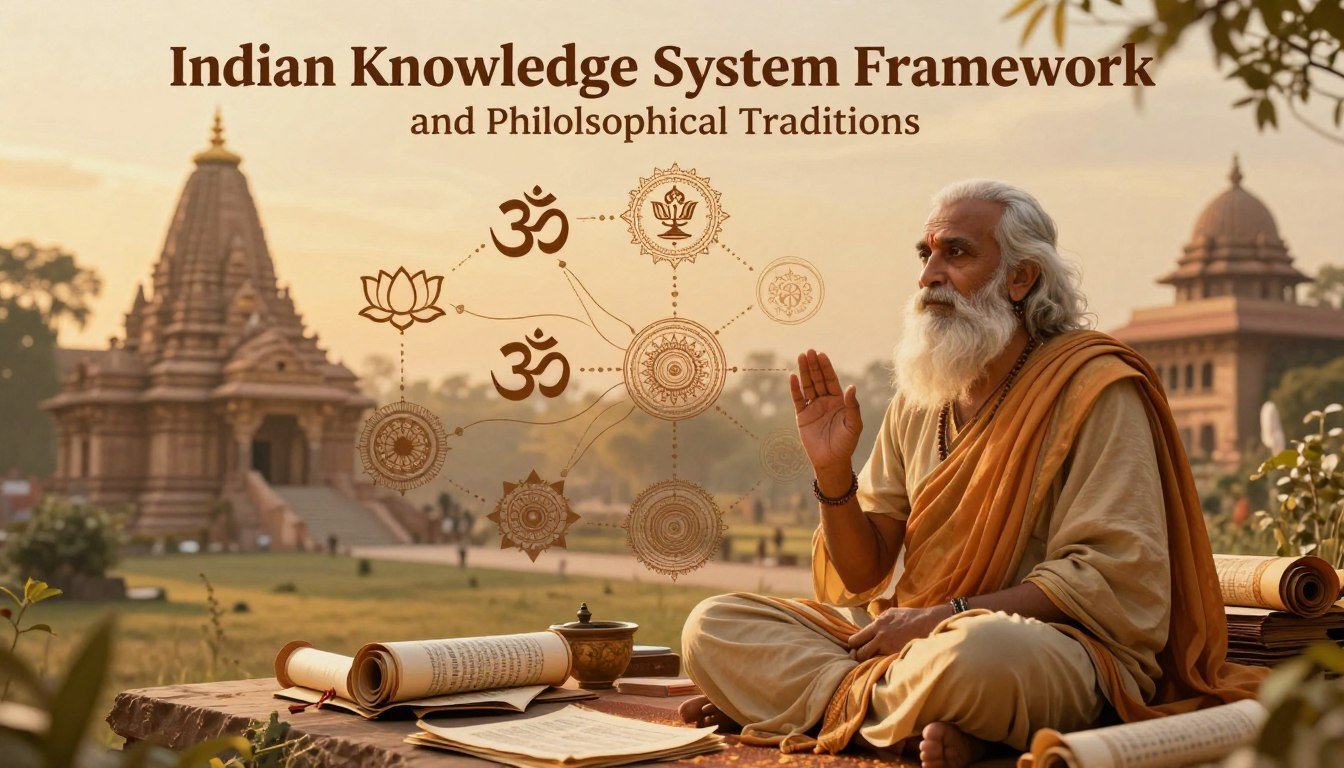
A young math student found out that zero, key to today’s computers, came from ancient India. This discovery led to a deeper look at how knowledge is passed down through time. It shows that wisdom knows no bounds of time or place, linking old ideas to today’s uses.
The Indian knowledge system is a rich tradition that spans thousands of years. It covers philosophy, science, arts, and how societies are run.
This tradition is special because it combines all kinds of knowledge in one. It connects old wisdom with today’s problems, helping us live better and more sustainably.
To grasp the indian knowledge system definition, we must look at three key points. First, it’s a treasure trove of wisdom passed down through generations. Second, it’s based on real experiences and connections. Third, it includes many areas like math, astronomy, medicine, architecture, and how societies are organized.
This journey shows how old knowledge can solve today’s big problems. It also helps keep our culture alive and encourages new ideas.
Key Takeaways
- The Indian Knowledge System encompasses thousands of years of accumulated wisdom across philosophy, science, arts, and governance
- It features a distinctive holistic approach that integrates multiple disciplines, not treating them as separate
- The framework includes seven major philosophical schools and extensive contributions to mathematics, astronomy, and medicine
- Ancient innovations like zero, decimal systems, and surgical techniques originated from this intellectual tradition
- The system emphasizes harmony between individuals, society, and nature through experiential validation
- Traditional knowledge offers relevant solutions for contemporary challenges including sustainability and holistic education
- Understanding its meaning, nature, and scope bridges historical heritage with modern applications and innovation
Understanding the Foundations of Indian Knowledge Traditions
The bharatiya gyan parampara is rooted in a deep commitment to sharing knowledge. It sees learning as both a sacred duty and a practical need for human growth. This tradition combines spiritual wisdom with scientific thought, helping us tackle modern issues like climate change and environmental degradation.
Unlike Western education, Indian knowledge traditions cover many subjects in a holistic way. They have been developed over thousands of years on the Indian subcontinent.
The foundations of this tradition are built on continuous refinement and adaptation. It answers big questions about existence, consciousness, and reality through careful inquiry. Indigenous knowledge systems in India are living practices, not static doctrines. They stay relevant through changing times and civilizations.
Historical Evolution of Bharatiya Gyan Parampara
The history of bharatiya gyan parampara shows a remarkable continuity from ancient times to today. Knowledge was mainly passed down through the Guru-Shishya parampara, a master-disciple lineage. This method focused on direct learning experiences, not just reading texts.
The oral tradition was key for keeping complex ideas safe. Scholars memorized texts with great precision, using special techniques to keep knowledge accurate over centuries. This approach helped students understand knowledge deeply, not just memorize it.
Indigenous knowledge systems in India grew from observing nature, society, and spiritual experiences. Scholars wrote about their findings in various fields like mathematics, astronomy, and medicine. They combined theory with practical use, making their knowledge unique.
Indian knowledge traditions valued intellectual rigor through debates and discussions. Scholars from different schools debated openly, refining their ideas through argument. This culture of inquiry kept ideas fresh and prevented dogmatic thinking.
The Timeless Continuum of Ancient Indian Wisdom
Ancient Indian wisdom remains relevant today by tackling timeless questions. It explores consciousness, the connection between individual and universe, and natural laws. This timeless quality comes from focusing on essential human experiences, not just cultural trends.
Knowledge is that which liberates, understanding is that which transforms, and wisdom is that which endures across the ages.
Concepts from ancient India influence modern science and philosophy. They resonate with today’s discoveries in quantum physics and ecology. Indian traditions anticipated holistic views that Western science is now embracing.
Ancient Indian wisdom stayed relevant by being adaptable yet true to its core. Each generation reinterpreted old ideas in new ways, keeping essential insights alive. This balance kept the tradition vibrant, not just a relic of the past.
This tradition’s depth allows for understanding on many levels. Ideas had practical uses in daily life and offered deep spiritual insights. This made knowledge accessible to all, regardless of their level of understanding or spiritual maturity.
Indigenous Knowledge Systems India: A Living Heritage
Indigenous knowledge systems in India are alive today, not just historical relics. They inform modern practices in medicine, agriculture, and more, while keeping cultural roots strong. Their practical efficacy shows they’re relevant now.
Ayurveda is a great example of how ancient medical knowledge meets today’s health needs. Traditional farming methods also show sustainable ways to address environmental issues. These examples prove Indian knowledge traditions offer real solutions, not just historical interest.
Learning methods have evolved to include modern education without losing traditional ways. Universities now teach ancient Indian sciences alongside modern subjects. This ensures younger generations learn from both old and new knowledge.
Indian knowledge traditions bring unique views to global discussions. They focus on interconnectedness, holistic understanding, and balance between material and spiritual. They offer alternatives to the narrow views common in modern thought. Indigenous knowledge systems in India provide tested solutions for today’s challenges.
Efforts to document and preserve traditional knowledge are underway in India. Government programs, schools, and cultural groups work together. They aim to keep this intellectual heritage alive, recognizing its value for today and tomorrow.
Defining the Indian Knowledge System
The Indian Knowledge System is a vast collection of wisdom. It combines observation with spiritual insight. This tradition has grown over thousands of years in the Indian subcontinent.
It offers a unique way to understand the world, humans, and the universe. Unlike other systems, it integrates different areas of study. This makes it a holistic approach.
This system covers many areas of human inquiry. It includes philosophy, science, art, and ethics. Each part helps us understand both the physical and spiritual sides of life.
Indian Knowledge System Definition and Conceptual Framework
The indian knowledge system definition is about the wisdom and methods from the Indian subcontinent. It includes sciences, philosophy, art, and ethics. It’s more than just facts; it’s a way to understand and apply knowledge.
This system sees everything as connected. Spiritual and scientific knowledge work together. Ethics guide how we use this knowledge.
It has many philosophical traditions like Vedanta and Yoga. Each one has its own way of knowing. But they all work together as a whole. It also includes sciences and technology, like mathematics and astronomy.
Arts and culture are key parts of this system. Vedic texts and classical Sanskrit works share knowledge. They help us understand music, dance, and social rules.
Core Principles of Indic Knowledge Heritage
The indic knowledge heritage is based on key principles. These principles help us understand how to know and share knowledge. Knowing these principles is key to understanding India’s intellectual legacy.
The idea of Dharma is central. Dharma means right conduct and cosmic order. It helps us know how to use knowledge ethically.
This heritage sees the material and spiritual worlds as connected. It doesn’t separate them like some other traditions do. This helps us understand everything more fully.
Direct experience is very important. It’s as valuable as logical reasoning. This shows that some truths can only be found through personal experience.
There are many ways to know things, called pramanas. Different philosophies recognize different pramanas. They include direct experience, inference, and more.
- Pratyaksha – Direct perception through sensory experience
- Anumana – Inference and logical reasoning
- Shabda – Testimony from reliable sources and scriptural authority
- Upamana – Comparison and analogy
- Arthapatti – Postulation or presumption
- Anupalabdhi – Non-perception or absence
This way of knowing lets us understand things fully. It uses many kinds of evidence and reasoning. It encourages looking at things from all sides.
Distinguishing Characteristics from Western Knowledge Paradigms
The characteristics of indian knowledge system are different from Western ways of knowing. Both traditions have greatly helped us understand the world. But they use different methods and ideas.
Western knowledge focuses on separating things and being objective. It uses the scientific method to test ideas. Knowledge areas are separate and have clear boundaries.
In contrast, Indian wisdom combines experience with observation. It sees the knower and the known as connected. This lets us study consciousness as a science.
Consciousness is a big difference. Western views often see it as a byproduct of brain processes. Indian thought sees consciousness as fundamental and possibly more important than matter.
The following table shows some key differences:
| Aspect | Indian Knowledge System | Western Knowledge Paradigm |
|---|---|---|
| Methodological Approach | Holistic integration of multiple knowledge domains with emphasis on interconnectedness | Analytical separation and reductionist methodology focusing on isolated components |
| Nature of Consciousness | Consciousness viewed as fundamental reality, potentially independent of material substrates | Consciousness typically considered emergent property of material brain processes |
| Validation Methods | Multiple pramanas including direct experience, inference, testimony, and intuitive insight | Primarily empirical observation, experimental verification, and logical consistency |
| Knowledge Goals | Liberation (moksha), ethical living (dharma), and holistic well-being alongside practical utility | Prediction, control, technological application, and understanding of natural mechanisms |
| Subject-Object Relationship | Knower and known understood as interconnected; observer affects the observed | Strict separation between observer and observed to maintain objectivity |
Western science aims to understand and predict nature. Indian knowledge also values practical use. But it also focuses on personal growth, ethics, and spiritual insight.
The Indian way looks at the big picture, not just parts. It’s good for solving complex problems. This approach is valuable for understanding complex issues.
Western knowledge looks at progress and new discoveries. Indian wisdom values ancient knowledge but also looks at new ways to apply it. Old texts are seen as living sources of knowledge.
These differences don’t mean one is better than the other. Today, people are combining insights from both. This could lead to new ways of understanding and solving problems.
Meaning, Nature, and Scope of Indian Knowledge System
Exploring Indian knowledge traditions shows a deep connection between meaning, nature, and scope. These three parts work together to show the full picture of Bharatiya epistemology. They form the classical indian intellectual heritage as a whole.
For centuries, Indian scholars have looked at knowledge in a holistic way. They saw that understanding knowledge means looking at many aspects together. This approach makes Indian epistemology different from others.
Comprehensive Understanding of the Triadic Framework
The meaning nature and scope of indian knowledge system are three parts that together make a complete framework. Meaning is about what the Indian Knowledge System stands for. It includes the philosophy, values, and concepts that make IKS unique.
Nature talks about how knowledge is gained, checked, and shared. It shows how Indian epistemology is different from others. IKS values both experience and theory.
Scope shows where IKS applies. It covers a wide range of areas, from metaphysics to practical sciences. The scope of indian knowledge traditions touches every part of human life, showing its wide reach.
Seeing these three parts as connected gives us a deeper look into IKS. Each part helps the others, showing the power of holistic thinking in indian intellectual heritage.
| Dimension | Primary Focus | Key Characteristics | Fundamental Questions |
|---|---|---|---|
| Meaning | Conceptual essence and philosophical foundations | Defines identity, values, and core principles of IKS | What does IKS fundamentally represent? |
| Nature | Epistemological methods and transmission processes | Holistic, experiential, ethical, and adaptive approaches | How is knowledge acquired and validated? |
| Scope | Breadth of domains and practical applications | Comprehensive coverage from spiritual to material knowledge | Where does this knowledge system apply? |
| Integration | Unified epistemological framework | Synergistic relationship among all three dimensions | How do these dimensions interconnect? |
Interconnected Dimensions of Knowledge Acquisition
The Indian Knowledge System sees knowledge through different paths that work together. Jnana (theory), karma (practice), and bhakti (devotion) are three ways to gain knowledge. This shows the holistic nature of Indian epistemology.
Theory gives us the intellectual base through study and reflection. Ancient scholars developed ways to analyze and refine ideas. But, theory alone is not enough for true knowledge.
Practice makes knowledge real by applying it in life. The meaning nature and scope of indian knowledge system says that true understanding comes from action. It connects abstract ideas with real life.
Devotion adds an emotional and experiential layer. It recognizes that some knowledge comes from direct experience and intuition. Combining these three ways gives us a complete model of learning.
This framework has unique qualities. It sees all knowledge as connected, not separate. It values experience and ethics in learning. Knowledge without ethics is seen as incomplete or dangerous.
This approach also values balance and long-term well-being. It adapts to change and accepts many paths to truth. This makes Indian knowledge traditions rich and diverse.
The Classical Indian Intellectual Heritage
The classical indian intellectual heritage supports the triadic framework. It includes many systems that together form a complete knowledge system. Understanding these elements shows the depth and complexity of Indian epistemology.
The six orthodox schools, or darshanas, offer frameworks for big questions. Nyaya deals with logic, Vaisheshika with metaphysics, and Samkhya with dualism. Yoga focuses on consciousness, Mimamsa on rituals, and Vedanta on ultimate reality. Each school has its own view but respects others.
The Vedic corpus is the base text for other systems. The four Vedas contain hymns, rituals, melodies, and practical knowledge. The Vedangas, six disciplines, help understand and share Vedic knowledge.
These disciplines include:
- Shiksha: Phonetics and pronunciation for accurate oral transmission
- Kalpa: Ritual procedures and protocols for proper performance
- Vyakarana: Grammar and linguistic analysis for precise communication
- Nirukta: Etymology and semantic interpretation for deeper meaning
- Chandas: Prosody and metrics for poetic composition
- Jyotisha: Astronomy and calendrical science for temporal calculations
Specialized systems called shastras cover specific areas. Dharmashastra deals with ethics and law, Arthashastra with politics and economy. Kamashastra looks at aesthetics, and Mokshashastra at spiritual liberation. Each shastra is a complete science in its field.
Epic literature, like the Mahabharata and Ramayana, is both story and philosophy. These Itihasas teach deep lessons through engaging stories. The Bhagavad Gita, part of the Mahabharata, combines different philosophies into a guide for action.
This heritage shows how Indian knowledge traditions cover all aspects of life. From abstract questions to daily concerns, they offer deep analysis and practical advice. The mix of theory and practice is key to this heritage.
Over time, IKS has evolved and grown. It has taken in ideas from other traditions, making it richer. Debates have sharpened arguments and strengthened logic. This ongoing dialogue has kept the tradition alive and true to its core.
Knowledge is the supreme goal; it illuminates all paths and reveals the interconnected nature of existence, transforming the knower, the known, and the process of knowing itself.
The triadic framework helps us understand Indian epistemology today. By looking at what IKS is, how it works, and where it applies, we see its depth and ongoing value. The classical indian intellectual heritage offers insights for today’s challenges, linking ancient wisdom with current needs.
Philosophical Foundations of Indian Knowledge System
Indian philosophy tackled big questions about consciousness, reality, and knowledge. It developed deep approaches to understanding the world. These methods are known for their systematic ways of finding truth.
Many schools of thought, like Vedanta, Yoga, Samkhya, Nyaya, Vaisheshika, Mimamsa, and Charvaka, shaped Indian philosophy. Each brought its own view, yet all followed strict rules for thinking. Together, they built a rich world of ideas that helped both in theory and practice.
Epistemological Principles in Indian Thought
Indian philosophy worked hard to figure out how we know things. It created detailed theories about how we get knowledge and tell truth from false. These theories went beyond just seeing and hearing to understand how we know the world.
Indian thinkers looked closely at how we get knowledge. They said we need the right tools and methods to know things. They also set rules for checking if knowledge is true.
They believed that knowledge must be systematic, verifiable, and useful. This made sure that their ideas were connected to real life and practical wisdom.
The Six Pramanas: Valid Means of Knowledge
The idea of pramanas is key in Indian philosophy. It talks about how we get real knowledge. Six pramanas are widely accepted, each with its own way of validating truth.
The six pramanas are:
- Pratyaksha – Direct perception through sensory experience and immediate awareness
- Anumana – Inference and logical reasoning based on observed relationships
- Upamana – Comparison and analogy drawing connections between known and unknown
- Shabda – Verbal testimony and authoritative scriptural knowledge
- Arthapatti – Postulation or presumption to explain observed facts
- Anupalabdhi – Non-apprehension recognizing absence as a form of knowledge
Each pramana has its own rules and gives different kinds of knowledge. This shows the deep thinking behind Indian knowledge traditions.
Pratyaksha: Direct Perception
Pratyaksha, or direct perception, is the base of all knowledge. Indian philosophers saw perception as an active process. It needs the right senses, contact with objects, and clear thinking.
The Nyaya school made a big difference between determinate perception and indeterminate perception. This shows their deep understanding of how we see the world.
Good perception must be free from mistakes like bad senses or not seeing clearly. Indian thinkers made detailed lists to tell true perception from false.
Anumana: Inference and Logical Reasoning
Anumana is about using logic to find new knowledge from what we already know. The Nyaya school was very good at this, almost as good as Aristotle. It needs a clear link between the reason and the conclusion.
The classic five-part syllogism includes:
- Pratijna – The proposition or thesis to be established
- Hetu – The reason or evidence supporting the proposition
- Udaharana – The universal example illustrating the relationship
- Upanaya – The application of the universal to the specific case
- Nigamana – The conclusion drawn from previous steps
This way of reasoning makes sure that conclusions are clear and can be checked. It shows how Indian philosophy valued reason along with other ways of knowing.
Metaphysical and Ontological Underpinnings
Indian philosophy went beyond just knowing to deep questions about reality and consciousness. It explored the nature of the world and our place in it. Different schools offered different views, enriching the discussion.
Advaita Vedanta believed in a non-dual reality where everything is connected. It said that what seems separate is just an illusion. Knowing this unity is the key to freedom from ignorance.
Samkhya philosophy saw the world as made of two parts: consciousness and matter. It explained how the world came to be through the evolution of matter, while keeping consciousness separate.
The Nyaya-Vaisheshika schools believed in a world made of many things, like souls and atoms. They focused on understanding the physical world through careful study and logic. They created detailed categories for both the material and spiritual worlds.
At the heart of these ideas was Dharma, or right living. It was about doing the right thing, keeping the world in order, and following moral duty. Dharma linked personal actions to the greater good, blending ethics with metaphysics.
Indian philosophy knew that ideas about the world had to match up with how we know things and how we should act. This mix of ideas created a complete view of the world. It showed how Indian philosophy was different from others that split these areas apart.
These deep ideas made Indian philosophy a powerful tool for understanding existence and knowledge. Even today, these ancient thoughts are valuable for thinking about big questions.
Nature of Indian Knowledge Tradition
Ancient Indian knowledge systems are unique. They focus on direct experience, holistic understanding, and consciousness. This approach sees knowledge as a transformative force that changes how we see the world.
Indian knowledge traditions have stood the test of time. They offer a holistic view of wisdom, not just a collection of facts. The focus is on experiential validation, not just theory.
Key Characteristics of Indian Epistemology
Indian knowledge tradition views knowledge as interconnected. It sees all knowledge domains as interconnected expressions of universal principles. This holistic view recognizes truth in various levels of reality and consciousness.
Indian epistemology emphasizes the connection between theory and practice. Knowledge must transform our character and consciousness. Ethics are woven into all knowledge, with Dharma guiding knowledge to serve righteous purposes.
This tradition values multiple sources of knowledge. It includes direct perception, inference, and verbal testimony. This approach shows the sophistication of ancient Indian knowledge systems.
Experiential and Empirical Validation
The focus on anubhava—direct personal experience—is key. While texts and logic are important, direct experience is the ultimate truth. This makes Indian knowledge different from text-based or logic-dependent systems.
In disciplines like Yoga and Vedanta, teachings are tested through practice. This approach prevents blind acceptance. Students are encouraged to become the knowledge, not just possess it.
This emphasis on experience is not limited to spiritual practices. Ayurvedic physicians and astronomers verified their knowledge through observation. Linguists refined grammar by studying language use. Each field valued both theory and empirical validation.
The methodology involves deepening understanding through stages. First, there’s intellectual comprehension. Then, contemplation, and lastly, direct experience. This three-fold process—shravana, manana, and nididhyasana—ensures knowledge becomes lived wisdom.
Unity of Knowledge and Consciousness
Indian knowledge tradition sees consciousness and knowledge as inseparable. Western epistemology often views consciousness as separate. Indian philosophy sees consciousness as the foundation of all knowing.
This view has deep implications for understanding. Transforming consciousness through contemplation unlocks new dimensions of knowing. Ordinary perception and logic operate within limited awareness. Refined consciousness accesses subtler realities.
The Upanishadic saying “Tat Tvam Asi” (That Thou Art) illustrates this unity. The knower, the process of knowing, and the object known merge into a singular conscious reality. This understanding doesn’t negate practical knowledge but contextualizes it within a broader framework.
Practical disciplines use meditative techniques to cultivate witness consciousness. This allows deeper insight into the nature of phenomena. Witnessing awareness transcends changing experiences.
Oral and Scriptural Transmission Methods
Indian knowledge systems used sophisticated oral transmission. Before written texts, elaborate systems preserved knowledge with remarkable accuracy. These methods are akin to modern digital redundancy systems.
Vedic recitation traditions used specific patterns for error detection. The Padapatha method separated words, while Kramapatha recited them in pairs. More complex patterns like Jatapatha and Ghanapatha made any alteration detectable.
These oral methods preserved knowledge and carried significance beyond semantic content. Proper pronunciation and rhythm were essential for the knowledge to manifest its intended effects. The sound vibrations themselves were seen as carriers of transformative power.
- Precise articulation patterns ensured phonetic accuracy across generations
- Metrical structures created natural memory aids through rhythm and cadence
- Repetition schedules reinforced retention without introducing variation
- Teacher-student verification processes caught and corrected errors immediately
- Multiple students learning simultaneously created redundancy safeguards
When writing systems emerged, they complemented oral traditions. Manuscripts served as references, but authentic transmission required oral instruction. The written word captured semantic content, but the living tradition conveyed proper interpretation and application.
The Guru-Shishya Parampara: Master-Disciple Lineage
The Guru-Shishya parampara is central to Indian knowledge tradition. It’s more than institutional education or information transfer. It’s a sacred bond for knowledge transmission, ethical formation, and spiritual awakening.
The Guru plays multiple roles beyond teaching. As a living embodiment of wisdom, the teacher demonstrates how knowledge manifests in life. Students observe not just what the Guru teaches but how the Guru lives. This modeling provides concrete examples of abstract principles in action.
This relationship is built on trust and commitment. Students commit to sincere practice and transformation, not just intellectual study. Teachers commit to guiding students toward realization, adapting instruction to individual capacities and needs. This personalized approach recognizes that one size does not fit all in knowledge transmission.
The parampara connects contemporary practitioners to ancient wisdom. Each generation receives, preserves, and transmits knowledge to the next. This continuity ensures authenticity while allowing adaptation to changing contexts. The lineage provides quality control, preventing distortion while permitting evolution.
| Aspect | Guru-Shishya Model | Modern Institutional Education | Key Distinction |
|---|---|---|---|
| Knowledge Focus | Transformative wisdom for character development | Information transfer for career preparation | Being versus having knowledge |
| Relationship Type | Sacred bond with lifelong commitment | Professional transaction with defined duration | Personal versus institutional connection |
| Transmission Method | Personalized oral instruction with direct experience | Standardized curriculum with mass delivery | Individual versus collective approach |
| Assessment Criteria | Internal transformation and practical mastery | External examination and credential acquisition | Qualitative versus quantitative measures |
Within this framework, knowledge is inseparable from the person who embodies it. The Guru doesn’t just possess information but represents a transformed consciousness. This relationship-centered transmission preserves the living quality of knowledge that written texts alone cannot capture.
The nature of Indian knowledge tradition is fundamentally experiential, consciousness-centered, orally preserved, and relationship-mediated. These characteristics create an epistemological framework where knowledge serves human flourishing through integrated development of intellectual, ethical, and spiritual dimensions. This holistic approach distinguishes Indian traditions from more fragmented or purely theoretical knowledge systems found in other cultural contexts.
The Holistic Approach in Indian Knowledge System
At the heart of Indian knowledge is a complete approach. It combines material and spiritual, theoretical and practical, and individual and universal. This holistic approach in Indian knowledge system is different from today’s education. It sees all knowledge as connected, showing a deeper universal truth.
This approach goes beyond just organizing knowledge. It’s a way of seeing the world as a single, indivisible whole. This view shapes how knowledge is taught and learned.
Indian knowledge traditions see humans as complete, needing balance in all areas. Physical health, mental clarity, emotional stability, and spiritual growth are all connected. This understanding leads to education that grows the whole person, not just the mind.
Integration of Material and Spiritual Dimensions
The holistic indian education system rejects the idea of separating mind from body. It comes from deep Indian philosophical roots. Material reality is seen as a part of deeper spiritual principles, not separate from consciousness.
Physical things show the deeper cosmic order, called rita in Vedic terms. This order brings harmony and regularity to both nature and morality. When studying physical sciences, students also explore deeper questions about existence.
Ayurveda is a great example of this integration. It doesn’t treat physical problems alone. It sees health as a balance of body, mind, and spirit. Diseases come from imbalances in these areas.
Ayurvedic treatments work on all levels. Doctors might use herbs for physical symptoms and recommend meditation for mental clarity. They also suggest lifestyle changes to restore balance with nature. This shows that healing needs to be a whole approach, not just treating symptoms.
Indian science traditions blend empirical study with spiritual inquiry. Astronomers who calculated planetary movements also thought about their spiritual meaning. Mathematicians who developed new systems also explored their spiritual symbols.
Interconnectedness of All Knowledge Domains
The holistic indian learning systems show how all knowledge is connected. Modern education separates subjects, but Indian traditions see them as part of a whole. This is because all knowledge comes from a deeper universal truth.
This connection goes beyond just organizing knowledge. It’s a deep belief in seeing the world as one whole. This view shapes how knowledge is taught and learned.
Indian knowledge traditions see humans as complete, needing balance in all areas. Physical health, mental clarity, emotional stability, and spiritual growth are all connected. This understanding leads to education that grows the whole person, not just the mind.
Balance Between Theoretical Understanding and Practical Application
The holistic indian education system balances theory and practice. It avoids two common mistakes: just abstract knowledge or just practical skills without theory. Shastric texts provide both philosophical frameworks and practical instructions.
These texts establish theoretical principles and offer practical guidance. This ensures that knowledge stays connected to reality while keeping its depth.
The Natya Shastra, a classic on performing arts, shows this balance. It explains the nature of drama and emotional response. It also gives detailed instructions for actors, dancers, musicians, and designers.
Students of the Natya Shastra learn about art and reality. They also learn specific techniques for performance. This ensures that performers understand both the why and the how of their craft.
Medical education followed similar principles. Students studied theory and got practical training. Theory guided practice, and practice tested and refined theory.
The Concept of Purusharthas: Four Goals of Life
The doctrine of Purusharthas is a key part of Indian knowledge traditions. It outlines four goals of life: dharma (righteousness), artha (prosperity), kama (pleasure), and moksha (liberation). These goals are seen as complementary, not competing.
Dharma is about living righteously and responsibly. It gives a moral foundation for all actions. Knowing dharma helps individuals make choices that keep them true to themselves and society.
Artha is about material success and worldly achievements. Indian traditions recognize the need for economic security and social advancement. Knowledge about economics, politics, and practical skills is important for artha.
Kama acknowledges the value of sensory pleasure and beauty. Humans naturally seek comfort and emotional satisfaction. Knowledge of arts and relationships serves this goal, as long as it’s balanced with dharma.
Moksha is about ultimate liberation and realizing one’s highest self. This spiritual goal is connected to worldly concerns. Knowledge for moksha includes philosophy, meditation, and self-understanding.
The holistic approach sees complete human flourishing as needing attention to all four goals. Knowledge systems aim to support this vision, not just focus on intellectual or spiritual aspects. A well-educated person can live ethically, be competent, appreciate beauty, and seek spiritual growth.
Educational curricula traditionally included content for all four Purusharthas. Students learned ethics and practical skills together. They studied texts on spiritual realization and economic competencies. This approach prepared individuals for full participation in life, not just specializing early.
Knowledge that doesn’t lead to dharma, artha, kama, and moksha is not true knowledge. True wisdom integrates all aspects of human existence into a harmonious whole.
The Purushartha framework avoids the fragmentation of modern education. It recognizes multiple legitimate human goals. This allows for diverse knowledge while keeping it integrated within a vision of human flourishing.
Today’s education often struggles with conflicting priorities. It forces choices between career preparation and personal growth, or between intellectual training and character formation. The holistic indian learning systems avoided this by nurturing multiple dimensions of life simultaneously, preparing individuals for success in all areas.
Scope of Vedic Knowledge Systems
The Vedic knowledge systems are among the most complete intellectual frameworks in human history. They cover everything from the universe’s origins to daily life practices. These ancient texts are seen as Apaurusheya (not made by humans) and Shruti (heard), forming the core of Indian knowledge.
They tackle spiritual, scientific, artistic, and practical aspects in a single framework. This shows the vastness of Vedic knowledge.
The Vedas cover many areas of human understanding. They range from the universe’s beginnings to farming tips. This shows how Vedic texts offer a complete view of knowledge.
This is different from today’s specialized fields.
Each Veda has a four-part structure. The Samhita part has hymns and mantras. The Brahmana explains rituals. The Aranyaka offers texts for contemplation, and the Upanishad shares spiritual wisdom.
This structure helps deepen understanding step by step.
The Four Vedas and Their Knowledge Domains
The four main Vedas cover different aspects of life. Together, they form a vast knowledge system that lasts for millennia. Each Veda adds its own knowledge while staying true to the tradition.
These texts are not just religious. They are vast knowledge collections. They record observations, organize practices, and share philosophical views that shaped society.
The Rigveda is the oldest record of human thought. It has 1,028 hymns in ten books called mandalas. These hymns go beyond simple prayers to explore deep questions about the universe and existence.
The famous Nasadiya Sukta (Hymn of Creation) shows deep philosophical thinking. It questions the start of existence with honesty rare in ancient texts. It says even gods came after creation began.
The Rigveda also has early scientific insights. It talks about weather, stars, and seasons. These early observations laid the groundwork for later studies in India.
Yajurveda: Ritualistic Procedures
The Yajurveda deals with rituals and sacrificial formulas. It gives detailed instructions for complex ceremonies. It exists in two versions: Shukla Yajurveda (White) and Krishna Yajurveda (Black), each with its own way of organizing.
This shows early systematic thinking.
The Yajurveda’s focus on precise rituals shows careful observation and accurate following. This approach is key to scientific method, where exact records allow for consistent results. It laid the groundwork for Indian thought.
Samaveda: Musical and Harmonic Sciences
The Samaveda turns Rigvedic verses into songs, starting Indian musicology. It shows a deep understanding of music’s effects on the mind and spirit. It marks humanity’s first serious study of musical science.
It introduces seven basic notes and their math, leading to the complex raga system of Indian music. Its insights into harmony also influenced math and aesthetics.
The Samaveda also talks about music’s healing and spiritual sides. It explains how certain melodies can change emotions and consciousness. This knowledge is ahead of modern music therapy.
Atharvaveda: Applied Sciences and Daily Life
The Atharvaveda deals with everyday life, including medicine, farming, social rules, and home life. It shows Vedic knowledge covers both spiritual and practical areas. It has about 6,000 mantras for various needs.
It includes herbal remedies, diagnosis, and treatments. These ideas helped start Ayurveda. It shows deep knowledge of plants and the body.
It also has wisdom on farming, like crop care and planning. Its views on nature show deep understanding of the environment. This knowledge helped farming in India for centuries.
Vedangas: Six Auxiliary Disciplines
The six Vedangas are tools for studying and using the Vedas. They cover language, math, and astronomy. Each Vedanga helps in understanding and applying Vedic wisdom.
The Vedangas include:
- Shiksha (phonetics): How to correctly say Vedic sounds for accurate sharing
- Vyakarana (grammar): Panini’s Ashtadhyayi is a key example of linguistic analysis
- Chandas (prosody): The rhythm and meter of Vedic verses
- Nirukta (etymology): Understanding the meanings and origins of words
- Kalpa (ritual rules): Rules for rituals, including geometry in Sulba Sutras
- Jyotisha (astronomy): Calculations for timing and calendars
Panini’s grammar is a highlight of human language study. His 3,959 sutras make Sanskrit precise, like modern computer linguistics. This work influenced logic, math, and organizing knowledge in India.
The Sulba Sutras in Kalpa texts show advanced math, like the Pythagorean theorem before Pythagoras. These geometric rules helped build altars with exact proportions. This shows Vedic knowledge includes deep math thinking.
Jyotisha laid the groundwork for Indian calendars. It calculates planets, eclipses, and seasons. This knowledge helped plan farming and navigation in India.
Upanishads and Advanced Philosophical Inquiry
The Upanishads are the deep thinking part of Vedic wisdom, known as Vedanta. They move from rituals to deep questions about self and reality. They explore the nature of self (Atman), ultimate reality (Brahman), and how to find liberating knowledge.
Key Upanishads like Brihadaranyaka and Chandogya shape Indian philosophy. They use dialogues to teach, encouraging direct questioning. This approach values active learning over just listening.
The Upanishads’ key idea, Tat Tvam Asi (That Thou Art), shows our true connection to the universe. This idea is central to Advaita Vedanta. Its simple yet profound nature shows the Upanishads’ ability to express complex ideas clearly.
The Upanishads reach the peak of Indian thought, combining earlier wisdom into deep metaphysics. They tackle big questions about consciousness, cause, and knowledge. Their ideas shape Indian logic, psychology, and contemplation.
From the unreal lead me to the real, from darkness lead me to light, from death lead me to immortality.
The Upanishads make a big difference between para vidya (higher knowledge) and apara vidya (lower knowledge). This view shapes how Indian traditions value knowledge. It sees practical knowledge as important but values wisdom more.
The wide scope of Vedic knowledge, from the Rigveda’s hymns to the Upanishads’ wisdom, shows a unified tradition. This approach is different from today’s specialized fields. It offers insights for today’s challenges of specialization and understanding everything as a whole.
Multidisciplinary Nature of Indian Knowledge System
The Indian knowledge system was incredibly diverse, covering math, astronomy, architecture, and the arts. It showed a civilization that excelled in many areas. Scholars approached knowledge in a systematic way across different fields.
This framework integrated science, technology, and art into one approach. It recognized the connection between all knowledge areas.
Indian sciences were more than just theory. Scholars used observation and logic to solve real-world problems. This approach laid the groundwork for future intellectual growth.
Indian knowledge spanned six main areas. These included sciences, health, arts, engineering, agriculture, and governance. Each area had its own texts and methods.
Ancient Indian Scientific Thought
Ancient Indian science focused on observation, experimentation, and logic. Scholars made significant discoveries before the European scientific revolution. They balanced theory and practical use.
This approach was different from just speculative philosophy. Scholars tested ideas through observation and refined them with evidence. This led to many scientific breakthroughs.
Indian mathematicians introduced key concepts like zero. Zero was seen as a number, not just a placeholder. This innovation changed math and calculation.
The decimal system developed in India made complex calculations easier. It was a major step forward in math.
Mathematicians like Brahmagupta and Bhaskara II worked on algebra. They developed methods for solving equations, including complex ones. Brahmagupta’s work in the 7th century introduced rules for zero and negatives.
The Sulba Sutras showed advanced geometric knowledge. They included the Pythagorean theorem and methods for square roots. This showed math’s practical use.
Astronomy: Planetary Motion and Celestial Calculations
Indian astronomers were very accurate in their calculations. They worked on planetary motions, eclipses, and celestial positions. Their texts showed advanced mathematical models.
Aryabhata proposed a heliocentric model in the 5th century CE. His work on Earth’s circumference was accurate for centuries. He combined observation and math to explain the sky.
Their focus was on making accurate predictions. They needed to understand solar and lunar cycles for calendars. Their work on eclipses showed their advanced math skills.
Chemistry and Metallurgy
India was known for its high-quality steel and alloys. Wootz steel was unmatched until the Industrial Revolution. Indian metallurgists controlled heating and cooling to create exceptional steel.
They understood how to process minerals and metals. The Iron Pillar of Delhi, standing for over 1,600 years, shows their advanced knowledge.
Dyeing techniques in India produced vibrant colors. They knew about mordants and fixatives. This supported thriving textile industries.
Architecture and Engineering Principles
Indian architecture showed advanced structural knowledge. Builders understood load distribution and material properties. They built temples and palaces that were both beautiful and functional.
They also built complex water systems. These included stepwells, canals, and reservoirs. Their engineering skills helped cities thrive in different climates.
Rock-cut architecture showed their technical skills. The Kailasa temple at Ellora was carved from living rock. It took a lot of planning and execution.
Vastu Shastra: Science of Space and Design
Vastu Shastra combined engineering with metaphysics. It dealt with orientation, proportions, and spatial arrangements. Buildings designed according to Vastu principles were both functional and aesthetically pleasing.
This system provided guidelines for site selection and structural design. Architects considered solar orientation and wind patterns. This ensured buildings were comfortable in all seasons.
Vastu principles also applied to urban planning. Ancient cities were planned with different zones. Streets were aligned with directions to optimize sunlight and airflow.
Arts, Music, and Aesthetic Theory
The approach to arts and aesthetics was systematic. Scholars developed frameworks for artistic creation and aesthetic experience. This elevated art to the same level as science.
The Natya Shastra systematized performing arts. It covered dramatic theory, dance, music, and the psychology of aesthetic experience. It analyzed how different elements could evoke emotions.
Rasa theory understood aesthetic experience deeply. It identified eight primary emotional flavors that art could evoke. Performers used specific expressions and movements to create the desired emotions.
Musical theory was also treated systematically. The concept of ragas showed deep understanding of music’s impact on consciousness. Each raga followed specific rules for notes and ornamentations.
Texts on poetics, known as Kavya Shastra, developed literary theory. Scholars analyzed linguistic beauty and emotional resonance in poetry. They classified various poetic devices.
The theory of alamkara identified many poetic devices. It distinguished between sound and meaning ornaments. This analytical approach to literature was as rigorous as scientific classification.
Knowledge is of two kinds: that which is absorbed and that which is heard. That which is heard does not become effective without that which is absorbed.
The Indian knowledge system was all-encompassing. It didn’t separate science from art or practical knowledge from philosophy. Scholars saw all knowledge as interconnected.
This integrated approach showed how math informed music, astronomy guided architecture, and aesthetics influenced science. It reflected the Indian belief in an interconnected reality.
| Knowledge Domain | Key Contributions | Representative Texts | Practical Applications |
|---|---|---|---|
| Mathematics | Zero, decimal system, algebra, geometry | Sulba Sutras, works of Aryabhata and Brahmagupta | Commerce, astronomy, architecture, land measurement |
| Astronomy | Planetary calculations, eclipse predictions, Earth’s rotation | Surya Siddhanta, Aryabhatiya | Calendar systems, navigation, agricultural timing |
| Metallurgy | High-carbon steel, rust-resistant alloys, mineral processing | Rasaratnakara, Arthashastra | Weapons, tools, construction materials, coinage |
| Architecture | Structural engineering, spatial design, urban planning | Vastu Shastra texts, Manasara, Mayamata | Temples, palaces, water systems, city layouts |
| Performing Arts | Dramatic theory, rasa aesthetics, musical frameworks | Natya Shastra, Sangita Ratnakara | Theater, dance, music, cultural expression |
Ancient Indian science was rigorous and evidence-based. It challenged the idea that Indian knowledge was mystical. Scholars used empirical methods and valued precision.
This heritage contributed to global intellectual progress. Understanding Indian knowledge can help today’s societies. It shows the value of integrating education and problem-solving.
Traditional Indian Sciences and Indigenous Knowledge
India’s indigenous knowledge systems have been around for thousands of years. They offer practical solutions for today’s health, environmental, and agricultural problems. These traditional sciences are based on observation, experimentation, and refinement over generations.
They differ from modern specializations by looking at everything as connected. This includes human health, the environment, and spiritual well-being.
These systems are very sophisticated. They meet basic human needs in a way that combines material knowledge with deep insights. This makes them living traditions, not just old ideas.
Ayurveda: The Holistic Science of Life and Health
Ayurveda is one of the oldest medical systems in the world. It focuses on balancing body, mind, and spirit for health. It uses the tridosha theory to find the right treatment for each person.
Classical texts like Charaka Samhita and Sushruta Samhita list thousands of plant medicines. Ayurveda also uses nadi pariksha (pulse diagnosis) to find problems early.
Ayurveda teaches prevention through daily routines, diet, and seasonal changes. It shows that health is connected to the environment and the universe.
Yoga: Science of Consciousness and Well-being
Yoga is more than just exercise. Patanjali’s Yoga Sutras outline the eight-limbed system (ashtanga) for exploring consciousness. It includes ethics, physical postures, breath control, and meditation.
Yoga improves mental focus and spiritual growth. Modern science supports yoga’s benefits for stress, brain health, and overall well-being. This shows how ancient wisdom and modern science can meet.
Yoga combines physical, mental, and spiritual training. It sees consciousness as a science, helping modern psychology and neuroscience.
Agricultural Knowledge and Ecological Wisdom
Traditional farming in India is based on centuries of observation. It understands natural cycles and soil well. Farmers use crop rotations, companion planting, and water harvesting.
Using neem for pest control is an example of ancient pest management. Crop diversification keeps soil healthy and reduces pests. These practices are key to today’s sustainability.
| Traditional Practice | Ecological Principle | Contemporary Relevance | Scientific Validation |
|---|---|---|---|
| Neem-based pest control | Natural pesticide compounds | Organic farming movement | Azadirachtin research confirmed |
| Crop rotation systems | Nitrogen fixation and soil health | Sustainable agriculture practices | Soil microbiology studies |
| Water harvesting structures | Watershed management | Climate adaptation strategies | Hydrological efficiency proven |
| Companion planting methods | Symbiotic plant relationships | Permaculture design systems | Allelopathy research validated |
Natural farming keeps biodiversity and yields high. Tribal communities know a lot about forests, plants, and harvesting. Modern conservation is learning from them.
Indigenous Environmental Conservation Practices
Indigenous cultures have always protected nature. Sacred groves are forests protected by local deities. They keep biodiversity alive.
Traditional rules on resource use protect wildlife. Community management of resources prevents overuse. The idea of Prakriti (nature) as sacred guides conservation.
These practices offer insights for today’s environmental issues. They show that caring for nature needs both knowledge and ethics. Modern conservation is learning from these traditional ways.
Ancient Indian Education System and Learning Framework
Ancient Indian learning traditions balanced intellectual rigor with ethical and spiritual growth. Education was key for both intellectual and moral development. The ancient indian education system offered personalized learning, immersive environments, and combined practical wisdom with theory.
This approach to learning was rooted in philosophical views that saw education as transformative. Teachers aimed to shape character and awaken consciousness, not just transmit information. The focus was on direct experience and embodied knowledge.
Universities like Takshashila, Nalanda, Vikramashila, and Vallabhi attracted students from across Asia. They offered a wide range of subjects, making India a global knowledge hub for centuries.
Structure of Classical Indian Education
The holistic indian education system organized learning into distinct stages. The Gurukula system focused on foundational learning, while larger universities offered advanced studies. Both emphasized character development alongside intellectual growth.
Learning needs changed across life stages. The curriculum adapted to match students’ capacities and responsibilities. This ensured knowledge remained relevant throughout life.
Gurukula System and Residential Learning
The Gurukula system provided residential learning environments. Students lived with their Guru in ashrams, learning through constant observation. This immersive approach extended beyond formal instruction hours.
Residential learning fostered deep Guru-Shishya relationships. Teachers tailored methods to individual capacities, recognizing unique strengths and timelines. This contrasts with modern education’s standardized approach.
The Gurukula environment emphasized discipline and character. Students engaged in meditation, physical exercises, and service to the teacher. These activities developed humility, perseverance, and self-regulation.
Oral transmission was the primary method in Gurukulas. Students memorized texts through repetition and mnemonic techniques. This tradition developed extraordinary memory and ensured textual accuracy.
Stages of Learning: Brahmacharya to Sanyasa
The ancient indian education system aligned learning with four life stages: Brahmacharya, Grihastha, Vanaprastha, and Sanyasa. Each stage focused on different knowledge and practices, ensuring lifelong development. This structure recognized changing priorities as individuals matured.
Brahmacharya, the student stage, focused on foundational learning and discipline. Students entered Gurukulas around age seven or eight. They dedicated years to mastering texts, languages, and philosophy.
Grihastha, the householder stage, applied knowledge to practical life. Individuals married, pursued livelihoods, and raised families. This stage emphasized practical wisdom and ethical decision-making.
Vanaprastha, the forest-dweller stage, involved gradual withdrawal from worldly life. Individuals reduced material attachments and increased contemplation. This stage emphasized reflection and mentoring.
Sanyasa, the renunciate stage, pursued ultimate spiritual realization. Individuals abandoned worldly ties to focus on liberation. This stage represented the culmination of lifelong learning.
| Life Stage (Ashrama) | Primary Focus | Educational Methods | Knowledge Outcomes |
|---|---|---|---|
| Brahmacharya (Student) | Foundational learning and discipline | Memorization, textual study, oral transmission, teacher service | Mastery of sacred texts, languages, foundational sciences, and philosophical systems |
| Grihastha (Householder) | Practical application and social contribution | Experiential learning, mentorship, ethical decision-making in complex situations | Practical wisdom, professional expertise, balanced approach to material and spiritual life |
| Vanaprastha (Forest-dweller) | Reflection and mentoring | Contemplative practices, teaching younger generations, philosophical inquiry | Integrated understanding of life experiences, deepened philosophical insight, wisdom transmission |
| Sanyasa (Renunciate) | Spiritual realization and liberation | Intensive meditation, scriptural contemplation, complete detachment from worldly affairs | Direct experiential realization of ultimate truths, transcendence of conceptual knowledge |
Holistic Indian Learning Systems
Holistic indian learning systems addressed multiple aspects of human development. Education went beyond intellectual training to include physical, emotional, ethical, and spiritual growth. This approach recognized that true excellence requires integration across all aspects of being.
Physical development received systematic attention through practices like archery and yoga. Students maintained health and developed discipline. Physical training complemented intellectual pursuits, recognizing the connection between bodily health and mental clarity.
Intellectual development proceeded through systematic study of various disciplines. Students mastered language, logic, mathematics, and specialized sciences. The curriculum emphasized both breadth and depth, ensuring students understood connections between different knowledge domains.
Emotional development occurred through arts and aesthetic training. Music, dance, and visual arts cultivated refined sensitivity and emotional intelligence. Aesthetic education was essential for complete human development, developing capacities for subtle perception and emotional expression.
Ethical development formed a central pillar of the ancient indian education framework. Moral instruction occurred through scriptural study and practical service. Students learned ethical principles as embodied practices, not abstract rules.
Spiritual development permeated all educational activities. Contemplative practices like meditation awakened deeper dimensions of consciousness. Education aimed at self-realization, understanding one’s true nature beyond ego identity.
The integration of these dimensions created educational experiences addressing the complete human being. Modern education’s fragmentation separates intellectual training from moral, physical, and spiritual development. Ancient educators recognized that these dimensions cannot truly be separated; development in one area affects all others.
Pedagogical Methods and Assessment Approaches
The ancient indian education framework employed diverse pedagogical methods. Teachers combined multiple approaches to ensure deep understanding. These methods emphasized active student engagement, critical thinking, and practical application.
Memorization techniques formed a foundational pedagogical approach. Students memorized texts using rhythm and repetition. Vedic recitation traditions developed sophisticated methods ensuring accurate transmission across generations.
Dialectical reasoning through debates, called shastrartha, developed critical thinking capacities. Students learned to construct logical arguments and defend positions. Public disputations tested intellectual abilities while teaching respectful disagreement.
Practical application through hands-on learning connected theoretical knowledge with real-world contexts. Medicine students practiced diagnosis and treatment under supervision. This experiential learning ensured students could apply knowledge practically.
Questioning and inquiry methods encouraged active learning. Teachers posed questions stimulating student reflection. The Socratic-style dialogue appears prominently in Upanishadic texts, where students ask profound questions and teachers guide discovery.
The teacher is not one who forces knowledge into the student, but one who kindles the flame of inquiry already present within.
Assessment approaches emphasized understanding over narrow testing. Oral examinations tested deep comprehension and application abilities. Students demonstrated mastery through recitations, debates, and practical demonstrations.
Periodic assessments occurred through discussions with teachers and senior students. Formal examinations happened at major transition points. Ancient universities like Nalanda maintained rigorous admission procedures, accepting only students demonstrating exceptional abilities.
The pedagogical sophistication of institutions like Nalanda rivaled modern universities in organizational complexity. Nalanda housed thousands of students and hundreds of teachers across multiple disciplines. The curriculum included logic, epistemology, linguistics, medicine, astronomy, and various philosophical schools.
These ancient institutions balanced scale with personalization. Despite large student populations, the teacher-student relationship remained central. Small group instruction and individual mentorship complemented larger lectures, ensuring knowledge transmission at scale while preserving transformative personal relationships.
The assessment philosophy recognized that education serves life development, not credential accumulation. Success meant demonstrated wisdom and character as much as intellectual mastery. Graduates were expected to contribute meaningfully to society, applying knowledge for collective benefit. This purpose-driven approach contrasts with modern education’s focus on individual advancement and economic competition.
Sanskrit Literature and Philosophy as Knowledge Repositories
Classical Indian intellectual heritage is shown through detailed texts. These texts combined philosophy and science into vast knowledge systems. They were organized frameworks that kept and spread wisdom for centuries.
These texts were more than just cultural items. They were active repositories of knowledge in many fields. This included ethics, governance, and even performing arts and economics.
The way texts were organized in ancient India was very sophisticated. Scholars created detailed systems to sort knowledge into different areas. This made it possible for knowledge to grow over time without getting lost.
Classical Texts and Their Enduring Significance
The great epics of ancient India were huge achievements in literature. They were also vast knowledge repositories. The Mahabharata, for example, is the longest epic poem, with over 100,000 verses.
It talks about philosophy, ethics, politics, and more. It explores big questions about duty, justice, and human nature.
The Ramayana also mixes great storytelling with deep exploration of ethics and governance. These epics made complex ideas easy to understand. They were for everyone, not just scholars.
Inside the Mahabharata, the Bhagavad Gita is a key philosophical work. It deals with duty, action, knowledge, and spiritual growth. It shows how ancient Indian thought tackled big human questions.
Puranic literature made Vedic and Upanishadic teachings easy to follow. It covered topics like the universe, myths, and how to live well. It made complex ideas simple for more people.
The Puranas are eighteen major texts and many smaller ones. Each one focuses on different knowledge areas but connects to the bigger tradition.
Shastras: Specialized Knowledge Systems
Shastras are a key part of Sanskrit literature and philosophy. They are detailed treatises on specific subjects. They use scientific methods to organize and present knowledge.
Shastric literature shows ancient India’s love for organized and analytical knowledge. These texts helped knowledge grow over time. They influenced how knowledge was taught and used in India.
Dharma Shastras: Ethical and Legal Framework
Dharma Shastras are texts on ethics, duties, laws, and governance. They include works like Manusmriti and Yajnavalkya Smriti. They cover how to classify crimes, gather evidence, and judge cases.
These texts were written for specific times but show advanced legal thinking. They shaped Indian law and governance for centuries. They deal with questions of authority, rights, and how to solve conflicts.
These texts also recognized different laws like customs and royal decrees. They tried to bring these together into one system. This shows a deep understanding of legal systems.
Artha Shastra: Economics and Statecraft
Kautilya’s Artha Shastra is a detailed guide on statecraft and economics. It talks about taxes, administration, diplomacy, and military strategy. It shows ancient Indian thought on governance.
The Artha Shastra looks at power through a material lens. It talks about how to control power, make money, and form alliances. It offers insights into politics and economics today.
The text also covers administration, trade, and resource management. It shows a deep understanding of economics and its link to stability. It’s one of the earliest works on political economy.
Natya Shastra: Performing Arts and Dramaturgy
Bharata Muni’s Natya Shastra is a detailed guide on performing arts. It covers dramatic theory, production, dance, music, and how to connect with audiences. It shows how arts knowledge was organized like science or philosophy.
The Natya Shastra’s theory of rasa is a big contribution to aesthetics. It explains how art creates emotions in us. This theory has shaped Indian arts for centuries.
The text also gives practical advice on stage design, costumes, and acting. It shows how artistic knowledge was passed down. The Natya Shastra is a great example of a practical manual that also explores big questions.
| Shastra Type | Primary Focus | Key Contributions | Representative Text |
|---|---|---|---|
| Dharma Shastra | Ethics, law, social duties | Legal frameworks, judicial procedures, ethical principles | Manusmriti, Yajnavalkya Smriti |
| Artha Shastra | Statecraft, economics, governance | Political strategy, administrative systems, economic policy | Kautilya’s Artha Shastra |
| Natya Shastra | Performing arts, aesthetics | Rasa theory, dramatic techniques, artistic frameworks | Bharata Muni’s Natya Shastra |
| Ayurveda Shastra | Medical science, health | Diagnostic methods, treatment systems, preventive care | Charaka Samhita, Sushruta Samhita |
These texts show how Sanskrit literature was used to keep knowledge alive. They organized and analyzed knowledge in many areas. This helped knowledge grow and be passed on for generations.
Scope of Traditional Indian Knowledge in Contemporary Context
In today’s fast-paced world, indigenous knowledge systems in India offer timeless solutions. They help us live sustainably and develop holistically. This knowledge is not just for learning; it solves real-world problems.
It shows how ancient wisdom can help us today. It’s used in education, science, and protecting the environment. This knowledge is key for a better future.
Government efforts are now recognizing this value. The IKS division was set up in October 2020. It aims to keep this knowledge alive for future generations.
Relevance to Modern Education Systems
The National Education Policy (NEP) 2020 is a big step forward. It makes sure traditional knowledge is part of education. This includes schools and universities.
Students learn about their heritage and global skills. This approach helps them grow in all areas. It’s based on the Panchkosh model from the Taittiriya Upanishad.
This way of learning makes students think critically. They learn to see problems from different angles. This helps them analyze better than just one way of thinking.
Creating good curricula is key. Teachers need to know both traditional and modern ways of teaching. Assessments should focus on growth, not just knowing facts.
Applications in Contemporary Science and Technology
Traditional knowledge helps in many scientific areas. It shows that old and new knowledge can work together. This approach is better than just one way of thinking.
Ayurveda helps in finding new medicines. It uses plants that have been used for ages. This makes finding medicines faster and cheaper.
Yoga and meditation are also being studied. They show how our brains can change. This knowledge is used in psychology and stress management.
Traditional building designs are also useful today. They help make buildings that use less energy. These designs are good for the environment.
Old math ideas are used in computers today. They help in making new algorithms. This shows how old ideas can lead to new technology.
Sustainability and Environmental Solutions
Traditional knowledge is key for the environment. It has been used for ages to live in harmony with nature. It offers better ways to use resources.
Old farming ways are better than chemical farming. They keep the soil healthy and protect biodiversity. This helps the environment and food systems.
Traditional ways of managing water are also important. They help keep water available all year. This is important for water security.
Traditional views on nature are important for the environment. They see humans as part of nature, not against it. This helps us live in harmony with the environment.
Local communities know how to manage resources well. They use traditional ways to keep resources safe. This is good for the environment and communities.
Integration with Global Knowledge Systems
Indian traditional knowledge can help the world. It adds to global knowledge and brings challenges. But, it’s important to share it with the world.
Comparing different philosophies is important. It helps us see new ideas. It makes us think differently about the world.
Traditional medicine is also important today. It helps in healthcare and is recognized worldwide. It shows how old ideas can help us today.
Traditional knowledge helps in protecting the environment. It gives us ideas for saving nature. It’s important for global discussions on the environment.
But, we need to be careful. We must respect the culture behind this knowledge. It’s important to keep the meaning and context of traditional ideas.
Revival and Preservation Initiatives
There are efforts to keep traditional knowledge alive. The IKS division was set up in October 2020. It works to preserve and promote this knowledge.
Projects are digitizing old texts. This makes them available to researchers. It helps keep the knowledge safe and accessible.
Universities are focusing on traditional knowledge. They offer courses and train teachers. This helps spread this knowledge.
But, there are concerns. There’s a risk of losing the true meaning of traditional knowledge. We need to be careful and respect the culture behind it.
| Traditional Knowledge Domain | Contemporary Application | Integration Challenges | Success Indicators |
|---|---|---|---|
| Ayurvedic Medicine | Drug discovery and integrative healthcare protocols | Standardization and clinical validation requirements | Evidence-based formulations and widespread clinical adoption |
| Yogic Practices | Stress management and mental health interventions | Secularization and maintaining practice integrity | Integration into healthcare and educational institutions |
| Traditional Agriculture | Sustainable farming and climate adaptation strategies | Scaling practices for modern agricultural demands | Reduced chemical inputs and enhanced soil health |
| Architectural Principles | Sustainable building design and urban planning | Compatibility with modern construction codes | Energy-efficient buildings with cultural resonance |
| Water Management | Rainwater harvesting and watershed conservation | Infrastructure investment and community participation | Improved groundwater levels and water security |
Traditional Indian knowledge is vital today. It helps us solve modern problems. We need to balance old and new ideas to make a better world.
Conclusion
The Indian knowledge system is a deep intellectual treasure that goes beyond old records. It offers real solutions to today’s big problems.
This system’s definition includes ancient wisdom, scientific methods, and moral codes. It tackles big issues like climate change and environmental damage. It also helps in finding ways to live sustainably.
This system is special because it combines physical and spiritual views. It shapes laws, health care, education, and more. It covers areas like Ayurveda, Yoga, math, architecture, and saving the environment.
Today’s science is starting to see the value in these old ideas. Things like the Guru-Shishya method, Vedic math, and green farming are very useful now.
We need careful study to separate true ancient wisdom from false claims. By deeply exploring these systems, we can find new ways to solve problems. These ways are based on strong ethics.
As we face big, connected problems, the Indian Knowledge System can help us find solutions. It’s a living legacy that keeps growing while staying true to its core values. It guides us towards a better, fairer future.
About the Author