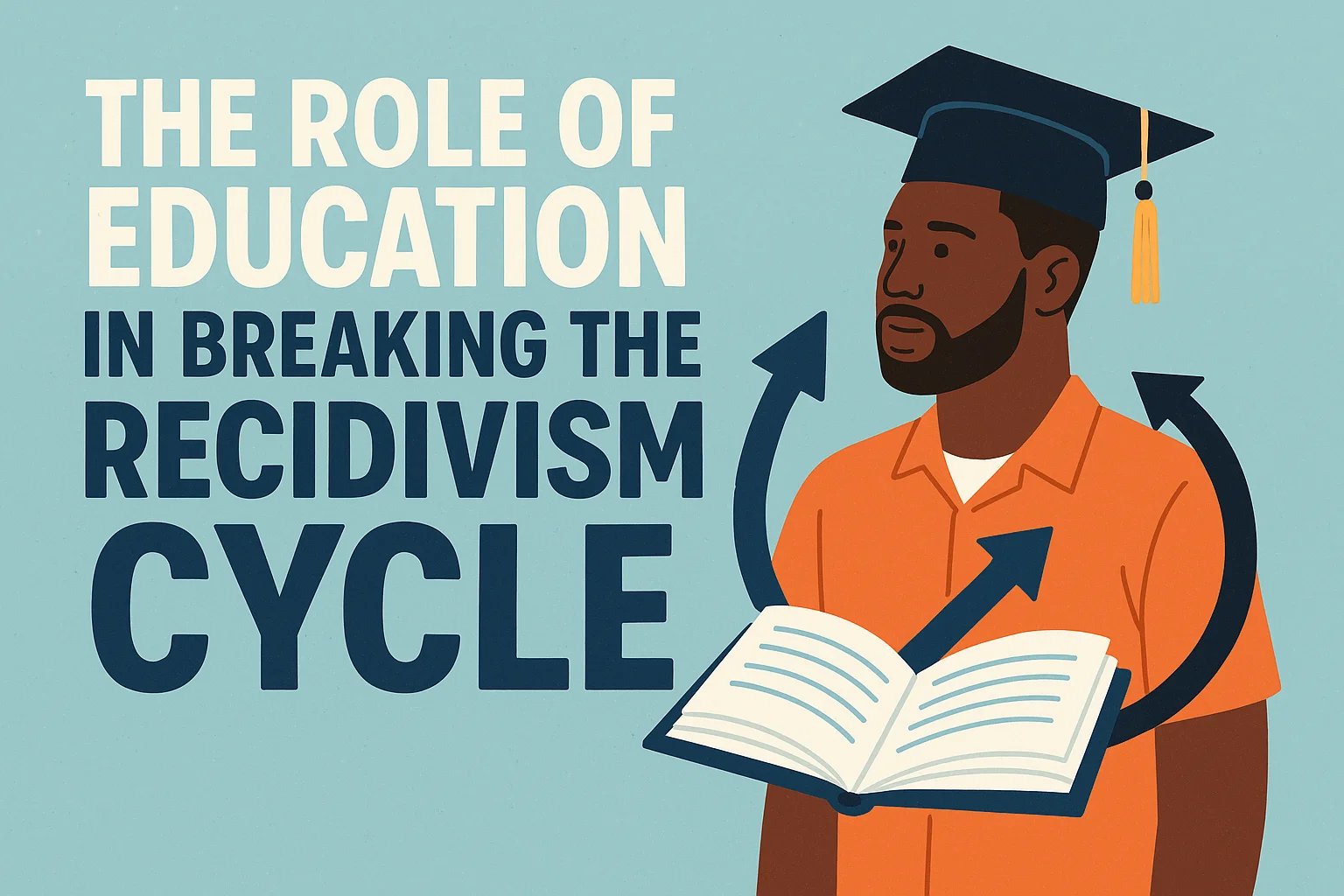
A prison sentence can end on paper long before it ends in a person’s life.
For many people leaving jail or prison, freedom begins with a bus ticket, a small amount of gate money, no stable housing, a criminal record, strained family ties, limited work history, and the heavy weight of shame. In that fragile moment, the world asks them to “do better,” but often gives them very few tools to actually build something better.
That is why The Role of Education in Breaking the Recidivism Cycle is not a soft side issue. It is central to public safety, economic stability, family restoration, and human dignity.
Education does more than fill time behind bars. At its best, it gives people language for their experiences, credentials for employment, confidence to solve problems, and a new identity beyond “offender,” “inmate,” or “ex-con.” It creates a bridge between punishment and possibility.
When we talk about The Role of Education in Breaking the Recidivism Cycle, we are really talking about whether society believes people can change—and whether we are willing to invest in the conditions that make change realistic.
Understanding the Recidivism Cycle
Recidivism generally refers to a person’s return to criminal behavior after release from incarceration, often measured by rearrest, reconviction, or reincarceration within a specific period. But the recidivism cycle is not simply a matter of “bad choices.” It is usually a repeating pattern shaped by poverty, trauma, addiction, limited education, unstable housing, unemployment, and weak support systems.
Many incarcerated people enter correctional facilities with major educational gaps. Some have not completed high school. Others struggle with literacy, learning disabilities, untreated mental health challenges, or years of school exclusion. These barriers do not disappear at release. In fact, they often become more visible.
This is where The Role of Education in Breaking the Recidivism Cycle becomes especially powerful. Education interrupts the pattern at multiple points: it strengthens decision-making, improves employability, builds self-worth, and connects people to healthier communities.
A Simple View of the Cycle
| Stage of the Cycle | Common Challenge | How Education Can Interrupt It |
|---|---|---|
| Before incarceration | Low literacy, school dropout, trauma, poverty | Adult basic education, GED preparation, counseling-informed learning |
| During incarceration | Isolation, lack of opportunity, institutional dependence | College courses, vocational training, peer tutoring, personal development |
| Pre-release | Fear, uncertainty, weak planning | Reentry education, career readiness, financial literacy |
| After release | Employment barriers, stigma, housing instability | Credentials, apprenticeships, community college pathways, job placement |
| Long-term reintegration | Lack of identity and belonging | Lifelong learning, mentoring, civic participation, family education |
The table shows why The Role of Education in Breaking the Recidivism Cycle must be understood as a continuum, not a one-time class.
Why Education Is More Than a Classroom Program
It is easy to reduce correctional education to test scores, certificates, or job training hours. Those things matter, but they do not tell the whole story.
Education changes the way people see themselves.
A person who has spent years being labeled as a problem may begin to experience themselves as a learner, writer, mechanic, coder, artist, entrepreneur, mentor, or college student. That identity shift is not cosmetic. It can influence daily decisions, relationships, and long-term goals.
The Role of Education in Breaking the Recidivism Cycle includes at least five major functions:
- Building practical skills
- Increasing employment opportunities
- Improving emotional regulation and critical thinking
- Strengthening social connection
- Creating a positive future identity
When someone believes they have a future worth protecting, the cost of returning to prison becomes more personal. Education helps make that future visible.
The Evidence: Education Reduces Recidivism
One of the strongest arguments for The Role of Education in Breaking the Recidivism Cycle is that it is supported by research.
A widely cited RAND Corporation study found that incarcerated people who participated in correctional education programs had significantly lower odds of returning to prison than those who did not. The study also reported that correctional education can be cost-effective because reductions in reincarceration save public money.
The exact outcomes vary depending on program quality, participant needs, facility conditions, and post-release support. Still, the overall pattern is clear: education is one of the most promising interventions available.
What Research Commonly Shows
| Educational Intervention | Common Benefits | Reentry Impact |
|---|---|---|
| Adult basic education | Improves reading, writing, math, confidence | Helps with job applications, forms, communication |
| GED/high school equivalency | Provides foundational credential | Opens doors to employment and further training |
| Vocational education | Builds marketable trade skills | Improves employability after release |
| College courses | Develops critical thinking and identity change | Supports long-term transformation and civic engagement |
| Digital literacy | Prepares people for modern workplaces | Reduces technology shock after release |
| Financial literacy | Teaches budgeting, credit, savings | Supports stability and reduces economic desperation |
| Social-emotional learning | Improves conflict resolution and self-awareness | Reduces impulsive decision-making |
The evidence does not suggest that education is magic. It suggests something more practical: when people gain skills, support, and hope, they are better equipped to avoid returning to prison.
That is the practical heart of The Role of Education in Breaking the Recidivism Cycle.
The Human Side: Education Restores Agency
Recidivism statistics are important, but they can flatten human beings into percentages. Behind every number is a person trying to rebuild a life.
Many incarcerated learners describe education as the first place where they felt seen for their potential instead of their worst mistake. A classroom can become one of the few spaces inside prison where curiosity is rewarded, dialogue is encouraged, and growth is expected.
This emotional dimension matters. People do not usually change because they are shamed into it. They change when they are challenged, supported, and given a meaningful path forward.
The Role of Education in Breaking the Recidivism Cycle is therefore not only about reducing crime. It is about restoring agency—the belief that one’s choices matter and that a different life is possible.
Case Study 1: Bard Prison Initiative
The Bard Prison Initiative, often known as BPI, is one of the most recognized college-in-prison programs in the United States. It offers rigorous liberal arts education to incarcerated students and grants degrees through Bard College.
The program gained national attention through the documentary series College Behind Bars, which showed incarcerated students engaging deeply with philosophy, literature, history, mathematics, and social science. The most striking part was not simply that students completed college work. It was that they were intellectually alive, debating ideas with seriousness and discipline.
Why This Case Matters
BPI illustrates The Role of Education in Breaking the Recidivism Cycle by showing how higher education can reshape identity. Students are not treated as passive recipients of programming. They are treated as scholars.
That distinction matters.
When education is demanding and dignified, it communicates a powerful message: “You are capable of serious thought. You are responsible for your mind. Your future can be larger than your past.”
Key Takeaway
College-in-prison programs can create deep personal transformation when they combine academic rigor, respect, and real credentials.
Case Study 2: The Last Mile and Digital Skills Training
The Last Mile is a program that began in California and focuses on technology training for incarcerated people, including coding, web development, and entrepreneurship. In an era where digital skills are essential for many jobs, this kind of training addresses a major reentry barrier: technological exclusion.
Many people leave prison after years or decades with little exposure to smartphones, online job applications, email platforms, video interviews, digital banking, or workplace software. This “technology shock” can make reentry even harder.
Why This Case Matters
The Last Mile demonstrates The Role of Education in Breaking the Recidivism Cycle in the modern economy. A person cannot fully reintegrate into today’s workforce without digital confidence.
Technology education also teaches more than coding. It teaches problem-solving, patience, collaboration, and adaptability. These are the same skills people need when navigating life after release.
Brief Analysis
This case is especially relevant because it shows that correctional education must evolve with labor market realities. Basic literacy remains essential, but digital literacy is now part of basic survival.
Key Takeaway
Modern reentry education should include digital skills, not as a luxury, but as a necessity.
Case Study 3: Norway’s Rehabilitation-Focused Model
Norway is often discussed in criminal justice reform because of its focus on rehabilitation, humane prison conditions, and normalization. While Norway’s system is different from systems in larger countries such as the United States, it offers useful lessons.
Norwegian prisons often emphasize education, work training, mental health support, and preparation for life outside. The guiding idea is that people will eventually return to society, so prison should prepare them to live responsibly within it.
Why This Case Matters
Norway’s approach highlights The Role of Education in Breaking the Recidivism Cycle at a systems level. Education is not treated as an optional extra. It is part of a broader philosophy: the loss of freedom is the punishment; the prison environment should still support growth.
Brief Analysis
The Norwegian model cannot be copied and pasted everywhere. Cultural, legal, economic, and political differences matter. But the core principle is transferable: if the goal is safer communities, correctional systems must prepare people for successful return.
Key Takeaway
Education works best when it is embedded in a correctional culture that expects reintegration, not permanent exclusion.
Case Study 4: Prison University Project / Mount Tamalpais College
Mount Tamalpais College, formerly associated with the Prison University Project at San Quentin State Prison, provides accredited college education to incarcerated students. The program has become a leading example of how serious academic instruction can operate inside a prison environment.
Students take courses in the humanities, social sciences, math, and science. The program emphasizes intellectual development, communication, and personal responsibility.
Why This Case Matters
This example reinforces The Role of Education in Breaking the Recidivism Cycle by demonstrating the importance of accreditation and quality. A weak program may keep people busy, but a strong program gives them a legitimate credential and a stronger sense of direction.
Brief Analysis
The value of this model is not only the degree itself. It is the community formed around learning. Students practice listening, questioning, writing, and revising their ideas. These habits are deeply relevant to successful reentry.
Key Takeaway
High-quality education inside prison should be held to real academic standards and connected to recognized credentials.
Case Study 5: Vocational Training and Apprenticeship Pathways
Not every incarcerated learner wants or needs a college degree. Many need practical training that leads directly to work. Vocational programs in fields such as welding, carpentry, culinary arts, commercial driving, electrical work, HVAC, barbering, and manufacturing can be life-changing when connected to real labor market demand.
However, vocational training must be more than outdated equipment and symbolic certificates. It should align with employer needs, licensing requirements, safety standards, and local job opportunities.
Why This Case Matters
Vocational education shows The Role of Education in Breaking the Recidivism Cycle in one of the most direct ways: employment stability.
People who can earn a legal income are less likely to rely on illegal economies. Work also provides structure, purpose, social contact, and a sense of contribution.
Brief Analysis
The strongest vocational programs include employer partnerships, apprenticeship pipelines, soft-skills coaching, and help navigating occupational licensing restrictions.
Key Takeaway
Vocational education is most effective when it leads to actual jobs, not just certificates.
The Economic Case for Correctional Education
Education in prisons is sometimes criticized as being too generous. Critics ask, “Why should people who committed crimes receive free education when law-abiding people struggle to afford college or training?”
It is an understandable concern, especially in communities where educational access is already unequal. But the question should not be framed as either helping incarcerated people or helping everyone else. A wise society invests in both.
The financial argument for The Role of Education in Breaking the Recidivism Cycle is straightforward: incarceration is expensive, and recidivism multiplies that expense. If education reduces the likelihood of return, it can save taxpayer money while also reducing harm.
Cost Comparison: Incarceration vs. Education
| Public Investment | Typical Cost Pattern | Long-Term Result |
|---|---|---|
| Reincarceration | Very high annual cost per person | Continues the cycle |
| Basic education | Lower cost than imprisonment | Improves literacy and employability |
| Vocational training | Moderate upfront cost | Can support job placement |
| College-in-prison | Costs vary, often partnership-based | Builds credentials and long-term stability |
| Reentry education | Relatively modest cost | Supports transition and reduces failure points |
The economic case does not replace the moral case. It strengthens it.
The Role of Education in Breaking the Recidivism Cycle benefits not only the learner, but also families, employers, neighborhoods, and taxpayers.
Education and Employment: The Reentry Connection
Employment is one of the strongest stabilizers after release. But people with criminal records often face major barriers, including background checks, employer bias, gaps in work history, lack of transportation, and occupational licensing restrictions.
Education helps, but only if it is connected to realistic opportunities.
A certificate in a field that refuses to hire people with certain convictions may lead to frustration. A college course without reentry advising may inspire growth but still leave a person unemployed. A GED without job coaching may not be enough.
That is why The Role of Education in Breaking the Recidivism Cycle must include career pathways.
Strong Education-to-Employment Programs Include:
- Labor market research before offering training
- Employer partnerships before release
- Resume and interview preparation
- Digital job search training
- Apprenticeship connections
- Transportation planning
- Help explaining criminal records honestly
- Continued support during the first months of employment
Education opens the door. Reentry support helps people walk through it.
The Importance of Literacy
Literacy is one of the most overlooked parts of The Role of Education in Breaking the Recidivism Cycle.
A person who struggles to read may have trouble understanding court documents, medical instructions, lease agreements, job applications, child support notices, probation conditions, and workplace safety rules. Low literacy can create frustration, dependency, and avoidable violations.
Improving literacy is not just about reading books. It is about navigating life.
Literacy Supports Reentry By Helping People:
| Literacy Skill | Reentry Application |
|---|---|
| Reading comprehension | Understanding legal and employment documents |
| Writing | Preparing resumes, emails, grievances, applications |
| Numeracy | Budgeting, measuring, calculating pay, managing bills |
| Digital reading | Using websites, online forms, and workplace platforms |
| Communication | Advocating for oneself clearly and professionally |
When adults gain literacy skills, they often gain confidence as well. That confidence can change how they parent, work, and participate in the community.
Education, Trauma, and Emotional Growth
Many incarcerated people have histories of trauma, including childhood abuse, community violence, family instability, untreated mental illness, or substance use disorders. Education cannot replace therapy, but trauma-informed education can support healing.
A trauma-informed classroom recognizes that behavior is often shaped by survival responses. It maintains structure and accountability while also emphasizing safety, respect, and choice.
This is another vital part of The Role of Education in Breaking the Recidivism Cycle. People need more than job skills. They need tools to manage anger, disappointment, conflict, rejection, and stress.
Skills That Reduce Reentry Risk
| Skill | Why It Matters |
|---|---|
| Emotional regulation | Helps prevent impulsive reactions |
| Conflict resolution | Reduces violence and relationship breakdown |
| Critical thinking | Improves decision-making |
| Communication | Supports employment and family repair |
| Goal-setting | Creates direction after release |
| Self-reflection | Helps people understand patterns and choices |
The most effective programs combine academic or vocational learning with personal development.
Family Education: Breaking Intergenerational Cycles
Recidivism affects families deeply. Children of incarcerated parents often experience emotional distress, financial hardship, stigma, and instability. When a parent returns home without support, family reunification can be difficult.
Education can help repair these bonds.
Parenting classes, family literacy programs, communication workshops, and restorative practices can support healthier relationships. Some prison education programs encourage incarcerated parents to read to their children, write letters, or participate in structured family learning activities.
This expands The Role of Education in Breaking the Recidivism Cycle beyond the individual. Education can interrupt intergenerational harm.
A parent who learns to communicate better may become more present. A child who sees a parent studying may begin to imagine education differently. A family that learns together may develop stronger tools for resilience.
The Role of Higher Education in Identity Transformation
Higher education can be especially powerful because it invites people to ask deeper questions:
- Who am I?
- What shaped my choices?
- What do I owe others?
- What kind of life do I want to build?
- How do systems, communities, and personal responsibility interact?
These questions matter. They help people move beyond survival mode.
The college classroom also teaches delayed gratification. Students must read, think, draft, revise, accept criticism, and try again. These habits are directly relevant to reentry.
That is why The Role of Education in Breaking the Recidivism Cycle includes liberal arts education, not only job training. People need employment, but they also need meaning.
A person who studies history may understand their community differently. A person who studies literature may develop empathy. A person who studies philosophy may wrestle with responsibility. A person who studies sociology may see patterns without denying personal agency.
Education does not excuse harm. It helps people understand it, take responsibility, and choose differently.
Vocational Education: Skills That Pay the Bills
While higher education is transformative, vocational education is often the fastest route to economic stability. For many returning citizens, the immediate question is not “What is my life philosophy?” but “How do I pay rent next month?”
A strong reentry system respects both needs.
Vocational education should be:
- Market-aligned
- Hands-on
- Credential-based
- Connected to employers
- Updated regularly
- Supported by reentry services
The best programs do not train people for jobs that no longer exist. They prepare people for industries with real openings and fair wages.
This is a practical dimension of The Role of Education in Breaking the Recidivism Cycle. A stable paycheck can reduce desperation, restore dignity, and support family reunification.
Digital Literacy: The New Reentry Essential
Imagine leaving prison after 15 years and discovering that nearly everything has moved online: job applications, banking, public benefits, medical appointments, transportation schedules, housing searches, and even family communication.
Without digital literacy, reentry can feel like landing in a foreign country.
Digital education should include:
- Email basics
- Online job applications
- Video interview skills
- Cybersecurity awareness
- Smartphone navigation
- Digital banking
- Online learning platforms
- Workplace software basics
In modern society, The Role of Education in Breaking the Recidivism Cycle must include technology access and training. Otherwise, returning citizens are expected to reintegrate into a world they were never taught how to navigate.
Barriers That Limit Correctional Education
If education is so effective, why is it not universally available in every jail and prison?
The answer is complicated. Correctional education faces political, financial, logistical, and cultural obstacles.
Common Barriers and Practical Solutions
| Barrier | Why It Hurts | Possible Solution |
|---|---|---|
| Limited funding | Programs remain small or inconsistent | Public-private partnerships, Pell access, state investment |
| Security restrictions | Classes may be canceled or materials limited | Better coordination between educators and correctional staff |
| Staff shortages | Programs cannot scale | Train peer tutors and expand remote instruction carefully |
| Technology limits | Digital learning becomes difficult | Secure tablets, monitored platforms, offline digital labs |
| Short jail stays | Learners leave before completing courses | Modular programs and community handoff systems |
| Transfer disruptions | Students lose progress when moved | Statewide education records and credit portability |
| Stigma | Public resistance blocks investment | Share evidence, victim-centered dialogue, community education |
| Reentry gaps | Learning stops at release | Partnerships with community colleges and workforce agencies |
These barriers are real, but they are not excuses for inaction. They are design challenges.
Understanding The Role of Education in Breaking the Recidivism Cycle means recognizing that good intentions are not enough. Programs need structure, continuity, and accountability.
What Makes a Prison Education Program Effective?
Not all education programs have the same impact. A poorly designed program may look impressive in a report but do little in practice. An effective program is built around the learner’s real needs and the realities of reentry.
Core Features of Effective Programs
| Feature | Why It Matters |
|---|---|
| Assessment | Identifies literacy level, goals, learning disabilities, career interests |
| Individual learning plans | Matches education to the person, not just the institution |
| Qualified instructors | Ensures quality and credibility |
| Recognized credentials | Makes learning valuable after release |
| Cultural relevance | Keeps learners engaged and respected |
| Trauma-informed teaching | Supports emotional safety and persistence |
| Reentry alignment | Connects learning to housing, employment, and community support |
| Data tracking | Measures outcomes and improves programs |
The strongest example of The Role of Education in Breaking the Recidivism Cycle is not a single class. It is an ecosystem.
The Reentry Bridge: What Happens After Release Matters Most
A person may complete a GED, earn college credits, or gain a trade certificate while incarcerated. But if they are released with no housing, no job leads, no transportation, and no continued educational pathway, progress can quickly unravel.
Reentry is where education must become portable.
Correctional systems should build direct pipelines to:
- Community colleges
- Trade unions
- Apprenticeship programs
- Workforce development boards
- Reentry nonprofits
- Employers willing to hire returning citizens
- Mental health and substance use treatment providers
- Housing support agencies
This is one of the most important lessons about The Role of Education in Breaking the Recidivism Cycle: education must follow the person home.
A certificate locked in a prison file is not enough. Credits must transfer. Employers must recognize training. Advisors must help students enroll. Communities must be ready to receive people who are trying to change.
Restorative Justice and Education
Education can also support accountability. Some people worry that focusing on education minimizes the harm caused by crime. But the opposite can be true.
A strong educational environment can help people face the consequences of their actions more honestly. Courses in ethics, victim impact, restorative justice, communication, and community responsibility can deepen accountability.
Restorative justice asks:
- Who was harmed?
- What are their needs?
- Who has obligations?
- How can repair happen where possible?
When combined thoughtfully, restorative justice and education strengthen The Role of Education in Breaking the Recidivism Cycle. They move the conversation beyond punishment alone and toward responsibility, repair, and prevention.
The Public Safety Argument
Public safety is often used as an argument against investing in incarcerated people. But if most incarcerated people will eventually return to society, then public safety depends on what happens before they come home.
Do they return with more anger, fewer skills, and deeper isolation?
Or do they return with education, support, accountability, and a plan?
This is the public safety logic behind The Role of Education in Breaking the Recidivism Cycle. Education reduces risk by increasing stability.
A person with a job, a mentor, a credential, stronger communication skills, and a reason to hope is generally better positioned to make lawful choices than someone released with nothing.
The Moral Argument: People Are More Than Their Worst Act
Any serious conversation about prison education must hold two truths at once:
- Crime causes real harm.
- People who cause harm can still change.
Education does not erase accountability. It makes accountability more meaningful because it asks people to grow into the kind of person who can live differently.
The moral foundation of The Role of Education in Breaking the Recidivism Cycle is simple: human beings should not be permanently defined by their lowest moment.
A justice system that offers no path to restoration becomes a warehouse for despair. A justice system that includes education creates the possibility of return—not just to society, but to responsibility.
Policy Recommendations for Expanding Correctional Education
To strengthen The Role of Education in Breaking the Recidivism Cycle, policymakers and correctional leaders should focus on practical reforms.
1. Expand Access to Quality Programs
Every incarcerated person should have access to basic education, literacy support, and meaningful skill development. Access should not depend only on facility location or sentence length.
2. Protect and Grow Pell Grant Pathways
The restoration of Pell Grant eligibility for incarcerated students in the United States represents a major opportunity. However, quality control matters. Programs should be accredited, ethical, and student-centered.
3. Build Credit Transfer Systems
Students should not lose progress because they are transferred between facilities or released. Education records should be portable.
4. Invest in Jail-Based Education
Jails often hold people for shorter periods, but they are crucial intervention points. Modular courses, rapid assessments, and community handoffs can make jail education more effective.
5. Include Digital Literacy
Secure technology can expand access while maintaining safety. Digital exclusion should not be allowed to become a permanent reentry barrier.
6. Connect Education to Reentry Services
Education departments, parole agencies, workforce boards, and community colleges should coordinate before release.
7. Measure Outcomes Honestly
Programs should track completion, employment, continued education, recidivism, and student feedback. Data should improve programs, not simply justify budgets.
These reforms would make The Role of Education in Breaking the Recidivism Cycle more than an ideal. They would make it a measurable public strategy.
A Practical Model: The Education-to-Reentry Pipeline
A strong system should guide a person from incarceration to community stability.
Education-to-Reentry Pipeline
| Phase | Main Goal | Key Actions |
|---|---|---|
| Intake | Understand learner needs | Assess literacy, education history, career goals |
| In-custody learning | Build skills and identity | Offer GED, college, vocational, digital, and life-skills education |
| Pre-release planning | Prepare for transition | Create education and employment plan, gather documents |
| Release handoff | Prevent disruption | Connect to college, employer, mentor, housing, treatment |
| First 90 days | Stabilize | Provide coaching, transportation help, job support |
| Long-term growth | Sustain change | Encourage continued education, advancement, leadership |
This pipeline captures the full meaning of The Role of Education in Breaking the Recidivism Cycle. The goal is not just program completion. The goal is life completion: a stable, meaningful, lawful future.
How Communities Can Support Educational Reentry
Communities play a major role in whether education leads to lasting change. Churches, nonprofits, colleges, employers, libraries, unions, and local governments can all help.
Community Actions That Matter
- Offer scholarships for returning citizens
- Create fair-chance hiring partnerships
- Provide mentoring and tutoring
- Help with transportation and technology access
- Support family reunification programs
- Build community college reentry offices
- Reduce stigma through public education
- Invite formerly incarcerated graduates to speak and lead
The community dimension of The Role of Education in Breaking the Recidivism Cycle is often underestimated. People need more than a second chance. They need a second-chance infrastructure.
Why Language Matters
The words we use shape what we believe is possible. Terms like “felon,” “inmate,” and “criminal” can freeze a person in a single identity. While legal accuracy has its place, humanizing language matters.
Saying “incarcerated person,” “returning citizen,” or “formerly incarcerated individual” does not deny accountability. It recognizes humanity.
Education itself changes language. A person learns to tell a fuller story about their life—one that includes harm, responsibility, growth, and contribution.
This is another subtle but powerful part of The Role of Education in Breaking the Recidivism Cycle. New language can support a new life.
Measuring Success Beyond Recidivism
Reducing recidivism is important, but it should not be the only measure of success.
A person may avoid reoffending but still struggle deeply. A stronger evaluation asks broader questions:
- Did the person find stable employment?
- Did they continue education?
- Did family relationships improve?
- Did they maintain housing?
- Did they participate in community life?
- Did their mental health improve?
- Did they develop a stronger sense of purpose?
These indicators give a fuller picture of The Role of Education in Breaking the Recidivism Cycle. The goal is not merely fewer arrests. The goal is human flourishing and community safety.
The Future of Correctional Education
The future of correctional education will likely include a blend of in-person instruction, secure digital learning, workforce partnerships, peer mentoring, college pathways, and reentry coaching.
But technology alone will not solve the problem. Nor will a single policy change.
The future depends on a shift in mindset.
If prisons are only places of punishment, education will always seem optional. If prisons are also places of preparation, education becomes essential.
That is why The Role of Education in Breaking the Recidivism Cycle should be central to criminal justice reform, not an afterthought.
Conclusion: Education Turns Release Into a Real Beginning
Recidivism is not inevitable. It is a pattern—and patterns can be interrupted.
Throughout this article, we have explored The Role of Education in Breaking the Recidivism Cycle from many angles: literacy, employment, higher education, vocational training, digital skills, trauma-informed learning, family restoration, public safety, and policy reform.
The message is clear: education works best when it is high-quality, accessible, connected to reentry, and rooted in human dignity.
A person leaving prison needs more than a warning not to return. They need tools. They need credentials. They need support. They need a reason to believe that the future can be different from the past.
Education provides that reason.
And when education helps one person rebuild a life, the benefits ripple outward—to children, families, neighborhoods, employers, taxpayers, and victims who want fewer people harmed in the future.
The ultimate promise of The Role of Education in Breaking the Recidivism Cycle is not simply that people stay out of prison. It is that they come home prepared to live, contribute, repair, and grow.
That is not charity. That is wisdom.
1. Why is education important in reducing recidivism?
Education is important because it improves literacy, employability, decision-making, confidence, and long-term stability. The Role of Education in Breaking the Recidivism Cycle is especially powerful because it addresses many root causes of reoffending, including limited job opportunities and lack of positive identity.
2. Does prison education really work?
Research consistently suggests that people who participate in correctional education programs are less likely to return to prison than those who do not. Results vary by program quality, but the evidence strongly supports The Role of Education in Breaking the Recidivism Cycle as a cost-effective public safety strategy.
3. What type of education is most effective for incarcerated people?
The most effective approach depends on the learner. Some people need basic literacy or GED preparation. Others benefit from vocational training, college courses, digital literacy, or financial education. The strongest programs combine multiple pathways and connect them to reentry support.
4. Should incarcerated people receive college education?
Yes, when programs are high-quality, accredited, and responsibly managed. College education can develop critical thinking, communication, discipline, and a new sense of identity. It is one important part of The Role of Education in Breaking the Recidivism Cycle, especially for long-term transformation.
5. How does vocational training help prevent reoffending?
Vocational training helps people gain practical skills that can lead to employment after release. Stable work reduces financial desperation, provides structure, and supports reintegration. However, vocational programs should match real labor market needs and connect participants with employers.
6. What barriers prevent prison education from expanding?
Common barriers include limited funding, security restrictions, lack of technology, staff shortages, public stigma, and weak reentry coordination. Solving these barriers requires policy support, community partnerships, and better planning between prisons, colleges, and workforce agencies.
7. How can communities support returning citizens who pursue education?
Communities can help by offering mentoring, scholarships, fair-chance hiring, tutoring, transportation assistance, technology access, and welcoming community college pathways. Community support strengthens The Role of Education in Breaking the Recidivism Cycle by helping learning continue after release.
8. Is education enough by itself to stop recidivism?
Education is powerful, but it is not enough by itself. People also need housing, healthcare, mental health support, addiction treatment, employment opportunities, family support, and fair policies. Education works best as part of a complete reentry strategy.
About the Author