Introduction: Continuity Is Not a Document—It’s a Decision-Making System
A business continuity plan that has not been tested against real risks is like a fire extinguisher hidden behind locked glass: technically present, but painfully useless when seconds matter.
Disruptions no longer arrive politely or predictably. A cyberattack can freeze operations before sunrise. A supplier failure can halt production across continents. A flood, outage, regulatory change, data breach, labor shortage, or geopolitical event can turn a normal business day into an expensive crisis.
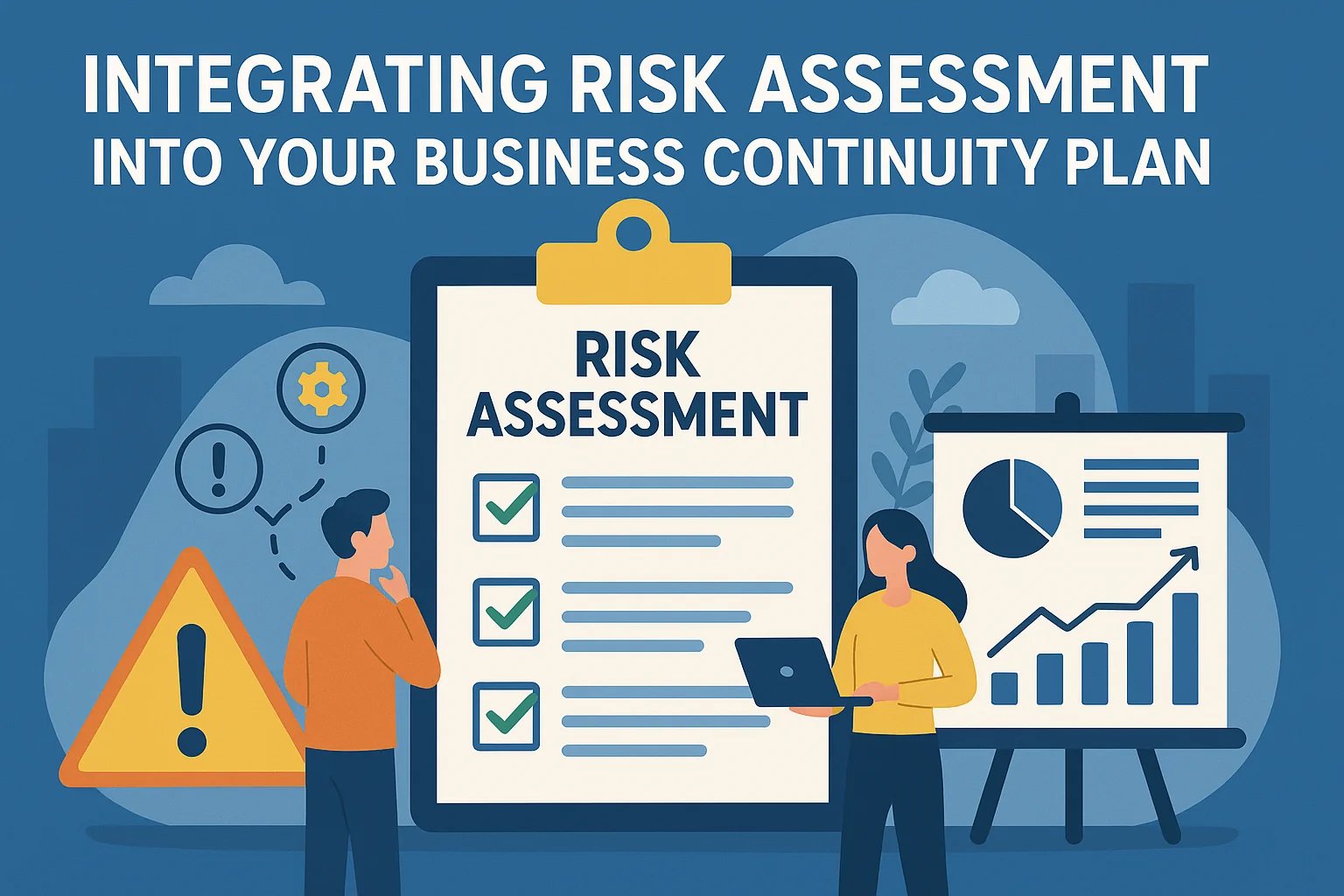
That is why Integrating Risk Assessment into Your Business Continuity Plan is no longer a “best practice” reserved for large enterprises. It is essential for every organization that wants to protect revenue, people, customers, data, reputation, and long-term viability.
A traditional business continuity plan often asks, “What do we do if something goes wrong?” A risk-integrated continuity plan asks a better question: “What is most likely to go wrong, what would hurt us most, and how do we prepare before it happens?”
That shift changes everything.
When you focus on Integrating Risk Assessment into Your Business Continuity Plan, your continuity strategy becomes sharper, more realistic, and easier to defend. You stop planning for vague emergencies and start preparing for the disruptions most likely to affect your specific business model.
This guide walks you through how to connect risk assessment and business continuity in a practical, strategic, and measurable way.
What Does Integrating Risk Assessment into Your Business Continuity Plan Really Mean?
Integrating Risk Assessment into Your Business Continuity Plan means using structured risk insights to shape your continuity priorities, response strategies, recovery timelines, resource allocation, testing, and improvement process.
In simple terms, it connects two critical disciplines:
| Discipline | Main Question | Primary Purpose |
|---|---|---|
| Risk Assessment | What could go wrong, and how likely or severe would it be? | Identify, evaluate, and prioritize threats |
| Business Continuity Planning | How will we continue or recover operations when disruption occurs? | Maintain essential functions and reduce downtime |
Without risk assessment, a business continuity plan may become generic. Without continuity planning, a risk assessment may become theoretical.
Together, they become an operational resilience system.
Integrating Risk Assessment into Your Business Continuity Plan ensures that your organization is not just reacting to disruption but actively preparing for the risks that matter most.
Why Risk Assessment Belongs at the Heart of Business Continuity
Many organizations create business continuity plans to satisfy audits, insurance requirements, customer contracts, or regulatory expectations. Unfortunately, those plans often sit in folders until something goes wrong.
The problem is not that planning is useless. The problem is that planning without risk intelligence is incomplete.
A risk-informed business continuity plan helps you:
- Identify the most serious threats to operations.
- Understand which business functions are truly critical.
- Prioritize limited resources.
- Improve recovery time objectives.
- Strengthen crisis decision-making.
- Reduce financial losses from downtime.
- Align continuity planning with enterprise risk management.
- Demonstrate governance and due diligence.
- Build confidence among employees, customers, regulators, and investors.
The goal of Integrating Risk Assessment into Your Business Continuity Plan is not to predict every crisis. No organization can do that. The goal is to build a disciplined process that helps your business absorb shocks, adapt quickly, and recover with less damage.
The Cost of Ignoring Risk in Business Continuity Planning
A continuity plan that ignores risk assessment often suffers from four major weaknesses.
1. It Prepares for the Wrong Scenarios
Some businesses spend years rehearsing building evacuations but have no credible plan for ransomware, cloud service disruption, or supply chain failure.
2. It Underestimates Dependencies
Many organizations depend on third-party vendors, logistics providers, utilities, data centers, software platforms, and specialized staff. If those dependencies are not assessed, recovery plans may fail.
3. It Misallocates Resources
Without risk prioritization, leaders may overinvest in low-impact risks and underinvest in high-impact vulnerabilities.
4. It Creates False Confidence
The most dangerous continuity plan is the one that looks complete but collapses under real-world pressure.
That is why Integrating Risk Assessment into Your Business Continuity Plan should be treated as a strategic necessity, not a compliance exercise.
Key Concepts You Need to Understand First
Before Integrating Risk Assessment into Your Business Continuity Plan, it helps to clarify several core terms.
| Term | Meaning | Example |
|---|---|---|
| Threat | A potential cause of disruption | Cyberattack, flood, supplier failure |
| Vulnerability | A weakness that increases exposure | No backup supplier, outdated software |
| Likelihood | Probability that a risk will occur | High chance of seasonal flooding |
| Impact | Consequence if the event occurs | Revenue loss, downtime, injury |
| Risk Rating | Combined likelihood and impact score | High, medium, low |
| Critical Function | Activity essential to operations | Payroll, order processing, patient care |
| RTO | Recovery Time Objective: maximum tolerable downtime | Restore system within 4 hours |
| RPO | Recovery Point Objective: maximum acceptable data loss | Lose no more than 15 minutes of data |
| BIA | Business Impact Analysis | Determines operational and financial impact |
Risk assessment identifies what could happen. Business impact analysis identifies what it would mean. Continuity planning defines what you will do about it.
The strongest approach combines all three.
A Practical Framework for Integrating Risk Assessment into Your Business Continuity Plan
The following framework can be used by organizations of almost any size.
Step 1: Define the Scope of Your Continuity Program
Start by deciding what your business continuity plan covers.
Ask:
- Which locations are included?
- Which departments are included?
- Which products or services are most critical?
- Which systems, people, vendors, and processes support them?
- What regulatory or contractual obligations apply?
This matters because Integrating Risk Assessment into Your Business Continuity Plan requires a clear view of what you are protecting.
For example, a hospital may prioritize patient care systems, emergency power, medication supply, and clinical staffing. A software company may prioritize cloud infrastructure, source code access, customer support, and cybersecurity controls.
Step 2: Identify Critical Business Functions
Not every activity is equally important during a disruption.
Critical functions are the operations your organization must maintain or recover quickly to avoid unacceptable harm.
Examples include:
- Customer service
- Payment processing
- Manufacturing lines
- Distribution
- IT infrastructure
- Safety operations
- Compliance reporting
- Procurement
- Payroll
- Data management
A useful question is: “If this function stopped for 24 hours, 72 hours, or one week, what would happen?”
This step is central to Integrating Risk Assessment into Your Business Continuity Plan because it connects risk exposure to operational reality.
Step 3: Conduct a Business Impact Analysis
A business impact analysis, or BIA, measures how disruption affects the organization over time.
It usually examines:
- Financial losses
- Operational downtime
- Legal or regulatory penalties
- Customer impact
- Employee safety
- Reputational damage
- Contractual breaches
- Data loss
- Supply chain consequences
Here is a simple BIA table:
| Business Function | Maximum Tolerable Downtime | Financial Impact | Operational Impact | Priority |
|---|---|---|---|---|
| Online ordering system | 4 hours | High | Lost sales and customer complaints | Critical |
| Payroll | 3 days | Medium | Employee dissatisfaction | High |
| Marketing campaigns | 1 week | Low | Delayed lead generation | Moderate |
| Warehouse operations | 24 hours | High | Shipment delays | Critical |
| Executive reporting | 1 week | Low | Delayed decisions | Moderate |
A BIA helps make Integrating Risk Assessment into Your Business Continuity Plan more precise. Instead of guessing which areas matter, you use evidence.
Step 4: Identify Threats and Risk Events
Next, list the threats that could disrupt each critical function.
Common risk categories include:
| Risk Category | Examples |
|---|---|
| Technology | Ransomware, system outage, data corruption, cloud failure |
| Physical | Fire, flood, earthquake, building access loss |
| Supply Chain | Vendor insolvency, shipping delays, raw material shortage |
| People | Pandemic, strike, key employee loss, skill shortage |
| Financial | Liquidity crisis, fraud, market disruption |
| Regulatory | New compliance rule, license suspension, audit failure |
| Reputation | Negative media, social media crisis, product recall |
| Security | Theft, workplace violence, sabotage, terrorism |
| Utility | Power outage, water disruption, telecom failure |
| Environmental | Extreme weather, pollution event, climate-related disruption |
When Integrating Risk Assessment into Your Business Continuity Plan, avoid relying only on historical incidents. The future may not look like the past. Include emerging risks such as artificial intelligence misuse, climate volatility, geopolitical instability, data sovereignty rules, and concentration risk in cloud providers.
Step 5: Evaluate Likelihood and Impact
Once risks are identified, score each one.
A simple scoring method uses a 1-to-5 scale:
| Score | Likelihood | Impact |
|---|---|---|
| 1 | Rare | Minimal disruption |
| 2 | Unlikely | Limited disruption |
| 3 | Possible | Moderate disruption |
| 4 | Likely | Major disruption |
| 5 | Almost certain | Severe or catastrophic disruption |
Risk score can be calculated as:
Likelihood × Impact = Risk Rating
Example:
| Risk Event | Likelihood | Impact | Score | Priority |
|---|---|---|---|---|
| Ransomware attack | 4 | 5 | 20 | Extreme |
| Local power outage | 4 | 3 | 12 | High |
| Key supplier failure | 3 | 5 | 15 | High |
| Office fire | 2 | 4 | 8 | Medium |
| Minor software bug | 3 | 2 | 6 | Low |
This is where Integrating Risk Assessment into Your Business Continuity Plan becomes powerful. The risk rating helps determine which scenarios deserve detailed continuity strategies.
Step 6: Create a Risk Heat Map
A risk heat map visually shows priority.
| Impact / Likelihood | 1 Rare | 2 Unlikely | 3 Possible | 4 Likely | 5 Almost Certain |
|---|---|---|---|---|---|
| 5 Catastrophic | Medium | High | High | Extreme | Extreme |
| 4 Major | Medium | Medium | High | High | Extreme |
| 3 Moderate | Low | Medium | Medium | High | High |
| 2 Minor | Low | Low | Medium | Medium | High |
| 1 Minimal | Low | Low | Low | Medium | Medium |
Use this heat map to decide where to focus planning, funding, testing, and executive attention.
For example, if ransomware is rated extreme and office flooding is rated medium, the continuity plan should include detailed cyber recovery procedures, backup validation, communication protocols, legal escalation, and manual workarounds.
That is the practical value of Integrating Risk Assessment into Your Business Continuity Plan: priorities become visible.
Turning Risk Findings into Continuity Strategies
Risk assessment is only useful if it changes what the organization does.
After identifying and scoring risks, convert them into specific continuity strategies.
| Risk | Continuity Strategy | Example Action |
|---|---|---|
| Ransomware | Cyber recovery and isolation | Immutable backups, incident response playbooks |
| Supplier failure | Supply chain redundancy | Secondary vendors, safety stock |
| Power outage | Facility resilience | Generators, UPS systems, remote work option |
| Pandemic | Workforce continuity | Cross-training, remote operations, health protocols |
| Data center outage | IT disaster recovery | Cloud failover, replication, alternate hosting |
| Transport disruption | Logistics flexibility | Multiple carriers, regional warehouses |
The essence of Integrating Risk Assessment into Your Business Continuity Plan is this conversion: risk intelligence becomes practical preparedness.
Aligning Risk Appetite with Business Continuity Decisions
Risk appetite defines how much risk an organization is willing to accept.
For example:
- A bank may have near-zero appetite for transaction processing downtime.
- A retailer may accept several hours of internal reporting delay.
- A hospital cannot accept failure of critical care systems.
- A manufacturer may tolerate short administrative delays but not production line shutdowns.
When Integrating Risk Assessment into Your Business Continuity Plan, risk appetite helps leaders decide how much resilience to build.
A highly risk-averse organization may invest in duplicate systems, multiple suppliers, alternate facilities, and 24/7 monitoring. A smaller business may choose targeted controls based on affordability and criticality.
The right answer depends on your business model, customer promises, regulation, and financial capacity.
The Role of Business Impact Analysis in Risk-Based Continuity
Many organizations confuse risk assessment with business impact analysis. They are related but different.
| Question | Risk Assessment | Business Impact Analysis |
|---|---|---|
| What can happen? | Yes | Partly |
| How likely is it? | Yes | No |
| What would it damage? | Yes | Yes |
| How quickly must we recover? | No | Yes |
| Which functions are critical? | Partly | Yes |
| What should we prioritize? | Yes | Yes |
A strong plan uses both. Risk assessment tells you where disruption may come from. BIA tells you how much disruption the business can tolerate.
That combination is the backbone of Integrating Risk Assessment into Your Business Continuity Plan.
Case Study 1: Maersk and the NotPetya Cyberattack
In 2017, shipping giant Maersk was hit by the NotPetya malware attack. The disruption affected systems across ports, terminals, and offices worldwide. Employees reportedly had to rely on manual workarounds, personal messaging apps, and improvised processes to keep cargo moving.
The attack caused hundreds of millions of dollars in estimated losses and revealed how quickly cyber risk can become an operational crisis.
What Happened
NotPetya spread rapidly through corporate networks, encrypting systems and crippling IT infrastructure. Maersk had to rebuild thousands of servers and endpoints.
Relevance to Integrating Risk Assessment into Your Business Continuity Plan
This case shows that cyber risk is not just an IT issue. It is a business continuity issue.
If an organization is serious about Integrating Risk Assessment into Your Business Continuity Plan, cyber scenarios must be linked to operational consequences. The plan should answer:
- Can we operate manually if systems go down?
- Are backups isolated from the network?
- Which systems must be restored first?
- Who makes decisions if email and collaboration tools are unavailable?
- How do we communicate with customers and regulators?
Brief Analysis
Maersk’s recovery is often praised because employees showed exceptional adaptability. But the event also demonstrates why business continuity plans must include technology dependencies, recovery sequencing, backup integrity, and crisis communication. Risk assessment should identify cyber events as enterprise-level threats, not technical inconveniences.
Case Study 2: Toyota and Supply Chain Disruption After the 2011 Japan Earthquake
The 2011 earthquake and tsunami in Japan disrupted global manufacturing networks. Toyota, like many manufacturers, experienced supply chain interruptions because key components came from affected suppliers.
After the crisis, Toyota worked to improve supply chain visibility and reduce dependency risks. The company reportedly developed stronger supplier mapping and inventory strategies for critical parts.
What Happened
The disaster damaged infrastructure, factories, transportation routes, and energy supply. Even companies outside the immediate disaster zone felt the effects because their suppliers or sub-suppliers were affected.
Relevance to Integrating Risk Assessment into Your Business Continuity Plan
This case highlights the importance of understanding second-tier and third-tier supplier dependencies. Many businesses know their direct suppliers but not the deeper network underneath them.
When Integrating Risk Assessment into Your Business Continuity Plan, organizations should ask:
- Which suppliers support our most critical products or services?
- Are any suppliers geographically concentrated?
- Do we have single-source dependencies?
- How quickly can we qualify alternative suppliers?
- What inventory buffers are appropriate?
Brief Analysis
Toyota’s experience shows that business continuity is not limited to internal operations. A company’s resilience is often only as strong as its supply chain. Risk assessment must include supplier concentration, geographic exposure, transportation routes, and substitute availability.
Case Study 3: The COVID-19 Pandemic and Remote Work Continuity
The COVID-19 pandemic tested business continuity plans worldwide. Some organizations transitioned quickly to remote work, digital service delivery, virtual customer support, and revised supply operations. Others struggled because their plans assumed short-term disruptions rather than prolonged global disturbance.
What Happened
The pandemic created simultaneous disruptions: workforce illness, office closures, travel restrictions, demand shocks, supply shortages, cybersecurity exposure, and regulatory uncertainty.
Relevance to Integrating Risk Assessment into Your Business Continuity Plan
The pandemic proved that continuity planning must consider compound risks. A health crisis can trigger workforce, technology, supply chain, financial, and customer service risks at the same time.
Organizations that had already focused on Integrating Risk Assessment into Your Business Continuity Plan were generally better positioned to:
- Support remote access securely.
- Cross-train essential roles.
- Communicate quickly with staff.
- Adjust customer delivery models.
- Monitor supplier and workforce risks.
- Make decisions under uncertainty.
Brief Analysis
COVID-19 exposed the weakness of static continuity plans. Plans must be living systems. Risk assessment should be updated regularly to reflect new operating models, workforce expectations, digital dependencies, and external threats.
Case Study 4: Colonial Pipeline and Operational Technology Risk
In 2021, Colonial Pipeline suffered a ransomware attack that led to a temporary shutdown of pipeline operations. The event caused fuel supply concerns across parts of the United States and attracted national attention.
What Happened
Although the attack reportedly affected business IT systems, the company shut down pipeline operations as a precaution. This illustrates how disruption in one environment can affect critical physical operations.
Relevance to Integrating Risk Assessment into Your Business Continuity Plan
This case demonstrates the need to assess interdependencies between IT, operational technology, safety, logistics, communications, and public impact.
When Integrating Risk Assessment into Your Business Continuity Plan, organizations with physical operations should ask:
- Could a business system outage force operational shutdown?
- Are operational technology environments segmented?
- Do we have safe manual operating procedures?
- How would public communication be handled?
- What regulatory notifications are required?
Brief Analysis
Colonial Pipeline shows that risk boundaries are often artificial. Cyber, operational, financial, and reputational risks can converge quickly. A risk-based continuity plan must reflect these connections.
How to Build a Risk-Based Business Continuity Plan
A risk-based business continuity plan should be clear, usable, and aligned with actual threats.
Here is a practical structure.
1. Executive Summary
Describe the purpose, scope, assumptions, and governance of the plan.
2. Risk Profile
Summarize top risks based on likelihood, impact, and business relevance.
3. Critical Functions
List essential business functions and their recovery priorities.
4. Recovery Objectives
Include recovery time objectives and recovery point objectives.
5. Response Teams
Define roles, responsibilities, escalation paths, and decision authority.
6. Continuity Strategies
Explain how the organization will maintain or restore operations.
7. Communication Plan
Include internal, customer, vendor, media, regulator, and emergency communications.
8. Resource Requirements
List people, systems, facilities, equipment, vendors, data, and documents required.
9. Scenario Playbooks
Create specific playbooks for top risks such as cyberattack, facility loss, supplier failure, pandemic, and power outage.
10. Testing and Maintenance
Define how the plan will be exercised, reviewed, and improved.
This structure makes Integrating Risk Assessment into Your Business Continuity Plan straightforward because risk findings are embedded throughout the document.
Example: Risk-to-Continuity Mapping Table
One of the best tools for Integrating Risk Assessment into Your Business Continuity Plan is a risk-to-continuity mapping table.
| Top Risk | Affected Function | Impact | Existing Controls | Continuity Response | Gaps |
|---|---|---|---|---|---|
| Ransomware | Order processing | Severe revenue loss | Backups, antivirus | Restore from immutable backups, manual order intake | Backup testing inconsistent |
| Supplier insolvency | Manufacturing | Production halt | Approved supplier list | Activate alternate supplier | Alternate not fully qualified |
| Power outage | Warehouse | Shipping delay | UPS for key systems | Generator and reroute shipments | Fuel contract missing |
| Staff shortage | Customer support | Longer response time | Cross-training | Shift priority customers to senior team | Limited multilingual coverage |
| Cloud outage | SaaS platform | Customer service disruption | Multi-zone hosting | Failover to alternate region | Failover test overdue |
This table connects risk assessment directly to action. It also makes gaps visible to leadership.
The People Side of Risk-Based Continuity
Business continuity is not only about systems and documents. It is about people making decisions under pressure.
When Integrating Risk Assessment into Your Business Continuity Plan, consider the human side:
- Who has authority to activate the plan?
- Who can approve emergency spending?
- Who communicates with employees?
- Who speaks to customers?
- Who handles legal or regulatory notifications?
- Who can step in if key leaders are unavailable?
- Are employees trained to follow the plan?
- Are responsibilities realistic during a crisis?
A brilliant plan can fail if people do not understand it.
Keep roles simple. Use plain language. Provide checklists. Train alternates. Make the plan accessible offline. During a disruption, nobody has time to decode a 100-page binder.
Common Risks That Should Be Included in Your Assessment
Every organization has a unique risk profile, but several risks deserve attention in most continuity plans.
Cybersecurity Disruption
Ransomware, phishing, credential theft, insider threats, data breaches, and denial-of-service attacks can shut down operations.
Technology Outage
Cloud platforms, ERP systems, payment systems, communication tools, and internet service providers are often mission-critical.
Supply Chain Failure
Supplier insolvency, transport disruption, geopolitical restrictions, port delays, and material shortages can interrupt delivery.
Facility Loss
Fire, flood, contamination, structural damage, or denial of access can make a site unusable.
Workforce Disruption
Illness, labor disputes, commuting disruption, resignations, or loss of key personnel can reduce operational capacity.
Extreme Weather and Climate Risk
Storms, heatwaves, wildfires, floods, and droughts are becoming more severe in many regions.
Regulatory and Legal Risk
New rules, licensing issues, sanctions, or compliance failures can stop business activity.
Reputation Crisis
A product failure, public complaint, executive misconduct, or viral controversy can trigger customer loss and operational pressure.
A serious approach to Integrating Risk Assessment into Your Business Continuity Plan looks at these risks not as isolated events, but as connected possibilities.
Scenario Planning: Making the Plan Real
Scenario planning helps turn abstract risks into practical exercises.
Instead of saying, “We might have a cyberattack,” create a scenario:
“At 7:30 a.m. on Monday, employees cannot access the ERP system. A ransom note appears on several screens. Customer orders are due to ship by noon. Email is unavailable. The CFO receives calls from two major clients asking whether their data is safe.”
Now the organization must answer:
- Who is notified first?
- Is the continuity plan activated?
- Do we shut down systems?
- How do teams communicate without email?
- Can orders be processed manually?
- What legal obligations apply?
- What message goes to customers?
- What is restored first?
Scenario planning is one of the most effective methods for Integrating Risk Assessment into Your Business Continuity Plan because it reveals assumptions, dependencies, and decision gaps.
Testing Your Risk-Integrated Business Continuity Plan
A plan is not reliable until it has been tested.
Testing can include:
| Test Type | Description | Best For |
|---|---|---|
| Tabletop Exercise | Discussion-based scenario walkthrough | Leadership decisions and coordination |
| Functional Test | Specific process or system test | IT recovery, call trees, backup restoration |
| Full Simulation | Realistic disruption exercise | Complex, high-risk environments |
| Call Tree Test | Verifies contact procedures | Emergency communication |
| Supplier Exercise | Tests vendor coordination | Supply chain resilience |
| Technical Failover Test | Validates system recovery | Disaster recovery readiness |
Testing is where Integrating Risk Assessment into Your Business Continuity Plan becomes measurable. If your top risk is ransomware, test ransomware response. If your top risk is supplier failure, test supplier switching. If your top risk is facility loss, test alternate work arrangements.
Do not test only easy scenarios. Test the risks that would hurt.
Metrics That Show Whether Your Plan Is Working
You cannot improve what you do not measure.
Useful metrics include:
| Metric | What It Measures |
|---|---|
| Percentage of critical functions with updated BIAs | Completeness |
| Number of high risks with documented continuity strategies | Risk coverage |
| Recovery time achieved during tests | Practical readiness |
| Backup restoration success rate | Data resilience |
| Supplier continuity plan coverage | Third-party resilience |
| Employee training completion | Preparedness |
| Open continuity gaps by severity | Improvement needs |
| Time to activate crisis team | Response speed |
| Communication delivery success rate | Message reliability |
By tracking these indicators, Integrating Risk Assessment into Your Business Continuity Plan becomes an ongoing management process rather than a one-time project.
Governance: Who Owns the Process?
One reason continuity plans fail is unclear ownership.
Risk-based continuity planning should involve:
- Executive leadership
- Risk management
- Business continuity manager
- IT and cybersecurity
- Operations
- Human resources
- Legal and compliance
- Finance
- Procurement
- Facilities
- Communications
- Department leaders
- Key vendors
Ownership should be documented.
| Role | Responsibility |
|---|---|
| Board or Executive Team | Approves risk appetite and resources |
| Risk Manager | Coordinates risk assessment |
| Business Continuity Lead | Maintains continuity plan |
| IT/DR Lead | Manages technology recovery |
| Department Heads | Identify critical functions and dependencies |
| Communications Lead | Manages stakeholder messaging |
| Procurement | Assesses supplier resilience |
| HR | Supports workforce continuity |
| Legal/Compliance | Advises on obligations |
Effective Integrating Risk Assessment into Your Business Continuity Plan requires collaboration. No single department sees the whole risk picture.
How Often Should You Update the Risk Assessment?
At minimum, review your risk assessment and business continuity plan annually. However, updates should also happen when major changes occur.
Trigger events include:
- New products or services
- New facilities
- Major technology changes
- Cloud migration
- Mergers or acquisitions
- New suppliers
- Regulatory changes
- Significant incidents
- Geographic expansion
- Leadership changes
- Market disruption
- Lessons from exercises
The business changes. Risks change. Your plan must change too.
A mature approach to Integrating Risk Assessment into Your Business Continuity Plan treats continuity as a living capability.
Common Mistakes to Avoid
Mistake 1: Treating Risk Assessment as a Checklist
A checklist can help, but it cannot replace analysis. You need to understand likelihood, impact, dependencies, and controls.
Mistake 2: Ignoring Third Parties
Vendors can be single points of failure. Assess their continuity capabilities.
Mistake 3: Focusing Only on Disasters
Business disruption is not always dramatic. A software outage, payment delay, or staffing gap can be just as damaging.
Mistake 4: Writing Plans Nobody Uses
A plan should be practical, concise, and accessible. If employees cannot use it during stress, it is too complicated.
Mistake 5: Failing to Test
Untested plans create false confidence.
Mistake 6: Not Linking Risk to Budget
If a risk is high but receives no funding or mitigation, leadership should consciously accept that exposure.
Avoiding these mistakes makes Integrating Risk Assessment into Your Business Continuity Plan more effective and credible.
Technology Tools That Support Risk-Based Continuity
Technology can make continuity planning easier, especially for complex organizations.
Useful tools include:
- Governance, risk, and compliance platforms
- Business continuity management software
- Incident management tools
- Emergency notification systems
- Vendor risk management platforms
- Cybersecurity monitoring tools
- Backup and disaster recovery platforms
- Data visualization dashboards
- Workflow automation tools
However, tools do not replace judgment.
The best software cannot decide your risk appetite, identify cultural weaknesses, or persuade leaders to invest in resilience. Technology should support Integrating Risk Assessment into Your Business Continuity Plan, not substitute for it.
Long-Tail Keyword Variations for Contextual SEO
To discuss this topic naturally, organizations and content teams may use related phrases such as:
- How to integrate risk assessment into a business continuity plan
- Business continuity risk assessment framework
- Risk-based business continuity planning
- Business continuity plan risk analysis
- BCP risk assessment process
- Integrating risk analysis into business continuity management
- Operational resilience risk assessment
- Business impact analysis and risk assessment
- Risk assessment for business continuity planning
- Enterprise risk management and business continuity integration
These variations support the core theme of Integrating Risk Assessment into Your Business Continuity Plan while making the content more natural and useful.
A Step-by-Step Checklist for Integrating Risk Assessment into Your Business Continuity Plan
Use this checklist as a practical starting point.
| Step | Action | Completed |
|---|---|---|
| 1 | Define the scope of the continuity plan | ☐ |
| 2 | Identify critical business functions | ☐ |
| 3 | Conduct a business impact analysis | ☐ |
| 4 | Identify internal and external threats | ☐ |
| 5 | Score risks by likelihood and impact | ☐ |
| 6 | Create a risk heat map | ☐ |
| 7 | Map risks to critical functions | ☐ |
| 8 | Define recovery time and recovery point objectives | ☐ |
| 9 | Develop continuity strategies for top risks | ☐ |
| 10 | Assign roles and escalation authority | ☐ |
| 11 | Build communication templates | ☐ |
| 12 | Include supplier and third-party risks | ☐ |
| 13 | Test high-priority scenarios | ☐ |
| 14 | Document gaps and improvement actions | ☐ |
| 15 | Review and update regularly | ☐ |
This checklist captures the practical heart of Integrating Risk Assessment into Your Business Continuity Plan.
Making the Business Case to Leadership
Executives often support resilience in principle but hesitate when investment is required. To gain buy-in, translate continuity risks into business language.
Instead of saying:
“We need better backup systems.”
Say:
“A ransomware event affecting our order platform could stop revenue for three days. Based on average daily sales, that exposure is approximately $1.2 million before reputational damage. A tested backup and recovery upgrade would reduce recovery time from three days to six hours.”
That is the language leaders understand.
When presenting Integrating Risk Assessment into Your Business Continuity Plan, focus on:
- Revenue protection
- Customer trust
- Regulatory compliance
- Contractual obligations
- Insurance expectations
- Reputation management
- Operational stability
- Competitive advantage
Resilience is not just a cost. It is a business enabler.
The Link Between Business Continuity and Enterprise Risk Management
Enterprise risk management, or ERM, helps organizations identify and manage strategic, financial, operational, and compliance risks. Business continuity focuses on keeping operations running during disruption.
The two should work together.
| Enterprise Risk Management | Business Continuity |
|---|---|
| Identifies enterprise-level risks | Prepares response and recovery actions |
| Reports to leadership and board | Activates during disruption |
| Defines risk appetite | Aligns recovery priorities |
| Monitors risk trends | Tests operational readiness |
| Supports strategic decisions | Protects critical functions |
Integrating Risk Assessment into Your Business Continuity Plan creates a bridge between ERM and day-to-day operational resilience. It ensures top enterprise risks are not merely reported but planned for.
How Small Businesses Can Apply This Without Overcomplicating It
Small businesses may not have dedicated risk managers or business continuity teams. That is okay.
A simple version can still be powerful.
Start with five questions:
- What are the five events most likely to interrupt our business?
- Which activities must continue no matter what?
- What tools, people, suppliers, and data do those activities depend on?
- How long can we survive without them?
- What can we do now to reduce downtime?
For a small business, Integrating Risk Assessment into Your Business Continuity Plan may involve:
- Keeping customer records backed up.
- Documenting emergency contacts.
- Having an alternate internet provider.
- Cross-training employees.
- Maintaining insurance.
- Identifying backup suppliers.
- Creating a manual payment process.
- Preparing customer communication templates.
You do not need a massive document. You need a usable plan.
The Future of Risk-Based Business Continuity
Business continuity is evolving. The next generation of resilience planning will be shaped by several trends.
1. More Climate-Related Disruption
Organizations will need to assess physical climate risks, facility exposure, water availability, heat stress, insurance changes, and logistics disruption.
2. Increased Cyber-Physical Convergence
Cyberattacks will increasingly affect physical operations, infrastructure, manufacturing, healthcare, and transportation.
3. Greater Supply Chain Transparency
Businesses will need deeper visibility into suppliers, sub-suppliers, regions, materials, and geopolitical exposure.
4. AI-Driven Risk Monitoring
Artificial intelligence may help detect risk signals earlier, but it will also introduce new risks such as model failures, misinformation, and automated decision errors.
5. Higher Stakeholder Expectations
Customers, regulators, insurers, and investors increasingly expect proof of resilience.
These trends make Integrating Risk Assessment into Your Business Continuity Plan even more important. Resilience will become a competitive differentiator, not merely an internal safeguard.
Conclusion: Resilience Starts Before the Crisis
A business continuity plan should not be a dusty document, a compliance artifact, or a last-minute scramble. It should be a living guide for protecting what matters most.
Integrating Risk Assessment into Your Business Continuity Plan gives that guide intelligence. It helps you identify your greatest exposures, prioritize critical functions, design realistic recovery strategies, test what matters, and improve over time.
The organizations that recover fastest are rarely the ones that predicted everything. They are the ones that prepared thoughtfully, understood their vulnerabilities, practiced difficult scenarios, and made resilience part of everyday decision-making.
Start small if you need to. Identify your top risks. Map them to your critical operations. Ask what would happen if those operations stopped. Build practical responses. Test them. Improve them.
The best time to strengthen your continuity plan was before the last disruption. The next best time is today.
1. What is the main purpose of integrating risk assessment into a business continuity plan?
The main purpose is to ensure your continuity plan focuses on the risks most likely to disrupt your organization and cause serious harm. Integrating Risk Assessment into Your Business Continuity Plan helps prioritize resources, improve recovery strategies, and reduce downtime.
2. How often should a business continuity risk assessment be updated?
At least once a year, but also whenever major changes occur, such as new systems, suppliers, locations, regulations, products, or business models. Risk assessment should also be updated after incidents or continuity exercises.
3. What is the difference between risk assessment and business impact analysis?
Risk assessment identifies what could go wrong and how likely or severe it might be. Business impact analysis determines how disruption would affect critical functions over time. Both are essential for Integrating Risk Assessment into Your Business Continuity Plan effectively.
4. Who should be involved in the process?
Key participants should include leadership, risk management, operations, IT, cybersecurity, HR, legal, compliance, procurement, finance, communications, and department heads. For some organizations, critical vendors should also be involved.
5. Can small businesses benefit from risk-based business continuity planning?
Absolutely. Small businesses may benefit even more because they often have fewer resources to absorb disruption. A simple plan based on top risks, critical activities, backup contacts, data protection, and supplier alternatives can make a major difference.
6. What are the most common risks to include in a business continuity plan?
Common risks include cyberattacks, technology outages, supply chain failures, facility loss, extreme weather, workforce shortages, regulatory disruption, utility outages, and reputation crises.
7. How do you test a risk-integrated business continuity plan?
Use tabletop exercises, technical recovery tests, supplier disruption drills, emergency communication tests, and full simulations. The most important rule is to test scenarios based on your highest-priority risks.
8. What is the biggest mistake organizations make?
The biggest mistake is creating a plan that is not connected to real risks. A generic plan may look good on paper but fail during an actual disruption. Integrating Risk Assessment into Your Business Continuity Plan ensures the plan is realistic, prioritized, and actionable.
About the Author