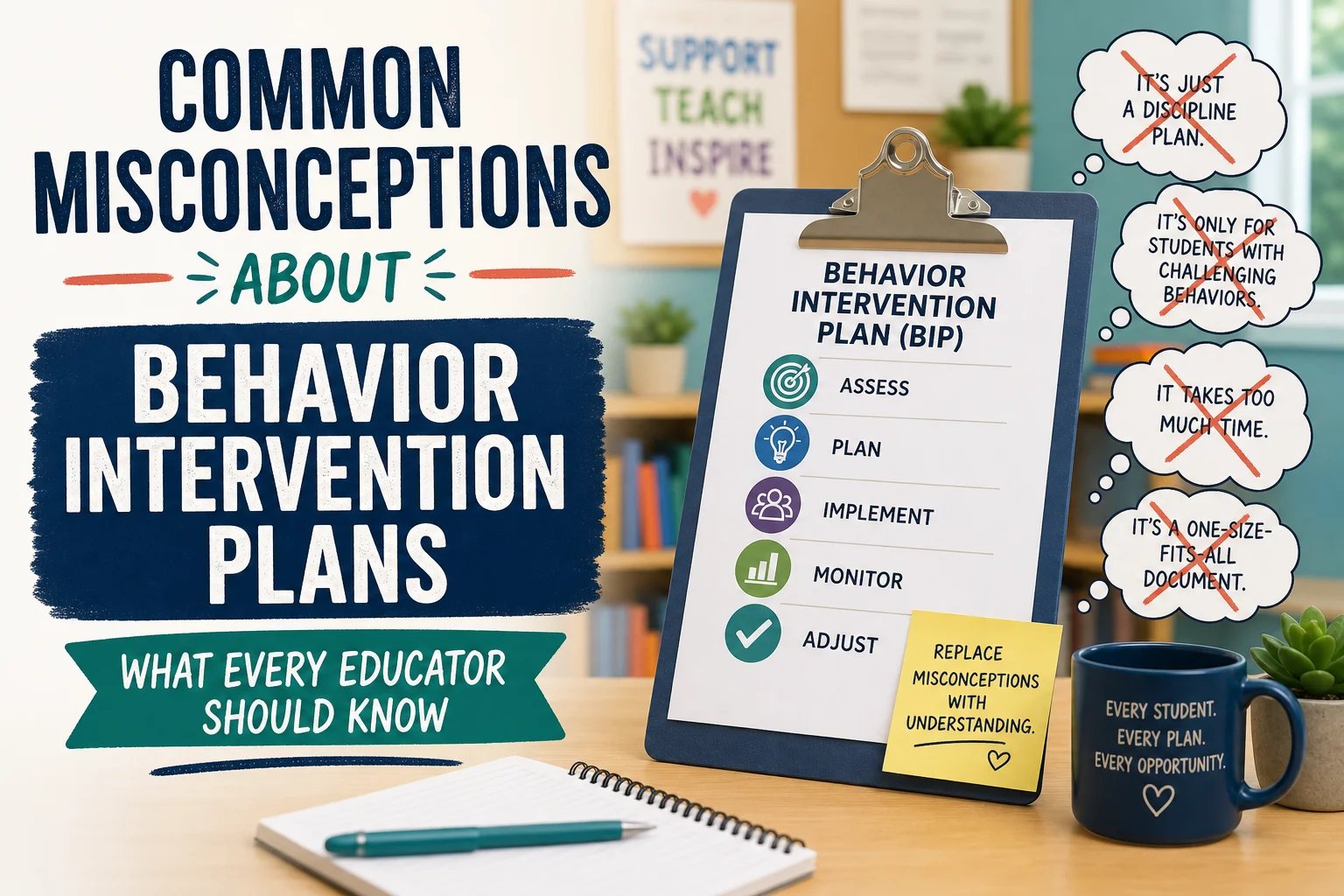
A Behavior Intervention Plan can change the entire trajectory of a student’s school experience. Done well, it helps a child feel understood, equips educators with practical strategies, and turns daily conflict into teachable moments. Done poorly—or misunderstood—it can become a binder document nobody uses, a punishment plan in disguise, or a source of frustration for teachers, families, and students alike.
That is why Common Misconceptions About Behavior Intervention Plans: What Every Educator Should Know is more than a professional development topic. It is a classroom reality.
Every educator has met a student whose behavior seems “out of nowhere.” The student who bolts from class. The child who shuts down and refuses to work. The teenager who argues with every adult. The student who jokes constantly, interrupts lessons, or becomes aggressive when corrected.
But behavior is rarely random. It communicates something.
A strong Behavior Intervention Plan, often called a BIP, is designed to identify what the behavior is communicating and teach the student a more appropriate way to get their needs met. Yet many educators still receive mixed messages about what BIPs are, who needs them, how they work, and what they are supposed to accomplish.
This article explores Common Misconceptions About Behavior Intervention Plans: What Every Educator Should Know in depth. We will look at myths, real classroom examples, practical strategies, and the mindset shifts that help BIPs become meaningful tools rather than paperwork.
Understanding Behavior Intervention Plans Before Addressing the Myths
Before unpacking Common Misconceptions About Behavior Intervention Plans: What Every Educator Should Know, it helps to define what a Behavior Intervention Plan actually is.
A Behavior Intervention Plan is a written, individualized plan designed to reduce challenging behavior and increase positive, functional replacement behaviors. It is usually based on data from a Functional Behavior Assessment, or FBA.
In simple terms:
- The FBA asks, “Why is this behavior happening?”
- The BIP answers, “What should we do about it?”
A good BIP does not simply list consequences. It outlines prevention strategies, replacement skills, adult responses, reinforcement systems, environmental supports, and methods for measuring progress.
A BIP should answer questions such as:
- What specific behavior are we addressing?
- When and where does it usually happen?
- What triggers or setting events make it more likely?
- What function does the behavior serve for the student?
- What skill should the student learn instead?
- How will adults respond consistently?
- How will progress be tracked?
When educators misunderstand these elements, plans can become ineffective. That is why the topic Common Misconceptions About Behavior Intervention Plans: What Every Educator Should Know deserves careful attention.
Misconception #1: A Behavior Intervention Plan Is Just a Discipline Plan
One of the biggest misunderstandings in Common Misconceptions About Behavior Intervention Plans: What Every Educator Should Know is the idea that a BIP is simply a formal discipline plan.
It is not.
A discipline plan often focuses on what happens after a rule is broken. A Behavior Intervention Plan focuses on why the behavior occurs and how to prevent it, teach alternatives, and reinforce success.
For example, if a student repeatedly leaves the classroom, a discipline-only approach might say:
“If the student leaves class, he will receive a referral.”
A BIP asks:
“Why is the student leaving? Is he escaping difficult work? Avoiding peer conflict? Seeking sensory regulation? Trying to access an adult?”
The response depends on the function of the behavior.
If the student is leaving to avoid challenging math tasks, the plan may include task chunking, pre-correction, a help card, scheduled breaks, and reinforcement for attempting work.
If the student is leaving because the room is too loud, the plan may include noise-reducing headphones, a calm corner, sensory breaks, or an alternate workspace.
The difference matters. Discipline alone may suppress behavior temporarily, but a BIP teaches a better path forward.
Discipline Plan vs. Behavior Intervention Plan
| Feature | Discipline Plan | Behavior Intervention Plan |
|---|---|---|
| Primary focus | Rule violations and consequences | Function of behavior and skill-building |
| Main question | “What rule was broken?” | “Why is the behavior happening?” |
| Timing | Often reactive | Proactive and responsive |
| Goal | Compliance and accountability | Behavior change and student growth |
| Tools used | Warnings, referrals, consequences | Prevention, replacement skills, reinforcement, data |
| Best use | School-wide expectations | Individualized behavior support |
Understanding this distinction is central to Common Misconceptions About Behavior Intervention Plans: What Every Educator Should Know.
Misconception #2: BIPs Are Only for Students With IEPs
Another common myth is that Behavior Intervention Plans are only for students receiving special education services.
While BIPs are often connected to Individualized Education Programs, especially when behavior interferes with learning, they are not exclusively for students with IEPs. General education students may also benefit from structured behavior support plans.
In some schools, teams may develop informal intervention plans through Multi-Tiered Systems of Support, Response to Intervention, student assistance teams, or counseling support processes.
The key question is not, “Does the student have an IEP?”
The better question is:
“Does the student need a structured, function-based plan to support behavior change?”
A student without a disability label may still experience anxiety, trauma, social skill deficits, academic frustration, grief, executive functioning challenges, or environmental stressors that show up as behavior.
This point is essential in Common Misconceptions About Behavior Intervention Plans: What Every Educator Should Know because waiting for a formal label can delay meaningful support.
Misconception #3: The Student Is Choosing to Be Difficult
This misconception can quietly sabotage even the best-written plan.
Educators are human. When a student disrupts instruction repeatedly, refuses directions, or speaks disrespectfully, it is easy to feel personally targeted. But one of the most important principles behind Common Misconceptions About Behavior Intervention Plans: What Every Educator Should Know is this:
Behavior is communication, not a character flaw.
That does not mean students are never responsible for their actions. Accountability matters. But accountability without instruction is incomplete.
A student may be communicating:
- “This work feels impossible.”
- “I do not know how to ask for help.”
- “I need attention and do not know how to get it appropriately.”
- “I feel unsafe.”
- “I am overwhelmed.”
- “I do not understand the social rules.”
- “I need control because other parts of my life feel chaotic.”
When adults interpret behavior as intentional defiance only, they often respond with escalation. When they interpret behavior as communication, they respond with curiosity and strategy.
A BIP should not excuse behavior. It should explain it well enough to change it.
Misconception #4: A BIP Will Work Immediately
Many educators hope that once a Behavior Intervention Plan is written, the behavior will improve quickly. Sometimes it does. More often, meaningful change takes time.
This is another key part of Common Misconceptions About Behavior Intervention Plans: What Every Educator Should Know.
A student who has used a behavior for months or years has learned that the behavior works. It may help them escape, gain attention, access something, or regulate emotions. Replacement behaviors must be taught, practiced, prompted, and reinforced consistently before they become reliable.
Think of it like teaching reading. We would never expect a student to decode multisyllabic words after one lesson. Behavior skills also require repetition.
A BIP may initially produce uneven progress. The behavior might decrease, then spike. The student may use the replacement skill in one setting but not another. Adults may implement the plan inconsistently at first. Data may reveal that the original hypothesis was incomplete.
This does not mean the plan failed. It means the team needs to monitor, adjust, and keep teaching.
Misconception #5: The BIP Belongs to the Special Education Teacher
A Behavior Intervention Plan does not belong to one staff member. It belongs to the team.
In many schools, special education teachers, school psychologists, behavior specialists, counselors, or administrators help write BIPs. But implementation often happens across settings: general education classrooms, lunchrooms, hallways, buses, recess, specials, and extracurricular activities.
If only one adult understands the plan, the plan is fragile.
A major lesson in Common Misconceptions About Behavior Intervention Plans: What Every Educator Should Know is that consistent adult response is one of the strongest predictors of success.
Everyone who works with the student should know:
- What the target behavior looks like
- What triggers to watch for
- What replacement behavior to prompt
- What reinforcement to provide
- What response to use if behavior escalates
- What data to collect, if applicable
This does not mean every staff member needs a 20-page document. In fact, many teams benefit from a one-page summary or quick-reference guide.
Example: BIP Quick-Reference Snapshot
| BIP Component | Staff Need-to-Know Example |
|---|---|
| Target behavior | Student leaves assigned area without permission |
| Common trigger | Independent writing tasks longer than 10 minutes |
| Function | Escape from difficult writing demands |
| Prevention | Provide graphic organizer and check in before writing |
| Replacement skill | Student uses break card or help card |
| Reinforcement | Praise and points for requesting help/break appropriately |
| Adult response | Calmly block unsafe exit if needed, redirect to choice |
| Data | Track frequency of leaving area and use of break card |
When staff can understand the plan quickly, implementation improves.
Misconception #6: Consequences Are the Most Important Part of a BIP
Consequences matter, but they are not the heart of a strong Behavior Intervention Plan.
A BIP that only says “If the student does X, adults will do Y” is incomplete. Effective BIPs emphasize antecedent strategies and replacement behaviors.
Antecedent strategies reduce the likelihood of the behavior before it happens. Replacement behaviors give the student a more appropriate way to meet the same need. Reinforcement makes the replacement behavior worth using again.
For example, if a student shouts out to gain peer attention, simply removing the student from class may not solve the problem. The student may still crave attention and may escalate to get it.
A stronger plan may include:
- Greeting the student warmly at the door
- Giving the student a structured leadership role
- Teaching appropriate ways to contribute
- Reinforcing hand-raising or using a response card
- Providing peer attention for positive participation
- Minimizing dramatic adult reactions to shouting
This distinction belongs at the center of Common Misconceptions About Behavior Intervention Plans: What Every Educator Should Know because many plans fail when they over-focus on what happens after misbehavior.
Misconception #7: Replacement Behaviors Should Be What Adults Prefer
A replacement behavior must serve the same function as the challenging behavior.
This is one of the most overlooked ideas in Common Misconceptions About Behavior Intervention Plans: What Every Educator Should Know.
If a student throws work on the floor to escape a task, teaching the student to apologize does not replace the behavior’s function. Apologizing may be socially appropriate later, but it does not help the student escape or manage the difficult task in the moment.
A functional replacement behavior might be:
- Asking for help
- Requesting a short break
- Choosing between two task options
- Asking for the first problem to be done together
- Using a “too hard” card
Similarly, if a student interrupts to gain attention, asking for a break may not help. The student needs an appropriate way to gain attention, such as raising a hand, using a comment card, or participating in a scheduled check-in.
Matching Function to Replacement Behavior
| Behavior Function | Challenging Behavior | Weak Replacement | Strong Replacement |
|---|---|---|---|
| Escape | Rips worksheet | Says “sorry” | Requests help or break |
| Attention | Makes loud jokes | Sits silently | Uses hand signal to share comment |
| Access | Grabs preferred item | Writes reflection | Requests item or earns access |
| Sensory/regulation | Rocks chair dangerously | Stops moving completely | Uses wobble cushion or movement break |
| Control/choice | Refuses all tasks | Receives lecture | Chooses task order or format |
A replacement behavior should be easier, more efficient, and socially acceptable. If the challenging behavior works faster than the replacement skill, the student will likely keep using the challenging behavior.
Case Study #1: The Student Who “Refused to Work”
Situation
Maya, a fourth-grade student, frequently put her head down during independent reading and refused to complete written responses. Her teacher initially believed Maya was being lazy or oppositional. The classroom consequence system involved losing recess minutes for incomplete work.
The behavior worsened. Maya began tearing papers and saying, “I don’t care.”
A school team conducted observations and reviewed work samples. They discovered that Maya struggled significantly with reading comprehension. The refusal happened most often during independent tasks involving written responses to grade-level text.
BIP Strategies
The team developed a plan that included:
- Previewing vocabulary before reading
- Offering audio support for longer passages
- Reducing the number of written responses while maintaining learning goals
- Teaching Maya to use a “help please” card
- Providing praise for task initiation
- Allowing oral responses before written responses
- Tracking completed work and help-card use
Outcome
Within six weeks, Maya’s refusal decreased. She still needed academic intervention, but the behavior no longer dominated reading time. She began asking for help before shutting down.
Brief Analysis
This case illustrates a central lesson in Common Misconceptions About Behavior Intervention Plans: What Every Educator Should Know: what looks like defiance may be academic avoidance. Maya was not refusing because she disliked the teacher. She was escaping a task that exposed a skill gap. The BIP worked because it addressed the function of behavior and taught a usable replacement skill.
Misconception #8: A BIP Should Focus Only on Reducing Bad Behavior
A strong BIP is not just about stopping behavior. It is about building skills.
If the only goal is “reduce disruptions,” educators may miss the bigger opportunity: teaching communication, self-regulation, problem-solving, flexibility, social interaction, emotional awareness, and academic persistence.
This is a vital point in Common Misconceptions About Behavior Intervention Plans: What Every Educator Should Know because behavior reduction without skill development can create temporary quiet but not long-term growth.
Instead of asking only, “How do we make this stop?” teams should ask:
- What does the student need to learn?
- What skill is missing or underdeveloped?
- How can we teach it explicitly?
- How will we know the student is becoming more independent?
A student who curses when frustrated may need emotional labeling and coping strategies. A student who grabs materials may need requesting skills. A student who refuses group work may need structured social scripts and gradual exposure.
Reducing behavior is important. Replacing it with something better is transformational.
Misconception #9: Data Collection Has to Be Complicated
Some educators feel overwhelmed when they hear “behavior data.” They imagine clipboards, spreadsheets, and endless forms.
But data collection does not have to be complicated to be useful.
In Common Misconceptions About Behavior Intervention Plans: What Every Educator Should Know, this myth matters because teams often abandon data when the process feels unrealistic.
Useful behavior data may include:
- Frequency: How many times did the behavior happen?
- Duration: How long did it last?
- Latency: How long after a direction did the student respond?
- Intensity: How severe was the behavior?
- ABC notes: What happened before, during, and after?
- Replacement behavior use: How often did the student use the new skill?
The best data system is one that staff can actually maintain.
Simple Weekly Behavior Data Chart
| Week | Target Behavior Frequency | Replacement Skill Use | Notes |
|---|---|---|---|
| Week 1 | 18 incidents | 2 uses | Plan introduced; student needed prompts |
| Week 2 | 14 incidents | 5 uses | Break card used during writing |
| Week 3 | 10 incidents | 9 uses | Fewer incidents after morning check-in |
| Week 4 | 7 incidents | 13 uses | Student independently requested help twice |
This type of data helps teams see whether the plan is working. It also prevents decision-making based only on emotion or memory.
Misconception #10: If the Plan Is Written Well, Implementation Will Be Easy
Even the best BIP can fail if implementation is unrealistic.
Teachers manage full classrooms, academic demands, pacing guides, parent communication, supervision duties, and unexpected disruptions. A BIP that requires constant one-on-one attention, complex tracking, or rewards that are impossible to deliver may not survive the school day.
A practical insight from Common Misconceptions About Behavior Intervention Plans: What Every Educator Should Know is that plans must fit real classrooms.
Before finalizing a BIP, teams should ask:
- Can the teacher implement this during instruction?
- Are materials ready and accessible?
- Does the reinforcement system fit the student’s age and setting?
- Are expectations clear enough for substitute teachers?
- Is the plan sustainable beyond one enthusiastic staff member?
- Have staff been trained in the response procedures?
A simple plan implemented consistently is better than a perfect plan nobody can follow.
Case Study #2: The Hallway Runner
Situation
Jordan, a second-grade student, frequently ran out of the classroom during transitions. Staff viewed the behavior as dangerous and attention-seeking. Each time Jordan ran, several adults followed him, spoke urgently, and sometimes physically guided him back.
An FBA showed that Jordan often ran during noisy transitions, especially before lunch and dismissal. He appeared overwhelmed by crowding and sound. Adult pursuit also provided intense attention, which may have reinforced the behavior.
BIP Strategies
The team designed a plan with layered supports:
- Jordan transitioned two minutes before the hallway became crowded.
- He carried a visual transition card.
- A preferred adult gave a calm, brief pre-correction.
- Jordan earned points for walking safely.
- If he began to run, adults used minimal verbal attention and followed safety procedures calmly.
- Jordan learned to request “quiet walk” or “wait please.”
Outcome
Running decreased significantly over eight weeks. Jordan began using the “quiet walk” request with prompting, then independently. Staff also reduced the intense reactions that had unintentionally strengthened the behavior.
Brief Analysis
Jordan’s case is a powerful example of Common Misconceptions About Behavior Intervention Plans: What Every Educator Should Know. The behavior was not simply “noncompliance.” It was connected to sensory overwhelm and reinforced by adult attention. The plan succeeded because it changed the environment, taught communication, and adjusted adult responses.
Misconception #11: Rewards Are Bribes
Many educators worry that reinforcement systems are bribes. This concern appears often in conversations about Common Misconceptions About Behavior Intervention Plans: What Every Educator Should Know.
The difference between a bribe and reinforcement is timing and purpose.
A bribe is often offered in desperation after behavior has escalated:
“If you stop screaming, I’ll give you candy.”
Reinforcement is planned, instructional, and connected to a desired behavior:
“When you use your break card instead of yelling, you earn points toward computer time.”
Reinforcement helps students see the value of using new skills. Over time, the goal is to fade artificial rewards and build natural reinforcement, such as successful peer interaction, academic confidence, positive relationships, and independence.
Adults use reinforcement constantly in life. Paychecks, compliments, grades, professional recognition, and social approval all reinforce behavior. Students with challenging behavior may need reinforcement that is more explicit, immediate, and frequent while they are learning.
The problem is not reinforcement. The problem is using it inconsistently, without teaching, or only after escalation.
Misconception #12: A BIP Means Lowering Expectations
Some educators fear that individualized behavior supports mean students are “getting away with it” or being held to lower standards.
In truth, a strong BIP maintains high expectations while providing the support needed to reach them.
This is one of the most important ideas in Common Misconceptions About Behavior Intervention Plans: What Every Educator Should Know.
Fair does not always mean identical. Fair means each student receives what they need to access learning and participate safely.
Consider a student who becomes aggressive when frustrated. Lowering expectations would mean allowing aggression or removing all challenging tasks. A good BIP does neither. Instead, it may teach the student to request help, tolerate mistakes, use calming strategies, and return to work after a break.
The expectation remains: participate, learn, communicate safely, and respect others.
The support changes so the student can meet that expectation.
Misconception #13: The Same Strategy Should Work for Every Student
Educators often share strategies that worked well for one student. That collaboration is valuable. But behavior interventions are not one-size-fits-all.
A sticker chart may motivate one child and embarrass another. A calm corner may help one student regulate and allow another to escape work. Public praise may encourage one student and trigger anxiety in another.
The essence of Common Misconceptions About Behavior Intervention Plans: What Every Educator Should Know is that function matters more than surface behavior.
Two students may both yell during math. One may be escaping hard work. Another may be seeking peer attention. They need different plans.
Same Behavior, Different Function
| Student | Same Observable Behavior | Likely Function | Better Intervention |
|---|---|---|---|
| Student A | Yells during math | Escape difficult tasks | Help card, task chunking, easier entry point |
| Student B | Yells during math | Peer attention | Planned positive attention, participation role |
| Student C | Yells during math | Sensory/emotional overload | Calm space, regulation tools, reduced noise |
| Student D | Yells during math | Control or choice | Choice of problem order or response method |
This is why copying a BIP from another student rarely works. Plans must be individualized.
Misconception #14: Families Are Optional in the Process
Families are not optional. They are essential partners.
A school team may understand classroom patterns, but families often understand history, stressors, preferences, strengths, medical concerns, cultural context, and what works at home.
In Common Misconceptions About Behavior Intervention Plans: What Every Educator Should Know, family collaboration is often underestimated. Yet family input can transform a plan.
Families can help answer:
- Does the behavior happen at home?
- Are there sleep, medication, health, or routine factors?
- What motivates the student?
- What calming strategies work outside school?
- Are there recent changes or stressors?
- How does the student describe school?
Educators should avoid contacting families only when something goes wrong. Positive, proactive communication builds trust before difficult conversations happen.
A family should not feel like the school is presenting a finished plan. They should feel like part of the team.
Misconception #15: Student Voice Does Not Matter
Students are often the least consulted people in behavior planning, even though the plan is about them.
Of course, the level of student involvement depends on age, communication ability, and developmental needs. But whenever possible, students should have a voice.
They may be able to identify:
- Triggers adults have missed
- Rewards that actually matter
- Supportive adults
- Embarrassing strategies to avoid
- Better ways to prompt them
- Early warning signs of escalation
- Personal goals
A student might say, “Please don’t tell me to calm down in front of everyone,” or “I need help starting, not after I’m already mad.”
That insight can make or break implementation.
This is a meaningful part of Common Misconceptions About Behavior Intervention Plans: What Every Educator Should Know because a BIP should not be something done to a student. It should be something built with the student as much as possible.
Case Study #3: The Teen Who “Didn’t Care”
Situation
Andre, a ninth-grade student, frequently skipped class, argued with teachers, and refused assignments. Staff described him as unmotivated. Several office referrals had not changed the pattern.
During interviews, Andre shared that he felt embarrassed reading aloud and believed teachers thought he was “stupid.” He skipped most often on days when classes involved presentations, group reading, or long written assignments.
BIP Strategies
The team created a plan that included:
- A trusted mentor check-in each morning
- Private rather than public correction
- Alternative ways to demonstrate understanding
- Advance notice before reading or presenting expectations
- A pass to request a brief reset with the counselor
- Reinforcement tied to attendance and task initiation
- Reading intervention support
Outcome
Andre’s attendance improved, and arguments decreased. He did not become a perfect student overnight, but he began completing assignments when he felt he had a dignified way to ask for support.
Brief Analysis
Andre’s story highlights another vital lesson in Common Misconceptions About Behavior Intervention Plans: What Every Educator Should Know: apathy may be self-protection. His behavior protected him from embarrassment. The plan worked because it preserved dignity while increasing accountability.
Misconception #16: Crisis Response Is the Same as a BIP
A crisis plan and a Behavior Intervention Plan are related, but they are not the same.
A crisis plan explains what to do when behavior becomes unsafe or severely escalated. It may include evacuation procedures, de-escalation steps, emergency contacts, or safety protocols.
A BIP is broader. It includes proactive supports, teaching strategies, reinforcement, and data tracking.
Confusing the two is common in Common Misconceptions About Behavior Intervention Plans: What Every Educator Should Know. If a plan only tells staff what to do during a crisis, it is missing the most important part: preventing the crisis from happening and teaching alternatives.
A complete plan may include both:
- Prevention strategies
- Early intervention steps
- Replacement skills
- Reinforcement
- De-escalation procedures
- Safety response steps
- Recovery and re-entry process
A crisis plan keeps people safe. A BIP helps reduce the need for crisis response over time.
Misconception #17: Once a BIP Is Written, It Is Finished
A BIP is a living document.
Students grow. Classroom demands change. Reinforcers lose power. New triggers emerge. Staff roles shift. A plan that worked in October may need revision by February.
One of the most practical lessons in Common Misconceptions About Behavior Intervention Plans: What Every Educator Should Know is that review is not a formality. It is part of the intervention.
Teams should review data regularly and ask:
- Is the target behavior decreasing?
- Is the replacement behavior increasing?
- Are staff implementing the plan consistently?
- Is the function still accurate?
- Does the student need more teaching or different reinforcement?
- Can any supports be faded?
- Are new concerns emerging?
If the plan is not working, the team should not blame the student first. They should examine the plan.
Misconception #18: Behavior Plans Should Be Secret or Highly Restricted
Confidentiality matters. Student information should never be casually shared. However, the adults responsible for supporting the student need enough information to implement the plan appropriately.
Sometimes, a BIP is written and filed but not communicated to paraprofessionals, specials teachers, lunch supervisors, bus staff, or substitute teachers. Then the student receives inconsistent responses across settings.
This issue appears frequently in Common Misconceptions About Behavior Intervention Plans: What Every Educator Should Know because schools sometimes confuse confidentiality with lack of communication.
A better approach is need-to-know sharing.
For example:
- A music teacher may need to know the student uses a break card.
- A lunch monitor may need to know how to prompt safe peer interaction.
- A substitute may need a brief, confidential behavior support summary.
- A bus driver may need specific safety procedures.
The goal is not to label the student. The goal is to support the student consistently.
Misconception #19: Cultural Context Does Not Matter
Behavior expectations are influenced by culture, community, language, identity, and lived experience.
A behavior that one adult interprets as disrespect may have a different meaning in another context. Eye contact, volume, personal space, emotional expression, questioning adults, and help-seeking can all be culturally influenced.
This does not mean schools abandon expectations. It means teams should examine assumptions.
In Common Misconceptions About Behavior Intervention Plans: What Every Educator Should Know, cultural responsiveness is essential. Without it, behavior plans can unintentionally punish students for differences rather than teach shared expectations.
Teams should ask:
- Are we interpreting behavior through one cultural lens?
- Have we considered language differences?
- Are expectations explicitly taught or simply assumed?
- Does the plan respect the student’s identity and dignity?
- Are family perspectives included?
- Are discipline patterns showing disproportionality?
A culturally responsive BIP is not softer. It is more accurate, respectful, and effective.
Misconception #20: Positive Relationships Are Nice but Not Necessary
Strategies matter. Data matters. Reinforcement matters.
But relationships often determine whether a student will trust the plan enough to use it.
A student who feels disliked may reject support, even if it is technically appropriate. A student who trusts an adult may accept correction, use a coping strategy, or try again after failure.
This is a foundational idea in Common Misconceptions About Behavior Intervention Plans: What Every Educator Should Know: relationships are not extras. They are interventions.
Relationship-building does not require grand gestures. It can include:
- Greeting the student by name
- Noticing strengths
- Offering choices
- Following through calmly
- Repairing after conflict
- Avoiding public power struggles
- Showing interest in the student’s life
- Separating the student from the behavior
A BIP without relationship is mechanical. A BIP with relationship becomes more humane and more effective.
What Every Educator Should Remember About Behavior Intervention Plans
After exploring Common Misconceptions About Behavior Intervention Plans: What Every Educator Should Know, several core truths stand out.
A strong BIP is:
- Individualized
- Function-based
- Proactive
- Skill-focused
- Data-informed
- Team-implemented
- Culturally responsive
- Practical for real classrooms
- Reviewed and revised over time
- Built with student dignity at the center
A weak BIP is usually:
- Generic
- Punishment-heavy
- Too complicated
- Not connected to data
- Poorly communicated
- Focused only on stopping behavior
- Implemented inconsistently
- Written without family or student input
- Never reviewed after creation
The difference between the two can be life-changing for students and sanity-saving for educators.
Practical Checklist for Reviewing a Behavior Intervention Plan
Use this checklist to evaluate whether a BIP is likely to work.
| Question | Yes/No |
|---|---|
| Is the target behavior clearly defined and observable? | |
| Is the likely function of behavior identified? | |
| Are triggers and setting events included? | |
| Are prevention strategies practical? | |
| Is a replacement behavior explicitly taught? | |
| Does the replacement behavior match the function? | |
| Is reinforcement immediate and meaningful? | |
| Are adult responses clear and consistent? | |
| Is data collection simple enough to maintain? | |
| Have family members contributed input? | |
| Has the student provided input when appropriate? | |
| Do all relevant staff understand their role? | |
| Is there a schedule for reviewing progress? |
This checklist turns Common Misconceptions About Behavior Intervention Plans: What Every Educator Should Know into action. It helps teams move from theory to implementation.
Long-Tail Keyword Variations for Contextual SEO
To discuss Common Misconceptions About Behavior Intervention Plans: What Every Educator Should Know naturally, educators and content creators may also use related phrases such as:
- common myths about Behavior Intervention Plans
- what teachers should know about BIPs
- Behavior Intervention Plan misconceptions in schools
- mistakes educators make with behavior plans
- how Behavior Intervention Plans really work
- function-based behavior intervention strategies
- BIP myths and facts for educators
- effective Behavior Intervention Plan examples
- misunderstandings about student behavior plans
- Behavior Intervention Plans and classroom management
These variations support readability while reinforcing the topic.
Conclusion: Moving From Misunderstanding to Meaningful Support
The heart of Common Misconceptions About Behavior Intervention Plans: What Every Educator Should Know is simple: students do well when they have the skills, support, and environment to succeed.
Behavior Intervention Plans are not magic documents. They are not punishment systems. They are not only for special education. They are not shortcuts to instant compliance.
At their best, BIPs are roadmaps. They help educators understand what a student is communicating, prevent predictable problems, teach better skills, and respond with consistency and compassion.
The most effective educators do not ask, “How do I make this student stop?”
They ask, “What is this student telling us, and what can we teach next?”
That question changes everything.
If your school is struggling with behavior, start small. Define the behavior clearly. Look for patterns. Ask why the behavior works for the student. Teach a replacement skill. Reinforce progress. Involve the family. Listen to the student. Review the data. Adjust with humility.
A well-designed Behavior Intervention Plan can restore hope—not only for the student, but for every adult trying to help.
1. What is the biggest misconception about Behavior Intervention Plans?
The biggest misconception is that a Behavior Intervention Plan is mainly a punishment or discipline plan. In reality, a BIP is designed to understand the function of behavior, prevent challenges, teach replacement skills, and reinforce positive behavior.
2. Do students need an IEP to have a Behavior Intervention Plan?
Not always. Many BIPs are connected to IEPs, but students without IEPs can also benefit from structured behavior support through general education interventions, MTSS, RTI, counseling teams, or school-based support systems.
3. How long does it take for a Behavior Intervention Plan to work?
It depends on the student, behavior, consistency of implementation, and accuracy of the plan. Some students improve quickly, while others need weeks or months of teaching, reinforcement, and adjustment. A BIP should be reviewed regularly using data.
4. Are rewards in a BIP the same as bribery?
No. Planned reinforcement is not bribery. Reinforcement is provided after the student uses a desired skill or behavior. Bribery usually happens during escalation and is used to stop behavior in the moment. Effective reinforcement teaches students that positive replacement behaviors are worthwhile.
5. What should educators do if a BIP is not working?
If a BIP is not working, the team should review the data and implementation. Ask whether the function of behavior was correctly identified, whether staff are following the plan consistently, whether the replacement behavior matches the function, and whether reinforcement is meaningful.
6. Who is responsible for implementing a Behavior Intervention Plan?
Everyone who works with the student may have a role. This can include general education teachers, special education teachers, paraprofessionals, counselors, administrators, related service providers, bus staff, and family members. Consistency across settings is critical.
7. Can a Behavior Intervention Plan include consequences?
Yes, but consequences should not be the only focus. A strong BIP includes prevention strategies, replacement behaviors, reinforcement, adult response procedures, and data collection. Consequences should be logical, instructional, and connected to safety and learning.
8. Why is student voice important in a BIP?
Student voice helps teams understand triggers, preferences, embarrassing supports, trusted adults, and meaningful reinforcers. When students are involved appropriately, they are more likely to understand and use the plan.
9. How often should a Behavior Intervention Plan be reviewed?
A BIP should be reviewed regularly, especially when data shows limited progress, behavior changes, settings change, or supports are no longer needed. Many teams review plans every few weeks initially, then less frequently once progress is stable.
10. What is the most important takeaway from Common Misconceptions About Behavior Intervention Plans: What Every Educator Should Know?
The most important takeaway is that behavior plans should teach, not just control. Effective BIPs are compassionate, practical, data-informed, and focused on helping students build the skills they need to succeed.
About the Author


The PsyForU Editorial Collective is the research and editorial team of PsyForU Research International. The collective prepares educational, psychological, mental-health-awareness, inclusion, neurodiversity, and research-methodology content for students, parents, educators, researchers, and general readers. PsyForU content is intended for awareness, education, and capacity-building and should not be treated as clinical diagnosis, therapy, medical advice, legal advice, or emergency mental-health support.