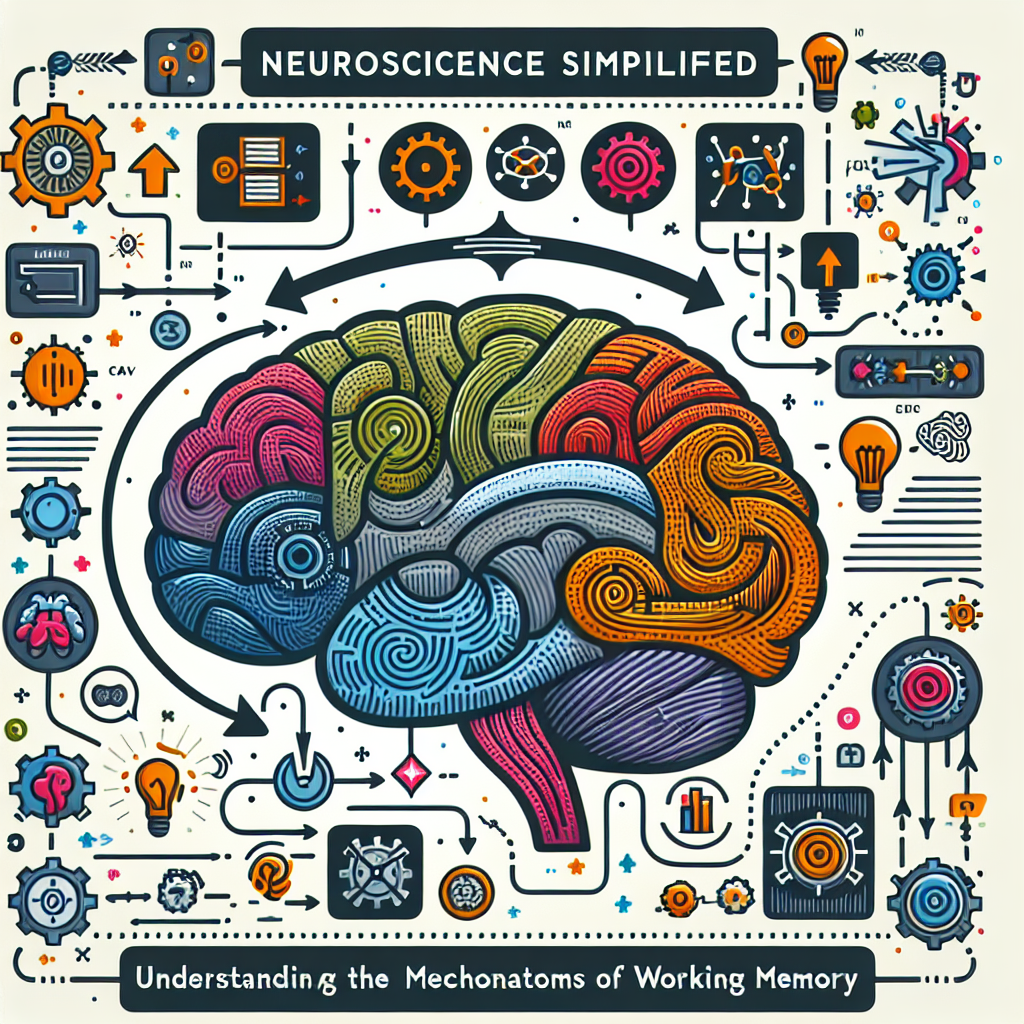
Introduction
Imagine you’re juggling multiple tasks: cooking dinner, responding to emails, and keeping an eye on the kids. What allows you to manage these various demands on your attention and thought processes? This ability to hold and manipulate information in your mind temporarily is known as working memory. Understanding how working memory operates is crucial, not just for academic success, but also for navigating daily life effectively. In this article, we’ll delve into the intricate mechanisms behind working memory, offering a simplified yet comprehensive overview of its neuroscience. Whether you’re a student looking to boost your grades or a professional aiming to enhance your cognitive agility, Neuroscience Simplified: Understanding the Mechanisms of Working Memory is your roadmap to improved cognitive capabilities.
What is Working Memory?
Defining Working Memory
Working memory is more than just short-term memory; it’s an active system that holds information available for immediate use. It allows us to process information, solve problems, and even make decisions. Psychologically, it’s often conceptualized as having a limited capacity, typically able to hold about 7 ± 2 items simultaneously—a rule popularly known as "Miller’s Law."
The Role of Working Memory in Daily Life
Consider how often you rely on your working memory in everyday situations:
- Calculating a tip in a restaurant.
- Following a recipe while cooking.
- Remembering a new acquaintance’s name.
In these instances, working memory enables you to manipulate and keep track of information, proving its essential role in our lives.
The Neuroscience Behind Working Memory
Key Brain Structures
The neuroscience of working memory involves several key brain regions:
Prefrontal Cortex (PFC): This area is critically involved in higher-level cognitive tasks and is often referred to as the "CEO" of the brain. The PFC is responsible for planning, attention, and decision-making.
Parietal Cortex: This region assists in spatial awareness and is involved in the manipulation of visual information.
- Hippocampus: While primarily known for its role in long-term memory, the hippocampus also plays a part in working memory, especially in relating new information to existing knowledge.
Neurotransmitters at Play
The functioning of working memory is modulated by various neurotransmitters:
Dopamine: Essential for reinforcing rewarding behaviors and enhancing focus, dopamine levels can significantly affect working memory performance.
- Acetylcholine: This neurotransmitter is crucial for attention and learning. Its levels increase during tasks requiring focus, thus supporting working memory processes.
The Connection Between Working Memory and Attention
A key aspect of working memory is its dependence on attention. The ability to filter irrelevant information and concentrate on the task at hand allows us to utilize working memory effectively. This interplay explains why individuals with attention deficit disorders may struggle with working memory tasks.
Case Studies: Practical Applications of Working Memory Insights
Case Study 1: The Role of Working Memory in Academic Performance
Researchers at a prominent university analyzed the working memory capacities of 500 students across various disciplines. They discovered a significant correlation between high working memory capacity and academic success, particularly in STEM fields. Students with better working memory were not only able to follow complex instructions but also excelled in problem-solving tasks. This reinforces the idea that optimizing working memory can lead to enhanced learning outcomes.
Analysis: The study underscores the relevance of working memory in educational settings and the importance of strategies aimed at improving it.
Case Study 2: Working Memory Training Programs
In one notable intervention, a group of elderly participants underwent training exercises designed to enhance their working memory. Over twelve weeks, they engaged in tasks that gradually increased in complexity. Results showed improvements not just in working memory tasks but also in general cognitive functioning, demonstrating the brain’s plasticity even in later life.
Analysis: This showcases the potential for targeted training programs to bolster working memory and, consequently, overall cognitive health.
Strategies for Enhancing Working Memory
Techniques and Exercises
Chunking Information:
Break down information into smaller, manageable units. For instance, when remembering a phone number, divide it into sections.Visualization:
Utilize imagery to create mental pictures of the information. This method helps in recalling complex concepts more easily.Rehearsal:
Repeatedly practicing information helps reinforce neural connections, making recall easier.- Mind Mapping:
Structuring information visually can aid in understanding complex topics and make it easier to retrieve related memories.
Technology and Tools
Various apps developed for enhancing cognitive skills can aid in boosting your working memory. Many of these tools incorporate games that are designed to challenge and improve essential cognitive functions.
Lifestyle Factors Affecting Working Memory
Aspects of everyday life can have profound effects on working memory:
Sleep: Sleep deprivation is known to impair cognitive functions, including working memory.
Nutrition: A diet rich in antioxidants, healthy fats, and low in processed sugars can support brain health.
- Physical Activity: Exercise increases blood flow to the brain and has been shown to improve working memory performance.
FAQs About Working Memory
FAQ 1: What is the difference between working memory and short-term memory?
Answer: While short-term memory refers to the temporary storage of information, working memory involves actively manipulating and processing that information for cognitive tasks.
FAQ 2: Can working memory be improved?
Answer: Yes, various exercises, techniques, and lifestyle changes can help enhance working memory performance.
FAQ 3: What cognitive tasks rely on working memory?
Answer: Tasks such as problem-solving, following multi-step instructions, and reasoning all depend heavily on working memory capabilities.
FAQ 4: What ages are most affected by working memory declines?
Answer: While working memory can decline with age, effective training strategies can mitigate these declines, even in older adults.
FAQ 5: How does anxiety impact working memory?
Answer: High levels of anxiety can impair working memory performance by consuming cognitive resources needed for effective information processing.
Conclusion
Understanding the mechanisms of working memory can unlock new potentials in both education and everyday life. From its neurobiological underpinnings to practical applications, Neuroscience Simplified: Understanding the Mechanisms of Working Memory provides valuable insights applicable to all individuals seeking to enhance their cognitive abilities. In our fast-paced world, harnessing the power of working memory not only helps in academic or professional environments but also improves our everyday decision-making and problem-solving skills. So, remember, it’s not just about the amount of information you can hold; it’s about how effectively you can use it. Start applying these insights today and watch your cognitive capabilities expand!
About the Author


The PsyForU Editorial Collective is the research and editorial team of PsyForU Research International. The collective prepares educational, psychological, mental-health-awareness, inclusion, neurodiversity, and research-methodology content for students, parents, educators, researchers, and general readers. PsyForU content is intended for awareness, education, and capacity-building and should not be treated as clinical diagnosis, therapy, medical advice, legal advice, or emergency mental-health support.