The Ultimate Guide to Thoughts, Feelings, Actions: The Triad of Cognitive Behavioral Therapy Explained
Introduction: Why One Small Thought Can Change an Entire Day
Have you ever woken up feeling fine, checked one message, and suddenly your whole mood shifted?
Maybe your boss wrote, “Can we talk later?” and within seconds your mind filled in the blanks: I did something wrong. I’m in trouble. I’m going to lose my job. Your chest tightened, your stomach dropped, and you spent the next few hours distracted, anxious, and avoiding your inbox.
Nothing had actually happened yet.
But your thought created a feeling, and that feeling shaped your action.
That is the heart of Thoughts, Feelings, Actions: The Triad of Cognitive Behavioral Therapy Explained. Cognitive Behavioral Therapy, often called CBT, is built on a practical but powerful idea: our thoughts, emotions, and behaviors constantly influence one another. When we understand this loop, we can stop feeling trapped by automatic reactions and start responding with more clarity, confidence, and intention.
Thoughts, Feelings, Actions: The Triad of Cognitive Behavioral Therapy Explained is not just a therapy concept. It is a life skill. It helps people manage anxiety, depression, stress, low self-esteem, procrastination, conflict, perfectionism, and emotional overwhelm.
This guide breaks down the triad in a clear, practical, real-world way. You will learn how thoughts affect feelings, how feelings influence actions, and how actions can reshape both mood and mindset. You will also see case studies, tools, tables, and strategies you can apply immediately.
What Is Cognitive Behavioral Therapy?
Cognitive Behavioral Therapy is a structured, evidence-based form of psychotherapy that focuses on the connection between thinking patterns, emotional states, and behavior.
Unlike some approaches that spend most of their time exploring the distant past, CBT often focuses on what is happening right now:
- What are you thinking?
- What are you feeling?
- What are you doing?
- Is this pattern helping or hurting you?
- What could you try instead?
This does not mean CBT ignores the past. Early experiences can shape beliefs, assumptions, fears, and coping habits. But CBT is especially interested in how those beliefs show up in daily life today.
That is why Thoughts, Feelings, Actions: The Triad of Cognitive Behavioral Therapy Explained is such a useful framework. It gives people a map. Instead of saying, “I’m just anxious,” or “I’m just lazy,” or “I’m just broken,” CBT invites a more compassionate and curious question:
What is the loop I’m stuck in, and where can I interrupt it?
Understanding the CBT Triad: Thoughts, Feelings, and Actions
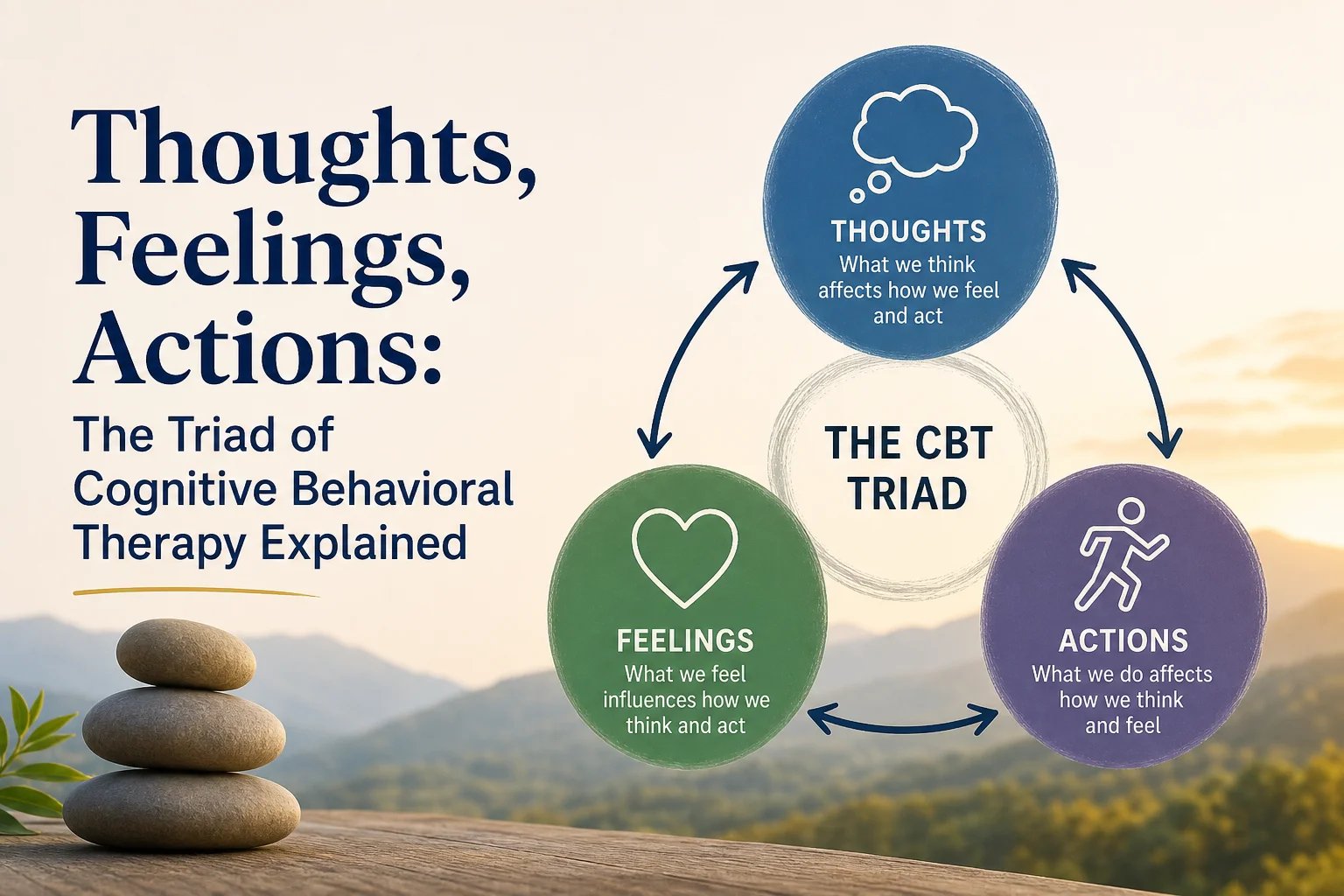
At the center of CBT is the idea that thoughts, feelings, and actions form an interconnected cycle.
A situation happens. You interpret it. That interpretation creates an emotional response. Then you act based on that emotional response. Your action often reinforces the original thought, making the cycle stronger.
This is why Thoughts, Feelings, Actions: The Triad of Cognitive Behavioral Therapy Explained matters so much. It shows that emotional suffering is not always caused directly by events themselves, but by the meaning we attach to those events.
The CBT Triad at a Glance
| Element | What It Means | Example | Why It Matters |
|---|---|---|---|
| Thoughts | Interpretations, beliefs, assumptions, self-talk | “They didn’t reply because they’re upset with me.” | Thoughts shape emotional reactions. |
| Feelings | Emotional and physical responses | Anxiety, sadness, shame, anger, tension | Feelings influence what we feel driven to do. |
| Actions | Behaviors, avoidance, habits, coping responses | Apologizing repeatedly, withdrawing, checking phone | Actions reinforce or challenge thoughts. |
In simple terms, Thoughts, Feelings, Actions: The Triad of Cognitive Behavioral Therapy Explained teaches that if you change one part of the cycle, the entire pattern can begin to shift.
Part One: Thoughts — The Stories We Tell Ourselves
Thoughts are not just words in your mind. They are interpretations. They are the stories your brain creates to explain what is happening.
Some thoughts are accurate and helpful. Others are distorted, exaggerated, incomplete, or based on fear rather than facts.
For example:
- “I made a mistake” is a thought.
- “I always ruin everything” is also a thought.
- “This is uncomfortable, but I can handle it” is a thought.
- “If I feel anxious, something terrible must happen” is a thought.
The problem is not that we think. Thinking is human. The problem begins when we treat every thought as truth.
This is a major lesson in Thoughts, Feelings, Actions: The Triad of Cognitive Behavioral Therapy Explained: thoughts are powerful, but they are not always reliable.
Automatic Thoughts
Automatic thoughts are fast, spontaneous interpretations that pop into the mind without deliberate effort.
They often sound like:
- “I can’t do this.”
- “They don’t like me.”
- “I’m going to fail.”
- “Something bad is going to happen.”
- “I should have done better.”
- “Everyone is judging me.”
Automatic thoughts can be so quick that we notice the emotion before we notice the thought. You may feel anxious, angry, or ashamed and only later realize what you were telling yourself.
Core Beliefs
Underneath automatic thoughts are deeper beliefs called core beliefs. These are broad conclusions people hold about themselves, others, or the world.
Examples include:
- “I am not good enough.”
- “People will abandon me.”
- “The world is unsafe.”
- “I must be perfect to be accepted.”
- “My needs do not matter.”
CBT helps people identify these beliefs and test whether they are accurate, helpful, and flexible.
Cognitive Distortions
Cognitive distortions are common thinking traps. They make situations feel worse than they are and often fuel emotional distress.
| Cognitive Distortion | What It Sounds Like | Balanced Alternative |
|---|---|---|
| All-or-nothing thinking | “If I’m not perfect, I’m a failure.” | “I can make mistakes and still be capable.” |
| Catastrophizing | “This will be a disaster.” | “This may be hard, but I can cope.” |
| Mind reading | “They think I’m stupid.” | “I don’t actually know what they think.” |
| Overgeneralizing | “This always happens to me.” | “This happened today, but not always.” |
| Emotional reasoning | “I feel afraid, so I must be in danger.” | “Fear is a signal, not proof.” |
| Should statements | “I should never feel this way.” | “Feelings are human, even when uncomfortable.” |
| Personalization | “It’s my fault they’re upset.” | “Their mood may have many causes.” |
A key insight from Thoughts, Feelings, Actions: The Triad of Cognitive Behavioral Therapy Explained is that changing thoughts does not mean “thinking positive.” It means thinking more accurately, flexibly, and compassionately.
Part Two: Feelings — The Body’s Emotional Signals
Feelings are emotional experiences that often come with physical sensations.
Anxiety may feel like a racing heart, tight chest, shallow breathing, or restlessness. Sadness may feel heavy, slow, or empty. Anger may feel hot, tense, and energized. Shame may feel like wanting to disappear.
Feelings are not enemies. They are signals.
The goal of CBT is not to eliminate emotions. The goal is to understand them, tolerate them, and respond wisely.
That distinction is crucial in Thoughts, Feelings, Actions: The Triad of Cognitive Behavioral Therapy Explained. Feelings matter. They deserve attention. But they do not always need to be obeyed.
Feelings Are Real, But Not Always Accurate
If you feel rejected, the feeling is real. But it does not always mean you were actually rejected.
If you feel unsafe, the sensation is real. But it does not always mean you are in danger.
If you feel like a failure, the pain is real. But it does not prove that you are one.
This is where CBT becomes empowering. It validates emotional experience while also questioning the conclusions attached to that experience.
Primary and Secondary Emotions
Sometimes the feeling we notice first is not the original feeling.
For example:
- You feel angry, but underneath is hurt.
- You feel numb, but underneath is grief.
- You feel irritated, but underneath is fear.
- You feel ashamed, but underneath is loneliness.
Understanding this helps people respond to the real need beneath the emotion.
The Role of the Body
CBT also recognizes that emotions are physical. When the body is activated, thoughts can become more intense and actions can become more impulsive.
That is why techniques like breathing, grounding, exercise, sleep improvement, and relaxation can support cognitive change. If your nervous system is calmer, your thoughts are often easier to examine.
In this way, Thoughts, Feelings, Actions: The Triad of Cognitive Behavioral Therapy Explained is not just about mindset. It is also about the body, behavior, and nervous system working together.
Part Three: Actions — The Habits That Reinforce or Rewrite the Cycle
Actions are what we do in response to thoughts and feelings.
They include visible behaviors, such as:
- Avoiding a difficult conversation
- Staying in bed all day
- Checking messages repeatedly
- Snapping at a partner
- Overworking
- Canceling plans
- Seeking reassurance
- Procrastinating
- Exercising
- Asking for help
Actions also include subtle behaviors, like rumination, mental rehearsing, self-criticism, or scanning for danger.
In Thoughts, Feelings, Actions: The Triad of Cognitive Behavioral Therapy Explained, actions are especially important because behavior can either maintain a problem or help resolve it.
Avoidance: The Short-Term Relief Trap
Avoidance is one of the most common patterns CBT addresses.
When something feels uncomfortable, avoidance provides immediate relief. But that relief teaches the brain, “Avoiding saved me.” Over time, the feared situation feels even more threatening.
Example:
- Thought: “If I go to the party, I’ll embarrass myself.”
- Feeling: Anxiety.
- Action: Stay home.
- Result: Immediate relief.
- Long-term effect: Social anxiety grows stronger.
Avoidance reduces discomfort today but increases fear tomorrow.
Behavioral Activation: Acting Before Motivation Arrives
When people feel depressed or overwhelmed, they often wait to feel motivated before acting. CBT flips that order.
Sometimes action comes first, and motivation follows.
Behavioral activation encourages people to schedule meaningful, manageable activities even when they do not feel like doing them.
This might include:
- Taking a short walk
- Showering
- Texting a friend
- Cooking a simple meal
- Doing one small work task
- Spending ten minutes outside
- Returning to a hobby
The lesson from Thoughts, Feelings, Actions: The Triad of Cognitive Behavioral Therapy Explained is practical: you do not have to feel better before you act differently. Sometimes acting differently helps you feel better.
How the Triad Becomes a Cycle
The triad does not move in only one direction. Thoughts affect feelings, feelings affect actions, and actions affect thoughts.
Here is a common anxiety loop:
| Step | Example |
|---|---|
| Situation | You receive no reply to a text. |
| Thought | “They’re mad at me.” |
| Feeling | Anxiety, dread, insecurity. |
| Action | Send multiple follow-up texts. |
| Result | Feel embarrassed or dependent. |
| Reinforced Thought | “I’m too needy; people will leave.” |
Now here is a more balanced CBT response:
| Step | Example |
|---|---|
| Situation | You receive no reply to a text. |
| Thought | “They may be busy. I don’t know yet.” |
| Feeling | Mild concern, but less panic. |
| Action | Wait, distract yourself, continue your day. |
| Result | Less emotional escalation. |
| New Learning | “I can tolerate uncertainty.” |
This is the practical beauty of Thoughts, Feelings, Actions: The Triad of Cognitive Behavioral Therapy Explained. It helps people move from automatic reaction to conscious response.
Case Study 1: Social Anxiety and the Fear of Being Judged
Background
Maya, a 29-year-old marketing professional, avoided speaking in meetings. She was competent and well-prepared, but whenever she considered sharing an idea, her anxiety spiked.
Her automatic thought was: “If I say something wrong, everyone will think I’m incompetent.”
Her feeling was intense anxiety.
Her action was silence.
At first, staying quiet gave her relief. But over time, she felt invisible and frustrated. Her managers assumed she lacked confidence or initiative.
CBT Intervention
Using Thoughts, Feelings, Actions: The Triad of Cognitive Behavioral Therapy Explained, Maya mapped the pattern:
| Element | Maya’s Pattern |
|---|---|
| Thought | “Everyone will judge me if I make a mistake.” |
| Feeling | Anxiety, tension, embarrassment. |
| Action | Avoid speaking. |
| Result | Temporary relief, long-term self-doubt. |
Maya began challenging the thought with questions:
- What evidence shows everyone will judge me?
- Have others made imperfect comments in meetings?
- Do I judge them harshly?
- What would I tell a friend in this situation?
She then created small behavioral experiments. In one meeting, she asked one question. In another, she shared one prepared point. Eventually, she contributed more naturally.
Analysis
This case shows how Thoughts, Feelings, Actions: The Triad of Cognitive Behavioral Therapy Explained works in real life. Maya did not eliminate anxiety overnight. Instead, she changed her relationship with anxiety. By adjusting thoughts and taking small actions, she gathered new evidence: speaking up was uncomfortable, but not dangerous.
Case Study 2: Depression and the Withdrawal Spiral
Background
Daniel, 42, had been feeling depressed for several months. He stopped exercising, declined invitations, and spent evenings scrolling on his phone. He told himself, “There’s no point. Nothing helps.”
His thought created hopelessness. His hopelessness led to withdrawal. Withdrawal reduced positive experiences, which made the original thought feel even more true.
CBT Intervention
Daniel and his therapist used Thoughts, Feelings, Actions: The Triad of Cognitive Behavioral Therapy Explained to identify the depression loop.
| Element | Daniel’s Pattern |
|---|---|
| Thought | “Nothing will make a difference.” |
| Feeling | Hopelessness, fatigue, sadness. |
| Action | Stay home, isolate, stop routines. |
| Result | Fewer rewarding experiences. |
| Reinforced Thought | “See? My life is empty.” |
Instead of waiting for motivation, Daniel practiced behavioral activation. He started with very small activities:
- Walk for five minutes after lunch.
- Reply to one friend’s message.
- Prepare breakfast three times per week.
- Spend ten minutes on guitar.
The focus was not instant happiness. It was re-engagement.
Analysis
Daniel’s case highlights an essential point in Thoughts, Feelings, Actions: The Triad of Cognitive Behavioral Therapy Explained: behavior can lead mood. By changing his actions first, Daniel slowly created experiences that challenged hopeless thoughts.
Case Study 3: Perfectionism and Burnout
Background
Leah, a 35-year-old attorney, worked late every night. She believed, “If I don’t do everything perfectly, I’ll fail.” She felt constant pressure and guilt whenever she rested.
Her action was overworking. Her overworking led to exhaustion. Exhaustion made mistakes more likely, which reinforced her fear that she was not doing enough.
CBT Intervention
Leah used Thoughts, Feelings, Actions: The Triad of Cognitive Behavioral Therapy Explained to examine her perfectionism loop.
| Element | Leah’s Pattern |
|---|---|
| Thought | “Anything less than perfect is failure.” |
| Feeling | Anxiety, guilt, pressure. |
| Action | Overwork, avoid rest, overcheck tasks. |
| Result | Burnout and reduced efficiency. |
| Reinforced Thought | “I’m barely keeping up.” |
She practiced replacing perfectionistic thoughts with balanced ones:
- “High standards are helpful; impossible standards are harmful.”
- “Rest supports performance.”
- “A strong draft is better than a perfect draft that never ends.”
- “My worth is not measured by flawless output.”
She also tested new behaviors, such as stopping work at a set time twice a week and submitting completed work after two reviews instead of six.
Analysis
Leah’s case demonstrates how Thoughts, Feelings, Actions: The Triad of Cognitive Behavioral Therapy Explained applies beyond clinical anxiety or depression. It is also useful for high achievers, leaders, students, caregivers, and anyone caught in pressure-driven patterns.
Case Study 4: Anger, Assumptions, and Relationship Conflict
Background
Marcus, 38, often argued with his partner. When his partner became quiet, Marcus thought, “She’s shutting me out on purpose.” He felt hurt and angry. He responded by criticizing or demanding answers.
His partner then withdrew more, which confirmed Marcus’s belief that she did not care.
CBT Intervention
Marcus used the framework of Thoughts, Feelings, Actions: The Triad of Cognitive Behavioral Therapy Explained to slow the conflict cycle.
| Element | Marcus’s Pattern |
|---|---|
| Thought | “She’s ignoring me because she doesn’t care.” |
| Feeling | Hurt, anger, fear of rejection. |
| Action | Criticize, pressure, raise voice. |
| Result | Partner withdraws further. |
| Reinforced Thought | “She never listens.” |
Marcus learned to pause before reacting and consider alternative thoughts:
- “She may be overwhelmed.”
- “Silence does not always mean rejection.”
- “I can ask directly instead of assuming.”
- “I feel hurt, but I can express that without attacking.”
He practiced saying, “I’m noticing I feel disconnected right now. Can we talk when you’re ready?”
Analysis
This case shows that Thoughts, Feelings, Actions: The Triad of Cognitive Behavioral Therapy Explained is deeply relevant to relationships. When people challenge assumptions and choose different behaviors, conflict patterns can soften.
Practical CBT Tools for Changing the Triad
CBT is not just theory. It is skill-based. The following tools help people work with the thoughts-feelings-actions cycle in daily life.
Tool 1: The Thought Record
A thought record helps you slow down and examine an emotional reaction.
| Prompt | Example |
|---|---|
| Situation | My friend canceled dinner. |
| Automatic thought | “They don’t value me.” |
| Feeling | Sadness 70%, anger 50%. |
| Evidence for thought | They canceled last minute. |
| Evidence against thought | They apologized and suggested another day. |
| Balanced thought | “I’m disappointed, but cancellation doesn’t mean rejection.” |
| New feeling | Sadness 35%, anger 20%. |
| Helpful action | Reply kindly and reschedule. |
The thought record is one of the clearest ways to apply Thoughts, Feelings, Actions: The Triad of Cognitive Behavioral Therapy Explained because it turns emotional confusion into a structured reflection.
Tool 2: Socratic Questioning
Socratic questioning means asking thoughtful questions instead of accepting automatic thoughts as facts.
Try asking:
- What evidence supports this thought?
- What evidence does not support it?
- Am I confusing a feeling with a fact?
- Is there another explanation?
- What would I tell a friend?
- Will this matter in one week, one month, or one year?
- What is the most balanced view?
- What action would help me move forward?
In Thoughts, Feelings, Actions: The Triad of Cognitive Behavioral Therapy Explained, Socratic questioning is the bridge between automatic reaction and intentional response.
Tool 3: Behavioral Experiments
A behavioral experiment tests a belief through action.
Example belief: “If I ask a question in class, people will think I’m stupid.”
Experiment: Ask one question and observe what actually happens.
Outcome: Most people barely react, and one person says they wondered the same thing.
New learning: “My fear was stronger than the actual risk.”
Behavioral experiments are powerful because they do not just argue with thoughts. They create lived evidence.
This is a central lesson of Thoughts, Feelings, Actions: The Triad of Cognitive Behavioral Therapy Explained: new actions create new emotional and cognitive possibilities.
Tool 4: Behavioral Activation
Behavioral activation is especially helpful for depression, burnout, and low motivation.
The idea is simple: schedule activities that provide pleasure, mastery, connection, or meaning.
| Activity Type | Examples | Benefit |
|---|---|---|
| Pleasure | Music, hobbies, nature, reading | Increases enjoyment and emotional relief. |
| Mastery | Cleaning one drawer, finishing a task | Builds confidence and momentum. |
| Connection | Calling a friend, joining a group | Reduces isolation. |
| Meaning | Volunteering, spiritual practice, creative work | Restores purpose. |
| Body-based | Walking, stretching, sleep routine | Supports nervous system regulation. |
Behavioral activation reflects the action side of Thoughts, Feelings, Actions: The Triad of Cognitive Behavioral Therapy Explained. It reminds us that even small behaviors can influence mood.
Tool 5: Exposure
Exposure is often used for anxiety. It involves gradually approaching feared situations instead of avoiding them.
For example, someone with social anxiety might build a ladder:
| Step | Exposure Task | Anxiety Level |
|---|---|---|
| 1 | Make eye contact with a cashier | Low |
| 2 | Say hello to a coworker | Low-medium |
| 3 | Ask a question in a meeting | Medium |
| 4 | Attend a small gathering | Medium-high |
| 5 | Give a short presentation | High |
The goal is not to force panic. The goal is to learn: “I can handle discomfort, and the feared outcome may not happen.”
Exposure is a practical expression of Thoughts, Feelings, Actions: The Triad of Cognitive Behavioral Therapy Explained because it uses behavior to reshape fear-based beliefs.
The CBT Change Process: A Simple Chart
Here is a practical way to understand the CBT change cycle:
| Stage | What You Do | Example |
|---|---|---|
| Notice | Identify emotional shift | “I feel anxious.” |
| Name | Label thought, feeling, action urge | “I’m thinking I’ll fail.” |
| Question | Examine accuracy | “Is that a fact or fear?” |
| Reframe | Create balanced thought | “I can prepare and do my best.” |
| Act | Choose helpful behavior | Study for 30 minutes. |
| Review | Learn from outcome | “Starting reduced my anxiety.” |
This chart summarizes Thoughts, Feelings, Actions: The Triad of Cognitive Behavioral Therapy Explained in practical form: notice, question, reframe, act, and learn.
Why the Triad Is So Effective
The reason Thoughts, Feelings, Actions: The Triad of Cognitive Behavioral Therapy Explained is so effective is that it gives people multiple points of change.
You do not have to fix everything at once.
If thoughts feel too intense, start with actions.
If actions feel too hard, start by naming feelings.
If feelings are overwhelming, regulate the body first.
If your body is calmer, examine thoughts.
This flexibility makes CBT practical. It adapts to the moment.
You Can Enter the Cycle Anywhere
| If You Start With… | You Might Try… | Possible Result |
|---|---|---|
| Thoughts | Challenge distortions, reframe beliefs | Reduced emotional intensity |
| Feelings | Name emotions, breathe, ground | Better tolerance and clarity |
| Actions | Take one helpful step | Increased confidence and momentum |
| Body | Relax muscles, slow breathing, sleep | Improved emotional regulation |
| Environment | Change cues, seek support | Fewer triggers and better routines |
This is one of the most hopeful messages in Thoughts, Feelings, Actions: The Triad of Cognitive Behavioral Therapy Explained: change is possible from more than one direction.
Common Misunderstandings About CBT
Misunderstanding 1: CBT Is Just Positive Thinking
CBT is not about pretending everything is fine. It is about replacing distorted thoughts with more accurate ones.
A positive but unrealistic thought might be: “Nothing bad will ever happen.”
A balanced CBT thought might be: “Something difficult could happen, but I can prepare and cope.”
Thoughts, Feelings, Actions: The Triad of Cognitive Behavioral Therapy Explained emphasizes realistic thinking, not forced optimism.
Misunderstanding 2: CBT Ignores Emotions
CBT does not ignore emotions. It helps people understand emotions more clearly.
In fact, CBT often begins with feelings:
- What emotion showed up?
- How intense was it?
- Where did you feel it in your body?
- What thought came with it?
- What action did it push you toward?
The triad respects emotions while also helping people respond thoughtfully.
Misunderstanding 3: CBT Blames People for Their Problems
CBT does not say, “Your suffering is your fault.” It says, “Some patterns may be keeping suffering going, and you can learn tools to change them.”
That is an important difference.
The purpose of Thoughts, Feelings, Actions: The Triad of Cognitive Behavioral Therapy Explained is empowerment, not blame.
Misunderstanding 4: CBT Works Instantly
CBT can provide quick insights, but lasting change takes practice.
Most people need repetition. New thinking patterns and behaviors become stronger over time, much like building a muscle.
Misunderstanding 5: CBT Is Only for Mental Illness
CBT is widely used for anxiety, depression, OCD, PTSD, eating disorders, insomnia, and more. But its principles also help with everyday challenges like stress, communication, productivity, confidence, and emotional regulation.
That is why Thoughts, Feelings, Actions: The Triad of Cognitive Behavioral Therapy Explained is useful for therapy clients, coaches, educators, parents, leaders, and anyone interested in personal growth.
Applying the CBT Triad in Everyday Life
You do not need to wait for a crisis to use CBT skills. The triad can help with ordinary moments, such as:
- Receiving criticism
- Making decisions
- Managing work stress
- Handling rejection
- Starting a difficult task
- Navigating family tension
- Coping with uncertainty
- Building healthier habits
A Daily CBT Check-In
Try this once per day:
- What situation affected me today?
- What thought did I have?
- What feeling followed?
- What did I do?
- Did my action help or hurt?
- What is a more balanced thought?
- What is one helpful action I can take now?
This short practice brings Thoughts, Feelings, Actions: The Triad of Cognitive Behavioral Therapy Explained into daily life in a manageable way.
A Practical Example: Procrastination
Procrastination is often misunderstood as laziness. CBT sees it as a loop.
| Element | Procrastination Example |
|---|---|
| Situation | You need to start a report. |
| Thought | “This will be too hard.” |
| Feeling | Anxiety, overwhelm. |
| Action | Avoid the task, scroll phone. |
| Short-term result | Relief. |
| Long-term result | More pressure and self-criticism. |
A CBT alternative:
| Element | Healthier Response |
|---|---|
| Balanced thought | “I don’t need to finish it now; I only need to start.” |
| Feeling | Less overwhelmed. |
| Action | Work for ten minutes. |
| Result | Momentum and reduced anxiety. |
This is Thoughts, Feelings, Actions: The Triad of Cognitive Behavioral Therapy Explained in action: changing the thought and behavior reduces emotional intensity.
A Practical Example: Self-Criticism
Self-criticism can feel motivating, but it often creates shame and avoidance.
Example loop:
- Thought: “I’m pathetic for struggling.”
- Feeling: Shame.
- Action: Withdraw or give up.
- Result: More evidence for the thought.
CBT response:
- Balanced thought: “I’m struggling, but that does not make me pathetic. It means I need support or a different strategy.”
- Feeling: Sadness or concern, but less shame.
- Action: Ask for help, take one step, rest appropriately.
- Result: More self-trust.
A major insight from Thoughts, Feelings, Actions: The Triad of Cognitive Behavioral Therapy Explained is that compassion is not weakness. Compassion often makes change more sustainable.
Working With a Therapist
Many CBT tools can be practiced independently, but working with a trained therapist can be especially helpful when patterns are severe, long-standing, or connected to trauma.
A CBT therapist may help you:
- Identify automatic thoughts
- Recognize cognitive distortions
- Understand core beliefs
- Build exposure plans
- Practice behavioral activation
- Improve emotional regulation
- Track progress
- Prevent relapse
If you are experiencing thoughts of self-harm, severe depression, panic attacks, trauma symptoms, or overwhelming distress, professional support is strongly recommended.
Thoughts, Feelings, Actions: The Triad of Cognitive Behavioral Therapy Explained can be a powerful self-help framework, but it is not a substitute for emergency care or individualized mental health treatment.
Long-Tail Keyword Variations Naturally Related to the Topic
Here are contextual long-tail variations connected to Thoughts, Feelings, Actions: The Triad of Cognitive Behavioral Therapy Explained:
- How thoughts feelings and actions work in CBT
- CBT thoughts feelings actions triangle
- Cognitive behavioral therapy triad explained
- How CBT connects thoughts emotions and behaviors
- Examples of thoughts feelings and actions in therapy
- CBT techniques for changing negative thoughts
- How actions influence emotions in CBT
- Cognitive distortions and the CBT triangle
- CBT thought record for anxiety and depression
- Using CBT to change behavior patterns
These variations all support the broader theme of Thoughts, Feelings, Actions: The Triad of Cognitive Behavioral Therapy Explained while helping readers understand the topic from different angles.
Conclusion: Change the Loop, Change the Life
The central message of Thoughts, Feelings, Actions: The Triad of Cognitive Behavioral Therapy Explained is both simple and life-changing: your thoughts, feelings, and actions are connected, and when you change one part of the pattern, the whole cycle can begin to shift.
You do not have to believe every thought.
You do not have to obey every feeling.
You do not have to repeat every old behavior.
CBT gives you a practical way to pause, observe, question, and choose. It helps you move from autopilot to awareness. From avoidance to action. From self-criticism to self-understanding. From emotional reactivity to intentional living.
The next time you feel overwhelmed, try asking:
- What am I thinking?
- What am I feeling?
- What am I doing?
- Is this helping me?
- What is one small, wiser step I can take?
That one pause can become the beginning of a new pattern.
And sometimes, a new pattern becomes a new life.
FAQs About Thoughts, Feelings, Actions: The Triad of Cognitive Behavioral Therapy Explained
1. What does “thoughts, feelings, actions” mean in CBT?
In CBT, thoughts, feelings, and actions refer to the three connected parts of human experience. Thoughts are interpretations or beliefs, feelings are emotional responses, and actions are behaviors. Thoughts, Feelings, Actions: The Triad of Cognitive Behavioral Therapy Explained shows how these three parts influence one another and how changing one can change the others.
2. Can changing my thoughts really change how I feel?
Yes, but not always instantly. When you identify and challenge distorted thoughts, emotional intensity often decreases. For example, changing “I’m definitely going to fail” to “This is difficult, but I can prepare” may reduce anxiety and support more effective action.
3. Is CBT only useful for anxiety and depression?
No. CBT is commonly used for anxiety and depression, but it can also help with stress, anger, perfectionism, procrastination, relationship conflict, insomnia, low self-esteem, and habit change. The framework of Thoughts, Feelings, Actions: The Triad of Cognitive Behavioral Therapy Explained applies to many areas of life.
4. What if my thoughts are true?
CBT does not require you to deny reality. If a thought is true, CBT helps you respond effectively. For example, “I made a mistake” may be true. But “I made a mistake, so I’m worthless” is likely distorted. CBT helps separate facts from painful interpretations.
5. How do actions change feelings?
Actions create experiences, and experiences influence mood. Taking a walk, completing a small task, having a conversation, or facing a fear can generate new evidence for the brain. This is why behavioral activation and exposure are important parts of Thoughts, Feelings, Actions: The Triad of Cognitive Behavioral Therapy Explained.
6. How long does CBT take to work?
It depends on the person, the issue, and the consistency of practice. Some people notice benefits within a few sessions, while deeper patterns may take longer. CBT is skill-based, so progress often improves with regular practice between sessions.
7. Can I practice CBT on my own?
Yes, many CBT tools can be practiced independently, such as thought records, behavioral activation, journaling, and cognitive reframing. However, a therapist can provide guidance, especially for severe anxiety, depression, trauma, OCD, or complex emotional patterns.
8. What is the first step to using the CBT triad?
Start by noticing one emotional moment. Write down the situation, the thought, the feeling, and the action. Then ask, “Is this thought completely accurate?” and “What action would help me respond in a healthier way?” That simple process captures the essence of Thoughts, Feelings, Actions: The Triad of Cognitive Behavioral Therapy Explained.
About the Author