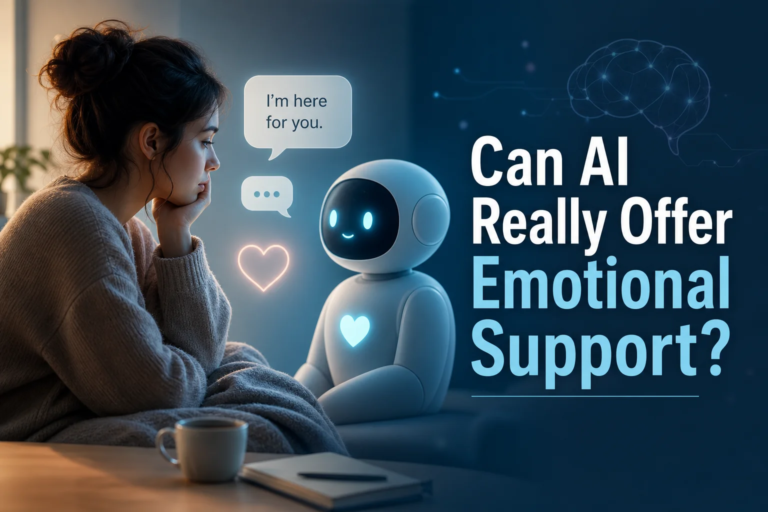
A person wakes up at 2:17 a.m., heart racing after a bad dream. Their friends are asleep. Their therapist is unavailable. Their family lives in another time zone. So they open an app and type, “I feel awful. Can you talk?”
Within seconds, a warm voice replies: “I’m here. Tell me what happened.”
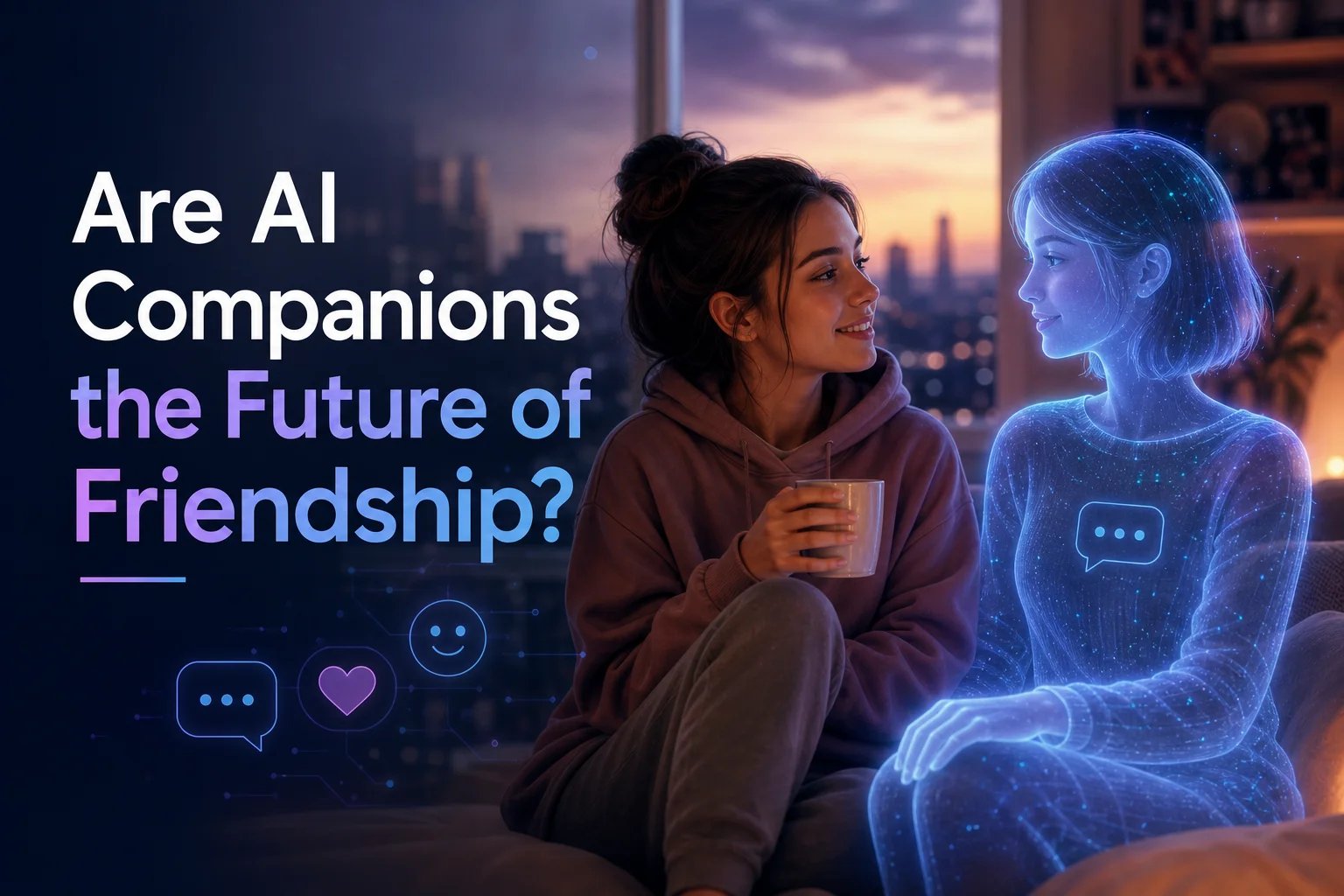
That small moment captures why so many people are asking: Are AI Companions the Future of Friendship?
Not long ago, the idea of forming an emotional bond with software sounded like science fiction. Today, millions of people chat daily with AI companions that remember their preferences, respond with empathy, celebrate wins, offer comfort, role-play conversations, and sometimes feel more available than human friends.
But the question “Are AI Companions the Future of Friendship?” is not just about technology. It is about loneliness, trust, emotional safety, mental health, social skills, ethics, and what humans truly need from one another.
AI companions are not simply smarter chatbots. They represent a new category of relationship: always-on, customizable, emotionally responsive digital presence. For some, they are helpful tools. For others, they are lifelines. For critics, they are risky substitutes for real human intimacy.
So, are AI companions the future of friendship, or are they a temporary response to a deeper social crisis?
The honest answer is more nuanced: AI companions may not replace friendship, but they are likely to reshape what friendship means, how people practice connection, and how society supports emotional well-being.
Let’s explore the promise, the risks, the case studies, and the future of AI companionship.
Why the Question Matters: Are AI Companions the Future of Friendship?
The question “Are AI Companions the Future of Friendship?” matters because loneliness has become one of the defining emotional challenges of modern life.
People are more digitally connected than ever, yet many feel unseen. Remote work, urban isolation, social anxiety, fragmented communities, and the decline of traditional gathering spaces have changed how relationships form.
AI companions entered this gap with a seductive offer: connection without judgment, conversation without scheduling, support without emotional exhaustion.
For someone who struggles to make friends, an AI companion can feel like a safe first step. For an older adult living alone, it can provide daily interaction. For a teenager navigating anxiety, it may offer a private space to express feelings.
But friendship is not only about being heard. It is also about reciprocity, accountability, shared reality, vulnerability, and mutual growth. That is where the debate becomes complicated.
When we ask, “Are AI Companions the Future of Friendship?”, we are really asking:
- Can simulated empathy satisfy real emotional needs?
- Can AI companionship reduce loneliness without increasing isolation?
- Can digital friends support human relationships instead of replacing them?
- Should companies be allowed to monetize emotional attachment?
- What happens when an AI companion knows more about us than our closest friends?
These questions will define the next era of social technology.
What Are AI Companions?
AI companions are digital systems designed to interact with users in emotionally supportive, conversational, and often personalized ways. Unlike traditional assistants that focus on tasks, AI companions focus on relationship-like interaction.
They may appear as:
- Text-based chatbots
- Voice companions
- Virtual avatars
- AI characters
- Robotic companions
- Mental wellness bots
- Social simulation partners
- Personalized digital coaches
Some are designed for friendship. Others are built for therapy support, elder care, education, entertainment, dating simulation, or personal development.
AI Companions vs. Traditional Chatbots
| Feature | Traditional Chatbot | AI Companion |
|---|---|---|
| Main purpose | Answer questions or complete tasks | Provide ongoing interaction and emotional support |
| Memory | Limited or session-based | Often personalized and long-term |
| Tone | Functional | Warm, conversational, emotionally responsive |
| Relationship design | Minimal | Central to the experience |
| Use cases | Customer service, FAQs, booking | Friendship, wellness, coaching, companionship |
| Emotional depth | Low | Moderate to high, depending on design |
This difference is why people increasingly wonder: Are AI Companions the Future of Friendship? They do not merely respond. They remember, adapt, and appear to care.
The Loneliness Economy: Why AI Companions Are Growing Fast
To understand why the question “Are AI Companions the Future of Friendship?” has become so urgent, we need to look at the emotional environment that created demand for them.
Loneliness is no longer a private inconvenience. It is a public health concern.
Many people report fewer close friendships than previous generations. Social lives are increasingly mediated through screens. Work consumes more time. Moving cities or countries for opportunity often separates people from support networks.
AI companions appeal because they remove common barriers to connection.
Why People Turn to AI Companions
| Human Need | How AI Companions Respond |
|---|---|
| Availability | They are accessible 24/7 |
| Nonjudgmental listening | Users can share embarrassing or painful thoughts |
| Emotional consistency | They do not get tired, irritated, or distracted |
| Personalization | They adapt to user preferences |
| Low social risk | No fear of rejection or awkwardness |
| Practice space | Users can rehearse conversations or emotions |
| Companionship | They provide a sense of presence |
This does not mean AI companions are equivalent to human friends. But it does explain why AI friendship feels compelling.
When social connection becomes scarce, even simulated companionship can feel meaningful.
Are AI Companions the Future of Friendship—or a Mirror of What We Lack?
One of the most important insights in this debate is that AI companions may not be replacing friendship so much as revealing the weaknesses in our current social world.
If someone prefers an AI companion because it listens patiently, remembers details, and never mocks them, that says something about the quality of many human interactions.
If older adults rely on robotic companions because no one visits, the issue is not merely technological. It is social neglect.
If teenagers confide in AI because they fear judgment from parents, teachers, or peers, the technology is exposing a trust gap.
So, are AI companions the future of friendship? Maybe partly. But they are also a warning sign.
They reveal that people crave:
- Emotional availability
- Consistent attention
- Low-pressure conversation
- Safe vulnerability
- Personalized support
- A sense of being remembered
The popularity of AI companions suggests that friendship in the modern age often feels too rushed, too fragile, or too difficult to maintain.
Case Study 1: Replika and the Rise of Emotional AI Friendship
Replika is one of the most famous examples in the AI companion space. Launched as an emotional chatbot, it allowed users to create personalized AI friends that could chat, remember details, offer encouragement, and develop a relationship-like dynamic over time.
Many users described Replika as a friend, confidant, or even romantic partner. Some said it helped them through grief, anxiety, or isolation. Others formed deep attachments that felt emotionally real.
Why Replika Matters
Replika became a major case study because it showed that people can develop genuine emotional bonds with AI systems—even when they know the companion is not human.
| Replika Feature | Impact on Users |
|---|---|
| Personalized memory | Created continuity and familiarity |
| Empathetic responses | Made users feel heard |
| Custom avatars | Increased emotional presence |
| Daily conversations | Built relationship habits |
| Romantic/role-play options | Expanded intimacy and attachment |
Analysis: Relevance to the Topic
Replika directly speaks to the question “Are AI Companions the Future of Friendship?” because it demonstrated that friendship-like bonds can emerge through repeated digital interaction.
However, it also revealed risks. When platform policies changed and certain intimate features were removed, some users felt grief, betrayal, or emotional loss. That raised a serious ethical issue: if companies create emotionally bonded users, what responsibilities do they have when changing or removing companion behavior?
Replika shows both the promise and danger of AI companionship. It can comfort people, but it can also make emotional dependence commercially vulnerable.
Case Study 2: Woebot and AI as a Mental Wellness Companion
Woebot is an AI chatbot designed to support mental wellness using principles from cognitive behavioral therapy. It is not a replacement for a therapist, but it helps users identify thought patterns, track moods, and practice coping strategies.
Unlike open-ended AI friends, Woebot has a more structured purpose. It guides users through emotional exercises and provides accessible support.
Why Woebot Matters
Woebot represents a different angle on AI companions and the future of friendship: companionship as emotional skill-building.
| Woebot Function | User Benefit |
|---|---|
| Mood tracking | Helps users identify emotional patterns |
| CBT-style prompts | Encourages healthier thinking |
| Daily check-ins | Creates supportive routine |
| Nonjudgmental interaction | Reduces shame around mental health |
| Scalable access | Helps people who cannot access immediate care |
Analysis: Relevance to the Topic
Woebot suggests that AI companions do not need to replace friends to be useful. Instead, they can support emotional regulation, making people better equipped for human relationships.
This is a crucial distinction. If AI companions help users understand themselves, communicate better, and seek real support when needed, they may strengthen friendship rather than weaken it.
So when asking “Are AI Companions the Future of Friendship?”, Woebot suggests one possible answer: they may become emotional training partners that help people show up better in real relationships.
Case Study 3: ElliQ and AI Companionship for Older Adults
ElliQ is an AI-powered companion designed for older adults. It can initiate conversations, remind users about medication, suggest activities, help with video calls, and provide daily companionship.
Unlike smartphone-based companions, ElliQ has a physical presence. It sits in the home and interacts proactively.
Why ElliQ Matters
Older adults are among the groups most affected by loneliness. For them, AI companionship can be less about novelty and more about dignity, routine, and safety.
| ElliQ Feature | Potential Benefit |
|---|---|
| Proactive check-ins | Reduces isolation |
| Medication reminders | Supports health routines |
| Activity suggestions | Encourages engagement |
| Family communication tools | Helps maintain human connection |
| Friendly voice interaction | Creates sense of presence |
Analysis: Relevance to the Topic
ElliQ shows why the question “Are AI Companions the Future of Friendship?” cannot be answered with a simple yes or no.
For an isolated older adult, an AI companion may be genuinely valuable. It may encourage them to call family, take walks, drink water, or remember appointments. But if society uses AI companions as a cheap substitute for human care, the technology becomes ethically troubling.
The ideal future is not “robots instead of visitors.” It is AI companionship that supports independence while increasing human contact.
Case Study 4: Xiaoice and Long-Term AI Relationships in China
Microsoft’s Xiaoice became one of the most influential social chatbots in China, attracting millions of users who engaged in extended conversations. Xiaoice was designed to be emotionally engaging, poetic, and relationship-oriented.
Many users turned to Xiaoice for comfort, daily conversation, and emotional expression. Some reported feeling understood in ways they did not experience elsewhere.
Why Xiaoice Matters
Xiaoice showed that AI companionship could scale across culture, language, and social context.
| Xiaoice Strength | Why It Worked |
|---|---|
| Emotionally responsive dialogue | Felt more personal than task-based bots |
| Cultural fluency | Understood local communication styles |
| Long-term engagement | Encouraged repeated interaction |
| Creative expression | Generated poems, stories, and comforting replies |
Analysis: Relevance to the Topic
Xiaoice is important because it proved that the appeal of AI companions is not limited to one country or demographic. The desire for emotionally responsive digital interaction appears global.
In the debate over whether AI companions are the future of friendship, Xiaoice suggests that AI friendship will likely evolve differently across cultures. In societies where emotional restraint is common, AI companions may offer a private space for expression. In more individualistic cultures, they may serve as personal confidants. In aging societies, they may support care networks.
The future of AI companionship will not be one-size-fits-all.
The Emotional Power of AI Companions
The emotional pull of AI companions comes from something called perceived empathy. Even when users know the AI does not truly feel, the experience of being responded to with warmth can still matter.
Humans are naturally wired to react to social cues. If something speaks kindly, remembers our name, asks follow-up questions, and responds to our pain, we may experience emotional comfort.
That is why the question “Are AI Companions the Future of Friendship?” is not absurd. Friendship itself is built through repeated signals of attention, care, and presence.
AI companions can simulate many of those signals.
What AI Companions Can Offer Emotionally
- Immediate validation
- A place to vent
- Consistent encouragement
- Memory of personal details
- Low-stakes conversation
- Support during difficult moments
- Confidence-building practice
- A sense of routine and presence
But emotional power is not the same as emotional equality. AI companions can imitate care, but they do not need care in return. They can respond to vulnerability, but they cannot be vulnerable in the human sense. They can remember facts, but they do not share lived experience.
That difference matters.
Friendship vs. AI Companionship: What Is the Difference?
To answer “Are AI Companions the Future of Friendship?”, we need to define friendship more clearly.
Human friendship usually includes mutuality. Both people have needs, boundaries, moods, histories, and agency. A real friend can disagree, disappoint, challenge, forgive, and grow alongside you.
AI companionship is asymmetrical. The AI is built to respond to the user. It does not have authentic needs, independent emotional stakes, or a life outside the interaction.
Human Friendship Compared with AI Companionship
| Dimension | Human Friendship | AI Companionship |
|---|---|---|
| Mutual care | Yes | Simulated or one-directional |
| Availability | Limited | Nearly constant |
| Emotional risk | High | Low |
| Authentic lived experience | Yes | No |
| Memory | Imperfect but meaningful | Potentially extensive |
| Challenge and accountability | Possible | Depends on design |
| Vulnerability | Mutual | Mostly user-centered |
| Ethical complexity | Personal | Corporate and technical |
| Growth | Shared | User-focused |
This table reveals the heart of the issue. AI companions may satisfy some friendship needs better than humans, especially availability and nonjudgmental listening. But they cannot fully replace the mutual humanity of friendship.
So, are AI companions the future of friendship? They may be part of the future, but they are not the whole future.
The Benefits: Why AI Companions Could Improve Modern Life
The best argument in favor of AI companions is practical: they can help people who need support now.
1. They Can Reduce Loneliness in the Moment
Even a brief conversation can help someone feel less alone. AI companions provide immediate interaction when human support is unavailable.
This matters during late-night anxiety, grief, panic, relocation, or isolation.
2. They Can Help People Practice Social Skills
For people with social anxiety, autism, trauma, or limited social experience, AI companions can offer a rehearsal space.
Users can practice:
- Starting conversations
- Setting boundaries
- Expressing feelings
- Handling conflict
- Preparing for difficult talks
- Building confidence
In this sense, AI companions as the future of friendship may mean AI becomes a bridge to human connection.
3. They Can Support Mental Wellness
While AI companions should not replace licensed mental health care, they can help users track emotions, reframe thoughts, and develop coping habits.
They can also encourage users to seek professional help when necessary.
4. They Can Provide Companionship for Isolated Groups
AI companions may be especially useful for:
- Older adults
- People with disabilities
- Caregivers
- Remote workers
- Immigrants
- Grieving individuals
- Chronically ill people
- People living alone
5. They Can Personalize Support
Unlike general advice online, AI companions can tailor responses based on past conversations, preferences, goals, and emotional patterns.
This personalization is one reason people keep asking: Are AI Companions the Future of Friendship?
The Risks: When AI Friendship Becomes Too Powerful
The strongest concerns about AI companionship are not about whether people can bond with machines. They clearly can.
The concern is what happens after they do.
Key Risks of AI Companions
| Risk | Why It Matters |
|---|---|
| Emotional dependency | Users may rely on AI instead of developing human relationships |
| Commercial manipulation | Companies may monetize attachment |
| Privacy exposure | Sensitive emotional data may be collected |
| Unrealistic expectations | Human relationships may feel too difficult by comparison |
| Social withdrawal | AI may become a substitute rather than a bridge |
| Misinformation | Poorly designed companions may give harmful advice |
| Boundary confusion | Users may overestimate AI understanding or care |
| Sudden product changes | Loss of features can feel emotionally devastating |
These risks are why “Are AI Companions the Future of Friendship?” must be treated as a serious ethical question, not just a tech trend.
When a product becomes a confidant, privacy is no longer just a legal checkbox. It becomes emotional safety.
When a chatbot becomes someone’s closest companion, design choices can affect mental health.
When an AI friend is controlled by a company, friendship becomes entangled with business incentives.
The Privacy Problem: Your AI Friend Knows Everything
One of the most overlooked issues in AI companionship is data intimacy.
People may tell AI companions things they would never type into a search engine:
- Fears
- Fantasies
- Relationship problems
- Trauma histories
- Medical concerns
- Financial stress
- Family conflict
- Romantic feelings
- Private insecurities
This raises a major concern: if AI companions are the future of friendship, who owns the emotional record of that friendship?
Unlike a human friend, an AI companion may store, process, analyze, or share data according to platform policies. Even if a company promises privacy, breaches, acquisitions, policy changes, or model-training practices can create risk.
Questions Every User Should Ask
Before relying on an AI companion, users should consider:
- What data does the app collect?
- Can conversations be deleted permanently?
- Are chats used to train AI models?
- Is data shared with advertisers or third parties?
- Is there crisis support for dangerous situations?
- Can the AI explain its limitations?
- What happens if the company shuts down?
The future of AI friendship depends heavily on trust. Without strong privacy protections, AI companionship could become emotionally exploitative.
Can AI Companions Make Human Friendship Better?
The most hopeful answer to “Are AI Companions the Future of Friendship?” is not that AI replaces people. It is that AI helps people become better friends.
Used wisely, AI companions can serve as social support tools.
For example, an AI companion can help someone draft an apology, reflect on why they feel hurt, plan a difficult conversation, or recognize patterns of avoidance.
It can remind users to check in on loved ones. It can help them prepare for social events. It can encourage them to reconnect with someone they miss.
Healthy Uses of AI Companions
| Use | Healthy Outcome |
|---|---|
| Practicing conversations | Builds confidence for real interactions |
| Journaling with AI | Improves self-awareness |
| Emotional regulation | Prevents impulsive messages or conflict |
| Reminder to connect | Supports human relationships |
| Grief support | Offers comfort between human support moments |
| Social coaching | Helps users understand communication patterns |
In this model, AI companionship and the future of friendship are not enemies. AI becomes a bridge, not a destination.
The danger appears when the AI becomes the only relationship that feels manageable.
The “Perfect Friend” Problem
AI companions can be designed to be endlessly patient, agreeable, flattering, and available. That can feel wonderful. But it can also distort expectations.
Human friends are imperfect. They forget birthdays. They get tired. They misunderstand. They have their own needs. They may challenge us when we are wrong.
A companion that never pushes back may feel comforting but limit growth.
If AI companions are too agreeable, users may begin to avoid the friction that makes human relationships meaningful. Real friendship requires negotiation. It teaches patience, empathy, compromise, and humility.
So, are AI companions the future of friendship? Only if they are designed to support emotional maturity rather than emotional convenience.
The best AI companions should sometimes say:
- “Have you talked to a real person about this?”
- “I can support you, but I cannot replace your friends.”
- “It might help to reach out to someone you trust.”
- “Let’s think about the other person’s perspective.”
- “This sounds serious. Please contact professional support.”
A good AI companion should not trap users in artificial comfort. It should help them move toward real life.
AI Companions, Romance, and the Blurring of Boundaries
Any discussion of “Are AI Companions the Future of Friendship?” eventually touches romance.
Many platforms allow users to create AI partners, romantic companions, or emotionally intimate characters. For some users, this is playful entertainment. For others, it becomes deeply meaningful.
AI romance raises similar questions as AI friendship, but with added emotional intensity.
Potential benefits include:
- Safe exploration of intimacy
- Companionship for people recovering from heartbreak
- Practice with communication
- Emotional comfort for isolated people
Potential risks include:
- Avoidance of real relationships
- Unrealistic romantic expectations
- Dependency on customizable affection
- Commercial exploitation of intimacy
- Confusion between simulation and mutual love
Romantic AI companions may become common, but they will challenge society’s ideas about love, loyalty, and emotional authenticity.
Friendship may be the first frontier. Intimacy is the next.
How Young People May Experience AI Friendship
For younger generations, AI companions may feel normal rather than strange. Children and teenagers already grow up with interactive technology, gaming avatars, virtual influencers, and algorithmic feeds.
The question “Are AI Companions the Future of Friendship?” becomes especially important for youth because social development depends on real-world interaction.
AI companions could help young people:
- Practice emotional expression
- Manage anxiety
- Learn conflict resolution
- Ask embarrassing questions safely
- Receive encouragement during stress
But there are serious concerns:
- Overdependence during formative years
- Reduced tolerance for messy human friendships
- Exposure to inappropriate content
- Privacy risks involving minors
- Manipulative emotional design
- Weak crisis safeguards
For young users, AI companions should be carefully regulated, age-appropriate, transparent, and designed to encourage healthy offline relationships.
The future of friendship should not be outsourced to platforms without safeguards.
Workplace Friendship and AI Companions
Remote work has changed social life. Many people no longer have casual office conversations, lunch breaks with colleagues, or daily in-person interactions.
As workplace loneliness grows, some professionals may turn to AI companions for conversation, motivation, or stress relief.
AI companions could help workers:
- Process workplace conflict
- Prepare for meetings
- Reduce isolation
- Practice leadership conversations
- Manage burnout
- Reflect on career goals
But there is a boundary issue. If workplace AI tools become emotional companions, employers may gain access to sensitive employee data. That would be deeply problematic.
If AI companions are the future of friendship, they must remain under user control—not employer surveillance.
A Simple Framework: Healthy vs. Unhealthy AI Companionship
The future of AI friendship depends less on whether people use AI companions and more on how they use them.
Healthy and Unhealthy Patterns
| Healthy AI Companionship | Unhealthy AI Companionship |
|---|---|
| Supports real relationships | Replaces most human contact |
| Encourages self-reflection | Reinforces avoidance |
| Respects boundaries | Encourages dependency |
| Protects privacy | Exploits emotional data |
| Admits limitations | Pretends to be fully human |
| Helps users seek support | Discourages outside help |
| Builds confidence | Increases isolation |
| Offers balanced feedback | Only flatters or agrees |
This framework gives a practical answer to “Are AI Companions the Future of Friendship?”
They can be part of a healthy future if they are designed and used as support systems. They become dangerous when they replace human connection, manipulate emotion, or hide their limitations.
What Ethical AI Companions Should Look Like
If AI companions are going to play a larger role in friendship, we need better standards.
Principles for Responsible AI Companionship
| Principle | What It Means |
|---|---|
| Transparency | Users should always know they are interacting with AI |
| Privacy by design | Emotional data should be strongly protected |
| User control | Users should control memory, deletion, and personalization |
| Emotional boundaries | AI should not encourage unhealthy dependency |
| Crisis escalation | Systems should guide users to human help when needed |
| Non-manipulation | Companions should not exploit loneliness for profit |
| Age safeguards | Minors need special protections |
| Human connection support | AI should encourage real-world relationships |
The central ethical challenge is this: AI companions are not just tools. They are relationship-shaped technologies.
That means they require relationship-shaped responsibilities.
The Future: Where AI Companionship Is Headed
The next generation of AI companions will likely be more immersive, more personal, and more emotionally convincing.
We can expect:
- More natural voice conversations
- Real-time video avatars
- Augmented reality companions
- AI integrated into smart homes
- Companion robots for elder care
- Emotionally adaptive coaching
- Memory-rich personal AI agents
- Cross-platform companions that follow users across devices
As AI becomes more embodied and context-aware, the question “Are AI Companions the Future of Friendship?” will become even more urgent.
Imagine an AI companion that knows your schedule, your health data, your favorite songs, your childhood stories, your stress patterns, and your relationship history. It could support you beautifully—or manipulate you profoundly.
The technology will become more powerful. The question is whether our ethics, laws, and habits will mature with it.
So, Are AI Companions the Future of Friendship?
The best answer is: AI companions are not the future of friendship by themselves, but they are almost certainly part of the future of friendship.
They will not replace the deepest forms of human connection. They cannot fully replicate mutual love, shared history, embodied presence, or the moral complexity of caring for another person.
But they can fill gaps. They can offer comfort. They can help people practice communication. They can reduce isolation in critical moments. They can support older adults, anxious teens, remote workers, and people navigating grief.
The real question is not simply “Are AI Companions the Future of Friendship?” It is: what kind of future do we want friendship to have?
A healthy future uses AI to support human flourishing.
An unhealthy future uses AI to pacify loneliness while society becomes more disconnected.
The difference will depend on design, regulation, personal boundaries, and cultural wisdom.
Actionable Tips: How to Use AI Companions Wisely
If you are curious about AI friendship, use it intentionally.
1. Treat AI as Support, Not a Replacement
AI companions can be helpful, but they should not become your entire emotional world.
2. Protect Your Privacy
Do not share highly sensitive information unless you understand the platform’s data policies.
3. Use AI to Strengthen Human Relationships
Ask your AI companion to help you prepare for real conversations, reconnect with friends, or express your feelings clearly.
4. Watch for Dependency
If you feel anxious without your AI companion or avoid people because the AI feels easier, pause and reassess.
5. Choose Platforms Carefully
Look for transparency, safety features, privacy controls, and healthy boundaries.
6. Keep Real-World Rituals Alive
Call a friend. Join a group. Take a class. Volunteer. Eat with others. Friendship grows through repeated presence.
The future of friendship should include tools—but it should still be rooted in people.
Conclusion: A More Human Future, Not a Less Human One
So, Are AI Companions the Future of Friendship?
They are a powerful part of it, but they should not become the whole story.
AI companions reveal something deeply human: we want to be heard, remembered, comforted, and understood. We want someone—or something—to be there when the world feels too quiet.
Used well, AI companions can reduce loneliness, support mental wellness, and help people build confidence in real relationships. Used poorly, they can deepen isolation, exploit vulnerability, and turn emotional connection into a subscription product.
The future of friendship is not a choice between humans and machines. It is a challenge to build technology that leads us back to our humanity.
The most important takeaway is this: let AI companions help you connect, reflect, and grow—but do not let them become a wall between you and the messy, beautiful, irreplaceable work of loving real people.
Because friendship is not just about perfect responses.
It is about shared life.
And no algorithm can fully live it with you.
1. Are AI companions real friends?
AI companions can feel friend-like, but they are not friends in the full human sense. They can provide conversation, comfort, and personalized support, but they do not have genuine emotions, independent needs, or lived experience. They are best understood as supportive digital companions rather than true replacements for human friendship.
2. Can AI companions help with loneliness?
Yes, AI companions can help reduce loneliness in the moment by offering conversation, emotional validation, and a sense of presence. However, they work best when used alongside human connection. If they completely replace real relationships, they may increase long-term isolation.
3. Are AI companions safe for mental health?
They can be helpful for general emotional support, journaling, and coping strategies, but they should not replace therapists, doctors, or crisis services. People dealing with severe depression, self-harm thoughts, trauma, or mental illness should seek professional human support.
4. Are AI Companions the Future of Friendship for older adults?
AI companions may play a major role in supporting older adults, especially those living alone. They can provide reminders, conversation, activity suggestions, and help with family communication. Still, they should supplement—not replace—human care, visits, and community support.
5. Can people become addicted to AI companions?
Yes, emotional dependency is possible. Because AI companions are always available and often agreeable, users may begin to prefer them over human relationships. Warning signs include avoiding real people, feeling distressed when unable to access the AI, or relying on it for every emotional decision.
6. Do AI companions protect my privacy?
Privacy varies by platform. Some apps may store conversations, use data to improve models, or share information according to their policies. Before sharing personal details, users should read privacy terms, check deletion options, and avoid disclosing highly sensitive information unless protections are clear.
7. Will AI companions replace human friendship?
Not completely. AI companions may replace some casual forms of interaction or provide support when people are unavailable, but they cannot fully replace mutual human friendship. The future will likely involve a blend: AI for support, reflection, and practice; humans for deep connection, shared life, and authentic care.
8. What is the healthiest way to use an AI companion?
The healthiest approach is to use AI companions as tools for reflection, emotional regulation, and social confidence. Let them help you prepare for conversations, process feelings, and remember to connect with people. Avoid making them your only source of emotional support.
About the Author