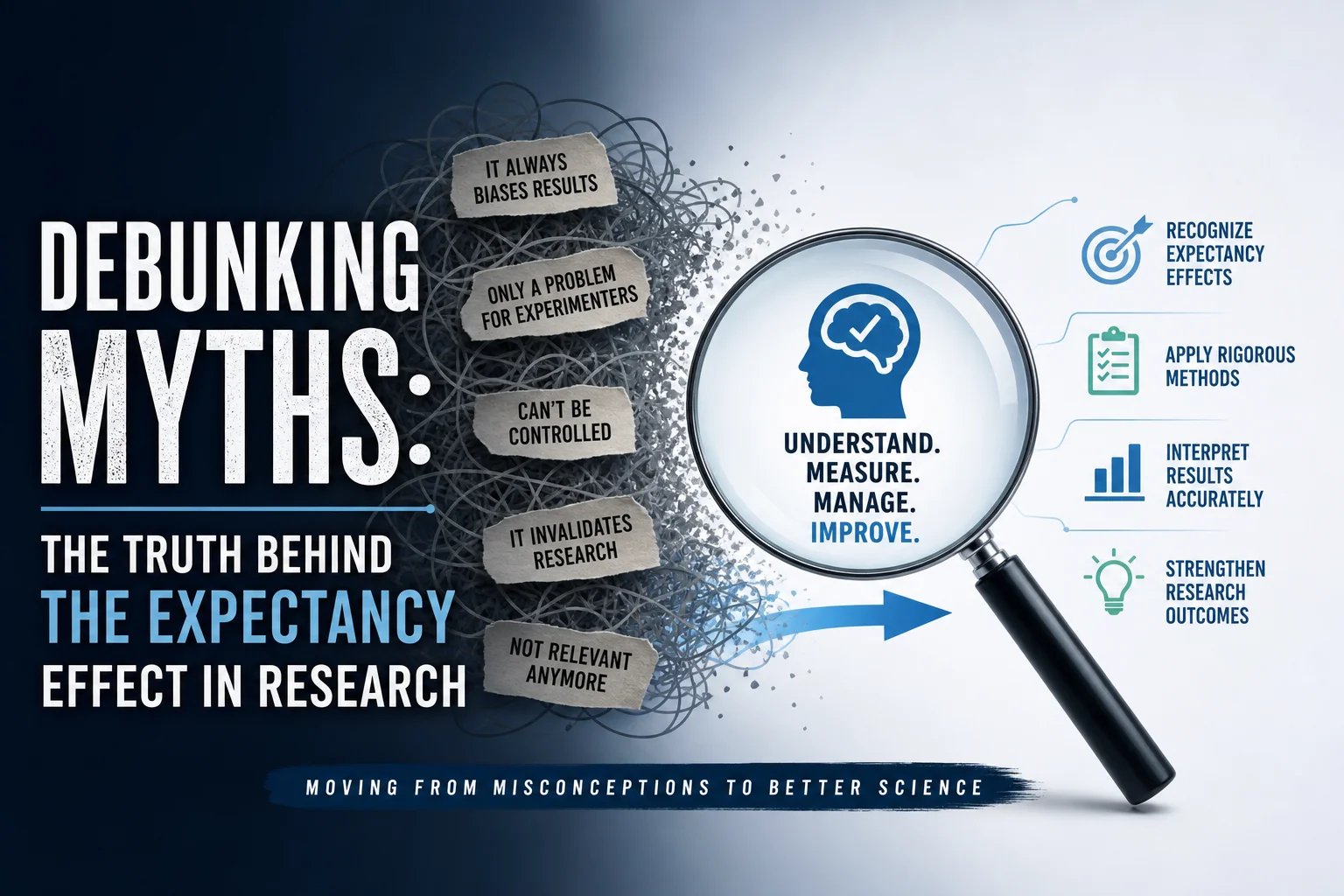
Introduction: The Invisible Hand That Can Bend Research Results
Imagine two scientists observing the same classroom, the same therapy session, or the same laboratory rat. One expects improvement. The other expects no change. Neither intends to distort the findings. Neither fabricates data. Yet their expectations may quietly shape what they notice, how they interpret behavior, how participants respond, and even how results are recorded.
That is the power—and the danger—of the expectancy effect.
The phrase Debunking Myths: The Truth Behind the Expectancy Effect in Research matters because expectancy effects sit at the crossroads of psychology, medicine, education, social science, behavioral economics, and clinical trials. They remind us that research is not conducted by machines in a vacuum. It is conducted by humans, with assumptions, hopes, incentives, and blind spots.
But here is the twist: the expectancy effect is often misunderstood.
Some people treat it as proof that research is hopelessly biased. Others dismiss it as a minor nuisance. Some confuse it with the placebo effect, confirmation bias, or the Hawthorne effect. Others imagine that simply “being objective” is enough to prevent it.
The truth is more interesting.
Debunking Myths: The Truth Behind the Expectancy Effect in Research is not about attacking science. It is about strengthening it. When researchers understand expectancy effects, they can design better studies, protect participants, improve measurement, and interpret findings with more humility and precision.
This article takes a deep, practical look at Debunking Myths: The Truth Behind the Expectancy Effect in Research—what it is, what it is not, why it happens, where it shows up, and how serious researchers reduce its influence.
What Is the Expectancy Effect in Research?
The expectancy effect occurs when a researcher’s, observer’s, clinician’s, teacher’s, or participant’s expectations influence the outcome of a study.
In simple terms:
Expectations can change behavior, perception, measurement, interpretation, or reporting.
The expectancy effect is sometimes called the observer-expectancy effect, experimenter expectancy effect, or Rosenthal effect, especially in psychology and education. In clinical contexts, related ideas include placebo and nocebo effects. In social settings, expectancy may operate through subtle cues, feedback, tone, attention, or differential treatment.
When we talk about Debunking Myths: The Truth Behind the Expectancy Effect in Research, we are really talking about how expectations can become part of the research environment.
A researcher may unconsciously:
- Give warmer instructions to one group than another.
- Interpret ambiguous behavior in favor of a hypothesis.
- Record borderline data differently depending on expectations.
- Ask follow-up questions in a leading way.
- Provide more encouragement to participants expected to improve.
- Notice “confirming” evidence more easily than disconfirming evidence.
Participants may also respond to what they think researchers want. If they believe they are receiving a powerful treatment, they may report feeling better. If they sense they are in a “low-performing” group, they may disengage.
That is why Debunking Myths: The Truth Behind the Expectancy Effect in Research requires looking at both sides: researcher expectations and participant expectations.
Why the Expectancy Effect Matters More Than Ever
Research today influences public policy, medical decisions, workplace systems, educational methods, artificial intelligence tools, and public trust. Small biases can have large consequences when findings are scaled into real-world decisions.
The expectancy effect matters because it can affect:
| Area | How Expectancy Can Influence Outcomes | Why It Matters |
|---|---|---|
| Medicine | Patients improve because they expect treatment to work | Can inflate perceived treatment effectiveness |
| Education | Teachers give more attention to students expected to succeed | Can widen or reduce achievement gaps |
| Psychology | Therapists’ beliefs influence client outcomes | Can affect evidence for therapeutic methods |
| Animal research | Handlers treat animals differently based on group assignment | Can distort biological findings |
| Social science | Interviewers ask questions differently | Can bias survey or qualitative results |
| Workplace studies | Managers’ expectations alter employee performance | Can affect hiring, training, and leadership programs |
The modern conversation around Debunking Myths: The Truth Behind the Expectancy Effect in Research is especially important because more people are questioning scientific authority. The right response is not defensiveness. It is transparency.
Good science does not deny bias. Good science designs against it.
Myth #1: “The Expectancy Effect Means Research Is Fake”
One of the biggest misconceptions is that if expectancy effects exist, research findings cannot be trusted.
That is false.
The existence of expectancy effects does not mean research is fake. It means research must be carefully designed. In fact, recognizing expectancy effects is one reason scientific methods have become more rigorous over time.
Randomization, blinding, placebo controls, preregistration, standardized protocols, independent replication, and statistical transparency all exist partly because researchers know that human judgment can be biased.
This is a central point in Debunking Myths: The Truth Behind the Expectancy Effect in Research: expectancy effects are not evidence against science. They are evidence for the need for better science.
A weak study ignores expectancy. A strong study anticipates it.
Myth #2: “Only Dishonest Researchers Create Expectancy Effects”
Expectancy effects are usually not about fraud. They are often unconscious.
A researcher may genuinely believe they are treating all participants equally. A teacher may sincerely think they are encouraging every student. A clinician may truly believe their tone is neutral. But subtle differences can still emerge.
For example:
- A smile lasts slightly longer.
- A prompt sounds more encouraging.
- An ambiguous answer is scored more generously.
- A participant receives more time to complete a task.
- A researcher notices improvement faster when expecting improvement.
This is why Debunking Myths: The Truth Behind the Expectancy Effect in Research requires compassion as well as rigor. The problem is not that researchers are bad people. The problem is that people are people.
Human brains are prediction machines. We constantly interpret the world through expectations. That ability helps us navigate life, but it can also distort research.
Myth #3: “The Expectancy Effect Is the Same as the Placebo Effect”
The expectancy effect and placebo effect are related, but they are not identical.
The placebo effect usually refers to changes in a participant’s symptoms, behavior, or physiology because they believe they are receiving an effective treatment.
The expectancy effect is broader. It includes the influence of researcher, observer, clinician, teacher, or participant expectations on outcomes.
| Concept | Main Source of Influence | Example |
|---|---|---|
| Expectancy effect | Researcher, observer, participant, teacher, clinician | A researcher rates expected-improvement participants more positively |
| Placebo effect | Participant’s belief in treatment | A patient feels less pain after taking an inactive pill |
| Nocebo effect | Participant’s expectation of harm | A patient experiences side effects after being warned strongly |
| Confirmation bias | Preference for evidence that supports beliefs | A scientist gives more weight to supportive results |
| Demand characteristics | Participant guesses study purpose and adjusts behavior | A participant acts more generous because they think generosity is being tested |
| Hawthorne effect | Behavior changes because people know they are observed | Workers improve productivity during a study |
A key goal of Debunking Myths: The Truth Behind the Expectancy Effect in Research is to separate these overlapping concepts. When terms are blurred, solutions become sloppy.
If participant expectations are the issue, researchers may need placebo controls or expectancy measurement. If observer expectations are the issue, researchers may need blinded raters. If demand characteristics are the issue, they may need better cover stories or indirect measures.
Different problems require different safeguards.
Myth #4: “Blinding Completely Solves the Problem”
Blinding is one of the most powerful tools for reducing expectancy effects. But it is not magic.
In a single-blind study, participants do not know which condition they are in. In a double-blind study, both participants and researchers interacting with them are unaware of group assignment. In triple-blind designs, data analysts may also be blinded.
Blinding helps, but it can fail.
Participants may guess their group based on side effects. Researchers may infer assignment based on participant responses. Therapists cannot always be blinded to the treatment they deliver. Teachers usually know which students are in a special program. Behavioral interventions are often difficult to conceal.
That is why Debunking Myths: The Truth Behind the Expectancy Effect in Research must include a realistic view of blinding. It is essential, but it must be tested and supported.
Strong studies often ask participants and researchers afterward:
- Which group do you think you were in?
- How confident are you?
- Did you notice anything that revealed the condition?
If most people correctly guess assignment, blinding may have been compromised.
Myth #5: “Expectancy Effects Are Always Large”
Expectancy effects can be powerful, but they are not always huge. Their size depends on the context.
They are more likely to matter when outcomes are subjective, ambiguous, socially influenced, or difficult to measure.
For example, expectancy may strongly affect:
- Pain ratings
- Mood reports
- Classroom participation
- Therapist-rated progress
- Interview interpretations
- Behavioral coding of ambiguous actions
It may have less influence on:
- Mortality
- Blood type
- Genetic sequencing
- Automatically recorded machine data
- Hard physical measurements with strict protocols
Even then, expectancy can influence which data are excluded, how samples are selected, or how results are interpreted.
A balanced approach to Debunking Myths: The Truth Behind the Expectancy Effect in Research avoids exaggeration. Expectancy effects are neither imaginary nor all-powerful. They are context-dependent.
How Expectancy Effects Actually Work
Expectancy effects can operate through several pathways.
1. Behavioral Cues
Researchers may unintentionally communicate expectations through facial expressions, tone, posture, or encouragement.
A participant who receives warmer feedback may become more confident and perform better. A student who is treated as capable may take more academic risks. A patient who senses optimism may report more hope.
2. Differential Treatment
Expectations may lead people to provide different opportunities.
A teacher may call more often on students expected to succeed. A coach may give more practice time to athletes considered promising. A therapist may persist longer with clients they believe will improve.
3. Selective Attention
People notice what they expect to see.
If a researcher expects anxiety to decrease, they may notice calm moments more than anxious ones. If an observer expects aggression, they may interpret neutral behavior as hostile.
4. Ambiguous Scoring
Many research outcomes require judgment.
Was the child “engaged” or merely quiet? Was the participant “hesitant” or “thoughtful”? Did the patient show “mild improvement” or “no meaningful change”?
Where scoring is subjective, expectancy can enter.
5. Participant Self-Fulfilling Prophecy
Participants respond to expectations.
If they believe they are in a high-performance condition, they may try harder. If they think a medication will cause fatigue, they may monitor themselves for tiredness and report it.
The practical value of Debunking Myths: The Truth Behind the Expectancy Effect in Research is that once we understand these mechanisms, we can design barriers against them.
A Simple Model of the Expectancy Effect
Here is a basic flowchart showing how expectations can influence research outcomes:
| Stage | What Happens | Possible Expectancy Risk |
|---|---|---|
| Hypothesis | Researcher forms prediction | Strong belief may shape design choices |
| Recruitment | Participants are selected | Language may attract certain expectations |
| Assignment | Participants enter conditions | Group labels may influence treatment |
| Interaction | Researcher communicates with participants | Tone and cues may differ |
| Measurement | Outcomes are recorded | Ambiguous data may be rated selectively |
| Analysis | Data are interpreted | Confirming patterns may be emphasized |
| Publication | Findings are reported | Positive findings may be framed more strongly |
This is why Debunking Myths: The Truth Behind the Expectancy Effect in Research is not just about one moment in a study. It is about the entire research pipeline.
Case Study 1: Clever Hans and the Birth of Observer-Expectancy Awareness
One of the most famous early examples of expectancy influence involved Clever Hans, a horse in early twentieth-century Germany. Hans appeared able to solve arithmetic problems by tapping his hoof. Crowds were amazed. His owner believed the horse could count.
Eventually, psychologist Oskar Pfungst investigated. He found that Hans performed well when questioners knew the answer but failed when they did not. The horse was not doing math. He was responding to subtle body cues—tiny changes in posture, facial tension, and anticipation as he approached the correct number of taps.
Why This Case Matters
Clever Hans is essential to Debunking Myths: The Truth Behind the Expectancy Effect in Research because it shows that expectancy effects do not require deliberate deception. The humans were not necessarily trying to cue the horse. Their expectations leaked through their bodies.
Brief Analysis
The Clever Hans case teaches three lasting lessons:
- Observers can influence behavior without realizing it.
- Nonverbal cues can carry expectations.
- Research designs must prevent information leakage.
This case still matters in animal research, child development studies, therapy research, and any setting where participants are sensitive to human cues.
Case Study 2: Rosenthal and Fode’s “Maze-Bright” and “Maze-Dull” Rats
In a classic experiment, researchers told student experimenters that some rats were bred to be “maze-bright” and others “maze-dull.” In reality, the rats were randomly assigned. Yet the supposedly “bright” rats were reported to perform better.
The likely explanation was not genetic superiority. It was expectancy. Students may have handled the “bright” rats more gently, encouraged them more indirectly, or interpreted their performance differently.
Why This Case Matters
This study is often central in Debunking Myths: The Truth Behind the Expectancy Effect in Research because it demonstrates that expectations can affect even animal experiments, where participants cannot understand verbal labels.
Brief Analysis
The relevance is profound: if expectations can influence rat performance, they can certainly affect studies involving humans, especially when outcomes are subjective or socially mediated.
The study also reminds us that labels are powerful. Once a subject is classified as “promising,” “difficult,” “treatment-resistant,” or “high-risk,” expectations may alter treatment.
Case Study 3: The Pygmalion Effect in the Classroom
Robert Rosenthal and Lenore Jacobson’s famous school study suggested that teacher expectations could influence student achievement. Teachers were told that certain students were likely to experience intellectual growth. Those students, selected at random, reportedly showed greater gains over time.
The study has been debated, reanalyzed, and criticized over the years. Some findings were stronger for younger students than older ones. Some methodological concerns remain. But the broader idea—that teacher expectations can shape student outcomes—has been supported in many educational contexts.
Why This Case Matters
The classroom example is central to Debunking Myths: The Truth Behind the Expectancy Effect in Research because it shows how expectancy effects can become self-fulfilling. Teachers may unknowingly provide more warmth, feedback, challenge, and opportunity to students they expect to succeed.
Brief Analysis
This case does not prove that expectations determine destiny. It proves something subtler and more useful: expectations influence environments. When expectations affect attention, patience, and opportunity, they can change performance trajectories.
For educators, the takeaway is practical. High expectations should be paired with equitable support, not reserved for a chosen few.
Case Study 4: Placebo-Controlled Clinical Trials
Clinical research offers one of the most rigorous responses to expectancy effects: the randomized placebo-controlled trial.
Suppose researchers test a new pain medication. If participants know they are receiving the drug, their pain may decrease partly because they expect relief. If researchers know who receives the drug, they may ask questions differently or interpret symptoms more favorably.
A placebo group helps separate improvement caused by the active treatment from improvement caused by expectation, attention, natural recovery, or study participation.
Why This Case Matters
Clinical trials are a practical foundation for Debunking Myths: The Truth Behind the Expectancy Effect in Research because they show that expectancy is not merely a philosophical concern. It can affect whether treatments are approved, prescribed, and trusted.
Brief Analysis
The best clinical trials do not assume expectancy is absent. They build safeguards:
- Random assignment
- Placebo control
- Double blinding
- Standardized outcome measures
- Independent monitoring
- Predefined analysis plans
However, even clinical trials face challenges. If a medication has noticeable side effects, participants may guess they are receiving the active drug. That guess can strengthen expectancy and complicate interpretation.
This is why some trials use active placebos, which mimic side effects without delivering the treatment mechanism.
Case Study 5: Psychotherapy Research and Therapist Allegiance
In psychotherapy research, expectancy effects can appear through therapist allegiance. A therapist who strongly believes in one method may deliver it with more enthusiasm, confidence, and skill than an alternative approach.
Participants may also sense therapist confidence. If a therapist communicates that a method is powerful and hopeful, clients may engage more deeply. If a therapist seems uncertain, clients may disengage.
Why This Case Matters
Psychotherapy is highly relevant to Debunking Myths: The Truth Behind the Expectancy Effect in Research because treatment is relational. The provider’s expectations are part of the intervention environment.
Brief Analysis
This does not mean therapy research is invalid. It means therapy studies must carefully manage allegiance effects. Useful strategies include:
- Training therapists equally across conditions
- Measuring therapist expectations
- Using multiple therapists
- Monitoring session fidelity
- Separating treatment developer from outcome evaluator
- Using blinded independent assessors when possible
Psychotherapy research reminds us that expectancy is not always a contaminant to eliminate. Sometimes hope, confidence, and expectation are part of healing. The challenge is measuring them honestly.
Case Study 6: Hiring, Leadership, and Workplace Performance
In organizational research, expectancy effects often appear in leadership studies. Managers who are told that certain employees have high potential may give them more mentorship, responsibility, and feedback. Over time, those employees may actually perform better.
This is sometimes called a workplace Pygmalion effect.
Why This Case Matters
The workplace context expands Debunking Myths: The Truth Behind the Expectancy Effect in Research beyond labs and classrooms. It shows that expectations shape opportunity structures in real organizations.
Brief Analysis
The lesson for companies is clear: talent identification systems can create the talent they claim merely to identify. If only selected employees receive developmental support, their later success may reflect unequal investment rather than innate superiority.
Organizations should ask:
- Are “high-potential” labels creating unequal access?
- Do managers receive bias training?
- Are performance metrics objective and transparent?
- Are opportunities distributed fairly?
- Do employees know expectations in ways that empower rather than limit them?
Expectancy effects can become ethical issues when they reinforce inequality.
Debunking Myths: The Truth Behind the Expectancy Effect in Research and Replication
No serious discussion of Debunking Myths: The Truth Behind the Expectancy Effect in Research can ignore replication.
Some classic expectancy studies have faced scrutiny. Sample sizes were sometimes small. Methods were sometimes less transparent than modern standards require. Effects may vary by context. Not every expectancy claim has replicated cleanly.
That does not mean the expectancy effect is a myth. It means the size, conditions, and mechanisms of expectancy effects require careful study.
Modern research increasingly emphasizes:
- Larger samples
- Preregistered hypotheses
- Open materials
- Transparent data analysis
- Multi-site replication
- Effect-size estimation
- Publication of null results
This is healthy. The goal is not to preserve famous findings at all costs. The goal is to understand reality more accurately.
The best version of Debunking Myths: The Truth Behind the Expectancy Effect in Research is not “expectancy explains everything.” It is “expectancy can matter, and we should test when, how, and how much.”
Expectancy Effect vs. Confirmation Bias: What Is the Difference?
These two ideas overlap, but they are not the same.
Confirmation bias is a cognitive tendency to favor information that supports existing beliefs.
The expectancy effect is broader and more behavioral. It includes ways expectations influence interactions, participant behavior, measurements, and outcomes.
| Feature | Confirmation Bias | Expectancy Effect |
|---|---|---|
| Main process | Selective thinking and interpretation | Expectations influencing behavior or outcomes |
| Who is affected? | Usually the thinker/interpreter | Researchers, participants, observers, subjects |
| Example | Researcher emphasizes supportive data | Researcher treats groups differently |
| Prevention | Preregistration, peer review, adversarial collaboration | Blinding, standardization, objective measurement |
In practical terms, Debunking Myths: The Truth Behind the Expectancy Effect in Research requires addressing both. A study may be distorted by how researchers interact with participants and by how they later interpret the data.
Expectancy Effect vs. Demand Characteristics
Demand characteristics occur when participants figure out what a study is about and change their behavior accordingly.
For example, if participants realize a study is measuring generosity, they may act more generous to appear kind. If they guess that a memory intervention is supposed to help them, they may try harder.
Demand characteristics are participant-driven. Expectancy effects may be researcher-driven, participant-driven, or interaction-driven.
This distinction matters in Debunking Myths: The Truth Behind the Expectancy Effect in Research because the prevention strategies differ.
To reduce demand characteristics, researchers may use:
- Neutral instructions
- Deception when ethically justified
- Indirect measures
- Filler tasks
- Post-study suspicion checks
- Naturalistic observation
To reduce researcher expectancy effects, they may use:
- Blinded observers
- Automated scoring
- Standardized scripts
- Independent data coding
- Predefined exclusion rules
Both can occur in the same study.
Where Expectancy Effects Are Most Likely to Appear
Expectancy effects are not evenly distributed across all research. They are more likely when studies involve ambiguity, interpersonal interaction, subjective judgment, or flexible procedures.
High-Risk Settings
| Research Setting | Why Risk Is Higher |
|---|---|
| Therapy outcome studies | Therapist belief and client expectations matter |
| Classroom interventions | Teacher expectations influence attention and feedback |
| Pain studies | Pain is subjective and expectation-sensitive |
| Behavioral coding | Observers interpret ambiguous actions |
| Animal behavior studies | Handler cues can affect animal behavior |
| Interviews and qualitative research | Interviewer reactions shape participant disclosure |
| Performance studies | Confidence and motivation affect outcomes |
Lower-Risk Settings
| Research Setting | Why Risk May Be Lower |
|---|---|
| Automated lab assays | Less human judgment during measurement |
| Genetic sequencing | Outcomes are less expectation-sensitive |
| Mortality endpoints | Harder to interpret subjectively |
| Pre-registered database studies | Less direct participant interaction |
However, even lower-risk settings are not immune. Expectancy can still influence research questions, data cleaning, subgroup analysis, or interpretation.
That is why Debunking Myths: The Truth Behind the Expectancy Effect in Research requires a full-system view.
How Researchers Can Reduce Expectancy Effects
The good news: expectancy effects can be managed.
They may not always be eliminated completely, but rigorous design can greatly reduce their influence.
1. Use Blinding Whenever Possible
Blinding prevents researchers, participants, or analysts from knowing condition assignments.
Best practices include:
- Single-blind designs
- Double-blind designs
- Blinded outcome assessors
- Blinded statisticians
- Testing whether blinding worked
2. Standardize Researcher Interactions
Scripts, checklists, and training reduce variability.
For example, all participants should receive the same instructions, tone, time, and encouragement as much as possible.
3. Use Objective Measures
Objective measures reduce interpretive flexibility.
Examples include:
- Automated sensors
- Timed tasks
- Biological markers
- Digital logs
- Independent scoring systems
4. Predefine Scoring Rules
Ambiguity invites bias. Clear coding manuals help prevent it.
Researchers should specify:
- What counts as improvement
- What counts as exclusion
- How missing data will be handled
- Which outcomes are primary
- Which analyses are exploratory
5. Measure Expectations Directly
Instead of pretending expectations do not exist, measure them.
Ask participants:
- How much improvement do you expect?
- Which group do you think you are in?
- How credible does the treatment seem?
- How confident are you in the intervention?
Ask researchers or clinicians:
- Which condition do you believe will perform best?
- How effective do you expect this treatment to be?
- How confident are you in each participant’s improvement?
This is one of the most underused tools in Debunking Myths: The Truth Behind the Expectancy Effect in Research.
6. Separate Roles
Whenever possible, the person delivering an intervention should not be the person assessing outcomes.
For example:
- Therapists deliver treatment.
- Independent assessors evaluate outcomes.
- Data analysts work with masked group labels.
7. Use Preregistration
Preregistration documents hypotheses and analysis plans before data are collected. This reduces the temptation to reinterpret results after the fact.
8. Encourage Replication
A finding that survives multiple labs, samples, and methods is more credible.
Replication is one of the strongest tools for Debunking Myths: The Truth Behind the Expectancy Effect in Research because it tests whether results depend on a specific researcher’s expectations.
Practical Checklist: Designing Studies Against Expectancy Effects
| Research Stage | Key Question | Safeguard |
|---|---|---|
| Planning | Could expectations influence outcomes? | Conduct expectancy risk assessment |
| Recruitment | Are participants being primed? | Use neutral recruitment language |
| Assignment | Can group labels bias treatment? | Mask condition names |
| Intervention | Are procedures identical across groups? | Use scripts and fidelity checks |
| Measurement | Are outcomes subjective? | Use blinded assessors |
| Coding | Could raters infer hypotheses? | Use independent coders |
| Analysis | Could analysts favor expected results? | Blind group labels |
| Reporting | Are limitations acknowledged? | Report expectancy controls transparently |
This checklist captures the practical side of Debunking Myths: The Truth Behind the Expectancy Effect in Research. The goal is not perfection. The goal is disciplined awareness.
When Expectancy Effects Are Not “Bias” but Part of the Intervention
Here is where the topic becomes more nuanced.
In some fields, expectancy is not merely noise. It may be part of the mechanism.
For example, in psychotherapy, hope and belief can support engagement. In medicine, positive expectations can influence pain, stress, and subjective well-being. In education, a teacher’s belief in a student can increase persistence and opportunity.
So should researchers eliminate expectancy?
Not always.
Sometimes researchers should measure it, model it, and understand it.
In treatment research, there is a difference between:
- The specific effect of a drug or technique
- The contextual effect of care, attention, and belief
- The natural course of recovery
- The participant’s expectation of improvement
A sophisticated approach to Debunking Myths: The Truth Behind the Expectancy Effect in Research recognizes that expectancy can be both a confound and a meaningful variable.
The key is clarity.
If a treatment works mostly because it increases hope, that may still be valuable—but it should be described honestly.
The Ethics of Expectancy Effects
Expectancy effects raise ethical questions.
If expectations can influence outcomes, researchers and practitioners have responsibilities.
In Research
Researchers must avoid misleading conclusions. If expectancy may explain results, they should say so. They should not oversell findings from unblinded or poorly controlled studies.
In Education
Teachers must avoid limiting students through low expectations. A child labeled “weak” may receive less challenge and less encouragement.
In Medicine
Clinicians should communicate honestly without creating unnecessary nocebo effects. Warning patients about side effects is important, but the framing matters.
In Workplaces
Managers should avoid turning early impressions into self-fulfilling prophecies.
The ethical heart of Debunking Myths: The Truth Behind the Expectancy Effect in Research is simple: expectations shape human experience, so they must be handled responsibly.
The Nocebo Side: When Negative Expectations Cause Harm
The nocebo effect is the darker cousin of placebo. It occurs when negative expectations contribute to negative outcomes.
For example, a patient warned that a treatment often causes headaches may become more likely to notice and report headaches. A student told a test is extremely difficult may perform worse because anxiety increases. An employee labeled as underperforming may lose confidence and decline further.
Nocebo effects are central to Debunking Myths: The Truth Behind the Expectancy Effect in Research because they show that expectations can harm as well as help.
This does not mean professionals should hide information. It means communication should be accurate, balanced, and supportive.
Instead of saying:
“This medication causes terrible nausea in many people.”
A clinician might say:
“Some people experience nausea, but many do not. If it happens, we have ways to manage it.”
The information remains honest, but the expectation is less threatening.
Expectancy Effects in the Age of AI and Big Data
It may seem that artificial intelligence and big data will eliminate expectancy effects. After all, algorithms do not smile, encourage, or believe in a hypothesis.
But expectancy can still enter AI-driven research.
Humans choose:
- Which data to collect
- Which labels to use
- Which outcomes matter
- Which models to test
- Which errors are acceptable
- Which results are meaningful
If researchers expect one group to be “high risk,” they may build models using historical data shaped by biased expectations. If clinicians expect an AI tool to be accurate, they may over-trust its recommendations. If participants know they are being monitored by “smart” technology, they may change behavior.
So Debunking Myths: The Truth Behind the Expectancy Effect in Research is not outdated. It is becoming more relevant.
In AI research, expectancy can appear as:
- Labeling bias
- Automation bias
- Interpretive bias
- Confirmation through selective model tuning
- Human overreliance on algorithmic outputs
Technology changes the form of expectancy. It does not remove the human element.
A Deeper Look: Expectancy Effects and Measurement
Measurement is where many expectancy effects become visible.
If an outcome is subjective, expectancy risk rises. But even objective measures require decisions.
Consider a study measuring stress reduction.
Possible outcomes include:
- Self-reported stress
- Cortisol levels
- Heart rate variability
- Sleep quality
- Work attendance
- Interview ratings
- Behavioral observations
Each measure has strengths and weaknesses.
| Measure | Expectancy Risk | Notes |
|---|---|---|
| Self-reported stress | High | Participants may report expected improvement |
| Interview rating | High | Interviewer expectations may influence scoring |
| Cortisol | Moderate | Biological but affected by timing and context |
| Heart rate variability | Moderate | More objective but requires analytic decisions |
| Sleep tracker data | Lower | Automated but device accuracy varies |
| Work attendance | Lower | Concrete but influenced by external factors |
A major lesson in Debunking Myths: The Truth Behind the Expectancy Effect in Research is that better measurement does not always mean one perfect measure. Often, it means multiple converging measures.
If self-report, biological markers, behavioral data, and blinded ratings point in the same direction, confidence increases.
The Role of Language: How Words Prime Expectations
Language is one of the most overlooked sources of expectancy.
Compare these study descriptions:
- “You are receiving an innovative treatment shown to improve focus.”
- “You are participating in a study comparing different attention tasks.”
- “You have been assigned to the control group.”
Each phrase creates different expectations.
Words like “advanced,” “real,” “control,” “sham,” “experimental,” “high-performing,” and “at-risk” can shape how participants understand their role.
In Debunking Myths: The Truth Behind the Expectancy Effect in Research, language deserves special attention because it is easy to standardize but often ignored.
Researchers should review participant-facing materials for expectancy cues, including:
- Consent forms
- Recruitment ads
- Intervention descriptions
- Debriefing scripts
- Group labels
- Researcher instructions
Even neutral-sounding language can carry signals.
Expectancy Effects in Qualitative Research
Expectancy effects are not limited to quantitative experiments. They also matter in interviews, ethnography, focus groups, and case studies.
In qualitative research, the researcher is often the primary instrument of data collection. That makes reflexivity essential.
A qualitative researcher’s expectations can influence:
- Which questions are asked
- Which answers are pursued
- Which emotions are noticed
- Which themes are emphasized
- Which quotes are selected
- Which interpretations feel convincing
This does not invalidate qualitative work. High-quality qualitative research openly addresses positionality, reflexivity, and analytic transparency.
For Debunking Myths: The Truth Behind the Expectancy Effect in Research, qualitative methods offer an important lesson: objectivity is not always achieved by pretending the researcher is invisible. Sometimes it is strengthened by acknowledging the researcher’s role.
Useful practices include:
- Reflexive journaling
- Team coding
- Member checking
- Audit trails
- Negative case analysis
- Transparent theme development
Common Warning Signs of Expectancy Problems
A study may have expectancy risk if:
- Researchers are not blinded.
- Outcomes are subjective.
- The intervention group receives more attention than the control group.
- Instructions differ across conditions.
- Participants can easily guess the hypothesis.
- The same person delivers treatment and rates outcomes.
- Data exclusion decisions are made after seeing results.
- Effects appear only on subjective outcomes.
- Researchers have strong allegiance to one condition.
- Null findings are dismissed as participant failure.
These warning signs do not automatically prove bias. But they should prompt careful questions.
The purpose of Debunking Myths: The Truth Behind the Expectancy Effect in Research is not to accuse researchers. It is to improve interpretation.
How Readers Can Evaluate Research Claims
You do not need a PhD to ask smart questions about expectancy effects.
When reading a study, ask:
- Were participants blinded?
- Were researchers blinded?
- Were outcome assessors independent?
- Were measures objective, subjective, or both?
- Did researchers measure participant expectations?
- Was the control group equally credible?
- Were procedures standardized?
- Was the analysis preregistered?
- Were limitations discussed honestly?
- Have other teams replicated the finding?
This reader-focused approach is a practical outcome of Debunking Myths: The Truth Behind the Expectancy Effect in Research. It helps people become thoughtful consumers of science without becoming cynical.
Skepticism is useful when it leads to better questions. Cynicism is less useful because it assumes the answer before looking.
The Most Persistent Myths About the Expectancy Effect
Here is a concise myth-versus-truth table:
| Myth | Truth |
|---|---|
| Expectancy effects prove science is unreliable | They prove why rigorous methods matter |
| Only dishonest researchers create expectancy effects | Most expectancy effects are unconscious |
| Blinding solves everything | Blinding helps but can fail |
| Expectancy is the same as placebo | Placebo is one type of expectancy-related effect |
| Expectancy effects are always huge | Their size depends on context |
| Objective data are immune | Expectancy can affect data selection and interpretation |
| Expectancy should always be eliminated | Sometimes it should be measured as part of the mechanism |
| AI removes expectancy bias | Humans still shape data, labels, models, and interpretations |
This table summarizes the core purpose of Debunking Myths: The Truth Behind the Expectancy Effect in Research: replacing simplistic beliefs with practical understanding.
Best Practices for Future Research
The future of expectancy-aware research should include more than basic blinding. It should involve a culture of methodological humility.
Essential Practices
Preregister expectancy-related hypotheses
If expectations are likely to matter, specify how they will be measured.
Use credible control conditions
A weak control group can inflate treatment effects.
Report blinding integrity
Do not just say the study was blinded. Show whether blinding worked.
Measure both researcher and participant expectations
Expectancy is not only a participant issue.
Use multiple outcome types
Combine subjective, behavioral, and biological measures when possible.
Train research staff carefully
Standardization reduces subtle differential treatment.
Publish null results
This reduces exaggerated narratives.
Encourage adversarial collaboration
Researchers with different expectations can design stronger studies together.
These practices embody the mature version of Debunking Myths: The Truth Behind the Expectancy Effect in Research. They make research more credible, not less.
Why Expectancy Effects Can Be Good News
At first, expectancy effects sound like a problem. And often, they are.
But they also reveal something hopeful: human beings are responsive to meaning, context, encouragement, and belief.
A teacher’s confidence can help a student grow. A clinician’s reassurance can reduce fear. A leader’s belief can unlock effort. A researcher’s awareness can improve science.
The point of Debunking Myths: The Truth Behind the Expectancy Effect in Research is not to strip humanity out of research or practice. It is to understand how humanity operates.
Expectations are powerful. That power can distort evidence, but it can also be ethically harnessed.
The challenge is to separate illusion from impact, bias from mechanism, and wishful thinking from measurable change.
Conclusion: Better Science Begins With Better Awareness
The expectancy effect is not a fringe idea, a fatal flaw, or a synonym for placebo. It is a real and nuanced phenomenon that can shape research through subtle cues, differential treatment, subjective scoring, participant beliefs, and interpretive bias.
The heart of Debunking Myths: The Truth Behind the Expectancy Effect in Research is this: expectations matter, but they do not make truth unreachable.
They make rigorous methods necessary.
Researchers can reduce expectancy effects through blinding, standardization, objective measurement, preregistration, independent assessment, and direct measurement of expectations. Educators, clinicians, managers, and policymakers can use expectancy awareness to avoid harmful labels and create fairer, more supportive environments.
The motivational takeaway is simple:
Do not fear bias. Design against it.
Do not deny expectations. Measure them.
Do not abandon science because humans are imperfect. Improve science because humans are imperfect.
That is the real truth behind Debunking Myths: The Truth Behind the Expectancy Effect in Research—not that research is weak, but that it becomes stronger when it faces its own vulnerabilities honestly.
1. What is the expectancy effect in research?
The expectancy effect occurs when expectations influence research outcomes. These expectations may come from researchers, participants, observers, teachers, clinicians, or analysts. In Debunking Myths: The Truth Behind the Expectancy Effect in Research, the key idea is that expectations can shape behavior, measurement, interpretation, and reporting.
2. Is the expectancy effect the same as the placebo effect?
No. The placebo effect is usually a participant response caused by belief in a treatment. The expectancy effect is broader. It includes researcher expectations, observer bias, participant beliefs, and interpersonal cues. Placebo effects are one important part of Debunking Myths: The Truth Behind the Expectancy Effect in Research, but they are not the whole story.
3. How can researchers prevent expectancy effects?
Researchers can reduce expectancy effects through blinding, standardized scripts, objective measures, independent assessors, preregistered analysis plans, and direct measurement of expectations. The practical goal of Debunking Myths: The Truth Behind the Expectancy Effect in Research is not perfect elimination, but better control and transparency.
4. Does the expectancy effect mean scientific results cannot be trusted?
No. Expectancy effects do not make science useless. They explain why rigorous design matters. Strong research anticipates possible bias and builds safeguards against it. Debunking Myths: The Truth Behind the Expectancy Effect in Research actually supports scientific credibility by encouraging better methods.
5. Where are expectancy effects most common?
They are most common in studies with subjective outcomes, interpersonal interaction, ambiguous scoring, or flexible procedures. Examples include therapy research, education studies, pain research, behavioral observation, qualitative interviews, and animal behavior studies.
6. Can expectancy effects be positive?
Yes. Positive expectations can sometimes improve motivation, confidence, engagement, and perceived well-being. However, in research, these effects must be measured carefully so they are not mistaken for the specific effect of a treatment or intervention.
7. What is the nocebo effect?
The nocebo effect occurs when negative expectations contribute to worse outcomes. For example, expecting side effects can increase the likelihood of noticing or reporting them. Nocebo effects are an important part of Debunking Myths: The Truth Behind the Expectancy Effect in Research because they show that expectations can harm as well as help.
8. Why is blinding important?
Blinding prevents participants, researchers, or analysts from knowing who is in which condition. This reduces the chance that expectations will influence behavior, measurement, or analysis. However, blinding should be tested because people sometimes guess their condition correctly.
9. How does the expectancy effect apply outside laboratories?
Expectancy effects appear in classrooms, hospitals, workplaces, coaching, therapy, and leadership. Whenever people’s expectations influence how they treat others, those expectations can shape outcomes. That is why Debunking Myths: The Truth Behind the Expectancy Effect in Research has real-world value beyond academic studies.
10. What is the biggest lesson from expectancy-effect research?
The biggest lesson is that expectations are powerful but manageable. They can bias results, but they can also be studied, measured, and controlled. The strongest research does not pretend expectations are absent; it designs with them in mind.
About the Author


The PsyForU Editorial Collective is the research and editorial team of PsyForU Research International. The collective prepares educational, psychological, mental-health-awareness, inclusion, neurodiversity, and research-methodology content for students, parents, educators, researchers, and general readers. PsyForU content is intended for awareness, education, and capacity-building and should not be treated as clinical diagnosis, therapy, medical advice, legal advice, or emergency mental-health support.