You climb into bed exhausted. Your body is begging for rest, but your mind has other plans.
Suddenly, the meeting you fumbled, the bill you forgot, the conversation you regret, and tomorrow’s impossible to-do list all show up at once. Your heart beats a little faster. Your shoulders tense. You check the clock. Then you check it again. Now you’re not only stressed about life — you’re stressed about not sleeping.
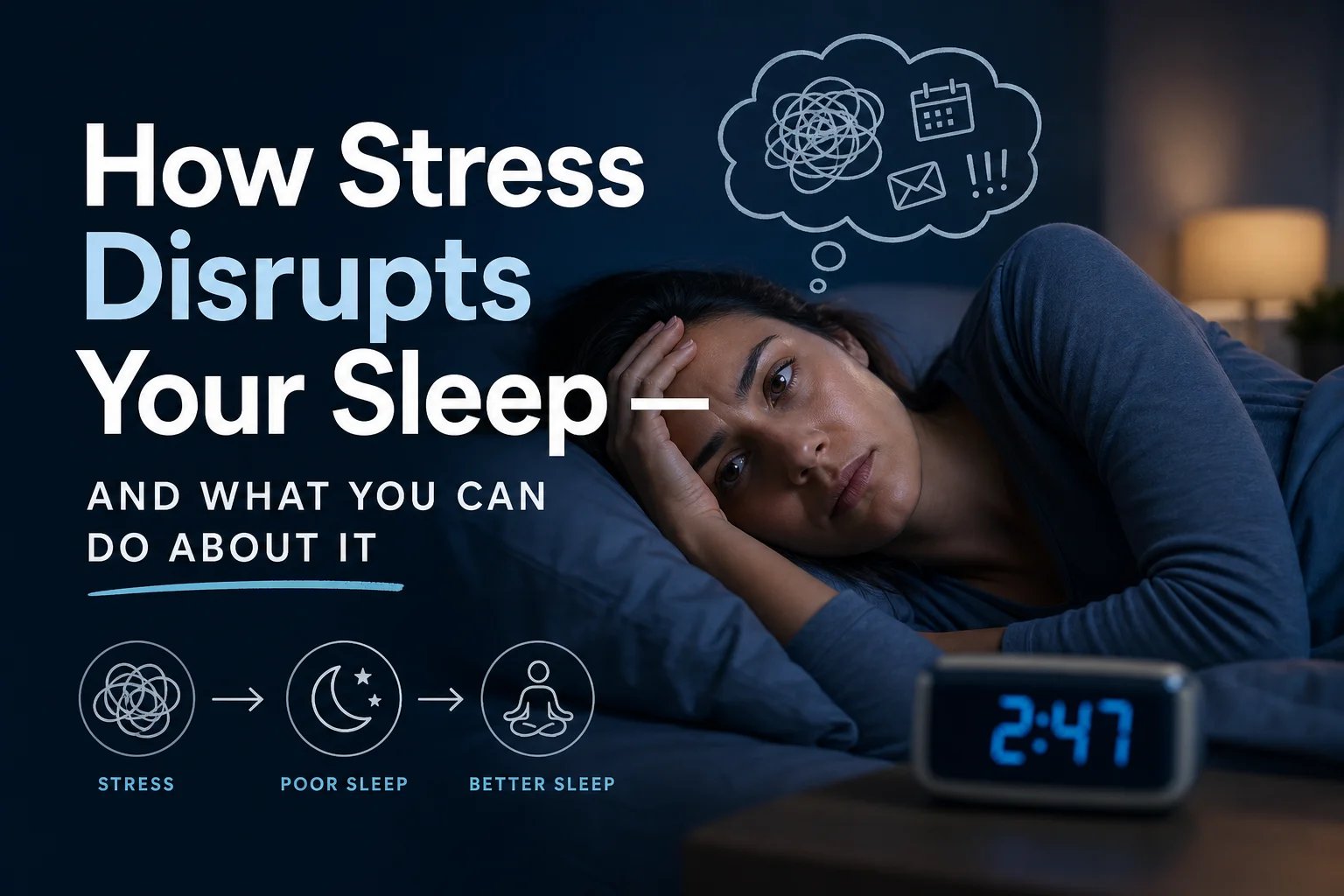
If this sounds familiar, you’re far from alone. Understanding How Stress Disrupts Your Sleep — and What You Can Do About It is one of the most important steps toward protecting your energy, mood, focus, immune health, and long-term well-being.
Stress and sleep have a powerful two-way relationship: stress makes sleep harder, and poor sleep makes stress feel bigger. The good news? This cycle is not permanent. With the right strategies, you can teach your nervous system to power down again.
This in-depth guide explores how stress disrupts sleep, why it happens biologically and emotionally, real-world examples of stress-related insomnia, and practical tools you can start using tonight.
Why Stress and Sleep Are So Deeply Connected
To understand How Stress Disrupts Your Sleep — and What You Can Do About It, it helps to begin with one simple truth: your body is designed to keep you safe before it lets you sleep.
Sleep requires a sense of safety. Your brain needs to believe that it can lower its guard. Stress sends the opposite message.
When you’re stressed, your nervous system shifts into a state of alertness. This is helpful if you’re facing a real threat, such as avoiding an accident or responding to an emergency. But the same stress response can be triggered by deadlines, relationship tension, money worries, health concerns, social pressure, or even a full inbox.
Your body does not always distinguish between “I’m in danger” and “I have too much to do tomorrow.” It simply prepares you to respond.
That response can include:
- Faster heart rate
- Increased breathing rate
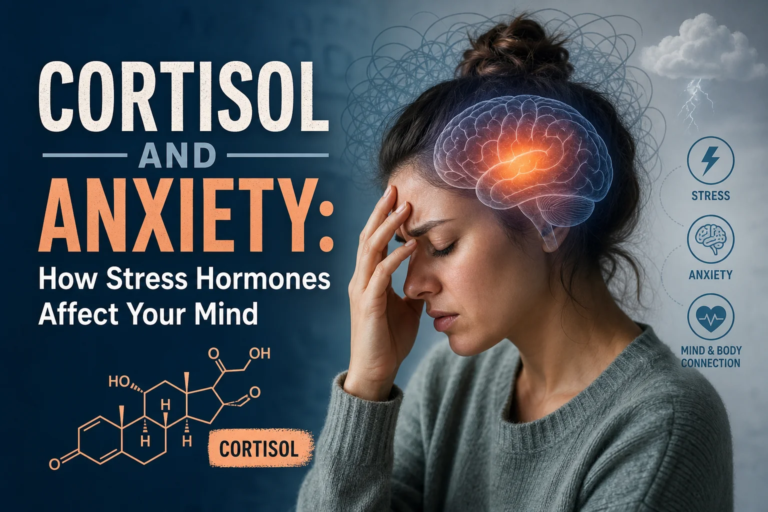
- Higher cortisol levels
- Muscle tension
- Racing thoughts
- Heightened emotional sensitivity
- Reduced melatonin production
- Difficulty entering deep sleep
This is the core of stress disrupting your sleep: your body is trying to stay alert when you need it to surrender.
The Stress-Sleep Cycle: A Loop That Feeds Itself
One of the most frustrating parts of How Stress Disrupts Your Sleep — and What You Can Do About It is that the problem often becomes self-reinforcing.
Stress causes poor sleep. Poor sleep lowers emotional resilience. Lower resilience makes everyday stressors feel more overwhelming. Then those bigger-feeling stressors disrupt sleep again.
Here’s what the cycle often looks like:
| Stage | What Happens | How It Affects Sleep |
|---|---|---|
| 1. Daily stress builds | Work, family, finances, health, or emotional pressure accumulates | Nervous system stays activated |
| 2. Bedtime arrives | Body is tired, but mind remains alert | Difficulty falling asleep |
| 3. Sleep becomes fragmented | You wake up during the night or too early | Less deep and REM sleep |
| 4. Next day feels harder | Mood, focus, patience, and decision-making decline | Stress feels more intense |
| 5. Sleep anxiety develops | You worry about whether you’ll sleep | The bed becomes associated with pressure |
This is why learning what you can do about stress-related sleep problems matters so much. You’re not just trying to “get more sleep.” You’re trying to interrupt a loop.
What Happens in the Body When Stress Disrupts Sleep
Stress-related insomnia is not “all in your head.” It is a real physiological process. When discussing How Stress Disrupts Your Sleep — and What You Can Do About It, we need to look at the body systems involved.
1. Cortisol Rises at the Wrong Time
Cortisol is often called the stress hormone, but it is not bad. In healthy amounts, cortisol helps you wake up, stay alert, regulate blood sugar, and respond to challenges.
Normally, cortisol is higher in the morning and gradually declines throughout the day. At night, it should be low enough to allow melatonin — your sleep-supporting hormone — to rise.
Chronic stress can flatten or shift this rhythm. You may feel tired all day, then strangely wired at night. This “tired but wired” feeling is one of the classic signs of stress disrupting your sleep.
2. The Sympathetic Nervous System Stays On
Your autonomic nervous system has two major branches:
- Sympathetic nervous system: fight-or-flight mode
- Parasympathetic nervous system: rest-and-digest mode
Sleep depends on parasympathetic dominance. Stress keeps the sympathetic branch active. That can make your body feel restless, even if you’re physically exhausted.
You might notice:
- A pounding heart at bedtime
- Shallow breathing
- Tight jaw or clenched fists
- Digestive discomfort
- Feeling “on edge” for no obvious reason
This is a key part of how stress affects sleep quality.
3. Rumination Keeps the Brain Awake
Stress does not only affect the body. It also changes how the mind behaves.
Rumination is the habit of replaying problems, conversations, fears, and “what ifs.” The brain tries to solve emotional discomfort by thinking harder — but bedtime thinking rarely leads to useful solutions.
Instead, it creates mental stimulation.
You may find yourself thinking:
- “What if I mess up tomorrow?”
- “Why did I say that?”
- “How will I handle this?”
- “What if I never sleep well again?”
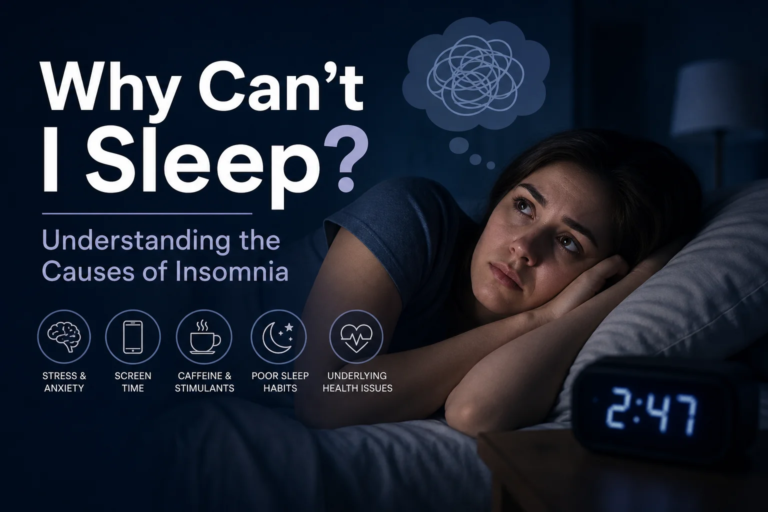
This is one of the most common ways stress interferes with falling asleep.
4. Stress Fragments Deep Sleep and REM Sleep
Even if you fall asleep, stress can reduce sleep quality. You may spend enough hours in bed but wake up feeling unrested.
Stress can affect:
- Deep sleep, which supports physical repair, immune function, and growth hormone release
- REM sleep, which supports emotional processing, memory, creativity, and mood regulation
- Sleep continuity, meaning how often you wake up during the night
This is why stress-related sleep disruption can leave you feeling emotionally raw the next day.
Common Signs Stress Is Disrupting Your Sleep
Not every bad night is stress-related. But certain patterns strongly suggest that stress is playing a role.
| Symptom | What It May Mean |
|---|---|
| You feel exhausted but alert at bedtime | Stress hormones may be elevated |
| You wake up around 2–4 a.m. with racing thoughts | Your nervous system may be reactivating overnight |
| You dread going to bed | Sleep anxiety may be developing |
| You sleep lightly and wake often | Stress may be reducing sleep depth |
| You grind your teeth or wake with tension | Physical stress may be carried into sleep |
| You need caffeine to function but it worsens sleep | A fatigue-stimulation cycle may be forming |
| You feel emotionally reactive after poor sleep | Sleep loss is reducing stress tolerance |
Recognizing these signs is the first step in understanding How Stress Disrupts Your Sleep — and What You Can Do About It in your own life.
Case Study 1: The High-Performing Professional Who Couldn’t “Switch Off”
Profile: Maya, 38, marketing director
Main stressor: High workload and constant availability
Sleep issue: Difficulty falling asleep and waking at 3 a.m.
Maya loved her career, but her phone never stopped. Even after dinner, she checked messages, reviewed campaign results, and mentally rehearsed meetings. By 10:30 p.m., she was physically tired but mentally activated.
Her bedtime routine included answering “just one more email,” scrolling through industry news, and checking tomorrow’s calendar. Once in bed, she replayed decisions and worried about missing something important.
Over time, Maya began associating bedtime with pressure. She would think, “I have to sleep now or tomorrow will be awful.” That thought alone made her heart race.
What Helped
Maya made three changes:
- A digital shutdown at 8:45 p.m.
- A written “tomorrow list” before leaving her desk
- A 10-minute breathing routine in bed
Within three weeks, she was falling asleep faster and waking less often.
Analysis
Maya’s story illustrates a common pattern in how stress disrupts your sleep: the brain never receives a clear signal that the workday is over. Her solution was not simply “relax more.” It was creating boundaries that allowed her nervous system to transition from performance mode to recovery mode.
Case Study 2: The Caregiver Running on Emotional Overload
Profile: James, 52, caring for an aging parent
Main stressor: Responsibility, worry, and interrupted routines
Sleep issue: Frequent night waking and early morning anxiety
James was balancing his job, his family, and his mother’s medical appointments. Even when nothing urgent was happening, he felt responsible for everything. At night, he woke easily, listening for his phone. His sleep became shallow and fragmented.
He tried going to bed earlier, but that didn’t solve the problem. More time in bed simply meant more time worrying.
What Helped
James began using:
- A shared caregiving calendar with siblings
- A “worry window” at 6:30 p.m.
- Progressive muscle relaxation before bed
- A consistent wake time, even after rough nights
Analysis
This case shows that stress-related sleep problems are not always caused by poor habits. Sometimes they come from emotional vigilance. James needed practical support and nervous system downshifting. Addressing both reduced the burden on his sleep.
Case Study 3: The Student Trapped in the Anxiety-Cramming Cycle
Profile: Lina, 21, university student
Main stressor: Exams and academic pressure
Sleep issue: Late nights, racing thoughts, irregular schedule
Lina studied late into the night because she felt guilty stopping. She drank coffee after dinner, reviewed notes in bed, and slept in on weekends to “catch up.” During exam season, she started waking up panicked, convinced she had forgotten something.
Her sleep schedule became unpredictable, and her brain began treating nighttime as study time.
What Helped
Lina changed her approach:
- No studying in bed
- Caffeine cutoff at 2 p.m.
- Study blocks ending at least one hour before sleep
- Morning sunlight exposure
- Short review sheets instead of late-night cramming
Analysis
Lina’s experience highlights how stress interferes with sleep through behavior. Anxiety led her to overwork at night, which trained her brain to stay alert in bed. By separating study from sleep, she restored the bed as a cue for rest.
The Mental Side: Why Bedtime Makes Stress Feel Louder
Many people wonder why they can cope during the day but fall apart at night. This is an important piece of How Stress Disrupts Your Sleep — and What You Can Do About It.
During the day, distractions help contain stress. You have tasks, conversations, movement, meals, notifications, errands, and responsibilities. At night, the world gets quiet. The mind finally has space — and sometimes it fills that space with unresolved tension.
Bedtime can magnify stress because:
- There are fewer distractions
- Fatigue reduces emotional control
- Darkness can intensify anxious thoughts
- The brain tries to process the day
- Tomorrow’s demands feel closer
- Silence makes body sensations more noticeable
This does not mean you are weak. It means your brain is trying to process too much at the wrong time.
The goal is not to eliminate every stressful thought before bed. The goal is to teach your mind, “This can wait until tomorrow.”
The Most Common Stress-Triggered Sleep Patterns
Stress does not disrupt everyone’s sleep in the same way. Identifying your pattern helps you choose the right solution.
| Sleep Pattern | Common Cause | Best First Strategy |
|---|---|---|
| Trouble falling asleep | Mental rumination, late stimulation | Wind-down routine, worry journal |
| Waking at 2–4 a.m. | Cortisol surge, anxiety, alcohol, blood sugar shifts | Calm breathing, reduce alcohol, consistent schedule |
| Early morning waking | Depression, anxiety, anticipatory stress | Morning light, CBT-I techniques, professional support if persistent |
| Light, restless sleep | Nervous system hyperarousal | Relaxation training, exercise, stress management |
| Sleeping too much but still tired | Burnout, poor sleep quality, depression | Medical evaluation, routine reset |
| Weekend catch-up sleep | Sleep debt and irregular rhythm | Consistent wake time, gradual recovery |
Understanding your pattern is central to what you can do about stress and sleep problems.
What You Can Do Tonight: A Practical Sleep Reset
When people search for How Stress Disrupts Your Sleep — and What You Can Do About It, they often want immediate relief. While long-term stress management matters, there are steps you can take tonight.
1. Do a Brain Dump Before Bed
Write down every thought competing for attention. Don’t organize it. Don’t solve it. Just unload it.
Then create two small lists:
| List | Purpose |
|---|---|
| “Not for tonight” | Problems you cannot solve before sleep |
| “First steps tomorrow” | One or two realistic actions |
This tells your brain, “We captured it. We don’t need to rehearse it all night.”
2. Try the 4-6 Breathing Method
Breathe in for 4 seconds. Exhale for 6 seconds. Repeat for 5 minutes.
Longer exhales stimulate the parasympathetic nervous system, helping your body shift toward rest. This is a simple way to counter stress disrupting your sleep in real time.
3. Lower the Lights Earlier
Bright light delays melatonin. Dim your environment 60–90 minutes before bed. Use lamps instead of overhead lights. Reduce screen brightness or use blue-light filters if screens are unavoidable.
Light is one of the strongest signals your brain uses to decide whether it is time to be awake or asleep.
4. Get Out of Bed If You’re Wide Awake
If you’ve been awake for about 20–30 minutes and feel increasingly frustrated, get out of bed. Do something quiet and boring in dim light: read something gentle, listen to calm audio, or sit quietly.
Return to bed when sleepy.
This helps prevent your brain from linking the bed with stress, effort, and failure.
5. Use a “Safe Enough” Statement
When stress feels intense, your nervous system needs reassurance. Try repeating:
- “I don’t have to solve this tonight.”
- “Rest is still helpful, even if sleep takes time.”
- “My body knows how to sleep.”
- “Tomorrow’s problems belong to tomorrow.”
This may sound simple, but compassionate self-talk can reduce sleep anxiety.
What You Can Do During the Day to Sleep Better at Night
Solving How Stress Disrupts Your Sleep — and What You Can Do About It does not begin at bedtime. It begins during the day.
1. Give Stress Somewhere to Go
Stress is physical. If it stays trapped in your body, it often shows up at night.
Helpful outlets include:
- Walking
- Strength training
- Yoga
- Dancing
- Stretching
- Swimming
- Cycling
- Shaking out tension
- Cleaning or gardening
You don’t need an intense workout. Even 10–20 minutes of movement can help discharge stress chemistry.
2. Protect Your Morning Light
Morning light anchors your circadian rhythm. Go outside within the first hour after waking if possible. Even cloudy light helps.
This improves nighttime melatonin timing and can reduce the “wired at night” pattern associated with stress-related insomnia.
3. Schedule a Worry Window
Instead of letting worries invade bedtime, give them an appointment.
Set aside 10–15 minutes in the early evening. Write down:
- What am I worried about?
- Is this controllable, partially controllable, or uncontrollable?
- What is one next step?
- What can wait?
This trains your brain not to use bedtime as problem-solving time.
4. Reduce Caffeine Pressure
Caffeine can stay active for many hours. If you are sensitive to stress or anxiety, caffeine may worsen nighttime alertness.
Try:
- Cutting off caffeine by early afternoon
- Reducing total intake gradually
- Switching to half-caf
- Avoiding caffeine after a bad night, when anxiety is already high
This is especially important when stress interferes with falling asleep.
5. Watch Alcohol’s Sneaky Sleep Effects
Alcohol may make you feel sleepy at first, but it often fragments sleep later in the night. It can reduce REM sleep, increase awakenings, and worsen early morning anxiety.
If you notice 3 a.m. wake-ups after drinking, alcohol may be part of the pattern.
The Evening Routine That Actually Works
A good evening routine is not about perfection. It is about predictability. Your brain loves cues. Repeated cues tell your nervous system: “We are safe. We are done. We can rest.”
Here is a sample routine for stress and sleep recovery.
| Time | Action | Why It Helps |
|---|---|---|
| 7:30 p.m. | Finish heavy tasks | Prevents late mental activation |
| 8:00 p.m. | Light tidy-up and prepare tomorrow’s essentials | Reduces morning worry |
| 8:30 p.m. | Write tomorrow list and worry notes | Clears mental clutter |
| 9:00 p.m. | Dim lights, reduce screens | Supports melatonin |
| 9:15 p.m. | Warm shower or bath | Helps body temperature drop afterward |
| 9:45 p.m. | Gentle reading, stretching, breathing | Signals safety |
| 10:15 p.m. | Bedtime | Consistency strengthens rhythm |
The routine does not need to be long. It needs to be repeatable.
CBT-I: The Gold-Standard Approach for Chronic Insomnia
If you’ve struggled for months, you may need more than sleep hygiene. Cognitive Behavioral Therapy for Insomnia, or CBT-I, is one of the most effective non-medication treatments for chronic insomnia.
CBT-I addresses the thoughts and behaviors that keep insomnia going. It is highly relevant to How Stress Disrupts Your Sleep — and What You Can Do About It because stress-related insomnia often becomes conditioned.
CBT-I may include:
- Stimulus control
- Sleep scheduling
- Cognitive restructuring
- Relaxation training
- Reducing sleep-related fear
- Improving sleep efficiency
For example, if you spend nine hours in bed but sleep only five, your brain may learn that bed equals wakefulness. CBT-I helps rebuild the bed-sleep connection.
If your sleep problems are persistent, consider working with a clinician trained in CBT-I.
The Role of Emotional Boundaries
Sometimes the solution to stress disrupting your sleep is not another relaxation technique. Sometimes it is a boundary.
Your sleep may improve when you stop letting other people’s urgency become your nighttime burden.
Examples of sleep-protective boundaries:
- No work email after a set time
- No serious arguments right before bed
- No doomscrolling in bed
- No saying yes automatically to every request
- No using sleep time to compensate for poor planning
- No keeping your phone within arm’s reach if it triggers vigilance
Boundaries are not selfish. They are biological protection.
Foods, Nutrients, and Sleep: What Matters Most
Nutrition cannot erase stress, but it can support sleep stability.
Helpful habits include:
- Eating regular meals to prevent nighttime blood sugar dips
- Including protein at dinner
- Avoiding very heavy meals close to bed
- Limiting spicy foods if they trigger reflux
- Staying hydrated earlier in the day
- Avoiding excessive fluids right before bed
Some people find magnesium-rich foods helpful, such as pumpkin seeds, spinach, almonds, black beans, and dark chocolate. Tart cherry juice, kiwi, and herbal teas may support sleep for some individuals, though responses vary.
If you use supplements, check with a healthcare professional, especially if you take medication, are pregnant, or have medical conditions.
When Stress-Related Sleep Problems Need Professional Help
Understanding How Stress Disrupts Your Sleep — and What You Can Do About It is empowering, but some situations deserve medical or mental health support.
Seek help if:
- Sleep problems last more than three months
- You regularly cannot function during the day
- You feel depressed, hopeless, or panicked
- You snore loudly or gasp during sleep
- You have restless legs or unusual nighttime movements
- You rely heavily on alcohol or sedatives to sleep
- Nightmares or trauma symptoms are present
- You have thoughts of self-harm
Sleep issues can be linked to anxiety disorders, depression, PTSD, thyroid problems, sleep apnea, chronic pain, medication effects, and other health concerns. You do not have to figure it out alone.
A 7-Day Plan to Start Breaking the Stress-Sleep Cycle
Here is a simple one-week plan for what you can do about stress disrupting your sleep.
| Day | Focus | Action |
|---|---|---|
| Day 1 | Awareness | Track bedtime, wake time, caffeine, stress level, and awakenings |
| Day 2 | Morning anchor | Get outdoor light within one hour of waking |
| Day 3 | Worry control | Add a 10-minute evening worry window |
| Day 4 | Body calming | Practice 5 minutes of slow breathing before bed |
| Day 5 | Digital boundary | Stop work/email/social media 60 minutes before bed |
| Day 6 | Bed reset | Leave bed if awake and frustrated; return when sleepy |
| Day 7 | Review | Notice what helped and repeat the top two strategies |
Small changes are more sustainable than dramatic overhauls. The nervous system responds well to consistency.
Quick Reference: Stress vs. Sleep Solutions
| If Stress Causes… | Try This |
|---|---|
| Racing thoughts | Brain dump, worry window, calming self-talk |
| Physical tension | Progressive muscle relaxation, stretching, warm bath |
| Night waking | Slow breathing, reduce alcohol, consistent wake time |
| Bedtime anxiety | Stimulus control, CBT-I tools, reassurance statements |
| Work-related hyperarousal | Shutdown ritual, email boundaries, tomorrow list |
| Emotional overload | Therapy, journaling, support systems, delegation |
| Irregular sleep rhythm | Morning light, fixed wake time, caffeine cutoff |
This table captures the heart of How Stress Disrupts Your Sleep — and What You Can Do About It: match the solution to the stress pattern.
Long-Tail Keyword Variations Covered Naturally
For readers and search intent, this article has addressed several related phrases, including:
- how stress disrupts your sleep
- what you can do about stress-related insomnia
- how stress affects sleep quality
- stress interfering with falling asleep
- stress and sleep problems
- how to sleep better when stressed
- stress-related sleep disruption
- why stress wakes you up at night
- how to calm your nervous system before bed
- what to do when anxiety keeps you awake
These variations reflect the many ways people experience and search for How Stress Disrupts Your Sleep — and What You Can Do About It.
Conclusion: Your Sleep Can Recover
Stress can make sleep feel fragile, unpredictable, and frustrating. It can keep your mind racing, your body tense, and your nights restless. But stress-related sleep problems are not a personal failure — they are a nervous system response.
The key lesson in How Stress Disrupts Your Sleep — and What You Can Do About It is this: you do not force sleep. You create the conditions that allow sleep to return.
Start small. Dim the lights earlier. Write down your worries. Move your body during the day. Set a boundary with your phone. Breathe longer on the exhale. Keep a consistent wake time. Ask for support when the load is too heavy.
Your body already knows how to sleep. Your job is to help it feel safe enough to do so.
Tonight does not have to be perfect. It only has to be a little calmer than last night.
1. Why does stress make it so hard to fall asleep?
Stress activates the fight-or-flight system, increasing alertness, heart rate, muscle tension, and stress hormones like cortisol. This makes it harder for your body to shift into the relaxed state needed for sleep. Racing thoughts and worry can also keep the brain mentally stimulated.
2. Can stress wake me up in the middle of the night?
Yes. Stress can contribute to nighttime awakenings, especially if your nervous system remains on alert. Some people wake around 2–4 a.m. with racing thoughts or anxiety. Alcohol, irregular sleep schedules, and unresolved worry can make this worse.
3. What is the fastest way to calm stress before bed?
Try a simple combination: write down your worries, dim the lights, and practice slow breathing with a longer exhale. For example, inhale for 4 seconds and exhale for 6 seconds for five minutes. This helps signal safety to your nervous system.
4. Should I stay in bed if I can’t sleep?
If you are calm and resting, staying in bed may be fine. But if you are awake, frustrated, and anxious for more than about 20–30 minutes, get up and do something quiet in dim light. Return when sleepy. This helps prevent your brain from associating bed with stress.
5. Does poor sleep make stress worse the next day?
Absolutely. Poor sleep reduces emotional regulation, patience, focus, and problem-solving ability. As a result, normal challenges can feel more overwhelming. This is why stress and sleep often create a cycle.
6. When should I seek professional help for stress-related insomnia?
Consider professional help if sleep problems last longer than three months, affect your daily functioning, or are linked with anxiety, depression, trauma, loud snoring, panic, or reliance on alcohol or sedatives. CBT-I and mental health support can be very effective.
7. Can lifestyle changes really fix stress-related sleep problems?
In many cases, yes. Consistent wake times, morning light, caffeine limits, evening wind-down routines, relaxation techniques, and better stress boundaries can significantly improve sleep. If the problem is chronic or severe, lifestyle changes work best alongside professional guidance.
About the Author