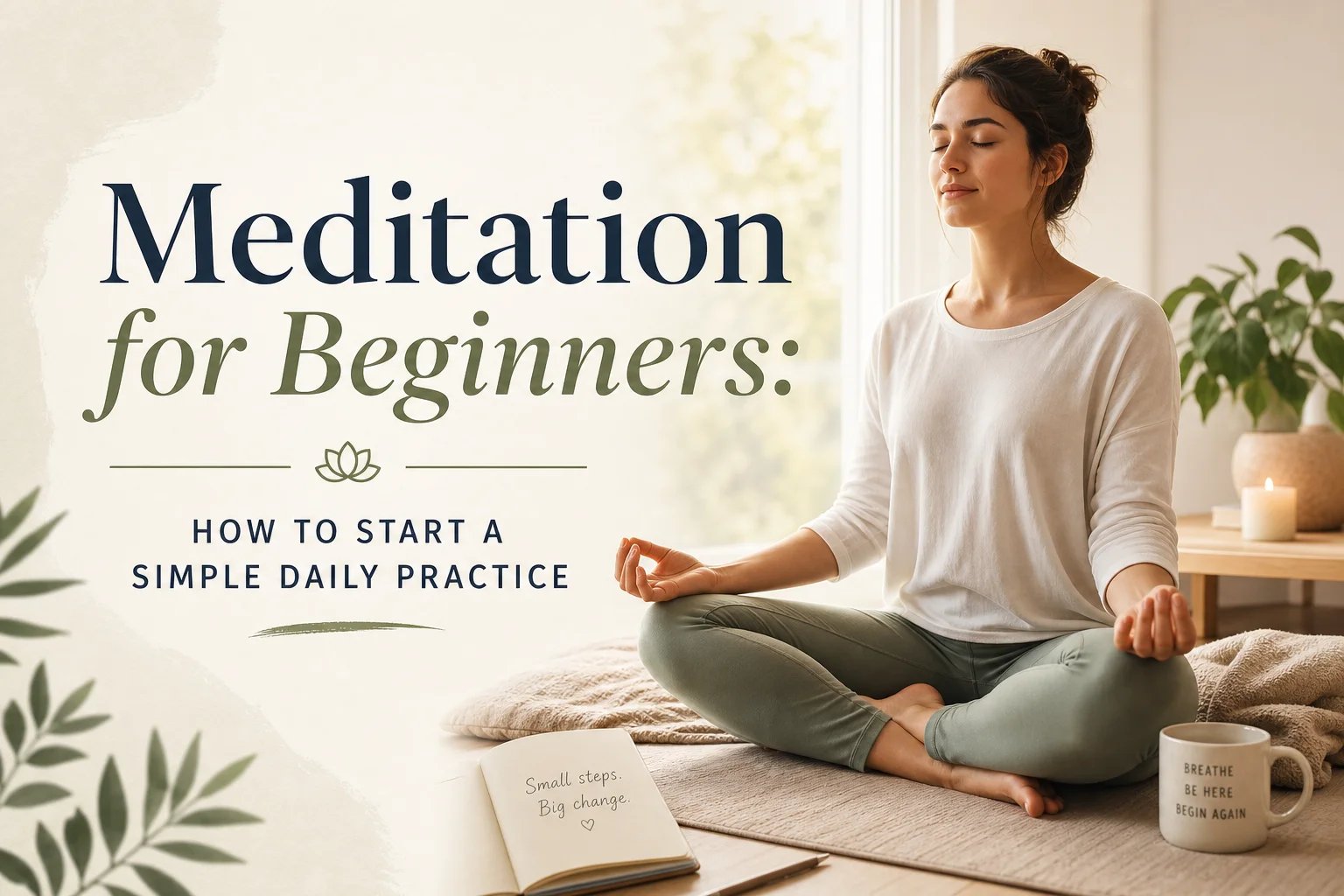
The Ultimate Guide to Meditation for Beginners: How to Start a Simple Daily Practice That Actually Sticks
Introduction: Your Mind Is Not Broken—It’s Just Overloaded
Most people do not begin meditation because life feels peaceful. They begin because life feels loud.
Maybe your thoughts start racing before your feet hit the floor in the morning. Maybe you scroll through your phone at night even though you are exhausted. Maybe stress has become so normal that silence feels unfamiliar, even uncomfortable.
That is exactly why Meditation for Beginners: How to Start a Simple Daily Practice matters.
Meditation is not about becoming a different person, forcing your mind to go blank, or sitting cross-legged for an hour while pretending you are calm. At its heart, meditation is much more practical: it is the skill of returning to the present moment with patience.
And like any skill, it can be learned.
This guide to Meditation for Beginners: How to Start a Simple Daily Practice is designed for real life. You do not need special equipment, spiritual expertise, or a perfectly quiet home. You need a few minutes, a simple method, and a willingness to begin again—because beginning again is the practice.
Whether you are stressed, distracted, emotionally overwhelmed, or simply curious, this article will walk you through the essentials of meditation for beginners, including how to sit, what to focus on, what to do when your mind wanders, and how to build a daily habit that feels natural instead of forced.
What Is Meditation, Really?
Meditation is a mental training practice that helps you develop awareness, focus, emotional balance, and self-understanding. While meditation has roots in ancient traditions, modern research has also shown its value for stress reduction, attention, sleep, and emotional regulation.
For beginners, meditation can be defined simply:
Meditation is the practice of noticing where your attention is and gently guiding it back.
That is it.
If you sit down, focus on your breath, notice your mind has wandered, and return to your breath, you are meditating. Even if you do that 100 times in five minutes, you are still practicing correctly.
This is one of the most important truths in Meditation for Beginners: How to Start a Simple Daily Practice: a wandering mind is not failure. It is part of the training.
Think of meditation like strength training for attention. Each time you bring your mind back, you are doing a “rep.” Over time, those small repetitions build steadiness.
Why Meditation Is So Helpful for Beginners
Many people come to meditation because they want relief. They want less stress, better sleep, more patience, or fewer spiraling thoughts. Those are valid reasons.
But meditation offers something deeper too: it helps you change your relationship with your mind.
Instead of believing every anxious thought, you learn to observe it. Instead of reacting instantly to frustration, you create a pause. Instead of being pulled in every direction by notifications, deadlines, and emotions, you learn how to return to yourself.
A simple daily meditation practice can support:
- Lower perceived stress
- Improved focus and concentration
- Better emotional regulation
- Increased self-awareness
- More patience in relationships
- Improved sleep quality
- Greater resilience during difficult moments
- A calmer response to uncertainty
The beauty of Meditation for Beginners: How to Start a Simple Daily Practice is that the benefits do not require perfection. They come from consistency.
Five minutes a day, practiced regularly, is more powerful than one 45-minute session once a month.
Common Myths About Meditation for Beginners
Before you begin, it helps to clear up a few myths. Many beginners quit early because they think they are “bad” at meditation. Usually, they are just judging the experience by unrealistic standards.
| Myth | Reality |
|---|---|
| “I need to stop thinking.” | Meditation is not about eliminating thoughts. It is about noticing them without getting lost in them. |
| “I have to sit perfectly still.” | Comfort matters. Small adjustments are fine. |
| “I need 30 minutes a day.” | Beginners can start with 2 to 5 minutes. |
| “Meditation is religious.” | Meditation can be spiritual, secular, or purely practical depending on your approach. |
| “If I feel restless, I’m doing it wrong.” | Restlessness is common. Noticing it is part of the practice. |
| “I should feel calm immediately.” | Calm may happen, but awareness is the real goal. |
This is why guides like Meditation for Beginners: How to Start a Simple Daily Practice are important. The first step is not mastering meditation. The first step is understanding what meditation actually is.
The Science Behind a Simple Daily Meditation Practice
Meditation has been studied in psychology, neuroscience, and clinical health research. While it is not a miracle cure, evidence suggests that regular mindfulness meditation may help reduce stress, improve attention, and support emotional well-being.
One reason meditation works is that it trains the brain’s attention networks. In daily life, attention is often scattered. Meditation gives the mind a single point of focus, such as the breath, sound, or body sensations. When attention wanders, the practice is to notice and return.
Over time, this process can strengthen awareness and reduce automatic reactivity.
Meditation may also calm the body’s stress response. When paired with slow, steady breathing, meditation can help activate the parasympathetic nervous system, often associated with rest and recovery.
In practical terms, this means that a beginner meditation practice can help you pause before reacting, breathe through discomfort, and recognize thoughts as mental events rather than absolute truths.
That is the foundation of Meditation for Beginners: How to Start a Simple Daily Practice: small moments of awareness repeated daily.
How to Start Meditating: The Beginner-Friendly Method
If you are new to meditation, do not overcomplicate it. You can begin today with a very simple breath awareness practice.
Step 1: Choose a Time
Pick a time that already fits your life. Morning is ideal for many people because the day has not yet become busy. Others prefer lunch breaks or evenings.
Good beginner times include:
- Right after waking up
- After brushing your teeth
- Before your first cup of coffee
- During a lunch break
- After work before checking your phone
- Before bed
The best time for Meditation for Beginners: How to Start a Simple Daily Practice is the time you can repeat.
Step 2: Choose a Place
You do not need a meditation room. Choose somewhere simple and comfortable.
It could be:
- A chair beside your bed
- A quiet corner of your living room
- Your parked car before work
- A bench outside
- Your office with the door closed
The place matters less than the routine.
Step 3: Set a Short Timer
Start with 2 to 5 minutes. This may sound too short, but short practices build consistency.
A common beginner mistake is starting too big. If you begin with 20 minutes and struggle, you may decide meditation is not for you. But if you begin with three minutes, you lower resistance.
In Meditation for Beginners: How to Start a Simple Daily Practice, the goal is not intensity. The goal is repeatability.
Step 4: Sit Comfortably
You can sit on a chair, cushion, or floor. Keep your spine upright but not stiff. Rest your hands on your thighs or in your lap.
Your posture should feel alert and relaxed.
Try this:
- Feet flat on the floor if sitting in a chair
- Shoulders soft
- Jaw unclenched
- Hands relaxed
- Eyes closed or gently lowered
You are not trying to look like someone meditating. You are simply creating conditions for awareness.
Step 5: Focus on Your Breath
Bring attention to your breathing. Do not force it. Notice the natural inhale and exhale.
You might focus on:
- Air moving through the nostrils
- The rise and fall of your chest
- The expansion of your belly
- The feeling of the body breathing itself
Silently say “in” as you inhale and “out” as you exhale if that helps.
Step 6: Notice When the Mind Wanders
Your mind will wander. This is normal.
You may think about emails, dinner, old conversations, future worries, random songs, or whether you are meditating correctly.
When you notice the mind has wandered, simply acknowledge it:
- “Thinking.”
- “Planning.”
- “Worrying.”
- “Remembering.”
Then return to the breath.
This moment—when you notice and come back—is the heart of Meditation for Beginners: How to Start a Simple Daily Practice.
Step 7: End Gently
When the timer rings, do not jump up immediately. Take one deeper breath. Notice your body. Open your eyes if they were closed.
Ask yourself:
“What do I notice right now?”
Then continue with your day.
A Simple 7-Day Meditation Plan for Beginners
If you want a clear starting point, use this one-week plan. It is designed to make Meditation for Beginners: How to Start a Simple Daily Practice feel approachable rather than overwhelming.
| Day | Time | Practice | Main Focus |
|---|---|---|---|
| Day 1 | 2 minutes | Breath awareness | Notice inhale and exhale |
| Day 2 | 3 minutes | Breath counting | Count breaths from 1 to 10 |
| Day 3 | 4 minutes | Body awareness | Notice body contact and posture |
| Day 4 | 5 minutes | Breath awareness | Return gently when distracted |
| Day 5 | 5 minutes | Sound meditation | Notice sounds without labeling too much |
| Day 6 | 6 minutes | Loving-kindness | Repeat kind phrases silently |
| Day 7 | 7 minutes | Open awareness | Notice breath, body, sounds, thoughts |
Beginner Progress Chart
Here is what a realistic first week might look like:
| Day | Minutes Practiced | Likely Experience |
|---|---|---|
| 1 | 2 | “That felt strange.” |
| 2 | 3 | “My mind wandered constantly.” |
| 3 | 4 | “I noticed tension in my body.” |
| 4 | 5 | “I had one calm moment.” |
| 5 | 5 | “Sounds distracted me, but I came back.” |
| 6 | 6 | “Kindness phrases felt awkward but nice.” |
| 7 | 7 | “I can see how this might help.” |
The goal is not to have a perfect week. The goal is to prove to yourself that you can show up.
Different Types of Meditation for Beginners
There are many styles of meditation. Beginners often benefit from trying a few and choosing one that feels sustainable.
| Meditation Type | How It Works | Best For |
|---|---|---|
| Breath Awareness | Focus on natural breathing | Stress, focus, simplicity |
| Body Scan | Move attention through the body | Relaxation, sleep, tension release |
| Loving-Kindness | Repeat phrases of goodwill | Self-compassion, relationships |
| Walking Meditation | Pay attention while walking slowly | Restlessness, active people |
| Mantra Meditation | Repeat a word or phrase | Mental focus, busy thoughts |
| Guided Meditation | Listen to a teacher or recording | Beginners needing structure |
| Open Awareness | Notice whatever arises | Building broad mindfulness |
For most people exploring Meditation for Beginners: How to Start a Simple Daily Practice, breath awareness is the easiest place to begin because the breath is always available.
The Best Meditation Posture for Beginners
Meditation posture should support alertness without creating unnecessary discomfort. You do not need to sit in a lotus position. In fact, forcing an uncomfortable posture can distract you and make meditation feel unpleasant.
Chair Meditation
This is ideal for most beginners.
Sit toward the front of a chair. Place both feet on the floor. Let your spine be upright and your shoulders relaxed.
Cushion Meditation
Sit on a cushion with your hips slightly elevated. Cross your legs comfortably. If your knees float high above the floor, use more support.
Lying Down Meditation
This can be useful for body scans or sleep meditation. However, if you fall asleep easily, sitting may be better for daily practice.
Walking Meditation
If sitting feels unbearable, walk slowly and pay attention to each step. Notice lifting, moving, and placing the foot.
A key principle in Meditation for Beginners: How to Start a Simple Daily Practice is this: choose a posture you can return to tomorrow.
What Should You Think About During Meditation?
This question comes up often. The answer may surprise you: you are not trying to think about anything in particular.
Instead, you choose an anchor. The anchor is the object of attention.
Common meditation anchors include:
- Breath
- Body sensations
- Sounds
- A word or mantra
- A candle flame
- Walking steps
- Kindness phrases
When thoughts appear, you do not fight them. You notice them, allow them to pass, and return to the anchor.
Imagine sitting by a river. Thoughts are leaves floating by. Meditation is not jumping into the river to chase every leaf. It is learning to sit on the bank and observe.
That image captures the essence of Meditation for Beginners: How to Start a Simple Daily Practice: you are learning not to be dragged away by every mental current.
How Long Should Beginners Meditate?
Beginners should start small. Two to five minutes is enough.
Once the habit feels stable, gradually increase.
| Experience Level | Suggested Duration | Frequency |
|---|---|---|
| Absolute beginner | 2–5 minutes | Daily or 5 days/week |
| After 1–2 weeks | 5–10 minutes | Daily |
| After 1 month | 10–15 minutes | Daily |
| Established beginner | 15–20 minutes | Most days |
If you miss a day, do not turn it into a story about discipline or failure. Just restart.
A sustainable approach to Meditation for Beginners: How to Start a Simple Daily Practice is based on kindness, not self-criticism.
How to Build a Daily Meditation Habit
Meditation becomes easier when it is attached to something you already do. This is called habit stacking.
For example:
- After I brush my teeth, I will meditate for three minutes.
- After I make coffee, I will sit and breathe before drinking it.
- After I close my laptop, I will meditate before leaving work.
- After I get into bed, I will do a short body scan.
The more specific your plan, the more likely you are to follow through.
Use the “Minimum Practice” Rule
Create a minimum version of your practice so small that it is hard to skip.
For example:
“My minimum meditation is one mindful breath.”
This may sound almost too easy, but it protects the habit. On busy days, one breath keeps the chain alive. On better days, one breath often becomes five minutes.
This is a powerful insight in Meditation for Beginners: How to Start a Simple Daily Practice: consistency grows from reducing friction.
Common Obstacles Beginners Face—and How to Handle Them
“My Mind Is Too Busy”
A busy mind is not a barrier to meditation. It is the reason to meditate.
If your mind wanders 50 times, you have 50 chances to practice returning.
“I Feel Restless”
Try shorter sessions or walking meditation. Restlessness is energy in the body. You can observe it instead of resisting it.
“I Get Sleepy”
Meditate sitting up, open your eyes slightly, or practice earlier in the day.
“I Don’t Have Time”
Start with one minute. If you have time to check your phone, you have time for three conscious breaths.
“I’m Not Sure It’s Working”
Meditation often works subtly. You may not notice dramatic changes during practice, but you might notice more patience later in the day.
In Meditation for Beginners: How to Start a Simple Daily Practice, progress is often measured not by what happens while sitting, but by how you respond when life gets messy.
Case Study 1: The Overwhelmed Manager Who Started with Three Minutes
Background
Maya, a 38-year-old project manager, felt constantly behind. Her workdays were packed with meetings, and by evening she was irritable and mentally drained. She had tried meditation apps before but quit after a week because 20-minute sessions felt impossible.
Approach
Instead of aiming for long sessions, Maya started with three minutes of breath awareness every morning after brushing her teeth. She used a timer and sat in a chair by her bedroom window.
Her practice was simple:
- Sit upright.
- Notice the breath.
- Label distractions as “thinking.”
- Return to the breath.
After two weeks, she increased to five minutes. After one month, she practiced for eight minutes most mornings.
Results
Maya reported that her stress did not disappear, but her reactions changed. During tense meetings, she noticed herself taking a breath before responding. She also became more aware of shoulder tension and began relaxing her body throughout the day.
Analysis
Maya’s experience shows why Meditation for Beginners: How to Start a Simple Daily Practice should start small. Her success came from consistency, not ambition. By attaching meditation to an existing habit and keeping it brief, she created a routine that survived busy mornings.
Case Study 2: The College Student Who Used Meditation for Sleep
Background
Jordan, a 21-year-old student, struggled with racing thoughts at night. Exams, social pressure, and late-night screen use made it difficult to fall asleep. He assumed meditation meant sitting silently for long periods, which did not appeal to him.
Approach
Jordan began with a 10-minute body scan in bed. Instead of focusing on the breath, he moved attention slowly through the body: feet, legs, hips, back, shoulders, arms, face.
When thoughts appeared, he gently returned to physical sensation.
Results
Within three weeks, Jordan found that the body scan helped him transition into sleep more easily. He still had stressful nights, especially before exams, but the practice gave him something concrete to do besides overthinking.
Analysis
This case highlights a useful variation of Meditation for Beginners: How to Start a Simple Daily Practice. Not every beginner needs to start with breath meditation. For people who feel anxious when focusing on the breath, body-based meditation may feel safer and more grounding.
Case Study 3: The Parent Who Practiced One Breath at a Time
Background
Elena, a 44-year-old parent of two, wanted to meditate but felt she had no uninterrupted time. Between work, meals, school schedules, and household responsibilities, even five quiet minutes seemed unrealistic.
Approach
Elena used micro-meditations throughout the day. Instead of waiting for perfect silence, she practiced one mindful breath during ordinary transitions:
- Before opening email
- After parking the car
- While waiting for water to boil
- Before responding to her children during conflict
- Before going to sleep
Eventually, she added a five-minute Sunday morning meditation.
Results
Elena noticed she was less reactive during stressful family moments. She described meditation as “a pause button” rather than another task on her list.
Analysis
Elena’s story expands the meaning of Meditation for Beginners: How to Start a Simple Daily Practice. A daily practice does not always mean one formal session. For busy people, several mindful pauses can create meaningful change and lay the foundation for longer practice later.
A Simple Breath Meditation Script for Beginners
Use this script when you are ready to practice.
Set a timer for three to five minutes.
Sit comfortably. Let your hands rest.
Take a gentle breath in.
Let it out slowly.
Notice where your body touches the chair or floor.
Allow your shoulders to soften.
Now bring attention to your natural breathing.
You do not need to change the breath.
Simply notice the inhale.
Notice the exhale.
If it helps, silently say:
“In” as you breathe in.
“Out” as you breathe out.
Sooner or later, your mind will wander.
When you notice, gently say, “thinking.”
Then return to the next breath.
No frustration is needed.
The return is the practice.
Again, inhale.
Again, exhale.
For the final few moments, notice your whole body sitting and breathing.
When you are ready, open your eyes.
Carry one mindful breath into the rest of your day.
This script captures the basic method of Meditation for Beginners: How to Start a Simple Daily Practice in a way you can use immediately.
How to Know If Meditation Is Working
Meditation progress can be quiet. You may not feel blissful. You may not have dramatic insights. That does not mean nothing is happening.
Signs your practice is working may include:
- You notice thoughts sooner.
- You pause before reacting.
- You become more aware of tension.
- You recover from stress a little faster.
- You listen more fully.
- You are kinder to yourself after mistakes.
- You recognize emotional patterns.
- You feel less controlled by every thought.
One of the best signs is subtle: you begin to notice the space between stimulus and response.
Someone says something irritating. Normally, you snap back. But this time, you breathe first.
That breath is progress.
That breath is the real-life value of Meditation for Beginners: How to Start a Simple Daily Practice.
Meditation and Stress: A Practical Perspective
Stress is not only in the mind. It lives in the body too. Tight shoulders, shallow breathing, clenched jaw, digestive discomfort, and fatigue can all be connected to chronic stress.
Meditation helps because it creates a moment of awareness before stress takes over completely.
Here is how meditation can interrupt the stress cycle:
| Stress Pattern | Meditation Response |
|---|---|
| Racing thoughts | Return attention to breath or body |
| Shallow breathing | Notice and allow slower breathing |
| Emotional reactivity | Create a pause before responding |
| Physical tension | Scan and soften the body |
| Overwhelm | Focus on one present-moment anchor |
| Rumination | Label thoughts and return |
For beginners, the key is not to use meditation as a way to suppress stress. Instead, meditation helps you relate to stress differently.
This is a central lesson in Meditation for Beginners: How to Start a Simple Daily Practice: meditation does not remove life’s challenges, but it can change how you meet them.
Guided vs. Silent Meditation: Which Is Better for Beginners?
Both guided and silent meditation can be useful.
Guided Meditation
A teacher or recording leads you through the practice. This can be helpful if you are unsure what to do or feel uncomfortable in silence.
Best for:
- Absolute beginners
- People with busy minds
- Those who like structure
- Sleep or relaxation practices
Silent Meditation
You practice without audio guidance. This builds independence and helps you become familiar with your own mind.
Best for:
- Building concentration
- Deepening self-awareness
- Practicing anywhere
- Reducing reliance on apps
A balanced approach works well. You might use guided meditation three days a week and silent meditation on other days.
In Meditation for Beginners: How to Start a Simple Daily Practice, the best method is the one that helps you keep practicing.
Creating a Meditation Space at Home
A meditation space does not have to be elaborate. It simply needs to signal to your mind: this is where I pause.
You might include:
- A comfortable chair or cushion
- A small blanket
- A candle
- A plant
- A journal
- Soft lighting
- A timer
Avoid making the setup so complicated that it becomes a barrier. The space should invite practice, not demand perfection.
Even a single chair can become powerful if you return to it daily.
What to Do After Meditation
The moments after meditation matter. Instead of rushing immediately into your phone or to-do list, take a brief transition.
Try one of these:
- Write down one word describing how you feel.
- Set an intention for the day.
- Take one mindful sip of water or tea.
- Stretch gently.
- Notice one thing you appreciate.
This helps meditation move from a separate activity into daily life.
A mature understanding of Meditation for Beginners: How to Start a Simple Daily Practice includes not only the sitting practice but also the way you carry awareness into ordinary moments.
Long-Tail Keyword Variations for Contextual SEO
Here are natural keyword variations related to Meditation for Beginners: How to Start a Simple Daily Practice:
- meditation for beginners
- how to start meditation daily
- simple daily meditation practice
- beginner meditation techniques
- easy meditation for beginners
- how to meditate for the first time
- daily mindfulness practice for beginners
- simple breathing meditation for beginners
- beginner guide to meditation
- how to build a meditation habit
- five-minute meditation for beginners
- meditation tips for beginners
- mindfulness meditation for beginners
- how to start a simple meditation routine
- daily meditation practice at home
These variations can help readers find practical answers while keeping the content natural and readable.
A 30-Day Beginner Meditation Roadmap
Once you complete the first week, you can continue with a simple 30-day plan.
| Week | Goal | Practice Length | Focus |
|---|---|---|---|
| Week 1 | Show up daily | 2–7 minutes | Breath, body, sound |
| Week 2 | Build consistency | 5–10 minutes | Breath counting |
| Week 3 | Explore emotions | 8–12 minutes | Label thoughts and feelings |
| Week 4 | Integrate mindfulness | 10–15 minutes | Practice during daily activities |
Weekly Reflection Questions
At the end of each week, ask:
- What time of day worked best?
- What obstacles showed up?
- What helped me return to practice?
- Did I notice any changes in daily life?
- What is the smallest version I can keep doing?
This reflection turns Meditation for Beginners: How to Start a Simple Daily Practice into a personal experiment rather than a rigid assignment.
Mindfulness in Daily Activities
Formal meditation is important, but mindfulness can also happen during everyday routines.
Try bringing awareness to:
- Brushing your teeth
- Washing dishes
- Drinking coffee
- Walking to your car
- Listening to someone speak
- Eating your first bite of food
- Waiting in line
- Taking a shower
The practice is simple: notice what is happening while it is happening.
For example, while washing dishes, feel the warm water, notice the movement of your hands, and listen to the sounds. When the mind wanders, return to the activity.
This is meditation in motion.
For many people, this is where Meditation for Beginners: How to Start a Simple Daily Practice becomes genuinely life-changing. You stop waiting for peaceful conditions and start bringing awareness into the life you already have.
When Meditation Feels Difficult
Sometimes meditation brings up discomfort. You may notice sadness, anxiety, frustration, or old memories. This does not mean meditation is harmful, but it does mean you should proceed gently.
Try these adjustments:
- Keep sessions short.
- Practice with eyes open.
- Focus on external sounds instead of internal sensations.
- Use guided meditations from trusted teachers.
- Try walking meditation.
- Stop if you feel overwhelmed.
- Seek support from a mental health professional if needed.
Meditation should not become a form of self-pressure. If you have trauma history, panic symptoms, or severe anxiety, a trauma-sensitive meditation approach may be more appropriate.
The healthiest version of Meditation for Beginners: How to Start a Simple Daily Practice respects your nervous system.
The Role of Self-Compassion in Meditation
Many beginners turn meditation into another place to judge themselves.
They think:
- “I’m terrible at this.”
- “I can’t focus.”
- “Other people are better at meditation.”
- “I should be calmer by now.”
But meditation is not a performance. It is a relationship with your own experience.
Self-compassion means you treat yourself like a human being learning something new.
When your mind wanders, you return.
When you miss a day, you restart.
When you feel restless, you notice restlessness.
When you judge yourself, you notice judgment too.
This gentle attitude is not weakness. It is what makes long-term practice possible.
In Meditation for Beginners: How to Start a Simple Daily Practice, kindness is not optional. It is part of the method.
Sample Daily Meditation Routines
Morning Routine
- Wake up.
- Use the bathroom and brush your teeth.
- Sit for five minutes.
- Focus on breathing.
- Set one intention for the day.
Workday Reset
- Close your laptop or pause between tasks.
- Sit upright.
- Take three slow breaths.
- Notice body tension.
- Return to work with one clear priority.
Evening Routine
- Dim the lights.
- Put your phone away.
- Do a 10-minute body scan.
- Let the body soften.
- Transition into sleep.
Each of these routines supports Meditation for Beginners: How to Start a Simple Daily Practice by making meditation specific, realistic, and repeatable.
Conclusion: Start Smaller Than You Think—and Keep Returning
Meditation is simple, but it is not always easy. You sit down, pay attention, get distracted, and come back. Then you do it again.
That small act of returning can change your life in quiet but meaningful ways.
You may become less reactive. You may sleep better. You may notice beauty in ordinary moments. You may discover that thoughts are not commands and emotions are not emergencies. You may find a steadier place inside yourself, even when life remains unpredictable.
The most important lesson from Meditation for Beginners: How to Start a Simple Daily Practice is this:
You do not need to become calm before you meditate. You meditate to build a kinder relationship with whatever is already here.
Start with two minutes today.
Sit comfortably.
Notice one breath.
When your mind wanders, return.
That return is enough.
And if you do it again tomorrow, you are already building a practice.
FAQs About Meditation for Beginners: How to Start a Simple Daily Practice
1. How do I start meditation as a complete beginner?
Start with two to five minutes of breath awareness. Sit comfortably, set a timer, notice your natural breathing, and gently return when your mind wanders. The simplest approach to Meditation for Beginners: How to Start a Simple Daily Practice is to make it short, easy, and repeatable.
2. Do I have to stop my thoughts during meditation?
No. You do not need to stop thinking. Thoughts are normal. Meditation teaches you to notice thoughts without automatically following them. When you realize your mind has wandered, gently return to your anchor, such as the breath.
3. What is the best time of day to meditate?
The best time is the time you can practice consistently. Morning works well for many beginners because it sets a calm tone for the day. Evening meditation can help with relaxation. For Meditation for Beginners: How to Start a Simple Daily Practice, consistency matters more than timing.
4. How long should a beginner meditate each day?
Beginners can start with just two minutes a day. After a week or two, increase to five or ten minutes if it feels manageable. It is better to meditate for three minutes daily than 30 minutes once in a while.
5. Can meditation help with anxiety?
Meditation may help you relate to anxious thoughts more calmly, but it is not a substitute for professional care when anxiety is severe or disruptive. Breath awareness, body scans, and grounding practices can be helpful beginner techniques.
6. Is guided meditation better than silent meditation?
Guided meditation is often easier for beginners because it provides structure. Silent meditation helps build independence. You can use both. Many people begin with guided sessions and gradually add silent practice.
7. What should I do if meditation makes me uncomfortable?
Keep sessions short, open your eyes, focus on sounds or external objects, or try walking meditation. If meditation brings up intense emotions or trauma-related distress, consider working with a qualified mental health professional or trauma-informed meditation teacher.
8. How do I stay consistent with meditation?
Attach meditation to an existing habit, such as brushing your teeth or making coffee. Use a small minimum practice, like one mindful breath, on busy days. The key to Meditation for Beginners: How to Start a Simple Daily Practice is removing pressure and making the habit easy to repeat.
About the Author


The PsyForU Editorial Collective is the research and editorial team of PsyForU Research International. The collective prepares educational, psychological, mental-health-awareness, inclusion, neurodiversity, and research-methodology content for students, parents, educators, researchers, and general readers. PsyForU content is intended for awareness, education, and capacity-building and should not be treated as clinical diagnosis, therapy, medical advice, legal advice, or emergency mental-health support.