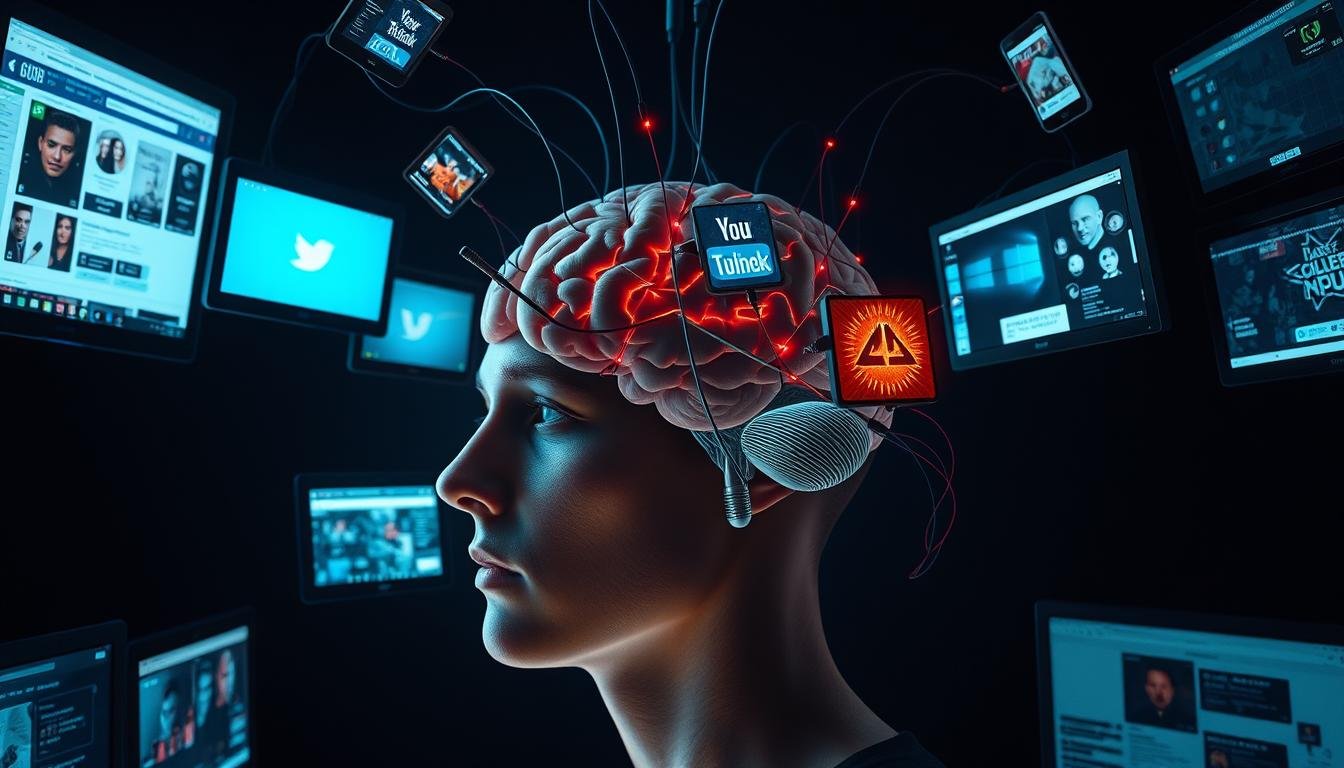
Have you ever felt like you can’t put down your phone, even when you really want to focus on something else?
The reason isn’t because you’re weak. It’s because of sophisticated psychological engineering. Digital platforms use science to grab your attention. They do this by messing with your brain’s systems. Studies show that every extra hour on devices can increase the chance of getting OCD by 5%.
Americans now spend over four hours a day staring at screens. This isn’t a coincidence. Apps use dopamine-driven feedback mechanisms to keep you hooked.
What looks like screen addiction is actually tech manipulation. These platforms play with your brain’s systems through design. Knowing how they work helps us see it’s not just about personal willpower.
To take back your attention, you need to understand how digital addiction works in your brain. This knowledge helps you spot the tricks and fight back.
Key Takeaways
- Digital platforms use behavioral psychology to deliberately capture and retain human attention through engineered mechanisms
- Each additional hour of screen time correlates with a 5% increased risk of developing obsessive-compulsive disorder
- Average Americans engage with screens for more than four hours daily, indicating widespread technological dependence
- Dopamine-driven feedback loops in applications exploit neurological reward systems to maintain user engagement
- What appears as personal weakness actually represents sophisticated technological manipulation of cognitive processes
- Effective attention reclamation requires understanding the specific psychological mechanisms employed by digital platforms
The Silent Takeover of Your Attention
Your devices have changed from simple tools to machines that grab your attention. They started as basic communication devices but now are computers focused on keeping you on the screen. This change happened slowly, making it hard to notice when it started.
The attention economy works by seeing your focus as a valuable resource. Companies use your attention in seconds, clicks, and engagement to make money. This idea has led to huge industries based on controlling your focus.
Learning about attention economy psychology shows how platforms changed from serving users to controlling them. Early social media showed content in order, letting users choose what to see. But this didn’t keep users engaged, so it was changed.
Now, algorithmic feeds control what you see, changing how you use digital content. These systems analyze your actions to guess what you’ll like most. They use this data to keep you on the platform longer.
This screen-based behavior modification happens without you realizing it. The algorithms learn your habits faster than you do. They find patterns in your behavior and use them to keep you engaged.

The cognitive impact of devices goes beyond how you use them. It changes how society views being always connected. People feel uneasy without their phones, even for a short time.
This change wasn’t random—technology mental manipulation makes you dependent. Platforms create features that make you feel like you’ll miss out if you’re not online. This Fear of Missing Out (FOMO) makes you check your devices constantly.
From being in control to being controlled by technology is a big change. Early digital tools were for your use, but now they shape your behavior. They make thousands of small design choices to keep you engaged.
These small changes might seem harmless, but together they make it hard to focus. Attention manipulation gets better with each update, making it harder to focus on things not online. You now have to fight to pay attention to things not on your screen.
This change was silent because each small update seemed helpful. Features like notifications and autoplay made platforms more engaging. But these “improvements” took away your control over your attention.
Seeing this takeover is the first step to taking back your attention. You can’t resist what you don’t see. Knowing how the attention economy works shows that being distracted is not your fault. It’s the result of smart design to keep your focus.
How Screens Hijack Your Brain: The Neuroscience Behind Digital Addiction
Modern technology uses brain chemistry in ways we never expected. It targets our ancient reward systems, which were meant for survival. These systems can’t tell the difference between real needs and digital tricks.
The dopamine response, once for finding food and friends, now comes from every notification. This hijacking is not a malfunction but a clever design. Engineers study our brains to make screens as addictive as they are.
It’s hard to resist screens because our brains are wired differently from technology. This gap makes it tough to break free, even when we want to. Knowing this helps us understand why we struggle.
The Dopamine Response Mechanism
Dopamine is not just about pleasure but about learning. It marks behaviors as important to repeat. This is key to understanding why screens are so addictive.
When we get rewards on screens, dopamine tells our brain to remember and seek more. This creates a cycle: a cue, a routine, and a reward. Each notification is a cue, and checking is the routine.
Research shows dopamine and screens work together like addictive substances. Brain scans show social media activates the same areas as food and drugs. The reward center lights up with every notification.
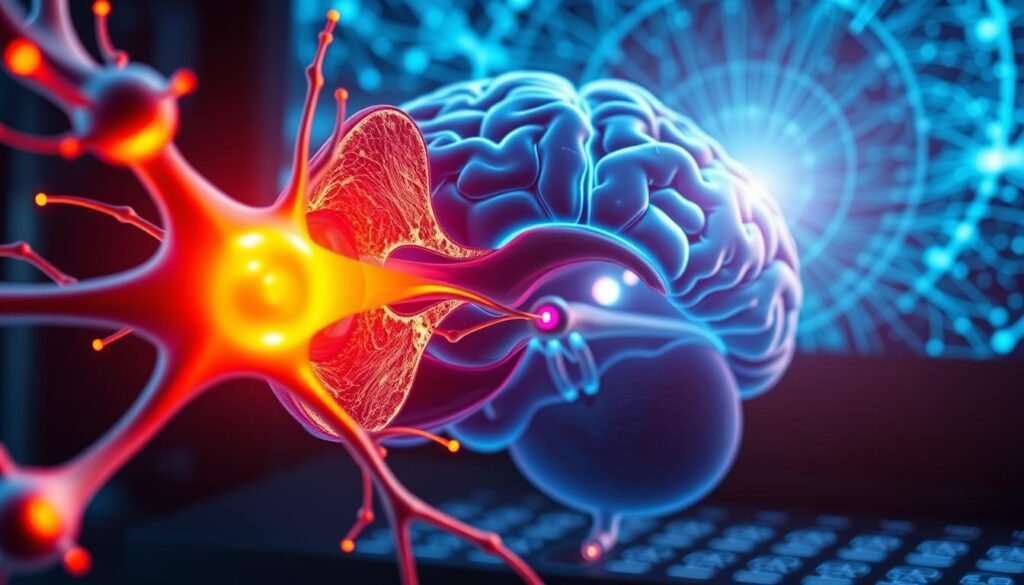
Digital rewards are different because they come often and intensely. Our ancestors got rewards rarely, like after a hunt. Today, screens offer rewards constantly, keeping us hooked.
Social media is extra addictive because it taps into our need for social acceptance. Humans need to belong, and screens offer that in a way that feels real. This makes social media very powerful.
Variable Reward Schedules and Your Brain
Unpredictable rewards make digital addiction worse. This is because our brains respond more to surprises than to regular rewards. This is why slot machines are so addictive.
Platforms use algorithms to make rewards unpredictable. This keeps us scrolling, hoping for something interesting. It’s a way to keep us engaged for a long time.
Uncertainty itself makes us want more. We check screens hoping for a reward, even if we don’t get one. This is why we can’t stop checking.
Studies show screens and dopamine work together like gambling. People addicted to screens and gamblers show similar brain activity. Both show a strong desire for anticipation over actual rewards.
| Reward Source | Delivery Pattern | Dopamine Response | Addictive Potentia |
|---|---|---|---|
| Natural Social Interaction | Predictable, limited frequency | Moderate, sustained release | Low to moderate |
| Food Acquisition | Variable but effort-dependent | Strong, achievement-linked | Moderate |
| Social Media Notifications | Highly variable, high frequency | Rapid, intermittent spikes | Very high |
| Infinite Scroll Content | Continuous variable rewards | Sustained anticipation state | Extremely high |
| Gaming Achievements | Algorithmically optimized timing | Precisely calibrated bursts | Very high |
The table shows natural rewards require effort and are rare. Digital rewards are easy to get and come often. This is why screens are so addictive.
Designers use psychology to keep us hooked. They make rewards unpredictable to keep us coming back. This is why it’s hard to stop, even when we want to.
Together, dopamine loops, variable rewards, and unpredictability create a powerful trap. Digital platforms are designed to activate our brains in ways that feel irresistible. This is why we can’t always resist the pull of screens.
The Infinite Scroll: Engineering Endless Engagement
Designers make it hard to stop scrolling. They remove natural breaks to keep us engaged. This turns casual browsing into long sessions without us realizing it.
Old media had clear breaks. Books had chapters, TV had episodes, and papers had final pages. These breaks let us pause and decide if we wanted to keep going.
Now, digital platforms don’t have these breaks. The infinite scroll is a design choice that focuses on keeping us engaged. It’s all about making money, not about what’s best for us.
The Psychology Behind Compulsive Scrolling
Scrolling can’t stop because of how it plays with our minds. Digital distraction psychology shows how design tricks us. It uses rewards like funny videos or news to keep us scrolling.
This mix of surprises keeps us hooked. If every scroll was the same, we’d lose interest fast. But the surprises keep us searching for more.
This endless search feels like being in a flow state. But it’s not the good kind. It drains our attention without giving us anything back.
The infinite scroll removes choices that let us stop. Before, we had to click to see more. This small step let us think if we wanted to keep going.
Now, content loads as we scroll. This makes it easy to keep going without thinking. It uses our tendency to keep doing what we’re doing.
This design makes us spend more time on screens. Studies show we stay longer on infinite-scroll sites than on others. This means more money for ads, even if it’s bad for us.
| Media Type | Natural Stopping Points | User Control Level | Engagement Duration |
|---|---|---|---|
| Traditional Books | Chapter endings, physical page turns | Complete user control | Self-determined sessions |
| Television Programs | Episode conclusions, commercial breaks | Scheduled programming boundaries | 30-60 minute segments |
| Paginated Websites | Page limits, manual navigation required | Active continuation choices | Moderate session lengths |
| Infinite Scroll Platforms | None (engineered for endless flow) | Minimal user agency | Extended, often excessive duration |
Automatic Content Queuing and User Agency
The autoplay trap is another design choice that keeps us engaged. Videos start playing automatically. This makes us passive viewers instead of active choosers.
Watching videos requires no effort. But stopping does. We have to find pause buttons or close tabs. This makes it hard to stop.
Autoplay makes us use our phones more. We might watch hours of videos because each one starts the next one. We never get to decide to stop.
Infinite scroll and autoplay together make us spend more time on screens. Platforms make money from our long use, even if it’s not good for us.
This is a big problem in digital distraction science. We need to understand how design affects us. Knowing how we’re being manipulated helps us take back control.
The design of infinite scroll and autoplay shows how technology shapes our behavior. These features are not accidents. They are made to keep us engaged. Recognizing this helps us see the problem and find solutions.
FOMO and the Fear-Driven Digital Cycle
Smartphone addiction comes from design choices that play on our social needs. Fear of Missing Out, or FOMO, is more than just wondering what friends are up to. It’s a tool that tech companies use to keep us hooked and dependent on technology.
Studies show that FOMO is more common in certain groups. People with anxiety or obsessive-compulsive disorder score higher on FOMO scales. This shows how deeply FOMO can affect our mental health.
FOMO leads to more time on social media, which can make us feel tired and stressed. This creates a cycle where anxiety from tech feeds into more anxiety. It’s a vicious loop.
How Social Media Manufactures Urgency
Platforms use design tricks to make us feel like we must act fast. These tricks tap into our ancient survival instincts, making us prioritize digital tasks over real-life ones.
The social media psychological effects come from these urgency tricks. They create a sense of scarcity and urgency that didn’t exist before we had social media.
Here are some ways they do it:
- “Live” indicators make us think content will disappear if we don’t see it now
- “Trending” labels make us think we’ll miss out if we don’t act fast
- Social proof notifications like “47 friends are attending” use peer pressure
- Countdown timers create fake deadlines for us to act
- View counts and real-time metrics make us feel competitive
- Story expiration windows (like 24 hours) make content seem scarce
These tactics play on our need to belong, feel relevant, and access information. What looks like simple design is actually a form of psychological manipulation. The “live” badge makes us feel like we must watch now, while trending indicators make us feel left out if we don’t.
These cues don’t really mean anything important. They just make us think they do because they’re limited in time. A friend’s vacation photo becomes urgent just because it will disappear in 24 hours, even if it’s not actually urgent.
The Notification Anxiety Loop
Notification systems create a cycle that links alerts with social threats or rewards. This conditioning process makes us stressed when we hear alert sounds, even if most alerts are not important.
This conditioning happens through repeated exposure. Alert sounds become linked with missing out or being left behind. At the same time, they’re connected to getting validation or important info. This mix creates strong pressure to check right away.
Notification overload has grown a lot in recent years. What used to be occasional alerts now floods our devices. Each alert gives us a quick dopamine hit, interrupting what we’re doing and demanding our attention.
This anxiety loop feeds on itself. Anxiety about missing info makes us check more. Checking shows most alerts are not important. This makes us anxious about missing something important among the trivial ones. This fear makes us check even more to make sure we don’t miss anything.
The cycle’s power comes from occasional rewards. Sometimes, a notification is really important—a job offer, a relationship development, or a time-sensitive opportunity. These rare meaningful alerts make us keep checking, despite all the trivial interruptions.
This screen time mental health impact shows up in our bodies. Our heart rate goes up at alert sounds. Cortisol levels rise with more alerts. Sleep gets disrupted when we can’t stop thinking about notifications. Our bodies treat digital alerts as real threats, activating stress systems all day long.
The notification anxiety loop plays on our deep fears of social exclusion and missing out on info. What used to protect us in small groups now keeps us glued to our devices through fake urgency and anxiety.
Parasocial Ties: The Illusion of Connection
Today, millions of people feel close to people they’ve never met. These parasocial ties are one-way relationships. People invest a lot of emotional energy into influencers and content creators who can’t respond back.
Platforms make these one-sided bonds feel real. Social media shows the same faces over and over. This makes our brains think we’re friends, even if we’re not.
Parasocial relationships have a big impact on our brains. Studies show we feel real emotions when we watch our favorite creators. It’s like we’re part of their lives, even though we’re not.
One-Sided Relationships That Feel Real
Why do parasocial ties feel real? Creators share personal stories, making us feel close. But we don’t share back, creating a false sense of closeness.
These relationships meet our basic social needs. We get likes and comments, making us feel connected. When creators reply, it feels like a real connection, making us feel even closer.
Video content is great at creating these feelings. Watching videos can feel like talking to someone face-to-face. Our brains think we’re really interacting, even if we’re not.
| Relationship Characteristic | Genuine Reciprocal Bonds | Parasocial Connections | Psychological Consequence |
|---|---|---|---|
| Mutual Recognition | Both parties know and acknowledge each other | Creator unaware of individual follower’s existence | Unmet need for recognition creates chronic dissatisfaction |
| Vulnerability Exchange | Bidirectional sharing of personal information | One-sided exposure to creator’s curated disclosure | False intimacy without authentic connection |
| Support Availability | Mutual assistance during difficulties | Viewer provides emotional investment without receiving support | Resource depletion without reciprocal benefit |
| Time Investment | Dedicated attention to specific individuals | Divided attention across dozens of creators | Shallow engagement preventing deep connection |
These relationships take the place of real connections. They use up time that could be spent on real friendships. This makes us less motivated to make real friends.
The Loneliness Paradox
Research shows more digital connection means more loneliness. Despite being connected to many people, we feel alone. This is the loneliness paradox.
Parasocial connections don’t meet our deep social needs. Humans need a few close friends, not many shallow ones. Digital connections make us feel like we have many friends, but we don’t.
Spending time on screens takes away from time with real people. Every hour watching videos is an hour not spent with someone in person. This makes us feel lonely, even when we’re “connected” online.
The loneliness paradox shows a big difference between connection quantity and connection quality. Digital platforms offer many interactions but they’re not deep. They don’t replace real, meaningful relationships.
This creates a cycle of loneliness and screen time. We turn to screens for comfort, but they make us feel more alone. Breaking this cycle means recognizing the need for real, present connections.
Algorithm Pulls: Your Personalized Addiction Machine
Your feed isn’t random—it’s the result of complex algorithms designed to keep you engaged. Digital platforms use artificial intelligence to curate your content. These algorithm pulls analyze your behavior to predict what you’ll like.
This shift changed how we interact with digital platforms. Instead of seeing posts in order, you get content that triggers strong emotions. This design has neurological effects that go beyond simple habits.
Learning about these systems shows how they create digital addiction. Algorithms don’t just follow your preferences; they shape them. This creates a feedback loop that increases engagement and limits your exposure to new information.
How Platforms Predict Your Next Click
Machine learning models track your behavior with great precision. They look at everything from clicks to how long you hover over content. This builds a detailed profile of your behavior.
These systems predict your actions based on patterns in billions of users. If someone like you engaged with certain content, the algorithm thinks you might too. This tech manipulation psychology works without you realizing it, showing you content that grabs your attention.
Platforms use several techniques to improve their predictions:
- Behavioral pattern recognition: They find micro-behaviors that show your preferences, even if you don’t realize them.
- Emotional response modeling: They focus on content that triggers strong emotions because it keeps you engaged.
- Temporal optimization: They deliver content when you’re most likely to engage, like when you’re bored or stressed.
- Novelty balancing: They mix familiar content with new variations to keep you interested without losing your attention.
The tech neurological effects of this constant prediction affect more than just your immediate actions. Your brain starts to anticipate the rewards these systems offer, leading to compulsive behavior. The algorithm trains your nervous system to seek its output.
Platforms often know your vulnerabilities better than you do. By analyzing millions of interactions, they identify psychological triggers with precision. This allows them to manipulate you in ways that feel like your choice but are actually engineered.
The Echo Chamber Effect
Algorithmic content curation creates filter bubbles that change how we see the world. These systems prioritize content that keeps you engaged over diverse perspectives. This creates an illusion of understanding while limiting your exposure to new ideas.
The neurological impacts of technology in these bubbles go beyond simple confirmation bias. Repeated exposure to content that confirms your beliefs strengthens your neural pathways. At the same time, opposing viewpoints get less attention, making your mind more resistant to new information.
Research shows several effects of algorithmic filtering:
- Increased polarization: Users become more extreme as moderate views disappear from their feeds.
- Reduced critical thinking: Constant validation of your beliefs weakens your ability to question information.
- Misinformation vulnerability: Without exposure to fact-checking or alternative views, false information spreads unchecked.
- Outgroup dehumanization: Limited exposure to opposing views makes it easier to dismiss those with different perspectives.
The personalized addiction machine works in two ways. It manipulates your immediate behavior through dopamine and reshapes your thinking through selective information. This creates a paradox where more information leads to less diversity in your views.
You see more content than ever before, but it’s often a narrow slice of perspective designed to keep you engaged. The neurological impact of screens becomes clear as your worldview narrows despite feeling fully informed.
The filter bubble effect also influences social validation. When your feed reflects similar views, dissenting opinions seem wrong and socially abnormal. This creates strong pressure to conform, making it hard to resist algorithmic manipulation.
Understanding tech manipulation psychology shows how these systems exploit our natural tendencies. We trust information from our social groups and seek confirmation of our beliefs. Algorithms use these traits to create artificial social environments that serve commercial interests, not truth or cognitive health.
The Multitasking Myth: Why Your Brain Can’t Keep Up
Your brain handles information one thing at a time, not all at once. This fact challenges the idea that we can do many things at once, common in today’s digital world. Neuroscience shows that our brains can’t really do complex tasks together. What looks like multitasking is actually quickly switching between tasks, which hurts our performance in all areas.
Digital screens make it hard to focus because they keep asking for our attention. Emails interrupt us while we’re working, and social media tries to get our attention away from important tasks. This makes us think we’re getting a lot done, but the facts tell a different story.
Being around screens a lot changes how our brains work. It makes us get used to quick changes in tasks, making it harder to focus on one thing for a long time.
Task Switching and Cognitive Overload
The part of our brain that helps us focus and make decisions can only handle so much at once. This means true multitasking is not possible. When we switch tasks, our brain has to clear out old information and load up new one, using up time and brain power.
Switching tasks often leads to mistakes and lost information. Thoughts from the old task don’t just disappear when we switch. They leave behind what researchers call attention residue, which gets in the way of doing the new task well.
Trying to keep up with many digital sources at once leads to cognitive overload. This includes emails, messages, social media, and more, all competing for our attention. This means we can’t give our full focus to any one task, leading to poor performance.
Smartphones affect our brains even when we’re not actively using them. Studies show that just having a phone nearby reduces our brain’s ability to focus. Our brain is always working to ignore the phone, which drains our mental energy.
Switching between tasks costs a lot, both mentally and physically. Studies show we make more mistakes, understand less, and solve problems less creatively when we’re switching tasks. This leaves us feeling tired and accomplishing less than we could if we focused on one thing.
The Productivity Illusion
Many people feel like they’re getting a lot done by quickly switching between tasks. But this feeling is often wrong. It’s easy to get caught up in the feeling of being busy, but it doesn’t always mean we’re actually accomplishing something.
Research shows that this way of working leads to worse results. Our work quality goes down, we make more mistakes, and we’re less creative. This is because we can’t focus deeply on one thing when we’re constantly switching.
Smartphones make it seem like we’re getting a lot done, but we’re not. Each time we switch tasks, it takes time and effort to get back into the swing of things. This means we’re actually spending more time on tasks than if we just focused on one thing.
Work environments that are heavy on screens make it hard to think deeply. With emails, messages, and browser tabs open, it’s hard to focus on complex tasks. But these distractions also make us feel like we’re getting a lot done, which keeps us in this cycle.
This pattern is concerning. People are busy but not productive, spending hours on screens without making quality work. The effects of using devices all the time are hidden, but they’re hurting our performance in ways we don’t even notice.
To break this cycle, we need to understand how our brains work best. They do their best when we focus on one thing at a time, not trying to do many things at once. Recognizing this is the first step to taking back our mental energy from the multitasking myth that screens promote.
Alert Fatigue: Death by a Thousand Notifications
Digital notifications have changed from helpful reminders to constant interruptions. They fragment human attention. What started as occasional alerts for important messages now floods us with news, social media, app promotions, and status updates.
Each notification, like a news alert or a “someone liked your post” message, hijacks our attention. This constant distraction depletes our ability to focus and manage stress. It’s a challenge to stay focused with devices designed to grab our attention all day.
Alert fatigue affects our brains and bodies. It’s not just a distraction but a real decrease in cognitive performance and stress resilience. Users face a big challenge: keeping their focus and mental balance in a world of constant interruptions.
Understanding alert fatigue means looking at its immediate effects on our brains and its long-term effects on our bodies. The impact of smartphones goes beyond distraction. It changes how our brains handle attention and stress.
The Constant Interruption Effect
Every notification interrupts us, even if we try not to check our devices. Research shows that even brief interruptions can hurt our performance on complex tasks. Our brains have to pause, acknowledge the interruption, decide if we’ll respond, and then get back to what we were doing.
This process is more expensive than we think. Studies say it takes an average of 23 minutes to get back to focus after an interruption. With notifications coming in every few minutes, deep focus becomes impossible. This constant connectivity prevents us from focusing on complex tasks.
Even when we’re not getting notifications, the fear of them coming can distract us. This is called vigilance splitting. Our brains are always scanning for alerts, which takes away from our focus on the task at hand.
Managing alert streams also adds to our mental load. Each notification requires a decision: respond now, later, or ignore it. These small decisions add up and drain our mental energy. By evening, we’re exhausted from dealing with our devices.
These interruptions change how our brains work. They make us expect to switch tasks often, which hurts our ability to concentrate. This is a worrying sign of tech-induced anxiety, where our brains are always ready for the next interruption.
Stress Hormones and Digital Alerts
Notifications also trigger a stress response in our bodies. The sudden sound or vibration activates our threat-detection system. While this is good for real threats, it’s bad for the constant alerts we get from our devices.
Each alert makes our body release stress hormones like cortisol. This is okay in small amounts but becomes a problem when it happens many times a day. It keeps our stress levels high, which can harm our health.
The long-term effects of this stress include weakened immune systems, bad sleep, and higher risks of anxiety and depression. Research shows that getting a lot of notifications can raise our cortisol levels and blood pressure. It affects our whole body, not just our minds.
Devices have become a source of stress, not just tools. They keep us in a state of constant alertness, which is bad for our mental and physical health. We’re always in a state of emergency, which stops our brains and bodies from recovering.
| Notification Type | Average Daily Frequency | Cognitive Impact | Stress Response |
|---|---|---|---|
| Social Media Updates | 35-45 alerts | Working memory disruption, attention fragmentation | Moderate cortisol elevation, social comparison anxiety |
| News and Media Alerts | 20-30 alerts | Context switching, vigilance priming | High cortisol spike, threat detection activation |
| App Promotions | 15-25 alerts | Decision fatigue, cognitive load increase | Mild stress response, irritation accumulation |
| Messaging Notifications | 25-35 alerts | Task interruption, attention reallocation | Social obligation stress, response pressure |
This detailed look at alert fatigue shows how technology manipulates our brains and bodies. The constant alerts from our devices don’t just compete for our attention. They actively harm our ability to focus and manage stress. Understanding this is the first step to finding ways to take back control over our attention and stress levels.
Blue Light and Your Brain’s Internal Clock
Modern screens emit a specific wavelength of light that your brain sees as a wake-up call. This blue light doesn’t just light up your screen. It talks directly to your brain’s ancient timing systems.
LED screens mimic midday sunlight, causing your brain to think it’s daytime even when it’s not. This messes with your body’s natural evening rhythm.
Special cells in your retina detect this blue light, even when you’re not looking at it. These cells have melanopsin, a special pigment that reacts to the light from screens. When this happens, it sends signals to your brain’s master clock.
The health effects of screens go beyond eye strain and tiredness. They change how your body works, affecting sleep, hormone release, and repair. This shows why screens at night can have big effects on your body.
Melatonin Suppression and Sleep Disruption
Your pineal gland makes melatonin as it gets dark, helping you sleep. This chemical tells your body it’s night. Blue light exposure in the evening stops this signal.
Using tablets before bed can lower melatonin by 23 percent. This makes it harder to fall asleep and reduces sleep quality. Screen time close to bedtime is the worst.
Evening use of light-emitting devices negatively affects sleep, circadian timing, and next-morning alertness.
Chronic melatonin suppression has big effects over time. It hurts how well your brain stores information and affects your mood. Sleep is key for emotional balance.
Good sleep boosts your immune system. It helps fight off infections and heal wounds. Screen time brain effects can weaken your immune system, making you more likely to get sick.
The link between screen time and mental health is strong. Lack of sleep can lead to depression and anxiety. It messes with your brain’s chemicals and stress levels.
Circadian Rhythm Interference
Your body has a natural rhythm that controls many processes, not just sleep. Body temperature and digestive enzymes work on a 24-hour cycle. Hormones like cortisol and testosterone also follow a schedule.
Evening blue light messes with these rhythms. It tells your body it’s daytime when it’s actually night. This causes problems with your body’s timing.
The neurological impact of screens shows up in many ways. It can affect how you metabolize food and increase the risk of weight gain. Eating at the wrong time can change how your body uses calories.
Heart health is also affected. Blood pressure naturally drops at night. But screens can disrupt this, putting extra strain on your heart. This can lead to high blood pressure and heart disease.
Cells also have a rhythm for repair and maintenance. Disrupting this can lead to cancer. Studies show that people who don’t follow a natural rhythm are more likely to get cancer.
Understanding screen time effects on your body’s rhythm is eye-opening. Your body evolved to follow natural light cycles. But screens introduce artificial light that your body isn’t ready for. This creates big problems for your health.
Neural Rewiring: How Screens Change Your Brain Structure
The human brain is amazing at changing itself. This is both its greatest strength and weakness in today’s digital world. Every time we use digital tech, our brain changes in a real way. This is called neuroplasticity, the brain’s ability to change its structure and function based on what we experience.
Using screens a lot can make our brains crave quick rewards. This changes how our brain works, making it hard to focus on things that don’t give us instant pleasure. These changes affect how our brain works, including areas for attention, impulse control, and reward.
These screen time brain effects are not just temporary. They change how our brain works, affecting our thoughts, decisions, and who we are. It’s important to understand how digital habits change our brain and the effects on our thinking.
Neuroplasticity and Digital Habits
The rule for neural rewiring is simple: neurons that work together, wire together. Doing the same things over and over makes some brain paths stronger while weakening others. Screen use, with its quick changes and instant rewards, makes our brain better at these things but worse at focusing for long periods.
Studies show that heavy screen users have different brains than those who use screens less. Their brains have less gray matter in areas for planning and controlling impulses. These studies also show changes in how brains respond to rewards, thanks to tech.
The changes happen in many parts of the brain:
- Prefrontal cortex alterations: Less volume and activity in areas for self-control and planning
- Reward system modifications: More sensitivity to digital stuff but less to non-screen rewards
- Attention network reorganization: Better at switching tasks fast but worse at focusing for long
- Memory system impacts: Changes in hippocampal areas for storing and getting information
These changes don’t just take up time; they change how our brain works. They affect our ability to control ourselves, focus, and remember things. These changes last long after we stop using screens.
Attention Span Degradation
One big problem is how our attention span has gotten shorter. Studies show that as we use screens more, our attention span gets shorter. Heavy social media users are the worst at focusing without distractions.
This is because our brains adapt to always having something new and exciting. We become good at switching tasks fast but bad at focusing for a long time. This means we trade deep thinking for quick information.
The effects show up in many ways:
- Harder to focus on one thing for more than a few minutes
- Easier to get distracted by things around us
- Less able to handle content that needs deep thinking
- Worse at deep reading and complex thinking
People who use social media a lot do worse on tasks that need focus. This is true, even in controlled studies. Young people, who grew up with screens, are most affected. This raises questions about how screens change our brains over time.
This is not just about being distracted. It’s about how screens change our brains in ways that affect society. When our brains adapt to always want new things, we struggle with deep thinking. This makes it hard for us to solve big problems.
These changes affect us as individuals and as a society. Our brains, changed by constant stimulation, struggle with the hard work needed to master anything. As a group, we face big challenges because we can’t focus, plan, or handle complex things well. These are the skills we need to solve today’s problems.
The Mental Health Toll of Screen Dependency
Screen dependency changes our mental health in big ways. It affects our emotional and thinking abilities over time. These changes are hard to reverse without help.
Studies show a strong link between screen use and mental health issues. Long-term studies show that screen time can lead to mood and thinking problems. This affects how we live our daily lives.
Watching too much news can stress us out a lot. Almost 17% of people who watch too much news feel more stressed and have poorer health. This constant worry can harm our brain’s ability to make decisions and control impulses.
Anxiety and Depression Correlations
Research links screen addiction to mood disorders. Studies show that more social media use leads to more depression and anxiety. This is true even when other factors are considered.
Experiments show that cutting down on social media improves our mood and feelings of loneliness. About 74% of those who watch too much news have mental health issues, compared to 8% who don’t.
There are many reasons why screen use is linked to mental health problems. Social comparison effects make us feel bad about ourselves. Not enough face-to-face time makes us feel lonely and disconnected.
Watching negative news in the morning can make us feel worse later. This shows how social media psychological effects last long after we stop using it. Poor sleep from screen time also makes us more likely to feel depressed.
Stress from too much information and constant distractions can make us anxious. This anxiety stays even when we’re not using screens. This mix of stress, loneliness, and poor sleep increases the risk of mood disorders.
Cognitive Consequences of Chronic Screen Use
Technology addiction hurts our thinking skills too. People who use screens a lot have trouble focusing and understanding deep reading. Digital tasks make us good at quick, shallow thinking, not deep analysis.
Distractions and poor sleep from screens hurt our memory. We think we learn from quick scrolling, but we don’t really remember it. This screen time mental health link affects our school and work performance.
Less time for daydreaming means we’re less creative. Our brain needs breaks to make new connections and solve problems. Constant screen use takes away these important mental breaks.
Not being able to handle uncomfortable feelings is another problem. Screens let us escape bad feelings quickly. This stops us from learning to deal with them in a healthy way.
These thinking problems make us use screens more as a way to cope. This cycle worsens our mental health and thinking skills. It’s hard to break this cycle, but it’s important to try.
Knowing how screens affect us is the first step to change. Screen dependency costs us in many ways, affecting how we feel and think.
Recognizing Your Screen Addiction Patterns
Screen addiction is a spectrum of behaviors. It can be measured by specific criteria and warning signs. Understanding your place on this spectrum requires looking at your daily digital habits closely.
Most people underestimate their screen time by 40-50%. This is because much of our digital interaction happens automatically. People with OCD are more affected by social media, showing how psychological patterns can increase addiction.
To identify problematic screen use, look at physical health, emotional regulation, and social interaction. These areas give a clear picture of whether you’re addicted to screens.
Self-Assessment: Are You Addicted?
To see if you’re addicted, use diagnostic criteria from mental health professionals. These criteria help you see if you’re addicted objectively. If you meet several criteria, you might need to pay attention to your screen use.
Being preoccupied with screens when not using them is a sign. Do you think about social media or gaming when you’re not online? This shows screens are taking up your thoughts even when you’re not using them.
Trying to cut down on screen time but failing is another sign. Have you set limits but can’t stick to them? Many people check their phones “just in case” they miss something important.
Using screens to avoid negative feelings is a big warning sign. Do you reach for your phone when you’re bored, anxious, or stressed? This shows you’re relying too much on technology to feel better.
Using screens a lot even though you know it’s bad is a sign of addiction. Maybe you know scrolling at night messes up your sleep, but you keep doing it. This is like substance addiction.
Feeling anxious or upset when you can’t use your device is another sign. Do you get upset when your phone battery dies or you can’t use it during meetings? This shows you’re really dependent on your phone.
Letting screens get in the way of important things is a serious sign. Has anyone worried about how much you’re on your phone? Have you missed deadlines or ignored important activities because of your phone?
Common Behavioral Red Flags
There are specific behaviors that show you might have a problem with screens. These signs are in your physical health, how you feel, and how you interact with others. Spotting these signs in yourself is the first step to getting help.
Some common signs include checking notifications a lot, scrolling through the same things over and over, or avoiding certain content. These actions are like habits that you can’t stop.
Physical Signs of Screen Dependency
Your body can tell you if you’re spending too much time on screens. Eye strain, headaches, and trouble sleeping are all signs. These problems come from staring at screens for too long.
Having trouble sleeping is a big sign. Do you have trouble falling asleep or wake up a lot during the night? This is because screens can mess up your sleep patterns.
Pain in your neck, shoulders, and back is another sign. This comes from holding your phone or computer in a bad position for too long. It can even hurt your body over time.
Not moving as much and getting less fit is also a sign. Spending too much time sitting in front of screens means you’re not moving enough. This can hurt your health in many ways.
Emotional and Social Warning Signs
Feeling anxious or upset when you can’t use your device is a sign. Do you get really upset when you can’t check your phone? This shows you’re too dependent on it.
Feeling bad when you can’t use your phone is another sign. Do you get angry or upset when someone talks to you while you’re scrolling? This shows you’re addicted to screens.
Not wanting to do things you used to enjoy is a big sign. Have you stopped doing things you loved because of your phone? This means you’re spending too much time on screens.
Using screens to feel better is a sign. Do you check your phone when you’re feeling down? This means you’re not learning to handle your feelings in a healthy way.
Feeling guilty or defensive about your screen use is a sign. Do you hide how much time you spend on your phone or get mad when someone comments on it? This shows you know something is wrong but don’t want to face it.
Tracking Your Screen Time Honestly
Measuring your screen time accurately is the first step to getting better. Most people don’t realize how much time they spend on screens. Knowing the truth is the first step to changing.
Devices like iOS and Android have built-in tools to track your screen time. They show how much time you spend on different apps and when. Apps like RescueTime or Moment can give you even more details.
To get accurate data, track your screen time for at least a week. Two weeks is even better to see patterns. This helps you understand your habits better.
Knowing when and why you use your phone the most helps you target your problem areas. Do you use your phone a lot during work, at night, or in the morning? Knowing this helps you plan how to change.
The table below helps you assess your screen use honestly:
| Assessment Category | Warning Sign Indicators | Severity Level | Immediate Action Required |
|---|---|---|---|
| Daily Screen Time | 4+ hours non-work usage, 50+ daily pickups | High | Implement strict time limits and app blocking |
| Physical Symptoms | Chronic pain, disrupted sleep, vision problems | Moderate to High | Schedule device-free periods, medical consultation |
| Emotional Dependence | Anxiety when separated, mood regulation through screens | High | Develop alternative coping strategies, consider therapy |
| Social Impact | Declining relationships, isolation, work interference | Critical | Professional intervention, structured detox program |
| Control Attempts | Multiple failed reduction efforts, compulsive checking | Moderate to High | External accountability systems, habit replacement |
This framework helps you understand your screen use better. Recognizing your addiction is the first step to changing. By knowing the truth about your screen use, you can start to make healthier choices.
Breaking Free: Practical Strategies for Digital Detox
Getting control over your attention is more than just willpower. It needs a plan that changes how you interact with digital devices. Digital detox means making changes in your environment, device settings, and how you use technology. These steps help you deal with how screens grab and keep your attention.
Being digital mindful is not about cutting out technology completely. It’s about using it in a smarter way. Studies show that technology dependency does better with small, steady changes, not big, sudden ones. The strategies below help you build healthier digital habits.
Step 1: Set Clear Boundaries and Screen-Free Zones
Starting to change your screen use begins with setting clear rules. These rules help you avoid mindless screen checking. Making your environment less inviting to screens is a key first step.
Create Physical Barriers
Putting your devices out of reach helps you break the habit of reaching for them. Charging your phone in a different room helps you avoid scrolling before bed and in the morning. This simple change helps you start your day better.
Using a special place for your devices during work hours makes it harder to check notifications. Try using a container or drawer that you need to open to get your phone. Some people find time-lock containers helpful for staying focused.
The idea of a No-Phone Zone goes beyond just rooms. It includes places like dinner tables, bedside areas, and bathrooms. Keeping screens away from these places helps you focus on what’s important.
Establish Time Boundaries
Setting times when you can and can’t use technology is just as important as setting physical boundaries. The first and last hour of your day are key times to avoid screens. This helps you sleep better and feel more alert in the morning.
Having set times to check your email, messages, and social media helps you stay focused. Instead of constantly checking, pick a few times a day to do it. This way, you can stay connected without getting distracted.
Setting limits on how much time you spend on devices helps you stay on track. Use built-in features or apps to track your time. This way, you can see how much time you spend and make better choices.
Step 2: Disable Attention-Stealing Features
Modern devices have features that grab your attention. Turning these off helps you stay focused. This step is about changing how devices work to help you stay in control.
Turn Off Non-Essential Notifications
Notifications can interrupt you a lot. Turn off most of them to focus better. This way, you can choose when to check your phone, not when it checks you.
Turning off visual alerts helps you use your devices on your own terms. This change makes you more aware of how much time you spend on screens. It helps you stay productive and feel better.
Remove Infinite Scroll Apps
Apps that keep scrolling can be hard to stop. Uninstalling them helps you avoid getting sucked in. Using web browsers instead of apps adds another layer of control.
Browser extensions that bring back pagination help you control your browsing. This way, you can decide when to stop, not when the app decides for you. It’s a simple change that makes a big difference.
Enable Grayscale Mode
Colorful screens are more tempting than gray ones. Turning your screen to grayscale makes it less appealing. This small change can help you use your devices less.
Using grayscale mode makes scrolling less fun. It helps you stay focused on what’s important. This simple setting can lead to big changes in how you use technology.
Step 3: Replace Digital Habits with Analog Activities
Changing your habits means finding new ways to do things. Instead of using screens, try doing things the old-fashioned way. This helps you find new ways to have fun and connect with others.
Physical Books Instead of Scrolling
Reading books is a great way to use your time. It’s better than scrolling because it keeps your attention. Keep books where you usually reach for your phone.
Reading books is different from scrolling. It’s more satisfying and good for your brain. It’s a better way to spend your time.
Face-to-Face Interactions Over Digital Communication
Talking to people face-to-face is better than texting or messaging. Make plans to meet up with friends and family. This way, you can connect in a real way.
Phone calls are a good middle ground. They let you talk without needing to be in the same place. This way, you can stay connected without getting too caught up in screens.
Outdoor Activities and Exercise
Being outside is good for you. It’s better than staring at screens. It helps you feel better and stay focused.
Make a habit of going outside regularly. It can be a walk in the morning or a workout in the afternoon. It helps you stay away from screens and feel better.
Step 4: Practice Intentional Technology Use
The last step is to use technology on purpose. This means thinking before you use your devices. It helps you use technology in a way that’s good for you.
Set Specific Purposes Before Picking Up Devices
Think about why you’re using your device before you start. Ask yourself what you want to do. This helps you stay focused and avoid getting sidetracked.
Being mindful of why you’re using your device helps you stay on track. It helps you avoid mindless scrolling. This way, you can use technology in a way that’s good for you.
Use App Timers and Website Blockers
Tools like Forest and Freedom help you stay on track. They block certain websites or apps for a set time. This helps you avoid getting sidetracked.
App timers remind you when you’ve reached your limit. This helps you stay aware of how much time you spend on screens. It’s a way to help you stay focused.
Implement the 20-20-20 Rule for Eye Health
The 20-20-20 rule is good for your eyes. It means looking away from screens every 20 minutes. This helps you avoid eye strain and stay focused.
Set reminders to take breaks from screens. This helps you stay focused and avoid getting too caught up. It’s a simple way to take care of your eyes and stay on track.
| Strategy Category | Specific Intervention | Primary Mechanism | Expected Outcome |
|---|---|---|---|
| Physical Boundaries | Bedroom device removal | Spatial separation reduces accessibility during vulnerable periods | Improved sleep quality and morning mental clarity |
| Temporal Boundaries | First/last hour technology-free | Protects critical transition periods from digital interference | Enhanced circadian rhythm regulation and reduced reactivity |
| Feature Modification | Notification elimination | Removes external triggers for reactive engagement | Decreased interruptions and increased sustained attention |
| Analog Substitution | Physical books replace scrolling | Satisfies stimulation needs without manipulation | Improved concentration capacity and reading comprehension |
| Intentional Use | Purpose articulation before device access | Creates conscious decision points interrupting automaticity | Transformation from reactive consumption to purposeful tool use |
These strategies work together to help you use technology better. They help you set boundaries, change how devices work, find new ways to have fun, and use technology on purpose. Start with one thing and make it a habit before moving on to the next.
Changing how you use technology starts with understanding its impact. By making small changes, you can take back control and use technology in a way that’s good for you. It’s about finding a balance that works for you.
Conclusion
Learning how screens control our brains changes how we see screen addiction. It’s not just about personal weakness. It’s about how technology is designed to keep us hooked.
Using screens can change our brains in big ways. It affects how we focus and control our impulses. It also messes with our sleep and can make us feel anxious or depressed.
Knowing how screens work is the first step to change. We can learn to use technology in healthier ways. By setting limits and being more mindful, we can take back control of our attention.
Going on a digital detox doesn’t mean cutting out technology completely. Small steps can make a big difference. They help us stay focused, feel better, and sleep better.
The battle against screen addiction is bigger than just personal. It’s about keeping our minds sharp and our connections real. With the right knowledge and strategies, we can use technology in a way that benefits us, not just the companies that make it.
FAQ
How do screens actually hijack your brain on a neurological level?
What is the dopamine loop and how does it contribute to screen addiction?
Why can’t I stop scrolling even when I want to?
What are variable rewards and why are they so powerful?
How does infinite scroll affect my brain and behavior?
What is FOMO and how do platforms deliberately create it?
What are parasocial ties and why do they feel so real?
How do algorithms predict what I’ll click on next?
What is the echo chamber effect and how does it develop?
Why is multitasking with screens actually impossible for my brain?
What is alert fatigue and how does it damage my cognition?
What is the relationship between social media and parasocial relationships?
How do I track my screen time honestly without self-deception?
What is cognitive overload and how do screens cause it?
How can I practice intentional technology use instead of mindless scrolling?
About the Author


The PsyForU Editorial Collective is the research and editorial team of PsyForU Research International. The collective prepares educational, psychological, mental-health-awareness, inclusion, neurodiversity, and research-methodology content for students, parents, educators, researchers, and general readers. PsyForU content is intended for awareness, education, and capacity-building and should not be treated as clinical diagnosis, therapy, medical advice, legal advice, or emergency mental-health support.