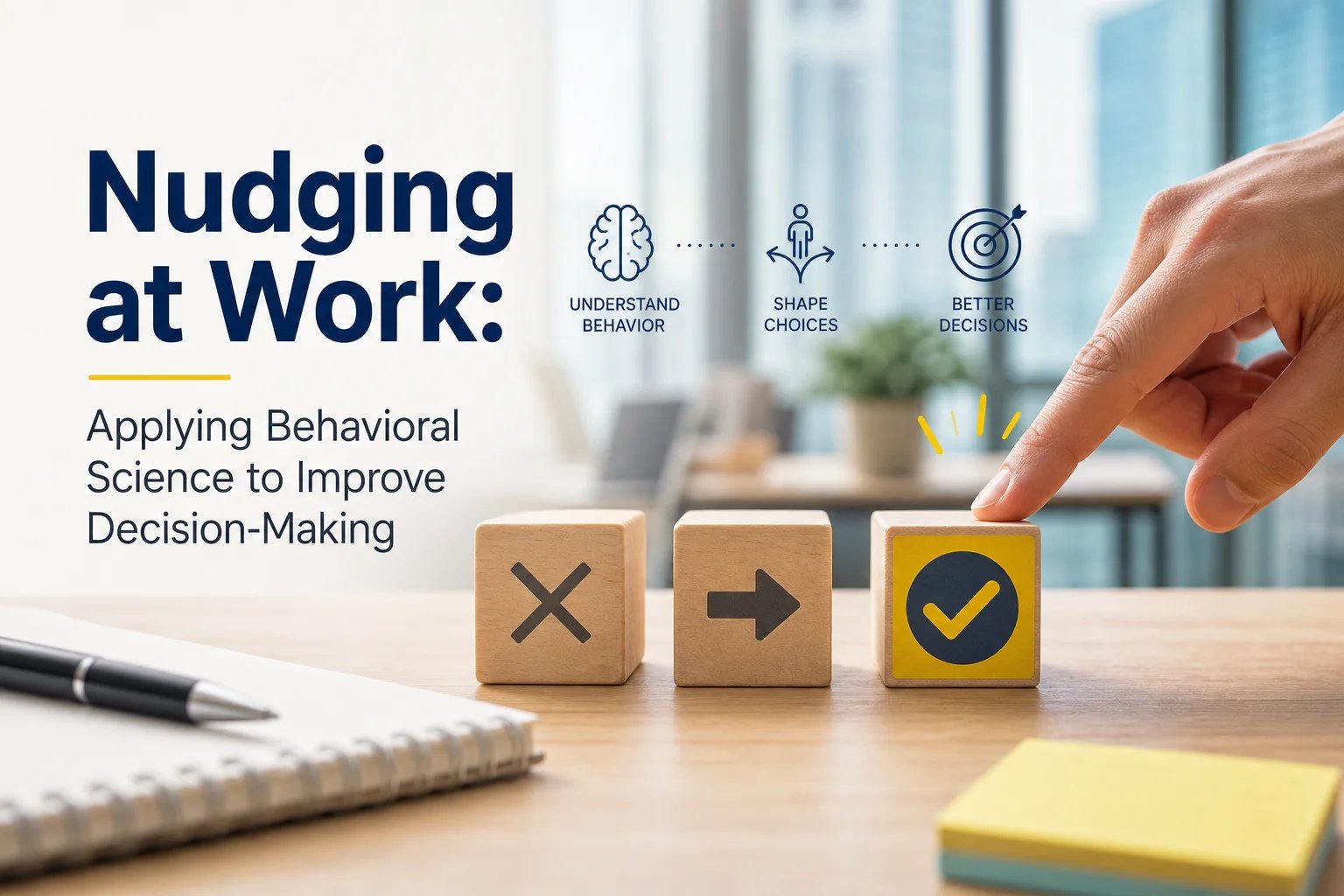
The Ultimate Guide to Nudging at Work: Applying Behavioral Science to Improve Decision-Making
Introduction: The Small Push That Can Change How Work Gets Done
Every workplace runs on decisions.
Some are big and strategic: Should we enter a new market? Should we hire this candidate? Should we restructure a team?
But most are small, repeated, and almost invisible: Do I save for retirement? Do I speak up in this meeting? Do I click the phishing email? Do I take a break before I burn out? Do I choose the healthier lunch? Do I approve this request carefully—or just rush through it?
These everyday choices shape productivity, safety, culture, ethics, innovation, and employee well-being. Yet organizations often try to improve decision-making with more training, more policies, more reminders, and more dashboards. Sometimes that works. Often, it doesn’t.
That’s where Nudging at Work: Applying Behavioral Science to Improve Decision-Making becomes powerful.
A workplace nudge is a thoughtful change in the environment that makes better decisions easier—without forcing people, removing choice, or relying on willpower alone. It might be a default setting, a timely reminder, a redesigned form, a peer comparison, a simplified process, or a prompt that encourages reflection before action.
The beauty of Nudging at Work: Applying Behavioral Science to Improve Decision-Making is that it respects a simple truth: people are not machines. Employees are busy, distracted, emotional, social, overloaded, and influenced by context. Better decision-making is not just about giving people more information. It is about designing better choice environments.
In this in-depth article, we’ll explore how nudging works, why it matters, where it can be applied, and how organizations can use behavioral science ethically to create smarter, healthier, and more human workplaces.
What Is Nudging at Work?
Nudging at Work: Applying Behavioral Science to Improve Decision-Making means using insights from psychology, behavioral economics, and organizational behavior to guide employees toward better choices while preserving their freedom to choose.
A nudge does not punish, mandate, or manipulate. Instead, it changes the “choice architecture”—the way options are presented, timed, framed, or made easier to act on.
For example:
- Automatically enrolling employees into a retirement plan while allowing them to opt out.
- Placing healthier food at eye level in the cafeteria.
- Sending managers a prompt before performance reviews reminding them to check for bias.
- Making secure password practices the default.
- Showing teams how their meeting hours compare with similar teams.
- Asking employees to schedule focus time before their calendars fill up.
These are all examples of workplace nudging—small design changes that can produce meaningful improvements.
The core idea behind Nudging at Work: Applying Behavioral Science to Improve Decision-Making is not that people are irrational. It is that human decision-making is shaped by shortcuts, habits, emotions, social cues, and environmental friction. If the workplace ignores those forces, bad decisions become easier than good ones.
Why Traditional Workplace Interventions Often Fail
Organizations typically respond to poor decisions in predictable ways:
- Send an email.
- Create a policy.
- Hold a training session.
- Add another approval step.
- Tell people to “be more careful.”
These interventions can help, but they often assume employees have unlimited attention, motivation, and self-control. In reality, most people are navigating packed calendars, competing priorities, ambiguous incentives, and constant digital interruptions.
That is why Nudging at Work: Applying Behavioral Science to Improve Decision-Making can be so effective. It works with human nature instead of against it.
Consider cybersecurity. Many organizations train employees not to click suspicious links. Yet phishing still works because people are hurried, curious, trusting, or distracted. A behavioral science approach might add a friction point before opening external links, use clearer warning labels, or provide instant feedback after a simulated phishing test.
The lesson: knowledge is important, but context often determines behavior.
The Behavioral Science Behind Workplace Nudges
To understand Nudging at Work: Applying Behavioral Science to Improve Decision-Making, it helps to understand the biases and mental shortcuts that influence employees every day.
Common Workplace Biases and Nudge Opportunities
| Behavioral Pattern | How It Shows Up at Work | Possible Nudge |
|---|---|---|
| Status quo bias | Employees stick with default settings or old habits | Set beneficial defaults, such as automatic savings enrollment |
| Present bias | People prioritize immediate comfort over long-term benefits | Use timely reminders and short-term incentives |
| Social proof | Employees follow what peers appear to be doing | Share positive team norms or peer benchmarks |
| Choice overload | Too many options lead to delay or poor decisions | Simplify menus, forms, and benefit choices |
| Loss aversion | People fear losses more than they value equivalent gains | Frame messages around what can be protected or avoided |
| Confirmation bias | Managers favor information that supports their existing view | Add structured decision checklists |
| Optimism bias | Teams underestimate time, cost, or risk | Use pre-mortems and planning prompts |
| Inattention | Important actions are missed due to distraction | Use salient, timely, and personalized reminders |
This table shows why behavioral science in workplace decision-making is so practical. It does not require leaders to diagnose employees as lazy or careless. It invites them to ask a better question: “How is the environment shaping the behavior?”
The Difference Between a Nudge and a Mandate
A common concern about Nudging at Work: Applying Behavioral Science to Improve Decision-Making is whether it crosses a line into control. The distinction matters.
A mandate removes choice. A nudge preserves choice.
For example:
- Mandate: “All employees must contribute 5% to retirement.”
Nudge: “Employees are automatically enrolled at 5%, but they can opt out or change the amount.”
- Mandate: “No meetings on Fridays.”
Nudge: “Friday meetings require a stated purpose and agenda before they can be scheduled.”
- Mandate: “Employees must take wellness breaks.”
- Nudge: “Calendars suggest protected break times after long meeting blocks.”
The best nudges make better decisions easier, but not compulsory. Ethical nudging at work helps people act in line with their own goals and the organization’s legitimate interests.
Why Nudging Works Especially Well in the Workplace
The workplace is full of repeated decisions, shared systems, and structured environments. That makes it ideal for behavioral design.
Think about how much employee behavior is shaped by:
- Calendar defaults
- Email notifications
- Form design
- Approval workflows
- Meeting norms
- Manager prompts
- Performance review templates
- Benefit enrollment processes
- Physical office layout
- Digital collaboration tools
Every one of these is already influencing behavior. Nudging at Work: Applying Behavioral Science to Improve Decision-Making simply makes that influence intentional, transparent, and beneficial.
A workplace without nudges does not mean employees are making “free” choices in a neutral environment. It means the nudges are accidental.
Key Principles for Effective Workplace Nudging
Successful Nudging at Work: Applying Behavioral Science to Improve Decision-Making requires more than clever reminders. It requires thoughtful design.
1. Make the Desired Action Easy
Friction is one of the biggest enemies of good decision-making.
If submitting expenses takes 14 steps, employees delay. If reporting a safety concern feels complicated, people stay silent. If changing retirement contributions requires navigating a confusing portal, participation drops.
A strong workplace nudge removes unnecessary effort.
Examples:
- Pre-fill forms where possible.
- Reduce benefit choices into simple tiers.
- Add one-click calendar blocks for focus time.
- Place the most commonly used tools on the first screen.
- Make the secure option the easiest option.
2. Use Defaults Carefully
Defaults are among the most powerful tools in behavioral science at work because many people stick with the preselected option.
Good defaults can improve:
- Retirement savings
- Cybersecurity settings
- Privacy preferences
- Meeting lengths
- Paperless payroll
- Learning plan enrollment
- Healthy food choices
But defaults must be ethical. Employees should understand the default and be able to change it easily.
3. Time the Nudge Well
A reminder sent too early is forgotten. A reminder sent too late is useless.
Effective nudges appear when people are most able to act.
For example:
- A bias reminder should appear before a hiring decision, not after.
- A safety prompt should appear before a risky task.
- A savings reminder should appear during benefits enrollment.
- A meeting prompt should appear when someone creates the invite.
- A cybersecurity warning should appear before opening a suspicious link.
Timing is central to Nudging at Work: Applying Behavioral Science to Improve Decision-Making because behavior depends heavily on context.
4. Use Social Norms Honestly
People are influenced by what others do. That is why social norm messaging can be powerful.
Examples:
- “Most employees in your department completed cybersecurity training this week.”
- “Teams like yours reduced meeting time by 12% last quarter.”
- “82% of employees selected paperless payslips.”
However, social norms must be accurate. If the norm is negative, broadcasting it can backfire. Saying “Many employees are not completing compliance training” may make noncompliance seem normal.
5. Provide Feedback Quickly
People learn faster when feedback is immediate.
Instead of waiting for an annual review, employees benefit from small feedback loops:
- “Your password strength is high.”
- “This meeting has no agenda attached.”
- “Your team has exceeded its weekly meeting target.”
- “This job description may contain gender-coded language.”
- “You are about to approve an invoice outside the usual range.”
Timely feedback supports better decisions without heavy-handed control.
A Practical Nudge Design Framework for Workplaces
Organizations can use the following framework to apply Nudging at Work: Applying Behavioral Science to Improve Decision-Making in a structured way.
Workplace Nudge Design Canvas
| Step | Question to Ask | Example |
|---|---|---|
| Define the decision | What specific choice needs improvement? | Employees are not enrolling in retirement plans |
| Identify the barrier | Why is the better choice not happening? | Procrastination, confusion, too many options |
| Choose a nudge | What design change could help? | Automatic enrollment with opt-out |
| Preserve autonomy | Can employees easily choose differently? | Yes, they can change or decline enrollment |
| Test the intervention | Does the nudge improve outcomes? | Compare participation rates before and after |
| Monitor side effects | Could there be unintended harm? | Employees may contribute less than ideal |
| Refine and scale | What should be adjusted? | Add auto-escalation or personalized contribution prompts |
This disciplined approach keeps nudging at work from becoming random experimentation. It turns behavioral design into a repeatable management capability.
Case Study 1: Retirement Auto-Enrollment and the Power of Defaults
One of the most famous examples of Nudging at Work: Applying Behavioral Science to Improve Decision-Making is automatic enrollment in retirement savings plans.
In many organizations, employees historically had to actively opt in to workplace retirement plans. Even when plans were financially beneficial, participation rates were often disappointingly low. The reason was not necessarily lack of interest. Many employees intended to enroll “later,” but procrastination, paperwork, uncertainty, and competing priorities got in the way.
When companies changed the default so employees were automatically enrolled unless they opted out, participation increased dramatically.
Why It Worked
The nudge addressed several behavioral barriers:
- Status quo bias: People tend to stick with the default.
- Procrastination: Enrollment happened automatically.
- Complexity avoidance: Employees did not need to make an immediate active choice.
- Present bias: The long-term benefit was made easier to begin.
Relevance to Nudging at Work
This case is central to Nudging at Work: Applying Behavioral Science to Improve Decision-Making because it shows how a simple change in choice architecture can improve long-term employee welfare without removing freedom.
Employees could still opt out. But the better long-term choice became the easier path.
Key Lesson
If an organization wants employees to make a beneficial decision, it should examine whether the current process requires too much effort, attention, or confidence.
Case Study 2: Google’s Cafeteria Design and Healthier Choices
Google has often been cited for experimenting with workplace food environments to encourage healthier eating. Instead of simply telling employees to eat better, the company changed how food was presented.
Examples have included placing healthier options more visibly, using smaller plates, making water more accessible, and positioning less healthy snacks in less prominent locations.
This is a practical example of Nudging at Work: Applying Behavioral Science to Improve Decision-Making because it shows that employee wellness is shaped not only by motivation but also by environment.
Why It Worked
Food choices are often fast, habitual, and influenced by visibility. Employees do not always make lunch decisions through careful nutritional analysis. They grab what is easy, attractive, and nearby.
The nudges worked by changing:
- Salience: Healthy options became more noticeable.
- Convenience: Better choices became easier to select.
- Portion norms: Smaller plates subtly reduced overeating.
- Environmental cues: Placement influenced automatic behavior.
Relevance to Nudging at Work
This case demonstrates that applying behavioral science to workplace decision-making can support well-being without lectures or restrictions. Nobody is forced to eat a salad. The environment simply makes healthier choices more natural.
Key Lesson
When decisions are routine and automatic, education alone is rarely enough. Design the environment so the better choice is visible, convenient, and normal.
Case Study 3: Virgin Atlantic and Fuel-Efficient Pilot Behavior
Virgin Atlantic participated in a large behavioral intervention with pilots to improve fuel efficiency. Pilots received different forms of feedback and encouragement about fuel-saving behaviors. Some received performance targets, some received feedback, and some received charitable incentives tied to performance.
The results showed that simple behavioral interventions could improve fuel-efficient actions and reduce costs and emissions.
This is a strong example of Nudging at Work: Applying Behavioral Science to Improve Decision-Making because the employees involved were highly skilled professionals. The point was not that pilots lacked expertise. The point was that feedback, goals, and salience can influence even expert behavior.
Why It Worked
The intervention used:
- Goal setting: Specific targets made desired actions clear.
- Feedback: Pilots saw how they were performing.
- Pro-social motivation: Charitable incentives connected behavior to purpose.
- Attention: Fuel efficiency became more visible in daily decision-making.
Relevance to Nudging at Work
Many leaders assume nudges are only useful for simple employee behaviors. This case shows that workplace behavioral science can improve complex professional decisions too.
Key Lesson
Experts also benefit from timely feedback, clear goals, and meaningful motivation.
Case Study 4: Bias Prompts in Hiring and Performance Reviews
Hiring and performance evaluation are vulnerable to unconscious bias. Managers may unintentionally favor candidates who resemble themselves, overvalue confidence, penalize career gaps, or rely too heavily on first impressions.
A growing number of organizations now use structured nudges in hiring systems and performance review platforms. These may include:
- Reminders to evaluate candidates against job criteria.
- Prompts to consider evidence before ratings.
- Alerts when feedback contains vague language.
- Structured interview scorecards.
- Diverse slate reminders.
- Calibration prompts before final decisions.
This is an important example of Nudging at Work: Applying Behavioral Science to Improve Decision-Making because it applies nudging to fairness, not just efficiency.
Why It Works
Bias often appears when decisions are fast, ambiguous, and unstructured. Nudges help by slowing down the process at key moments and directing attention to objective criteria.
They address:
- Confirmation bias
- Similarity bias
- Halo effect
- Recency bias
- Ambiguity bias
Relevance to Nudging at Work
This case highlights how nudging at work to improve decision-making can support diversity, equity, and inclusion. A small prompt before a rating can change what evidence a manager considers.
Key Lesson
When fairness matters, do not rely only on good intentions. Build structure into the decision environment.
Case Study 5: Hand Hygiene Nudges in Healthcare Workplaces
Hospitals and healthcare organizations have long worked to improve hand hygiene. Traditional approaches include training, posters, compliance rules, and audits. But behavioral science has introduced more targeted nudges.
Examples include:
- Placing sanitizer dispensers directly in the path of movement.
- Using brightly colored visual cues.
- Giving units feedback on compliance rates.
- Displaying peer comparison data.
- Using signs that emphasize patient safety.
This is a practical example of Nudging at Work: Applying Behavioral Science to Improve Decision-Making because it addresses a high-stakes behavior where small actions can save lives.
Why It Works
Healthcare workers are trained professionals, but they are also busy, interrupted, and under pressure. Nudges improve reliability by making the desired action timely, visible, and easy.
Relevance to Nudging at Work
The case shows that behavioral nudges in the workplace can improve safety and quality, especially when employees are operating in complex environments.
Key Lesson
For critical behaviors, put the nudge at the exact point of action.
Where Nudging at Work Can Improve Decision-Making
The applications of Nudging at Work: Applying Behavioral Science to Improve Decision-Making are broad. Here are some of the most valuable areas.
1. Employee Benefits and Financial Well-Being
Benefits decisions are often confusing. Employees may delay enrollment, underinsure themselves, or fail to use valuable resources.
Useful nudges include:
- Default retirement enrollment.
- Simple plan comparisons.
- Personalized contribution projections.
- Reminders before enrollment deadlines.
- Preselected recommended options based on life stage.
- “Save more tomorrow” auto-escalation programs.
These examples of nudging at work help employees make decisions that support long-term security.
2. Health, Wellness, and Burnout Prevention
Wellness programs often struggle because they ask employees to change habits in demanding environments.
Behavioral nudges can help by:
- Suggesting breaks after long meeting blocks.
- Encouraging walking meetings.
- Making mental health resources easier to find.
- Sending recovery prompts after late-night work.
- Placing healthy food and water in visible areas.
- Encouraging managers to model time off.
The best wellness nudges do not shame employees. They reduce friction and normalize recovery.
3. Cybersecurity and Risk Management
Cybersecurity depends heavily on human decisions.
Nudges can include:
- Strong password defaults.
- Just-in-time phishing warnings.
- Visual labels for external emails.
- Confirmation prompts for unusual transfers.
- Short feedback after simulated attacks.
- Secure file-sharing defaults.
This is one of the most urgent uses of Nudging at Work: Applying Behavioral Science to Improve Decision-Making because one rushed click can create major organizational risk.
4. Meetings and Collaboration
Many workplaces suffer from meeting overload. Employees may accept meetings automatically, schedule longer meetings than needed, or invite too many people.
Meeting nudges can include:
- Default meeting length of 25 or 50 minutes.
- Required agenda fields.
- Prompts asking, “Is this meeting necessary?”
- Suggested attendee limits.
- No-meeting focus blocks.
- Team dashboards showing meeting load.
These nudges improve workplace decision-making by helping employees protect attention and time.
5. Inclusion and Psychological Safety
Employees often hesitate to speak up, challenge assumptions, or share dissenting views.
Nudges can encourage inclusion through:
- Rotating meeting facilitators.
- Prompts for managers to invite quieter voices.
- Anonymous idea collection before discussions.
- Structured turn-taking.
- Bias reminders before talent decisions.
- Meeting summaries that attribute ideas fairly.
Here, Nudging at Work: Applying Behavioral Science to Improve Decision-Making becomes a culture-building tool.
6. Learning and Development
Employees often intend to learn new skills but postpone development because urgent work takes over.
Learning nudges can include:
- Calendar-based learning blocks.
- Personalized course recommendations.
- Manager prompts to discuss growth goals.
- Progress reminders.
- Social learning cohorts.
- Default enrollment in role-relevant training.
These nudges help organizations turn learning from aspiration into habit.
The Ethics of Nudging at Work
No serious discussion of Nudging at Work: Applying Behavioral Science to Improve Decision-Making is complete without ethics.
Because nudges influence behavior, they must be designed with care. The goal should be to help employees make better decisions—not to exploit them.
Ethical Workplace Nudging Checklist
| Ethical Question | Why It Matters |
|---|---|
| Is the nudge transparent? | Employees should not feel tricked |
| Does it preserve choice? | Nudging should not become coercion |
| Does it benefit employees, not only the company? | Shared value builds trust |
| Is the data use appropriate? | Privacy must be protected |
| Could it disadvantage any group? | Nudges should be tested for fairness |
| Can employees opt out? | Autonomy is essential |
| Is the intervention evidence-based? | Good intentions are not enough |
Ethical nudging at work requires humility. Leaders should be willing to test, listen, disclose, and revise.
A good rule: if you would be uncomfortable explaining the nudge openly to employees, you probably should not use it.
Common Mistakes Organizations Make With Workplace Nudges
Even well-intentioned organizations can misuse Nudging at Work: Applying Behavioral Science to Improve Decision-Making.
Mistake 1: Using Nudges to Avoid Real Problems
A nudge cannot fix a toxic culture, unfair pay, chronic understaffing, or poor leadership. If employees are burned out because workloads are unreasonable, a mindfulness reminder is not enough.
Nudges work best when they support—not replace—substantive change.
Mistake 2: Overloading Employees With Prompts
Too many reminders become noise. Employees ignore them or become irritated.
A good nudge is timely, relevant, and limited.
Mistake 3: Ignoring Measurement
Organizations sometimes launch nudges because they “feel” smart. But applying behavioral science at work should include testing and evaluation.
Measure outcomes before and after. Compare groups when appropriate. Look for unintended effects.
Mistake 4: Assuming One Nudge Fits Everyone
Different employee groups may face different barriers. A nudge that helps new hires may annoy experienced employees. A financial wellness nudge may need to vary by income level, age, or employment type.
Personalization can improve relevance, but it must respect privacy.
Mistake 5: Confusing Manipulation With Design
Manipulation hides intent. Ethical nudging clarifies options and supports better decisions.
The purpose of Nudging at Work: Applying Behavioral Science to Improve Decision-Making should be to empower employees, not quietly extract more from them.
How to Build a Workplace Nudge Strategy
A strong nudge strategy does not begin with tools. It begins with decisions.
Step 1: Identify High-Impact Decisions
Ask: Which employee decisions have the greatest impact on performance, well-being, risk, or culture?
Examples:
- Choosing whether to report safety concerns.
- Deciding how much to save.
- Approving expenses.
- Hiring candidates.
- Scheduling meetings.
- Taking breaks.
- Sharing knowledge.
- Escalating ethical concerns.
Step 2: Diagnose the Behavioral Barrier
Do not assume the problem is motivation. Ask what is really getting in the way.
Possible barriers include:
- Confusion
- Fear
- Friction
- Forgetfulness
- Social pressure
- Lack of feedback
- Too many choices
- Poor timing
- Unclear norms
This diagnostic step is essential to Nudging at Work: Applying Behavioral Science to Improve Decision-Making.
Step 3: Match the Nudge to the Barrier
| Barrier | Best-Fit Nudge |
|---|---|
| Forgetfulness | Timely reminders |
| Complexity | Simplification |
| Procrastination | Defaults or commitment devices |
| Lack of confidence | Guided recommendations |
| Social uncertainty | Positive norm messages |
| Bias | Structured checklists and prompts |
| Poor timing | Just-in-time cues |
| Low salience | Visual design and framing |
| No feedback | Immediate performance signals |
Step 4: Start Small and Test
Pilot the nudge with one team, department, or workflow. Compare results to a baseline.
Useful metrics include:
- Participation rates
- Completion rates
- Error rates
- Time saved
- Employee satisfaction
- Equity outcomes
- Risk incidents
- Adoption rates
- Behavioral persistence
Step 5: Scale What Works
Once a nudge proves effective, scale it carefully. Continue monitoring outcomes and employee feedback.
The best organizations treat Nudging at Work: Applying Behavioral Science to Improve Decision-Making as an ongoing learning process, not a one-time campaign.
A Simple Workplace Nudge Scorecard
Before launching a nudge, score it across five dimensions.
| Dimension | Question | Score 1–5 |
|---|---|---|
| Impact | Will this improve an important decision? | |
| Ease | Is it simple to implement? | |
| Autonomy | Does it preserve employee choice? | |
| Fairness | Is it unlikely to disadvantage any group? | |
| Measurability | Can we track results clearly? |
A nudge with high impact, high autonomy, and strong measurability is a good candidate for testing.
Examples of High-Value Workplace Nudges
Here are practical examples of Nudging at Work: Applying Behavioral Science to Improve Decision-Making that many organizations can adapt.
Email and Communication Nudges
- Delay-send prompts for late-night emails.
- Warning before sending sensitive information externally.
- “Do you need all recipients?” prompt for large email groups.
- Suggested subject-line clarity scores.
- Reminder to include a decision owner and deadline.
Manager Nudges
- Prompt managers to recognize employees regularly.
- Reminder to hold one-on-one meetings.
- Bias check before performance ratings.
- Suggested coaching questions before feedback conversations.
- Alert when one employee consistently receives less speaking time.
Productivity Nudges
- Default meeting lengths of 25 minutes.
- Focus time auto-blocking.
- Weekly planning prompts.
- “Top three priorities” check-ins.
- Visual work-in-progress limits.
Ethics and Compliance Nudges
- Conflict-of-interest reminders during procurement.
- Confirmation prompts for unusual approvals.
- Speak-up channel visibility at key moments.
- Short scenario-based reminders before high-risk tasks.
Safety Nudges
- Visual cues near hazardous equipment.
- Peer safety norms.
- Pre-task checklists.
- Near-miss reporting made mobile-friendly.
- Immediate feedback after inspections.
Each of these supports workplace decision-making using behavioral science by making the right action easier, more visible, or more timely.
The Role of Leaders in Nudging at Work
Leaders play a crucial role in Nudging at Work: Applying Behavioral Science to Improve Decision-Making. They shape the environment, model norms, approve systems, and decide what gets measured.
A leader who says “take care of your well-being” but sends emails at midnight creates a conflicting choice environment. A leader who asks for diverse opinions but rewards only agreement sends a different signal.
Leadership nudges include:
- Publicly taking vacation.
- Ending meetings early.
- Asking junior employees to speak first.
- Sharing decision criteria before debates.
- Recognizing ethical behavior, not just results.
- Using checklists for major decisions.
- Encouraging pre-mortems before big projects.
The most powerful workplace nudge is often leadership behavior. People watch what leaders do more than what they announce.
Measuring the ROI of Nudging at Work
Organizations should measure the impact of Nudging at Work: Applying Behavioral Science to Improve Decision-Making in both quantitative and qualitative ways.
Potential ROI Metrics
| Area | Metrics to Track |
|---|---|
| Productivity | Meeting hours reduced, cycle time, project completion |
| Well-being | Burnout scores, break usage, vacation uptake |
| Financial wellness | Retirement enrollment, contribution rates |
| Risk | Security incidents, compliance completion, error rates |
| Inclusion | Speaking time distribution, promotion equity, hiring outcomes |
| Learning | Course completion, skill adoption, internal mobility |
| Safety | Near-miss reporting, incident reduction, checklist completion |
The ROI of nudging can be substantial because many interventions are low-cost. A default change, prompt, or form redesign may produce measurable improvements without major infrastructure investment.
But not everything important can be captured immediately. Trust, fairness, and culture may require longer-term tracking.
The Future of Nudging at Work
The future of Nudging at Work: Applying Behavioral Science to Improve Decision-Making will likely be shaped by digital tools, analytics, and personalization.
Workplace platforms already influence behavior through defaults and notifications. As AI and people analytics become more common, organizations will have more opportunities to deliver personalized nudges.
For example:
- A manager may receive a prompt before a difficult conversation.
- An employee may get a suggestion to take recovery time after repeated late-night work.
- A project team may receive a risk prompt when deadlines slip.
- A hiring panel may be alerted if evaluation patterns show inconsistency.
- A knowledge worker may receive a focus-time suggestion based on meeting load.
These possibilities are exciting, but they also raise ethical questions. The more personalized nudges become, the more important transparency, consent, and privacy become.
The future of nudging at work should not be surveillance disguised as support. It should be humane design that helps people do their best work.
Long-Tail Keyword Variations for Contextual SEO
To support the main keyword Nudging at Work: Applying Behavioral Science to Improve Decision-Making, here are useful long-tail variations naturally connected to the topic:
- Nudging at work to improve employee decision-making
- Applying behavioral science in the workplace
- Behavioral science strategies for better workplace decisions
- Workplace nudges for productivity and well-being
- Ethical nudging in organizations
- How to use nudges at work
- Behavioral economics in employee decision-making
- Choice architecture in the workplace
- Workplace behavioral design examples
- Nudging employees toward better decisions
- Behavioral science for HR leaders
- Employee decision-making nudges
- Using nudges to improve workplace culture
- Behavioral nudges for managers
- Workplace nudging case studies
These variations help broaden the SEO footprint while keeping the article natural and reader-friendly.
Conclusion: Small Design Changes, Big Workplace Results
Nudging at Work: Applying Behavioral Science to Improve Decision-Making is not about controlling employees. It is about designing workplaces that help people make better choices with less friction, less confusion, and less reliance on willpower.
The most effective organizations understand that behavior is shaped by context. If the better choice is buried, complicated, delayed, or socially awkward, many people will not choose it—even when they want to. But when the better choice is easy, timely, visible, and aligned with human psychology, decision-making improves.
We have seen how workplace nudges can increase retirement savings, support healthier choices, reduce risk, improve fairness, strengthen safety, and protect focus. The best nudges are ethical, measurable, transparent, and designed around real employee needs.
The takeaway is simple: if you want better decisions at work, do not just ask people to try harder. Build a better decision environment.
Start small. Pick one recurring decision. Remove one barrier. Test one nudge. Measure what happens.
That is the real power of Nudging at Work: Applying Behavioral Science to Improve Decision-Making—small, thoughtful changes that help people become the decision-makers they already want to be.
FAQs About Nudging at Work: Applying Behavioral Science to Improve Decision-Making
1. What does nudging at work mean?
Nudging at work means using behavioral science to design workplace environments that make better decisions easier. Examples include helpful defaults, timely reminders, simplified forms, feedback prompts, and social norm messages. The goal of Nudging at Work: Applying Behavioral Science to Improve Decision-Making is to guide behavior without removing choice.
2. Is workplace nudging manipulative?
It can be if done poorly or secretly. Ethical workplace nudging should be transparent, respectful, and easy to opt out of. A good nudge helps employees make decisions that align with their own interests and the organization’s legitimate goals. Manipulation hides intent; ethical nudging supports informed choice.
3. What are examples of nudges in the workplace?
Examples include automatic retirement enrollment, default 25-minute meetings, cybersecurity warnings before opening suspicious links, bias reminders before performance reviews, healthy food placement in cafeterias, and prompts encouraging managers to recognize employees. These are practical examples of Nudging at Work: Applying Behavioral Science to Improve Decision-Making.
4. How can HR teams use behavioral science at work?
HR teams can use behavioral science to improve hiring, onboarding, benefits enrollment, learning participation, performance reviews, employee well-being, and inclusion. For example, HR can simplify benefit choices, add structured interview scorecards, or send timely prompts before important manager decisions.
5. Do nudges work for remote and hybrid teams?
Yes. Digital workplaces are full of choice architecture. Calendar defaults, notification settings, collaboration tools, meeting templates, and workflow systems all shape behavior. Remote teams can use nudges such as focus-time blocks, agenda requirements, asynchronous communication prompts, and well-being reminders.
6. How do you measure whether a workplace nudge is successful?
Start with a clear behavior and baseline. Then track measurable outcomes such as completion rates, participation, errors, meeting hours, security incidents, savings rates, or employee feedback. The strongest approach is to test the nudge with one group and compare results before scaling.
7. What is the biggest mistake companies make with nudging?
The biggest mistake is using nudges as a substitute for deeper change. A nudge can help employees take breaks, but it cannot fix unrealistic workloads. A bias prompt can improve hiring decisions, but it cannot replace a serious commitment to equity. Nudging at Work: Applying Behavioral Science to Improve Decision-Making works best when paired with real leadership action.
8. Can small nudges really create meaningful workplace change?
Yes. Small nudges can produce large effects when they influence repeated decisions. A default setting, reminder, or redesigned process may affect hundreds or thousands of choices over time. That is why Nudging at Work: Applying Behavioral Science to Improve Decision-Making is so valuable: it turns small design improvements into lasting behavioral impact.
About the Author