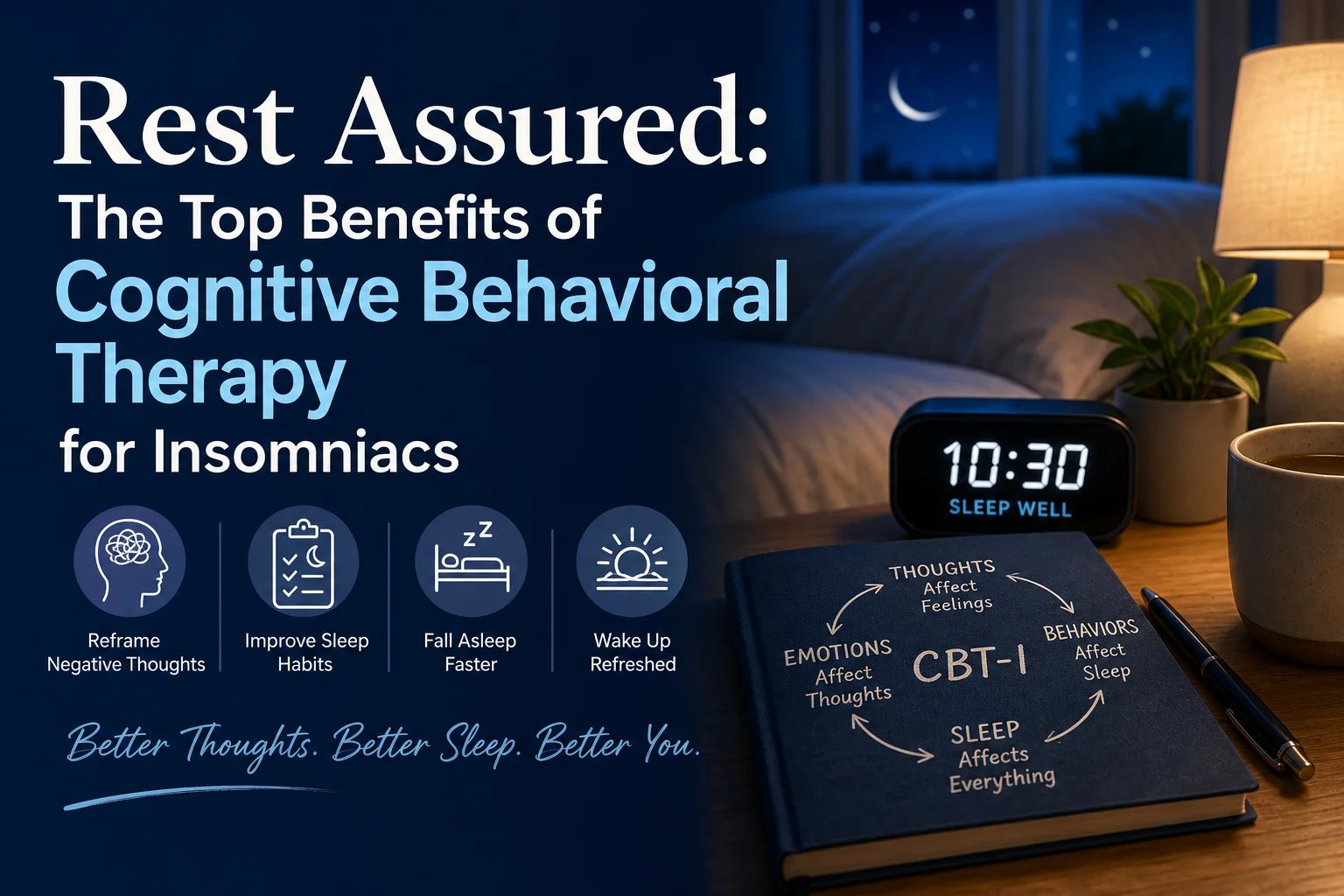
Proven Rest Assured: The Top Benefits of Cognitive Behavioral Therapy for Insomniacs
At 3:17 a.m., the bedroom can feel like a courtroom. The mind presents evidence: You’ll be exhausted tomorrow. You’ll make mistakes. Something is wrong with you. Why can’t you just sleep? The body tightens, the clock glows, and sleep becomes less like a natural rhythm and more like a performance you keep failing.
If that sounds familiar, you are not alone. Insomnia affects millions of people, and for many, it is not simply “having trouble sleeping.” It can become a cycle of worry, frustration, daytime fatigue, and growing fear of bedtime itself.
That is where Rest Assured: The Top Benefits of Cognitive Behavioral Therapy for Insomniacs becomes more than a headline. Cognitive Behavioral Therapy for Insomnia, often called CBT-I, is one of the most evidence-supported treatments for chronic insomnia. Unlike quick fixes that may temporarily sedate the body, CBT-I targets the mental, behavioral, and physiological patterns that keep insomnia alive.
In other words, it does not just ask, “How can we make you sleep tonight?” It asks, “What is training your brain to stay awake—and how can we retrain it?”
This in-depth guide explores Rest Assured: The Top Benefits of Cognitive Behavioral Therapy for Insomniacs, including how CBT-I works, why it is so effective, what real-world results look like, and how insomniacs can use its principles to rebuild trust in sleep.
Understanding Insomnia: Why “Just Relax” Doesn’t Work
Insomnia is often misunderstood. People who sleep well may assume insomnia is caused by too much caffeine, stress, or poor discipline. While those can contribute, chronic insomnia is usually more complex.
Many insomniacs experience a loop:
- A period of poor sleep begins.
- The person worries about not sleeping.
- Bed becomes associated with anxiety and wakefulness.
- The person changes behavior to compensate, such as napping, sleeping in, or spending more time in bed.
- These habits unintentionally weaken the sleep drive.
- Sleep becomes even more difficult.
This is why simple advice—“turn off your phone,” “drink tea,” “try harder to relax”—often falls short.
The core promise of Rest Assured: The Top Benefits of Cognitive Behavioral Therapy for Insomniacs is that insomnia is not a character flaw. It is a learned pattern, and learned patterns can be changed.
CBT-I helps people address insomnia at multiple levels: thoughts, habits, body cues, and sleep timing. That makes cognitive behavioral therapy for insomniacs uniquely powerful.
What Is Cognitive Behavioral Therapy for Insomnia?
Cognitive Behavioral Therapy for Insomnia is a structured, short-term therapy designed specifically for sleep problems. It is usually delivered over four to eight sessions by a trained therapist, sleep specialist, psychologist, or certified CBT-I provider. Digital CBT-I programs are also available and can be effective for many people.
CBT-I typically includes several components:
| CBT-I Component | What It Targets | Why It Matters |
|---|---|---|
| Sleep education | Understanding sleep biology | Reduces fear and confusion |
| Stimulus control | Rebuilding the bed-sleep connection | Makes the bedroom feel safe again |
| Sleep restriction therapy | Strengthening sleep drive | Improves sleep efficiency |
| Cognitive restructuring | Challenging catastrophic thoughts | Lowers nighttime anxiety |
| Relaxation training | Reducing physical arousal | Helps the body shift into rest |
| Sleep hygiene refinement | Adjusting lifestyle factors | Supports long-term sleep health |
| Relapse prevention | Planning for future bad nights | Builds confidence and resilience |
This is why the benefits of CBT-I are so broad. It is not one technique. It is a system.
When people search for Rest Assured: The Top Benefits of Cognitive Behavioral Therapy for Insomniacs, they are often looking for something more durable than another sleep tip. CBT-I offers exactly that: a practical roadmap for changing the patterns that maintain insomnia.
Why CBT-I Is Considered a First-Line Treatment
Major medical and sleep organizations often recommend CBT-I as a first-line treatment for chronic insomnia. This is because it has strong research support and can produce lasting improvements without the dependency risks associated with some sleep medications.
That does not mean medication is never appropriate. For some people, short-term medication may be useful, especially during acute stress, illness, or crisis. But medication usually works by helping induce sleep. CBT-I works by helping the brain and body relearn sleep.
Here is a simplified comparison:
| Feature | CBT-I | Sleep Medication |
|---|---|---|
| Main goal | Retrain sleep patterns | Promote sleep chemically |
| Typical duration | Short-term treatment, long-term skills | Often short-term or ongoing use |
| Dependency risk | None | Possible with some medications |
| Side effects | Temporary fatigue during adjustment | Varies; may include grogginess, tolerance |
| Long-term benefit | Often sustained after treatment | May fade when medication stops |
| Best for | Chronic insomnia patterns | Acute or medically supervised support |
This comparison is central to Rest Assured: The Top Benefits of Cognitive Behavioral Therapy for Insomniacs. CBT-I gives people skills they can keep using long after therapy ends.
Benefit #1: CBT-I Targets the Root Causes of Chronic Insomnia
One of the top benefits of cognitive behavioral therapy for insomniacs is that it looks beneath the symptom.
Insomnia is not only about insufficient sleep. It is often about conditioned arousal. The brain starts to associate bedtime with effort, worry, alertness, or frustration. Over time, the bed becomes a cue for wakefulness rather than sleep.
CBT-I helps reverse this conditioning.
For example, stimulus control therapy may ask a person to:
- Use the bed only for sleep and intimacy.
- Go to bed only when sleepy.
- Leave the bed if unable to sleep after a reasonable period.
- Wake up at the same time every day.
- Avoid long daytime naps.
These steps may sound simple, but they are powerful. They rebuild the association between bed and sleep.
When discussing Rest Assured: The Top Benefits of Cognitive Behavioral Therapy for Insomniacs, this root-cause approach is essential. CBT-I does not merely mask insomnia. It teaches the nervous system to stop treating bedtime as a threat.
Benefit #2: CBT-I Reduces Sleep Anxiety
Many people with insomnia do not fear the dark. They fear the consequences of not sleeping.
Thoughts may include:
- “If I don’t sleep, tomorrow will be ruined.”
- “I’ll never get better.”
- “My body has forgotten how to sleep.”
- “I’m going to lose control.”
- “Everyone else can sleep except me.”
These thoughts activate the stress response. Heart rate increases. Muscles tense. Cortisol may rise. The person becomes more alert—the exact opposite of what sleep requires.
Cognitive restructuring, a key part of CBT-I, helps people identify and challenge these thoughts.
Instead of “I’ll be useless tomorrow,” a CBT-I approach might reframe the thought as:
“I may feel tired tomorrow, but I have handled tired days before. One poor night is uncomfortable, not catastrophic.”
This shift matters. The brain cannot easily sleep while preparing for disaster.
A major reason people embrace Rest Assured: The Top Benefits of Cognitive Behavioral Therapy for Insomniacs is that CBT-I helps remove the fear from wakefulness. When being awake at night no longer feels like an emergency, sleep often returns more naturally.
Benefit #3: CBT-I Improves Sleep Efficiency
Sleep efficiency refers to the percentage of time in bed actually spent asleep.
For example:
| Time in Bed | Time Asleep | Sleep Efficiency |
|---|---|---|
| 8 hours | 5 hours | 62.5% |
| 7 hours | 6 hours | 85.7% |
| 6.5 hours | 6 hours | 92.3% |
Many insomniacs spend extra time in bed hoping to “catch” more sleep. Unfortunately, this can backfire. More time in bed awake teaches the brain that the bed is a place for thinking, worrying, and waiting.
Sleep restriction therapy, one of the most misunderstood parts of CBT-I, temporarily limits time in bed to better match actual sleep time. This increases sleep pressure and improves sleep efficiency.
Despite the name, sleep restriction is not about depriving someone indefinitely. It is about consolidating sleep. As sleep becomes more efficient, time in bed gradually expands.
This is one of the most practical benefits of CBT-I for insomnia: better quality sleep, not just more time under the covers.
In the context of Rest Assured: The Top Benefits of Cognitive Behavioral Therapy for Insomniacs, sleep efficiency is a game changer. People often stop chasing sleep and start building it.
Benefit #4: CBT-I Builds Confidence Without Dependence
Insomnia can make people feel powerless. Many become dependent on rituals, supplements, medications, background noise, or perfect conditions. If one part of the routine fails, panic follows.
CBT-I helps restore confidence by teaching flexible sleep skills.
The goal is not to create a fragile routine that must be performed perfectly. The goal is to help people trust that their body can sleep, even after a rough night.
This is why cognitive behavioral therapy for insomniacs is so empowering. It changes the question from:
“What do I need to take to sleep?”
to:
“What patterns help my sleep system work naturally?”
That sense of agency is one of the most overlooked parts of Rest Assured: The Top Benefits of Cognitive Behavioral Therapy for Insomniacs. CBT-I helps people stop feeling like victims of the night.
Benefit #5: CBT-I Can Reduce Reliance on Sleep Medications
Many people come to CBT-I after months or years of relying on sleep aids. Some are worried about tolerance. Others dislike morning grogginess. Some simply want another option.
CBT-I can help people reduce reliance on medication when done under medical supervision. This is especially important: anyone taking prescribed sleep medication should consult a healthcare professional before changing dosage.
CBT-I does not shame medication use. Instead, it provides tools that may make medication less necessary over time.
Common CBT-I skills that support medication reduction include:
- Consistent wake time
- Bedtime only when sleepy
- Managing anxious thoughts
- Reducing clock-watching
- Strengthening sleep drive
- Developing relapse plans
For readers exploring Rest Assured: The Top Benefits of Cognitive Behavioral Therapy for Insomniacs, this is often one of the most appealing benefits. CBT-I offers a path toward sleeping with less fear and fewer external crutches.
Benefit #6: CBT-I Helps With Coexisting Anxiety and Depression
Insomnia rarely travels alone. It often overlaps with anxiety, depression, chronic stress, trauma, pain, menopause, shift work, or medical conditions.
Poor sleep can worsen mood. Low mood can disrupt sleep. Anxiety can trigger hyperarousal. Hyperarousal can prevent sleep. It becomes a self-reinforcing loop.
CBT-I can help interrupt this loop.
Although CBT-I is not a full treatment for every mental health condition, improving sleep can have meaningful effects on emotional regulation. People often report feeling less reactive, more hopeful, and more capable during the day.
The connection is clear:
| Sleep Improvement | Possible Daytime Benefit |
|---|---|
| Fewer long awakenings | Less frustration and dread |
| Better sleep efficiency | More daytime energy |
| Reduced sleep anxiety | Lower evening tension |
| Consistent wake time | More stable daily rhythm |
| Improved confidence | Less helplessness |
This is another reason Rest Assured: The Top Benefits of Cognitive Behavioral Therapy for Insomniacs matters. Better sleep is not just a nighttime victory. It can change how people experience the entire day.
Benefit #7: CBT-I Is Personalized and Practical
Generic sleep advice can be frustrating because it assumes everyone has the same problem. But insomnia patterns vary.
One person cannot fall asleep. Another wakes at 2 a.m. A third sleeps lightly and checks the clock all night. Someone else sleeps well on weekends but struggles before workdays.
CBT-I begins with assessment. A sleep diary is often used to track:
- Bedtime
- Time to fall asleep
- Number and length of awakenings
- Wake time
- Time out of bed
- Naps
- Caffeine or alcohol use
- Perceived sleep quality
This information helps identify patterns and tailor the plan.
For example, someone who spends nine hours in bed but sleeps only five may need sleep consolidation. Someone with intense bedtime worry may need cognitive restructuring. Someone who works rotating shifts may need circadian rhythm strategies.
That practical personalization is at the heart of Rest Assured: The Top Benefits of Cognitive Behavioral Therapy for Insomniacs. CBT-I meets the person’s actual sleep pattern, not an imaginary ideal.
A Simple CBT-I Sleep Diary Example
| Day | Bedtime | Estimated Sleep Time | Wake Time | Time in Bed | Sleep Quality |
|---|---|---|---|---|---|
| Monday | 10:00 p.m. | 5.5 hrs | 7:00 a.m. | 9 hrs | Poor |
| Tuesday | 11:30 p.m. | 6 hrs | 6:30 a.m. | 7 hrs | Fair |
| Wednesday | 12:00 a.m. | 6.25 hrs | 6:30 a.m. | 6.5 hrs | Good |
| Thursday | 11:45 p.m. | 6 hrs | 6:30 a.m. | 6.75 hrs | Good |
The key insight here is that less time in bed can sometimes produce better sleep quality. That surprises many insomniacs, but it is one of the proven benefits of CBT-I.
Case Study #1: The Executive Who Couldn’t “Turn Off”
Profile: Daniel, 46, senior operations director
Main issue: Difficulty falling asleep due to work-related rumination
Pattern: In bed by 10 p.m., asleep around 1 a.m., checking emails during the night
CBT-I focus: Stimulus control, cognitive restructuring, evening wind-down boundaries
Daniel described himself as “great in a crisis, terrible in bed.” His mind became most active the moment the lights went out. He replayed meetings, anticipated problems, and mentally drafted emails.
His CBT-I provider helped him create a “worry appointment” at 7:30 p.m. During this time, Daniel wrote down unresolved concerns and one next action for each. He also stopped using the bed as a place to review work.
When he could not sleep, he got out of bed and read something neutral in dim light until sleepy. At first, this felt annoying. After two weeks, his sleep onset time dropped from nearly three hours to about 45 minutes. By week six, he was usually asleep within 20 to 30 minutes.
Analysis
Daniel’s case illustrates a core theme in Rest Assured: The Top Benefits of Cognitive Behavioral Therapy for Insomniacs: insomnia often persists because the brain links bed with problem-solving. CBT-I helped Daniel retrain that association. His sleep improved not because work became less stressful, but because bedtime stopped being his office.
Case Study #2: The New Mother With Fragmented Sleep
Profile: Priya, 34, mother of a toddler
Main issue: Frequent awakenings even after her child began sleeping through the night
Pattern: Waking every 90 minutes, scanning for sounds, unable to return to sleep
CBT-I focus: Sleep education, relaxation training, reducing monitoring behavior
Priya’s insomnia began during infancy-related night wakings. Even after her child slept well, Priya’s nervous system stayed on alert. She described sleeping “with one ear open.”
Her CBT-I plan included body-based relaxation, sound boundaries, and reducing safety-checking behaviors. She also practiced reframing wake-ups as normal rather than dangerous.
Instead of thinking, “I’m awake again; this is going to ruin me,” she learned to say, “Brief awakenings are normal. My body knows how to return to sleep.”
After several weeks, her awakenings became shorter and less emotionally charged. She still woke sometimes, but she no longer spiraled.
Analysis
Priya’s story shows why cognitive behavioral therapy for insomniacs is not only about sleep schedules. It also addresses hypervigilance. In Rest Assured: The Top Benefits of Cognitive Behavioral Therapy for Insomniacs, this is a crucial point: the goal is not perfect sleep, but a calmer relationship with sleep.
Case Study #3: The Retiree Spending Too Much Time in Bed
Profile: Elaine, 68, retired teacher
Main issue: Early morning awakenings and low sleep efficiency
Pattern: In bed from 9 p.m. to 7 a.m., sleeping around 5.5 hours
CBT-I focus: Sleep restriction therapy, consistent wake time, daytime activity
Elaine believed she needed ten hours in bed because she was older and tired. But much of that time was spent awake. She watched television in bed, dozed in the afternoon, and became increasingly frustrated by early waking.
Her CBT-I clinician introduced a temporary sleep window from 11:30 p.m. to 6:00 a.m. Elaine was skeptical. The first week was difficult, but by the third week, her sleep became deeper and more consolidated.
Once her sleep efficiency improved, her time in bed was gradually increased.
Analysis
Elaine’s experience highlights one of the top benefits of CBT-I for insomnia: it can correct well-intentioned habits that accidentally worsen sleep. Rest Assured: The Top Benefits of Cognitive Behavioral Therapy for Insomniacs is not about blaming people for insomnia. It is about identifying which behaviors are helping and which are quietly keeping the cycle alive.
Case Study #4: The College Student With Revenge Bedtime Procrastination
Profile: Marcus, 21, university student
Main issue: Delayed sleep schedule and inconsistent wake time
Pattern: Phone use until 2 a.m., sleeping late on weekends, Monday insomnia
CBT-I focus: Circadian consistency, stimulus control, digital boundaries
Marcus did not initially think he had insomnia. He thought he had “no discipline.” But his sleep pattern was chaotic. He would stay up late for personal time, then struggle to wake for classes. On Sundays, he tried to sleep early and failed.
CBT-I helped him shift his wake time gradually and create a realistic wind-down routine. He also moved gaming and scrolling out of bed.
Within a month, his schedule stabilized. He still stayed up late occasionally, but he knew how to reset without panic.
Analysis
Marcus’s case is relevant because modern insomnia is often tied to technology, irregular schedules, and delayed circadian rhythms. A major benefit of cognitive behavioral therapy for insomniacs is that it offers structure without moral judgment.
The CBT-I Process: What to Expect
Many people feel nervous before starting CBT-I. They wonder whether it will be strict, exhausting, or overly clinical.
A typical CBT-I process may look like this:
| Phase | What Happens | Goal |
|---|---|---|
| Assessment | Sleep history, diary, medical review | Understand the pattern |
| Education | Learn how sleep drive and circadian rhythm work | Reduce fear |
| Behavioral changes | Adjust time in bed, wake time, bed use | Recondition sleep |
| Cognitive work | Identify and reframe sleep-related thoughts | Reduce anxiety |
| Skill building | Relaxation, planning, relapse prevention | Build independence |
| Maintenance | Adjust plan as sleep improves | Sustain progress |
The first couple of weeks can be challenging, especially if sleep restriction is involved. Some people feel temporarily more tired. But with professional guidance, the plan is adjusted carefully.
The long-term payoff is why Rest Assured: The Top Benefits of Cognitive Behavioral Therapy for Insomniacs deserves attention. CBT-I may require effort, but it teaches skills that last.
Why CBT-I Works: The Science in Plain English
CBT-I works because it targets three major systems involved in insomnia.
1. Sleep Drive
The longer you are awake, the stronger your biological pressure for sleep becomes. Excessive time in bed, long naps, and irregular wake times can weaken this pressure. CBT-I strengthens it.
2. Circadian Rhythm
Your internal clock influences when you feel alert or sleepy. Consistent wake times, morning light, and stable routines help anchor this rhythm.
3. Hyperarousal
Insomnia is often a state of increased mental and physical alertness. CBT-I reduces hyperarousal by changing thoughts, behaviors, and conditioned responses.
Together, these systems explain why CBT-I is so effective. It works with the body’s sleep mechanisms rather than fighting them.
This scientific foundation is central to Rest Assured: The Top Benefits of Cognitive Behavioral Therapy for Insomniacs. CBT-I is not positive thinking. It is behavioral sleep medicine.
Common Myths About CBT-I
Myth 1: “CBT-I is just sleep hygiene.”
Sleep hygiene is only one small part of CBT-I. CBT-I is more structured and targeted.
Myth 2: “If I restrict my sleep, I’ll get worse.”
Sleep restriction can be temporarily uncomfortable, but it is carefully adjusted. The aim is to consolidate sleep, not deprive you forever.
Myth 3: “CBT-I only works for mild insomnia.”
Research and clinical experience suggest CBT-I can help many people with chronic insomnia, including those with long-standing sleep difficulties.
Myth 4: “I already know my thoughts are irrational, so cognitive therapy won’t help.”
CBT-I is not just about knowing. It is about practicing new responses until the nervous system stops reacting as strongly.
Myth 5: “Bad sleepers are broken.”
This is perhaps the most damaging myth. Insomnia is treatable. The brain can relearn sleep.
The more people understand these myths, the more they can appreciate Rest Assured: The Top Benefits of Cognitive Behavioral Therapy for Insomniacs as a realistic, evidence-based path forward.
CBT-I Techniques You Can Discuss With a Professional
While a full CBT-I plan should be personalized, these techniques are commonly used:
| Technique | How It Helps |
|---|---|
| Fixed wake time | Stabilizes the body clock |
| Bed only for sleep | Rebuilds bed-sleep association |
| Leaving bed when awake | Reduces conditioned frustration |
| Sleep scheduling | Improves sleep efficiency |
| Thought records | Challenges catastrophic predictions |
| Relaxation exercises | Lowers physical tension |
| Morning light exposure | Supports circadian rhythm |
| Relapse planning | Prevents one bad night from becoming a spiral |
These tools are why the benefits of cognitive behavioral therapy for insomniacs extend beyond the therapy room. People learn how to respond skillfully when sleep gets rocky.
How Long Does CBT-I Take to Work?
Many people notice improvements within two to four weeks, though lasting change may take six to eight weeks or longer. Results vary depending on insomnia severity, medical factors, consistency, and whether other conditions are present.
A rough timeline may look like this:
| Timeframe | Possible Experience |
|---|---|
| Week 1 | Tracking sleep, learning principles, initial adjustments |
| Weeks 2–3 | Sleep may feel more consolidated; fatigue may temporarily increase |
| Weeks 4–6 | Falling asleep faster, fewer long awakenings, improved confidence |
| Weeks 7–8+ | Plan refined; relapse prevention strengthened |
The key is consistency. CBT-I is not a trick performed once. It is a retraining process.
For anyone reading Rest Assured: The Top Benefits of Cognitive Behavioral Therapy for Insomniacs, the most important expectation is this: progress is often uneven. A bad night does not mean failure. In CBT-I, bad nights become practice opportunities.
Who Can Benefit From CBT-I?
CBT-I may help people who experience:
- Difficulty falling asleep
- Frequent nighttime awakenings
- Early morning awakenings
- Sleep-related anxiety
- Long-term dependence on elaborate sleep rituals
- Poor sleep efficiency
- Chronic insomnia lasting three months or more
- Insomnia linked to stress, life transitions, or schedule disruption
However, some people need additional medical evaluation. Sleep apnea, restless legs syndrome, medication effects, thyroid issues, pain conditions, and mood disorders can all affect sleep.
CBT-I is powerful, but it should not replace medical assessment when symptoms suggest another sleep disorder.
Signs to discuss with a healthcare professional include:
- Loud snoring or gasping during sleep
- Unusual movements at night
- Severe daytime sleepiness despite adequate time in bed
- Sudden insomnia with major mood changes
- Chest pain, breathing difficulty, or neurological symptoms
- Insomnia related to medication changes
A responsible view of Rest Assured: The Top Benefits of Cognitive Behavioral Therapy for Insomniacs includes knowing when to seek professional support.
The Emotional Benefit: Making Peace With Wakefulness
One of the most profound changes in CBT-I is emotional. People stop treating wakefulness as the enemy.
This does not mean they enjoy being awake at night. It means they no longer add panic to the problem.
A person may learn to think:
“I’m awake right now. That’s uncomfortable, but it’s not dangerous. I know what to do.”
That calm response can prevent a 20-minute awakening from turning into a three-hour battle.
This emotional shift is one of the most share-worthy insights in Rest Assured: The Top Benefits of Cognitive Behavioral Therapy for Insomniacs. Sometimes sleep improves not when we chase it harder, but when we stop fighting wakefulness so fiercely.
CBT-I vs. Popular Sleep Hacks
The internet is full of sleep hacks: magnesium, weighted blankets, mouth taping, blue-light glasses, special teas, white noise machines, and elaborate evening rituals.
Some may help some people. But hacks often fail when insomnia is maintained by conditioned arousal and anxiety.
CBT-I differs because it is systematic.
| Sleep Hack Approach | CBT-I Approach |
|---|---|
| “Try this product.” | “Let’s understand your sleep pattern.” |
| Focuses on comfort | Focuses on conditioning and behavior |
| May help temporarily | Aims for lasting change |
| Often generic | Personalized |
| Can create dependency | Builds confidence |
This distinction matters. The top benefits of CBT-I for insomnia come from changing the sleep system, not decorating the bedroom with more solutions.
Practical Action Steps to Start Today
If you are struggling with insomnia, you do not have to overhaul your entire life tonight. Start with small, evidence-informed steps.
1. Keep a sleep diary for one week
Track when you go to bed, when you wake, and roughly how long you sleep. Do not obsess over precision. Look for patterns.
2. Choose a consistent wake time
A stable wake time is one of the strongest anchors for sleep rhythm.
3. Stop using the bed as a problem-solving zone
If possible, reserve the bed for sleep and intimacy. Move planning, scrolling, worrying, and working elsewhere.
4. Reduce clock-checking
Clock-watching fuels anxiety. Turn the clock away if needed.
5. Get morning light
Morning light helps set your circadian rhythm and supports nighttime sleepiness.
6. Seek a trained CBT-I provider
If insomnia is chronic, professional guidance can make the process safer and more effective.
These steps reflect the core message of Rest Assured: The Top Benefits of Cognitive Behavioral Therapy for Insomniacs: better sleep is built through patterns, not pressure.
Long-Tail Keyword Variations Naturally Related to the Topic
For readers and content planners interested in related search phrases, useful long-tail variations include:
- Benefits of CBT-I for chronic insomnia
- Cognitive behavioral therapy for insomniacs
- CBT-I techniques for better sleep
- How CBT-I helps insomnia naturally
- CBT-I vs sleep medication for insomnia
- Best therapy for chronic insomnia
- Sleep anxiety treatment with CBT-I
- Cognitive behavioral therapy for sleep problems
- Proven insomnia treatment without medication
- Rest assured with CBT-I for insomnia
These phrases all connect naturally to Rest Assured: The Top Benefits of Cognitive Behavioral Therapy for Insomniacs and reflect what many people are searching for when they want lasting sleep help.
Conclusion: Rest Is a Skill You Can Rebuild
Insomnia can make sleep feel mysterious, fragile, and out of reach. But CBT-I offers a hopeful truth: sleep is not something you have to force. It is something you can relearn.
The biggest lessons from Rest Assured: The Top Benefits of Cognitive Behavioral Therapy for Insomniacs are clear. CBT-I addresses the root patterns of insomnia, reduces sleep anxiety, improves sleep efficiency, builds confidence, and can create lasting change without relying solely on medication.
It is not always effortless. The first steps may feel counterintuitive. Getting out of bed when awake, limiting time in bed, or challenging long-held beliefs about sleep can be uncomfortable at first. But these changes are designed to teach the brain a new message:
The bed is safe. Wakefulness is not a crisis. Sleep can return.
If you are an insomniac, you are not broken. You are not weak. Your sleep system may simply be stuck in a pattern that made sense at one time but no longer serves you.
With the right guidance, patience, and practice, you can build a healthier relationship with the night.
Rest assured—better sleep is possible.
FAQs About CBT-I and Insomnia
1. What is CBT-I?
CBT-I stands for Cognitive Behavioral Therapy for Insomnia. It is a structured treatment that helps people change the thoughts and behaviors that keep insomnia going. It is one of the most recommended non-drug treatments for chronic insomnia.
2. How is CBT-I different from regular sleep hygiene?
Sleep hygiene focuses on general habits like reducing caffeine, keeping the room dark, and avoiding screens. CBT-I includes sleep hygiene but goes further by using targeted techniques such as stimulus control, sleep restriction, cognitive restructuring, and relapse prevention.
3. How long does CBT-I take to work?
Many people notice improvement within four to six weeks, though some improve sooner and others need more time. The process depends on the severity of insomnia, consistency with the plan, and any underlying medical or mental health issues.
4. Is CBT-I safe?
CBT-I is generally considered safe for many people, especially when guided by a trained professional. However, sleep restriction can cause temporary daytime sleepiness, so people with certain medical conditions, high-risk jobs, bipolar disorder, seizure disorders, or severe sleepiness should consult a healthcare provider before starting.
5. Can CBT-I help me stop taking sleeping pills?
CBT-I may help reduce reliance on sleep medication, but you should never stop or change prescribed medication without medical supervision. Many people use CBT-I alongside a physician-guided tapering plan.
6. What if CBT-I makes me more tired at first?
That can happen, especially during sleep restriction therapy. Temporary tiredness is often part of the adjustment period. A trained CBT-I provider can modify the plan to balance effectiveness and safety.
7. Does CBT-I work for anxiety-related insomnia?
Yes, CBT-I can be especially helpful for sleep anxiety. It teaches people to challenge catastrophic thoughts, reduce nighttime hyperarousal, and respond more calmly to wakefulness.
8. Can I do CBT-I online?
Yes. Digital CBT-I programs can be effective for many people. However, people with complex medical conditions, severe mental health symptoms, or other suspected sleep disorders may benefit more from working directly with a clinician.
9. Is CBT-I only for people with severe insomnia?
No. CBT-I can help people with mild, moderate, or severe insomnia. It is especially useful when sleep problems have lasted for several months or have become tied to anxiety and unhelpful habits.
10. What is the main takeaway from Rest Assured: The Top Benefits of Cognitive Behavioral Therapy for Insomniacs?
The main takeaway is that insomnia is treatable. CBT-I helps insomniacs retrain sleep patterns, reduce fear around bedtime, improve sleep quality, and build long-term confidence in their ability to rest.
About the Author