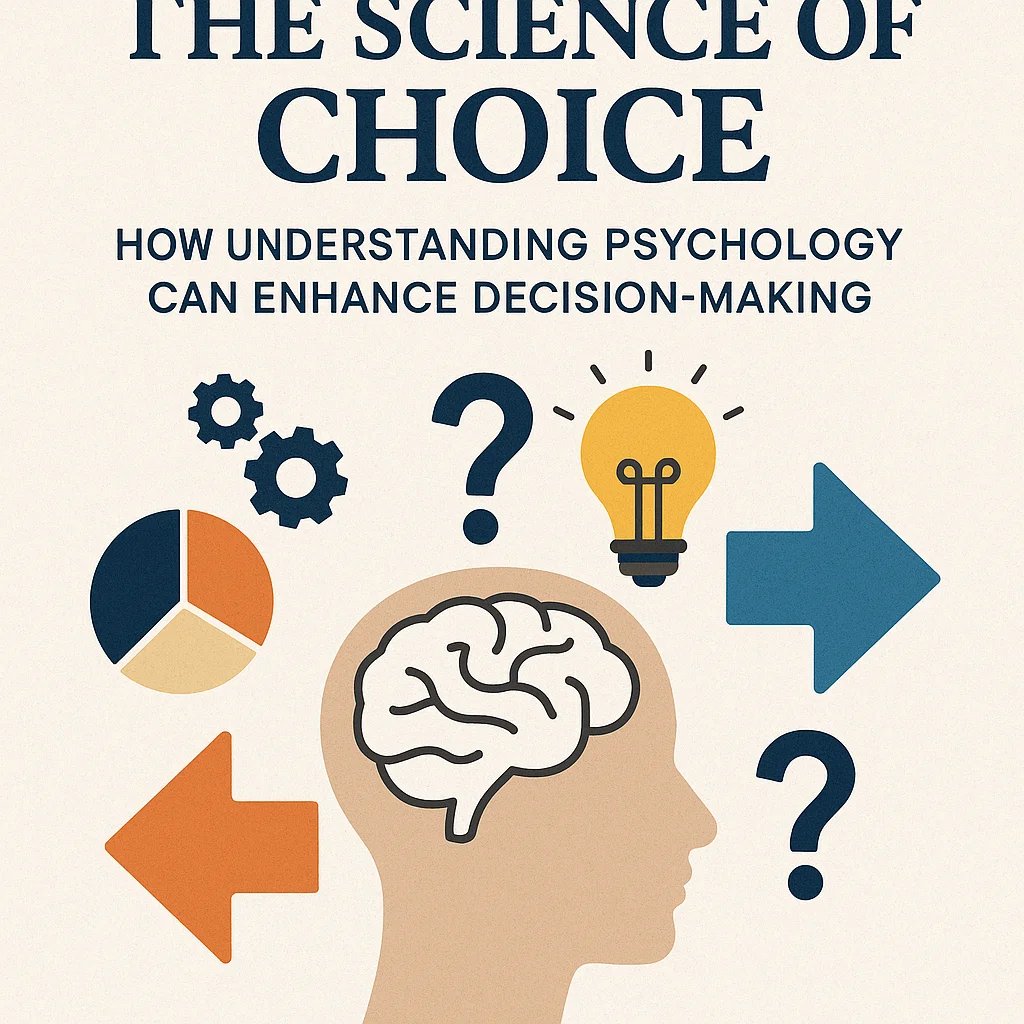
The Ultimate Guide to The Science of Choice: How Understanding Psychology Can Enhance Decision-Making
Every day, you make hundreds—sometimes thousands—of choices. Some are tiny: coffee or tea, reply now or later, take the stairs or the elevator. Others shape the direction of your life: accept the job, end the relationship, launch the business, invest the savings, speak up, stay silent.
Yet here is the uncomfortable truth: we often believe we are making decisions rationally when, in reality, our brains are quietly influenced by emotion, habit, memory, social pressure, timing, framing, fatigue, and hidden biases.
That is why The Science of Choice: How Understanding Psychology Can Enhance Decision-Making matters so much. It gives us a practical way to understand why we choose what we choose—and how to make better choices with more clarity, confidence, and self-awareness.
At its heart, The Science of Choice: How Understanding Psychology Can Enhance Decision-Making is about learning how the mind works under uncertainty. It combines psychology, behavioral economics, neuroscience, and real-world decision strategy to help us choose more wisely in business, health, relationships, money, leadership, and everyday life.
The good news? Better decision-making is not reserved for geniuses, executives, or naturally “rational” people. It is a skill. And like any skill, it can be trained.
What Is The Science of Choice?
The Science of Choice: How Understanding Psychology Can Enhance Decision-Making explores the mental processes behind decisions. It asks questions such as:
- Why do we avoid certain choices even when they are good for us?
- Why do defaults influence behavior so strongly?
- Why do we sometimes choose short-term comfort over long-term success?
- Why do too many options make us anxious instead of free?
- Why do emotions help some decisions but distort others?
- Why do people make different choices when the same information is framed differently?
The science of choice is not about removing emotion and becoming robotic. Instead, it helps us understand the relationship between emotion, logic, context, and behavior.
A better decision is rarely just the result of “thinking harder.” Often, it comes from designing a better decision environment.
Why Decision-Making Is Harder Than We Think
We like to imagine the mind as a clean courtroom where evidence is presented, arguments are weighed, and a wise judge delivers a verdict.
In reality, the mind is often more like a crowded marketplace. Emotions shout. Memories interrupt. Fears negotiate. Habits offer shortcuts. Social expectations whisper. The future is blurry. The present feels urgent.
That is why The Science of Choice: How Understanding Psychology Can Enhance Decision-Making is so valuable: it reveals the hidden forces operating beneath the surface.
Common reasons decisions become difficult
| Challenge | What It Feels Like | Psychological Cause | Example |
|---|---|---|---|
| Too many options | Overwhelm, hesitation | Choice overload | Scrolling endlessly through streaming apps |
| Fear of regret | Avoidance, second-guessing | Anticipated regret | Staying in a safe but unfulfilling job |
| Social pressure | Choosing to fit in | Conformity bias | Buying something because peers recommend it |
| Emotional urgency | Impulsive action | Hot-state decision-making | Sending an angry email immediately |
| Unclear priorities | Confusion | Values conflict | Choosing between salary and meaningful work |
| Past investment | Feeling trapped | Sunk cost fallacy | Continuing a failing project because you already spent money |
Understanding these patterns does not make decision-making effortless, but it makes it more manageable. You begin to notice when your mind is helping you—and when it is misleading you.
The Two Systems Behind Your Choices
One of the most influential ideas in decision psychology is that the mind often works through two broad modes of thinking.
These are commonly described as fast thinking and slow thinking.
| Thinking Mode | Strengths | Weaknesses | Best Used For |
|---|---|---|---|
| Fast thinking | Quick, intuitive, efficient | Prone to bias and emotional reaction | Routine decisions, pattern recognition |
| Slow thinking | Analytical, deliberate, careful | Requires effort and time | Complex, high-stakes decisions |
Fast thinking helps you brake when a car suddenly stops ahead. It helps you read facial expressions, catch a ball, or sense danger.
Slow thinking helps you compare mortgage options, evaluate a job offer, review legal contracts, or diagnose a complicated business problem.
The goal of The Science of Choice: How Understanding Psychology Can Enhance Decision-Making is not to reject intuition. Intuition is powerful when it is built on experience and feedback. The goal is to know when to trust intuition and when to slow down.
When to trust intuition
Intuition is more reliable when:
- You have deep experience in the area.
- The environment gives quick feedback.
- Patterns are consistent.
- The stakes are manageable.
- You are emotionally calm.
A firefighter sensing that a building is unsafe may be using highly trained intuition. A chess master recognizing a strong move may be doing the same.
When to slow down
You should pause and analyze when:
- The decision is unfamiliar.
- The stakes are high.
- You feel emotionally activated.
- You are under social pressure.
- You have incomplete information.
- You notice yourself rushing to confirm what you already believe.
In other words, The Science of Choice: How Understanding Psychology Can Enhance Decision-Making teaches us that wisdom is not always about choosing quickly or slowly. It is about matching the decision process to the situation.
The Psychology of Choice Architecture
Choice architecture is the design of the environment in which people make decisions.
A cafeteria layout, a website checkout page, a retirement enrollment form, a hospital discharge checklist, and a phone notification setting are all forms of choice architecture.
Small design changes can produce large behavioral effects.
For example:
- Putting healthier foods at eye level can increase healthier eating.
- Making retirement savings automatic can increase participation.
- Showing total subscription costs upfront can reduce accidental overspending.
- Reducing form complexity can increase application completion.
This is one of the most practical parts of The Science of Choice: How Understanding Psychology Can Enhance Decision-Making. It shows that better choices do not depend only on willpower. They also depend on systems.
Choice architecture tools
| Tool | How It Works | Example |
|---|---|---|
| Defaults | Preselects an option unless changed | Automatic retirement enrollment |
| Framing | Presents information in a specific way | “90% survival rate” vs. “10% mortality rate” |
| Simplification | Reduces complexity | Shorter forms, clearer pricing |
| Feedback | Shows consequences quickly | Budgeting apps showing spending patterns |
| Commitment devices | Locks in future behavior | Scheduling workouts with a friend |
| Social proof | Shows what others do | “Most customers choose this plan” |
| Timely prompts | Delivers reminders at the right moment | Medication alerts |
Choice architecture can be ethical or manipulative. Ethical choice design helps people act in line with their own goals. Manipulative design pushes people toward outcomes that primarily benefit the designer.
That distinction matters.
Case Study 1: Retirement Savings and the Power of Defaults
One of the most famous real-world examples of decision psychology involves retirement savings.
For years, many companies offered employees the option to enroll in retirement plans. The rational assumption was simple: if saving for retirement is beneficial, employees will sign up.
But many did not.
Not because they disliked retirement security. Not because they had carefully rejected the plan. Many simply procrastinated, felt overwhelmed by forms, or postponed the decision indefinitely.
Then some organizations changed the default. Instead of requiring employees to opt in, they automatically enrolled employees while still allowing them to opt out.
Participation rose dramatically.
Brief analysis
This case is central to The Science of Choice: How Understanding Psychology Can Enhance Decision-Making because it shows that people do not always fail to choose well because they lack motivation. Sometimes they fail because friction, complexity, and inertia get in the way.
Automatic enrollment worked because it aligned the default with the long-term interests of most employees. It reduced the need for immediate effort while preserving freedom of choice.
The lesson: if a beneficial decision is easy to delay, design the environment so the good option is easier to start.
Choice Overload: When More Options Make Us Less Happy
We often assume more choice equals more freedom.
Sometimes it does.
But beyond a certain point, more choice can create stress, confusion, regret, and inaction. This is called choice overload.
Imagine opening a menu with 200 dishes. At first, it seems exciting. Then the questions begin:
What if I choose wrong? What if another option is better? Should I check reviews? What did others order? Why is this taking so long?
The more options you consider, the more opportunity there is for regret.
This is another key insight from The Science of Choice: How Understanding Psychology Can Enhance Decision-Making: freedom is not just the number of options available. It is the ability to choose meaningfully among them.
How choice overload appears in modern life
| Area | Choice Overload Example | Result |
|---|---|---|
| Streaming | Thousands of shows | Endless browsing, little watching |
| Dating apps | Constant profiles | Lower commitment, comparison fatigue |
| Careers | Many possible paths | Anxiety, delayed action |
| Consumer goods | Dozens of similar products | Decision fatigue |
| Productivity tools | Too many apps | Tool switching instead of working |
How to reduce choice overload
Try these strategies:
Set criteria before exploring options.
Decide what matters before you start comparing.
Limit the option set.
Choose from your top three to five options.
Use “good enough” thresholds.
Not every decision needs perfection.
Separate reversible and irreversible decisions.
Spend less time on choices you can easily change.
- Decide when you will decide.
Open-ended decisions create mental clutter.
The science of choice in everyday decision-making often comes down to this: fewer meaningful options beat endless mediocre ones.
Case Study 2: The Jam Experiment and Consumer Choice
A well-known consumer psychology study examined how shoppers responded to different numbers of jam samples. In one condition, shoppers saw a large selection. In another, they saw a smaller selection.
The larger display attracted more attention, but the smaller display led to more purchases.
Although later research has shown that choice overload depends heavily on context, the study remains useful because it illustrates a common experience: more options can increase interest while reducing action.
Brief analysis
This case study supports The Science of Choice: How Understanding Psychology Can Enhance Decision-Making by showing that attention and conversion are not the same thing.
In business, offering more products may attract curiosity, but it may also make the buying decision harder. In personal life, considering every possible path may feel responsible, but it can lead to paralysis.
The lesson: choices should be abundant enough to feel empowering but limited enough to be actionable.
Cognitive Biases: The Invisible Forces Behind Decisions
A cognitive bias is a predictable pattern of distorted thinking.
Biases are not signs of stupidity. They are mental shortcuts. In many situations, shortcuts help us function efficiently. But in complex or high-stakes choices, they can lead us astray.
Understanding bias is one of the most essential parts of The Science of Choice: How Understanding Psychology Can Enhance Decision-Making.
Common cognitive biases and how to counter them
| Bias | What It Means | Decision Risk | Practical Antidote |
|---|---|---|---|
| Confirmation bias | Seeking evidence that supports what you already believe | Ignoring warning signs | Ask: “What would prove me wrong?” |
| Anchoring bias | Overweighting the first number or idea you encounter | Poor negotiation or estimation | Compare multiple reference points |
| Sunk cost fallacy | Continuing because you already invested | Wasting more time or money | Ask: “Would I choose this today?” |
| Availability bias | Judging likelihood by what comes easily to mind | Overestimating dramatic risks | Look for base rates and data |
| Loss aversion | Feeling losses more strongly than gains | Avoiding smart risks | Compare potential loss with long-term upside |
| Status quo bias | Preferring things to stay the same | Missing better opportunities | Calculate the cost of inaction |
| Overconfidence bias | Overestimating your accuracy or skill | Underpreparing | Use forecasts, feedback, and pre-mortems |
Biases become especially dangerous when we do not realize they are operating.
The moment you can name a bias, you gain distance from it. You move from being inside the reaction to observing the reaction. That pause can change the decision.
Emotions Are Not the Enemy of Good Choices
Many people think better decision-making means suppressing emotion.
That is not true.
Emotions provide information. Fear may signal risk. Excitement may signal opportunity. Guilt may reveal a values conflict. Anger may identify a boundary violation. Sadness may show attachment or loss.
The problem is not emotion itself. The problem is making permanent decisions from temporary emotional states.
The Science of Choice: How Understanding Psychology Can Enhance Decision-Making helps us distinguish between emotional data and emotional distortion.
Emotional decision check
Before making an important choice, ask:
- What am I feeling right now?
- Is this emotion connected to the current situation or something older?
- Would I make the same choice tomorrow?
- What would I advise a friend to do?
- What value is this emotion pointing toward?
- Is this a hot-state decision that should be delayed?
A simple rule: never make a major life decision while hungry, exhausted, furious, panicked, or desperate unless immediate safety is involved.
The Role of Values in Better Decision-Making
Good decisions are not just logical. They are aligned.
A decision can look smart on paper and still be wrong for you if it violates your values.
For example, a job may offer higher pay but require constant travel that damages family life. A business deal may be profitable but ethically uncomfortable. A prestigious opportunity may look impressive but drain your health.
The psychology of better choices requires values clarity.
Values-based decision table
| If You Value… | Your Decision Should Prioritize… | Warning Sign |
|---|---|---|
| Freedom | Flexibility, autonomy, optionality | Feeling trapped |
| Security | Stability, predictability, savings | Chronic uncertainty |
| Growth | Learning, challenge, feedback | Comfort becoming stagnation |
| Connection | Relationships, community, presence | Isolation or disconnection |
| Integrity | Honesty, ethical alignment | Rationalizing discomfort |
| Health | Energy, rest, sustainability | Success that causes burnout |
The science of choice and personal decision-making becomes much more powerful when values are explicit. Otherwise, you may optimize for goals you do not truly care about.
Case Study 3: Medical Decisions and Shared Decision-Making
Healthcare provides some of the clearest examples of complex decision-making.
A patient may face several treatment options, each with benefits, risks, costs, side effects, and lifestyle implications. A doctor may understand the medical evidence, but the patient understands their own values, fears, responsibilities, and quality-of-life priorities.
Shared decision-making brings these together.
Instead of a physician simply telling the patient what to do, the clinician explains options clearly, discusses probabilities, answers questions, and helps the patient choose based on both evidence and personal values.
Brief analysis
This case shows why The Science of Choice: How Understanding Psychology Can Enhance Decision-Making is not only about speed or efficiency. It is about fit.
A medically reasonable choice may not be the best choice for every patient. Psychology matters because people interpret risk differently. Some prioritize longevity. Others prioritize comfort, mobility, independence, or avoiding certain side effects.
The lesson: better decisions often emerge when expert knowledge and personal values meet.
Decision Fatigue: Why Timing Changes Your Choices
Your brain uses energy to make decisions.
As the day progresses, repeated choices can reduce mental stamina. This is often called decision fatigue.
When decision fatigue sets in, people tend to:
- Avoid decisions.
- Choose the easiest option.
- Become more impulsive.
- Rely heavily on defaults.
- Show less patience.
- Make inconsistent judgments.
This is why grocery shopping while tired can lead to unhealthy purchases. It is why late-night online browsing can become expensive. It is why important conversations often go badly when both people are exhausted.
The Science of Choice: How Understanding Psychology Can Enhance Decision-Making reminds us that timing is not a minor detail. The same person may make a different decision at 9 a.m. than at 11 p.m.
How to reduce decision fatigue
- Make important decisions earlier in the day.
- Create routines for repeated choices.
- Meal plan or automate simple decisions.
- Use checklists.
- Set spending rules before shopping.
- Avoid major decisions when depleted.
- Sleep before finalizing high-stakes commitments.
A strong decision system protects you from your weakest moments.
The “DECIDE” Framework for Smarter Choices
To turn psychology into action, use a structured framework.
Here is a practical model:
| Step | Meaning | Key Question |
|---|---|---|
| D | Define the decision | What exactly am I deciding? |
| E | Examine the context | What pressures, emotions, and constraints are present? |
| C | Clarify values and criteria | What matters most? |
| I | Identify options | What realistic choices exist? |
| D | Detect biases | What might be distorting my thinking? |
| E | Execute and evaluate | What will I do, and how will I learn from it? |
This framework captures the heart of The Science of Choice: How Understanding Psychology Can Enhance Decision-Making because it turns awareness into a repeatable process.
Let’s break it down.
1. Define the decision
Many bad decisions begin with unclear questions.
Instead of asking, “Should I quit my job?” ask:
- “Should I leave this job within the next six months?”
- “Should I search for a new role while staying employed?”
- “Should I negotiate changes before deciding to leave?”
The quality of your answer depends on the quality of your question.
2. Examine the context
Ask what is influencing you.
Are you tired? Pressured? Afraid? Overexcited? Comparing yourself to others? Reacting to one recent event?
Context shapes choice.
3. Clarify values and criteria
Before comparing options, define what a good outcome means.
For example:
- Income
- Time freedom
- Learning
- Family impact
- Ethical fit
- Health
- Long-term opportunity
Without criteria, you may be seduced by whatever looks best in the moment.
4. Identify options
Avoid false binaries.
Many decisions are framed as “this or that,” but better options may exist.
Instead of:
- Stay or quit.
- Buy or don’t buy.
- Say yes or no.
Consider:
- Delay.
- Test.
- Negotiate.
- Delegate.
- Reduce scope.
- Run a pilot.
- Seek advice.
- Combine options.
5. Detect biases
Ask:
- Am I favoring familiar options?
- Am I avoiding loss more than pursuing gain?
- Am I trying to justify a past investment?
- Am I ignoring evidence that contradicts me?
- Am I choosing to impress others?
6. Execute and evaluate
Once you decide, act.
Then review:
- What happened?
- What did I predict correctly?
- What surprised me?
- What would I do differently?
- What did I learn about myself?
Decision-making improves through feedback.
Case Study 4: Aviation Checklists and High-Stakes Decisions
Aviation is one of the best examples of decision systems saving lives.
Pilots are highly trained professionals, but they still use checklists. Why? Because even experts can forget steps under stress, fatigue, or pressure.
Checklists reduce reliance on memory. They standardize critical actions. They make invisible assumptions visible.
In emergencies, pilots also use structured communication and decision protocols to avoid panic-driven mistakes.
Brief analysis
This case powerfully supports The Science of Choice: How Understanding Psychology Can Enhance Decision-Making because it proves that expertise alone is not enough.
The best decision-makers do not simply “trust their gut.” They build systems that help them perform under pressure.
The lesson: if a decision matters, do not rely only on memory, mood, or confidence. Use a process.
Framing: How Presentation Changes Perception
The way information is presented can change the choice people make.
Consider these two statements:
- “This treatment has a 90% survival rate.”
- “This treatment has a 10% mortality rate.”
The information is mathematically equivalent, but emotionally different.
That is framing.
Framing affects decisions in finance, medicine, politics, marketing, relationships, and leadership. A manager saying, “We failed to hit the target” creates a different response than, “We learned what must change to hit the next target.”
Neither frame should distort reality. But frames guide attention.
Positive and negative framing
| Situation | Negative Frame | Constructive Frame |
|---|---|---|
| Mistake | “This was a failure.” | “This is feedback.” |
| Budget cut | “We are losing resources.” | “We must prioritize what matters most.” |
| Health change | “I can’t eat that anymore.” | “I’m choosing foods that support my energy.” |
| Career transition | “I’m starting over.” | “I’m applying what I’ve learned in a new direction.” |
The science of choice in decision-making psychology shows that people do not respond only to facts. They respond to meaning.
Social Influence: Why Other People Shape Our Decisions
Humans are social beings. We look to others for cues about what is safe, desirable, normal, and valuable.
Social influence can be helpful. Reviews can guide purchases. Mentors can improve career choices. Community norms can encourage healthy behavior.
But social influence can also mislead us.
We may choose careers to impress family, buy things to signal status, stay silent to avoid rejection, or imitate people whose goals are not our own.
The Science of Choice: How Understanding Psychology Can Enhance Decision-Making helps us ask an important question:
“Is this truly my choice, or am I outsourcing my judgment?”
Three forms of social influence
Conformity
Choosing what the group chooses.
Authority influence
Trusting experts or leaders, sometimes too much.
- Social proof
Assuming popularity means quality.
Social information is useful, but it should be filtered through your goals and values.
Case Study 5: Organ Donation Defaults
Organ donation policies vary across countries. In some systems, people must actively opt in to become donors. In others, donation is the default unless people opt out.
Countries with opt-out systems often show much higher donor registration rates.
This does not necessarily mean people in those countries are more generous. It means the default structure changes behavior.
Brief analysis
This case is a classic example of The Science of Choice: How Understanding Psychology Can Enhance Decision-Making in public policy.
The default does not eliminate choice. People can still opt out. But it recognizes that inertia is powerful. Many people accept the preselected path, especially when the decision is complex, emotional, or easy to postpone.
The lesson: ethical defaults can help societies produce outcomes that many citizens already support in principle.
Risk, Uncertainty, and the Fear of Regret
Many important decisions involve uncertainty. You cannot know for sure whether a business will succeed, a relationship will last, an investment will grow, or a move will make you happier.
Because uncertainty is uncomfortable, people often seek impossible guarantees.
But wise decision-making is not about certainty. It is about making the best choice with available information.
Risk vs. uncertainty
| Concept | Meaning | Example |
|---|---|---|
| Risk | Probabilities can be estimated | Insurance pricing |
| Uncertainty | Probabilities are unclear | Launching a new product in a new market |
One of the most useful insights from The Science of Choice: How Understanding Psychology Can Enhance Decision-Making is that regret can be managed but not eliminated.
How to reduce future regret
- Make decisions based on values, not mood.
- Document why you chose what you chose.
- Consider the cost of doing nothing.
- Seek disconfirming evidence.
- Run small experiments when possible.
- Accept that good decisions can have bad outcomes.
That last point is crucial. A good decision is not defined only by its result. Sometimes you can make a thoughtful, well-informed choice and still face an unfavorable outcome because reality is uncertain.
Judge your process, not just your luck.
The Power of Pre-Mortems
A pre-mortem is a decision tool where you imagine that your decision failed, then work backward to identify why.
Instead of asking, “Will this work?” ask:
“Suppose this fails badly six months from now. What likely caused the failure?”
This technique reduces overconfidence and reveals blind spots.
Pre-mortem example
Decision: Launch a new online course.
Possible failure reasons:
- Audience need was not validated.
- Price was too high.
- Marketing started too late.
- Course content was too broad.
- No follow-up support existed.
- The launch depended on one platform.
- Customer objections were not addressed.
Now you can improve the plan before failure happens.
A pre-mortem captures the practical spirit of The Science of Choice: How Understanding Psychology Can Enhance Decision-Making: do not wait for mistakes to teach you if imagination can warn you first.
Business Applications of the Science of Choice
Organizations make choices constantly:
- Which markets to enter
- Which products to build
- Which customers to serve
- Which employees to promote
- Which risks to take
- Which strategies to abandon
Poor decisions can cost millions. Better psychological awareness can improve leadership, marketing, hiring, innovation, and culture.
How businesses can apply decision psychology
| Business Area | Psychological Insight | Practical Application |
|---|---|---|
| Marketing | People respond to framing and simplicity | Clear messaging, fewer plan options |
| Product design | Defaults shape behavior | Ethical onboarding defaults |
| Hiring | Bias affects evaluation | Structured interviews |
| Leadership | Groupthink reduces dissent | Assign a devil’s advocate |
| Strategy | Sunk costs distort judgment | Regular project kill criteria |
| Customer experience | Friction reduces action | Simplified checkout |
| Employee wellness | Decision fatigue harms performance | Reduce unnecessary meetings |
The science of choice in business decision-making is not manipulation when used ethically. It is about helping customers, employees, and leaders make clearer, more beneficial choices.
Case Study 6: Subscription Pricing and the Decoy Effect
Many companies offer three pricing tiers:
- Basic
- Standard
- Premium
Sometimes the middle or premium option is made to look especially attractive by including a third option that is intentionally less appealing. This is known as the decoy effect.
For example:
| Plan | Price | Features |
|---|---|---|
| Basic | $9 | Limited features |
| Pro | $19 | Most features |
| Premium | $20 | Most features plus priority support |
Here, the Pro option may seem less attractive because Premium offers more for only $1 extra. The Premium plan becomes the obvious choice.
Brief analysis
This case illustrates the commercial side of The Science of Choice: How Understanding Psychology Can Enhance Decision-Making.
Context changes perceived value. People rarely evaluate options in isolation. They compare.
For consumers, the lesson is to ask: “Would I still choose this if the other options were not presented this way?”
For businesses, the ethical lesson is to design pricing that clarifies value rather than tricks people into unnecessary purchases.
Personal Finance and the Psychology of Better Choices
Money decisions are deeply psychological.
Spending, saving, investing, debt, and generosity are influenced by emotion, identity, upbringing, fear, social comparison, and future imagination.
Many people know what they “should” do financially. The challenge is behavior.
This is where The Science of Choice: How Understanding Psychology Can Enhance Decision-Making becomes practical.
Better financial choice strategies
Automate savings.
Reduce reliance on willpower.
Use cooling-off periods.
Wait 24–72 hours before large nonessential purchases.
Name your accounts.
“Emergency fund” is more motivating than “Savings 2.”
Track emotional spending triggers.
Notice when boredom, stress, or loneliness leads to spending.
Set default investment rules.
Avoid constant reactive changes.
- Make future self vivid.
Imagine your life in 10, 20, or 30 years.
The more emotionally charged the money decision, the more structure helps.
Relationships and the Science of Choice
Relationship decisions are among the hardest because they combine attachment, identity, emotion, memory, fear, hope, and uncertainty.
Should you forgive? Commit? Leave? Have the conversation? Set the boundary? Move closer? Step back?
In relationships, The Science of Choice: How Understanding Psychology Can Enhance Decision-Making encourages us to slow down and separate reaction from wisdom.
Relationship decision questions
- Am I choosing from fear or love?
- Is this a pattern or a one-time event?
- Have I communicated clearly?
- Am I hoping someone will change without evidence?
- What boundary is needed?
- What would self-respect choose?
- What would compassion choose?
- Can both be true?
Good relationship choices are not always easy, but they become clearer when you identify the needs, values, and patterns beneath the conflict.
The Hidden Role of Identity
People do not choose only based on outcomes. They choose based on identity.
A person who sees themselves as “bad with money” may avoid budgeting. Someone who sees themselves as “not athletic” may resist exercise. A leader who sees themselves as “the person with all the answers” may struggle to ask for input.
Identity shapes what feels possible.
To change decisions, sometimes you must change the story.
Instead of:
- “I’m trying to save money.”
- “I’m trying to exercise.”
- “I’m trying to be more decisive.”
Try:
- “I’m the kind of person who pays myself first.”
- “I’m someone who keeps promises to my body.”
- “I’m a thoughtful decision-maker who acts when the evidence is enough.”
This identity-based approach aligns beautifully with The Science of Choice: How Understanding Psychology Can Enhance Decision-Making because it recognizes that choices are not isolated events. They are expressions of who we believe we are.
A Practical Decision Quality Pyramid
Here is a simple way to visualize better decision-making:
| Level | Focus | Question |
|---|---|---|
| 5 | Learning | What feedback will improve future choices? |
| 4 | Action | What decision will I commit to? |
| 3 | Evaluation | What trade-offs am I willing to accept? |
| 2 | Awareness | What biases or emotions are influencing me? |
| 1 | Clarity | What am I actually deciding? |
Most people jump straight to Level 4: action.
But better decisions usually begin at Level 1: clarity.
The science of choice and decision-making psychology teaches that the best answer is useless if you are answering the wrong question.
How to Make Better Decisions Under Pressure
Pressure narrows attention. It makes the urgent feel more important than the important. It pushes the brain toward familiar patterns.
When pressure rises, use simple tools.
The 10-10-10 method
Ask:
- How will I feel about this in 10 minutes?
- How will I feel in 10 months?
- How will I feel in 10 years?
This creates psychological distance.
The friend test
Ask:
“What would I advise a friend in this exact situation?”
This reduces emotional entanglement.
The reversibility test
Ask:
“Is this decision reversible?”
If yes, decide faster. If no, slow down.
The minimum viable action
Ask:
“What is the smallest step that gives me useful information?”
This turns uncertainty into learning.
These tools are simple, but they are grounded in The Science of Choice: How Understanding Psychology Can Enhance Decision-Making. They help you escape panic, perfectionism, and paralysis.
Ethical Decision-Making: Choosing What Is Right, Not Just What Works
Decision science can be used to persuade, sell, influence, and optimize. That power carries responsibility.
A choice can be effective but unethical. A marketing strategy can increase conversions while exploiting confusion. A workplace policy can increase productivity while damaging well-being. A negotiation tactic can win while destroying trust.
The deepest version of The Science of Choice: How Understanding Psychology Can Enhance Decision-Making includes ethics.
Before making or designing a choice, ask:
- Who benefits?
- Who could be harmed?
- Is the information clear?
- Is consent meaningful?
- Are people free to choose otherwise?
- Would I be comfortable if this process were public?
- Does this respect human dignity?
Better decision-making is not only about better outcomes. It is about better ways of reaching them.
Long-Tail Keyword Variations for Contextual SEO
Here are natural long-tail variations related to The Science of Choice: How Understanding Psychology Can Enhance Decision-Making:
| Keyword Variation |
|---|
| the science of choice in everyday decision-making |
| how psychology improves decision-making |
| understanding psychology to make better choices |
| behavioral science and smarter decisions |
| psychology of choice and decision-making |
| decision-making psychology for personal growth |
| cognitive biases in choice science |
| how choice architecture affects decisions |
| emotional intelligence and better decision-making |
| practical science of choice strategies |
| psychology-based decision-making framework |
| how understanding human behavior improves choices |
These variations support the broader theme of The Science of Choice: How Understanding Psychology Can Enhance Decision-Making while keeping the language natural and reader-friendly.
Action Plan: How to Apply The Science of Choice Today
Reading about choice is useful. Practicing it is transformative.
Here is a simple seven-day plan.
Day 1: Notice your defaults
Look at your routines. What happens automatically? Which defaults help you? Which hurt you?
Day 2: Identify one recurring bad decision
Maybe it is late-night snacking, impulse spending, avoiding difficult conversations, or overcommitting.
Day 3: Change the environment
Make the better choice easier and the worse choice harder.
Day 4: Use a decision journal
Write down one important decision, your reasoning, expected outcome, and emotional state.
Day 5: Ask for disconfirming evidence
Invite someone to challenge your thinking.
Day 6: Run a small experiment
Test before committing fully.
Day 7: Review and refine
Ask what you learned.
This is the practical beauty of The Science of Choice: How Understanding Psychology Can Enhance Decision-Making: small improvements compound. You do not need to become perfect. You need to become more aware, more intentional, and more willing to learn.
Conclusion: Better Choices Create Better Lives
Your life is shaped by choices—but your choices are shaped by psychology.
That is the central message of The Science of Choice: How Understanding Psychology Can Enhance Decision-Making. Every decision carries invisible influences: emotion, bias, context, social pressure, identity, fatigue, values, and environment.
When you understand those influences, you gain power.
You learn to pause before reacting. You learn to design better defaults. You learn to reduce overload. You learn to question your assumptions. You learn to use emotion without being ruled by it. You learn to choose based on values, not just urgency.
Most importantly, you learn that better decision-making is not about always being right. It is about building a better process.
A good process will not guarantee perfect outcomes, but it will give you something even more valuable: self-trust.
So the next time you face a difficult choice, do not simply ask, “What should I do?”
Ask:
“What is influencing me?”
“What matters most?”
“What would a wise process look like?”
“What choice aligns with the person I want to become?”
That is where The Science of Choice: How Understanding Psychology Can Enhance Decision-Making becomes more than a concept. It becomes a way to live with clarity, courage, and intention.
FAQs About The Science of Choice and Decision-Making Psychology
1. What does “The Science of Choice” mean?
The science of choice refers to the study of how people make decisions. It includes psychology, behavioral economics, neuroscience, and social science. The Science of Choice: How Understanding Psychology Can Enhance Decision-Making focuses on using these insights to make wiser, more intentional choices.
2. Can psychology really improve decision-making?
Yes. Psychology helps you understand biases, emotions, habits, social influence, and mental shortcuts. When you recognize these factors, you can slow down, ask better questions, and design environments that support better decisions.
3. What is the biggest mistake people make when deciding?
One of the biggest mistakes is assuming they are being fully rational. Most decisions are influenced by hidden factors such as fear, fatigue, framing, defaults, and past experiences. Awareness is the first step to improvement.
4. How can I avoid overthinking every decision?
Separate decisions by importance and reversibility. Spend more time on high-stakes, hard-to-reverse choices. Make low-stakes, reversible decisions quickly. The goal of decision-making psychology is not to analyze everything endlessly; it is to apply the right amount of thought to the right decision.
5. What is choice overload?
Choice overload happens when too many options make decision-making harder. It can lead to stress, delay, dissatisfaction, or no decision at all. Limiting options and setting clear criteria can reduce overload.
6. Are emotions bad for decision-making?
No. Emotions provide valuable information. The key is to understand them without being controlled by them. Strong temporary emotions can distort judgment, so it is often wise to pause before making major decisions.
7. How can businesses use the science of choice ethically?
Businesses can use choice science ethically by simplifying decisions, making information transparent, creating helpful defaults, reducing friction, and respecting customer autonomy. Ethical choice architecture helps people make decisions aligned with their own interests.
8. What is one simple tool I can use today?
Use the question: “Would I choose this again today?” This helps counter the sunk cost fallacy and reveals whether you are continuing something because it still makes sense—or only because you already invested time, money, or energy.
9. How does The Science of Choice apply to personal growth?
Personal growth is built on repeated decisions. Understanding psychology helps you create habits, avoid self-sabotage, manage fear, and make choices aligned with your values. In that sense, The Science of Choice: How Understanding Psychology Can Enhance Decision-Making is a practical foundation for becoming more intentional in every area of life.
About the Author