A teenager suddenly becomes impulsive after a concussion. A high-performing executive starts missing deadlines and forgetting meetings. A child labeled “defiant” turns out to have a language-processing disorder. An older adult’s personality changes long before memory loss becomes obvious.
Behavior rarely appears out of nowhere.
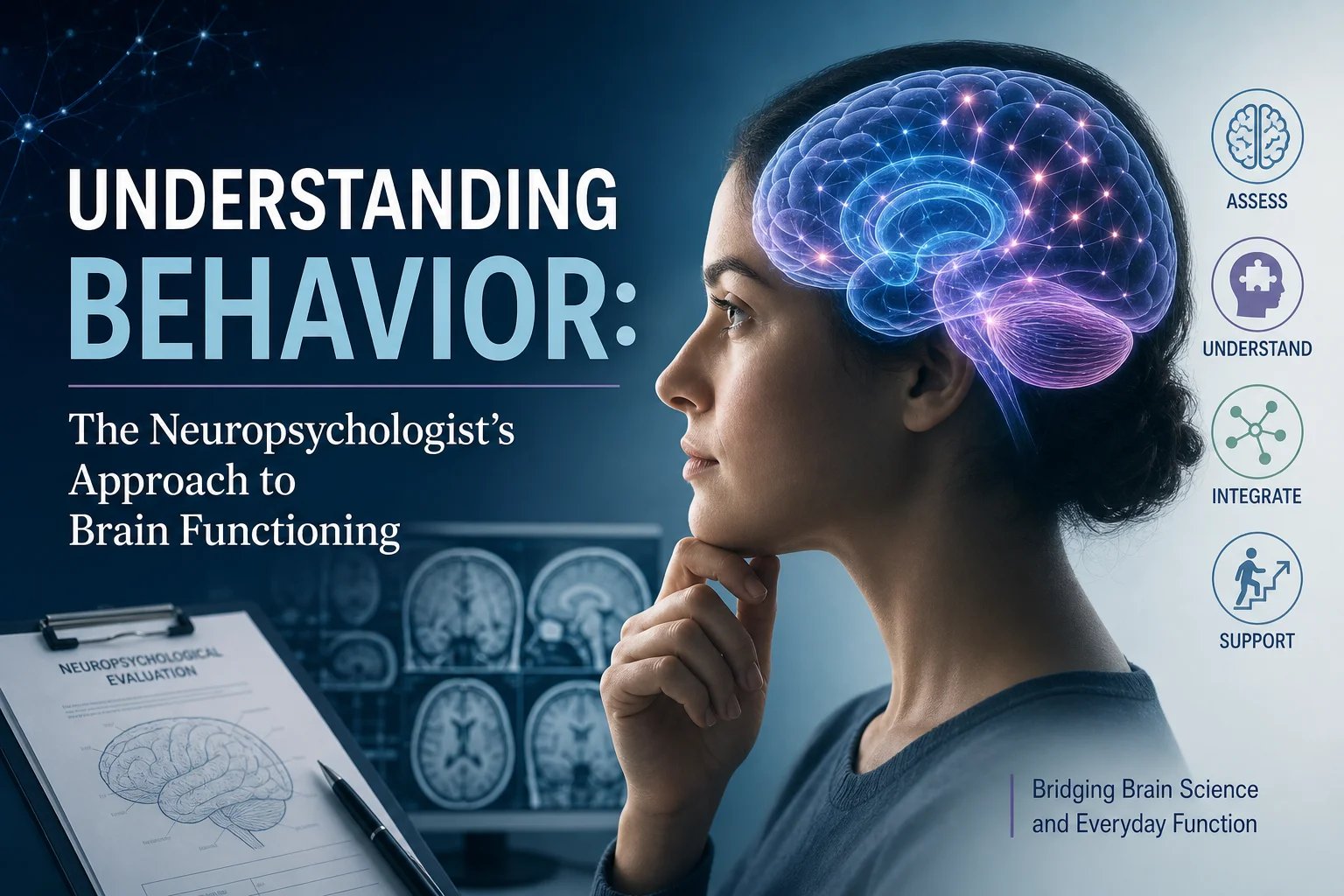
Behind the choices people make, the emotions they struggle to regulate, the tasks they avoid, and the relationships they find difficult, there is often a complex interaction between brain systems, development, environment, personality, and lived experience. That is why Understanding Behavior: The Neuropsychologist’s Approach to Brain Functioning is so valuable: it gives us a practical, science-based way to connect what people do with how their brains work.
Neuropsychology sits at the crossroads of psychology, neurology, education, rehabilitation, and human behavior. It does not reduce a person to a brain scan or test score. Instead, it asks a deeper question:
What can a person’s behavior tell us about the brain—and what can the brain tell us about the behavior?
This article explores Understanding Behavior: The Neuropsychologist’s Approach to Brain Functioning in depth, including how neuropsychologists assess thinking and behavior, how brain networks influence daily life, and how real-world case studies reveal the power of this approach.
What Is Neuropsychology?
Neuropsychology is the study of the relationship between brain functioning and behavior. A neuropsychologist is trained to evaluate cognitive, emotional, and behavioral skills and interpret them in the context of brain development, injury, illness, or neurological change.
When we talk about Understanding Behavior: The Neuropsychologist’s Approach to Brain Functioning, we are talking about much more than identifying “what is wrong.” The goal is to understand patterns.
For example:
- Why does someone remember stories but forget appointments?
- Why can a child solve math problems orally but fail written tests?
- Why does a patient after a stroke become emotionally reactive?
- Why does someone with ADHD know what to do but struggle to do it consistently?
- Why might depression affect concentration, processing speed, and memory?
A neuropsychologist looks at these questions through the lens of brain systems.
Rather than seeing behavior as simply “good” or “bad,” this approach asks:
What brain functions are supporting—or interfering with—this behavior?
That is the heart of Understanding Behavior: The Neuropsychologist’s Approach to Brain Functioning.
Why Behavior Is a Window Into the Brain
The brain does not announce its difficulties directly. It communicates through behavior.
A person with frontal lobe dysfunction may not say, “My executive functioning network is impaired.” Instead, they may appear disorganized, impulsive, emotionally intense, or unable to follow through.
A person with right hemisphere damage may not say, “I have trouble interpreting social tone and spatial information.” Instead, they may miss jokes, ignore one side of space, or misread facial expressions.
A child with working memory weaknesses may not say, “I cannot hold and manipulate information long enough to complete multi-step instructions.” Instead, they may seem inattentive, oppositional, or careless.
This is why Understanding Behavior: The Neuropsychologist’s Approach to Brain Functioning is essential. It helps translate observable behavior into meaningful information about cognitive and neurological processes.
The Core Principle: Behavior Has a Brain-Based Context
One of the most important insights in neuropsychology is that behavior is not random. Even confusing behavior often has an underlying logic when viewed through the right framework.
That does not mean every behavior is caused only by the brain. Human behavior is influenced by:
- Biology
- Learning history
- Culture
- Family systems
- Stress
- Trauma
- Sleep
- Medication
- Motivation
- Personality
- Social expectations
- Medical conditions
However, Understanding Behavior: The Neuropsychologist’s Approach to Brain Functioning adds a crucial layer by examining how cognitive systems contribute to what we see.
For instance, a student who refuses homework may not be lazy. The real issue could be slow processing speed, dysgraphia, anxiety, poor planning, or fatigue after a full school day.
A spouse who seems emotionally distant may not lack care. They may have difficulty reading social cues after a traumatic brain injury.
A worker who misses details may not be careless. They may have attention regulation problems, visual scanning deficits, or reduced mental stamina.
The neuropsychologist’s approach helps replace blame with understanding—and understanding opens the door to effective support.
Key Brain Functions Neuropsychologists Evaluate
To understand behavior, neuropsychologists assess multiple domains of brain functioning. These domains do not operate in isolation. They work together, often like members of an orchestra.
Table: Brain Functions and Everyday Behavior
| Brain Function | What It Helps Us Do | Behavioral Signs of Difficulty |
|---|---|---|
| Attention | Focus, shift, and sustain mental effort | Distractibility, incomplete work, careless errors |
| Memory | Learn, store, and retrieve information | Forgetting conversations, repeating questions |
| Executive Functioning | Plan, organize, inhibit, problem-solve | Impulsivity, poor time management, disorganization |
| Language | Understand and express ideas | Word-finding problems, trouble following directions |
| Processing Speed | Think and respond efficiently | Slow work pace, fatigue, delayed responses |
| Visual-Spatial Skills | Interpret visual information and space | Getting lost, poor copying, driving difficulties |
| Motor Skills | Coordinate movement | Clumsiness, slow handwriting, poor fine motor control |
| Emotional Regulation | Manage feelings and reactions | Mood swings, irritability, low frustration tolerance |
| Social Cognition | Read social cues and intentions | Misunderstandings, awkward interactions |
This table captures why Understanding Behavior: The Neuropsychologist’s Approach to Brain Functioning is so practical. It connects brain-based abilities with real-life challenges.
Understanding Behavior: The Neuropsychologist’s Approach to Brain Functioning in Assessment
A neuropsychological evaluation is not just a long list of tests. It is an investigation.
The process usually includes:
Clinical interview
The neuropsychologist gathers history about development, education, medical issues, mental health, family background, and current concerns.
Behavioral observation
How does the person approach tasks? Do they rush? Give up easily? Ask for repetition? Become frustrated? Use strategies?
Standardized testing
Tests measure skills such as attention, memory, language, executive functioning, processing speed, visual-spatial reasoning, academic ability, and emotional functioning.
Collateral information
Input from parents, teachers, partners, physicians, or therapists may be included when appropriate.
Pattern analysis
The neuropsychologist looks at strengths and weaknesses—not just individual scores.
- Diagnosis and recommendations
The final report explains what the findings mean and how to support the person at school, work, home, or in treatment.
The most important part of Understanding Behavior: The Neuropsychologist’s Approach to Brain Functioning is not the test score itself. It is the interpretation of the pattern.
Two people may both have memory complaints, but one may have true memory storage difficulty, while the other has attention-related encoding problems. The recommendations would be very different.
Brain Regions and Behavioral Clues
Different brain regions are associated with different functions, although modern neuropsychology emphasizes networks rather than isolated “centers.” Still, certain patterns are clinically useful.
Table: Brain Areas and Common Behavioral Associations
| Brain Area/Network | Common Functions | Possible Behavioral Changes |
|---|---|---|
| Frontal Lobes | Planning, inhibition, judgment, emotional control | Impulsivity, poor organization, personality changes |
| Temporal Lobes | Memory, language, emotion | Forgetfulness, word-finding issues, emotional shifts |
| Parietal Lobes | Spatial awareness, sensory integration, calculation | Getting lost, left-right confusion, math difficulty |
| Occipital Lobes | Visual processing | Visual recognition problems, reading difficulties |
| Cerebellum | Coordination, timing, some cognitive regulation | Balance issues, slowed thinking, coordination problems |
| Limbic System | Emotion, motivation, memory | Anxiety, mood instability, emotional reactivity |
| White Matter Networks | Communication between brain regions | Slowed processing, reduced efficiency, fatigue |
Again, Understanding Behavior: The Neuropsychologist’s Approach to Brain Functioning does not mean making simplistic claims like “this behavior equals this brain area.” Instead, it means recognizing patterns that guide more accurate interpretation.
Executive Functioning: The Brain’s Management System
Executive functioning is one of the most important concepts in Understanding Behavior: The Neuropsychologist’s Approach to Brain Functioning.
Executive functions help us:
- Start tasks
- Stop ourselves from acting impulsively
- Shift between activities
- Hold information in mind
- Plan ahead
- Organize materials
- Monitor mistakes
- Regulate emotions
- Learn from feedback
When executive functioning is weak, people may know what to do but struggle to do it at the right time, in the right order, and with the right level of control.
This is why executive dysfunction is often misunderstood as laziness, immaturity, carelessness, or lack of motivation.
A neuropsychologist may identify that a student’s “poor effort” is actually difficulty with initiation and working memory. An adult’s “irresponsibility” may reflect impaired planning after a brain injury. A patient’s emotional outbursts may come from reduced inhibitory control.
This is a major reason Understanding Behavior: The Neuropsychologist’s Approach to Brain Functioning can be life-changing: it reframes behavior in a way that leads to better strategies.
Memory: Not One Skill, but Many Systems
People often say, “My memory is bad,” but memory is not a single ability.
Neuropsychologists examine different memory processes:
- Encoding: Taking in new information
- Storage: Keeping information over time
- Retrieval: Accessing stored information
- Recognition: Identifying previously learned information
- Working memory: Holding and manipulating information in the moment
- Visual memory: Remembering images, locations, or patterns
- Verbal memory: Remembering words, stories, or conversations
In Understanding Behavior: The Neuropsychologist’s Approach to Brain Functioning, memory complaints are interpreted carefully.
For example, someone with anxiety may have trouble encoding information because worry consumes attention. Someone with early dementia may encode information but lose it rapidly. Someone with ADHD may forget because they never fully registered the information in the first place.
Same complaint. Different brain-behavior explanation. Different intervention.
Emotions and the Brain: Why Feelings Affect Thinking
Thinking and emotion are deeply connected. A person’s cognitive performance can change dramatically depending on stress, sleep, pain, depression, anxiety, or trauma.
The neuropsychologist’s approach does not separate “emotional” from “cognitive” as if they are unrelated. Instead, Understanding Behavior: The Neuropsychologist’s Approach to Brain Functioning recognizes that emotional regulation depends on brain networks involving the frontal lobes, limbic system, autonomic nervous system, and stress-response pathways.
When someone is anxious, the brain may prioritize threat detection over learning. When someone is depressed, processing speed and mental flexibility may decline. When someone has trauma-related hypervigilance, attention may be constantly pulled toward possible danger.
This means emotional symptoms are not “just feelings.” They can shape memory, concentration, decision-making, and behavior.
Case Study 1: The “Defiant” Child Who Couldn’t Process Language
Background:
Maya, age 8, was referred for a neuropsychological evaluation because teachers described her as oppositional. She often failed to follow directions, stared blankly during lessons, and became upset when asked to complete written assignments.
Her parents were confused. At home, Maya was imaginative, warm, and curious. But school had become a battleground.
Neuropsychological findings:
Testing showed that Maya had strong nonverbal reasoning and creativity. However, she struggled with receptive language, phonological processing, and working memory. She could understand simple directions but became overwhelmed by multi-step verbal instructions.
Interpretation:
Maya was not intentionally refusing. She was losing information before she could act on it.
Recommendations included:
- Short, one-step directions
- Visual schedules
- Extra processing time
- Speech-language therapy
- Reduced copying demands
- Teacher check-ins for comprehension
Brief analysis:
This case shows the power of Understanding Behavior: The Neuropsychologist’s Approach to Brain Functioning. What looked like defiance was actually a language-processing and working memory issue. Once adults understood the brain-based reason behind the behavior, they could respond with support instead of punishment.
Case Study 2: The Executive After a Mild Traumatic Brain Injury
Background:
Daniel, a 42-year-old project manager, sustained a concussion in a cycling accident. His brain imaging was normal, and he was told he should recover quickly. Yet months later, he felt unlike himself.
He forgot meetings, became irritable with colleagues, struggled to manage multiple projects, and felt exhausted by midday.
Neuropsychological findings:
Daniel’s intelligence remained high, but testing revealed reduced processing speed, weaker divided attention, and difficulty with complex executive tasks under time pressure.
Interpretation:
Daniel could perform well in quiet, structured settings but struggled when tasks required speed, multitasking, and sustained mental effort.
Recommendations included:
- Gradual return-to-work plan
- Reduced multitasking
- Scheduled cognitive breaks
- External reminders and project management tools
- Sleep and headache management
- Education for workplace supervisors
Brief analysis:
This case illustrates Understanding Behavior: The Neuropsychologist’s Approach to Brain Functioning in rehabilitation. Daniel’s problems were not due to low motivation. His brain was less efficient after injury, especially under cognitive load. The evaluation translated invisible symptoms into practical accommodations.
Case Study 3: Personality Change in an Older Adult
Background:
Elaine, age 67, was brought for evaluation by her adult daughter. Elaine had not shown obvious memory loss, but her personality had changed. She made inappropriate comments, spent money impulsively, and neglected household responsibilities.
Friends thought she was depressed. Her family worried she was “just being difficult.”
Neuropsychological findings:
Testing showed relatively preserved memory but impaired inhibition, mental flexibility, judgment, and social reasoning. Behavioral history suggested progressive changes in personality and self-monitoring.
Interpretation:
The pattern raised concern for a neurodegenerative condition affecting frontal systems.
Recommendations included:
- Neurology referral
- Financial safeguards
- Family education
- Safety planning
- Structured routines
- Support for caregivers
Brief analysis:
This is a powerful example of Understanding Behavior: The Neuropsychologist’s Approach to Brain Functioning. Memory loss is not always the first sign of brain change. Sometimes behavioral and personality shifts are the earliest clues.
Case Study 4: ADHD, Anxiety, or Both?
Background:
Sofia, a 16-year-old student, had declining grades. She procrastinated, forgot assignments, and panicked before exams. One clinician suspected ADHD; another suggested anxiety.
Neuropsychological findings:
Sofia showed weaknesses in sustained attention, working memory, and planning. Emotional measures also showed significant performance anxiety and perfectionism.
Interpretation:
Her attention difficulties were real, but anxiety made them worse. She avoided assignments because she feared doing them imperfectly, then became overwhelmed by deadlines.
Recommendations included:
- ADHD-informed academic supports
- Cognitive-behavioral therapy for anxiety
- Study planning routines
- Breaking assignments into smaller parts
- Testing accommodations
- Parent coaching around reduced criticism and increased structure
Brief analysis:
This case demonstrates that Understanding Behavior: The Neuropsychologist’s Approach to Brain Functioning is not about choosing one explanation when several may be true. Brain functioning and emotional experience often interact.
How Neuropsychologists Turn Findings Into Solutions
A good neuropsychological evaluation does not end with a diagnosis. It provides a roadmap.
In Understanding Behavior: The Neuropsychologist’s Approach to Brain Functioning, recommendations are tailored to the person’s actual cognitive profile.
Table: From Brain-Behavior Findings to Practical Strategies
| Finding | Possible Real-Life Problem | Helpful Strategy |
|---|---|---|
| Weak working memory | Forgets multi-step instructions | Use written checklists and visual reminders |
| Slow processing speed | Takes longer to complete work | Provide extended time and reduce timed pressure |
| Poor inhibition | Interrupts, acts impulsively | Teach pause routines and environmental cues |
| Weak planning | Misses deadlines | Use calendars, task breakdowns, and accountability |
| Verbal memory weakness | Forgets spoken information | Record instructions and use repetition |
| Visual-spatial weakness | Gets lost or misaligns math work | Use maps, templates, graph paper |
| Emotional dysregulation | Overreacts to frustration | Build coping plans and reduce overload |
| Attention variability | Inconsistent performance | Use structured routines and distraction control |
This is where Understanding Behavior: The Neuropsychologist’s Approach to Brain Functioning becomes practical. It helps people stop asking, “Why can’t I just do this?” and start asking, “What support does my brain need to do this well?”
The Role of Development: Children Are Not Mini Adults
Children’s brains are still developing. That means neuropsychological interpretation must consider age, maturity, and developmental expectations.
A behavior that is concerning at one age may be typical at another. For example, a 4-year-old who struggles to wait their turn may be developing normally. A 14-year-old with the same level of impulse control may need assessment.
Understanding Behavior: The Neuropsychologist’s Approach to Brain Functioning is especially useful in children because learning problems, attention issues, autism spectrum differences, language disorders, and emotional challenges can overlap.
A child may act out because they cannot read well. Another may refuse group activities because social communication is confusing. Another may melt down after school because they spent the day masking sensory overload.
Neuropsychological assessment helps identify the “why” beneath the behavior.
The Adult Brain: Work, Relationships, and Identity
In adults, cognitive changes often affect identity. A person who has always been organized may feel ashamed when they suddenly cannot manage bills. A skilled professional may feel frightened when they lose mental sharpness. A partner may feel rejected when a loved one becomes emotionally flat or irritable.
This is why Understanding Behavior: The Neuropsychologist’s Approach to Brain Functioning is not only clinical—it is deeply human.
For adults, neuropsychologists may evaluate concerns related to:
- Traumatic brain injury
- Stroke
- Epilepsy
- Multiple sclerosis
- Parkinson’s disease
- Dementia
- ADHD
- Learning disabilities
- Depression and anxiety
- Long COVID cognitive symptoms
- Workplace performance changes
- Medical treatments affecting cognition
The goal is to understand how brain functioning impacts daily independence, decision-making, emotional life, and quality of life.
Why “Normal” Test Scores Do Not Always Mean Nothing Is Wrong
One common misconception is that if test scores are average, the person must be fine. But neuropsychologists interpret scores in context.
An average score may represent a decline for someone who previously functioned at a very high level. Also, structured testing environments are often quieter and more supportive than real life.
A person may perform adequately during a one-on-one evaluation but struggle in a noisy office, busy classroom, or emotionally stressful home environment.
That is why Understanding Behavior: The Neuropsychologist’s Approach to Brain Functioning includes history, observation, and real-world functioning—not just numbers.
The best evaluations combine data with clinical judgment.
Neuropsychology and Mental Health: A Two-Way Street
Mental health conditions can affect cognitive functioning, and cognitive weaknesses can contribute to emotional distress.
For example:
- ADHD can lead to chronic criticism, which increases anxiety.
- Dyslexia can lead to school avoidance and low self-esteem.
- Brain injury can cause depression due to neurological and lifestyle changes.
- Anxiety can impair attention and memory.
- Depression can slow thinking and reduce motivation.
- Autism-related social difficulties can lead to isolation.
Understanding Behavior: The Neuropsychologist’s Approach to Brain Functioning helps clarify these interactions. It prevents oversimplified explanations like “it’s all emotional” or “it’s all neurological.”
Often, it is both.
That balanced view leads to better care.
Common Tools Used in Neuropsychological Evaluation
Neuropsychologists use standardized instruments, but they also rely on careful observation and interpretation.
Common assessment areas include:
Cognitive Testing
- Intellectual reasoning
- Attention and concentration
- Working memory
- Processing speed
- Learning and memory
- Language
- Visual-spatial skills
- Executive functioning
Academic Testing
- Reading accuracy
- Reading comprehension
- Writing
- Spelling
- Math calculation
- Math reasoning
Emotional and Behavioral Measures
- Anxiety
- Depression
- Emotional regulation
- Social functioning
- Adaptive skills
- Personality patterns
Performance Validity
Neuropsychologists may also assess whether test results accurately reflect the person’s true abilities. This is important because pain, fatigue, distress, misunderstanding, or poor effort can affect performance.
In the context of Understanding Behavior: The Neuropsychologist’s Approach to Brain Functioning, testing is not about labeling people. It is about building a useful model of how they function.
The Difference Between Neurology, Psychology, and Neuropsychology
Many people are unsure when to see a neurologist, psychologist, or neuropsychologist.
Table: Who Does What?
| Professional | Main Focus | Common Role |
|---|---|---|
| Neurologist | Nervous system diseases and medical treatment | Diagnoses and treats neurological conditions, orders imaging/medication |
| Psychologist | Emotion, behavior, therapy, mental health | Provides therapy, psychological testing, behavioral treatment |
| Neuropsychologist | Brain-behavior relationships | Evaluates cognitive, emotional, and behavioral effects of brain functioning |
These fields often work together. A neurologist may diagnose epilepsy, while a neuropsychologist evaluates how seizures affect memory and learning. A therapist may treat anxiety, while a neuropsychologist clarifies whether attention problems are also present.
This teamwork reflects the practical value of Understanding Behavior: The Neuropsychologist’s Approach to Brain Functioning.
How Brain Functioning Shapes Everyday Decisions
Behavior is not limited to dramatic symptoms. Brain functioning influences ordinary daily choices:
- Whether you start a task now or delay it
- How you respond when someone criticizes you
- Whether you remember why you entered a room
- How well you track a conversation in a noisy restaurant
- Whether you can resist an impulse purchase
- How quickly you recover from frustration
- Whether you notice subtle social cues
- How accurately you judge risk
Through Understanding Behavior: The Neuropsychologist’s Approach to Brain Functioning, these everyday experiences become more understandable. We begin to see behavior not as isolated actions but as the visible output of attention, memory, emotion, perception, and self-regulation.
The Power of Strength-Based Interpretation
A high-quality neuropsychological evaluation does not only identify weaknesses. It also highlights strengths.
Strengths matter because they become tools for intervention.
For example:
- A child with weak verbal memory but strong visual reasoning may benefit from diagrams and visual notes.
- An adult with slow processing speed but excellent problem-solving may need more time, not simpler work.
- A person with executive dysfunction but strong verbal ability may benefit from talking through plans out loud.
- A patient with memory impairment but good procedural learning may benefit from routines and repeated practice.
This strength-based view is central to Understanding Behavior: The Neuropsychologist’s Approach to Brain Functioning. It reminds us that the goal is not to define people by deficits. The goal is to help them function better using the abilities they have.
Practical Strategies Inspired by Neuropsychology
You do not need a formal diagnosis to benefit from brain-based strategies. Many tools used in neuropsychological recommendations can help everyday functioning.
1. Externalize Memory
Do not rely on memory alone. Use:
- Calendars
- Alarms
- Written checklists
- Whiteboards
- Medication organizers
- Reminder apps
2. Reduce Cognitive Load
The brain performs better when it is not overloaded.
Try:
- Breaking tasks into smaller steps
- Doing one task at a time
- Reducing background noise
- Preparing materials in advance
- Creating routines
3. Match the Strategy to the Problem
If the issue is attention, use distraction control.
If the issue is memory, use repetition and reminders.
If the issue is planning, use timelines and task breakdowns.
This is a practical expression of Understanding Behavior: The Neuropsychologist’s Approach to Brain Functioning: the right support depends on the underlying brain-behavior pattern.
4. Build Pause Points
For impulsivity or emotional reactivity, create moments between feeling and action.
Examples:
- Count to five before responding.
- Write the email, then wait before sending.
- Use a cue phrase such as “pause and plan.”
- Step away briefly during conflict.
5. Protect Sleep and Recovery
Sleep affects attention, memory, emotional regulation, and processing speed. Without sleep, even strong cognitive systems become less reliable.
6. Use Visual Supports
Visual tools help reduce working memory demands.
Examples:
- Color-coded folders
- Flowcharts
- Visual schedules
- Maps
- Sticky notes
- Step-by-step diagrams
Ethical and Human Considerations
Neuropsychological findings can be powerful, so they must be used carefully.
A diagnosis should never become a person’s identity. A test score should never be treated as the full measure of someone’s potential. And brain-based explanations should never be used to remove responsibility entirely.
The balanced message of Understanding Behavior: The Neuropsychologist’s Approach to Brain Functioning is this:
Behavior becomes more manageable when it is understood—but understanding does not mean giving up on growth.
Instead, it means choosing interventions that are realistic, respectful, and effective.
Long-Tail Keyword Variations for Contextual SEO
Here are natural keyword variations related to Understanding Behavior: The Neuropsychologist’s Approach to Brain Functioning:
| Keyword Variation |
|---|
| neuropsychologist approach to brain functioning and behavior |
| understanding behavior through neuropsychology |
| brain functioning and behavioral assessment |
| how neuropsychologists explain behavior |
| neuropsychological evaluation for behavior problems |
| brain-behavior relationship in neuropsychology |
| cognitive testing and behavior patterns |
| executive functioning and behavior |
| neuropsychology of emotional regulation |
| understanding behavior after brain injury |
| neuropsychological approach to learning difficulties |
| brain-based explanation for behavior changes |
These variations help expand the topic while keeping the focus on Understanding Behavior: The Neuropsychologist’s Approach to Brain Functioning.
When Should Someone Consider a Neuropsychological Evaluation?
A neuropsychological evaluation may be helpful when behavior, thinking, learning, or emotional regulation changes in a way that affects daily life.
Consider an evaluation when there are concerns such as:
- Sudden or gradual memory decline
- Attention problems interfering with school or work
- Personality changes
- Difficulty after concussion or brain injury
- Learning struggles despite effort
- Problems with planning and organization
- Unexplained decline in performance
- Concerns about dementia
- Cognitive symptoms related to medical illness
- Behavioral changes after stroke, seizure, or neurological diagnosis
The purpose of Understanding Behavior: The Neuropsychologist’s Approach to Brain Functioning is not to pathologize every struggle. It is to identify when patterns suggest that deeper evaluation could help.
The Future of Understanding Behavior and Brain Function
Neuropsychology continues to evolve. Advances in brain imaging, digital assessment, genetics, artificial intelligence, and rehabilitation science are expanding what clinicians can understand.
Yet the core of the field remains personal and human.
No technology can replace the careful work of listening to a person’s story, observing how they solve problems, understanding their environment, and interpreting their behavior with compassion.
The future of Understanding Behavior: The Neuropsychologist’s Approach to Brain Functioning will likely become more precise, but its greatest value will remain the same: helping people make sense of themselves and others.
Conclusion: From Judgment to Understanding
Behavior is often the first signal that something deeper is happening. It may reflect stress, development, brain injury, emotional distress, learning differences, neurological illness, or a combination of factors.
Understanding Behavior: The Neuropsychologist’s Approach to Brain Functioning gives us a framework for looking beneath the surface. It helps explain why a child struggles in school, why an adult changes after injury, why memory complaints can have different causes, and why emotional regulation is inseparable from brain functioning.
The most important takeaway is simple:
When we understand the brain-behavior connection, we respond with better questions, better strategies, and greater compassion.
Instead of asking, “What is wrong with this person?” we can ask, “What is this behavior telling us, and what kind of support would make success more possible?”
That shift can transform classrooms, workplaces, families, clinical care, and personal growth.
1. What does a neuropsychologist do?
A neuropsychologist evaluates how brain functioning affects thinking, behavior, emotions, learning, and daily life. They use interviews, standardized tests, observations, and history to identify patterns of strengths and weaknesses.
2. Is neuropsychological testing only for brain injuries?
No. Neuropsychological evaluations can help with many concerns, including ADHD, learning disorders, dementia, stroke, epilepsy, autism, multiple sclerosis, psychiatric conditions, and unexplained cognitive or behavioral changes.
3. How is Understanding Behavior: The Neuropsychologist’s Approach to Brain Functioning different from regular therapy?
Therapy often focuses on emotional healing, coping skills, relationships, and behavior change. Neuropsychological assessment focuses on identifying cognitive and brain-based patterns that may explain behavior. The two often work well together.
4. Can a neuropsychologist diagnose ADHD or learning disorders?
Yes, neuropsychologists commonly assess for ADHD, dyslexia, dysgraphia, dyscalculia, and other learning or attention-related conditions. They also examine whether anxiety, depression, sleep, or other issues may be contributing.
5. Do normal brain scans mean behavior changes are not neurological?
Not necessarily. Many cognitive and behavioral problems do not appear on standard imaging. A person can have a normal MRI or CT scan and still experience attention, memory, processing speed, or executive functioning difficulties.
6. How long does a neuropsychological evaluation take?
It varies, but many evaluations take several hours and may be completed in one day or across multiple appointments. The process usually includes an interview, testing, scoring, interpretation, and a feedback session.
7. What should I bring to a neuropsychological evaluation?
Helpful materials may include medical records, school records, previous evaluations, medication lists, work or academic concerns, and notes from family members or teachers. The more context available, the more accurate the interpretation.
8. Can neuropsychological results improve treatment?
Yes. Results can guide therapy, school accommodations, workplace supports, rehabilitation planning, medical decisions, and family strategies. The real value of Understanding Behavior: The Neuropsychologist’s Approach to Brain Functioning is turning insight into practical action.
About the Author


The PsyForU Editorial Collective is the research and editorial team of PsyForU Research International. The collective prepares educational, psychological, mental-health-awareness, inclusion, neurodiversity, and research-methodology content for students, parents, educators, researchers, and general readers. PsyForU content is intended for awareness, education, and capacity-building and should not be treated as clinical diagnosis, therapy, medical advice, legal advice, or emergency mental-health support.