The Ultimate Guide to Deconstructing Fear: Behavioral Techniques for Effective Phobia Treatments
A phobia can make the ordinary feel impossible.
A dog on the sidewalk. An elevator door sliding open. A plane boarding announcement. A needle at a routine appointment. For someone without a phobia, these moments may be mildly inconvenient or even forgettable. For someone living with one, they can trigger a full-body alarm: racing heart, shallow breathing, dizziness, nausea, trembling, dread, and one urgent message from the brain—escape now.
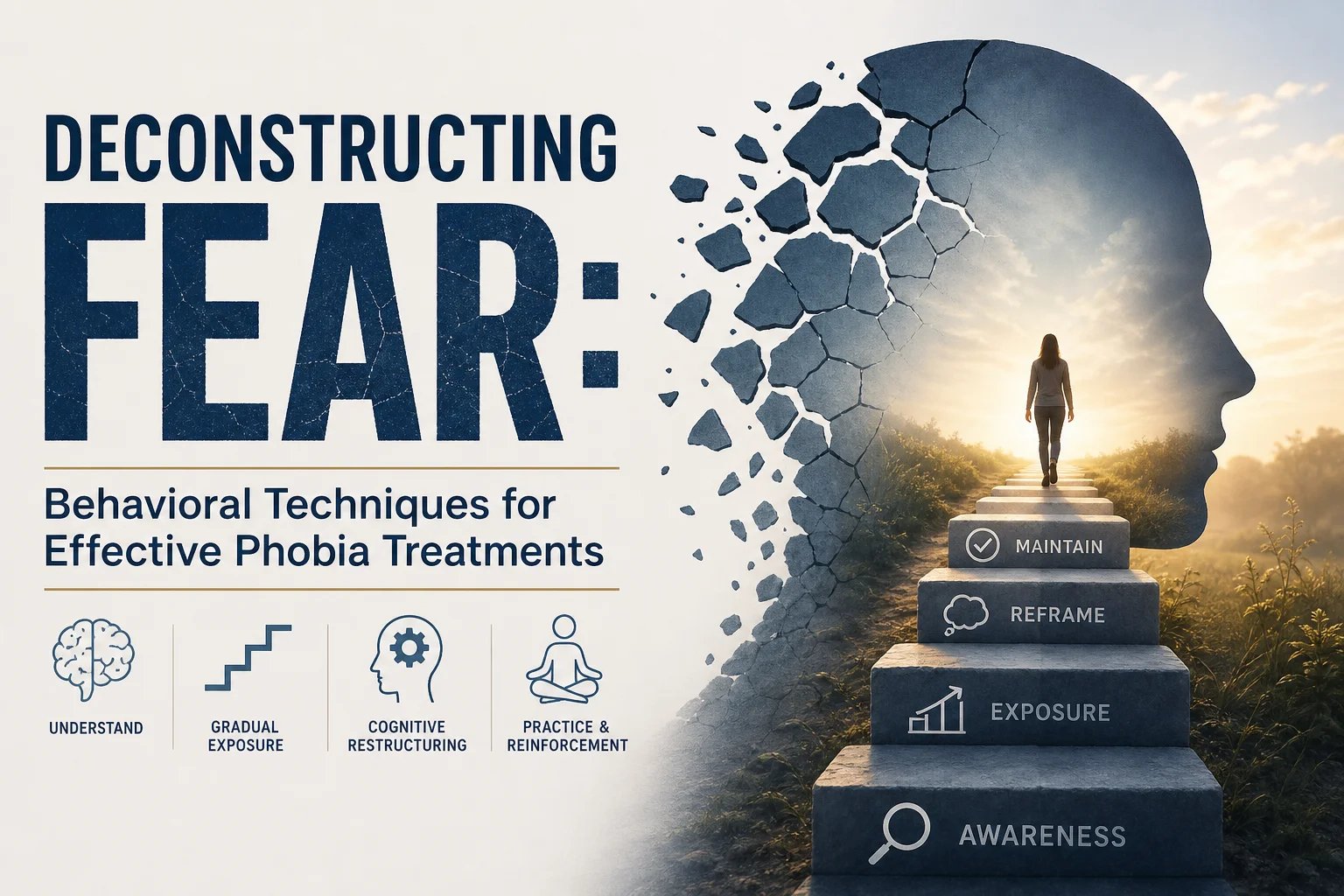
That is why Deconstructing Fear: Behavioral Techniques for Effective Phobia Treatments matters so much. Phobias are not signs of weakness, irrationality, or poor character. They are learned fear patterns that become reinforced through avoidance. The good news is that because phobias are learned, they can also be relearned, retrained, and reduced through practical, evidence-based behavioral methods.
This article explores Deconstructing Fear: Behavioral Techniques for Effective Phobia Treatments in depth—how fear forms, why avoidance keeps it alive, and how behavioral therapy helps people gradually reclaim their freedom. We will look at exposure therapy, systematic desensitization, modeling, behavioral experiments, virtual reality exposure, response prevention, applied tension, and real-world case studies that show these methods in action.
The goal is not to “delete” fear. Fear is useful. It protects us. The goal is to teach the brain the difference between genuine danger and a false alarm.
Understanding Phobias: When Fear Becomes a Cage
A phobia is an intense, persistent fear of a specific object, situation, activity, or experience that is out of proportion to the actual threat. Common examples include fear of flying, heights, spiders, dogs, blood, injections, vomiting, enclosed spaces, public speaking, driving, or social judgment.
What makes a phobia different from ordinary fear is not simply intensity. It is the combination of:
- Immediate anxiety response
- Strong urge to avoid or escape
- Recognition that the fear may be excessive
- Significant distress or life interference
- Persistence over time
A person with a snake phobia may refuse hiking trips. Someone with claustrophobia may avoid elevators, trains, tunnels, or MRI scans. A person with emetophobia, the fear of vomiting, may avoid restaurants, travel, pregnancy, children, alcohol, hospitals, or certain foods.
This is where Deconstructing Fear: Behavioral Techniques for Effective Phobia Treatments becomes powerful. Instead of asking, “Why can’t I just stop being afraid?” behavioral treatment asks, “What is the fear teaching your brain, and how can we teach it something more accurate?”
The Avoidance Cycle: The Engine That Keeps Phobias Running
Phobias survive through avoidance.
Avoidance works in the short term. If someone terrified of elevators takes the stairs, anxiety drops. The relief feels rewarding. But the brain learns a dangerous lesson: “I survived because I avoided the elevator.”
This strengthens the phobia.
Over time, avoidance spreads. First, the person avoids crowded elevators. Then all elevators. Then tall buildings. Then job opportunities, hotels, medical appointments, or social events that might involve elevators.
The behavioral model of phobias is simple but profound:
| Stage | What Happens | What the Brain Learns |
|---|---|---|
| Trigger | Person encounters feared object or situation | “Danger is present.” |
| Anxiety spike | Body enters fight-or-flight mode | “I need to escape.” |
| Avoidance or escape | Person leaves or avoids the situation | “Avoidance saved me.” |
| Relief | Anxiety decreases quickly | “I should avoid this again.” |
| Phobia strengthens | Future fear becomes more intense | “This threat is still dangerous.” |
This is the heart of deconstructing fear behavioral techniques: interrupt the avoidance cycle and create new learning. Instead of reinforcing “I escaped, therefore I survived,” treatment helps the person discover, “I stayed, I tolerated the anxiety, and nothing catastrophic happened.”
Deconstructing Fear: Behavioral Techniques for Effective Phobia Treatments Begins with Learning Theory
Many phobias develop through classical conditioning, observational learning, misinformation, traumatic experiences, or repeated avoidance.
For example:
- A child is bitten by a dog and later fears all dogs.
- A teenager has a panic attack on a plane and begins avoiding flights.
- A person sees a parent react fearfully to spiders and learns spiders are dangerous.
- Someone faints during a blood test and begins fearing medical settings.
- A person reads about elevator accidents and begins overestimating risk.
Behavioral treatments work because they target the learning process directly. The aim is not to argue fear away. Logic alone rarely cures phobias. Most people with phobias already know their fear is exaggerated. The issue is not lack of information—it is a fear network stored in the body and brain.
That is why behavioral techniques for effective phobia treatments focus on experience. The person must encounter the feared situation in a structured, safe, repeated way long enough for the brain to update its prediction.
Exposure Therapy: The Gold Standard for Phobia Treatment
Exposure therapy is one of the most researched and effective behavioral techniques for phobias. It involves gradually and repeatedly approaching feared objects, sensations, or situations without escaping, avoiding, or using excessive safety behaviors.
Exposure is not “throwing someone into the deep end.” Good exposure therapy is collaborative, planned, paced, and respectful. The person is not forced. They learn to become an active participant in retraining fear.
How Exposure Therapy Works
Exposure helps through several mechanisms:
Habituation
Anxiety naturally decreases when a person stays in the feared situation long enough.
Inhibitory learning
The brain learns a new association: “This may feel scary, but it is not actually dangerous.”
Self-efficacy
The person learns, “I can handle this.”
Disconfirmation of catastrophic predictions
The feared outcome does not occur, or the person copes better than expected.
- Reduction of avoidance
Life becomes bigger as avoidance shrinks.
In Deconstructing Fear: Behavioral Techniques for Effective Phobia Treatments, exposure is often the central tool because it directly challenges the phobia’s fuel source: avoidance.
Building an Exposure Ladder
An exposure ladder is a step-by-step plan that ranks feared situations from easier to harder. Each step is practiced repeatedly until anxiety becomes manageable or the person gains confidence.
Here is an example for a dog phobia:
| Step | Exposure Task | Fear Rating Before Practice |
|---|---|---|
| 1 | Look at cartoon images of dogs | 2/10 |
| 2 | View photos of small dogs | 3/10 |
| 3 | Watch videos of calm dogs | 4/10 |
| 4 | Stand across the street from a leashed dog | 5/10 |
| 5 | Stand 10 feet from a calm dog | 6/10 |
| 6 | Stand beside a calm dog | 7/10 |
| 7 | Touch dog’s back briefly | 8/10 |
| 8 | Pet dog for one minute | 9/10 |
| 9 | Walk a calm dog with owner nearby | 9/10 |
The key is repetition. One exposure is rarely enough. The brain needs multiple learning trials in varied contexts.
A strong plan for Deconstructing Fear: Behavioral Techniques for Effective Phobia Treatments includes clear goals, realistic steps, tracking, and reflection after each exposure.
Systematic Desensitization: Pairing Fear with Calm
Systematic desensitization is a classic behavioral treatment that combines gradual exposure with relaxation training. The person learns a relaxation skill—such as diaphragmatic breathing, progressive muscle relaxation, or guided imagery—then practices facing feared stimuli in small steps.
While modern exposure therapy does not always require relaxation, systematic desensitization can be helpful for people who feel overwhelmed at the start.
The process usually involves:
- Learning relaxation techniques
- Creating a fear hierarchy
- Imagining or encountering each step
- Practicing until anxiety decreases
- Moving to the next step
For example, someone with a fear of flying may begin by imagining an airport, then looking at airport photos, then watching takeoff videos, then visiting an airport, then sitting on a parked plane, and eventually taking a short flight.
This method remains relevant in effective phobia treatments because it gives people a sense of control and structure. However, it works best when relaxation does not become a safety behavior. The deeper goal is not “I can only cope if I relax perfectly,” but rather “I can tolerate fear even when it shows up.”
Safety Behaviors: The Hidden Barrier to Recovery
Many people attempt exposure but unknowingly keep the phobia alive through safety behaviors.
Safety behaviors are actions used to prevent feared outcomes, reduce anxiety, or feel protected. They may seem harmless, but they can interfere with new learning.
Examples include:
- Holding a “lucky” object during exposure
- Standing near an exit at all times
- Repeatedly checking pulse or breathing
- Over-researching safety statistics
- Bringing a companion everywhere
- Avoiding eye contact during social exposure
- Taking anti-anxiety medication only to endure feared situations
- Distracting constantly instead of fully engaging
Not all coping tools are bad. But when a person believes, “I only survived because of this safety behavior,” the fear remains intact.
A crucial part of Deconstructing Fear: Behavioral Techniques for Effective Phobia Treatments is identifying and gradually dropping these behaviors. The person learns that safety comes not from rituals or escape routes, but from accurate learning and growing confidence.
Behavioral Experiments: Testing Fear Predictions
Behavioral experiments are structured activities designed to test what a person predicts will happen.
They are especially useful when phobias involve catastrophic beliefs such as:
- “If I ride the elevator, I’ll suffocate.”
- “If I see a spider, it will jump on me.”
- “If I panic while driving, I’ll lose control.”
- “If I speak in public, everyone will laugh.”
- “If I feel nauseous, I will definitely vomit.”
A behavioral experiment might include:
| Fear Prediction | Experiment | Result |
|---|---|---|
| “I will faint if I see blood.” | Look at a small image of blood while using applied tension | Felt dizzy but did not faint |
| “The elevator will trap me.” | Ride one floor with therapist | Elevator worked normally |
| “People will notice my shaking.” | Hold a cup while speaking to a small group | One person noticed but reacted kindly |
| “A spider will chase me.” | Observe spider in container for 10 minutes | Spider stayed still |
Behavioral experiments are central to deconstructing fear for phobia recovery because they transform vague dread into testable predictions. Fear becomes less mysterious when it is examined carefully.
In Vivo, Imaginal, and Interoceptive Exposure
Exposure therapy can take different forms depending on the phobia.
In Vivo Exposure
This means real-life exposure. For a fear of dogs, it means seeing or approaching actual dogs. For a fear of elevators, it means riding elevators. In vivo exposure is often the most powerful because it directly targets real-world avoidance.
Imaginal Exposure
This involves vividly imagining feared scenarios. It can help when real-life exposure is difficult, unavailable, or emotionally complex. For example, someone with a fear of loved ones becoming ill may practice imagining uncertainty without compulsive reassurance.
Interoceptive Exposure
This targets feared physical sensations. It is commonly used for panic-related phobias, such as fear of driving, flying, or enclosed spaces due to fear of panic symptoms.
Examples include:
- Spinning in a chair to induce dizziness
- Breathing through a straw to mimic breathlessness
- Running in place to raise heart rate
- Holding breath briefly to create body sensations
The goal is to learn: “These sensations are uncomfortable, but not dangerous.”
A complete approach to Deconstructing Fear: Behavioral Techniques for Effective Phobia Treatments often blends these forms of exposure to address both external triggers and internal sensations.
Applied Tension for Blood-Injection-Injury Phobia
Blood-injection-injury phobia is unique because it often involves fainting. Many phobias raise heart rate and blood pressure, but blood-injection-injury fear can produce a vasovagal response: blood pressure drops, and the person may faint.
For this phobia, applied tension is especially useful.
How Applied Tension Works
The person learns to tense large muscle groups—arms, legs, torso—for 10 to 15 seconds, then release slightly without fully relaxing. This helps raise blood pressure and reduce fainting risk.
A typical sequence:
- Notice early signs of faintness
- Tense muscles firmly
- Hold for 10–15 seconds
- Release halfway for 20–30 seconds
- Repeat several rounds
Applied tension is usually combined with gradual exposure to medical cues, needles, blood images, clinics, or actual procedures.
This is a strong example of behavioral techniques for effective phobia treatments being tailored to the specific fear pattern rather than using a one-size-fits-all method.
Modeling and Participant Modeling
Modeling involves watching someone else calmly interact with the feared object or situation. Participant modeling goes further: the therapist or trusted person demonstrates the behavior, then the client gradually joins.
For example, in spider phobia treatment, a therapist may first stand near a spider in a container, then touch the container, then place a hand nearby, and eventually guide the client through similar steps.
Modeling is particularly effective for children, but adults benefit too. Seeing another person safely do the feared action provides powerful social learning.
In the broader framework of Deconstructing Fear: Behavioral Techniques for Effective Phobia Treatments, modeling helps replace imagined catastrophe with visible evidence.
Virtual Reality Exposure Therapy
Virtual reality exposure therapy, or VRET, uses immersive technology to simulate feared situations. It can be helpful for fears that are difficult to recreate repeatedly, such as flying, heights, storms, public speaking, or driving.
Benefits include:
- Controlled intensity
- Repeatable scenarios
- Privacy
- Gradual progression
- Lower logistical barriers
- Safe practice before real-world exposure
For example, someone with fear of flying can experience boarding, taxiing, takeoff, turbulence, and landing in a virtual setting before taking an actual flight.
VRET is not always a full replacement for real-world exposure, but it can be an excellent bridge. It is one of the most exciting developments in modern behavioral phobia treatments.
Case Study 1: Fear of Flying and the Power of Prediction Testing
Client profile: “Maya,” a 34-year-old consultant, avoided flying for six years after a turbulent flight. Her career stalled because she turned down travel opportunities. She knew flying was statistically safe, but every time she imagined boarding a plane, her chest tightened.
Fear predictions:
- “If there is turbulence, I will panic uncontrollably.”
- “I’ll scream or embarrass myself.”
- “I won’t be able to escape.”
- “The plane might crash.”
Treatment plan:
Maya began with education about the anxiety cycle, then created an exposure ladder:
| Step | Exposure |
|---|---|
| 1 | Listen to airplane cabin sounds |
| 2 | Watch takeoff videos |
| 3 | Visit airport without flying |
| 4 | Sit near departure gates |
| 5 | Use virtual reality flight simulation |
| 6 | Book a short 45-minute flight |
| 7 | Fly with reduced safety behaviors |
| 8 | Fly alone for work |
During treatment, Maya practiced interoceptive exposure by intentionally increasing her heart rate and sitting with the sensation. She also reduced safety behaviors, such as repeatedly checking turbulence forecasts.
Outcome:
Her first flight was uncomfortable but successful. She experienced anxiety during takeoff, but it peaked and then decreased. After three flights, her confidence rose significantly.
Analysis:
This case illustrates Deconstructing Fear: Behavioral Techniques for Effective Phobia Treatments because Maya did not recover by receiving more reassurance about aviation safety. She improved by testing predictions, reducing avoidance, and learning through experience that anxiety could rise and fall without disaster.
Case Study 2: A Child’s Dog Phobia and Participant Modeling
Client profile: “Leo,” age 8, developed a dog phobia after a neighbor’s dog barked loudly near him. He refused parks, birthday parties, and walks around the block.
Treatment plan:
Because Leo was young, treatment used playful exposure and participant modeling. The therapist first introduced toy dogs, then dog cartoons, then videos of calm dogs. Leo drew “fear thermometer” ratings from 1 to 10.
Later, a trained therapy dog was introduced at a distance. The therapist and Leo’s parent modeled calm behavior by standing near the dog and describing what they noticed: “The dog is sitting. Its tail is moving slowly. It is not coming closer.”
Leo gradually progressed from standing across the room to tossing a treat, then touching the dog’s back for two seconds.
Outcome:
After several sessions, Leo could visit parks again and calmly pass leashed dogs on sidewalks.
Analysis:
This example shows how deconstructing fear behavioral techniques can be adapted for children. The treatment did not shame Leo or force contact. It used gradual exposure, modeling, reinforcement, and age-appropriate language to rebuild safety learning.
Case Study 3: Blood-Injection Phobia and Applied Tension
Client profile: “Marcus,” age 42, avoided blood tests for more than a decade. He had fainted twice during medical procedures and feared it would happen again. His doctor recommended routine testing, but Marcus postponed appointments repeatedly.
Fear predictions:
- “I will faint as soon as I see the needle.”
- “The nurse will panic.”
- “I’ll lose control of my body.”
- “I won’t be able to complete the test.”
Treatment plan:
Marcus learned applied tension and practiced it daily before beginning exposure. His hierarchy included:
- Saying the word “blood” and “needle”
- Looking at drawings of syringes
- Watching short videos of blood draws
- Holding a capped syringe
- Visiting the clinic waiting room
- Sitting in the blood draw chair
- Completing a real blood test while using applied tension
Outcome:
Marcus completed his blood test. He felt lightheaded but did not faint. More importantly, he stopped interpreting lightheadedness as inevitable failure.
Analysis:
This case highlights the importance of matching technique to phobia type. Behavioral techniques for effective phobia treatments must consider physiology. For blood-injection-injury phobia, applied tension can be the difference between avoidance and success.
Case Study 4: Social Phobia and Dropping Safety Behaviors
Client profile: “Amara,” age 27, feared public speaking. She avoided meetings, declined promotions, and rehearsed excessively before any conversation. When speaking, she gripped her notes tightly, avoided eye contact, and spoke quickly to “get it over with.”
Fear predictions:
- “If I pause, people will think I’m incompetent.”
- “If I blush, everyone will notice.”
- “If I lose my place, I’ll humiliate myself.”
Treatment plan:
Amara practiced behavioral experiments:
| Experiment | Purpose |
|---|---|
| Give a short update while making eye contact | Test whether eye contact increases judgment |
| Intentionally pause for three seconds | Test whether pauses seem catastrophic |
| Say “I lost my train of thought” and continue | Test recoverability |
| Speak without over-rehearsing | Reduce safety behavior |
| Ask trusted colleagues what they noticed | Compare fear prediction with reality |
Outcome:
Amara learned that pauses felt longer to her than to listeners. A few people noticed nervousness, but no one judged her harshly. Her speaking confidence improved through repeated experiments.
Analysis:
This is a strong example of Deconstructing Fear: Behavioral Techniques for Effective Phobia Treatments beyond animal or situational phobias. Social fears often persist because safety behaviors prevent genuine learning. Dropping them allows the person to discover they can be accepted even while imperfect.
Comparing Key Behavioral Techniques
Different phobias often require different combinations of strategies. The table below summarizes major methods.
| Technique | Best For | Main Goal | Example |
|---|---|---|---|
| Exposure therapy | Most specific phobias | Reduce avoidance and create new learning | Riding elevators repeatedly |
| Systematic desensitization | High initial anxiety | Pair gradual exposure with calm skills | Imagining then approaching dogs |
| Interoceptive exposure | Panic-related fears | Reduce fear of body sensations | Running in place to mimic racing heart |
| Applied tension | Blood/injection phobia | Prevent fainting response | Tensing muscles during blood draw |
| Modeling | Children, animal fears, skill-based fears | Learn through observation | Watching therapist touch spider container |
| Behavioral experiments | Catastrophic beliefs | Test predictions | Pausing during a speech |
| Virtual reality exposure | Flying, heights, public speaking | Practice in controlled simulation | VR airplane takeoff |
| Response prevention | Ritual-driven avoidance | Stop compulsive safety behaviors | Not checking exits repeatedly |
This comparison is central to Deconstructing Fear: Behavioral Techniques for Effective Phobia Treatments because it shows that effective care is strategic, not random.
What Makes Phobia Treatment Work?
Successful phobia treatment is not just about “facing your fear.” Many people try that and feel worse because they do it without structure, support, or repetition.
Effective treatment includes:
1. Clear Fear Mapping
The person identifies triggers, predictions, body sensations, avoidance behaviors, and safety behaviors.
2. Gradual but Meaningful Challenge
Exposure should be challenging enough to create learning but not so overwhelming that the person quits.
3. Repetition Across Contexts
Practicing in only one setting may not generalize. Someone with dog phobia may need exposure to small dogs, large dogs, barking dogs, dogs in parks, and dogs on sidewalks.
4. Reduced Safety Behaviors
The person gradually drops behaviors that prevent new learning.
5. Reflection After Exposure
The most important question after exposure is not “How anxious were you?” but “What did you learn?”
6. Willingness to Feel Discomfort
Recovery is not the absence of fear. It is the ability to act with fear present.
These principles make Deconstructing Fear: Behavioral Techniques for Effective Phobia Treatments more than a set of exercises. It becomes a method for rebuilding trust in oneself.
A Practical Framework for Deconstructing Fear
Here is a simple framework that therapists and clients often adapt.
Step 1: Name the Fear
Be specific. “I fear dogs” is a start, but “I fear large unleashed dogs running toward me” is more useful.
Step 2: Identify the Prediction
Ask: “What do I think will happen?”
Examples:
- “I’ll be bitten.”
- “I’ll faint.”
- “I’ll panic and lose control.”
- “People will laugh.”
- “I’ll be trapped.”
Step 3: Rate the Fear
Use a 0–10 scale or 0–100 scale. This helps build a ladder.
Step 4: Choose a Behavioral Exercise
Select an exposure or experiment that tests the prediction.
Step 5: Stay Long Enough to Learn
Do not leave at the first anxiety spike. Anxiety needs time to rise, peak, and fall—or at least become tolerable.
Step 6: Drop One Safety Behavior
Reduce checking, reassurance, distraction, or escape planning.
Step 7: Review the Evidence
Ask:
- What did I predict?
- What actually happened?
- What surprised me?
- What can I try next?
This process captures the heart of Deconstructing Fear: Behavioral Techniques for Effective Phobia Treatments in everyday language.
Common Mistakes That Slow Phobia Recovery
Even motivated people can get stuck. Here are common obstacles.
Mistake 1: Waiting to Feel Ready
Confidence usually comes after action, not before it.
Mistake 2: Moving Too Fast
Flooding yourself with overwhelming exposure can backfire if it leads to escape and discouragement.
Mistake 3: Using Exposure as a Test of Courage
Exposure is not a moral exam. It is a learning exercise.
Mistake 4: Keeping Safety Behaviors Hidden
If you white-knuckle through exposure while secretly relying on rituals, the phobia may remain strong.
Mistake 5: Practicing Only Once
Repetition is where the brain changes.
Mistake 6: Measuring Success by Anxiety Level Alone
Sometimes anxiety remains high, but the person still learns, “I can handle this.” That is progress.
Avoiding these mistakes makes behavioral phobia treatment techniques more effective and less discouraging.
Long-Tail Keyword Variations for Contextual Use
For readers, clinicians, or content creators researching this topic, useful long-tail variations include:
- Deconstructing Fear: Behavioral Techniques for Effective Phobia Treatments
- behavioral techniques for effective phobia treatments
- deconstructing fear in phobia therapy
- exposure therapy for specific phobias
- how behavioral therapy treats phobias
- systematic desensitization for phobia treatment
- behavioral experiments for anxiety and phobias
- virtual reality exposure therapy for phobias
- applied tension for blood injection phobia
- how to overcome avoidance in phobia recovery
- evidence-based behavioral phobia treatment
- gradual exposure techniques for fear reduction
- deconstructing fear with exposure therapy
- phobia treatment without avoidance
- behavioral strategies for overcoming irrational fears
Used naturally, these variations support the central theme of Deconstructing Fear: Behavioral Techniques for Effective Phobia Treatments without making the writing feel repetitive.
When to Seek Professional Help
Self-guided exposure can help with mild fears, but professional support is recommended when:
- The phobia causes major life disruption
- Panic attacks occur frequently
- Avoidance is expanding
- The fear involves medical procedures or fainting
- Trauma is connected to the phobia
- Depression, OCD, PTSD, or substance use is also present
- Attempts at exposure have repeatedly failed
- The person feels unsafe practicing alone
A licensed mental health professional trained in cognitive behavioral therapy, exposure therapy, or anxiety disorders can create a tailored plan.
Deconstructing Fear: Behavioral Techniques for Effective Phobia Treatments is most effective when it respects both science and the person’s pace. Treatment should be challenging, but it should also be ethical, collaborative, and compassionate.
The Future of Effective Phobia Treatments
Behavioral treatment continues to evolve. Promising developments include:
- More accessible virtual reality exposure
- Mobile apps for exposure tracking
- Teletherapy-guided exposure sessions
- Wearable devices to monitor physiological arousal
- Personalized treatment planning based on fear patterns
- Greater focus on inhibitory learning rather than simple habituation
- Integration of acceptance-based approaches
The future of Deconstructing Fear: Behavioral Techniques for Effective Phobia Treatments is not about replacing therapists with technology. It is about giving people more precise, flexible tools to practice courage in real life.
Conclusion: Fear Shrinks When Life Expands
Phobias can make the world feel smaller. They turn places, objects, sensations, and opportunities into threats. But fear is not fixed. The brain can learn new patterns at any age.
The central message of Deconstructing Fear: Behavioral Techniques for Effective Phobia Treatments is hopeful: avoidance teaches fear to grow, but gradual approach teaches fear to loosen its grip.
Exposure therapy, systematic desensitization, behavioral experiments, modeling, applied tension, virtual reality exposure, and response prevention all share one powerful principle—new learning happens through experience.
You do not need to become fearless to recover. You need to become willing to take one well-designed step toward what fear has been guarding. Then another. Then another.
Over time, the elevator becomes just an elevator. The dog becomes just a dog. The airplane becomes transportation. The needle becomes a brief medical tool. The stage becomes a place to speak.
Fear may still visit. But it no longer gets to run the whole life.
FAQs About Deconstructing Fear: Behavioral Techniques for Effective Phobia Treatments
1. What is the most effective behavioral treatment for phobias?
Exposure therapy is widely considered one of the most effective behavioral treatments for specific phobias. It works by gradually helping a person face feared situations without avoidance, allowing the brain to learn that the feared outcome is unlikely or manageable.
2. Is exposure therapy dangerous or traumatic?
Proper exposure therapy should not be dangerous or coercive. It is planned collaboratively and usually progresses step by step. The goal is not to overwhelm the person, but to create meaningful new learning. If trauma is involved, treatment should be guided by a qualified professional.
3. How long does phobia treatment take?
It depends on the phobia, severity, avoidance patterns, and practice frequency. Some specific phobias improve in a few sessions, while more complex fears may require weeks or months. Consistent practice usually speeds progress.
4. Can phobias go away without treatment?
Some fears reduce naturally, but many phobias persist because avoidance reinforces them. Without treatment, avoidance can spread and make life more restricted. Behavioral techniques can interrupt this cycle.
5. What if I panic during exposure?
Panic during exposure can feel frightening, but it is not usually harmful. Interoceptive exposure can help people learn that panic sensations are uncomfortable but temporary. A therapist can help design exercises that feel challenging but manageable.
6. Are medications necessary for phobia treatment?
Medication is not always necessary for specific phobias. Behavioral treatments, especially exposure-based methods, are often highly effective. However, medication may be helpful for some people, especially when other anxiety or mood conditions are present. A medical professional can provide guidance.
7. Can children benefit from behavioral phobia treatments?
Yes. Children often respond well to gradual exposure, modeling, play-based practice, and positive reinforcement. Treatment should be age-appropriate and involve caregivers when helpful.
8. What is the first step in deconstructing fear?
The first step is mapping the fear: identify the trigger, feared outcome, avoidance behavior, safety behaviors, and life impact. From there, a gradual exposure plan can be created.
9. Is virtual reality exposure as good as real-life exposure?
Virtual reality exposure can be very helpful, especially for fears like flying, heights, or public speaking. It may not fully replace real-world practice, but it can be an effective bridge toward in vivo exposure.
10. Can I practice phobia exposure on my own?
For mild phobias, self-guided exposure may help if done gradually and safely. For severe phobias, fainting risk, trauma-related fears, or complex anxiety, professional guidance is strongly recommended.
About the Author