A person rarely walks into a clinic, shelter, school, workplace, or counseling office and says, “I am experiencing domestic violence, and I need help.” More often, the truth arrives quietly—through missed appointments, vague injuries, anxiety, exhaustion, a partner who refuses to leave the room, or a story that changes because fear is sitting beside the survivor.
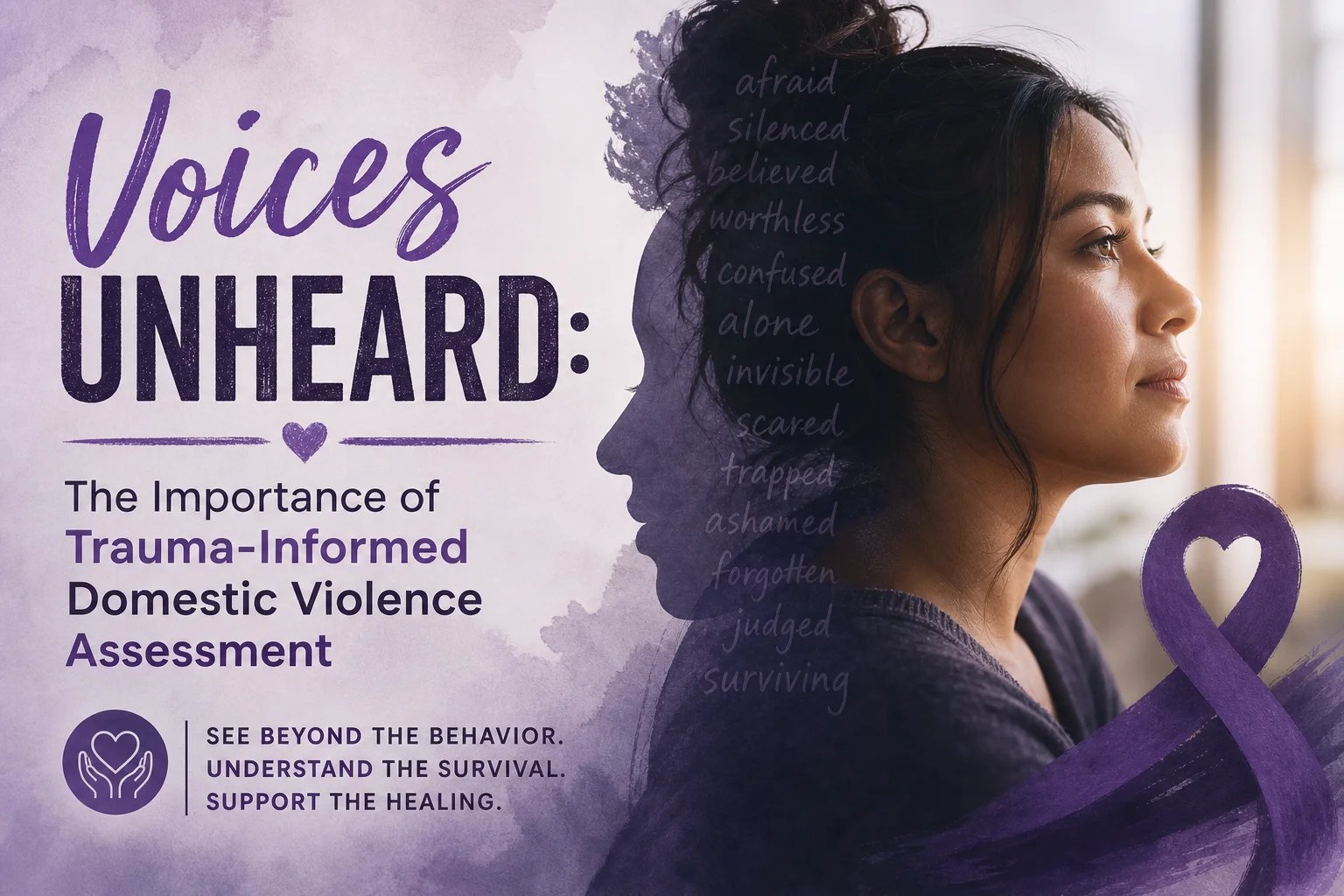
That is why Voices Unheard: The Importance of Trauma-Informed Domestic Violence Assessment is more than a professional topic. It is a life-saving practice.
Domestic violence is not always visible. It may look like control over money, isolation from friends, threats involving children or immigration status, forced sex, stalking, humiliation, digital surveillance, or emotional manipulation. Survivors often carry deep trauma, and when systems respond with disbelief, pressure, judgment, or rushed questioning, their voices become unheard all over again.
A trauma-informed domestic violence assessment changes that.
It asks not only, “What happened to you?” but also, “What do you need to feel safe enough to speak?” It recognizes that disclosure is not a single event. It is a process shaped by fear, culture, shame, survival, and trust.
This article explores Voices Unheard: The Importance of Trauma-Informed Domestic Violence Assessment in depth—why it matters, how it works, what professionals often miss, and how better assessments can help survivors regain safety, dignity, and choice.
Important note: This article is educational and not a substitute for emergency, legal, medical, or mental health care. If you or someone you know is in immediate danger, call local emergency services. In the United States, the National Domestic Violence Hotline is available at 1-800-799-7233, thehotline.org, or text START to 88788.
Understanding Voices Unheard: The Importance of Trauma-Informed Domestic Violence Assessment
At its core, Voices Unheard: The Importance of Trauma-Informed Domestic Violence Assessment is about listening in a way that does not cause further harm.
Traditional domestic violence screening often focuses on identifying abuse quickly. That is important, but it is not enough. A checklist alone cannot capture coercive control, fear, trauma responses, or the complicated reasons survivors may stay silent.
A trauma-informed approach understands that survivors may:
- Minimize abuse to protect themselves.
- Avoid details because remembering feels overwhelming.
- Recant because the danger increased after disclosure.
- Seem calm while describing severe harm.
- Appear angry, guarded, or “uncooperative” due to trauma.
- Fear losing children, housing, income, community, or legal status.
- Not identify their experience as abuse because control has been normalized.
This is where Voices Unheard: The Importance of Trauma-Informed Domestic Violence Assessment becomes essential. It helps professionals move beyond “Why didn’t they leave?” toward “What barriers, risks, and strengths are shaping this survivor’s choices?”
Why Domestic Violence Is So Often Missed
Domestic violence is not always a black eye or a police report. In fact, many survivors never contact law enforcement. Others may seek care for headaches, chronic pain, panic attacks, sleep problems, depression, pregnancy complications, or stress-related symptoms without naming abuse.
Professionals may miss domestic violence because they are looking for the wrong signs.
Common Reasons Abuse Goes Undetected
| Barrier | How It Shows Up | Why Trauma-Informed Assessment Helps |
|---|---|---|
| Fear of retaliation | Survivor avoids disclosure or changes story | Prioritizes safety and private conversation |
| Shame or self-blame | Survivor says, “It’s my fault” | Uses nonjudgmental language |
| Cultural pressure | Survivor fears family/community rejection | Includes culturally responsive questions |
| Financial dependence | Survivor feels unable to leave | Assesses practical barriers, not just abuse incidents |
| Coercive control | Partner monitors phone, transport, money | Explores patterns of control |
| System distrust | Survivor fears police, courts, child welfare | Builds choice and transparency |
| Trauma symptoms | Survivor appears numb, confused, defensive | Recognizes survival responses |
The framework of Voices Unheard: The Importance of Trauma-Informed Domestic Violence Assessment helps reveal the hidden layers. It reminds professionals that silence is not proof that violence is absent. Sometimes silence is evidence of danger.
What Makes an Assessment Trauma-Informed?
A trauma-informed domestic violence assessment is not simply a list of questions. It is a way of being with someone who may be living under threat.
The most effective assessments are built around six principles:
- Safety
- Trustworthiness
- Choice
- Collaboration
- Empowerment
- Cultural humility
When these principles guide the process, Voices Unheard: The Importance of Trauma-Informed Domestic Violence Assessment becomes practical, not theoretical.
Trauma-Informed vs. Traditional Assessment
| Traditional Assessment | Trauma-Informed Assessment |
|---|---|
| “Are you being abused?” | “Sometimes people are hurt, controlled, or frightened by someone close to them. Has anything like that happened to you?” |
| Focuses on incident-based violence | Explores patterns of coercion, fear, and control |
| May push for immediate disclosure | Allows survivor to share at their own pace |
| Asks questions in front of others | Ensures privacy and safety first |
| Measures success by reporting/leaving | Measures success by increased safety, options, and support |
| May unintentionally blame | Validates survival strategies |
| Treats the professional as expert | Treats survivor as expert in their own life |
This distinction is central to Voices Unheard: The Importance of Trauma-Informed Domestic Violence Assessment. Survivors are not cases to be solved. They are people navigating danger with limited options and remarkable resilience.
The Hidden Role of Coercive Control
One of the biggest mistakes in domestic violence assessment is focusing only on physical violence. Physical assault is serious, but it may be only one part of a larger pattern.
Coercive control can include:
- Monitoring phone calls, texts, or location.
- Controlling money or employment.
- Threatening deportation or legal consequences.
- Isolating the survivor from support.
- Using children as leverage.
- Damaging property or harming pets.
- Threatening suicide or homicide.
- Humiliating or degrading the survivor.
- Restricting access to medication, transportation, or healthcare.
A survivor may say, “They never hit me,” while living in constant fear.
That is why Voices Unheard: The Importance of Trauma-Informed Domestic Violence Assessment requires questions that uncover control, not only injury.
For example:
- “Do you feel free to make your own decisions?”
- “Does anyone monitor where you go or who you talk to?”
- “Has your partner ever threatened you, your children, your pets, or your immigration status?”
- “Are you afraid of what might happen if you disagree?”
- “Does your partner control access to money, medication, transportation, or documents?”
These questions create space for survivors whose experiences do not fit narrow stereotypes.
The Neuroscience of Trauma: Why Survivors May Not “Tell the Story Clearly”
A trauma-informed assessment also recognizes how trauma affects the brain and body.
When a person is threatened, the nervous system may shift into survival responses: fight, flight, freeze, fawn, or collapse. These responses are not choices in the ordinary sense. They are protective adaptations.
A survivor may:
- Forget details.
- Remember events out of order.
- Laugh or appear detached.
- Struggle to make decisions.
- Return to the person causing harm.
- Avoid eye contact.
- Become emotional or shut down.
Without trauma awareness, professionals may misread these responses as dishonesty, indifference, or resistance. But through the lens of Voices Unheard: The Importance of Trauma-Informed Domestic Violence Assessment, these behaviors are understood as possible signs of survival.
The goal is not to interrogate. The goal is to create enough safety for the survivor’s voice to emerge.
Building Safety Before Asking Sensitive Questions
One of the most important rules in domestic violence assessment is this: never ask sensitive questions unless it is safe to do so.
Safety includes physical privacy, emotional readiness, confidentiality clarity, and awareness of digital risks.
Before beginning, professionals should consider:
- Is the survivor alone?
- Could the partner hear the conversation?
- Is there a child, relative, interpreter, or friend present who may not be safe?
- Is the survivor’s phone being monitored?
- Are printed materials safe to take home?
- Does the survivor understand limits to confidentiality?
- Could documentation increase risk if accessed by the abusive partner?
This practical side of Voices Unheard: The Importance of Trauma-Informed Domestic Violence Assessment cannot be overstated. A careless question asked in the wrong setting may place someone in greater danger.
Safe Assessment Checklist
| Safety Step | Why It Matters |
|---|---|
| Speak privately | Abusive partners often monitor conversations |
| Use professional interpreters | Family members may distort or expose disclosures |
| Explain confidentiality | Survivors need to know what may be reported |
| Ask permission | Restores choice and control |
| Use neutral written materials | DV brochures may be dangerous if discovered |
| Assess technology safety | Phones and accounts may be monitored |
| Create a safe exit phrase | Allows survivor to stop if unsafe |
A trauma-informed professional might say:
“I ask everyone some questions about safety at home because many people experience harm or control in relationships. You do not have to answer anything you do not want to. Before we begin, is it safe for us to talk privately right now?”
That simple statement reflects Voices Unheard: The Importance of Trauma-Informed Domestic Violence Assessment in action.
Asking Better Questions: Language That Opens Doors
The way questions are asked can determine whether a survivor feels safe enough to answer.
Avoid blunt, blaming, or overly clinical language. Instead, use warm, normalizing, specific questions.
Less Helpful vs. More Trauma-Informed Questions
| Less Helpful | More Trauma-Informed |
|---|---|
| “Why haven’t you left?” | “What makes it difficult or unsafe to leave right now?” |
| “Did you provoke them?” | “No one deserves to be hurt or controlled.” |
| “Are you a victim of domestic violence?” | “Has anyone close to you made you feel afraid, trapped, or controlled?” |
| “Why did you go back?” | “What changed or what did you need at that time?” |
| “You need to report this.” | “Would you like to talk through your options?” |
| “Tell me everything that happened.” | “You can share as much or as little as feels okay.” |
This is the heart of Voices Unheard: The Importance of Trauma-Informed Domestic Violence Assessment: words matter. Tone matters. Timing matters.
Survivors often remember not only what professionals asked, but how they made them feel.
Risk Assessment: Identifying Escalation and Lethality
A trauma-informed approach is compassionate, but it is also precise. Domestic violence can escalate quickly, and risk assessment is essential.
High-risk indicators may include:
- Threats to kill the survivor, children, pets, or self.
- Strangulation or choking.
- Access to firearms or weapons.
- Stalking.
- Escalating frequency or severity of violence.
- Forced sex.
- Extreme jealousy or possessiveness.
- Recent separation or attempts to leave.
- Pregnancy.
- Substance misuse combined with violence.
- Unemployment or major stressors.
- Violation of protection orders.
- Survivor’s belief that the abuser may kill them.
A key insight in Voices Unheard: The Importance of Trauma-Informed Domestic Violence Assessment is that survivors are often the best judges of danger. If a survivor says, “I think they might kill me,” that statement must be taken seriously.
Risk assessment should not become a cold checklist. It should be woven into a conversation that validates the survivor’s instincts and supports safety planning.
Safety Planning Without Pressure
Safety planning is not the same as telling someone to leave.
In fact, leaving can be one of the most dangerous times for a survivor. A trauma-informed safety plan is individualized, realistic, and survivor-led.
It may include:
- Identifying safe people to contact.
- Creating a code word with trusted friends.
- Keeping important documents accessible.
- Planning safe routes out of the home.
- Saving emergency numbers under disguised names.
- Packing medication, keys, cash, and documents if safe.
- Reviewing digital privacy.
- Planning for children and pets.
- Connecting with advocacy services.
- Discussing legal options without pressure.
The philosophy of Voices Unheard: The Importance of Trauma-Informed Domestic Violence Assessment is choice-centered. The professional’s role is not to command. It is to support informed decisions.
A helpful phrase:
“You know your situation best. We can think through options together, and you get to decide what feels safest.”
Case Study 1: The Patient With “Unexplained” Pain
Scenario:
Maria, a 38-year-old patient, visits a community clinic several times for migraines, stomach pain, and insomnia. Her partner always comes with her and answers questions. Staff initially see him as supportive. During one visit, a nurse gently says she needs to complete part of the appointment alone with Maria, as clinic policy.
Once alone, Maria is asked, “Sometimes stress, fear, or control at home can affect health. Has anyone close to you made you feel unsafe or unable to make your own choices?” Maria pauses and says, “He doesn’t hit me. But he tracks my phone and won’t let me sleep if he’s angry.”
The clinic connects Maria with an advocate, discusses digital safety, and schedules follow-up appointments using neutral language.
Analysis:
This case shows why Voices Unheard: The Importance of Trauma-Informed Domestic Violence Assessment matters in healthcare. Maria’s symptoms were real, but the root cause was hidden by coercive control. A private, normalized, nonjudgmental question opened the door without forcing disclosure.
Case Study 2: The Teen Who Became “Defiant”
Scenario:
Jalen, a 16-year-old student, is referred to a school counselor for skipping class and arguing with teachers. Instead of starting with discipline, the counselor says, “When students are under a lot of stress, school can get hard. I’m not here to judge you. I want to understand what’s been going on.”
Over several meetings, Jalen shares that his mother’s boyfriend threatens the family, breaks objects, and controls the household. Jalen has been staying awake at night to protect his younger siblings.
The counselor works with a domestic violence agency, follows mandatory reporting requirements, and helps create a safety plan that does not put Jalen at further risk.
Analysis:
This example highlights a key lesson in Voices Unheard: The Importance of Trauma-Informed Domestic Violence Assessment: children and teens exposed to domestic violence may be mislabeled as disruptive, lazy, or oppositional. Trauma-informed assessment looks beneath behavior and asks what survival role the young person may be carrying.
Case Study 3: The Survivor Facing Immigration Threats
Scenario:
Aisha, a 29-year-old immigrant, meets with a social worker after missing several appointments for housing support. She seems anxious and hesitant. The social worker uses a professional interpreter and explains confidentiality carefully.
Aisha eventually says her spouse threatens to report her to immigration authorities if she speaks to anyone. He controls her documents and money. She fears being separated from her children.
The social worker connects her with a culturally specific domestic violence organization and legal advocacy resources.
Analysis:
This case demonstrates how Voices Unheard: The Importance of Trauma-Informed Domestic Violence Assessment must include cultural humility and awareness of immigration-related abuse. Without asking about documents, threats, language access, and fear of systems, Aisha’s experience might remain invisible.
Case Study 4: The Older Adult Whose Abuse Was Overlooked
Scenario:
Thomas, age 72, lives with his adult daughter, who is also his caregiver. A home health worker notices Thomas appears withdrawn and has missed medications. His daughter says he is “forgetful and difficult.” Instead of assuming neglect is accidental, the worker privately asks Thomas whether he feels safe and whether anyone withholds care, money, or medication.
Thomas reveals that his daughter takes his pension and refuses to refill prescriptions when angry.
The worker follows elder abuse reporting laws and connects Thomas with protective and advocacy services.
Analysis:
Domestic violence assessment must include older adults and caregiver abuse. Voices Unheard: The Importance of Trauma-Informed Domestic Violence Assessment reminds us that abuse can occur in intimate partnerships, family caregiving relationships, and households where dependency is exploited.
Intersectionality: Why Some Voices Are More Unheard Than Others
Not all survivors face the same barriers. Race, gender identity, disability, age, language, religion, poverty, immigration status, sexual orientation, and geography can shape both abuse and access to help.
For example:
- LGBTQ+ survivors may fear being outed.
- Disabled survivors may depend on the abusive person for care.
- Rural survivors may have fewer confidential resources.
- Black, Indigenous, and other survivors of color may fear discriminatory systems.
- Male survivors may fear disbelief or ridicule.
- Survivors with mental health diagnoses may be dismissed as unreliable.
- Deaf survivors may face communication barriers.
- Religious survivors may feel pressure to preserve the relationship at all costs.
A powerful application of Voices Unheard: The Importance of Trauma-Informed Domestic Violence Assessment is recognizing that “unheard” does not mean silent. Sometimes survivors are speaking, but systems are not listening in the right language, context, or cultural frame.
Documentation: Writing Records That Do Not Harm
Documentation can help survivors access protection, medical care, housing, or legal remedies. But careless documentation can also increase risk.
Trauma-informed documentation should be:
- Accurate.
- Objective.
- Survivor-centered.
- Free from blaming language.
- Clear about direct quotes.
- Sensitive to confidentiality and record access.
- Specific about observed injuries or statements.
- Careful with labels unless clinically or legally appropriate.
Instead of writing:
“Client claims partner attacked her but is inconsistent.”
Write:
“Client stated, ‘My partner pushed me into the wall.’ Client appeared tearful and paused several times. Client reported difficulty remembering the sequence of events.”
This approach reflects Voices Unheard: The Importance of Trauma-Informed Domestic Violence Assessment because it avoids turning trauma symptoms into credibility problems.
The Role of Workplaces, Schools, Clinics, and Faith Communities
Domestic violence assessment is not only the responsibility of shelters or police. Survivors often come into contact with many systems before they ever disclose abuse.
Where Trauma-Informed Assessment Can Make a Difference
| Setting | Possible Warning Signs | Trauma-Informed Response |
|---|---|---|
| Healthcare | Frequent injuries, anxiety, chronic pain, partner controlling visit | Ask privately, normalize safety questions, offer resources |
| Schools | Absences, aggression, fatigue, caregiving behavior | Explore stress and home safety gently |
| Workplace | Harassing calls, lateness, sudden performance changes | Provide confidential support and safety accommodations |
| Faith communities | Requests for marital counseling, isolation, shame | Avoid pressuring reconciliation; connect with DV advocates |
| Housing services | Eviction risk, partner sabotage, financial abuse | Screen for coercion and safety needs |
| Legal settings | Recantation, fear, confusion | Understand trauma and intimidation |
| Mental health care | Depression, PTSD, substance use, panic | Assess relationship safety as part of care |
The broad relevance of Voices Unheard: The Importance of Trauma-Informed Domestic Violence Assessment is clear: every doorway can become a safe doorway when professionals know how to listen.
Avoiding Common Mistakes
Even well-meaning professionals can cause harm if they rush, judge, or assume.
Mistakes to Avoid
Asking in front of the abusive partner.
This can put the survivor at serious risk.Treating leaving as the only success.
Safety is complex. Survivors need options, not ultimatums.Minimizing nonphysical abuse.
Coercive control can be devastating and dangerous.Overpromising confidentiality.
Always explain limits clearly.Using family members as interpreters.
This can compromise safety and accuracy.Assuming a survivor is lying because details change.
Trauma affects memory and communication.Ignoring survivor intuition.
If they feel danger is escalating, listen.- Failing to consider technology abuse.
Devices, accounts, cars, and apps may be monitored.
These mistakes are exactly why Voices Unheard: The Importance of Trauma-Informed Domestic Violence Assessment should be part of professional training across sectors.
Practical Framework: The LISTEN Model
To make Voices Unheard: The Importance of Trauma-Informed Domestic Violence Assessment easier to apply, professionals can use the LISTEN model.
| Letter | Meaning | Practice |
|---|---|---|
| L | Look for safety first | Ensure privacy, confidentiality, and immediate danger assessment |
| I | Invite, don’t interrogate | Ask permission and use gentle, normalizing language |
| S | Support autonomy | Offer options without pressure |
| T | Track patterns of control | Ask about fear, monitoring, threats, money, children, documents |
| E | Evaluate risk | Identify escalation, weapons, strangulation, stalking, threats |
| N | Navigate resources together | Connect to advocates, safety planning, legal/medical support |
The LISTEN model captures the spirit of Voices Unheard: The Importance of Trauma-Informed Domestic Violence Assessment: slow down, make room, and respond with care.
Technology Abuse: The New Front Line
Modern domestic violence often includes digital control. A survivor’s phone may be tracked. Their email may be monitored. Smart home devices may be used to intimidate. Shared accounts may reveal searches, locations, purchases, or messages.
Assessment should include questions like:
- “Do you feel safe using your phone?”
- “Does anyone know your passwords or check your messages?”
- “Has anyone used tracking apps, cameras, or devices to monitor you?”
- “Would it be safer to look up resources on a different device?”
- “Is it safe for us to call, text, email, or leave voicemail?”
This is an increasingly important part of Voices Unheard: The Importance of Trauma-Informed Domestic Violence Assessment because offering help through unsafe channels can unintentionally increase danger.
Professionals should avoid sending obvious domestic violence materials unless the survivor confirms it is safe.
When Survivors Do Not Disclose
A trauma-informed assessment does not fail when someone says, “No, everything is fine.”
The person may not be ready. It may not be safe. They may need more trust. They may not identify their experience as abuse yet.
A helpful response is:
“Thank you for answering. If anything ever changes, or if you ever feel unsafe in a relationship, you can talk with us. You deserve support.”
This keeps the door open.
The deeper message of Voices Unheard: The Importance of Trauma-Informed Domestic Violence Assessment is that every respectful interaction matters. A survivor may remember your calm, nonjudgmental response months later when they are ready to seek help.
Training Professionals to Hear What Is Not Said
Good intentions are not enough. Organizations need training, policies, supervision, and partnerships.
Effective training should include:
- Dynamics of domestic violence and coercive control.
- Trauma and the nervous system.
- Cultural humility.
- Safe screening procedures.
- Mandatory reporting and confidentiality.
- Lethality indicators.
- Safety planning.
- Documentation.
- Technology-facilitated abuse.
- Working with interpreters.
- Referral pathways.
- Vicarious trauma and staff support.
Embedding Voices Unheard: The Importance of Trauma-Informed Domestic Violence Assessment into organizational culture means professionals are not left to improvise during high-risk conversations.
Caring for the Helper: Vicarious Trauma Matters
Listening to stories of violence can affect advocates, clinicians, teachers, social workers, nurses, and first responders. Trauma-informed systems care for staff too.
Signs of vicarious trauma may include:
- Emotional exhaustion.
- Cynicism.
- Sleep disruption.
- Intrusive thoughts.
- Feeling helpless.
- Overidentifying with survivors.
- Avoidance or numbness.
Organizations should provide reflective supervision, manageable workloads, peer support, and mental health resources. The work of Voices Unheard: The Importance of Trauma-Informed Domestic Violence Assessment is meaningful, but it must be sustainable.
Helpers cannot pour from an empty cup, especially when survivors need steady, grounded support.
Measuring Success Differently
In many systems, success is measured by whether the survivor reports, leaves, prosecutes, or enters shelter. But trauma-informed practice uses broader, more humane measures.
Success may look like:
- A survivor learning abuse is not their fault.
- A first safe conversation.
- A hidden hotline number.
- A safer phone plan.
- A follow-up appointment.
- A connection to an advocate.
- A child receiving support.
- A survivor identifying a trusted person.
- A professional documenting accurately.
- A survivor feeling believed.
This is the quiet power of Voices Unheard: The Importance of Trauma-Informed Domestic Violence Assessment. It honors progress that may be invisible from the outside but life-changing on the inside.
Long-Tail Keyword Variations for Context
Relevant long-tail variations of Voices Unheard: The Importance of Trauma-Informed Domestic Violence Assessment include:
- Trauma-informed domestic violence assessment for survivors.
- Importance of trauma-informed domestic violence screening.
- Survivor-centered domestic violence assessment.
- How to conduct a trauma-informed domestic violence assessment.
- Domestic violence assessment using trauma-informed care.
- Trauma-informed intimate partner violence screening.
- Coercive control and trauma-informed assessment.
- Domestic violence risk assessment and safety planning.
- Trauma-informed questions for domestic violence survivors.
- Listening to unheard voices in domestic violence support.
These variations reflect the broader search intent behind Voices Unheard: The Importance of Trauma-Informed Domestic Violence Assessment and help connect the topic to practical survivor-centered care.
Conclusion: Hearing the Voices That Fear Has Silenced
Voices Unheard: The Importance of Trauma-Informed Domestic Violence Assessment is ultimately about restoring dignity.
It reminds us that survivors are not silent because they have nothing to say. Many are silent because speaking has been dangerous. Others have spoken before and were dismissed, blamed, rushed, or misunderstood.
A trauma-informed domestic violence assessment creates a different experience. It says:
- You are not to blame.
- You do not have to prove your pain.
- You are the expert on your own safety.
- You have choices.
- Help can move at your pace.
- Your voice matters.
Whether you are a healthcare provider, counselor, teacher, advocate, employer, faith leader, policymaker, or concerned friend, you can help make unheard voices heard. Start with safety. Ask with care. Listen without judgment. Offer options, not orders.
The most powerful assessments do not begin with forms. They begin with respect.
And sometimes, one respectful question is the first step toward freedom.
1. What is a trauma-informed domestic violence assessment?
A trauma-informed domestic violence assessment is a survivor-centered approach to identifying abuse, coercive control, safety risks, and support needs while minimizing retraumatization. It emphasizes safety, choice, trust, collaboration, empowerment, and cultural sensitivity.
2. Why is Voices Unheard: The Importance of Trauma-Informed Domestic Violence Assessment so important?
Voices Unheard: The Importance of Trauma-Informed Domestic Violence Assessment is important because many survivors do not disclose abuse directly. Trauma-informed assessment helps professionals recognize hidden signs, ask safer questions, and respond in ways that protect survivor dignity and safety.
3. What questions should professionals ask during a trauma-informed assessment?
Helpful questions include: “Do you feel safe at home?” “Has anyone close to you made you feel afraid or controlled?” “Does anyone monitor your phone, money, transportation, or relationships?” and “What would help you feel safer right now?” Questions should always be asked privately and with permission.
4. Is trauma-informed assessment only for physical abuse?
No. Trauma-informed domestic violence assessment includes emotional abuse, financial abuse, sexual coercion, stalking, technology abuse, threats, isolation, and coercive control. Physical violence may be present, but it is not the only form of harm.
5. What if a survivor does not want to leave?
Do not pressure them. Leaving can be dangerous, and survivors understand their risks better than anyone. Offer support, safety planning, resources, and reassurance. The goal is not to force a decision but to increase safety and options.
6. How can organizations improve domestic violence assessment?
Organizations can train staff, create private screening procedures, partner with domestic violence advocates, use professional interpreters, improve documentation practices, address technology safety, and build clear referral pathways.
7. What should I do if someone tells me they are experiencing domestic violence?
Listen calmly. Believe them. Avoid blaming or pushing them to act immediately. Ask what they need, help them connect with specialized support, and encourage them to consider safety planning. If there is immediate danger, contact emergency services.
8. Can trauma-informed assessment reduce harm?
Yes. When done correctly, Voices Unheard: The Importance of Trauma-Informed Domestic Violence Assessment can reduce harm by improving safety, strengthening trust, identifying high-risk situations, connecting survivors to resources, and preventing systems from retraumatizing people who are already under threat.
About the Author


The PsyForU Editorial Collective is the research and editorial team of PsyForU Research International. The collective prepares educational, psychological, mental-health-awareness, inclusion, neurodiversity, and research-methodology content for students, parents, educators, researchers, and general readers. PsyForU content is intended for awareness, education, and capacity-building and should not be treated as clinical diagnosis, therapy, medical advice, legal advice, or emergency mental-health support.