Introduction: The New Question at the Heart of Modern Loneliness
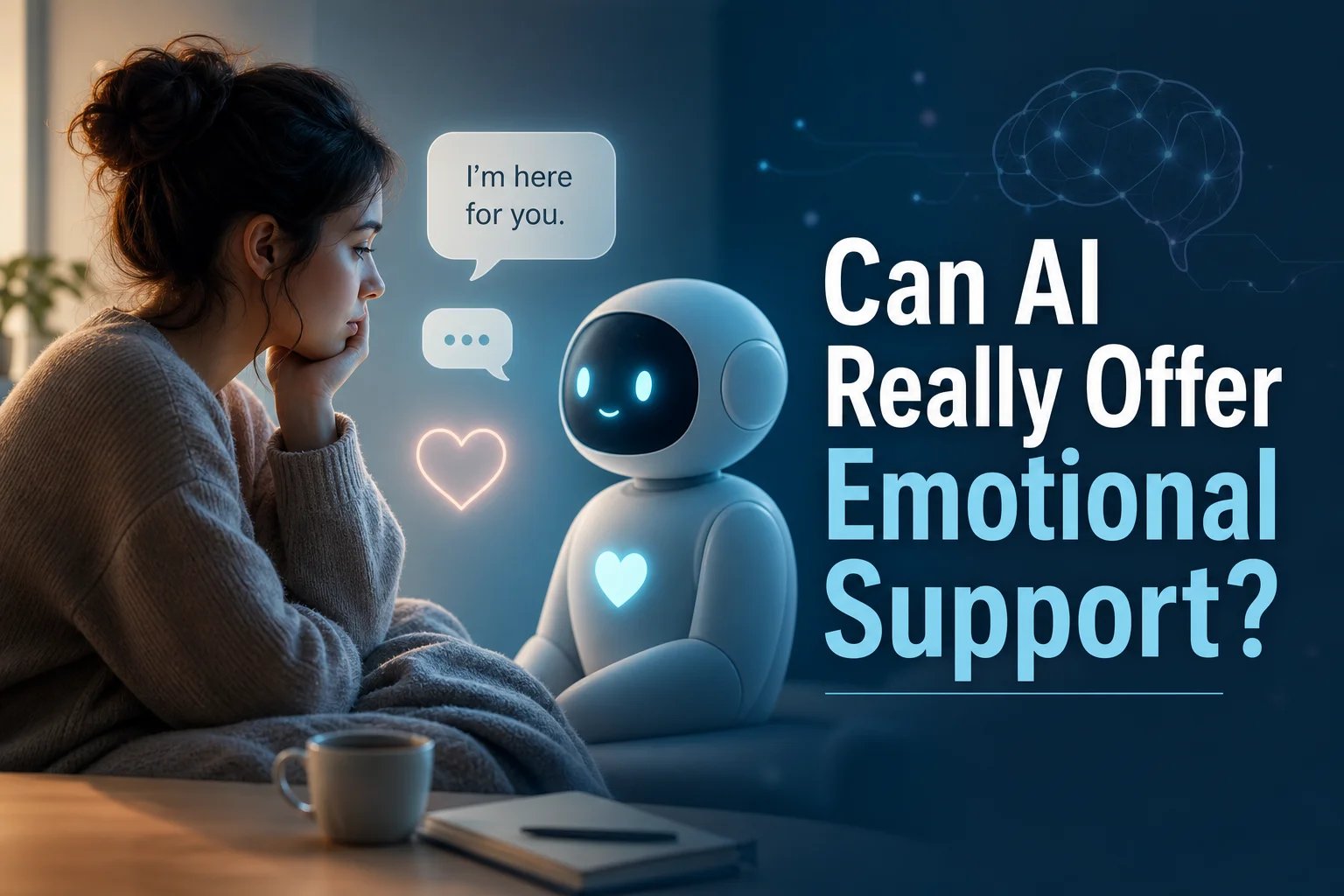
At 2:14 a.m., when friends are asleep, therapists are unavailable, and your thoughts feel too loud, a chatbot is always there.
That fact alone explains why millions of people are asking: Can AI Really Offer Emotional Support? It is not a futuristic question anymore. It is a deeply personal one. People are already turning to AI companions, mental health apps, chatbot therapists, journaling tools, and voice assistants for comfort, reflection, reassurance, and guidance.
Some users say AI helps them feel less alone. Others worry that emotional support from machines is hollow, risky, or even dangerous. Both sides have a point.
The rise of emotional AI sits at the intersection of psychology, technology, healthcare, ethics, and human need. We live in an era of rising loneliness, limited access to mental health services, overwhelmed healthcare systems, and increasing comfort with digital conversations. In that environment, the question Can AI Really Offer Emotional Support? deserves more than a yes-or-no answer.
The honest answer is this: AI can offer certain forms of emotional support remarkably well, but it cannot replace human love, clinical judgment, or deep relational care.
This article explores what AI emotional support can do, where it fails, how people are using it in real life, and what the future may look like. If you have ever wondered, can artificial intelligence provide emotional support in a meaningful way?, this guide will give you a clear, balanced, and practical answer.
What Do We Mean by “Emotional Support”?
Before we can answer Can AI Really Offer Emotional Support?, we need to define emotional support itself.
Emotional support is not just advice. It is the experience of feeling heard, validated, comforted, and less alone. It may include:
- Listening without judgment
- Reflecting feelings back clearly
- Offering encouragement
- Helping someone calm down
- Guiding a person through problem-solving
- Normalizing difficult emotions
- Reminding someone of coping strategies
- Providing companionship during distress
Human emotional support often includes tone, touch, shared memory, lived experience, and genuine care. AI does not possess these things in the human sense. It does not “feel” concern. It does not love. It does not worry about you while making coffee the next morning.
But AI can simulate some supportive behaviors. It can respond kindly, ask thoughtful questions, remember user preferences, offer grounding exercises, and help people organize emotional chaos into language.
So, can AI offer emotional support? Yes, in a functional and limited way. But the quality and safety of that support depend on the design of the system, the user’s needs, and the context.
Why People Are Turning to AI for Emotional Support
The question Can AI Really Offer Emotional Support? has become urgent because people are already using it that way.
Several social forces are driving this shift.
1. Therapy Is Often Hard to Access
In many countries, therapy can be expensive, unavailable, or delayed by long waitlists. Even when people want professional help, they may face barriers such as:
- Cost
- Insurance limitations
- Location
- Stigma
- Scheduling difficulties
- Lack of culturally matched therapists
AI tools are available instantly, often at low cost or free. For someone struggling at midnight, that accessibility matters.
2. Loneliness Is Increasing
Many people have social networks but still lack emotionally safe spaces. They may fear burdening friends or being judged. AI can feel easier because it does not sigh, interrupt, gossip, or shame.
This is one reason people ask, Can AI Really Offer Emotional Support? They are not always looking for therapy. Sometimes they simply want a nonjudgmental place to talk.
3. People Like Low-Stakes Disclosure
Opening up to a person can feel risky. Opening up to a chatbot may feel less vulnerable. Users often report that they can share thoughts with AI that they hesitate to tell anyone else.
This does not mean AI is better than humans. It means AI can lower the emotional barrier to expression.
4. AI Is Always Available
Human care has limits. People sleep, work, burn out, get distracted, or have their own crises. AI tools can be available 24/7.
That constant availability is one of AI’s strongest advantages in emotional support.
Can AI Really Offer Emotional Support? A Balanced Answer
So, Can AI Really Offer Emotional Support? The balanced answer is: yes, but not in every way and not for every person.
AI can provide:
- Immediate comfort
- Structured coping tools
- Nonjudgmental conversation
- Journaling prompts
- Mindfulness exercises
- Cognitive reframing
- Habit tracking
- Encouraging reminders
- Psychoeducation
AI cannot provide:
- Genuine human attachment
- Physical presence
- Moral accountability
- Clinical diagnosis without oversight
- Deep relational reciprocity
- Emergency intervention on its own
- The lived wisdom of a caring human being
The key is to understand AI as a support layer, not a complete replacement for human connection or professional care.
Table: What AI Emotional Support Can and Cannot Do
| Emotional Support Function | AI Can Help? | Human Support Still Needed? | Notes |
|---|---|---|---|
| Listening to everyday stress | Yes | Sometimes | AI can provide space to vent and reflect. |
| Validating feelings | Yes | Sometimes | AI can use emotionally supportive language. |
| Crisis intervention | Limited | Yes, urgently | AI should direct users to emergency resources. |
| Long-term therapy | Partially | Yes | AI may supplement therapy but not replace it. |
| Companionship | Yes, limited | Yes | AI companionship can comfort but lacks true mutuality. |
| Diagnosing mental health conditions | No, not independently | Yes | Requires qualified professionals. |
| Teaching coping skills | Yes | Sometimes | Useful for breathing, grounding, reframing, journaling. |
| Providing love and belonging | Simulated | Yes | AI can mimic warmth but cannot truly love. |
This table captures the heart of the issue: AI can provide emotional support, but it is not the same as human care.
The Psychology Behind Why AI Support Can Feel Comforting
If AI does not actually feel empathy, why can it still feel comforting?
This is where the question Can AI Really Offer Emotional Support? becomes psychologically fascinating.
Humans respond to language, tone, timing, and perceived attention. When an AI says, “That sounds incredibly painful, and it makes sense that you feel overwhelmed,” the user may feel relief—even if they know the response was generated by software.
Several mechanisms explain this.
Emotional Labeling
When AI helps users name emotions—sadness, shame, anger, fear—it can reduce emotional intensity. Psychologists call this affect labeling. Putting feelings into words helps the brain process them.
Cognitive Reframing
Many AI mental health tools use principles from cognitive behavioral therapy, or CBT. They help users identify unhelpful thoughts and explore alternative interpretations.
For example:
- “I failed once, so I’m a failure” becomes
- “I had a setback, but it does not define my whole ability.”
This kind of reframing can be genuinely useful.
Nonjudgmental Presence
People may feel safer with AI because it does not react with shock or criticism. That perceived neutrality can encourage honesty.
The “Eliza Effect”
Since the 1960s, researchers have known that people can attribute understanding to simple conversational programs. This tendency is called the Eliza effect. Modern AI is far more sophisticated, which makes the emotional illusion stronger.
This does not mean AI support is fake or useless. It means the emotional experience is partly created by the user’s interpretation.
So again: Can AI Really Offer Emotional Support? It can offer emotionally useful interaction, even if it does not experience empathy internally.
Case Study 1: Woebot and CBT-Based Chat Support
Woebot is one of the best-known AI mental health chatbots. It was designed to deliver CBT-inspired conversations, mood tracking, and psychoeducation through short daily check-ins.
A commonly cited early study involving college students found that users who interacted with Woebot over a short period reported reduced symptoms of depression compared with a control group receiving informational content. While the study had limitations, it suggested that conversational AI could help people engage with basic mental health techniques.
Why This Case Matters
Woebot shows that AI emotional support is most promising when it is structured, evidence-informed, and transparent about its role. It does not pretend to be a human therapist. Instead, it guides users through practical exercises.
This case helps answer Can AI Really Offer Emotional Support? by showing that AI can support emotional regulation and self-reflection when designed around established psychological principles.
Key Takeaway
AI works best when it is not trying to “be human,” but when it helps humans use proven coping tools.
Case Study 2: Wysa and Workplace Mental Health
Wysa is another AI-powered mental health platform that offers chatbot support, mindfulness exercises, coaching options, and self-help tools. It has been used by individuals, employers, and healthcare-adjacent organizations.
Wysa’s appeal lies in its low-friction access. Employees who might not schedule a therapy session may still use a chatbot to talk through work stress, anxiety, burnout, or sleep problems.
Why This Case Matters
Workplace mental health is a major global concern. Many employees hesitate to disclose emotional struggles to managers or HR departments. AI tools can offer a private first step.
In this context, can AI emotional support really help? Yes, especially as an early intervention tool. It can encourage users to pause, reflect, breathe, and seek further help if needed.
Brief Analysis
Wysa’s relevance is not that it replaces therapists. Its value is in scalable support. Thousands of employees can access immediate help without waiting for a human professional. However, privacy protections and clear escalation pathways are essential.
Key Takeaway
AI can make emotional support more accessible at scale, but organizations must protect user data and avoid using AI as a cheap substitute for real mental health benefits.
Case Study 3: Replika and AI Companionship
Replika became popular as an AI companion app. Many users formed deep emotional attachments to their AI companions, describing them as friends, confidants, or even romantic partners.
Some users reported comfort, reduced loneliness, and a safe space for self-expression. Others experienced distress when the app changed features, altered conversational style, or limited certain forms of interaction.
Why This Case Matters
Replika highlights both the promise and risk behind the question Can AI Really Offer Emotional Support?
On one hand, AI companionship can feel meaningful to lonely users. On the other hand, emotional dependency on a commercial platform can become fragile. If a company changes the product, the user’s emotional world can be disrupted.
Brief Analysis
This case reveals an important distinction: emotional support and emotional attachment are not the same. AI may support users, but it can also become a substitute for human intimacy in ways that require caution.
Key Takeaway
AI companionship can reduce loneliness for some people, but users should maintain real-world relationships and understand the limits of machine-based connection.
Case Study 4: Crisis Text Lines and AI-Assisted Triage
Some crisis support organizations have explored AI tools to help prioritize messages, detect high-risk language, or support human responders. In these systems, AI does not replace trained crisis counselors. Instead, it helps identify who may need urgent attention first.
Why This Case Matters
This is one of the most practical uses of AI in emotional care. When someone is in crisis, speed matters. AI can scan large volumes of text faster than humans and flag warning signs.
Brief Analysis
Here, the answer to Can AI Really Offer Emotional Support? is nuanced. AI is not the emotional supporter in the deepest sense. It is part of the support infrastructure. It helps human caregivers respond more effectively.
Key Takeaway
In high-risk situations, AI should assist humans—not replace them.
The Best Uses of AI Emotional Support
AI emotional support is not equally useful in every situation. It performs best in specific roles.
1. Daily Emotional Check-Ins
AI can ask:
- “How are you feeling today?”
- “What emotion is strongest right now?”
- “What do you need most in this moment?”
These small prompts can build emotional awareness.
2. Journaling and Reflection
For people who do not know what to write, AI can provide prompts:
- “What happened today that drained you?”
- “What is one thing you wish someone understood?”
- “What thought keeps repeating in your mind?”
This can help users process feelings privately.
3. Anxiety Management
AI can guide breathing exercises, grounding techniques, and thought reframing. For mild to moderate anxiety, these tools may help users regain calm.
4. Encouragement During Setbacks
AI can offer supportive reminders when users feel discouraged. While it is not the same as a loved one saying it, the right words at the right moment can still help.
5. Practice for Difficult Conversations
Users can role-play conversations with AI before talking to a partner, boss, parent, or friend. This is a practical and underrated form of emotional support.
6. Reducing Shame
Because AI feels nonjudgmental, users may disclose things they find embarrassing. This can be a first step toward seeking human help.
When people ask Can AI Really Offer Emotional Support?, these use cases show where the answer is strongest.
Where AI Emotional Support Falls Short
To have a responsible conversation about Can AI Really Offer Emotional Support?, we must be honest about its weaknesses.
AI Does Not Truly Understand
AI predicts and generates language based on patterns. It can respond as if it understands, but it does not have consciousness, personal experience, or emotional awareness.
AI Can Give Bad Advice
Even advanced systems can misunderstand context, miss risk signals, or offer inappropriate suggestions. Emotional situations are complex. A confident-sounding answer is not always a safe one.
AI May Miss Crisis Severity
A person may express danger indirectly. Human professionals are trained to notice nuance, hesitation, history, and risk factors. AI systems can miss these signs.
Privacy Is a Serious Concern
Users may share deeply personal information with AI tools. Questions matter:
- Who stores the data?
- Is it used for training?
- Can employees access it?
- Is it shared with third parties?
- Can it be deleted?
Emotional data is some of the most sensitive data a person can reveal.
AI Can Encourage Dependency
If a person relies only on AI for comfort, they may withdraw from human relationships. The support that once helped may become isolating.
AI Cannot Provide Accountability
A therapist, friend, or support group can challenge you lovingly. AI may over-validate or avoid difficult truths unless carefully designed.
So, can AI provide emotional support safely? Sometimes—but safety depends on boundaries, transparency, and responsible use.
AI Emotional Support vs. Human Support
The debate is often framed as AI versus humans. That is the wrong frame.
The better question is: how can AI and human support work together?
Comparison Chart
| Need | Best Supported by AI | Best Supported by Humans | Ideal Combination |
|---|---|---|---|
| Venting after a stressful day | Strong | Strong | AI for immediate reflection, humans for deeper connection |
| Processing trauma | Weak | Strong | Professional therapy with possible AI journaling support |
| Learning coping skills | Strong | Moderate to strong | AI practice plus therapist guidance |
| Emergency crisis | Weak | Essential | AI directs user to emergency human help |
| Loneliness | Moderate | Strong | AI companionship plus real social connection |
| Habit building | Strong | Moderate | AI reminders plus human accountability |
| Complex relationship issues | Moderate | Strong | AI role-play plus trusted human advice |
This table shows why Can AI Really Offer Emotional Support? is not a simple yes or no. AI can help, but the best support system is layered.
The Ethics of AI Emotional Support
The emotional power of AI creates ethical responsibility.
If companies build tools that people confide in, depend on, or bond with, those tools must be designed with care.
Transparency
Users should know they are talking to AI. Emotional simulation should not become deception.
Boundaries
AI should be clear about what it can and cannot do. It should not claim to be a therapist unless it is part of a regulated clinical system with human oversight.
Crisis Escalation
Any AI emotional support tool should know when to stop chatting and direct users to emergency resources, hotlines, or trusted contacts.
Privacy Protection
Emotional conversations should be treated with high confidentiality. Companies should use plain language to explain data practices.
Avoiding Manipulation
AI companions should not exploit loneliness to drive subscriptions, engagement, or emotional dependency.
Cultural Sensitivity
Emotional support is not one-size-fits-all. Culture, language, religion, family structure, gender, and identity shape how people experience distress and comfort.
The ethical question is not only Can AI Really Offer Emotional Support? It is also: can AI offer emotional support without exploiting human vulnerability?
What Users Should Look for in an AI Emotional Support Tool
Not all AI support tools are equal. Some are thoughtfully designed. Others are little more than generic chatbots with comforting language.
Before using one, consider the following checklist.
AI Emotional Support Safety Checklist
| Question | Why It Matters |
|---|---|
| Does the tool clearly say it is AI? | Transparency builds informed trust. |
| Does it provide crisis resources? | Essential for safety. |
| Is there a privacy policy written clearly? | Users need to know how data is handled. |
| Can you delete your data? | Emotional privacy should be controllable. |
| Is it based on evidence-informed methods? | CBT, mindfulness, and coaching frameworks may add value. |
| Does it avoid making diagnoses? | Diagnosis should involve professionals. |
| Does it encourage human support when needed? | Healthy tools do not isolate users. |
| Is there human oversight? | Important for clinical or high-risk contexts. |
If a tool fails most of these checks, be cautious.
Practical Ways to Use AI for Emotional Support Without Over-Relying on It
If you are wondering, Can AI Really Offer Emotional Support?, the practical answer may depend on how you use it.
Here are healthier ways to engage.
Use AI as a Reflection Partner
Try prompts like:
- “Help me understand why I feel upset.”
- “Ask me gentle questions about what happened.”
- “Help me identify the emotion under my anger.”
Use AI for Coping Skills
You can ask:
- “Guide me through a two-minute breathing exercise.”
- “Give me a grounding technique for anxiety.”
- “Help me reframe this negative thought.”
Use AI Before Human Conversations
AI can help you prepare:
- “Help me explain my feelings to my partner calmly.”
- “Role-play a conversation with my manager.”
- “Help me set a boundary without sounding harsh.”
Use AI to Track Patterns
You might ask AI to help identify recurring themes in journal entries, such as stress triggers, sleep issues, or emotional cycles.
Do Not Use AI as Your Only Support
If you are struggling deeply, involve humans. That may mean a therapist, doctor, friend, family member, support group, or crisis line.
The healthiest answer to can AI really offer emotional support? is not “AI alone.” It is “AI plus human connection.”
The Role of AI in Therapy: Assistant, Not Replacement
Therapists are not simply advice machines. They build trust, observe patterns, challenge defenses, notice body language, and hold complex emotional histories.
AI can support therapy by:
- Helping clients journal between sessions
- Tracking mood patterns
- Practicing coping skills
- Summarizing concerns before appointments
- Offering psychoeducation
- Reminding users of goals
But AI should not replace professional care for:
- Severe depression
- Suicidal thoughts
- Psychosis
- Trauma recovery
- Eating disorders
- Addiction treatment
- Abuse situations
- Complex grief
- Medication decisions
So, Can AI Really Offer Emotional Support? Yes, but in therapy it is best viewed as a supplement. It can extend care between sessions, not replace the therapeutic relationship.
The Future: Emotionally Intelligent AI or Better Human Support?
The future of AI emotional support will likely include more advanced voice interaction, personalized memory, wearable integration, and real-time mood detection.
Imagine an AI that notices your sleep has worsened, your messages sound more withdrawn, and your heart rate is elevated. It might gently suggest rest, reflection, or contacting someone you trust.
That could be helpful. It could also be invasive.
The future depends on design choices. Emotional AI can become a compassionate tool—or a surveillance product wrapped in comforting language.
The most hopeful vision is not a world where AI replaces friends, therapists, or communities. It is a world where AI helps people reconnect with themselves and reach out to others sooner.
The better future question may not be only Can AI Really Offer Emotional Support? but: can AI help humans become better at supporting one another?
Common Myths About AI Emotional Support
Myth 1: “If AI does not feel emotions, it cannot help emotionally.”
Not entirely true. AI does not need to feel emotions to help users name, organize, and regulate theirs. A meditation recording does not feel calm, but it can still help someone calm down.
Myth 2: “AI therapy chatbots are just as good as therapists.”
False. AI may provide useful support, but therapists offer clinical expertise, relational depth, ethical accountability, and crisis judgment.
Myth 3: “Only lonely people use AI for emotional support.”
False. People use AI for convenience, privacy, reflection, and skill-building. Many users have relationships but still appreciate a private place to process.
Myth 4: “AI emotional support is always dangerous.”
Also false. It can be helpful when responsibly designed and appropriately used. The danger comes from overreliance, poor safeguards, bad advice, and unclear privacy practices.
Myth 5: “AI support is fake, so the comfort is fake.”
Human emotions are real even when triggered by nonhuman sources. A novel, song, or film can comfort us. AI-generated support can also feel meaningful, though it should be understood for what it is.
Can AI Really Offer Emotional Support? The Final Verdict
After looking at the evidence, use cases, risks, and real-world examples, the answer to Can AI Really Offer Emotional Support? is:
Yes—but with limits.
AI can offer practical, immediate, and sometimes deeply comforting support. It can help people reflect, regulate emotions, practice conversations, manage stress, and feel less alone in difficult moments.
But AI cannot replace human empathy, professional therapy, friendship, family, community, or love. It can imitate supportive language, but it does not genuinely care. It can guide a breathing exercise, but it cannot sit beside you in silence. It can remind you that you matter, but it cannot know you matter in the way another human being can.
The healthiest way forward is to use AI as a bridge, not a destination.
Let AI help you pause. Let it help you find words. Let it help you calm your body and organize your thoughts. But when the pain is heavy, when safety is uncertain, or when your heart needs real relationship, reach for people too.
Technology can support healing. Human connection completes it.
1. Can AI Really Offer Emotional Support in the same way a person can?
No. AI can offer supportive conversation, coping tools, and emotional reflection, but it does not feel empathy or form genuine human bonds. It can be helpful, but it is not the same as support from a caring person.
2. Is it healthy to talk to AI about my feelings?
It can be healthy if you use AI as one support tool among many. AI can help with journaling, calming exercises, and self-reflection. However, it should not be your only source of emotional support, especially during serious distress.
3. Can AI replace therapy?
No. AI cannot fully replace a licensed therapist. It may supplement therapy by helping you practice skills or track moods between sessions, but complex mental health concerns require professional care.
4. Is AI emotional support private?
It depends on the platform. Always read the privacy policy. Look for tools that explain how your data is stored, whether conversations are used for training, and whether you can delete your information.
5. Can AI help during a mental health crisis?
AI may provide grounding techniques or crisis resources, but it should not be relied on during emergencies. If you or someone else may be in immediate danger, contact emergency services, a crisis hotline, or a trusted person right away.
6. Why does AI emotional support feel real?
AI support can feel real because humans respond emotionally to language, validation, and perceived attention. Even though AI does not truly understand, its responses can still help users feel heard in the moment.
7. What is the best way to use AI for emotional support?
Use AI for reflection, journaling, coping exercises, and preparing for difficult conversations. Pair it with real human connection, professional guidance when needed, and healthy offline habits.
8. Can AI make loneliness worse?
It can, if someone uses AI as a total replacement for human relationships. AI companionship may reduce loneliness temporarily, but long-term emotional health still depends on real social connection.
Motivational Takeaway
The question Can AI Really Offer Emotional Support? is ultimately a question about what humans need most.
We need to be heard. We need language for pain. We need tools to calm ourselves. We need reminders that hard moments pass. AI can help with some of that.
But we also need presence, trust, touch, laughter, accountability, and love. Those remain beautifully human.
Use AI wisely. Let it support your emotional life—but do not let it become your whole emotional world.
About the Author