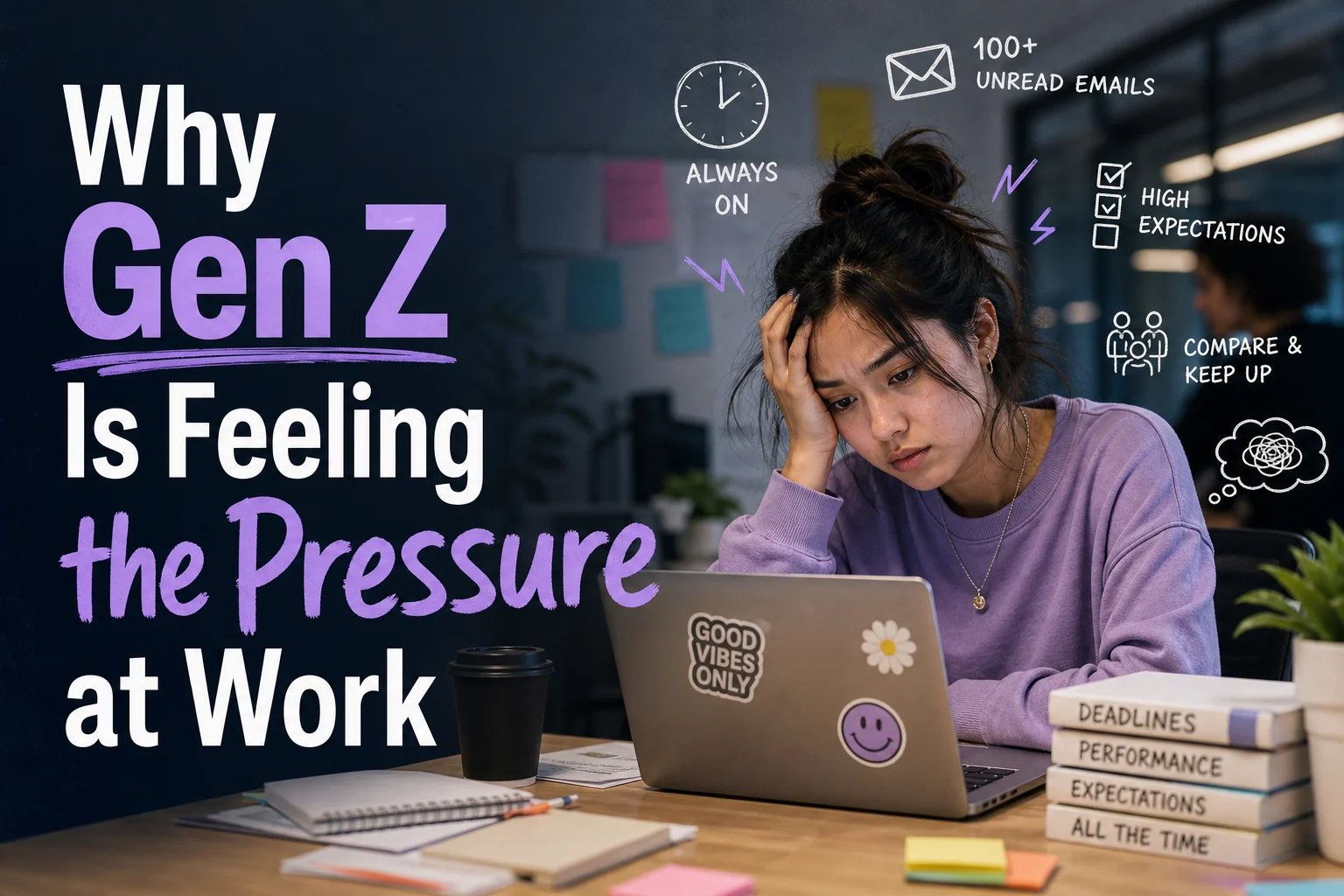
Gen Z entered the workforce with a reputation for confidence, digital fluency, and big expectations. But behind the memes about “quiet quitting,” flexible work demands, and side hustles is a more serious reality: many young workers are carrying intense pressure at work before they have even had time to build professional confidence.
Understanding Why Gen Z Is Feeling the Pressure at Work matters because this generation is not a small workplace footnote. Gen Z is rapidly becoming a major part of the global labor force. Their experience will shape company culture, leadership expectations, productivity trends, and the future of work itself.
The pressure they feel is not simply about being “too sensitive” or “not wanting to work hard.” That explanation is lazy—and usually wrong. The real story is more layered. Gen Z is navigating economic uncertainty, digital overload, unstable career paths, rising costs, social comparison, mental health challenges, and workplace systems that were often designed for a very different era.
This article explores Why Gen Z Is Feeling the Pressure at Work, what employers often misunderstand, how young professionals are responding, and what both organizations and Gen Z workers can do to create healthier, more sustainable careers.
Understanding the Gen Z Workplace Moment
Gen Z generally refers to people born between the late 1990s and early 2010s. Many are now early-career employees, interns, freelancers, entrepreneurs, and first-time managers.
They grew up with smartphones, social media, remote learning, economic disruption, climate anxiety, political polarization, and a pandemic that changed how people think about work. That background matters.
When people ask Why Gen Z Is Feeling the Pressure at Work, they are often asking the wrong question. It is not, “Why can’t young workers cope?” A better question is, “What kind of workplace are they entering, and what pressures are unique to this moment?”
Gen Z is not weak. They are adapting to a workplace that is faster, more visible, more uncertain, and more emotionally demanding than many previous generations experienced at the same age.
Quick Snapshot: Why Gen Z Is Feeling the Pressure at Work
| Pressure Point | What It Looks Like at Work | Why It Hits Gen Z Hard |
|---|---|---|
| Economic instability | Fear of layoffs, low starting salaries, student debt, high rent | Many entered adulthood during inflation, recession fears, and job market volatility |
| Digital overload | Constant notifications, Slack fatigue, always-on expectations | Gen Z has lived online but often struggles to disconnect from work |
| Career uncertainty | Pressure to grow fast, switch jobs, build a personal brand | Traditional career ladders feel less reliable |
| Mental health strain | Anxiety, burnout, emotional exhaustion | Gen Z is more open about mental health but also reports high stress |
| Social comparison | Seeing peers succeed online | LinkedIn, TikTok, and Instagram amplify career comparison |
| Lack of workplace support | Unclear expectations, limited mentorship | Many started careers remotely or in hybrid settings |
| Values conflict | Wanting purpose, ethics, inclusion, and flexibility | Gen Z often expects work to align with personal values |
This table gives a clear overview of Why Gen Z Is Feeling the Pressure at Work, but the deeper story is found in the daily experiences behind each factor.
1. Economic Anxiety Is Shaping Gen Z’s Work Experience
One major reason Why Gen Z Is Feeling the Pressure at Work is economic uncertainty.
Many Gen Z workers are entering the workforce during a time when rent is expensive, wages often feel insufficient, and long-term financial security seems harder to achieve. Even those with full-time jobs may feel like they are falling behind.
For previous generations, a stable job often came with a clearer promise: work hard, move up, buy a home, build savings, retire comfortably. Gen Z sees that promise as far less guaranteed.
They are not imagining the pressure. Housing costs, healthcare expenses, student loans, and inflation have made adulthood more expensive. At the same time, entry-level roles often demand experience, technical skills, emotional intelligence, and adaptability—while offering limited training.
How Economic Pressure Shows Up at Work
| Economic Concern | Workplace Behavior It Can Trigger |
|---|---|
| Fear of layoffs | Overworking, avoiding vacation, reluctance to speak up |
| High rent or debt | Taking side gigs, accepting poor work-life balance |
| Low salary growth | Job hopping, salary transparency conversations |
| Uncertain future | Anxiety, disengagement, difficulty planning long-term |
This is a key part of Why Gen Z Is Feeling the Pressure at Work: work is not only a place to earn money. It has become the battlefield where they fight for stability in an unstable world.
2. The “Always-On” Digital Workplace Is Exhausting
Gen Z is often called the first truly digital-native generation. But being comfortable with technology does not mean being immune to digital burnout.
In fact, digital fluency can create its own trap. Employers may assume Gen Z workers are naturally available, fast, and comfortable juggling multiple platforms. Email, Slack, Teams, project management tools, video calls, shared docs, calendar alerts, and workplace apps can make the workday feel endless.
This helps explain Why Gen Z Is Feeling the Pressure at Work even in jobs that are technically “flexible.” Remote and hybrid work can reduce commuting stress, but it can also blur boundaries. If work lives on the same laptop and phone as friends, entertainment, banking, and personal life, switching off becomes difficult.
The Digital Pressure Cycle
| Stage | What Happens | Result |
|---|---|---|
| Notification | A message arrives after hours | Worker feels urgency |
| Response | Worker replies quickly | Availability becomes expected |
| Reinforcement | Manager or team praises responsiveness | Boundary weakens |
| Habit | Worker checks constantly | Stress becomes normal |
| Burnout | Rest time disappears | Energy and creativity decline |
One overlooked reason Why Gen Z Is Feeling the Pressure at Work is that the modern office no longer ends at the office door. For many young professionals, work follows them into bed, weekends, vacations, and even social time.
3. Gen Z Is Starting Careers Without Enough Mentorship
A major factor in Why Gen Z Is Feeling the Pressure at Work is the lack of structured guidance.
Many Gen Z employees began school, internships, or early jobs during pandemic disruption. Some missed out on informal office learning: overhearing how colleagues handle clients, watching managers navigate conflict, learning professional norms in real time, or getting casual feedback after meetings.
Remote work can be efficient, but it can also isolate early-career employees. A senior worker may appreciate fewer interruptions. A new worker may interpret silence as failure.
When expectations are unclear, Gen Z employees often fill the gap with anxiety.
They may wonder:
- Am I doing this right?
- Should I ask more questions or fewer?
- Is my manager disappointed?
- What does “take ownership” actually mean?
- How do I know if I am ready for promotion?
- Why does everyone else seem to understand things I was never taught?
This is one reason Why Gen Z Is Feeling the Pressure at Work in ways leaders may not immediately notice. The pressure is not always visible. It can look like over-preparation, perfectionism, avoidance, or sudden disengagement.
Case Study 1: The Remote Graduate Who Never Got the “Office Manual”
Scenario:
Maya, a 23-year-old marketing coordinator, started her first full-time job remotely. Her manager was kind but busy. Team meetings were short, and most communication happened through Slack. Maya received tasks like “draft campaign ideas” or “support the launch,” but little context about what good work looked like.
After three months, she was exhausted. She worked late, rewrote simple emails multiple times, and avoided asking questions because she did not want to seem incompetent. Her manager assumed she was quiet but doing fine.
Eventually, Maya admitted she felt lost. The company paired her with a mentor, created weekly check-ins, and gave her examples of strong past work. Within two months, her confidence and output improved noticeably.
Analysis
Maya’s experience shows Why Gen Z Is Feeling the Pressure at Work when onboarding is weak. Her stress was not caused by laziness or entitlement. It came from ambiguity, isolation, and lack of feedback.
The lesson for employers is simple: early-career workers need more than tasks. They need context, examples, expectations, and human connection.
4. Social Media Has Turned Career Growth Into a Public Performance
Another important reason Why Gen Z Is Feeling the Pressure at Work is the constant visibility of other people’s achievements.
Previous generations compared themselves to classmates, neighbors, siblings, or coworkers. Gen Z compares themselves to everyone—every day.
On LinkedIn, someone is always announcing a promotion. On TikTok, someone is making six figures at 24. On Instagram, someone is working remotely from Bali. On YouTube, someone is explaining how they quit corporate life and built a business in six months.
Even when Gen Z knows social media is curated, comparison still affects confidence.
This creates a strange workplace tension. Gen Z is told to be patient and “pay dues,” while online culture tells them they should already be thriving, earning, investing, traveling, healing, networking, and building a personal brand.
That emotional contradiction is central to Why Gen Z Is Feeling the Pressure at Work.
The Comparison Trap
| Online Message | Internal Pressure |
|---|---|
| “I landed my dream job at 22” | “I am behind” |
| “Here is my six-figure remote routine” | “I am underpaid” |
| “I quit my job and became my own boss” | “Maybe I am wasting my life” |
| “Your 20s determine your future” | “Every decision feels permanent” |
| “Build your personal brand” | “I have to perform even after work” |
The problem is not ambition. Ambition can be powerful. The problem is constant comparison without full context.
5. Gen Z Wants Meaning—but Work Often Feels Transactional
A common discussion around Why Gen Z Is Feeling the Pressure at Work centers on values.
Gen Z is often described as purpose-driven. Many want work that aligns with their beliefs around inclusion, sustainability, mental health, ethics, and social impact. Some leaders misinterpret this as unrealistic idealism.
But the desire for meaning is not new. What is new is Gen Z’s willingness to question workplaces that fail to match their stated values.
They grew up watching companies make public commitments about diversity, climate, wellness, and community. They also learned to spot performative messaging. If an employer claims to care about well-being but rewards constant overtime, Gen Z notices. If a company celebrates inclusion but lacks diverse leadership, Gen Z notices. If a brand talks about sustainability while ignoring harmful practices, Gen Z notices.
This is another layer of Why Gen Z Is Feeling the Pressure at Work. They are not only trying to perform well. They are also trying to reconcile personal values with corporate realities.
For many young workers, the question is not just, “Can I succeed here?” It is, “Can I succeed here without becoming someone I do not want to be?”
6. Mental Health Awareness Is Higher—but So Are Stress Levels
Gen Z is more open about mental health than many previous generations. They are more likely to discuss anxiety, burnout, therapy, boundaries, and emotional well-being.
Some employers see this openness and assume Gen Z is fragile. But a more accurate interpretation is that Gen Z has a better vocabulary for stress.
One reason Why Gen Z Is Feeling the Pressure at Work is that they are naming problems that used to be ignored. Burnout existed long before Gen Z. Toxic managers existed long before Gen Z. Workplace anxiety existed long before Gen Z. The difference is that younger workers are less willing to pretend these issues are normal.
That said, awareness alone does not remove pressure. In some cases, it can create a painful gap: Gen Z knows what healthy work should look like, but they still need income, experience, and stability.
So they may remain in stressful jobs while knowing the stress is harmful. That contradiction can be emotionally draining.
Case Study 2: The High Performer Who Burned Out in Silence
Scenario:
Jordan, a 25-year-old analyst at a financial services company, quickly became known as reliable. He answered messages quickly, volunteered for extra projects, and stayed late to help senior colleagues.
At first, the praise felt motivating. But after a year, Jordan was anxious, sleeping poorly, and making small mistakes. His manager was surprised when Jordan requested time off and admitted he felt burned out.
The company reviewed his workload and realized he had become the “default fixer” for urgent tasks. They redistributed responsibilities, trained other team members, and set clearer after-hours communication rules.
Analysis
Jordan’s story illustrates Why Gen Z Is Feeling the Pressure at Work even when they appear successful. High performers often receive more work as a reward for being competent. Without boundaries, recognition can become a pathway to burnout.
For employers, the lesson is that performance should not be measured only by output. Sustainability matters.
7. Entry-Level Jobs Are Not Always Entry-Level Anymore
Another practical reason Why Gen Z Is Feeling the Pressure at Work is the changing nature of entry-level work.
Many job descriptions labeled “entry-level” now ask for multiple years of experience, technical skills, software knowledge, portfolio samples, certifications, and strong communication abilities. Young candidates may feel they need to be fully formed professionals before they even get hired.
Once hired, they may receive limited training because companies are moving fast and teams are lean.
This creates a frustrating contradiction:
- Employers want experienced entry-level workers.
- Gen Z needs entry-level roles to gain experience.
- Companies say they value learning but often lack training systems.
- Young workers are expected to adapt instantly.
This is a major reason Why Gen Z Is Feeling the Pressure at Work: the first rung of the career ladder is higher than it used to be.
Entry-Level Then vs. Entry-Level Now
| Traditional Entry-Level Expectations | Modern Entry-Level Expectations |
|---|---|
| Learn on the job | Arrive with technical skills |
| Receive close supervision | Work independently quickly |
| Build confidence gradually | Demonstrate impact early |
| Stay in one role for years | Keep growing or risk falling behind |
| Training provided | Self-directed learning expected |
This does not mean Gen Z cannot handle responsibility. Many can and do. But responsibility without support creates unnecessary stress.
8. The Fear of Falling Behind Is Constant
When exploring Why Gen Z Is Feeling the Pressure at Work, it is impossible to ignore the fear of being left behind.
Technology changes quickly. AI tools are transforming roles. Industries are evolving. Job security feels uncertain. Career advice online often says workers must constantly upskill, network, create content, change jobs, negotiate, invest, and plan their exit strategy.
For a 22-year-old trying to master their first job, that is a lot.
Many Gen Z workers feel they cannot simply work. They must also:
- Build a portfolio
- Grow a professional network
- Maintain a LinkedIn presence
- Learn AI tools
- Develop side income
- Track industry trends
- Protect mental health
- Save money
- Plan career moves
- Avoid burnout
This helps explain Why Gen Z Is Feeling the Pressure at Work even when their workload looks manageable on paper. The job itself is only one part of the pressure. The invisible career maintenance around the job can be just as exhausting.
9. Workplace Communication Styles Are Creating Friction
Generational differences often show up in communication.
Some managers value in-person conversations, phone calls, and long hours as signs of commitment. Many Gen Z workers prefer written clarity, flexible communication, direct feedback, and respect for boundaries.
Neither style is automatically wrong. But when expectations are unspoken, tension grows.
A manager may think, “Why don’t they speak up more in meetings?”
A Gen Z employee may think, “Why was I put on the spot without context?”
A manager may think, “They lack initiative.”
A Gen Z employee may think, “I was never told what decisions I am allowed to make.”
A manager may think, “They want too much feedback.”
A Gen Z employee may think, “I need to know if I am meeting expectations.”
Communication mismatch is one reason Why Gen Z Is Feeling the Pressure at Work. The pressure often comes from decoding workplace norms that nobody explains.
Case Study 3: The Manager Who Rebuilt Feedback Culture
Scenario:
A mid-sized software company noticed high turnover among employees under 27. Exit interviews revealed a common theme: young workers felt unsure about performance expectations and career progression.
The company introduced three changes:
- Monthly one-on-one check-ins focused on growth, not just tasks
- Clear promotion criteria for junior roles
- A “feedback in 48 hours” norm after major projects
Within a year, younger employees reported higher confidence and stronger connection to their managers. Turnover among early-career staff decreased.
Analysis
This case study reveals Why Gen Z Is Feeling the Pressure at Work when feedback is vague or delayed. Gen Z often wants feedback not because they need praise constantly, but because they want to improve quickly and reduce uncertainty.
Clear communication is not hand-holding. It is good management.
10. Gen Z Is Challenging Old Definitions of Success
Another reason Why Gen Z Is Feeling the Pressure at Work is that they are caught between two definitions of success.
The old model says success means climbing the ladder, staying loyal, working long hours, and sacrificing now for future reward.
The emerging model says success means flexibility, well-being, purpose, financial independence, autonomy, and a life outside work.
Gen Z is trying to build careers while also questioning whether traditional success is worth the cost.
This creates pressure from both sides. Older leaders may judge them for wanting balance. Online peers may judge them for not moving fast enough. Family members may push stability. Social media may glorify entrepreneurship. Employers may demand loyalty while offering limited security.
The result is a generation that often feels squeezed between ambition and self-protection.
11. Why Gen Z Is Feeling the Pressure at Work More Intensely Than Employers Realize
Employers may underestimate Why Gen Z Is Feeling the Pressure at Work because pressure does not always look like panic.
Sometimes it looks like:
- Being quiet in meetings
- Asking for frequent clarification
- Leaving a job quickly
- Turning down extra work
- Requesting flexible hours
- Avoiding office politics
- Taking mental health days
- Wanting salary transparency
- Setting communication boundaries
These behaviors are often interpreted as disengagement. In reality, they may be attempts to manage stress, create clarity, or avoid burnout.
The companies that understand this will have an advantage. They will retain young talent, build healthier teams, and avoid mistaking adaptation for attitude problems.
12. What Employers Can Do to Reduce the Pressure
If organizations want to address Why Gen Z Is Feeling the Pressure at Work, they need practical solutions—not stereotypes.
1. Improve Onboarding
Do not assume new hires understand workplace norms. Teach them.
Strong onboarding should include:
- Role expectations
- Communication norms
- Examples of good work
- Key contacts
- First 30/60/90-day goals
- Company culture explained honestly
- Space for questions
2. Train Managers to Coach, Not Just Assign
Gen Z often benefits from managers who explain context, provide feedback, and support growth. This does not mean lowering standards. It means making standards visible.
3. Create Clear Career Paths
Uncertainty fuels anxiety. Companies can reduce pressure by explaining:
- Promotion criteria
- Skill expectations
- Salary bands where appropriate
- Learning opportunities
- Internal mobility options
4. Respect Boundaries
If leaders send late-night messages, employees may assume they must respond. Companies should clarify communication expectations and model healthy behavior from the top.
5. Make Mental Health Support Real
Wellness programs are not enough if workloads are unreasonable. Mental health support should include realistic staffing, manager training, psychological safety, and access to resources.
6. Build Community
Gen Z workers need connection, especially in hybrid environments. Mentorship programs, peer groups, team rituals, and inclusive office experiences can reduce isolation.
7. Pay Fairly and Transparently
Compensation is not the only answer, but it matters. Financial stress is a major part of Why Gen Z Is Feeling the Pressure at Work. Fair pay and transparency build trust.
13. What Gen Z Can Do to Manage Workplace Pressure
While employers have a major responsibility, Gen Z workers also benefit from tools that help them navigate pressure with confidence.
1. Ask for Clarity Early
Instead of guessing, ask:
- “What does success look like for this project?”
- “What should I prioritize first?”
- “Can you show me an example?”
- “When would you like an update?”
- “How will this work be evaluated?”
Clarity reduces stress.
2. Build Professional Boundaries
Boundaries do not have to sound confrontational. Try:
- “I can take this on tomorrow morning.”
- “I am at capacity today. Which task should I deprioritize?”
- “I do not want to rush this. Can we align on the deadline?”
- “I check messages until 6 p.m. unless something is urgent.”
3. Separate Feedback From Identity
Early-career feedback can feel personal. But feedback is information, not a verdict on your worth.
4. Avoid Comparing Your Full Life to Someone Else’s Highlight Reel
This is crucial. Much of Why Gen Z Is Feeling the Pressure at Work comes from comparison without context. Someone else’s promotion does not mean you are failing.
5. Track Wins
Keep a simple document of projects, results, compliments, challenges solved, and skills learned. This helps with performance reviews, salary discussions, and confidence.
6. Find Mentors, Not Just Influencers
Career influencers can be helpful, but real mentors understand your situation. Look for people who can give honest, specific guidance.
7. Learn the Business
Understanding how your company makes money, serves customers, and measures success can reduce uncertainty and help you make better decisions.
14. The Role of AI and Automation in Gen Z Workplace Pressure
A newer reason Why Gen Z Is Feeling the Pressure at Work is the rise of AI.
Gen Z workers are entering the workforce at a time when many tasks are being automated or reshaped. On one hand, AI can help young professionals work faster, learn skills, and reduce repetitive tasks. On the other hand, it creates anxiety about job security and future relevance.
Young workers may wonder:
- Will my job exist in five years?
- Do I need to become an AI expert?
- Will employers expect more output because tools are faster?
- How do I compete with people who already have more experience?
- What skills will actually matter?
The answer is not to panic. The answer is to build adaptable skills.
Skills That Will Matter More in an AI-Influenced Workplace
| Skill | Why It Matters |
|---|---|
| Critical thinking | AI can generate output, but humans must judge quality |
| Communication | Clear writing and collaboration remain essential |
| Emotional intelligence | Trust, empathy, and leadership are hard to automate |
| Data literacy | Workers need to interpret information wisely |
| Adaptability | Tools will keep changing |
| Ethical judgment | AI raises questions about bias, privacy, and responsibility |
| Creativity | Original ideas and taste become more valuable |
AI is part of Why Gen Z Is Feeling the Pressure at Work, but it can also become part of the solution if organizations train employees instead of simply demanding more productivity.
15. The Hidden Strengths Behind Gen Z’s Pressure
The conversation about Why Gen Z Is Feeling the Pressure at Work should not become a list of complaints. Pressure can reveal problems, but it can also reveal strengths.
Gen Z brings valuable qualities to the workplace:
- Comfort with technology
- Openness to change
- Awareness of mental health
- Desire for inclusion
- Entrepreneurial thinking
- Strong sense of fairness
- Willingness to question outdated norms
- Interest in meaningful work
- Fast learning habits
- Ability to build communities online and offline
Their pressure is not proof they are failing. It is often proof that workplaces need to evolve.
The best organizations will not ask, “How do we make Gen Z fit into old systems?” They will ask, “What can we learn from the pressure Gen Z is experiencing?”
That shift matters.
16. Why Leaders Should Take Gen Z Pressure Seriously
Some leaders still dismiss the topic of Why Gen Z Is Feeling the Pressure at Work as generational drama. That is a mistake.
Ignoring Gen Z’s pressure can lead to:
- Higher turnover
- Lower engagement
- Weaker employer brand
- More burnout
- Poor communication
- Reduced innovation
- Loss of future leaders
Taking the issue seriously can lead to:
- Stronger retention
- Better management practices
- Healthier workplace culture
- More inclusive leadership
- Higher productivity
- Greater trust
- More resilient teams
Gen Z is not asking for workplaces without standards. Most young workers want to grow, contribute, and succeed. But they are asking for workplaces where success does not require chronic exhaustion.
17. Long-Tail Keyword Variations Related to Why Gen Z Is Feeling the Pressure at Work
For readers, writers, HR teams, and workplace researchers exploring this topic, here are useful long-tail variations connected to Why Gen Z Is Feeling the Pressure at Work:
| Keyword Variation | Search Intent |
|---|---|
| why Gen Z employees feel stressed at work | Understanding workplace stress |
| reasons Gen Z feels overwhelmed in the workplace | Identifying causes |
| Gen Z workplace pressure and burnout | Mental health and burnout |
| why young workers are struggling at work | Broader early-career challenges |
| how employers can support Gen Z workers | Practical employer solutions |
| Gen Z mental health in the workplace | Wellness and support |
| why Gen Z wants work-life balance | Flexibility and boundaries |
| Gen Z career anxiety at work | Career development concerns |
| how to retain Gen Z employees | HR and leadership strategy |
| Gen Z workplace expectations | Culture and management insight |
These variations help explain the broader context of Why Gen Z Is Feeling the Pressure at Work without reducing the issue to one simple cause.
18. A Practical Framework: The PRESSURE Model
To make sense of Why Gen Z Is Feeling the Pressure at Work, it helps to use a simple framework: PRESSURE.
| Letter | Meaning | Workplace Example |
|---|---|---|
| P | Pay and financial stress | Salary does not match cost of living |
| R | Remote isolation | Limited mentorship or connection |
| E | Expectations unclear | Vague feedback and shifting priorities |
| S | Social comparison | Feeling behind because of online success stories |
| S | Speed of change | AI, automation, and constant upskilling |
| U | Unstable career paths | Fear of layoffs or limited advancement |
| R | Reduced boundaries | Always-on digital communication |
| E | Emotional strain | Burnout, anxiety, and values conflict |
The PRESSURE model shows that Why Gen Z Is Feeling the Pressure at Work is not about one bad manager, one tough job, or one dramatic generation. It is a system of overlapping forces.
Conclusion: Turning Pressure Into Progress
So, Why Gen Z Is Feeling the Pressure at Work comes down to more than workload. It is the result of economic uncertainty, digital overload, weak mentorship, social comparison, mental health strain, unclear career paths, values conflicts, and changing definitions of success.
Gen Z is not rejecting work. They are rejecting outdated versions of work that ignore human limits.
For employers, the path forward is clear: provide clarity, mentorship, fair pay, flexibility, feedback, and real support. Do not confuse boundaries with laziness. Do not mistake questions for disrespect. Do not assume young workers should simply “figure it out” in silence.
For Gen Z, the challenge is to build resilience without abandoning self-respect. Ask for clarity. Protect your energy. Learn continuously. Seek mentors. Stop measuring your career against someone else’s edited timeline.
The pressure is real—but it does not have to define the future.
If leaders listen and young workers keep growing, this moment can become more than a generational workplace conflict. It can become the beginning of a healthier, smarter, and more human way to work.
1. Why is Gen Z feeling more pressure at work than previous generations?
Gen Z is feeling pressure at work because they are entering the workforce during a period of economic instability, high living costs, digital overload, rapid technological change, and shifting career expectations. They also face constant social comparison through online platforms, which can make them feel behind even when they are progressing normally.
2. Is Gen Z really less resilient at work?
Not necessarily. Gen Z is often more open about stress, burnout, and mental health, which can be mistaken for low resilience. In many cases, they are not less capable—they are more willing to name unhealthy workplace patterns and ask for better support.
3. How can managers help Gen Z employees handle workplace pressure?
Managers can help by setting clear expectations, giving regular feedback, offering mentorship, respecting boundaries, and explaining the “why” behind tasks. Structured onboarding and transparent career paths also reduce uncertainty and stress.
4. Why does Gen Z care so much about work-life balance?
Gen Z values work-life balance because they have seen the consequences of burnout and unstable work cultures. Many want successful careers, but they do not want achievement to come at the cost of mental health, relationships, or personal identity.
5. Does social media contribute to Gen Z workplace stress?
Yes. Social media can intensify career comparison. Seeing peers post about promotions, high salaries, entrepreneurship, or luxury lifestyles can make Gen Z workers feel behind, even when those posts show only a curated part of reality.
6. What role does remote work play in Gen Z pressure?
Remote work can offer flexibility, but it can also create isolation, unclear communication, and fewer mentorship opportunities. For early-career employees, remote work is most effective when companies provide strong onboarding, regular check-ins, and intentional team connection.
7. How can Gen Z workers reduce pressure at work?
Gen Z workers can reduce pressure by asking for clarity, setting healthy boundaries, tracking accomplishments, seeking mentors, limiting career comparison, and focusing on long-term skill growth rather than immediate perfection.
8. Why should companies care about Gen Z workplace pressure?
Companies should care because Gen Z represents the future of the workforce. If organizations ignore Why Gen Z Is Feeling the Pressure at Work, they risk higher turnover, lower engagement, weaker culture, and loss of emerging talent. Supporting Gen Z is not just compassionate—it is strategic.
About the Author