Introduction: Why Blinding Can Make or Break Research
Imagine two patients taking the same pill. One believes it is a powerful new treatment. The other thinks it might be a placebo. Now imagine the doctor also knows who received the real treatment and who did not. Without meaning to, the doctor may ask different follow-up questions, interpret symptoms differently, or encourage one patient more than another.
That is the quiet power of bias.
In research, especially clinical trials, psychology experiments, product testing, education studies, and behavioral science, the way information is hidden—or revealed—can dramatically affect results. This is where the debate around Double-Blind vs. Single-Blind: Which Research Method Offers More Reliability? becomes essential.
Blinding is not just a technical detail buried in a methods section. It is one of the strongest safeguards against expectation, interpretation, and measurement bias. When done well, it helps researchers get closer to the truth. When done poorly, it can make weak findings look convincing.
So, in the contest of double-blind vs. single-blind research methods, which one offers more reliability? The short answer: double-blind studies usually provide stronger protection against bias, but single-blind designs can still be reliable when carefully designed and used in the right context.
This article explores Double-Blind vs. Single-Blind: Which Research Method Offers More Reliability? in depth, with practical examples, case studies, tables, and clear guidance for choosing the right method.
What Does “Blinding” Mean in Research?
Blinding is a research technique used to prevent people involved in a study from knowing key information that could influence their behavior, reporting, or interpretation.
In most cases, the hidden information is the participant’s group assignment. For example:
- Did the patient receive the real drug or a placebo?
- Did the student receive the new teaching method or the standard one?
- Did the consumer test the premium product or the cheaper alternative?
- Did the patient receive actual treatment or a sham procedure?
The purpose is simple: reduce bias.
When participants know they are receiving a treatment, they may report feeling better because they expect to improve. When researchers know who received the treatment, they may unconsciously rate outcomes more favorably. Blinding helps control these effects.
This is why the question Double-Blind vs. Single-Blind: Which Research Method Offers More Reliability? matters across many disciplines.
Single-Blind Studies: What They Are and How They Work
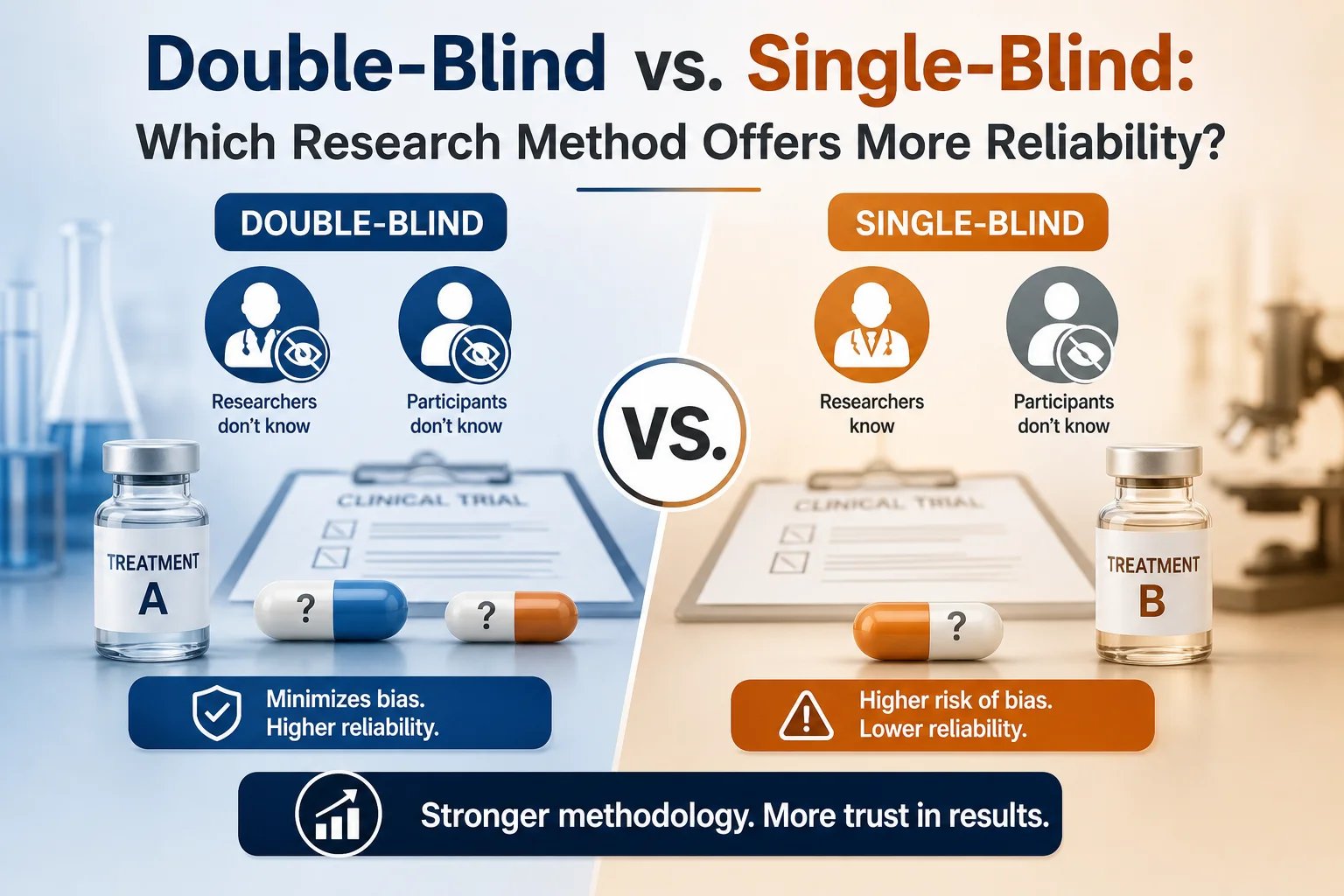
A single-blind study is a research design where one major group involved in the study is unaware of key information, usually the participants.
Most commonly, participants do not know whether they are receiving the experimental treatment, placebo, standard treatment, or control condition. However, the researchers, clinicians, or experimenters may know.
Example of a Single-Blind Study
Suppose researchers are testing a new pain-relief cream. Participants are randomly assigned to receive either:
- The active pain-relief cream
- A placebo cream with no active ingredient
The participants do not know which cream they received, but the researchers applying the cream do know.
This is a single-blind design.
Benefits of Single-Blind Research
Single-blind studies can reduce participant-related bias, including:
- Placebo effects
- Expectation effects
- Demand characteristics
- Self-report distortion
- Anxiety or disappointment based on treatment assignment
Single-blind designs are often easier, cheaper, and more practical than double-blind designs.
Limitations of Single-Blind Research
The biggest weakness is that researchers may still influence the results, even unintentionally. If a researcher knows which participants received the treatment, they may:
- Give more encouragement to the treatment group
- Probe more deeply for improvement
- Interpret unclear responses differently
- Record outcomes with subtle bias
- Communicate expectations through tone or body language
This is why, when comparing single-blind vs. double-blind reliability, double-blind methods often have the advantage.
Double-Blind Studies: What They Are and Why They Matter
A double-blind study is a research design where both participants and key researchers are unaware of group assignments.
In the classic version, neither the participants nor the people administering the intervention or assessing outcomes know who received the treatment and who received the placebo.
Example of a Double-Blind Study
Researchers are testing a new blood pressure medication. Participants are randomly assigned to receive either:
- The real medication
- A placebo pill
The pills look identical. Neither the participants nor the doctors measuring blood pressure know which pill each participant received. Only a separate data management team or pharmacy unit holds the assignment codes until the study ends.
This is double-blind research.
Why Double-Blind Studies Are Powerful
Double-blind designs reduce bias from both sides:
- Participant bias: Participants cannot change their behavior or reporting based on knowing their group.
- Researcher bias: Researchers cannot consciously or unconsciously treat groups differently.
- Observer bias: Outcome assessors are less likely to interpret results in favor of one group.
- Expectation effects: Both participant and investigator expectations are minimized.
That is why the topic Double-Blind vs. Single-Blind: Which Research Method Offers More Reliability? often leads to the conclusion that double-blind studies are the gold standard when feasible.
Double-Blind vs. Single-Blind: Which Research Method Offers More Reliability?
In general, double-blind research offers more reliability than single-blind research because it controls more sources of bias.
However, the most accurate answer is more nuanced.
Double-blind methods are usually more reliable when:
- Outcomes are subjective
- Researchers interact closely with participants
- Placebo effects are likely
- The intervention involves symptoms, perception, or behavior
- Investigator expectations could influence assessment
- The stakes are high, such as drug approval or clinical guidelines
Single-blind methods can still be reliable when:
- Outcomes are objective and automatically measured
- Researcher influence is minimal
- Blinding researchers is impossible or unethical
- Independent blinded assessors are used
- Strong randomization and allocation concealment are in place
So, when asking Double-Blind vs. Single-Blind: Which Research Method Offers More Reliability?, the best answer is: double-blind designs are generally more reliable, but reliability depends on context, execution, outcome measures, and bias control.
Quick Comparison Table: Double-Blind vs. Single-Blind Research
| Feature | Single-Blind Study | Double-Blind Study |
|---|---|---|
| Who is blinded? | Usually participants | Participants and researchers/outcome assessors |
| Main bias reduced | Participant expectation bias | Participant and researcher bias |
| Cost | Usually lower | Usually higher |
| Complexity | Moderate | Higher |
| Best for | Simple trials, product tests, some behavioral studies | Drug trials, clinical research, subjective outcomes |
| Weakness | Researcher bias may remain | Harder to implement |
| Reliability level | Moderate to high if well-designed | Usually high when properly executed |
| Practicality | Easier | More demanding |
This table shows why double-blind vs. single-blind reliability is not just about labels. A poorly executed double-blind study may be less trustworthy than a carefully designed single-blind study with objective outcomes.
Why Reliability Depends on More Than Blinding
Reliability means consistency. A reliable study produces findings that are stable, repeatable, and not overly dependent on chance, bias, or flawed measurement.
Blinding improves reliability, but it is not the only factor.
A study’s reliability also depends on:
- Randomization quality
- Sample size
- Measurement accuracy
- Protocol consistency
- Data transparency
- Statistical power
- Attrition rates
- Replication
- Outcome objectivity
- Allocation concealment
This is important because some people treat the phrase Double-Blind vs. Single-Blind: Which Research Method Offers More Reliability? as if the answer is automatic. In reality, blinding is one major pillar of reliable research, not the entire building.
The Main Types of Bias Blinding Helps Prevent
To understand Double-Blind vs. Single-Blind: Which Research Method Offers More Reliability?, we need to look at the biases each design controls.
| Type of Bias | What It Means | Reduced by Single-Blind? | Reduced by Double-Blind? |
|---|---|---|---|
| Placebo effect | Participants improve because they expect to improve | Yes | Yes |
| Nocebo effect | Participants feel worse because they expect harm | Yes | Yes |
| Observer bias | Researchers interpret outcomes based on expectations | Partly/No | Yes |
| Performance bias | Participants or staff behave differently by group | Partly | Yes |
| Detection bias | Outcomes are assessed differently between groups | Partly/No | Yes |
| Reporting bias | Participants report symptoms differently based on beliefs | Yes | Yes |
| Confirmation bias | Researchers notice evidence supporting expectations | No | Yes |
This explains why double-blind research methods are often preferred when subjective judgment plays a role.
Case Study 1: The Salk Polio Vaccine Trial
One of the most famous examples in medical research history is the 1954 Salk polio vaccine field trial.
Polio was a terrifying disease, especially for children. The trial involved over a million children and was designed to test whether Jonas Salk’s vaccine could prevent paralytic polio.
A major part of the trial used a randomized, placebo-controlled, double-blind design. Children received either the vaccine or a placebo, and neither families nor many of the researchers assessing outcomes knew which children were in which group.
Why This Case Matters
The Salk trial showed that double-blind methods could produce powerful public health evidence. Because researchers minimized expectation and observer bias, the results were more credible.
The vaccine was found to be effective, and the findings helped launch one of the most important vaccination campaigns in history.
Relevance to Double-Blind vs. Single-Blind Reliability
This case strongly supports the idea that, in high-stakes medical research, double-blind designs offer greater reliability. If the Salk trial had been only single-blind, critics could have argued that outcome assessment was influenced by researchers’ hopes.
In the debate over Double-Blind vs. Single-Blind: Which Research Method Offers More Reliability?, the Salk trial remains a landmark example of the value of double-blind research.
Case Study 2: Antidepressant Trials and the Power of Expectation
Antidepressant trials often use double-blind, placebo-controlled designs. This is because depression outcomes frequently involve subjective ratings, such as mood, sleep quality, motivation, and emotional well-being.
If patients know they are receiving an active medication, their expectations may influence how they report symptoms. If clinicians know who received medication, their ratings may also be affected.
Double-blind designs help reduce both problems.
What Researchers Have Learned
In many antidepressant trials, placebo groups also show meaningful improvement. This does not mean depression is “imaginary.” It means expectations, patient-clinician interaction, natural symptom fluctuation, and study participation can all influence outcomes.
Because of this, double-blinding is especially important.
Relevance to the Topic
This case illustrates why double-blind vs. single-blind clinical trials matter most when outcomes are subjective. A single-blind antidepressant trial might reduce patient expectation bias, but it would not fully prevent clinician interpretation bias.
For mental health studies, the answer to Double-Blind vs. Single-Blind: Which Research Method Offers More Reliability? usually favors double-blind research.
Case Study 3: Sham Surgery Trials in Parkinson’s Disease
Surgical research raises difficult ethical and practical questions. In some studies, researchers have used sham surgery controls to test whether an experimental procedure truly works beyond placebo effects.
In Parkinson’s disease research, some trials involving fetal tissue transplantation or other neurosurgical interventions used sham procedures as controls. Participants did not know whether they received the actual intervention or a simulated surgery.
These trials revealed something remarkable: some patients who received sham surgery still reported improvement, likely due to placebo effects and expectations.
Why This Case Is Complicated
Unlike pill trials, surgery is hard to blind. Surgeons usually know what procedure they are performing. Full double-blinding may be impossible. However, researchers can still blind participants and outcome assessors.
This creates a hybrid design: not always fully double-blind, but stronger than basic single-blind research.
Relevance to Double-Blind vs. Single-Blind Reliability
This case shows that Double-Blind vs. Single-Blind: Which Research Method Offers More Reliability? is not always a simple choice. Sometimes full double-blinding is impractical or ethically controversial.
Still, the more blinding researchers can apply—especially blinding outcome assessors—the more reliable the results become.
Case Study 4: Education Research and Teacher Expectation Bias
Imagine a school testing a new reading program. Students are randomly assigned to either the new program or the standard curriculum. Students may not know which method is considered “experimental,” but teachers do.
If teachers believe the new program is superior, they may unconsciously give those students more enthusiasm, feedback, or patience. This can affect student performance.
That makes education research vulnerable to expectation bias.
Single-Blind Approach
Students may be blinded to the study hypothesis, but teachers often cannot be blinded because they deliver the intervention.
Stronger Design
Researchers can improve reliability by using:
- Independent graders
- Standardized tests
- Blinded outcome assessors
- Automated scoring
- Random assignment by classroom
- Pre-registered analysis plans
Relevance to the Topic
In education research, full double-blind designs are often impossible. But the comparison of single-blind vs. double-blind research methods still matters because researchers can borrow double-blind principles.
Even when teachers cannot be blinded, outcome assessors can be. This improves reliability.
Case Study 5: Consumer Product Testing
Companies often test products using blind or double-blind methods. For example, a beverage company may ask consumers to compare two drinks without knowing the brand names.
A single-blind product test hides the product identity from consumers, but the test administrators may know which sample is which.
A double-blind product test hides the product identity from both consumers and administrators. Samples may be coded by a separate team to prevent influence.
Why This Matters
If administrators know which product is premium, they may unintentionally present it more positively. Even subtle facial expressions, tone, or order of presentation can influence consumer ratings.
Relevance to Double-Blind vs. Single-Blind Reliability
For sensory testing, the answer to Double-Blind vs. Single-Blind: Which Research Method Offers More Reliability? often favors double-blind design. Taste, smell, texture, and preference are subjective. That makes them vulnerable to expectation effects.
Double-blind product testing can prevent brand reputation and administrator cues from shaping results.
Reliability Ranking: Which Design Is Strongest?
Here is a simplified reliability ranking for common research designs, assuming each is properly conducted.
| Rank | Research Design | Typical Reliability Strength |
|---|---|---|
| 1 | Randomized double-blind controlled trial | Very high |
| 2 | Randomized single-blind controlled trial with blinded outcome assessment | High |
| 3 | Randomized single-blind trial without blinded assessors | Moderate |
| 4 | Open-label randomized trial | Moderate to low depending on outcomes |
| 5 | Non-randomized observational study | Variable |
| 6 | Anecdotal evidence/case reports | Low for causal claims |
This ranking reinforces the central point: in Double-Blind vs. Single-Blind: Which Research Method Offers More Reliability?, double-blind randomized trials are usually the strongest option for causal evidence.
When Double-Blind Studies Are Clearly Better
Double-blind research is especially valuable when outcomes are subjective, difficult to measure, or vulnerable to interpretation.
Double-blind studies are usually better for:
- Pain medication trials
- Antidepressant and anxiety medication research
- Sleep studies
- Nutritional supplement trials
- Allergy treatments
- Consumer preference testing
- Cosmetic product trials
- Behavioral interventions with subjective outcomes
- Symptom-based clinical research
For example, pain is real, but it is also highly subjective. A patient’s pain score can be influenced by expectations, reassurance, fear, and trust in the treatment. That makes double-blinding extremely important.
In these cases, the question Double-Blind vs. Single-Blind: Which Research Method Offers More Reliability? has a clear practical answer: double-blind designs are more reliable.
When Single-Blind Studies Can Be Enough
Single-blind research is not automatically weak. In some cases, it is perfectly reasonable.
Single-blind studies may be enough when:
- The outcome is objective
- The researcher has limited interaction with participants
- Automated tools collect the data
- Blinding the researcher is impossible
- The study is exploratory or early-stage
- The intervention is obvious to providers
- Independent blinded assessors review outcomes
Example
A trial comparing two surgical techniques may not be able to blind surgeons. However, patients may be blinded, and imaging results can be reviewed by independent radiologists who do not know which procedure was used.
That design may not be fully double-blind, but it can still be reliable.
So, in the debate over Double-Blind vs. Single-Blind: Which Research Method Offers More Reliability?, single-blind methods deserve a fair evaluation when practical limitations exist.
The Role of Allocation Concealment
Blinding is often confused with allocation concealment, but they are different.
Allocation concealment means that the person enrolling participants does not know in advance which group the next participant will enter.
This prevents selection bias.
For example, if a researcher knows that the next participant will receive the experimental treatment, they might unconsciously enroll a sicker or healthier person. Allocation concealment prevents this.
Blinding vs. Allocation Concealment
| Concept | When It Happens | Purpose |
|---|---|---|
| Allocation concealment | Before and during participant assignment | Prevents selection bias |
| Blinding | After assignment | Prevents performance and detection bias |
A study can be double-blind but still flawed if allocation concealment is poor. Likewise, a single-blind study with strong allocation concealment and objective outcomes may still produce useful evidence.
This is another reason why Double-Blind vs. Single-Blind: Which Research Method Offers More Reliability? requires careful analysis.
Blinded Outcome Assessment: The Often-Overlooked Reliability Booster
Sometimes researchers cannot blind everyone. But they can often blind the people who assess outcomes.
This is called blinded outcome assessment.
For example:
- A radiologist reviews scans without knowing treatment assignment.
- A psychologist scores interviews without knowing which therapy the participant received.
- A teacher grades essays without knowing which teaching method students experienced.
- A statistician analyzes coded data without knowing group labels.
Blinded outcome assessment can dramatically improve reliability, especially in single-blind or open-label studies.
In the practical world of double-blind vs. single-blind study reliability, blinded outcome assessment is one of the most valuable compromises.
Common Myths About Double-Blind and Single-Blind Studies
Myth 1: Double-blind studies are always perfect.
They are not. A double-blind study can still suffer from small sample size, poor randomization, selective reporting, weak measurement, or flawed statistics.
Myth 2: Single-blind studies are unreliable.
Not necessarily. They can be reliable when outcomes are objective and bias is well controlled.
Myth 3: Blinding is only for medicine.
False. Blinding matters in psychology, marketing, education, nutrition, social science, forensics, and product testing.
Myth 4: If participants are blinded, the study is unbiased.
Participant blinding helps, but researcher and assessor bias may remain.
Myth 5: Double-blind means nobody knows anything.
Usually, someone knows the assignments, such as a pharmacist, data safety board, or independent coordinator. The key is that people who could influence results remain blinded.
Understanding these myths makes the question Double-Blind vs. Single-Blind: Which Research Method Offers More Reliability? easier to answer with nuance.
Practical Decision Matrix: Which Method Should Researchers Choose?
| Research Situation | Better Choice | Why |
|---|---|---|
| Testing a new drug for pain | Double-blind | Pain reporting is subjective |
| Testing a vaccine | Double-blind when feasible | Reduces expectation and assessment bias |
| Comparing two surgical techniques | Single-blind plus blinded assessors | Surgeons cannot be blinded |
| Evaluating a new teaching method | Single-blind or assessor-blind | Teachers may know the intervention |
| Testing consumer taste preference | Double-blind | Prevents brand and administrator influence |
| Studying lab-measured blood markers | Single-blind may be enough | Outcomes are more objective |
| Testing psychotherapy methods | Often single-blind with blinded evaluators | Therapists and clients usually know the therapy |
| Evaluating cosmetics | Double-blind | Expectations strongly influence perception |
This decision matrix shows that Double-Blind vs. Single-Blind: Which Research Method Offers More Reliability? depends on feasibility, ethics, and the type of outcome.
The Ethics of Blinding
Blinding can improve science, but it must be ethical.
Researchers must consider:
- Is it ethical to use a placebo?
- Are participants being denied proven treatment?
- Is deception involved?
- Can participants give informed consent?
- Are risks minimized?
- Is there a safety monitoring plan?
In some cases, double-blinding may not be ethical. For example, if an effective treatment already exists for a serious disease, giving a placebo may be inappropriate unless participants also receive standard care.
Ethical research balances scientific reliability with participant welfare.
That means the answer to Double-Blind vs. Single-Blind: Which Research Method Offers More Reliability? should never ignore ethics.
How Blinding Can Fail
Even well-designed blinded studies can become unblinded.
This can happen when:
- A medication has obvious side effects
- A treatment causes visible physical changes
- Participants guess their group based on symptoms
- Staff accidentally reveal information
- Packaging differs between treatment and placebo
- The intervention is difficult to mimic
For example, if a drug causes a distinctive metallic taste, participants may correctly guess they are receiving the active drug. This can weaken the blind.
Researchers can test blinding by asking participants and staff to guess group assignments at the end of a study. If guesses are much better than chance, blinding may have failed.
This is a key issue in double-blind vs. single-blind research reliability because a double-blind study is only as strong as its actual blinding.
How to Make Single-Blind Studies More Reliable
When double-blinding is not possible, researchers can strengthen single-blind studies using several strategies.
1. Use objective outcomes
Blood pressure, mortality, lab values, exam scores, and imaging results are less vulnerable to interpretation than self-reported feelings.
2. Blind outcome assessors
Even if researchers delivering the intervention know group assignments, independent assessors can remain blinded.
3. Standardize interactions
Use scripts, protocols, and training to ensure all participants are treated similarly.
4. Automate data collection
Wearables, lab machines, digital platforms, and standardized scoring systems reduce human influence.
5. Pre-register the study
Pre-registration prevents researchers from changing hypotheses after seeing the data.
6. Use independent data analysis
Analysts can work with coded groups, such as Group A and Group B, until final interpretation.
These methods help single-blind studies compete better in the Double-Blind vs. Single-Blind: Which Research Method Offers More Reliability? discussion.
How to Evaluate a Study’s Blinding Quality
When reading research, do not just look for the word “double-blind.” Ask deeper questions.
Checklist for Readers
| Question | Why It Matters |
|---|---|
| Who exactly was blinded? | “Double-blind” can mean different things |
| Were participants blinded? | Reduces placebo and expectation effects |
| Were care providers blinded? | Reduces performance bias |
| Were outcome assessors blinded? | Reduces detection bias |
| Was allocation concealed? | Prevents selection bias |
| Was blinding tested? | Shows whether the blind held |
| Were outcomes objective or subjective? | Subjective outcomes need stronger blinding |
| Were dropouts balanced between groups? | Unequal attrition can distort results |
| Was the study pre-registered? | Reduces selective reporting |
This checklist is useful for anyone trying to answer Double-Blind vs. Single-Blind: Which Research Method Offers More Reliability? while reading scientific papers.
Double-Blind vs. Single-Blind in Different Fields
Medicine
Double-blind randomized controlled trials are often considered the gold standard, especially for drugs and vaccines.
Psychology
Double-blind methods are valuable but not always possible. Blinded assessors and standardized protocols are common alternatives.
Nutrition
Blinding is difficult when diets are visibly different. However, supplement trials can often be double-blind.
Education
Full double-blinding is rare because teachers usually know what they are teaching. Blinded grading can help.
Marketing
Double-blind testing is useful for taste tests, product comparisons, packaging research, and brand perception studies.
Forensic Science
Blinding can prevent investigators from being influenced by case details. For example, fingerprint examiners may be blinded to suspect information.
Across fields, Double-Blind vs. Single-Blind: Which Research Method Offers More Reliability? remains a practical question about how much bias can be realistically controlled.
SEO Keyword Variations Used in This Topic
Relevant long-tail variations for this topic include:
- double-blind vs. single-blind research reliability
- single-blind vs. double-blind study design
- which is more reliable double-blind or single-blind
- double-blind vs. single-blind clinical trials
- advantages of double-blind studies over single-blind studies
- when to use single-blind research methods
- double-blind study reliability in clinical research
- single-blind research bias control
- double-blind vs. single-blind experiment examples
- best blinding method for reliable research
These variations support the central keyword Double-Blind vs. Single-Blind: Which Research Method Offers More Reliability? while keeping the article natural and readable.
So, Which Research Method Offers More Reliability?
If we had to give one clear answer, it would be this:
Double-blind studies generally offer more reliability than single-blind studies because they reduce both participant bias and researcher bias.
But the best research method is not always the most theoretically perfect one. It is the most rigorous method that is ethical, feasible, and appropriate for the research question.
A double-blind study is strongest when:
- The placebo effect is likely
- Outcomes are subjective
- Researcher interaction could influence results
- The intervention can be masked effectively
A single-blind study may be acceptable when:
- Full blinding is impossible
- Outcomes are objective
- Independent assessors are blinded
- Bias is controlled through protocol design
So the real answer to Double-Blind vs. Single-Blind: Which Research Method Offers More Reliability? is: double-blind is usually more reliable, but single-blind can still produce credible evidence when strengthened by smart safeguards.
Conclusion: Better Blinding, Better Evidence
The debate over Double-Blind vs. Single-Blind: Which Research Method Offers More Reliability? is ultimately a debate about trust.
Can we trust the results?
Can we trust that expectations did not shape the outcome?
Can we trust that researchers measured what really happened, not what they hoped would happen?
Double-blind studies usually provide stronger protection because they keep both participants and researchers from knowing group assignments. This makes them especially valuable in clinical trials, psychological research, consumer testing, and any study involving subjective outcomes.
Single-blind studies, however, still have an important place. When double-blinding is impractical or impossible, researchers can improve reliability with objective measures, blinded assessors, standardized procedures, allocation concealment, and transparent analysis.
The motivational takeaway is simple: reliable research does not happen by accident. It is designed. Whether you are a scientist, clinician, student, policymaker, or curious reader, learning to evaluate blinding helps you separate strong evidence from shaky claims.
When in doubt, ask: who knew what, when did they know it, and could that knowledge have changed the results?
That question is at the heart of Double-Blind vs. Single-Blind: Which Research Method Offers More Reliability?
1. What is the main difference between single-blind and double-blind studies?
In a single-blind study, usually the participants do not know which group they are in, but researchers may know. In a double-blind study, both participants and key researchers or outcome assessors do not know group assignments.
2. Which is more reliable: double-blind or single-blind research?
Double-blind research is generally more reliable because it reduces both participant bias and researcher bias. However, a well-designed single-blind study can still be reliable, especially with objective outcomes and blinded assessors.
3. Why are double-blind studies considered the gold standard?
Double-blind studies are considered the gold standard because they minimize expectation effects, placebo effects, observer bias, and detection bias. This makes results more trustworthy, especially in clinical trials.
4. Are single-blind studies bad science?
No. Single-blind studies are not bad science. They are useful when double-blinding is impractical, unethical, or impossible. Their reliability depends on study design, outcome measures, randomization, and bias control.
5. Can a double-blind study still be biased?
Yes. Double-blind studies can still have problems such as poor randomization, small sample size, selective reporting, weak measurement, or failed blinding. Double-blind design improves reliability, but it does not guarantee perfection.
6. When is a single-blind study acceptable?
A single-blind study is acceptable when researcher blinding is not feasible, when outcomes are objective, or when independent blinded assessors are used. It is common in surgery, education, psychotherapy, and behavioral research.
7. What is a placebo, and why does it matter?
A placebo is an inactive treatment designed to look like the real treatment. It matters because people can improve simply because they believe they are receiving treatment. Blinding helps separate true treatment effects from placebo effects.
8. What is blinded outcome assessment?
Blinded outcome assessment means the person evaluating results does not know which group participants were assigned to. This improves reliability by reducing interpretation bias.
9. Can participants figure out which group they are in?
Yes. This is called unblinding. It can happen if a treatment has noticeable side effects or obvious differences. Researchers sometimes test blinding by asking participants to guess their assignment after the study.
10. What is the final answer to Double-Blind vs. Single-Blind: Which Research Method Offers More Reliability?
The final answer is that double-blind research usually offers more reliability because it controls more sources of bias. Still, single-blind research can be dependable when designed carefully, especially with objective outcomes and blinded assessment.
About the Author


The PsyForU Editorial Collective is the research and editorial team of PsyForU Research International. The collective prepares educational, psychological, mental-health-awareness, inclusion, neurodiversity, and research-methodology content for students, parents, educators, researchers, and general readers. PsyForU content is intended for awareness, education, and capacity-building and should not be treated as clinical diagnosis, therapy, medical advice, legal advice, or emergency mental-health support.