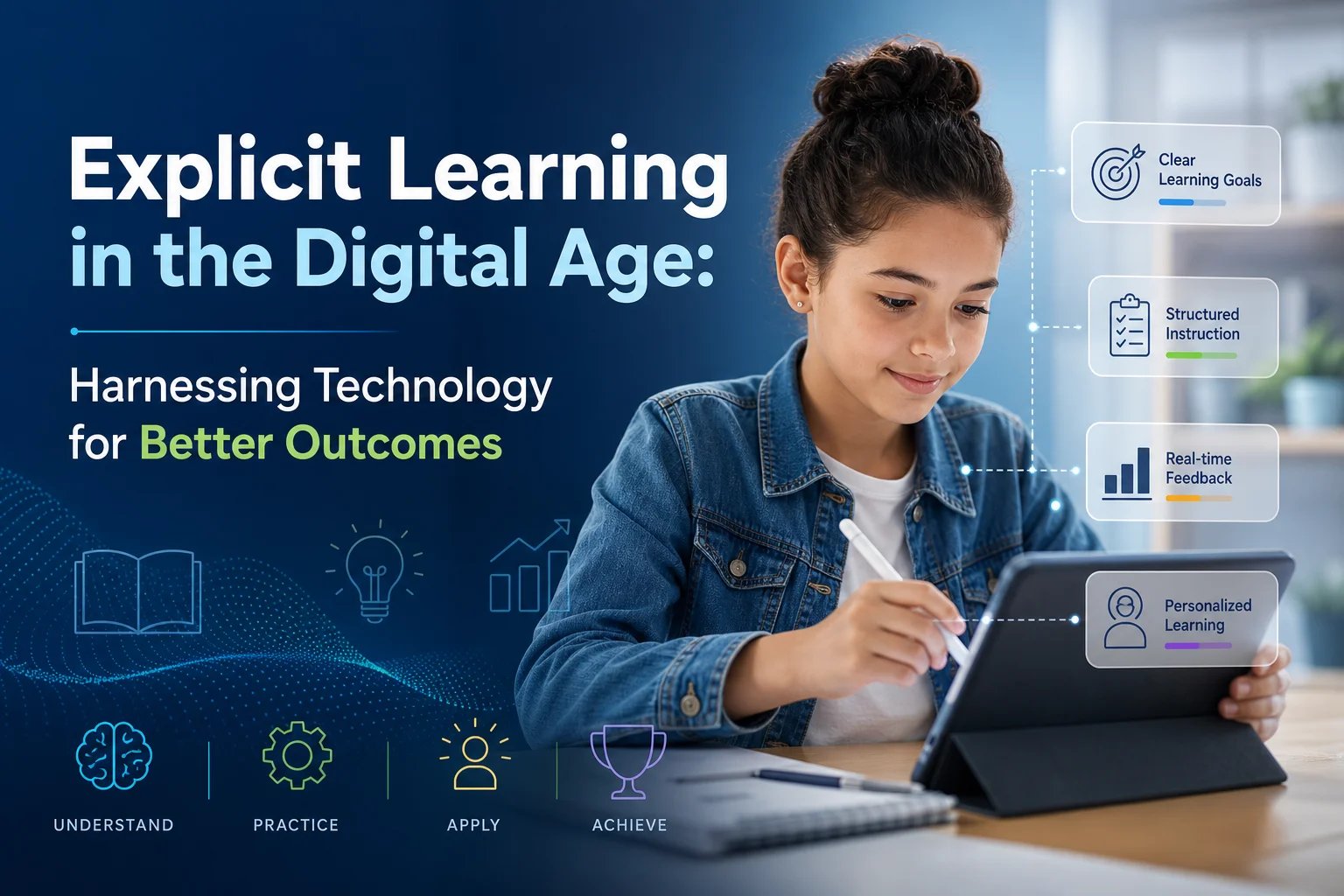
Introduction: Why “Figuring It Out” Is No Longer Enough
A student opens a math app and stares at a problem she almost understands. A nurse completes a simulation before assisting in a real procedure. A new employee clicks through an onboarding module that teaches not just what to do, but why it matters. A language learner receives instant feedback on pronunciation before speaking with a real person.
In each case, technology is doing something powerful—but only when paired with the right learning design.
That is the heart of Explicit Learning in the Digital Age: Harnessing Technology for Better Outcomes.
For years, educators, trainers, and organizations have debated whether people learn best through discovery or direct instruction. The truth is more practical: learners need clarity. They need models. They need guided practice. They need feedback that arrives before mistakes become habits. They need opportunities to apply knowledge in meaningful contexts.
Digital tools can make all of this easier, faster, and more personalized—if we use them intentionally.
Explicit learning in the digital age is not about replacing teachers, mentors, coaches, or managers with screens. It is about using technology to make instruction clearer, practice smarter, feedback faster, and outcomes more measurable. Done well, it helps learners move from confusion to confidence.
This article explores Explicit Learning in the Digital Age: Harnessing Technology for Better Outcomes in depth: what it means, why it matters, which tools work best, where real-world case studies show promise, and how schools, universities, and workplaces can apply it without overwhelming learners or educators.
What Is Explicit Learning?
Explicit learning is a structured approach in which learners are clearly taught what they need to know, why it matters, how to do it, and how to improve.
Instead of expecting learners to discover everything on their own, explicit learning provides:
- Clear objectives
- Direct explanations
- Step-by-step modeling
- Guided practice
- Immediate feedback
- Independent application
- Reflection and revision
In simple terms, explicit learning says: “Let’s make the invisible visible.”
For example, a teacher does not simply ask students to “write a persuasive essay.” Instead, the teacher explains the structure, models a strong introduction, shows examples and non-examples, guides students through practice, and provides feedback before students write independently.
In workplace training, explicit learning might involve showing employees exactly how to handle a customer complaint, including the language to use, the decision tree to follow, and the system steps required to document the interaction.
The value of Explicit Learning in the Digital Age: Harnessing Technology for Better Outcomes is that digital tools can strengthen every part of this process.
Explicit Learning vs. Implicit Learning
Explicit learning is often compared with implicit learning. Both have value, but they serve different purposes.
| Feature | Explicit Learning | Implicit Learning |
|---|---|---|
| Instruction style | Direct, structured, intentional | Indirect, exploratory, experience-based |
| Learner awareness | Learners know what they are learning | Learners may absorb patterns unconsciously |
| Best for | Foundational knowledge, procedures, rules, complex skills | Social norms, intuition, pattern recognition |
| Feedback | Frequent and specific | Often delayed or indirect |
| Example | Teaching grammar rules before writing | Picking up grammar through conversation |
| Digital support | Tutorials, simulations, adaptive practice, dashboards | Immersive games, social platforms, exposure-based tools |
The smartest learning systems blend both. However, when learners are beginners, when mistakes are costly, or when skills are complex, explicit learning is especially important.
That is why explicit learning in the digital age has become such an essential conversation. Technology gives us more opportunities than ever to guide learners clearly while still allowing exploration and creativity.
Why Explicit Learning Matters More in the Digital Age
We live in an information-rich world, but access to information is not the same as understanding.
A learner can watch 20 videos and still miss the main concept. An employee can complete an online course and still be unable to perform the job task. A student can use AI to generate an answer without understanding how the answer was built.
This is why Explicit Learning in the Digital Age: Harnessing Technology for Better Outcomes is so relevant now. Digital abundance creates new learning opportunities, but it also creates noise.
Learners today face:
- Too much information
- Too many platforms
- Constant distractions
- Uneven digital literacy
- AI-generated shortcuts
- Reduced attention spans
- Pressure to learn quickly
Explicit learning cuts through the noise. It provides structure.
Technology can support that structure through:
- Short instructional videos
- Interactive tutorials
- Adaptive quizzes
- Learning management systems
- AI tutoring tools
- Simulations
- Digital flashcards
- Feedback dashboards
- Virtual and augmented reality
- Collaborative whiteboards
But technology alone does not guarantee better outcomes. A poorly designed digital course is still a poorly designed course. A flashy app cannot fix unclear instruction.
The real promise of Explicit Learning in the Digital Age: Harnessing Technology for Better Outcomes lies in combining strong pedagogy with smart tools.
The Core Principles of Explicit Digital Learning
To make explicit learning work online, educators and organizations need more than software. They need a framework.
Here are the essential principles.
1. Start With Clear Learning Goals
Learners should know exactly what success looks like.
Instead of saying:
“Understand data analysis.”
A stronger explicit learning goal would be:
“By the end of this module, you will be able to clean a spreadsheet, identify missing values, create a pivot table, and explain three trends using evidence.”
Digital platforms make learning goals visible through module pages, progress bars, checklists, and rubrics.
In explicit learning in the digital age, goals should be specific, measurable, and learner-friendly.
2. Break Complex Skills Into Smaller Steps
Digital learning fails when it dumps too much information at once.
Explicit instruction works best when complex skills are broken into manageable chunks. This is especially important in online learning, where cognitive overload can happen quickly.
For example, instead of teaching “public speaking” in one module, a course might break it into:
- Understanding the audience
- Structuring a message
- Writing an opening hook
- Using voice effectively
- Designing slides
- Handling questions
- Practicing with feedback
This step-by-step structure is central to Explicit Learning in the Digital Age: Harnessing Technology for Better Outcomes.
3. Model the Process
Learners need to see expert thinking.
A math teacher might solve a problem on a digital whiteboard while explaining each decision. A coding instructor might record a screen-share showing how to debug an error. A sales trainer might demonstrate a call with pauses to explain tone, timing, and word choice.
Modeling is powerful because it reveals what experts often do automatically.
Technology supports modeling through:
- Screen recordings
- Annotation tools
- Interactive worked examples
- Pause-and-predict videos
- Split-screen demonstrations
- AI-generated walkthroughs reviewed by instructors
When we discuss harnessing technology for better outcomes through explicit learning, modeling is one of the highest-impact uses of digital media.
4. Provide Guided Practice
Practice is where learning becomes real.
But beginners should not be left alone too early. Guided practice gives learners support while they build confidence.
Examples include:
- Hints in math platforms
- Code editors that flag errors
- Writing tools that highlight unclear sentences
- Language apps that provide pronunciation feedback
- Simulations that offer prompts during decision-making
Guided practice is a cornerstone of Explicit Learning in the Digital Age: Harnessing Technology for Better Outcomes because digital systems can offer help at the exact moment learners need it.
5. Give Immediate, Specific Feedback
Feedback is one of the biggest advantages of digital learning.
In a traditional classroom, a student might wait days to receive feedback on a quiz. In a digital environment, feedback can be instant.
But not all feedback is equal.
Weak feedback says:
“Incorrect.”
Strong feedback says:
“Incorrect. You multiplied before applying the exponent. Review the order of operations, then try step two again.”
The best explicit digital learning systems explain the mistake, redirect attention, and offer another opportunity to practice.
This is where explicit learning in the digital age can dramatically improve outcomes: faster feedback means faster correction.
6. Use Data to Adjust Instruction
Digital tools generate learning data. The question is whether we use it well.
Useful data might show:
- Which concepts learners struggle with
- How long learners spend on tasks
- Which questions produce the most errors
- Whether learners improve after feedback
- Who needs enrichment or intervention
In Explicit Learning in the Digital Age: Harnessing Technology for Better Outcomes, data should serve people—not overwhelm them.
Teachers and trainers do not need endless dashboards. They need actionable insights.
Technology Tools That Strengthen Explicit Learning
The digital age offers countless tools. The key is choosing technology that supports the learning goal—not technology that merely looks impressive.
| Technology | How It Supports Explicit Learning | Best Use Case |
|---|---|---|
| Learning Management Systems | Organize lessons, goals, resources, assessments | Schools, universities, corporate training |
| Adaptive Learning Platforms | Adjust difficulty based on performance | Math, language, test prep |
| AI Tutors | Offer explanations, examples, and practice prompts | Personalized support |
| Screen Recording Tools | Model processes step by step | Coding, writing, design, software training |
| Simulations | Allow safe practice in realistic scenarios | Healthcare, aviation, leadership |
| Digital Whiteboards | Make thinking visible | Problem-solving, collaboration |
| Quiz Tools | Provide retrieval practice and feedback | Knowledge checks |
| Analytics Dashboards | Identify gaps and progress | Intervention planning |
| VR/AR Tools | Create immersive guided practice | Technical, medical, spatial skills |
| Discussion Platforms | Support reflection and peer explanation | Higher education, professional learning |
The best approach to Explicit Learning in the Digital Age: Harnessing Technology for Better Outcomes is not to use every tool. It is to use the right tool at the right moment.
A Practical Framework: Explain, Model, Practice, Feedback, Transfer
One useful way to design explicit digital learning is the EM-PFT framework:
- Explain the concept clearly
- Model the skill or thinking process
- Practice with guidance
- Feedback immediately and specifically
- Transfer learning to a real-world task
| Stage | Learner Question | Digital Strategy |
|---|---|---|
| Explain | What am I learning and why? | Short video, infographic, interactive reading |
| Model | How does an expert do it? | Screen recording, worked example, live demo |
| Practice | Can I try with support? | Adaptive quiz, guided worksheet, simulation |
| Feedback | How can I improve? | Automated feedback, instructor comments, peer review |
| Transfer | Can I use this independently? | Project, case analysis, workplace task |
This framework captures the heart of Explicit Learning in the Digital Age: Harnessing Technology for Better Outcomes: clarity first, independence later.
Case Study 1: Carnegie Learning and MATHia in Algebra Instruction
Carnegie Learning’s MATHia platform is one of the better-known examples of technology-supported explicit math learning. Built from cognitive science research, MATHia provides students with step-by-step practice, hints, feedback, and adaptive pathways.
In many classrooms, the platform is used alongside teacher-led instruction. The teacher introduces and models concepts, while the software provides individualized practice and data on student progress.
What Makes It Explicit?
MATHia does not simply give students a set of problems and hope they figure things out. It guides them through mathematical thinking with structured tasks, immediate feedback, and targeted hints.
Why It Matters
Algebra is a gatekeeper subject. Students who fall behind often struggle because small misconceptions accumulate. Digital explicit learning helps catch those misconceptions earlier.
Brief Analysis
This case is highly relevant to Explicit Learning in the Digital Age: Harnessing Technology for Better Outcomes because it shows how technology can support—not replace—the teacher. The platform handles some individualized practice and feedback, while the teacher focuses on explanation, discussion, and intervention.
The lesson is clear: technology works best when integrated into a coherent instructional model.
Case Study 2: Duolingo for Schools and Language Learning
Language learning often combines explicit and implicit approaches. Learners need exposure to real language, but they also benefit from clear instruction in vocabulary, grammar, pronunciation, and sentence structure.
Duolingo for Schools allows teachers to assign practice, track progress, and reinforce specific language skills. While the platform uses gamification, it also includes explicit cues, corrective feedback, repetition, and structured skill progression.
What Makes It Explicit?
Learners receive immediate feedback on translation, listening, vocabulary, and grammar tasks. Skills are sequenced from easier to more difficult. Teachers can assign targeted practice based on classroom goals.
Why It Matters
Language learners often need frequent low-stakes practice. A teacher may not have time to hear every student pronounce every word or correct every grammar mistake. Digital tools can extend practice beyond the classroom.
Brief Analysis
This example illustrates explicit learning in the digital age because it shows how structured digital practice can strengthen human instruction. The platform alone is not a complete language education, but when paired with conversation, cultural context, and teacher explanation, it becomes a valuable learning accelerator.
Case Study 3: Osso VR and Surgical Training
In healthcare, mistakes can have serious consequences. That makes explicit learning especially important.
Osso VR is a virtual reality surgical training platform that allows medical professionals to practice procedures in a simulated environment. Learners can repeat steps, receive performance feedback, and build confidence before working in real clinical settings.
What Makes It Explicit?
The platform breaks procedures into steps, provides visual guidance, and allows deliberate practice. Learners are not left to “pick it up” in a high-pressure environment. They can rehearse with structure.
Why It Matters
Traditional medical training often depends on observation, apprenticeship, and supervised practice. These remain essential, but VR adds another layer: safe, repeatable, measurable practice.
Brief Analysis
This is a powerful example of Explicit Learning in the Digital Age: Harnessing Technology for Better Outcomes because it demonstrates how technology can improve skill development where precision matters. VR does not replace mentors or clinical experience, but it can prepare learners more effectively before real-world performance.
Case Study 4: IBM SkillsBuild and Workforce Reskilling
The digital economy demands continuous learning. Workers need to reskill in areas such as cybersecurity, cloud computing, data analysis, project management, and artificial intelligence.
IBM SkillsBuild provides free digital learning pathways, credentials, and career resources for students, job seekers, educators, and professionals. The platform organizes learning into structured modules and skill tracks.
What Makes It Explicit?
Learners follow clear pathways. They know which skills they are developing, what sequence to follow, and how completed modules connect to career goals. Digital badges make progress visible.
Why It Matters
Adult learners often need flexible, practical, career-aligned learning. They may not have time for vague exploration. They need clear instruction and evidence of progress.
Brief Analysis
IBM SkillsBuild reflects harnessing technology for better outcomes through explicit learning because it connects structured instruction with employability. It also shows that explicit digital learning is not just for schools—it is essential for lifelong learning.
The Role of AI in Explicit Learning
Artificial intelligence has changed the conversation dramatically.
AI can explain concepts, generate examples, provide feedback, create quizzes, summarize readings, and simulate tutoring conversations. Used carefully, AI can make Explicit Learning in the Digital Age: Harnessing Technology for Better Outcomes more scalable and personalized.
But AI must be handled thoughtfully.
How AI Can Help
AI tools can support explicit learning by:
- Rephrasing explanations at different reading levels
- Generating practice questions
- Providing instant feedback
- Creating examples and non-examples
- Simulating role-play conversations
- Helping teachers design lesson plans
- Offering hints instead of full answers
- Translating content for multilingual learners
Where AI Can Go Wrong
AI can also:
- Provide inaccurate information
- Encourage shortcuts
- Reduce productive struggle
- Generate generic feedback
- Reinforce bias
- Make learners dependent
- Create privacy concerns
The goal is not “AI everywhere.” The goal is better learning.
In explicit learning in the digital age, AI should function like a learning assistant, not an unquestioned authority.
Designing Better Digital Lessons With Explicit Instruction
A strong digital lesson is not just a video followed by a quiz. It should feel like a guided journey.
Here is a practical structure.
Digital Lesson Blueprint
| Lesson Component | Purpose | Example |
|---|---|---|
| Hook | Create relevance | “Why do passwords get hacked?” |
| Objective | Clarify outcome | “You will identify three traits of secure passwords.” |
| Explanation | Teach key concept | Short video or interactive text |
| Model | Show expert thinking | Demonstration of password evaluation |
| Guided Practice | Let learners try with help | Choose stronger password examples |
| Feedback | Correct misunderstandings | Explain why an answer is weak or strong |
| Independent Task | Apply learning | Create a password policy |
| Reflection | Strengthen transfer | “What will you change about your own habits?” |
This structure works in schools, universities, and workplaces.
The more complex the topic, the more important it is to design lessons around Explicit Learning in the Digital Age: Harnessing Technology for Better Outcomes rather than assuming learners will navigate content successfully on their own.
The Power of Microlearning
Microlearning is the practice of delivering content in short, focused segments.
It is especially useful for explicit digital learning because it reduces overload and supports spaced practice.
A five-minute lesson on “how to write a strong thesis statement” can be more effective than a 45-minute lecture that covers everything at once.
Microlearning works well for:
- Workplace training
- Compliance learning
- Language practice
- Software tutorials
- Safety procedures
- Exam review
- Professional development
However, microlearning should not mean shallow learning. A series of short lessons should still connect to a larger learning path.
When designed well, microlearning supports explicit learning in the digital age by making instruction clear, focused, and repeatable.
Feedback Loops: The Engine of Better Outcomes
If explicit instruction is the map, feedback is the GPS.
Learners need to know:
- Where they are
- Where they need to go
- What to adjust next
Digital tools can make feedback faster and more frequent, but feedback must be meaningful.
Effective Digital Feedback Should Be:
| Feedback Quality | What It Means | Example |
|---|---|---|
| Timely | Given soon after performance | Instant quiz correction |
| Specific | Identifies the exact issue | “Your evidence does not support the claim.” |
| Actionable | Tells the learner what to do next | “Add one statistic from the source.” |
| Encouraging | Builds motivation | “Your claim is clear; now strengthen the reasoning.” |
| Iterative | Allows another attempt | Revision opportunity |
This is one of the most important elements of Explicit Learning in the Digital Age: Harnessing Technology for Better Outcomes. Without feedback, learners may practice mistakes. With strong feedback, practice becomes progress.
Personalization Without Isolation
Personalized learning is often promoted as one of technology’s greatest promises. But personalization can be misunderstood.
It should not mean every learner sits alone on a device all day.
Good personalization means learners receive the right support at the right time. Some may need reteaching. Others may need extension. Some may need visual models. Others may need more practice.
Technology helps by identifying patterns and adapting content, but human connection remains essential.
In Explicit Learning in the Digital Age: Harnessing Technology for Better Outcomes, personalization should be balanced with:
- Teacher guidance
- Peer discussion
- Collaborative projects
- Mentoring
- Real-world application
- Social-emotional support
Learning is both cognitive and human.
Digital Equity: A Critical Issue
No discussion of explicit learning in the digital age is complete without addressing equity.
Technology can expand access, but it can also widen gaps.
Some learners have fast internet, quiet study spaces, and modern devices. Others share phones, rely on public Wi-Fi, or work in noisy environments. Some learners are confident with digital tools; others are not.
To make Explicit Learning in the Digital Age: Harnessing Technology for Better Outcomes truly effective, institutions must address:
- Device access
- Internet reliability
- Accessibility for learners with disabilities
- Language support
- Digital literacy
- Culturally responsive content
- Data privacy
- Teacher training
A digital learning strategy that ignores equity will produce uneven results.
Explicit instruction can help here because it reduces hidden expectations. When directions, goals, examples, and feedback are clear, more learners can participate successfully.
Accessibility and Universal Design
Explicit digital learning should be accessible by design.
That means content should work for learners with different needs, including visual, hearing, cognitive, language, and motor differences.
Accessibility Features That Support Explicit Learning
| Feature | Benefit |
|---|---|
| Captions | Support deaf learners and improve comprehension |
| Transcripts | Help review and translation |
| Screen reader compatibility | Supports visually impaired learners |
| Adjustable playback speed | Allows learners to control pacing |
| Clear navigation | Reduces confusion |
| Alt text | Describes images for assistive technology |
| Plain language | Improves understanding |
| Multiple formats | Supports varied learning preferences |
Accessibility is not an add-on. It is central to Explicit Learning in the Digital Age: Harnessing Technology for Better Outcomes because explicit learning depends on clarity—and clarity should be available to everyone.
The Teacher’s Role Is More Important Than Ever
Some people assume technology reduces the need for teachers. In reality, effective digital learning often increases the importance of expert educators.
Teachers and trainers make critical decisions:
- What should learners focus on?
- Which misconceptions are most likely?
- When should technology be used?
- When should learners talk, write, build, or reflect?
- Which data matters?
- Who needs intervention?
- How can learning transfer beyond the platform?
Technology can automate tasks, but it cannot fully replace professional judgment.
The best version of Explicit Learning in the Digital Age: Harnessing Technology for Better Outcomes positions educators as designers, facilitators, coaches, and interpreters of learning data.
Corporate Training and Explicit Digital Learning
Businesses increasingly rely on digital learning for onboarding, compliance, leadership development, and technical training. But many corporate courses fail because they are too passive.
Employees click through slides, answer obvious questions, and forget the content a week later.
Explicit digital learning can improve corporate training by making it more practical and performance-based.
Example: Customer Service Training
A weak digital course might say:
“Always be professional with customers.”
An explicit digital course would show:
- What professional language sounds like
- How to respond to an angry customer
- Which phrases to avoid
- How to use the support system
- How to escalate an issue
- What a successful interaction looks like
- How performance will be evaluated
This is Explicit Learning in the Digital Age: Harnessing Technology for Better Outcomes applied directly to workplace performance.
Higher Education: From Content Delivery to Guided Mastery
Universities have expanded online and hybrid learning, but many courses still rely heavily on readings, recorded lectures, and discussion posts.
Those can be useful, but students often need more explicit guidance.
A strong online university course should include:
- Clear weekly outcomes
- Instructor walkthroughs
- Worked examples
- Rubrics
- Practice opportunities
- Frequent low-stakes assessments
- Feedback before high-stakes assignments
- Opportunities for revision
- Real-world applications
In higher education, explicit learning in the digital age does not mean lowering rigor. It means making the path to rigor clearer.
Students can still analyze, debate, research, and create. Explicit instruction gives them the tools to do those things well.
K–12 Education: Building Foundations With Technology
In K–12 settings, explicit learning is especially important for foundational skills such as reading, writing, math, and science reasoning.
Digital tools can support teachers by offering:
- Phonics practice
- Math fluency drills
- Interactive science models
- Writing feedback
- Vocabulary review
- Progress monitoring
- Differentiated assignments
However, young learners need careful guidance. Too much screen time or poorly designed software can reduce engagement and deepen confusion.
The most effective K–12 use of Explicit Learning in the Digital Age: Harnessing Technology for Better Outcomes usually includes a blend of teacher-led instruction, digital practice, small-group support, and hands-on activities.
Common Mistakes to Avoid
Technology can strengthen explicit learning, but only if implemented wisely.
Here are common mistakes.
Mistake 1: Choosing Tools Before Defining Goals
A platform should solve a learning problem. It should not create one.
Mistake 2: Confusing Engagement With Learning
Gamified points and badges can motivate learners, but they do not automatically create understanding.
Mistake 3: Overloading Learners
Too many links, tools, tabs, and instructions can overwhelm learners.
Mistake 4: Ignoring Feedback Quality
Instant feedback is not helpful if it is vague.
Mistake 5: Replacing Human Interaction
Digital learning should not remove discussion, mentoring, collaboration, or emotional support.
Mistake 6: Failing to Train Educators
Teachers and trainers need time and support to use tools effectively.
Avoiding these mistakes is essential for Explicit Learning in the Digital Age: Harnessing Technology for Better Outcomes.
Measuring Better Outcomes
If we want better outcomes, we need to define what “better” means.
Outcomes may include:
- Higher test scores
- Better skill performance
- Faster completion
- Improved retention
- Greater confidence
- Reduced error rates
- Stronger transfer to real tasks
- Increased learner engagement
- Better equity across learner groups
Useful Metrics for Explicit Digital Learning
| Outcome Area | Possible Metric | Example |
|---|---|---|
| Knowledge | Quiz performance | 85% mastery on key concepts |
| Skill | Performance task | Correctly complete procedure |
| Retention | Delayed assessment | Recall after two weeks |
| Engagement | Participation data | Completed practice cycles |
| Feedback use | Revision quality | Improved second submission |
| Equity | Subgroup progress | Reduced performance gaps |
| Transfer | Real-world application | Workplace task success |
The best measurement strategy combines platform data with human evaluation.
This is another reason Explicit Learning in the Digital Age: Harnessing Technology for Better Outcomes is so powerful: technology gives us more visibility into the learning process, not just the final result.
A Step-by-Step Implementation Roadmap
For schools, universities, or organizations ready to apply explicit digital learning, here is a practical roadmap.
| Step | Action | Key Question |
|---|---|---|
| 1 | Identify the learning need | What problem are we solving? |
| 2 | Define outcomes | What should learners know or do? |
| 3 | Map the learning sequence | What comes first, next, and last? |
| 4 | Choose tools | Which technology supports the goal? |
| 5 | Create models and examples | What does success look like? |
| 6 | Build guided practice | How will learners practice safely? |
| 7 | Design feedback | How will learners know what to improve? |
| 8 | Measure progress | What evidence will show growth? |
| 9 | Support educators | What training do instructors need? |
| 10 | Revise continuously | What does the data suggest? |
This roadmap keeps Explicit Learning in the Digital Age: Harnessing Technology for Better Outcomes grounded in purpose rather than novelty.
The Human Side of Explicit Digital Learning
The phrase “digital age” can make learning sound mechanical. But good learning is deeply human.
Learners need encouragement. They need trust. They need to feel that mistakes are part of growth. They need instructors who explain clearly and care about their progress.
Technology can support those things, but it cannot fully create them on its own.
A feedback dashboard can show that a student is struggling. A teacher decides how to respond with empathy.
An AI tutor can explain a concept. A mentor helps the learner believe they can master it.
A simulation can prepare an employee for a difficult conversation. A manager helps them reflect afterward.
The future of Explicit Learning in the Digital Age: Harnessing Technology for Better Outcomes is not cold automation. It is thoughtful integration.
Future Trends in Explicit Learning and Educational Technology
The next phase of digital learning will likely bring even more powerful tools.
1. AI-Powered Personal Tutors
AI tutors will become more conversational and adaptive. They may provide step-by-step explanations, ask guiding questions, and adjust based on learner responses.
2. Immersive Simulations
VR and AR will expand in healthcare, manufacturing, engineering, emergency response, and soft-skill training.
3. Learning Analytics With Better Insights
Dashboards will become more predictive, helping educators intervene earlier.
4. Skills-Based Credentials
Digital badges and microcredentials will become more common in workforce education.
5. Multilingual Learning Support
Real-time translation and language scaffolding will improve access for global learners.
6. Ethical AI Governance
Privacy, transparency, and bias prevention will become central concerns.
These trends will shape Explicit Learning in the Digital Age: Harnessing Technology for Better Outcomes for years to come. The challenge will be keeping learning goals—not technology hype—at the center.
Best Practices for Educators and Trainers
Here are practical strategies you can apply immediately.
State the goal before introducing content.
Learners should never wonder, “Why am I doing this?”Use short explanations.
Break content into focused segments.Show examples and non-examples.
Learners need to see what works and what does not.Model expert thinking.
Explain decisions, not just steps.Build in frequent checks for understanding.
Use polls, quizzes, prompts, or quick reflections.Give feedback learners can act on.
Avoid vague comments like “good job” or “try harder.”Let learners revise.
Improvement requires another attempt.Use data carefully.
Look for patterns, not just scores.Keep the interface simple.
Digital confusion blocks learning.- Balance technology with human connection.
Discussion, encouragement, and mentoring still matter.
These practices bring Explicit Learning in the Digital Age: Harnessing Technology for Better Outcomes into everyday teaching and training.
Long-Tail Keyword Variations for Context
The topic can be discussed using related phrases such as:
- explicit learning in digital education
- technology-supported explicit instruction
- explicit teaching with digital tools
- harnessing technology for better learning outcomes
- digital age learning strategies
- explicit instruction and educational technology
- AI-supported explicit learning
- digital tools for guided practice
- explicit learning for workplace training
- improving outcomes through explicit digital learning
These variations help describe the broader meaning of Explicit Learning in the Digital Age: Harnessing Technology for Better Outcomes without making the language feel forced.
Conclusion: Clarity Is the Competitive Advantage
The digital age has given us more tools than any generation of learners has ever had. We can access courses, videos, simulations, tutors, communities, and entire libraries from a single device.
But access is not enough.
Learners still need clarity. They need guidance. They need practice, feedback, and meaningful application. They need someone—or something thoughtfully designed—to make the path visible.
That is why Explicit Learning in the Digital Age: Harnessing Technology for Better Outcomes matters so much.
When we combine explicit instruction with smart technology, we create learning experiences that are more focused, more equitable, more responsive, and more effective. We help students master foundational skills. We help professionals reskill for changing careers. We help organizations reduce errors and improve performance. We help learners move from passive consumption to active mastery.
The takeaway is simple:
Do not use technology just because it is available. Use it to make learning clearer, practice stronger, feedback faster, and outcomes better.
That is the proven promise of Explicit Learning in the Digital Age: Harnessing Technology for Better Outcomes.
1. What does explicit learning mean in digital education?
Explicit learning in digital education means using online tools, platforms, and resources to teach concepts and skills clearly and directly. It includes clear goals, step-by-step explanations, modeling, guided practice, feedback, and assessment.
2. How does technology improve explicit learning?
Technology improves explicit learning by offering instant feedback, adaptive practice, multimedia explanations, simulations, progress tracking, and personalized support. These features make Explicit Learning in the Digital Age: Harnessing Technology for Better Outcomes practical at scale.
3. Can explicit digital learning replace teachers?
No. Technology can support instruction, but teachers, trainers, and mentors remain essential. Human educators provide judgment, encouragement, context, relationship-building, and deeper feedback that technology cannot fully replace.
4. Is explicit learning only useful for beginners?
Explicit learning is especially helpful for beginners, but it also supports advanced learners when they are tackling complex skills, technical procedures, or unfamiliar concepts. Even experts benefit from clear models and targeted feedback when learning something new.
5. What are the best tools for explicit learning in the digital age?
The best tools depend on the goal. Common options include learning management systems, adaptive learning platforms, AI tutors, simulations, screen recording tools, digital whiteboards, quiz platforms, and analytics dashboards.
6. How can schools use explicit learning with technology effectively?
Schools can use technology effectively by setting clear learning goals, modeling skills, assigning guided practice, using digital assessments, reviewing learning data, and providing targeted support. The key is aligning tools with instruction.
7. What is the biggest risk of digital explicit learning?
The biggest risk is assuming technology itself creates learning. Without strong instructional design, digital tools can become distracting, overwhelming, or superficial. Effective explicit learning in the digital age requires intentional planning.
8. How can organizations apply explicit learning to employee training?
Organizations can use explicit digital learning for onboarding, compliance, technical training, leadership development, and customer service. Training should include clear expectations, realistic scenarios, step-by-step demonstrations, practice, feedback, and performance measurement.
9. Does AI have a role in explicit learning?
Yes. AI can generate explanations, examples, quizzes, summaries, and feedback. However, AI should be used carefully, with attention to accuracy, privacy, bias, and learner independence.
10. What is the main goal of Explicit Learning in the Digital Age: Harnessing Technology for Better Outcomes?
The main goal is to use technology intentionally to make learning clearer, more guided, more personalized, and more effective—so learners can achieve stronger, measurable outcomes.
About the Author


The PsyForU Editorial Collective is the research and editorial team of PsyForU Research International. The collective prepares educational, psychological, mental-health-awareness, inclusion, neurodiversity, and research-methodology content for students, parents, educators, researchers, and general readers. PsyForU content is intended for awareness, education, and capacity-building and should not be treated as clinical diagnosis, therapy, medical advice, legal advice, or emergency mental-health support.