Introduction: The New Workplace Revolution Has a Young Face
A quiet workplace revolution is happening in real time — not because of new software, economic pressure, or another management trend, but because a new generation is asking better questions.
Why should work require burnout to prove commitment?
Why should career growth be vague?
Why should employees stay silent about mental health, inclusion, pay transparency, or purpose?
Why should the office be the default if the work can be done well elsewhere?
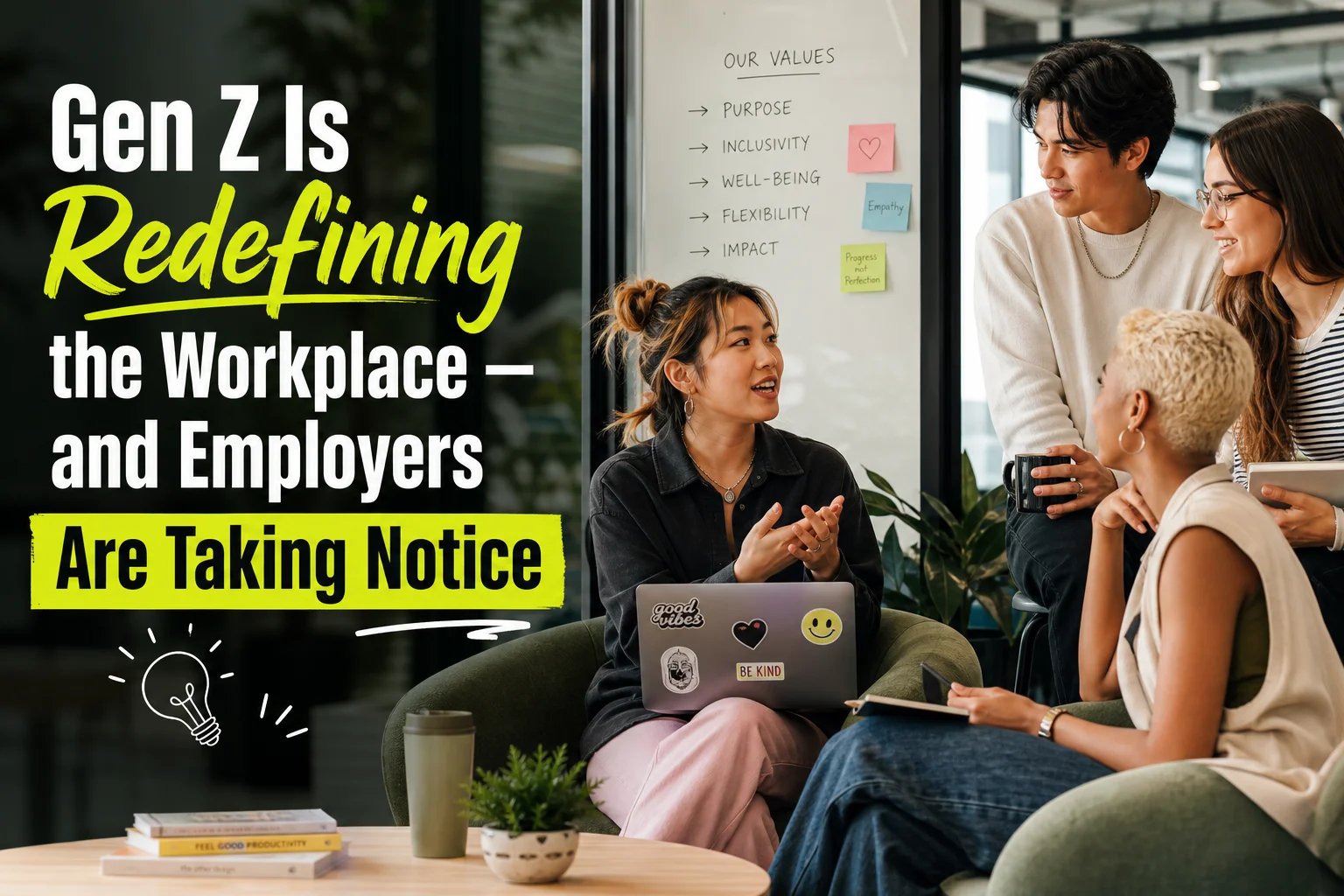
That is why Gen Z Is Redefining the Workplace — and Employers Are Taking Notice. Born roughly between the late 1990s and early 2010s, Gen Z is entering the workforce with different expectations from previous generations. They are digitally fluent, socially aware, highly pragmatic, and unusually vocal about what they want from employers.
This does not mean Gen Z is “difficult,” “entitled,” or “anti-work,” as some lazy stereotypes suggest. In many cases, the opposite is true. Gen Z wants meaningful work, fair treatment, strong leadership, flexibility, skills development, and honest communication. They are not rejecting work; they are rejecting outdated workplace models that no longer match modern life.
For employers, this shift is impossible to ignore. As Gen Z becomes a larger share of the global workforce, organizations are rethinking everything from hiring and onboarding to leadership development, benefits, office design, communication norms, and company culture.
In short, Gen Z is redefining the workplace — and employers are taking notice because they have to. The companies that listen will attract stronger talent, build healthier cultures, and stay competitive. The ones that dismiss these expectations as a passing phase may find themselves struggling to recruit, retain, and motivate the next generation of workers.
Who Is Gen Z in the Workplace?
Gen Z is the first generation to grow up fully immersed in the digital age. They do not remember a world without smartphones, social media, instant search, online reviews, and global connectivity. They came of age during economic uncertainty, climate anxiety, political polarization, a pandemic, and rapid technological change.
That combination shaped their workplace mindset.
They are often practical rather than idealistic. Many watched older generations work hard without guaranteed security. They saw layoffs, student debt, rising housing costs, and burnout. As a result, Gen Z tends to ask direct questions about compensation, flexibility, advancement, values, and well-being.
They are also used to transparency. They compare salaries online, review employers on platforms like Glassdoor, learn skills from YouTube and TikTok, and expect information to be accessible. When communication is unclear, they notice. When leadership is performative, they notice. When company values do not match company behavior, they really notice.
This is one reason Gen Z Is Redefining the Workplace — and Employers Are Taking Notice across industries, not just in technology or creative fields.
Why Gen Z’s Workplace Expectations Matter Now
Some employers still treat generational change as a side issue. That is a mistake.
Gen Z is no longer just a group of interns and entry-level employees. They are becoming managers, entrepreneurs, specialists, creators, consultants, and influential consumers. Their expectations are shaping workplace norms for everyone.
Many of the things Gen Z wants are not exclusive to Gen Z. Millennials, Gen X, and even Baby Boomers often want the same things: flexibility, respect, fair pay, supportive managers, and purpose. Gen Z is simply more willing to say it out loud.
That is the deeper reason Gen Z is reshaping the workplace and employers are paying attention. They are accelerating changes that were already overdue.
Key Workplace Shifts Driven by Gen Z
| Workplace Area | Traditional Model | Gen Z-Influenced Model |
|---|---|---|
| Career growth | Wait your turn | Clear paths, faster feedback, skills-based growth |
| Communication | Formal, top-down updates | Transparent, frequent, multi-channel communication |
| Flexibility | Office-first, fixed hours | Hybrid, remote, outcome-based work |
| Leadership | Authority-based management | Coaching, empathy, accountability |
| Benefits | Standard healthcare and retirement | Mental health, wellness, flexibility, financial support |
| Purpose | Mission statement on website | Values reflected in daily decisions |
| Learning | Occasional training sessions | Continuous upskilling and self-directed learning |
| Retention | Loyalty to company | Loyalty to growth, culture, and meaningful work |
This shift is not about catering to one generation. It is about building a more modern workplace.
1. Flexibility Is No Longer a Perk — It Is an Expectation
One of the clearest ways Gen Z Is Redefining the Workplace — and Employers Are Taking Notice is through flexibility.
For Gen Z, flexibility is not just about working from home. It includes flexible hours, asynchronous communication, autonomy, trust, and the ability to integrate work with life rather than constantly sacrificing life for work.
Many Gen Z employees entered the workforce during or shortly after the COVID-19 pandemic, when remote and hybrid work became normal. They saw that many jobs could be done effectively outside traditional office structures. As a result, they are less convinced by arguments that productivity requires physical presence.
That does not mean Gen Z never wants to come into the office. Many younger workers value mentorship, social connection, and collaborative energy. But they want office time to have a purpose. Commuting just to sit on video calls feels inefficient and outdated.
What Employers Are Doing
Forward-thinking employers are responding by:
- Offering hybrid work models
- Creating “anchor days” for collaboration
- Redesigning offices as social and creative spaces
- Measuring performance by outcomes rather than hours
- Supporting asynchronous work across time zones
- Giving teams flexibility based on role requirements
Case Study: Spotify’s “Work From Anywhere” Model
Spotify introduced a flexible work model allowing employees to choose where they work, depending on role and business needs. Instead of forcing a one-size-fits-all return-to-office policy, the company leaned into autonomy and trust.
Analysis:
Spotify’s approach reflects how Gen Z is redefining work expectations around flexibility. Younger employees are more likely to view autonomy as a sign of respect. By offering choice, Spotify strengthens its employer brand and appeals to talent that values freedom, performance, and work-life integration.
This case shows why Gen Z Is Redefining the Workplace — and Employers Are Taking Notice: flexibility has become a competitive advantage in talent attraction.
2. Mental Health Is Becoming a Business Priority
Gen Z is one of the most open generations when it comes to discussing mental health. They are more likely to talk about anxiety, stress, burnout, therapy, and emotional well-being without shame.
This openness is changing workplace culture.
In older workplace models, stress was often seen as proof of ambition. Long hours were normalized. Burnout was framed as a personal weakness rather than an organizational warning sign. Gen Z is challenging that thinking.
They are asking employers to recognize that mental health affects performance, retention, creativity, and engagement.
Mental Health Expectations by Generation
| Expectation | Why It Matters to Gen Z | Employer Response |
|---|---|---|
| Mental health benefits | Therapy and counseling are seen as normal healthcare needs | Expanded EAPs, therapy stipends, wellness platforms |
| Manager empathy | Poor management can increase stress and turnover | Leadership training and coaching |
| Boundaries | Constant availability leads to burnout | No-meeting blocks, communication norms |
| Psychological safety | Employees want to speak without fear | Inclusive team practices |
| Workload transparency | Hidden overload damages trust | Better planning and prioritization |
When Gen Z redefines the workplace, mental health moves from a private issue to a leadership issue.
Case Study: Microsoft and Well-Being Data
Microsoft has published extensive research through its Work Trend Index on employee well-being, hybrid work, meetings, and digital overload. The company has also built tools into Microsoft Viva to help organizations understand employee engagement and work patterns.
Analysis:
While Microsoft serves a multi-generational workforce, its focus on well-being aligns strongly with Gen Z expectations. Gen Z employees are more likely to expect organizations to take burnout seriously and use data responsibly to improve work conditions. This illustrates how employers are taking notice of Gen Z workplace expectations by investing in tools that measure and support healthier work patterns.
3. Purpose and Values Must Be Real, Not Decorative
Gen Z is often described as purpose-driven. But that phrase can be misunderstood.
It does not mean every Gen Z employee expects their job to save the world. It means they want to know whether their employer’s actions align with its stated values.
If a company talks about sustainability but ignores environmental impact, Gen Z notices. If a company promotes diversity but has no inclusive leadership pipeline, Gen Z notices. If a company celebrates employee wellness while rewarding overwork, Gen Z notices.
For this generation, authenticity matters.
That is another reason Gen Z Is Redefining the Workplace — and Employers Are Taking Notice. Employer branding can no longer rely on polished slogans alone. Employees can compare internal reality with external messaging and share their experiences publicly.
What Purpose Looks Like in Practice
Purpose does not have to be grand. It can show up in practical ways:
- Ethical leadership decisions
- Community involvement
- Transparent sustainability goals
- Inclusive hiring and promotion practices
- Honest communication during crises
- Products and services that solve real problems
- Respectful treatment of employees and customers
Purpose becomes powerful when it is visible in everyday decisions.
Case Study: Patagonia’s Values-Driven Employer Brand
Patagonia has long been known for environmental activism, responsible business practices, and values-led decision-making. Its public commitment to sustainability has helped it attract employees who want their work to align with personal beliefs.
Analysis:
Patagonia is not simply offering a job; it is offering alignment. That matters deeply in a labor market where Gen Z is redefining workplace loyalty. Employees are less likely to stay with a company because of tradition alone. They stay when the organization’s values feel credible and lived. Patagonia shows how values can become a talent magnet when they are backed by action.
4. Gen Z Wants Growth, Not Guesswork
Career development is one of the biggest factors shaping Gen Z’s workplace expectations.
This generation is entering the workforce during a time of rapid skills disruption. Artificial intelligence, automation, remote collaboration, and industry transformation mean that career paths are less linear than they used to be. Gen Z understands that staying employable requires continuous learning.
They do not want vague promises like “There may be opportunities later.” They want clarity.
They want to know:
- What skills do I need to grow?
- How will my performance be evaluated?
- What does promotion look like?
- Can I move laterally?
- Will the company invest in my development?
- How often will I receive feedback?
This is a major way Gen Z is transforming the workplace. They are pushing employers to make career growth more transparent and skills-based.
Career Development: Old vs. New
| Old Workplace Assumption | Gen Z Workplace Expectation |
|---|---|
| Promotions come with tenure | Promotions should reflect skills, impact, and readiness |
| Feedback happens annually | Feedback should be frequent and useful |
| Learning is company-assigned | Learning should be continuous and personalized |
| Career paths are linear | Careers can be flexible, lateral, and multi-disciplinary |
| Managers direct development | Managers coach and support development |
Case Study: IBM’s Skills-First Talent Strategy
IBM has been a prominent advocate of skills-first hiring and career development, including roles that do not always require traditional four-year degrees. The company has invested in digital learning, apprenticeships, and credential-based pathways.
Analysis:
IBM’s approach is relevant because Gen Z is redefining the workplace around skills rather than credentials alone. Many Gen Z workers value practical learning, certifications, and real-world experience. A skills-first model helps employers widen talent pools while giving younger workers clearer pathways into meaningful careers.
This is exactly why employers are taking notice as Gen Z redefines the workplace: traditional hiring filters can exclude capable talent, while skills-based systems feel more transparent and fair.
5. Feedback Must Be Fast, Clear, and Human
Gen Z grew up in an environment of instant feedback — likes, comments, messages, ratings, analytics, and real-time updates. While workplace feedback should be more thoughtful than social media feedback, the expectation for timely communication carries over.
Annual performance reviews are not enough.
Gen Z employees often want frequent check-ins, clear expectations, and practical coaching. They do not want to wait months to learn whether they are succeeding or failing. They want managers to tell them what is working, what needs improvement, and how to grow.
This does not mean Gen Z needs constant praise. It means they value clarity.
A lack of feedback creates anxiety. Clear feedback builds trust.
Better Feedback Practices for Gen Z Employees
| Practice | Why It Works |
|---|---|
| Weekly or biweekly one-on-ones | Builds trust and prevents confusion |
| Clear success metrics | Reduces ambiguity |
| Real-time recognition | Reinforces positive behavior |
| Constructive coaching | Helps employees improve faster |
| Written follow-ups | Creates accountability and clarity |
| Two-way feedback | Makes employees feel heard |
When Gen Z Is Redefining the Workplace — and Employers Are Taking Notice, management styles must evolve. The best managers are becoming coaches, not just supervisors.
6. Transparency Is the New Trust Currency
Gen Z has little patience for vague corporate communication. They are used to researching everything, from salary benchmarks to company reviews to leadership controversies.
This has made transparency a powerful workplace expectation.
Gen Z wants clarity around:
- Pay ranges
- Promotion criteria
- Company strategy
- Layoff decisions
- Diversity data
- Remote work policies
- Performance expectations
- Leadership accountability
Of course, not every business detail can be public. But unnecessary secrecy damages trust.
Pay transparency is especially important. Many Gen Z employees are comfortable discussing compensation, and salary information is more accessible than ever. Employers that avoid the conversation may appear outdated or unfair.
Case Study: Buffer’s Transparent Salary Formula
Buffer, a social media management company, has been known for radical transparency, including publishing salary formulas and openly discussing company decisions. While Buffer’s model may not work for every organization, it demonstrates a distinctive approach to trust.
Analysis:
Buffer’s transparency aligns with the workplace Gen Z is helping create. Younger workers often prefer employers that explain how decisions are made. Transparency reduces suspicion and strengthens credibility. This case proves that when Gen Z is redefining the workplace, trust is built through openness, not polished corporate language.
7. Diversity, Equity, and Inclusion Are Expected — Not Optional
For Gen Z, diversity and inclusion are not side projects. They are core workplace expectations.
This generation is the most racially and ethnically diverse in many countries, and it has grown up with broader conversations around identity, representation, accessibility, gender, race, neurodiversity, and equity.
Gen Z employees are likely to evaluate whether an organization’s commitment to inclusion is real. They look at leadership representation, promotion patterns, hiring practices, employee resource groups, accessibility, and how leaders respond to social issues.
A company cannot simply post inclusive messaging once a year and expect credibility.
What Gen Z Looks For in Inclusive Workplaces
| Inclusion Signal | What It Communicates |
|---|---|
| Diverse leadership | Opportunity is real, not symbolic |
| Fair promotion processes | Advancement is based on merit and equity |
| Inclusive benefits | Different employee needs are recognized |
| Employee resource groups | Belonging is supported |
| Accessibility practices | Disability inclusion matters |
| Bias training with accountability | Inclusion is tied to behavior, not just awareness |
This is another reason Gen Z Is Redefining the Workplace — and Employers Are Taking Notice. Inclusion has moved from “nice to have” to a factor that affects employer reputation, retention, and innovation.
8. Technology Is a Baseline, Not a Bonus
Gen Z expects workplace technology to be intuitive, fast, and useful. They are not impressed by clunky systems, outdated software, repetitive manual processes, or poor digital communication.
To be clear, Gen Z does not expect every company to operate like a Silicon Valley startup. But they do expect tools that help them do their jobs effectively.
When workplace technology is frustrating, it sends a message: the company does not value employees’ time.
This matters because digital friction can hurt productivity and morale. If employees spend hours navigating broken systems, duplicating work, or waiting for approvals that could be automated, they disengage.
Gen Z’s Technology Expectations
| Technology Expectation | Employer Benefit |
|---|---|
| Easy collaboration tools | Faster teamwork |
| Mobile-friendly platforms | Better accessibility |
| AI-supported workflows | Reduced repetitive tasks |
| Self-service HR tools | Less administrative friction |
| Modern learning platforms | Continuous skills development |
| Clear digital communication norms | Less overload and confusion |
As Gen Z redefines workplace technology expectations, employers are investing in better digital employee experiences.
9. Gen Z Is Changing Leadership Expectations
Leadership used to be associated with authority, hierarchy, and control. Gen Z is pushing a different model: leadership based on trust, empathy, clarity, and accountability.
Gen Z employees tend to respect leaders who are authentic, communicative, and willing to listen. They are less impressed by titles alone.
They want leaders who can answer hard questions honestly. They value managers who recognize individual strengths, give meaningful feedback, and support growth. They expect leaders to care about culture, not just numbers.
This does not mean leaders should avoid high standards. In fact, Gen Z often responds well to ambitious goals when expectations are clear and support is real.
The leadership challenge is balance: high empathy and high accountability.
The Gen Z Leadership Model
| Leadership Trait | Why It Matters |
|---|---|
| Transparency | Builds trust |
| Empathy | Supports well-being |
| Accountability | Prevents performative culture |
| Coaching | Develops talent |
| Inclusivity | Strengthens belonging |
| Adaptability | Matches fast-changing work environments |
| Digital fluency | Improves communication and execution |
When Gen Z Is Redefining the Workplace — and Employers Are Taking Notice, leadership development becomes urgent. Managers who rely on command-and-control habits may struggle to retain younger talent.
10. The Rise of Work-Life Integration
Previous generations often discussed work-life balance as if work and life sat on opposite sides of a scale. Gen Z tends to think more in terms of work-life integration.
They want work to fit into a sustainable life. They care about boundaries, but they also want flexibility to manage energy, family responsibilities, health, hobbies, and personal growth.
This is not laziness. It is a reaction to burnout culture.
Many Gen Z workers have seen what happens when people give everything to work and receive little security in return. As a result, they are less likely to romanticize overwork.
Employers that mistake this for lack of ambition may miss the point. Gen Z can be highly ambitious, but they often define ambition differently. It may include financial independence, meaningful impact, location freedom, entrepreneurship, creative expression, or personal well-being.
This is why Gen Z is redefining professional success, and employers are adjusting.
11. Loyalty Is Being Rewritten
A common complaint about Gen Z is that they “job hop.” But the real issue is not loyalty. It is the basis of loyalty.
Older workplace models often assumed employees would stay because loyalty itself was a virtue. Gen Z tends to stay when the employer continues to offer growth, respect, fair compensation, healthy culture, and alignment.
If those disappear, they leave.
This is rational behavior in a labor market where skills can become outdated quickly and traditional job security is less guaranteed.
What Builds Loyalty for Gen Z?
| Loyalty Driver | Why It Works |
|---|---|
| Clear career growth | Employees see a future |
| Fair pay | Trust increases |
| Supportive managers | Daily experience improves |
| Flexibility | Work feels sustainable |
| Purpose | Employees feel connected |
| Learning opportunities | Skills stay relevant |
| Recognition | Contribution feels valued |
So yes, Gen Z Is Redefining the Workplace — and Employers Are Taking Notice, especially when it comes to retention. Keeping young talent requires more than a paycheck. It requires an employee experience worth staying for.
12. Case Study: Deloitte and Gen Z Workplace Insights
Deloitte’s annual Gen Z and Millennial research has consistently highlighted themes such as cost-of-living concerns, mental health, climate anxiety, flexible work, and the desire for purpose-driven employers.
Many young workers report stress about finances and the future, while also seeking employers that support well-being and meaningful work.
Analysis:
Deloitte’s research is valuable because it shows that Gen Z workplace expectations are not based on isolated anecdotes. They reflect broad patterns across markets. Employers are taking notice because these expectations influence hiring, retention, brand reputation, and engagement. When Gen Z is redefining the workplace, leadership teams need data-backed strategies, not stereotypes.
13. Case Study: Chipotle and Education Benefits
Chipotle has invested in education benefits, debt-free degree programs for eligible employees, tuition assistance, and career pathway initiatives. These programs are designed to attract and retain employees in a competitive labor market, especially younger workers.
Analysis:
This case matters because Gen Z is highly focused on skills, financial stability, and upward mobility. Education benefits can be a powerful retention tool when they connect frontline roles to long-term growth. It shows how employers are taking notice as Gen Z changes workplace expectations around development and financial support.
14. What Employers Often Get Wrong About Gen Z
Despite the growing evidence, some employers still misunderstand Gen Z. They interpret requests for flexibility as laziness, mental health conversations as weakness, and desire for feedback as neediness.
These assumptions can damage culture.
Here are common myths — and the reality.
| Myth About Gen Z | Reality |
|---|---|
| Gen Z does not want to work | Gen Z wants work that is fair, meaningful, and sustainable |
| Gen Z is too demanding | Many expectations reflect modern workplace improvements |
| Gen Z cannot handle criticism | They want clear, useful feedback, not vague judgment |
| Gen Z is not loyal | They are loyal to growth, trust, and values |
| Gen Z only cares about remote work | They care about autonomy and purposeful collaboration |
| Gen Z is anti-corporate | They are skeptical of performative corporate behavior |
The companies that thrive will be those that replace stereotypes with curiosity.
15. How Employers Can Adapt Without Losing Business Discipline
Adapting to Gen Z does not mean lowering standards. It means modernizing how standards are communicated, supported, and measured.
High-performing workplaces can absolutely meet Gen Z expectations while maintaining accountability.
Here is how.
1. Build Flexibility Around Outcomes
Instead of asking, “Where are employees sitting?” ask, “Are they delivering strong work?”
Set clear goals, deadlines, collaboration expectations, and performance measures. Then give people reasonable autonomy.
2. Train Managers to Coach
Managers are the daily face of company culture. If managers are unclear, unavailable, or dismissive, Gen Z employees disengage quickly.
Invest in manager training around feedback, inclusion, psychological safety, and performance conversations.
3. Make Career Growth Visible
Create transparent career frameworks. Show employees what skills are needed for advancement. Offer mentorship, learning budgets, internal mobility, and stretch assignments.
4. Communicate Honestly
Gen Z does not expect perfection. They expect honesty. If a policy changes, explain why. If the company faces challenges, communicate clearly. If leaders make mistakes, acknowledge them.
5. Support Mental Health Practically
Well-being should not be reduced to inspirational emails. Offer real resources, manageable workloads, supportive managers, and clear boundaries.
6. Align Values With Decisions
If your company claims to value inclusion, sustainability, or employee well-being, show how those values shape hiring, promotions, policies, and investments.
7. Upgrade Workplace Technology
Remove digital friction. Use tools that help employees collaborate, learn, and work efficiently.
When employers follow these steps, they do more than respond to Gen Z. They create better workplaces for everyone.
16. What Gen Z Can Learn From Employers, Too
A balanced conversation matters. While Gen Z Is Redefining the Workplace — and Employers Are Taking Notice, the relationship is not one-sided.
Gen Z employees also benefit from understanding business realities. Companies must balance flexibility with customer needs, profitability, compliance, collaboration, and operational complexity.
To thrive, Gen Z professionals should develop:
- Communication skills
- Resilience
- Professional judgment
- Long-term career thinking
- Collaboration across generations
- Comfort with constructive criticism
- Business and financial literacy
- Patience with organizational change
The best workplaces will not be built by one generation demanding change and another resisting it. They will be built through mutual learning.
Gen Z brings urgency, digital fluency, and fresh expectations. Older generations bring experience, institutional knowledge, and perspective. Together, they can create workplaces that are both humane and high-performing.
17. The Business Case for Listening to Gen Z
Employers are not adapting just to be nice. There is a strong business case.
When companies respond to Gen Z workplace expectations, they can improve:
- Recruitment
- Retention
- Employee engagement
- Innovation
- Employer brand
- Diversity and inclusion
- Productivity
- Customer relevance
- Leadership pipelines
Ignoring Gen Z can be expensive. Turnover costs money. Poor culture damages reputation. Outdated technology slows execution. Lack of transparency erodes trust.
On the other hand, organizations that understand why Gen Z Is Redefining the Workplace — and Employers Are Taking Notice can turn generational change into strategic advantage.
Business Impact of Gen Z-Informed Workplace Practices
| Workplace Practice | Potential Business Benefit |
|---|---|
| Flexible work | Wider talent access and better retention |
| Mental health support | Lower burnout and higher engagement |
| Transparent career paths | Stronger internal mobility |
| Skills-based hiring | Larger, more diverse talent pools |
| Inclusive culture | Better innovation and belonging |
| Modern technology | Higher productivity |
| Purpose-driven leadership | Stronger employer brand |
| Frequent feedback | Faster employee development |
This is not about chasing trends. It is about designing work for the future.
18. How Gen Z Is Influencing Other Generations
One of the most interesting effects of this shift is that Gen Z’s expectations are spreading across the workforce.
When younger employees ask for flexibility, older employees often benefit. When Gen Z pushes for mental health resources, everyone gains access. When they ask for pay transparency, inequities become easier to address. When they challenge outdated communication norms, teams become more efficient.
In this way, Gen Z is redefining the workplace not only for themselves, but for colleagues across generations.
A Gen X parent may appreciate hybrid work. A Millennial manager may welcome mental health support. A Baby Boomer approaching retirement may value flexible schedules. A neurodivergent employee may benefit from clearer communication and inclusive practices.
The Gen Z effect is larger than Gen Z.
19. The Future Workplace Gen Z Is Helping Build
If current trends continue, the workplace of the future will be more flexible, transparent, skills-based, inclusive, and human-centered.
It will likely include:
- More hybrid and remote-friendly roles
- AI-supported workflows
- Personalized learning paths
- Skills-based hiring and promotion
- Stronger manager coaching
- More transparent pay practices
- Well-being integrated into business strategy
- Greater employee voice
- More flexible benefits
- Purpose measured through action
This future will not arrive evenly. Some companies will lead; others will resist. Some industries will adapt faster than others. But the direction is clear.
Gen Z Is Redefining the Workplace — and Employers Are Taking Notice because the old employment bargain is changing. Employees are no longer satisfied with vague promises, rigid systems, and performative culture. They want workplaces that are clear, fair, flexible, and meaningful.
And increasingly, employers know they must respond.
Practical Checklist for Employers
If your organization wants to attract and retain Gen Z talent, start here.
| Action | Question to Ask |
|---|---|
| Review flexibility policies | Are we measuring outcomes or attendance? |
| Improve onboarding | Do new hires understand expectations and culture? |
| Train managers | Are managers equipped to coach younger employees? |
| Clarify career paths | Can employees see how to grow here? |
| Support mental health | Are benefits matched by healthy workloads? |
| Increase transparency | Are pay, promotion, and policy decisions clear? |
| Modernize tools | Are employees slowed down by outdated systems? |
| Strengthen inclusion | Are our values visible in leadership and decisions? |
| Gather feedback | Do employees have safe ways to speak up? |
| Act on data | Are we changing based on what we learn? |
The most important step is simple: listen seriously, then act consistently.
Long-Tail Keyword Variations for Context
To support SEO naturally, related keyword variations include:
- Gen Z is redefining the workplace
- how Gen Z is changing workplace culture
- why employers are taking notice of Gen Z
- Gen Z workplace expectations
- Gen Z and the future of work
- how employers can attract Gen Z talent
- Gen Z employee retention strategies
- Gen Z workplace trends
- Gen Z is reshaping modern work
- employers adapting to Gen Z expectations
These variations reflect the broader conversation around why Gen Z Is Redefining the Workplace — and Employers Are Taking Notice across industries.
Conclusion: The Future Belongs to Workplaces That Listen
The rise of Gen Z is not a workplace problem to solve. It is an opportunity to build something better.
Gen Z is challenging outdated assumptions about flexibility, leadership, mental health, career growth, transparency, inclusion, and purpose. They are asking employers to be clearer, fairer, more human, and more accountable.
That is why Gen Z Is Redefining the Workplace — and Employers Are Taking Notice. The shift is already here, and it is reshaping how organizations attract talent, develop leaders, design culture, and define success.
The best employers will not respond with defensiveness. They will respond with curiosity. They will ask what these expectations reveal about the future of work. They will recognize that many Gen Z priorities are not radical at all — they are practical, overdue, and beneficial across generations.
For leaders, the takeaway is clear: do not wait until turnover, disengagement, or reputation damage forces change. Start now. Listen to younger employees. Train managers. Clarify growth paths. Support well-being. Build flexibility with accountability. Make values real.
The companies that adapt will not just win Gen Z talent. They will build workplaces people of all generations want to join, contribute to, and stay with.
1. Why is Gen Z redefining the workplace?
Gen Z is redefining the workplace because they entered work during a time of rapid digital change, economic uncertainty, and increased awareness of mental health, inclusion, and flexibility. They expect transparency, purpose, fair pay, career growth, and healthier work models.
2. What do Gen Z employees want most from employers?
Gen Z employees typically want flexibility, clear communication, mental health support, career development, inclusive culture, fair compensation, and authentic values. They also want managers who provide useful feedback and respect their time.
3. Are Gen Z workers less loyal than previous generations?
Not necessarily. Gen Z is loyal when employers provide growth, trust, fair treatment, and meaningful work. They are less likely to stay in roles that feel stagnant, unhealthy, or misaligned with their values.
4. How can employers attract Gen Z talent?
Employers can attract Gen Z talent by offering flexible work, transparent pay ranges, strong learning opportunities, inclusive policies, modern technology, and a credible employer brand. Authenticity matters more than polished recruitment messaging.
5. Does adapting to Gen Z mean lowering workplace standards?
No. Adapting to Gen Z means updating management practices, not reducing expectations. Employers can maintain high standards while offering flexibility, clear goals, regular feedback, and supportive leadership.
6. How is Gen Z changing leadership?
Gen Z is pushing leadership toward coaching, transparency, empathy, and accountability. They respect leaders who communicate honestly, support development, and act consistently with company values.
7. Why are employers taking notice of Gen Z workplace expectations?
Employers are taking notice because Gen Z is becoming a larger share of the workforce. Their expectations affect recruitment, retention, culture, productivity, and employer reputation. Companies that ignore these changes risk losing talent.
8. Is Gen Z’s impact limited to office jobs?
No. Gen Z is influencing workplaces across industries, including retail, healthcare, manufacturing, hospitality, education, and technology. While flexibility may look different by role, expectations around respect, growth, communication, and well-being apply broadly.
About the Author