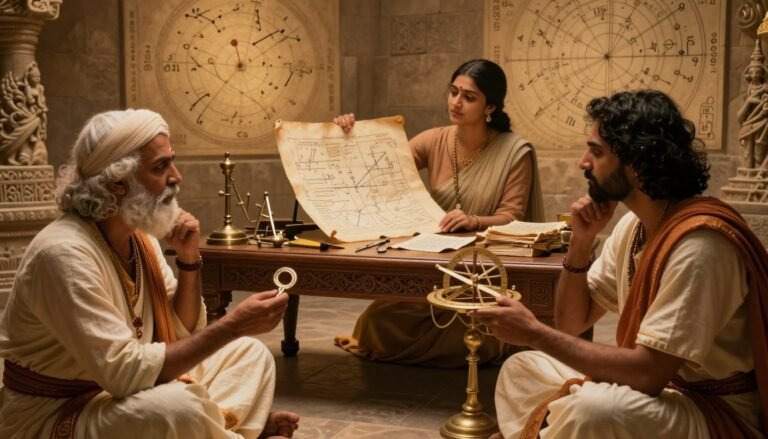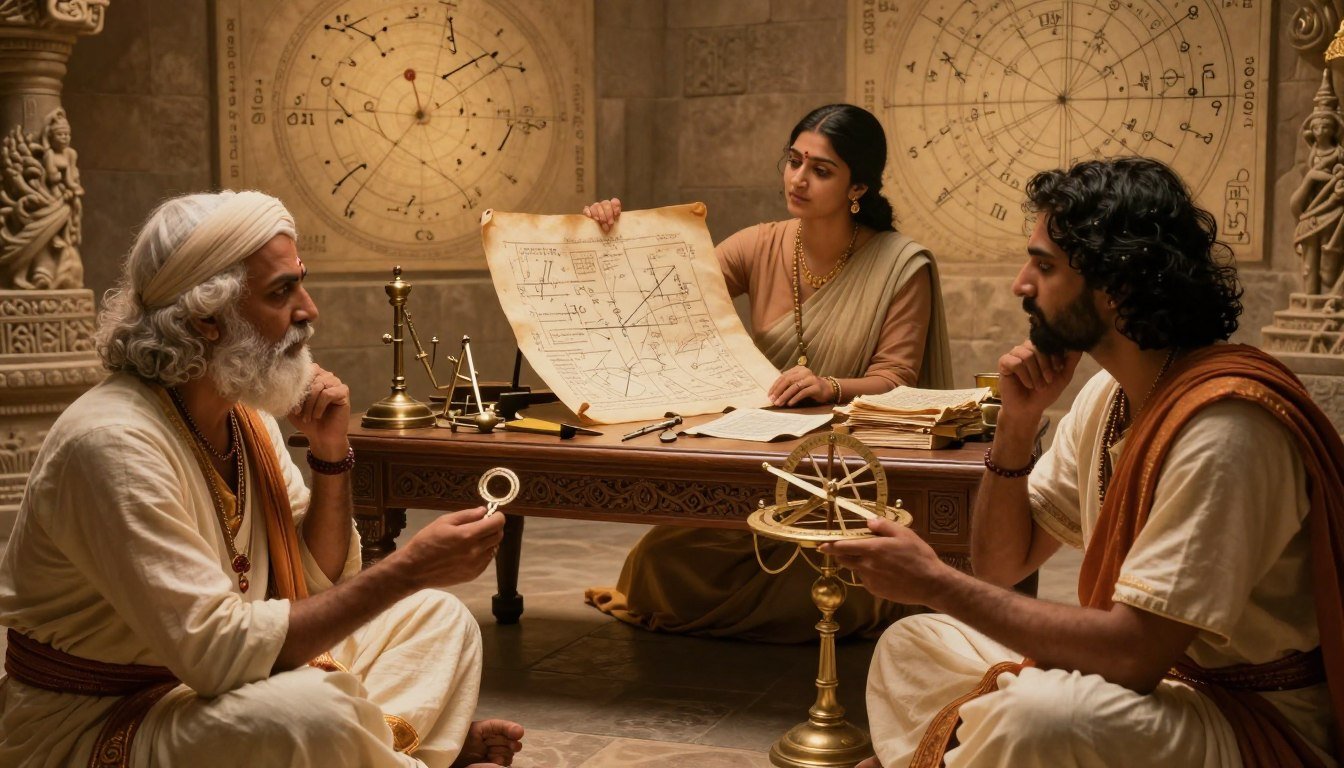
Imagine a world without the number zero. Merchants couldn’t calculate profits. Astronomers couldn’t map the stars with precision. Engineers couldn’t design structures that stand for centuries. This seemed impossible to ancient civilizations in Europe, the Middle East, and parts of Asia. Yet, in India, scholars saw a profound truth: nothing itself was something worth naming and using in calculations.
This simple but revolutionary insight came from India’s scientific heritage. It was a time when most cultures saw mathematics as just practical arithmetic. The ancient Indian innovations in mathematics changed how we understand numbers and measurement.
The decimal system, with its use of zero, originated in India around 3300-1900 BCE. This change would reshape global commerce, science, and technology for millennia.
India has a rich intellectual legacy spanning five thousand years. The Vedas, Itihāsas, Brāhmaṇas, Āraṇyakas, Upanishads, and Purāṇas hold sophisticated knowledge in various fields. Ancient Indian scholars excelled in mathematics, astronomy, medicine, metallurgy, linguistics, and ecology.
The scientific heritage of India shows a tradition of rigorous inquiry. Religious practices sparked systematic investigation into geometry, astronomy, and mathematical principles. These needs gave rise to independent fields of study pursued for intellectual understanding itself.
Indian scholars went beyond practical applications to seek knowledge as a fundamental cultural value. Learning became the foundation of civilizational achievement.
What makes these contributions unique is their systematic nature and abstract reasoning. Unlike scattered discoveries, India developed an interconnected intellectual framework. Mathematics informed astronomical calculations. Medical knowledge incorporated chemical principles. Linguistic analysis employed logical frameworks that influenced philosophy and grammar for centuries.
Key Takeaways
- The decimal system and the concept of zero originated in ancient India and transformed global mathematics and science
- Ancient Indian innovations emerged from practical needs like ritual timing and altar construction but evolved into independent intellectual pursuits
- The scientific heritage of India encompasses mathematics, astronomy, medicine, linguistics, and ecology as interconnected disciplines
- Indian scholars developed rigorous methodologies combining empirical observation with abstract reasoning
- Ancient contributions to mathematics laid the foundation for advances in astronomy, medicine, and other scientific fields
- Indian civilization prioritized knowledge-seeking and learning as fundamental cultural values alongside practical applications
Overview of Indian Contributions to Various Fields
Ancient India was a hub of intellectual achievements in many scientific fields. Scholars there developed key scientific principles that influenced the world for centuries. They introduced the decimal system and made advanced astronomical calculations.
These innovations changed how we see the world. They came from deep study, cultural support for learning, and philosophical inquiry into nature.
The ancient texts, like the Vedas and Upanishads, were more than spiritual guides. They also held practical knowledge in mathematics, astronomy, and medicine. The Chandogya Upanishad mentions the science of numbers as essential. The Mundaka Upanishad shows a system for organizing knowledge into superior and inferior categories.
The term ganita—meaning the science of calculation—appears often in Vedic literature. The Vedanga Jyotisha ranks ganita as the highest science. This shows how much Indian culture valued mathematical thinking.
Indian math went beyond practical needs. It was about abstract reasoning and spiritual significance. This set Indian math apart from other civilizations.
Significance of Ancient Indian Innovations
Indian innovations changed science in many areas:
- The decimal system changed arithmetic worldwide
- Astronomy discoveries led to precise calendars used by many cultures
- Medical practices introduced new surgical techniques and remedies
- Linguistic analysis laid the groundwork for modern grammar
- Ecological practices showed sustainable resource management long before modern environmentalism
These achievements came from a culture that valued learning. It saw intellectual inquiry as a path to mastery and understanding.
Historical Context of Indian Contributions
Indian scientific achievements spanned different periods. The Ṛgvedic Period (3300-1900 BCE) started systematic observation and recorded knowledge. Later periods refined these ideas through texts and teaching traditions.
Indian epistemology divided knowledge into parā vidyā (superior) and aparā vidyā (inferior). This showed advanced thinking about learning’s purpose. It made math and astronomy culturally important. The Vedic system honored quantitative reasoning and analysis as lifelong pursuits.
Mathematics: The Legacy of Indian Scholars
Indian mathematicians changed how we see numbers and solve problems. Their work has shaped modern math, science, and technology. They introduced zero and the decimal system, changing math worldwide.
The Concept of Zero and Its Impact
The discovery of zero was a huge breakthrough. Before zero, numbers were hard to represent. Indian scholars made zero a real number, changing math forever.
The idea of zero started with deep thoughts. The Sanskrit word Sunya means “void.” This idea turned into a math tool. Pingala’s Chandah-sutra used zero in patterns and syllables around 200 BCE.
Brahmagupta (598–668 CE) made zero key in math. He set rules for using zero in math. This was a big step for math worldwide. The word Sunya became “cipher” in English.
Contributions of Aryabhata and Brahmagupta
Aryabhata (476–550 CE) and Brahmagupta made big changes in math. Aryabhata used letters for numbers, making math easier. His Aryabhatiya solved equations.
Brahmagupta’s Brahmasphuta-siddhanta (628 CE) was a big step in algebra. He explained how to use zero and solve equations. Their work linked math and astronomy.
| Scholar | Time Period | Major Contributions | Impact on Mathematics |
|---|---|---|---|
| Aryabhata | 476–550 CE | Alphabetical number notation, linear and quadratic equation solutions, trigonometric functions, precise π calculation | Simplified complex number representation and astronomical problem-solving |
| Brahmagupta | 598–668 CE | Arithmetic rules using zero, algebra advancement, indeterminate equations, positive and negative number operations | Established zero as operational number and expanded algebraic methods |
| Pingala | c. 200 BCE | Zero usage in prosodic calculations, combinatorial mathematics | Earliest known mathematical application of zero concept |
The decimal system was another big change. It used ten digits, including zero, to represent numbers. This made math faster and more accurate.
Old inscriptions show the decimal system’s use. The Gwalior inscription is from around 876 CE. Over thirty inscriptions show this system. This proves Indians used it long before Europe.
- Zero represented both absence and a mathematical quantity
- The decimal place value system used positional notation with ten digits
- Indian scholars integrated mathematics with astronomy and practical applications
- Mathematical concepts were often compressed into verses for memorization
- Arithmetic operations with zero became systematic and well-defined
Indian math went beyond zero and the decimal system. Scholars worked on algebra, geometry, and trigonometry. They created formulas for complex problems. Their work spread to Europe, shaping modern math.
Astronomy: Ancient Indian Observations and Theories
Ancient India had a rich tradition in astronomy. They combined careful observation with advanced math. Their work helped shape our understanding of the cosmos.
Indian astronomers tracked celestial bodies and predicted eclipses with great accuracy. They spent centuries studying and experimenting.
Their work was driven by practical needs. People needed to know when to plant crops and celebrate festivals. They also wanted to understand the movements of planets and stars.
This focus led to the development of better tools and methods. It pushed astronomers to innovate.
Historical Texts on Indian Astronomy
Several key texts are at the heart of Indian astronomy. The Vedanga Jyotisha was one of the earliest works. It set up a framework for understanding the calendar and the relationship between solar and lunar cycles.
The Surya Siddhanta came later and offered detailed mathematical models. It explained how to calculate positions of planets and predict eclipses.
The Aryabhatiya was a groundbreaking work. Written by Aryabhata around 499 CE, it introduced bold new ideas. Varahamihira’s Pancha Siddhantika, created in the sixth century, brought together five different astronomical schools. These texts showed how Indian thinkers compared methods and improved their celestial calculations.
- Vedanga Jyotisha: Earliest systematic framework for calendrical astronomy
- Surya Siddhanta: Mathematical models for planetary motion and eclipse prediction
- Aryabhatiya: Revolutionary concepts about Earth’s rotation and planetary positions
- Pancha Siddhantika: Synthesis of five astronomical schools and their methodologies
The Role of Aryabhata in Astronomical Calculations
Aryabhata changed how people thought about astronomy. He proposed that Earth rotates on its axis instead of the sky revolving around Earth. This idea was radical for his time.
He suggested the Sun was at the center of planetary motion. His work showed that careful math could explain what people saw in the sky.
Aryabhata made concrete contributions to celestial calculations. He measured Earth’s circumference with impressive accuracy. He calculated the length of the solar year to within minutes of the true value.
He created methods to predict eclipses by understanding the shadows of Earth and Moon. His development of the sine function as a computational tool was groundbreaking. He created tables of sine differences for different angles.
These tools made complex calculations faster and more accurate. Indian astronomers who came after him built on these foundations, refining trigonometric methods and developing new mathematical techniques.
| Astronomer | Time Period | Major Contribution | Impact on Celestial Calculations |
|---|---|---|---|
| Aryabhata | 476-550 CE | Earth’s axial rotation and heliocentric model concepts | Revolutionized understanding of planetary motion and eclipse prediction |
| Varahamihira | 505-587 CE | Synthesis of five astronomical schools | Improved methods for calculating calendar dates and planetary positions |
| Brahmagupta | 598-668 CE | Advanced mathematical models for planetary motion | Enhanced accuracy in predicting celestial events and eclipses |
| Bhaskara II | 1114-1185 CE | Trigonometric refinements and mathematical innovations | Elevated precision of astronomical calculations to new levels |
Aryabhata’s work spread beyond India through Islamic scholars. Al-Biruni studied Indian texts and brought these ideas into Arabic astronomy. The significant astronomy findings of Indian astronomers eventually reached Europe during the Renaissance.
These discoveries helped build modern science. They showed that mathematics could unlock the secrets of the universe.
Medicine: Ayurveda and Its Influence
Ayurveda is one of the oldest holistic healthcare systems in the world. It comes from ancient India and has shaped health practices globally. It views health as a balance between physical, mental, and spiritual aspects.
In ancient India, medicine evolved from careful observation and detailed records. Scholars developed theories on body functions and illness causes. Their knowledge was passed down through generations, influencing health worldwide.
Foundations of Ayurvedic Medicine
Ayurvedic medicine is based on three bodily energies: vata, pitta, and kapha. These energies control body and mind functions. Balance in these energies means good health; imbalance leads to illness.
Holistic healthcare in Ayurveda uses various treatments:
- Diet changes for body types
- Herbal medicines from plants and minerals
- Lifestyle routines by season
- Cleansing to remove toxins
- Meditation and breathing for mental balance
Prevention was key in ancient Ayurveda. Practitioners believed harmony prevents most diseases. This approach is vital in understanding health today.
Key Figures in Ancient Indian Medicine
Charaka and Sushruta were major medical scholars. They wrote foundational texts that shaped Ayurveda. Their work combined science and practical experience.
Charaka documented thousands of medicines and their uses. He organized internal medicine into a system doctors could follow. He focused on understanding disease causes before treatment.
Sushruta was a master of surgery, making breakthroughs in reconstructive surgery. His detailed anatomy studies led to the Sushruta Samhita, describing surgical instruments and procedures. His contributions include:
| Surgical Achievement | Description | Modern Relevance |
|---|---|---|
| Rhinoplasty | Nose reconstruction using forehead tissue grafts | Used in modern plastic surgery |
| Cataract Surgery | Lens displacement technique using curved needle | Foundation for eye surgery methods |
| Skin Grafting | Tissue transfer for wound treatment | Core technique in modern reconstructive surgery |
| Fracture Management | Setting broken bones and treating dislocations | Orthopedic surgical principles |
Sushruta stressed the importance of cleanliness in medicine. He used wine and other substances for pain relief, early forms of anesthesia. His texts show the value of sanitation in surgery.
Both physicians added ethical principles to their work. They saw doctors as having more than just treating illness. Their contributions laid the groundwork for modern medicine’s key practices.
Linguistics: The Evolution of Sanskrit
Ancient India made groundbreaking discoveries in linguistics research. They shaped how we understand language. Indian scholars created systematic frameworks for analyzing grammar and meaning thousands of years before modern linguistics emerged.
These innovations in linguistics laid the foundation for contemporary language science. They also influenced computational approaches to understanding how languages work.
Sanskrit stands as one of history’s most perfectly analyzed languages. Ancient Indian grammarians approached their work with scientific precision. They created detailed systems to describe how language functions at every level.
This grammatical systematization became a model for linguistic study across the world. The texts they produced remain remarkable examples of systematic thinking about language structure.
Panini and the Rules of Sanskrit Grammar
Panini created the Ashtadhyayi around 500 BCE, a masterwork of grammatical analysis. This text contains roughly 4,000 rules that describe how to construct correct Sanskrit sentences. Panini used a compact notation system that packed maximum information into minimal space.
He employed special markers called anubandha to classify grammatical categories with remarkable precision. Panini’s approach anticipated modern linguistic concepts by centuries. He recognized that language has deep underlying structures beneath surface forms.
His methodology treated grammar as a generative system—rules that can produce all correct expressions from basic elements like word roots and affixes. The ordered application of his rules ensured logical consistency throughout the entire system.
Key features of Panini’s grammatical system include:
- Metalinguistic markers for classification of grammatical elements
- Abbreviated notation systems for phonological classes
- Logical sequencing of rules to prevent contradictions
- Recognition of transformational relationships in language
- Systematic coverage of all aspects of Sanskrit structure
Complementary texts enhanced this linguistic foundation. Yaska’s Nirukta pioneered etymological analysis and semantic categorization. Patanjali’s Mahabhashya provided philosophical commentary addressing theoretical questions about language meaning and usage. The Pratishakhya texts analyzed Vedic phonology with exceptional precision and detail.
Influence on Modern Linguistics
Western scholars discovering Sanskrit in the late 18th century recognized its systematic sophistication. This discovery sparked comparative philology and led to understanding the Indo-European language family. Panini’s formal methodology influenced 19th-century historical linguistics development.
The computational linguistics foundations owe considerable debt to Panini’s algorithmic approach. Modern computer scientists noticed striking parallels between Paninian rule systems and context-free grammars used in programming. Contemporary natural language processing draws directly from these ancient principles. Computer programming languages themselves developed from understanding grammar as a formal, rule-governed system.
| Ancient Indian Linguistic Contributions | Modern Application | Field Impacted |
|---|---|---|
| Panini’s systematic grammar rules | Context-free grammars in computing | Computer Science |
| Yaska’s etymological analysis | Comparative historical linguistics | Linguistics Research |
| Phonological classification systems | Computational language processing | Natural Language Processing |
| Rule-based language generation | Machine translation algorithms | Artificial Intelligence |
| Structural analysis methodology | Syntactic parsing techniques | Computational Linguistics |
Innovations in linguistics continue building on these ancient Indian principles. Scholars explicitly acknowledge Panini’s influence when developing modern grammatical theories. The recognition of language as a systematic, rule-governed phenomenon traces back to these pioneering Indian thinkers.
Their work demonstrates that rigorous, scientific thinking about language predates modern linguistics by more than two millennia.
The grammatical systematization developed in ancient India created frameworks that are relevant today. These approaches shaped how linguists think about language structure, organization, and generation. Indian contributions to linguistics research remain foundational to contemporary understanding of how languages operate and how computers can process natural language effectively.
Ecology: Traditional Indian Practices
Ancient Indian civilization showed great care for the environment. They managed resources and protected nature in smart ways. Their knowledge of nature and how to live with it was deep.
Indian scriptures show a deep love for nature. They taught about taking care of the earth and using resources wisely. This view helped communities manage forests, water, and land for thousands of years.

Ancient Indian Practices Related to Nature
Indian communities used many ways to keep nature balanced. They solved big problems like water scarcity and soil health. Their methods were smart and worked for many generations.
- Water Harvesting Systems: Stepwells, tanks, and irrigation networks caught rainwater and managed water well
- Sacred Groves: Protected forests kept biodiversity high and served as early conservation areas
- Agricultural Techniques: They used crop rotation and organic fertilizers to keep soil healthy
- Forest Classification: They managed forests based on their needs and the forest’s type
Harappan cities were well-planned for the environment. Mohenjo-daro had streets, sewers, granaries, and baths. These showed advanced water and sanitation management.
Role of Ecological Wisdom in Modern India
Today, we face big environmental problems. But, ancient wisdom can help solve them. Modern people are learning from the old ways to live sustainably.
| Traditional Practice | Modern Application | Environmental Benefit |
|---|---|---|
| Water harvesting structures | Revived systems addressing water scarcity in arid regions | Sustainable water management and groundwater replenishment |
| Sacred grove conservation | Biodiversity protection through designated protected areas | Higher species diversity compared to surrounding landscapes |
| Organic agriculture methods | Integration into sustainable farming movements | Improved soil health and reduced chemical contamination |
| Plant-based medicine systems | Ayurvedic principles in pharmaceutical development | Reduced environmental impact from synthetic production |
Sacred groves show the power of ancient wisdom. They have more biodiversity than other areas. This shows how old beliefs helped protect nature before we knew about science.
The Arthashastra and other texts taught us to care for nature. These ideas are important today for protecting the environment. Mixing old wisdom with new science helps us care for the earth better.
The Intersection of Mathematics and Astronomy
Ancient Indian scholars found that math and astronomy are like two sides of a coin. Astronomers needed math to predict where planets and stars would appear. This need led to big scientific discoveries.
Math and astronomy work together because of real-world problems. Astronomers needed math to figure out where planets were. This pushed mathematicians to come up with new ways to solve problems.
Mathematical Foundations of Astronomical Calculations
Aryabhata changed astronomy by using trigonometric functions. He made tables of sine values to track celestial bodies accurately. These functions helped predict where planets were and when eclipses would happen.
The Sulba Sutras had geometric principles useful for astronomy. Baudhāyana found important math relationships, like the Pythagorean theorem and pi. These helped astronomers understand the paths of stars and planets.
- Sine and cosine values organized in mathematical tables
- Geometric theorems for measuring celestial distances
- Coordinate systems for tracking star positions
- Algebraic equations for solving planetary conjunctions
Contributions of Indian Mathematicians to Astronomical Studies
Madhava of Sangama Grama found infinite series for trigonometric functions in the 14th century. His work was ahead of European discoveries at the time. The Kerala School of mathematicians built on his ideas, creating calculus for better predictions.
Brahmagupta and Bhaskara II solved equations from astronomy. Their work on the chakravala method helped with precise calculations. Ancient texts like the Siddhantas gave models for planetary motion and star positioning.
| Mathematician | Period | Key Contribution | Astronomical Application |
|---|---|---|---|
| Aryabhata | 476–550 CE | Trigonometric functions and sine tables | Planetary position calculation |
| Brahmagupta | 598–668 CE | Algebraic equations and difference formulas | Eclipse prediction and lunar calculations |
| Bhaskara II | 1114–1185 CE | Chakravala method and second-order differences | Celestial coordinate transformations |
| Madhava of Sangama Grama | 1340–1425 CE | Infinite series for trigonometric functions | Refined eclipse and planetary predictions |
In ancient India, math and astronomy worked together to create a powerful system. Scholars needed better math to solve astronomy problems. This cycle of improvement led to knowledge that changed science for centuries.
Innovations in Medicine: The Ayurvedic Approach
Ancient Indian medicine made big strides in healthcare. The Ayurvedic tradition mixed observation with detailed records. This created a complete healing system. Scholars like Charaka and Sushruta documented how to treat diseases and manage health.
Their work shows ancient doctors combined practical skills with theory. These texts show Indian medicine was connected to other sciences. Math and astronomy helped in calculating treatment times.
This mix of disciplines led to a holistic health approach. It’s an approach that’s valuable today.
Herbal Remedies and Their Applications
In ancient India, studying plants and minerals was a big deal. The Rigveda listed many medicinal plants and their uses. Later texts built on this, classifying plants in detail.
Ayurvedic doctors developed ways to make medicines work better:
- They used decoction and infusion to get the most from plants
- Powder and paste made medicines easier to take
- Medicated oils and ghees offered lasting benefits
- Fermented medicines helped with digestion
- Mineral and metal compounds treated long-term issues
They knew about over 500 plants, including how to use them. Charaka talked about how to identify plants, where to find them, and how much to use. Each plant was sorted by taste, qualities, and effects. This was centuries ahead of modern pharmacology.
The Role of Surgery in Ancient Medical Practices
Surgery in ancient India was advanced. The Sushruta Samhita detailed eight types of surgery with great detail. Doctors used over 120 special tools made from different materials.
Some key surgeries included:
| Surgical Procedure | Description | Historical Significance |
|---|---|---|
| Rhinoplasty | Nose reconstruction using forehead flap technique | Method remained standard until modern era |
| Cataract Removal | Couching technique for lens displacement | Gold standard treatment for centuries |
| Skin Grafting | Reconstructive procedures for burn and wound repair | Foundation for modern plastic surgery |
| Bone Setting | Fracture treatment with splints and braces | Systematic approach to orthopedic care |
| Hernia Repair | Surgical correction of abdominal hernias | Complex technique requiring anatomical knowledge |
Ancient surgeons knew the importance of keeping things clean. They sterilized tools and cleaned wounds with special decoctions. Honey and turmeric were used for their healing properties.
They used wine and other substances to numb patients during surgery. This allowed them to work without causing pain.
The Sushruta Samhita showed deep understanding of anatomy. This came from studying cadavers and observing. Surgeons knew how to plan surgeries based on anatomy.
Medical progress in ancient India went beyond treating diseases. Ayurvedic texts talked about living healthy, eating right, and following seasonal advice. This approach, along with surgery and prevention, laid the groundwork for modern medicine.
Linguistics and Its Cultural Impact
Ancient Indian linguistics research changed how we see language. Scholars in India created advanced ways to study words, sounds, and grammar thousands of years ago. Their work laid the groundwork for language study worldwide.
Indian linguists knew language needed careful protection. They saw how knowledge could vanish without effort. So, they built systems to keep language accurate over time. These systems are key for keeping languages alive today.
Preservation of Language Through Texts
Ancient Indian scholars found ways to keep languages pure. They made systems to keep sacred texts exact for centuries. These methods combined written records with oral traditions for precision.
Their preservation methods included:
- Memorization patterns for easy recall
- Phonological analysis for exact pronunciation
- Detailed dictionaries for meaning and usage
- Commentarial traditions for textual explanations
- Mathematical analysis of poetry for metrical accuracy
Sanskrit grammar, set by ancient scholars, created a stable language. This standardization helped spread ideas without losing meaning. It allowed for pan-Indian intellectual discourse while respecting local variations.
Linguistic Diversity in India
India’s language scene was complex in ancient times. Sanskrit coexisted with many regional languages and dialects. This diversity was documented and valued, not erased.
Ancient Indian texts categorized languages:
| Language Category | Purpose and Use | Documentation Method |
|---|---|---|
| Sanskrit | Pan-Indian scholarly and literary exchange | Comprehensive grammatical texts |
| Prakrit Forms | Buddhist and Jain religious literature | Distinct grammatical traditions |
| Tamil and Dravidian Languages | Regional literature and administration | Independent grammar systems like Tolkappiyam |
| Regional Vernaculars | Local communication and commerce | Inscription records and texts |
Inscriptions show India’s linguistic diversity. They used Sanskrit, Prakrit, Tamil, and more based on the audience. This shows a deep understanding of the need for languages in their own forms.
This recognition of language diversity was ahead of its time. Ancient Indian scholars saw language variation as natural and worth studying. They viewed multilingualism as normal, a view that modern researchers build on today.
Contributions to Environmental Science
Ancient Indian civilization had advanced ways to manage the environment and conserve biodiversity. These methods combined spiritual love for nature with practical ways to use resources wisely. The wisdom from Indian traditions is very useful today for solving environmental problems.
Indian scholars and leaders saw nature as a connected system. This view is similar to today’s ecology, which also sees all parts of nature as connected. They protected forests, water, and wildlife, guiding sustainable practices for many years.
Traditional Knowledge and Modern Ecology
Indian environmental management systems show deep ecological knowledge. They knew different lands had different soil, water, and plants. This helped communities choose the right farming methods for each area.
Managing water was also advanced. The Arthashastra, an old text, gave detailed advice on irrigation and soil care. Communities built special water systems to catch rain and prevent waste. These helped crops grow well all year.
Biodiversity conservation was a big part of Indian philosophy and practice. Hindu, Buddhist, and Jain traditions valued all life. This led to rules to protect certain animals and plants. Sacred groves were set aside to keep biodiversity high.
- Soil management through crop rotation and mixed farming
- Forest succession understanding informing timber harvesting
- Watershed dynamics knowledge connecting upland forests to agricultural plains
- Biological pest control using natural predators and botanical pesticides
- Seasonal restrictions on hunting and resource extraction
Case Studies of Indian Ecological Practices
Examples from history show how Indian civilization used ecology innovations. Sacred forests in places like Meghalaya were biodiversity hotspots. These protected areas kept plant and animal diversity through generations.
Water harvesting systems were engineering marvels that were also good for the environment. Places like Rani ki Vav in Gujarat and Chand Baori in Rajasthan caught rainwater. Tank systems in southern India spread water well. The Apatani wet rice system in Arunachal Pradesh combined fish farming with rice, making ecosystems productive.
Community-managed forests in places like Uttarakhand show how to use resources wisely. Van Panchayats let local groups manage forests with their own rules. This protected forests while meeting community needs.
| Ecological Practice | Region | Primary Benefit | Environmental Management System |
|---|---|---|---|
| Sacred Groves | Meghalaya, Western Ghats | Biodiversity Conservation | Cultural Protection Rules |
| Stepwells and Tanks | Gujarat, Rajasthan, Tamil Nadu | Water Resource Management | Rainfall Capture and Distribution |
| Van Panchayats | Uttarakhand | Sustainable Timber Harvesting | Community-Based Regulations |
| Rice-Fish Integration | Arunachal Pradesh, Wetland Areas | Agricultural Productivity | Polyculture Farming Systems |
| Mixed Cropping | Throughout India | Soil Fertility and Pest Control | Biodiversity in Agricultural Fields |
The Arthashastra had rules for wildlife conservation, like protected areas and hunting limits. These rules helped keep species alive. Penalties for harming protected animals taught people to respect nature.
Indian ecological practices show deep understanding of nature. Modern science is starting to see the value of these old ways. Mixing ancient wisdom with new research helps us solve today’s environmental problems.
Cross-Disciplinary Innovations
Ancient Indian scholars believed knowledge is all connected. They mixed different fields together, like we do today. This way, they made big steps in math, astronomy, medicine, and more.
They saw all knowledge as part of a bigger picture. This idea led to amazing discoveries in many areas. It showed how different fields can help each other.
Integration of Mathematics and Medicine
In ancient India, math was key in medicine. The Sushruta Samhita used shapes to find important body spots. Doctors mixed ingredients in exact amounts to heal.
They used math to figure out how much medicine to give. This was based on the patient’s age, weight, and sickness. They also mixed different medicines to find the best treatment.
- Geometric mapping for identifying vital anatomical locations
- Mathematical ratios in compound medicine formulations
- Arithmetic progressions for dosage calculations
- Combinatorial analysis of disease patterns
The Influence of Astronomy on Mathematical Techniques
Astronomy pushed math forward in India. Aryabhata used new math to find planets. He created tables for sine values.
Later, others found new ways to solve math problems. This helped with finding π and other important values. Brahmagupta even found ways to guess where planets were.
| Mathematician | Contribution | Application |
|---|---|---|
| Aryabhata | Sine function and tables | Planetary position calculations |
| Brahmagupta | Interpolation formulas | Estimating celestial positions |
| Madhava | Infinite series expansions | Computing trigonometric values |
Pingala’s Chandah Shastra is another example of combining knowledge. It’s about poetic meter and uses binary code. This idea was ahead of its time and helped modern tech.
Indian thinkers believed math could solve problems in other fields. This idea led to a culture that valued combining knowledge. Their work inspires us today.
Global Recognition of Indian Contributions
The world now knows science didn’t start in Europe alone. For years, people thought science began in the West. But today, scholars worldwide recognize India’s role in science and learning.
The Indian National Science Academy and others highlight ancient Indian achievements. Universities and research centers study India’s scientific traditions from ancient times to now. India’s importance in science is on par with ancient Greece.
International recognition of Indian discoveries is growing. Western universities now teach that Indian scholars found mathematical theorems before Europeans. These discoveries shape how we use numbers today.
Many Indian students don’t know about their scientific heritage. They should learn from primary sources and original texts.
Modern Perspectives on Historical Achievements
Historians of science have changed their views on India’s role in science. Scholars like George Sarton and Joseph Needham documented Indian contributions. Their work showed knowledge traveled between India and other cultures.
Arab scholars studied Indian texts during the medieval period. Al-Biruni and others learned from Indian astronomy and mathematics. Later, European scholars got this knowledge through Arabic translations and direct contact.
Today, researchers keep finding evidence of Indian scientific achievements. They study ancient texts, archaeological finds, and historical records. This work helps the world see India’s true place in scientific history.
Prominent Institutions Celebrating These Contributions
Many organizations work to preserve and share India’s scientific heritage. The following institutions lead these efforts:
- The Indian National Science Academy documents historical scientific developments
- The K.S. Krishnan Centre for History and Philosophy of Science conducts specialized research
- The National Science Centre in New Delhi displays ancient Indian scientific instruments
- Digital archives and databases make historical texts available to researchers worldwide
- Universities include Indian science history in their educational programs
- International conferences bring scholars together to discuss these achievements
Educational programs now teach students about ancient Indian discoveries. Schools and universities add content about Indian contributions. Digital libraries make original texts accessible to anyone interested in learning. Museums showcase instruments and writings that demonstrate Indian scientific knowledge.
| Institution Type | Primary Focus | Impact on Scientific Heritage Recognition |
|---|---|---|
| National Science Academy | Documentation and research of Indian scientific history | Establishes credibility and systematic record of achievements |
| Research Centers | Specialized studies of specific scientific disciplines | Provides detailed analysis and scholarly validation |
| Museums and Exhibitions | Public display of ancient scientific artifacts | Makes achievements visible and accessible to general audiences |
| Educational Programs | Integration of Indian science history into curricula | Educates new generations about their scientific heritage |
| Digital Archives | Online access to historical manuscripts and texts | Democratizes knowledge and enables global research |
| International Conferences | Scholarly exchange and discussion of findings | Builds international acknowledgment and peer validation |
Young people need to read ancient Indian texts and understand the science within them. This knowledge can inspire new discoveries and technological advances. Understanding India’s scientific past helps people develop modern applications of ancient wisdom and become pioneers in future scientific fields.
Conclusion: The Lasting Impact of Indian Innovations
The scientific legacy of ancient India is vast and profound. Scholars in ancient India made discoveries in mathematics, astronomy, medicine, and linguistics. These discoveries, like the decimal system and zero, changed how we calculate. Panini’s work on grammar and Aryabhata’s astronomy observations are also key.
These achievements are more than just historical facts. They are the base for today’s technology and science. They show how ancient India’s knowledge is essential for our modern world.
It’s time for schools to teach about India’s true contributions to science. Western universities now know that some math theorems were first found in India. This knowledge should be shared with students everywhere.
Students should learn how ancient Indian scholars helped create computer programming languages. The binary system, used in computers, comes from ancient Indian work on prosody. This shows how ancient knowledge is connected to our digital world.
Reflection on the Future of Indian Contributions
Today, ancient Indian knowledge helps solve many modern problems. Ayurvedic medicine, for example, is used in drug research. The discovery of reserpine from Rauwolfia serpentina shows how traditional medicine can lead to new medicines.
Traditional ecological knowledge helps with environmental issues. It teaches us how to manage resources and protect biodiversity. Ancient architecture also offers solutions for sustainable cities.
It’s important to study ancient Indian texts accurately. This means using primary sources and understanding classical languages. It’s also key to work together with historians, scientists, and traditional knowledge keepers.
By recognizing India’s scientific achievements, we can correct Eurocentric views. This approach honors India’s contributions while showing their place in global history.
Continuing Influence in Modern Disciplines
Ancient Indian innovations are important today. Computer science, mathematics, medicine, and astronomy all benefit from ancient Indian knowledge. For example, Paninian linguistics helps in computer grammar, and Ayurvedic medicine is used in research.
These influences show that ancient Indian knowledge is valuable for today’s challenges. It’s time to appreciate these contributions fully.
We need to study ancient Indian knowledge with respect and accuracy. This means recognizing India’s role in global science while avoiding overemphasis. By doing this, we can use ancient wisdom to solve today’s problems.
About the Author