Introduction
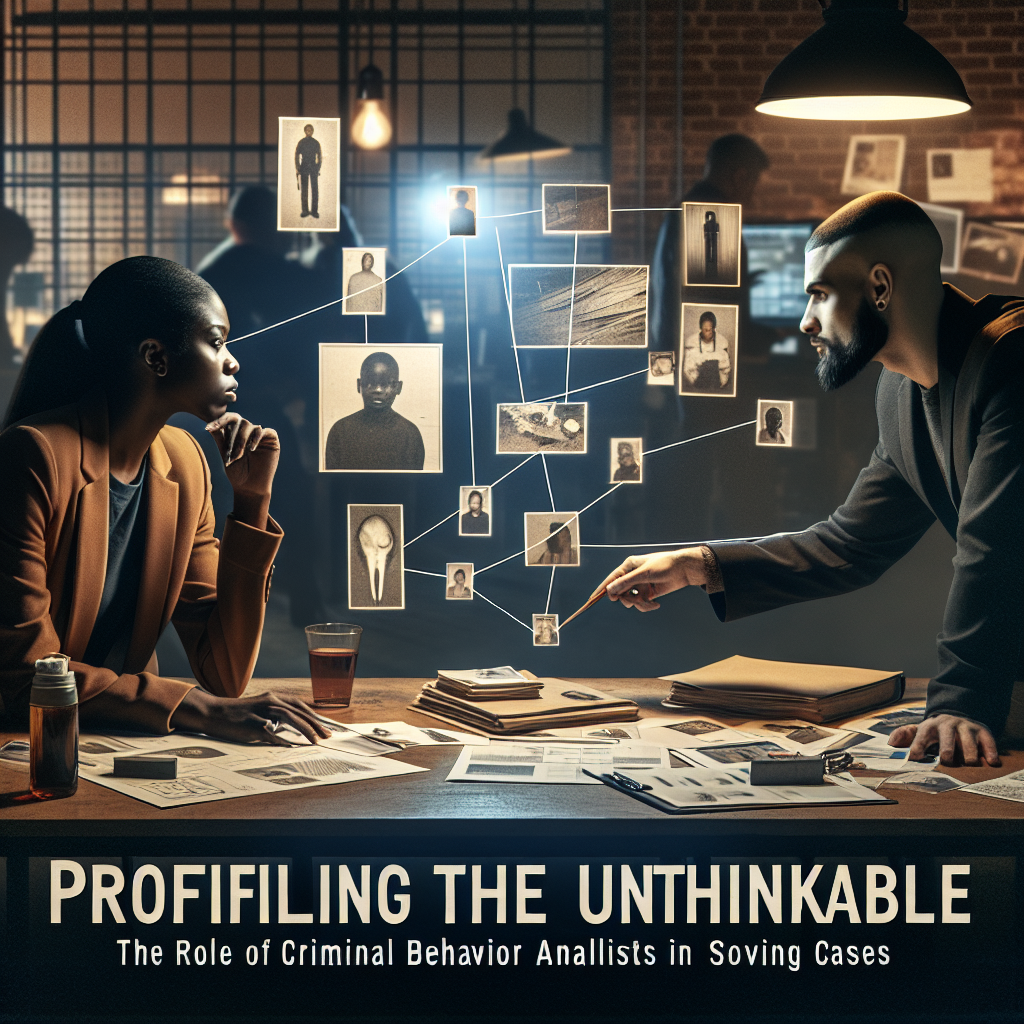
In a world grappling with the complexities of crime, the narrative often skews towards sensationalism, overshadowing the meticulous work that goes into solving cases. Behind every headline of a notorious criminal act lies a team of unsung heroes: criminal behavior analysts. These experts wield psychological insights and behavioral evidence like a subtle compass, guiding law enforcement through the fog of uncertainty. As we delve into the riveting realm of criminal behavior analysis, we uncover how these professionals are pivotal in "Profiling the Unthinkable: The Role of Criminal Behavior Analysts in Solving Cases."
The Emergence of Criminal Behavior Analysis
The Foundation of Criminal Profiling
Criminal profiling, often conflated with popular media portrayals, is a scientific discipline grounded in psychology, sociology, and criminology. In the late 1970s, the FBI pioneered behavioral analysis in response to the increasing complexity of violent crimes. They sought to apply psychological principles to identify patterns among offenders.
Key Concepts:
- Modus Operandi (MO): The method employed by an offender when executing a crime.
- Signature Behavior: Actions taken by the offender that go beyond what’s necessary to commit the crime, revealing their motivations.
- Victimology: The study of the victim’s role in the crime, including their characteristics and relationship to the offender.
The Role of Criminal Behavior Analysts
Criminal behavior analysts bridge the gap between psychology and law enforcement. Their day-to-day tasks include constructing profiles of offenders, consulting on active cases, and conducting research to improve crime-solving methodologies. Their work is vital in understanding the psychological motives behind criminal acts.
Responsibilities:
- Analyzing crime scenes to deduce offender behavior
- Creating psychological profiles to predict future actions
- Assisting law enforcement in interrogation techniques
- Engaging in threat assessments for potential future crimes
Case Studies Illustrating the Impact
The Unsolved Case of the Zodiac Killer
Background: This infamous case remains one of America’s most notorious unsolved crimes. Between 1968 and 1969, the Zodiac Killer claimed the lives of multiple victims in the San Francisco Bay Area.
Role of Analysts: Criminal behavior analysts studied the letters sent by the Zodiac, analyzing his language, symbols, and taunts. By assessing his psychological profile, they inferred characteristics such as a possible history of violent behavior and a desire for notoriety.
Analysis: This case underscores the importance of linguistic analysis and how behavior analysts can draw critical insights from a suspect’s communication, even when traditional investigative methods stall.
The Boston Strangler
Background: Between 1962 and 1964, Albert DeSalvo terrorized women in the Boston area, claiming responsibility for several murders.
Role of Analysts: From a psychological perspective, analysts examined DeSalvo’s background and behavioral patterns. His confession, which was later deemed unreliable, prompted analysts to reconstruct the psychological profile of a man seeking control over women through violence.
Analysis: The traditional investigation methods alone couldn’t capture his psyche. The insights drawn from behavior analysis played a crucial role in connecting the dots, allowing investigators to comprehend not just the "what" but the "why" behind the atrocities.
The Tools of the Trade
Behavioral Analysis Units
The FBI’s Behavioral Analysis Unit (BAU) specializes in criminal profiling and has been instrumental in many high-profile cases. Here, specialized analysts collaborate to dissect criminal behavior, often utilizing advanced technologies.
Tools Used:
- Computer Software: Algorithms analyze behavioral patterns derived from previous crimes.
- Geographic Profiling: Mapping locations helps predict where new crimes may occur.
- Psychological Testing: Assessing personality traits related to criminal behavior.
Data-Driven Decision Making
Criminal behavior analysts are increasingly leveraging big data and artificial intelligence to enhance profiling efforts. By accessing vast amounts of crime data, analysts can identify trends that would be impossible to discern through manual analysis.
Table: Comparison of Traditional vs. Data-Driven Approaches
| Aspect | Traditional Approach | Data-Driven Approach |
|---|---|---|
| Data Analysis | Manual reviews and anecdotal evidence | Automated algorithms processing large datasets |
| Speed | Slower, longer investigative timelines | Faster identification of patterns |
| Predictive Capabilities | Limited to historical context | Capable of real-time trend forecasting |
Challenges in Profiling Criminal Behavior
Ethical Considerations
While profiling can be incredibly effective, it raises ethical dilemmas. The effectiveness of profiling often hinges on generalizations derived from statistical trends, which can inadvertently lead to biases against certain demographic groups.
Limitations of Profiling
Criminal behavior analysts also face the challenge of working with incomplete evidence. A profile is only as good as the data it’s based on. Analysts need to be cautious about making assumptions without sufficient information.
The Future of Criminal Behavior Analysis
Advancements in Technology
The integration of artificial intelligence in criminal profiling is set to revolutionize the field. Predictive algorithms and machine learning can sift through unimaginable volumes of data, making it easier for analysts to identify and predict criminal behavior.
Training the Next Generation
Educational institutions are beginning to offer specialized programs focusing on criminal behavior analysis. This ensures that future analysts are equipped not only with psychological expertise but also with the latest technological skills.
Conclusion
The role of criminal behavior analysts is an indispensable facet of modern law enforcement. With their insights, law enforcement agencies can navigate the complex nature of criminal behavior, piecing together the puzzle that often remains elusive. "Profiling the Unthinkable: The Role of Criminal Behavior Analysts in Solving Cases" reveals the intersection of psychology and criminology, showing us that the unspeakable can become understandable, with the right expertise.
Ultimately, the journey of understanding criminal behavior doesn’t end with the capture of a suspect; it ignites a myriad of questions about societal impacts, preventive measures, and the very fabric of human nature itself. Let’s embrace the profound insights of criminal behavior analysis as a beacon of hope in our often troubled world.
FAQs
1. What is criminal profiling?
Criminal profiling involves the process of analyzing behavior, psychological traits, and crime patterns to create a profile of potential offenders.
2. How effective is criminal behavior analysis in solving cases?
While not foolproof, criminal behavior analysis has proven effective in many cases, leading to the capture of suspects who may have otherwise gone unnoticed.
3. What types of crimes benefit most from profiling?
Violent crimes, serial offenses, and cases with psychological motivations tend to benefit the most from criminal behavior analysis.
4. Are there ethical concerns with criminal profiling?
Yes, profiles can sometimes lead to biases based on demographic data. Analysts must be aware of ethical responsibilities when creating profiles.
5. How do analysts stay current with advancements in technology?
Many analysts engage in continuous education, attend conferences, and collaborate with tech experts to keep up with the latest trends and tools available for crime analysis.
In understanding "Profiling the Unthinkable: The Role of Criminal Behavior Analysts in Solving Cases," we recognize the fusion of art and science that shapes modern law enforcement, pushing the boundaries of what we can predict and prevent in the realm of crime.
About the Author