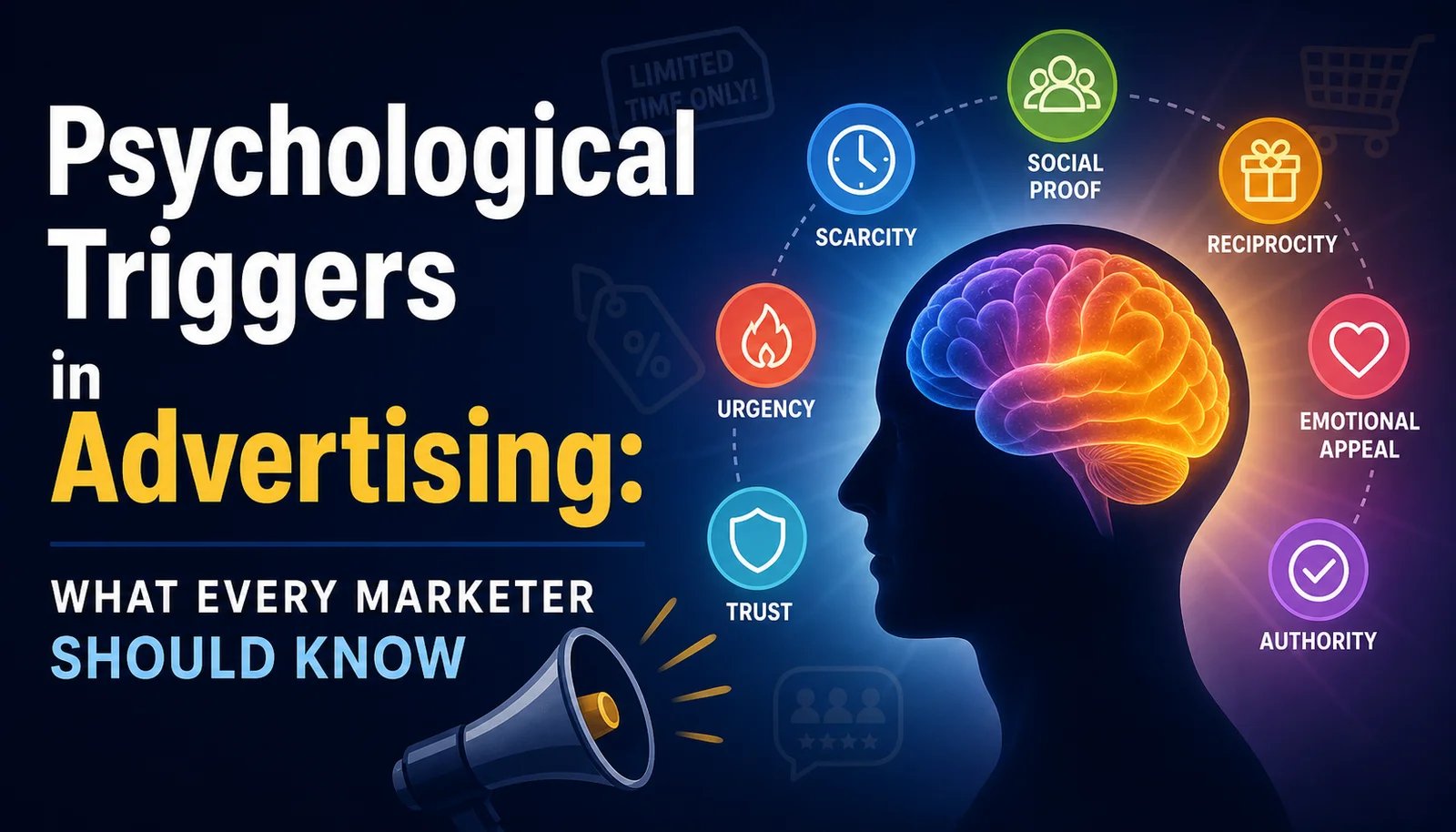
The Ultimate Guide to Psychological Triggers in Advertising: What Every Marketer Should Know
A great advertisement rarely wins because it simply “explains” a product.
It wins because it makes someone feel something.
A shopper clicks because the offer feels urgent. A subscriber signs up because the brand feels trustworthy. A buyer chooses one product over another because the message confirms who they believe they are — or who they want to become.
That is the real power behind Psychological Triggers in Advertising: What Every Marketer Should Know. Modern consumers are overwhelmed by messages, offers, content, and choices. Logic still matters, of course, but attention, memory, trust, desire, and action are deeply emotional and psychological processes.
The best marketers understand this.
They do not manipulate people. They understand people.
They know that advertising psychology is not about tricking customers into buying things they do not need. It is about communicating value in a way that matches how people naturally think, feel, compare, decide, and act.
In this in-depth guide to Psychological Triggers in Advertising: What Every Marketer Should Know, we will explore the most powerful psychological triggers used in advertising, why they work, how leading brands apply them, and how marketers can use them ethically to create more persuasive campaigns.
What Are Psychological Triggers in Advertising?
Psychological triggers in advertising are mental, emotional, or behavioral cues that influence how people respond to marketing messages.
They can affect attention, curiosity, trust, desire, urgency, memory, and purchase behavior.
For example:
- A limited-time offer triggers urgency.
- Customer reviews trigger social proof.
- A premium price can trigger perceived value.
- A free trial triggers reciprocity.
- A familiar logo triggers trust and recognition.
- A before-and-after image triggers transformation desire.
At its core, Psychological Triggers in Advertising: What Every Marketer Should Know is about understanding why people say yes, why they hesitate, and what helps them move from awareness to action.
The most effective advertising psychological triggers often work because they reduce mental effort. Consumers are busy. They do not always compare every option logically. Instead, they use shortcuts, emotional signals, and contextual clues to make decisions faster.
These shortcuts are often called heuristics.
A customer might think:
“Thousands of people bought this, so it must be good.”
“Only three spots left, so I should act now.”
“This brand understands me.”
“That expert recommends it, so I trust it.”
“This feels like the kind of product someone like me would use.”
That is why psychological triggers in marketing and advertising can be so powerful.
Why Psychological Triggers Matter More Than Ever
Consumers today are exposed to thousands of brand messages each week. Social media ads, email promotions, influencer content, search results, video ads, podcasts, billboards, product placements, and app notifications all compete for the same limited resource: attention.
The challenge is no longer just reaching people.
The challenge is being noticed, remembered, trusted, and chosen.
This is exactly why Psychological Triggers in Advertising: What Every Marketer Should Know has become such an essential topic for marketers, founders, copywriters, media buyers, brand strategists, and content creators.
Psychological triggers help marketers:
| Marketing Challenge | Psychological Trigger That Helps | Why It Works |
|---|---|---|
| Low attention | Curiosity, novelty, contrast | Interrupts automatic scrolling or scanning |
| Low trust | Social proof, authority, familiarity | Reduces perceived risk |
| Low urgency | Scarcity, deadlines, loss aversion | Encourages immediate action |
| Low differentiation | Identity, storytelling, emotion | Makes the brand feel meaningful |
| Low conversion | Simplicity, reciprocity, commitment | Reduces friction and builds momentum |
| Low retention | Belonging, consistency, reward | Encourages repeat behavior |
Great advertising does not just present information. It frames information in a way the human brain cares about.
That is the foundation of Psychological Triggers in Advertising: What Every Marketer Should Know.
The Ethical Line: Persuasion vs. Manipulation
Before diving deeper, it is important to address ethics.
Psychological triggers can be used responsibly or irresponsibly.
Ethical advertising helps people make confident decisions. Manipulative advertising pressures, deceives, exaggerates, or exploits fear and insecurity.
A responsible marketer uses psychological triggers to:
- Clarify real value.
- Reduce uncertainty.
- Make choices easier.
- Build trust.
- Encourage beneficial action.
- Match the message to the customer’s actual needs.
An irresponsible marketer uses psychological triggers to:
- Create fake scarcity.
- Exaggerate benefits.
- Hide important information.
- Shame customers.
- Exploit vulnerability.
- Push unsuitable products.
The goal of understanding Psychological Triggers in Advertising: What Every Marketer Should Know should never be deception. The goal should be better communication.
A simple ethical test is this:
Would the customer still feel respected after discovering how the campaign worked?
If the answer is yes, you are likely using advertising psychology in a healthy way.
1. The Scarcity Trigger: “I Might Miss Out”
Scarcity is one of the most familiar psychological triggers in advertising.
When people believe something is limited, they tend to value it more. Scarcity works because humans are wired to avoid missed opportunities. We often feel the pain of losing something more strongly than the pleasure of gaining something similar.
This is connected to loss aversion, a concept from behavioral economics.
Scarcity appears in advertising through messages like:
- “Only 5 left in stock.”
- “Limited edition.”
- “Offer ends tonight.”
- “Registration closes Friday.”
- “Exclusive release.”
- “While supplies last.”
Scarcity works especially well when the limitation is real and specific.
Weak scarcity sounds vague:
“Hurry, limited time only!”
Stronger scarcity sounds concrete:
“Enrollment closes at 11:59 p.m. tonight. Next opening is in six months.”
In the context of Psychological Triggers in Advertising: What Every Marketer Should Know, scarcity is essential because it helps overcome procrastination. Many customers are interested but inactive. Scarcity gives them a reason to act now.
Case Study: Booking.com and Real-Time Availability
Booking.com has long used scarcity-based messaging in its hotel listings. Users often see phrases such as:
- “Only 1 room left at this price”
- “In high demand”
- “Booked 6 times in the last 24 hours”
Brief Analysis
This strategy is relevant because hotel booking involves uncertainty and comparison. Users may delay while checking alternatives. Scarcity messaging reduces hesitation by making the cost of waiting feel real.
The trigger works because it combines scarcity with social proof. Not only is the room limited, but other people are also interested. This creates urgency without needing a hard sell.
However, this type of advertising trigger must be accurate. False scarcity can destroy trust quickly.
2. The Social Proof Trigger: “People Like Me Trust This”
Social proof is the psychological tendency to look at others when deciding what to believe or do.
If thousands of people recommend a product, we assume it is safer. If a restaurant is full, we assume it is good. If a software tool has strong testimonials from companies like ours, we become more confident.
Social proof appears in many forms:
| Type of Social Proof | Example |
|---|---|
| Customer reviews | “Rated 4.8 by 12,000 customers” |
| Testimonials | “This tool saved our team 10 hours per week” |
| User counts | “Trusted by 2 million creators” |
| Expert endorsements | “Recommended by dermatologists” |
| Influencer approval | Creator reviews or product demos |
| Case studies | Detailed proof of results |
| Media mentions | “Featured in Forbes” |
| Community activity | Comments, shares, user-generated content |
For marketers studying Psychological Triggers in Advertising: What Every Marketer Should Know, social proof is one of the highest-impact tools for reducing perceived risk.
People often ask themselves:
“Will this work for someone like me?”
Social proof answers:
“Yes, because it worked for people like you.”
Case Study: Slack’s Growth Through Customer Proof
Slack’s early marketing leaned heavily on proof from real teams. Instead of focusing only on technical features, Slack highlighted how companies used the platform to improve collaboration.
Its website and campaigns emphasized recognizable customers, adoption numbers, and workplace transformation stories.
Brief Analysis
Slack’s use of social proof worked because the product required behavior change. Teams had to shift communication habits. That creates resistance.
By showing that respected companies and productive teams were already using Slack, the brand made adoption feel safer and more modern. The trigger was not simply “many people use this.” It was “smart teams use this.”
That distinction matters in psychological triggers in marketing.
3. The Authority Trigger: “Experts Know Best”
Authority is another major principle in Psychological Triggers in Advertising: What Every Marketer Should Know.
People are more likely to trust claims when they come from credible sources. This is why brands feature doctors, scientists, industry experts, certifications, awards, professional credentials, or respected publications.
Authority helps answer the question:
“Why should I believe you?”
Examples include:
- “Dentist recommended”
- “Clinically tested”
- “Award-winning”
- “Certified organic”
- “Backed by research”
- “Used by Fortune 500 companies”
- “Approved by leading experts”
Authority is especially important in industries where trust and risk are high, such as:
- Healthcare
- Finance
- Cybersecurity
- Education
- Legal services
- Enterprise software
- Supplements
- Parenting products
But authority must be specific.
A weak authority claim says:
“Experts recommend this.”
A stronger claim says:
“Recommended by 9 out of 10 surveyed dermatologists in a 2024 independent study.”
Specificity makes authority more believable.
Case Study: Colgate and Dentist Recommendations
Colgate has frequently used dentist recommendations in its advertising. The brand often positions itself as a toothpaste trusted by dental professionals.
Brief Analysis
Toothpaste is a routine product, but it still involves health-related trust. Consumers may not understand the chemistry of fluoride, enamel protection, or plaque reduction. Dentist authority simplifies the decision.
This is a classic example of advertising psychology triggers working through credibility. The consumer does not need to become an oral health expert. They can rely on professional endorsement.
4. The Reciprocity Trigger: “They Gave Me Value First”
Reciprocity is the human tendency to return favors.
When a brand gives something useful before asking for a sale, people often feel more open, appreciative, and willing to engage.
In advertising and marketing, reciprocity can include:
- Free samples
- Free trials
- Valuable guides
- Webinars
- Templates
- Free audits
- Helpful newsletters
- Educational content
- Bonus gifts
- Loyalty rewards
This is one of the most practical lessons in Psychological Triggers in Advertising: What Every Marketer Should Know: value given upfront can lower resistance.
The customer thinks:
“This brand has already helped me. Maybe their paid product is worth considering.”
Reciprocity is powerful because it shifts the relationship from seller-buyer to helper-helped.
Case Study: HubSpot’s Free Educational Content
HubSpot built much of its brand through free tools, certifications, templates, blogs, and educational resources. Before many users ever became customers, they had already received value from HubSpot’s content ecosystem.
Brief Analysis
HubSpot’s strategy demonstrates how reciprocity can support long-term brand growth. The company did not simply advertise software. It educated the market.
By helping marketers and sales teams solve real problems for free, HubSpot built trust, authority, and goodwill. When buyers were ready for software, HubSpot was already familiar and credible.
This is one reason psychological triggers in advertising often work best when integrated into a broader customer experience.
5. The Curiosity Trigger: “I Need to Know More”
Curiosity is a powerful attention driver.
The brain dislikes information gaps. When people notice a gap between what they know and what they want to know, they feel motivated to close it.
That is why headlines like these work:
- “The mistake most first-time investors make”
- “Why your ads are getting clicks but no sales”
- “The simple pricing change that increased revenue by 31%”
- “What top-performing brands do differently”
- “The hidden reason customers abandon carts”
Curiosity is central to Psychological Triggers in Advertising: What Every Marketer Should Know because advertising must first earn attention before it can persuade.
However, curiosity should not become clickbait.
Clickbait creates a promise and fails to satisfy it. Ethical curiosity creates a promise and delivers meaningful value.
Curiosity Formula
| Element | Purpose | Example |
|---|---|---|
| Information gap | Creates tension | “Most brands overlook this conversion factor” |
| Relevance | Makes it personal | “If your landing page gets traffic but no sales…” |
| Specificity | Builds credibility | “3 checkout changes that reduced abandonment by 18%” |
| Payoff | Satisfies the promise | Clear explanation, data, or useful insight |
Curiosity works best when it is tied to a real customer problem.
6. The Emotion Trigger: “This Feels Important”
People may justify purchases with logic, but emotion often starts the decision.
Emotional advertising works because feelings guide attention, memory, and meaning. A message that makes someone feel hopeful, inspired, understood, amused, proud, safe, or relieved is more likely to be remembered.
Common emotional triggers include:
- Joy
- Fear
- Relief
- Pride
- Belonging
- Nostalgia
- Hope
- Empathy
- Surprise
- Aspiration
In Psychological Triggers in Advertising: What Every Marketer Should Know, emotion is not decoration. It is strategy.
A product feature tells people what something does.
An emotional benefit tells people why it matters.
For example:
| Feature | Emotional Benefit |
|---|---|
| Cloud backup | Peace of mind |
| Noise-canceling headphones | Calm and focus |
| Fitness coaching app | Confidence and progress |
| Premium skincare | Self-care and pride |
| Home security camera | Family safety |
| Budgeting software | Control and relief |
The best advertising connects features to emotions.
Case Study: Nike’s “Just Do It”
Nike’s advertising rarely focuses only on shoe materials or technical specifications. Instead, Nike sells determination, identity, achievement, and inner strength.
The “Just Do It” platform taps into the emotional experience of overcoming resistance.
Brief Analysis
Nike’s success shows that psychological triggers in advertising are strongest when connected to identity and aspiration. Customers are not just buying athletic gear. They are buying into a story about who they can become.
This is why emotional advertising can build brands, not just generate clicks.
7. The Identity Trigger: “This Is Who I Am”
Identity is one of the deepest psychological triggers in advertising.
People buy products not only for utility, but also for self-expression. They choose brands that reflect their values, status, lifestyle, beliefs, and communities.
Identity-based advertising answers:
“What does choosing this brand say about me?”
Examples:
- Patagonia: environmentally conscious and adventurous
- Apple: creative, modern, design-focused
- Tesla: innovative and future-oriented
- Harley-Davidson: independent and rebellious
- Lululemon: wellness-focused and active
- Liquid Death: anti-corporate, humorous, unconventional
Identity triggers are especially powerful because they create loyalty. A cheaper alternative may exist, but if a brand feels tied to the customer’s self-concept, switching becomes less appealing.
For anyone exploring Psychological Triggers in Advertising: What Every Marketer Should Know, identity may be the most important trigger for brand building.
Case Study: Apple’s “Think Different”
Apple’s famous “Think Different” campaign positioned the brand around creativity, rebellion, and visionary thinking. It was not just about computers. It was about people who challenged convention.
Brief Analysis
This campaign is a masterclass in identity-based advertising. Apple invited customers to see themselves as creative nonconformists. The product became a symbol of personal philosophy.
That is why psychological triggers in advertising can create cultural meaning, not just short-term conversions.
8. The Simplicity Trigger: “This Feels Easy”
Complexity kills action.
When people feel confused, overwhelmed, or uncertain, they delay decisions. Simplicity is a psychological trigger because it lowers cognitive load.
In advertising, simplicity can appear through:
- Clear headlines
- One main call to action
- Simple pricing
- Clean landing pages
- Easy comparisons
- Short forms
- Plain language
- Visual hierarchy
- Step-by-step explanations
The customer should instantly understand:
- What is this?
- Who is it for?
- Why should I care?
- What should I do next?
A major lesson from Psychological Triggers in Advertising: What Every Marketer Should Know is that persuasion is not only about adding more reasons to buy. Sometimes it is about removing reasons to hesitate.
Simplicity Checklist for Ads
| Question | Why It Matters |
|---|---|
| Is the main benefit clear in 5 seconds? | Attention is limited |
| Is there one primary CTA? | Too many choices reduce action |
| Is the offer easy to understand? | Confusion creates friction |
| Is the copy written in customer language? | Familiar wording builds comfort |
| Is the next step obvious? | Clarity improves conversion |
Simplicity is not the same as being basic. It means making the valuable thing easy to understand.
9. The Commitment and Consistency Trigger: “I Already Started”
People like to behave consistently with their previous actions and stated beliefs.
This is the commitment and consistency trigger.
Once someone takes a small step, they are more likely to take a larger step later. This is why marketers use:
- Email opt-ins
- Quizzes
- Free trials
- Product configurators
- Wish lists
- Account creation
- Small deposits
- Low-cost starter products
- Progress bars
- Onboarding steps
A small commitment creates momentum.
For example, a person who completes a skincare quiz is more likely to consider the recommended products. A user who starts a free trial is more likely to upgrade if they experience value. A shopper who adds an item to a wish list has already signaled interest.
In Psychological Triggers in Advertising: What Every Marketer Should Know, this trigger is especially useful for long sales cycles.
Case Study: Duolingo’s Streak System
Duolingo uses streaks, progress indicators, reminders, and small daily commitments to encourage continued app usage.
Brief Analysis
Although Duolingo is not traditional advertising, its behavioral design offers important lessons for marketers. Once users build a streak, they want to maintain consistency. The product reinforces identity: “I am someone who learns every day.”
Brands can apply this to advertising by encouraging small, meaningful actions that lead toward larger conversions.
10. The Anchoring Trigger: “This Is the Reference Point”
Anchoring happens when people rely heavily on the first piece of information they see when making a decision.
In advertising, anchoring often appears in pricing.
For example:
- “Was $199, now $99”
- “Plans start at just $12/month”
- “Compared to hiring an agency for $5,000/month…”
- “Premium package: $499, Standard package: $249”
The first number shapes how the next number feels.
If a customer first sees a $500 product, a $250 product may feel affordable. If they first see a $50 product, the same $250 product may feel expensive.
Anchoring is one of the most commercially useful concepts in Psychological Triggers in Advertising: What Every Marketer Should Know because it influences perceived value.
Pricing Anchor Example
| Offer | Customer Perception |
|---|---|
| Basic: $29 | Low entry point |
| Pro: $79 | Balanced value |
| Premium: $199 | Makes Pro feel reasonable |
| Enterprise: Custom | Signals scalability and seriousness |
The goal is not to trick people. The goal is to frame value clearly.
A strong anchor helps customers understand what they are getting relative to alternatives.
11. The Loss Aversion Trigger: “I Don’t Want to Lose This”
People are often more motivated to avoid losses than to achieve equivalent gains.
This is loss aversion.
In advertising, loss aversion can be used through messages like:
- “Don’t miss your chance”
- “Stop losing money to inefficient systems”
- “Protect your data before a breach happens”
- “Avoid costly mistakes”
- “Your discount expires tonight”
- “Seats are almost gone”
Loss aversion is closely related to scarcity, but it is not identical.
Scarcity says:
“There is not much available.”
Loss aversion says:
“You may lose something valuable.”
For marketers studying Psychological Triggers in Advertising: What Every Marketer Should Know, loss aversion is especially useful in categories where prevention matters, such as insurance, cybersecurity, healthcare, legal services, and financial planning.
But it must be used carefully. Fear-based advertising can backfire if it feels exaggerated or exploitative.
The best loss-aversion ads pair risk with empowerment:
“Here is the problem — and here is how you can protect yourself.”
12. The Novelty Trigger: “This Is New and Interesting”
Humans notice what is new, unusual, or unexpected.
Novelty captures attention because the brain is always scanning for changes in the environment. In advertising, novelty can come from:
- A surprising visual
- An unusual headline
- A new product feature
- A fresh format
- Unexpected humor
- A bold comparison
- A counterintuitive claim
- A unique brand voice
Novelty is one reason creative advertising matters.
If every brand in a category says the same thing, customers tune out. A novel message breaks the pattern.
Case Study: Liquid Death’s Unusual Water Branding
Liquid Death sells canned water, but its branding looks more like an edgy beer, energy drink, or punk music brand. Its name, packaging, and humorous advertising are intentionally unexpected.
Brief Analysis
Liquid Death demonstrates how novelty and identity can transform a commodity product. Water is not new. But the brand frame is new.
This is a powerful example of psychological triggers in advertising because the product category is familiar, yet the advertising creates surprise and cultural conversation.
Novelty earns attention. Identity sustains loyalty.
13. The Belonging Trigger: “People Like Us Choose This”
Belonging is a core human need.
People want to feel part of groups, movements, communities, and shared identities. Advertising can activate belonging by showing customers that a brand is connected to people like them.
This trigger appears in:
- Community-driven brands
- Membership programs
- Social campaigns
- Brand hashtags
- Customer spotlights
- Events
- Lifestyle imagery
- Shared values messaging
Belonging is different from social proof.
Social proof says:
“Other people approve of this.”
Belonging says:
“This is where you fit.”
In Psychological Triggers in Advertising: What Every Marketer Should Know, belonging is especially powerful for brands that want long-term advocacy.
Customers who feel they belong do not just buy. They recommend, defend, share, and participate.
Example: Peloton’s Community Messaging
Peloton is not only selling exercise equipment. It sells connection, motivation, instructor relationships, and community energy.
The leaderboard, live classes, member stories, and shared milestones create a sense of belonging.
Brief Analysis
Fitness can be lonely and inconsistent. Peloton reduces that emotional barrier by making exercise feel social and identity-driven. The belonging trigger turns a bike into a community experience.
14. The Trust Trigger: “This Brand Feels Safe”
Trust is not one single trigger. It is the result of many psychological signals working together.
Trust can be built through:
- Consistent branding
- Transparent pricing
- Clear return policies
- Secure checkout badges
- Real customer reviews
- Professional design
- Helpful content
- Honest limitations
- Responsive support
- Guarantees
- Third-party validation
Trust is especially important online because customers cannot physically inspect the product or meet the seller.
In Psychological Triggers in Advertising: What Every Marketer Should Know, trust is the foundation. Without trust, urgency feels pushy, authority feels fake, and emotional messaging feels hollow.
Trust Signals Table
| Trust Signal | What It Communicates |
|---|---|
| Money-back guarantee | Lowers purchase risk |
| Customer reviews | Shows real-world satisfaction |
| Secure payment icons | Protects sensitive data |
| Transparent pricing | Reduces suspicion |
| Founder story | Humanizes the brand |
| Clear policies | Shows professionalism |
| Real photos/videos | Increases authenticity |
| Fast support | Signals reliability |
A useful rule:
The higher the price or risk, the more trust signals your advertising needs.
15. The Personalization Trigger: “This Was Made for Me”
Personalization makes advertising feel more relevant.
When customers feel that a message matches their needs, goals, location, behavior, or preferences, they are more likely to pay attention.
Personalization can include:
- Dynamic product recommendations
- Industry-specific landing pages
- Retargeting ads
- Personalized email subject lines
- Behavior-based offers
- Segmented messaging
- Quiz-based recommendations
- Location-based promotions
Personalization works because relevance is persuasive.
A generic message says:
“This might be for someone.”
A personalized message says:
“This is for you.”
For marketers learning Psychological Triggers in Advertising: What Every Marketer Should Know, personalization is one of the most practical ways to improve performance.
However, personalization has a boundary. If it feels too invasive, it can create discomfort.
Helpful personalization feels like service. Creepy personalization feels like surveillance.
16. The Storytelling Trigger: “I Can See Myself in This”
Stories help people understand, remember, and emotionally connect with information.
A story gives context. It creates characters, tension, transformation, and meaning.
In advertising, storytelling often follows a simple structure:
- The customer has a problem.
- The problem creates frustration or desire.
- The brand introduces a better path.
- The customer experiences transformation.
- Life improves.
This structure works because customers do not just want products. They want better versions of their current reality.
In Psychological Triggers in Advertising: What Every Marketer Should Know, storytelling is the bridge between information and emotion.
Example Story Framework
| Story Element | Advertising Role |
|---|---|
| Character | The target customer |
| Problem | Pain point or desire |
| Guide | The brand/product |
| Plan | How it works |
| Action | Call to action |
| Success | Desired outcome |
| Avoided failure | What they escape |
A strong brand story makes the customer the hero, not the company.
The company is the guide.
How Psychological Triggers Work Across the Buyer Journey
Not every trigger works equally well at every stage.
A customer seeing your brand for the first time has different needs than someone comparing pricing or deciding whether to buy today.
Here is how psychological triggers in advertising can map to the buyer journey:
| Buyer Journey Stage | Customer Mindset | Best Psychological Triggers |
|---|---|---|
| Awareness | “What is this?” | Curiosity, novelty, emotion |
| Interest | “Is this relevant to me?” | Personalization, identity, storytelling |
| Consideration | “Can I trust this?” | Social proof, authority, trust signals |
| Decision | “Should I act now?” | Scarcity, loss aversion, anchoring, simplicity |
| Retention | “Should I keep using this?” | Commitment, rewards, belonging |
| Advocacy | “Should I share this?” | Identity, community, emotional connection |
This is a key insight in Psychological Triggers in Advertising: What Every Marketer Should Know: triggers are not random tactics. They should match the customer’s stage of decision-making.
A cold audience may not respond well to aggressive scarcity. They may need curiosity and relevance first.
A warm audience may not need more education. They may need urgency and reassurance.
A loyal customer may not need discounts. They may need belonging and recognition.
How to Use Psychological Triggers Without Sounding Pushy
One reason some marketers hesitate to use psychological triggers is that they worry their advertising will sound manipulative.
The solution is subtlety and honesty.
Instead of forcing a trigger, integrate it naturally.
Pushy vs. Persuasive Examples
| Trigger | Pushy Version | Better Version |
|---|---|---|
| Scarcity | “BUY NOW OR REGRET IT FOREVER!” | “Enrollment closes Friday so we can begin onboarding Monday.” |
| Authority | “Experts say we’re the best!” | “Developed with certified nutritionists and tested by 1,200 users.” |
| Social proof | “Everyone loves us!” | “Join 40,000 small business owners using our invoicing tools.” |
| Loss aversion | “Your business will fail without this.” | “Avoid common cash-flow mistakes before they become expensive.” |
| Reciprocity | “We gave you a free guide, now buy.” | “Use the free checklist today. If you want help implementing it, we can support you.” |
Ethical psychological triggers in advertising feel like helpful context, not pressure.
Common Mistakes Marketers Make With Psychological Triggers
Understanding Psychological Triggers in Advertising: What Every Marketer Should Know also means knowing what not to do.
1. Using Fake Urgency
Fake countdown timers and false scarcity may increase short-term clicks, but they damage trust. If the same “24-hour sale” runs every day, customers notice.
2. Overloading the Message
Too many triggers in one ad can feel chaotic. An ad that uses scarcity, fear, authority, social proof, discounts, urgency, and emotional storytelling all at once may overwhelm the viewer.
3. Ignoring Audience Awareness
A new visitor may need education. A returning cart abandoner may need reassurance. A loyal customer may need recognition. Different audiences need different psychological cues.
4. Forgetting the Product
Psychological triggers cannot save a weak product forever. Advertising may create the first purchase, but customer experience creates repeat purchases.
5. Confusing Attention With Trust
A shocking ad may get clicks, but if it does not support the brand promise, it can weaken credibility.
6. Treating Customers Like Data Points Only
Behavioral data is useful, but customers are people with emotions, values, fears, and goals. Great advertising respects that complexity.
A Practical Framework for Applying Psychological Triggers
Here is a simple framework marketers can use when building campaigns.
Step 1: Identify the Customer’s Main Barrier
Ask:
- Are they unaware?
- Confused?
- Skeptical?
- Interested but delaying?
- Comparing alternatives?
- Worried about risk?
- Looking for belonging?
- Unsure about value?
Step 2: Match the Barrier to a Trigger
| Customer Barrier | Best Trigger |
|---|---|
| “I don’t notice you” | Novelty, curiosity |
| “I don’t understand the value” | Simplicity, storytelling |
| “I don’t trust you” | Authority, social proof, trust signals |
| “I’ll decide later” | Scarcity, loss aversion |
| “This feels expensive” | Anchoring, value framing |
| “Is this for me?” | Personalization, identity |
| “I feel alone in this” | Belonging, community |
| “I’m not ready for a big step” | Reciprocity, small commitment |
Step 3: Build the Message
A strong ad often combines three layers:
- Attention trigger: curiosity, novelty, emotion
- Trust trigger: proof, authority, transparency
- Action trigger: urgency, simplicity, clear CTA
For example:
“Most freelancers lose billable hours every week without realizing it. Join 25,000 independent professionals using TimeTrackr to recover lost revenue. Start your free 14-day trial today.”
This message uses:
- Curiosity: “lose billable hours without realizing it”
- Social proof: “25,000 independent professionals”
- Reciprocity/low risk: “free 14-day trial”
- Simplicity: clear CTA
This is the kind of practical application that makes Psychological Triggers in Advertising: What Every Marketer Should Know valuable beyond theory.
Long-Tail Keyword Variations for SEO Context
To optimize naturally, marketers can use long-tail variations of the focus keyword throughout content, landing pages, and supporting articles.
Examples include:
- Psychological triggers in advertising
- Psychological triggers in marketing campaigns
- Advertising psychology triggers every marketer should know
- How psychological triggers influence consumer behavior
- Ethical psychological triggers in advertising
- Consumer psychology in advertising
- Emotional triggers in advertising
- Psychological marketing tactics for better conversions
- Behavioral psychology in advertising strategy
- Persuasion triggers in digital advertising
- What marketers should know about psychological triggers
- Psychological triggers in advertising examples
- How brands use psychology in ads
- Advertising psychology principles for marketers
- Psychological triggers that increase conversions
Using variations helps avoid awkward repetition while still supporting the SEO focus of Psychological Triggers in Advertising: What Every Marketer Should Know.
Mini Case Study Comparison Chart
| Brand | Trigger Used | How It Worked | Marketing Lesson |
|---|---|---|---|
| Booking.com | Scarcity + social proof | Shows limited rooms and active demand | Urgency works best when specific and credible |
| Slack | Social proof | Highlights adoption by respected teams | Proof reduces risk in behavior-change products |
| Colgate | Authority | Uses dentist recommendations | Expert credibility simplifies decisions |
| HubSpot | Reciprocity | Gives free tools and education | Value-first marketing builds long-term trust |
| Nike | Emotion + identity | Inspires achievement and self-belief | Sell the transformation, not just the product |
| Apple | Identity | Positions users as creative thinkers | Strong brands reflect customer self-image |
| Liquid Death | Novelty + identity | Makes water culturally distinctive | Pattern-breaking can revive ordinary categories |
| Peloton | Belonging | Creates community around fitness | Community increases retention and advocacy |
These examples show that Psychological Triggers in Advertising: What Every Marketer Should Know is not limited to one industry. The principles apply across SaaS, retail, fitness, travel, consumer goods, education, and personal brands.
The Future of Psychological Triggers in Advertising
Advertising is becoming more personalized, automated, and data-driven. Artificial intelligence, predictive analytics, behavioral segmentation, and dynamic creative tools make it easier for brands to deliver the right message at the right moment.
But the fundamentals of human psychology remain surprisingly stable.
People still want:
- Safety
- Belonging
- Progress
- Recognition
- Simplicity
- Trust
- Control
- Meaning
- Confidence
- Hope
The future of Psychological Triggers in Advertising: What Every Marketer Should Know will not be about replacing human understanding with technology. It will be about using technology to deliver more human-centered communication.
The brands that win will be those that combine data with empathy.
They will not just ask:
“What will make people click?”
They will ask:
“What does our audience need to feel, understand, and believe before they can confidently act?”
That question leads to better advertising.
Conclusion: The Real Power of Psychological Triggers in Advertising
The most successful advertising does not happen by accident.
It is built on a deep understanding of how people think, feel, decide, and behave.
Throughout this guide to Psychological Triggers in Advertising: What Every Marketer Should Know, we explored the triggers that shape consumer response: scarcity, social proof, authority, reciprocity, curiosity, emotion, identity, simplicity, commitment, anchoring, loss aversion, novelty, belonging, trust, personalization, and storytelling.
Each trigger works because it connects to a real human need or decision pattern.
But the most important lesson is this:
Psychological triggers are not magic buttons. They are communication tools.
Used carelessly, they can feel manipulative. Used ethically, they help customers notice value, reduce uncertainty, make confident choices, and connect with brands that genuinely serve them.
If you are a marketer, the next step is simple. Review your current ads and ask:
- Are we earning attention?
- Are we building trust?
- Are we reducing friction?
- Are we making value clear?
- Are we respecting the customer?
- Are we giving people a good reason to act now?
When you apply Psychological Triggers in Advertising: What Every Marketer Should Know with empathy and strategy, your campaigns become more than promotional messages.
They become meaningful bridges between customer needs and brand value.
And that is where great marketing begins.
FAQs About Psychological Triggers in Advertising
1. What are psychological triggers in advertising?
Psychological triggers in advertising are emotional, cognitive, or behavioral cues that influence how people respond to marketing messages. Common examples include scarcity, social proof, authority, curiosity, reciprocity, and emotional appeal.
2. Are psychological triggers manipulative?
Not necessarily. Psychological triggers become manipulative when they are used dishonestly, such as fake scarcity or exaggerated fear. When used ethically, they help customers understand value, reduce uncertainty, and make better decisions.
3. What is the most powerful psychological trigger in advertising?
There is no single most powerful trigger for every situation. Social proof is excellent for building trust, scarcity helps encourage action, emotion improves memorability, and identity supports brand loyalty. The best trigger depends on the audience, product, and buyer journey stage.
4. How can small businesses use psychological triggers in advertising?
Small businesses can use customer reviews, testimonials, limited-time offers, free resources, clear guarantees, simple messaging, and authentic storytelling. These psychological triggers in advertising do not require huge budgets; they require customer understanding.
5. How often should marketers use scarcity in ads?
Scarcity should be used only when it is real. If a product quantity, event capacity, or deadline is genuinely limited, scarcity can be effective. Overusing fake urgency can damage brand trust and reduce long-term conversions.
6. Why does social proof work so well?
Social proof works because people look to others when making decisions, especially when they feel uncertain. Reviews, testimonials, case studies, and user numbers help reduce perceived risk and make the purchase feel safer.
7. How do emotional triggers improve advertising results?
Emotional triggers improve advertising by making messages more memorable and personally meaningful. Emotions such as hope, pride, relief, joy, and belonging can help customers connect the product to a desired outcome or identity.
8. What is the role of ethics in Psychological Triggers in Advertising: What Every Marketer Should Know?
Ethics is essential. The goal should be persuasion through clarity, relevance, and trust — not pressure or deception. Ethical use of psychological triggers respects the customer and supports long-term brand credibility.
About the Author