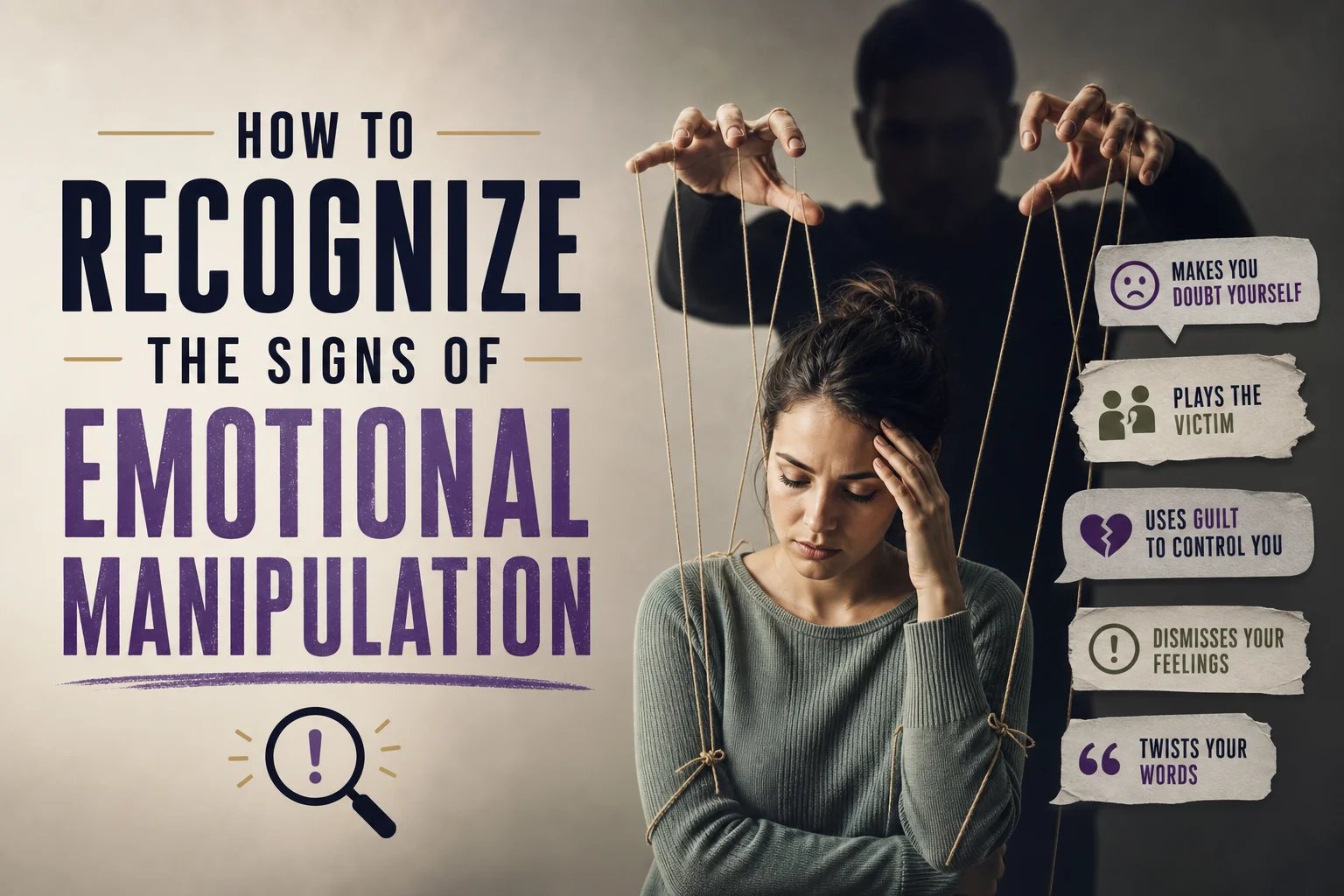
The Essential Guide on How to Recognize the Signs of Emotional Manipulation and Reclaim Your Confidence
Emotional manipulation rarely announces itself with a dramatic entrance. It often arrives quietly—through a “joke” that cuts too deep, a guilt trip disguised as concern, a sudden cold shoulder after you say no, or a compliment that somehow leaves you feeling smaller.
That is what makes it so confusing.
You may not immediately think, I’m being manipulated. Instead, you may wonder, Am I too sensitive? Did I misunderstand? Why do I feel guilty when I did nothing wrong? Over time, emotional manipulation can erode your confidence, cloud your judgment, and make you question your own needs.
Learning How to Recognize the Signs of Emotional Manipulation is not about becoming suspicious of everyone. It is about becoming more emotionally literate, self-protective, and grounded. When you can identify unhealthy patterns early, you can respond with clarity instead of confusion.
This in-depth guide explores How to Recognize the Signs of Emotional Manipulation in relationships, families, workplaces, friendships, and online interactions. You will learn common tactics, real-world examples, warning signs, response strategies, and practical ways to rebuild trust in yourself.
What Is Emotional Manipulation?
Emotional manipulation is the use of psychological tactics to influence, control, or exploit another person’s feelings, choices, or behavior—often for the manipulator’s benefit.
It can be subtle or obvious. Sometimes it looks like affection. Sometimes it looks like anger. Sometimes it is wrapped in concern, humor, victimhood, or “helpful advice.”
At its core, emotional manipulation involves an imbalance: one person pressures another to ignore their own boundaries, instincts, or needs.
Understanding How to Recognize the Signs of Emotional Manipulation begins with noticing patterns. A single disagreement or insensitive comment does not automatically mean someone is manipulative. But repeated behaviors that leave you feeling guilty, confused, afraid, responsible, or emotionally exhausted are worth paying attention to.
Why Emotional Manipulation Is So Hard to Spot
Many people miss the early signs because manipulation often targets good qualities: empathy, loyalty, patience, generosity, and the desire to avoid conflict.
Manipulators may also alternate between kindness and cruelty. This creates emotional whiplash. One day they praise you, the next day they punish you with silence. One moment they apologize, the next they blame you for “making them” act that way.
This inconsistency can make you work harder to regain their approval.
Here are common reasons people struggle with recognizing emotional manipulation:
| Reason It’s Hard to Spot | What It Sounds Like Internally | Why It Keeps You Stuck |
|---|---|---|
| You care about the person | “They didn’t mean it.” | You excuse repeated harm. |
| They mix affection with control | “But they can be so loving.” | Kind moments minimize bad ones. |
| You fear conflict | “It’s easier to give in.” | Your boundaries weaken over time. |
| They blame you | “Maybe I really am the problem.” | You question your reality. |
| The behavior is gradual | “It wasn’t always like this.” | You normalize small escalations. |
Knowing How to Recognize the Signs of Emotional Manipulation helps you step back and ask, “Is this relationship making me feel respected—or managed?”
How to Recognize the Signs of Emotional Manipulation: Core Warning Signals
While every situation is different, emotional manipulation often produces similar emotional effects.
You may be experiencing manipulation if you frequently feel:
- Guilty for having normal needs
- Afraid to express disagreement
- Responsible for someone else’s emotions
- Confused after conversations
- Pressured to decide quickly
- Exhausted from explaining yourself
- Ashamed for setting boundaries
- Like you are “walking on eggshells”
- Unsure whether your memory is accurate
- Obligated to rescue, fix, or soothe someone
A helpful way to understand How to Recognize the Signs of Emotional Manipulation is to focus less on the manipulator’s intent and more on the repeated impact.
Ask yourself:
“After interacting with this person, do I feel respected, free, and clear—or guilty, anxious, and controlled?”
That question can be incredibly revealing.
1. Gaslighting: When Someone Makes You Doubt Reality
Gaslighting is one of the most damaging forms of emotional manipulation. It happens when someone denies, distorts, or minimizes your experience so persistently that you begin to question your perception.
Common gaslighting phrases include:
- “That never happened.”
- “You’re imagining things.”
- “You’re too sensitive.”
- “You always twist everything.”
- “Everyone else agrees with me.”
- “You’re crazy.”
- “I was just joking. Why are you so dramatic?”
Gaslighting can happen in romantic relationships, families, workplaces, and friendships. It is especially harmful because it attacks your confidence in your own mind.
Example
You calmly tell your partner, “When you mocked me in front of your friends, I felt embarrassed.”
They respond, “I never mocked you. You’re making things up again. You always need to be the victim.”
Instead of addressing your feelings, they rewrite the event and attack your character.
Why This Matters
A key part of How to Recognize the Signs of Emotional Manipulation is noticing when conversations leave you defending your sanity instead of discussing the actual issue.
Healthy people may disagree about details. Manipulative people repeatedly deny your reality to avoid accountability.
2. Guilt-Tripping: When Your Conscience Is Used Against You
Guilt is a normal human emotion. But manipulators use guilt as a tool to control your behavior.
A guilt trip may sound like:
- “After everything I’ve done for you…”
- “I guess I’m just a terrible person then.”
- “If you really loved me, you would.”
- “Fine, go have fun while I sit here alone.”
- “I sacrificed so much for you, and this is how you repay me?”
Guilt-tripping is powerful because it makes you feel selfish for making reasonable choices.
Healthy Request vs. Manipulative Guilt Trip
| Situation | Healthy Communication | Emotional Manipulation |
|---|---|---|
| A friend wants support | “I’m having a hard day. Are you free to talk?” | “You’re never there for me. Don’t bother pretending you care.” |
| A parent wants a visit | “I’d love to see you this weekend if you’re available.” | “I guess I’ll just be alone again because my children forgot me.” |
| A partner wants help | “Could you help me with this?” | “If you cared about this relationship, I wouldn’t have to ask.” |
Learning How to Recognize the Signs of Emotional Manipulation includes understanding the difference between someone expressing disappointment and someone weaponizing disappointment.
3. Love Bombing: When Affection Becomes a Hook
Love bombing is intense attention, praise, affection, or generosity used to create quick emotional dependency. It often happens early in a relationship, friendship, or even professional connection.
At first, it can feel wonderful. The person may say:
- “I’ve never felt this connected to anyone.”
- “You’re perfect.”
- “We’re soulmates.”
- “No one understands me like you do.”
- “I want to spend every second with you.”
The concern is not affection itself. Healthy affection develops alongside respect, patience, and boundaries. Love bombing becomes manipulative when it pressures you to move faster than you feel comfortable.
Warning Signs of Love Bombing
- They push for instant commitment.
- They become upset when you need space.
- They give extravagant gifts with strings attached.
- They overwhelm you with constant messages.
- They idealize you before truly knowing you.
- They later withdraw affection to punish you.
If you are studying How to Recognize the Signs of Emotional Manipulation, pay close attention to relationships that feel intoxicating but rushed. Manipulation often begins with intensity, not cruelty.
4. The Silent Treatment: Punishment Through Withdrawal
Everyone needs space sometimes. Taking time to cool down can be healthy when communicated respectfully.
The silent treatment is different. It is used to punish, control, or create anxiety.
It may look like:
- Ignoring your messages for days after conflict
- Refusing to speak until you apologize
- Acting cold while denying anything is wrong
- Withholding affection to make you “learn a lesson”
- Making you beg for basic communication
The silent treatment is emotional manipulation because it creates uncertainty and fear. You may start abandoning your boundaries just to restore connection.
Healthy Space vs. Silent Treatment
| Healthy Space | Manipulative Silence |
|---|---|
| “I’m upset and need an hour to cool down.” | Refusing to speak without explanation |
| Has a clear return point | Leaves you guessing indefinitely |
| Protects the conversation | Punishes the other person |
| Respects both people | Creates anxiety and power imbalance |
A crucial lesson in How to Recognize the Signs of Emotional Manipulation is this: silence can be respectful, or it can be coercive. The difference is communication and intent.
5. Blame-Shifting: When Accountability Disappears
Manipulative people often struggle to take responsibility. Instead, they turn the conversation back on you.
You say: “It hurt me when you yelled.”
They say: “I wouldn’t yell if you didn’t push my buttons.”
You say: “Please don’t criticize me in public.”
They say: “Maybe if you weren’t so embarrassing, I wouldn’t have to.”
This tactic shifts focus from their behavior to your supposed flaws.
Blame-shifting can make you feel like you caused the harm done to you. Over time, you may start over-apologizing and under-expecting.
A major part of How to Recognize the Signs of Emotional Manipulation is noticing whether someone can say, “I was wrong,” without adding, “but you made me.”
6. Playing the Victim to Avoid Responsibility
Some manipulators use victimhood as a shield. Whenever you express hurt, they collapse into self-pity.
They may say:
- “I can’t do anything right.”
- “Everyone always attacks me.”
- “You’re just like everyone else who abandoned me.”
- “I guess I’m the worst person alive.”
- “You know I’ve had a hard life, so why would you bring this up?”
This can make you comfort them instead of addressing the original issue.
Of course, people with painful histories deserve compassion. But past pain does not excuse ongoing harm.
When learning How to Recognize the Signs of Emotional Manipulation, remember this: genuine vulnerability invites connection; manipulative victimhood prevents accountability.
7. Emotional Blackmail: Fear, Obligation, and Guilt
Emotional blackmail happens when someone uses threats—direct or indirect—to control you.
Psychotherapist Susan Forward famously described emotional blackmail through the acronym FOG: fear, obligation, and guilt.
| FOG Element | Manipulative Message | Emotional Effect |
|---|---|---|
| Fear | “If you leave, you’ll regret it.” | You feel unsafe or intimidated. |
| Obligation | “You owe me.” | You feel trapped. |
| Guilt | “You’re hurting me by saying no.” | You feel selfish. |
Emotional blackmail can include threats to end the relationship, expose private information, harm themselves, ruin your reputation, or withdraw support.
If someone threatens self-harm to control your behavior, take it seriously without accepting responsibility for managing them alone. Contact emergency services, a crisis line, or a trusted person who can intervene.
Understanding How to Recognize the Signs of Emotional Manipulation can protect both your emotional safety and physical safety when threats escalate.
8. Moving the Goalposts: You Can Never Do Enough
Another common sign is constantly changing expectations.
You apologize, but they say your apology was not good enough.
You help, but they say you helped too late.
You spend time with them, but they say you seemed distracted.
You improve one thing, and they find another fault.
This keeps you chasing approval that never arrives.
Common Pattern
- They criticize you.
- You try to fix it.
- They dismiss your effort.
- You try harder.
- They raise the standard again.
This tactic is exhausting because it makes the relationship feel like a test you can never pass.
A practical step in How to Recognize the Signs of Emotional Manipulation is to ask: “Are expectations clear and fair, or are they always changing to keep me in the wrong?”
9. Isolation: Cutting You Off From Support
Manipulators often prefer when you are emotionally dependent on them. One way they create dependence is by isolating you from friends, family, coworkers, or communities.
Isolation may sound like:
- “Your friends are bad influences.”
- “Your family doesn’t really care about you.”
- “Why do you need to talk to them about us?”
- “I’m the only one who truly understands you.”
- “People are trying to turn you against me.”
Sometimes isolation is gradual. They may create conflict whenever you make plans. They may guilt you for spending time with others. They may become jealous of any outside support.
When exploring How to Recognize the Signs of Emotional Manipulation, isolation is one of the most serious red flags. Healthy love does not require you to shrink your world.
10. Triangulation: Pulling Other People Into the Conflict
Triangulation happens when someone brings in a third person to create pressure, jealousy, competition, or insecurity.
Examples include:
- “Even my friends think you’re unreasonable.”
- “My ex never complained about this.”
- “Your sibling agrees you’re selfish.”
- “Everyone at work says you’re difficult.”
- “Maybe I should be with someone who appreciates me.”
Sometimes the “other people” may not have said anything at all. The goal is to make you feel outnumbered or replaceable.
A key skill in How to Recognize the Signs of Emotional Manipulation is refusing to argue with invisible crowds. You can calmly say, “I’m willing to discuss your concerns, but I won’t debate unnamed third-party opinions.”
Case Study 1: The Romantic Relationship That Started Too Fast
Scenario
Maya met Daniel through mutual friends. Within two weeks, Daniel was calling her his soulmate. He sent flowers to her office, texted constantly, and said he had never felt so understood.
At first, Maya felt cherished. But when she wanted a weekend alone, Daniel became cold. He said, “I guess I care more than you do.” Later, he apologized and showered her with affection again.
Over time, Maya stopped making plans without him because she dreaded his reaction. When she tried to discuss it, Daniel said, “You’re scared of real love because of your past.”
Analysis
This case shows love bombing, guilt-tripping, and subtle blame-shifting. Daniel’s affection was not freely given; it became conditional on Maya’s availability and compliance.
This example is relevant to How to Recognize the Signs of Emotional Manipulation because early intensity can feel romantic while quietly weakening boundaries. The warning sign was not Daniel’s affection—it was his punishment when Maya needed normal independence.
Case Study 2: The Workplace Manager Who Used Praise and Fear
Scenario
Andre worked for a manager named Lisa. When he worked late, Lisa praised him publicly: “Andre is the only one who really cares about this team.”
But when Andre asked to leave on time for a family commitment, Lisa said, “I thought you were leadership material. Maybe I was wrong.”
She often compared employees against each other and hinted that promotions depended on “loyalty.” People became afraid to set limits.
Analysis
Lisa used conditional approval, guilt, comparison, and fear to control her team. Instead of clearly defining expectations, she equated overwork with character.
This workplace case is important for recognizing the signs of emotional manipulation because manipulation is not limited to personal relationships. Professional environments can also reward unhealthy compliance while punishing reasonable boundaries.
Case Study 3: The Parent Who Made Independence Feel Like Betrayal
Scenario
Nina moved to another city for graduate school. Her mother called daily and expected immediate responses. If Nina missed a call, her mother sent messages like, “I hope your new life is worth forgetting your family.”
When Nina explained that she was busy, her mother cried and said, “You have no idea how lonely I am. I gave up everything for you.”
Nina began skipping social events to stay available. She felt guilty every time she enjoyed her independence.
Analysis
This case involves guilt-tripping, emotional dependency, and role reversal. The parent’s loneliness became Nina’s responsibility.
This example highlights How to Recognize the Signs of Emotional Manipulation in family systems, where guilt can be mistaken for love or duty. Healthy family closeness allows independence; manipulation frames independence as abandonment.
Quick Reference Chart: Emotional Manipulation Tactics
| Tactic | What It Looks Like | How It Makes You Feel | Healthier Response |
|---|---|---|---|
| Gaslighting | Denying your reality | Confused, unstable | Write things down; seek outside perspective |
| Guilt-tripping | Making you feel selfish | Obligated, ashamed | Restate your boundary calmly |
| Love bombing | Intense affection too soon | Flattered, pressured | Slow the pace |
| Silent treatment | Withholding communication | Anxious, desperate | Refuse to beg for basic respect |
| Blame-shifting | Making their behavior your fault | Defensive, guilty | Return to the original issue |
| Victim-playing | Avoiding accountability through self-pity | Responsible for soothing them | Validate feelings without dropping the issue |
| Isolation | Undermining your support system | Dependent, alone | Maintain outside relationships |
| Emotional blackmail | Threats or ultimatums | Afraid, trapped | Seek support and safety planning |
This chart can help you practice How to Recognize the Signs of Emotional Manipulation quickly when emotions are high.
Emotional Manipulation vs. Normal Conflict
Not every hurtful interaction is manipulation. People can communicate poorly, act defensively, or say the wrong thing without trying to control you.
The difference usually lies in pattern, accountability, and respect.
| Normal Conflict | Emotional Manipulation |
|---|---|
| Both people can express feelings | One person dominates the emotional reality |
| Apologies include changed behavior | Apologies are used to reset the cycle |
| Boundaries are respected | Boundaries are punished |
| Disagreement is allowed | Disagreement triggers guilt, rage, or withdrawal |
| The goal is resolution | The goal is control |
A balanced understanding of How to Recognize the Signs of Emotional Manipulation prevents over-labeling while still protecting you from harmful patterns.
Physical and Emotional Effects of Being Manipulated
Emotional manipulation can affect more than your mood. It can influence your nervous system, self-image, relationships, and decision-making.
Common effects include:
- Chronic anxiety
- Trouble sleeping
- Difficulty making decisions
- Loss of confidence
- Feeling emotionally numb
- Over-apologizing
- People-pleasing
- Fear of saying no
- Social withdrawal
- Depression or hopelessness
- Hypervigilance
- Constant self-doubt
If you notice that one relationship consistently makes you feel smaller, more anxious, or less like yourself, that is important information.
Learning How to Recognize the Signs of Emotional Manipulation is not just about identifying another person’s behavior. It is also about listening to your body’s signals.
Why Smart, Strong People Still Get Manipulated
One harmful myth is that only “weak” people are manipulated. That is false.
Emotionally intelligent, compassionate, loyal, and high-achieving people can be especially vulnerable because they often try to understand others deeply. They may give repeated chances, take responsibility, or assume good intentions.
Manipulators often exploit virtues, not flaws.
You may be vulnerable if you:
- Hate disappointing people
- Were taught to prioritize others’ comfort
- Grew up around unpredictable emotions
- Equate love with sacrifice
- Feel responsible for keeping peace
- Struggle to trust your instincts
- Believe boundaries are rude
Understanding How to Recognize the Signs of Emotional Manipulation can be empowering because it shifts the focus from shame to skill-building.
You were not foolish. You were responding with the tools you had.
Now you can build stronger ones.
How to Respond When You Notice Emotional Manipulation
Recognizing manipulation is the first step. Responding effectively is the next.
Here are practical strategies.
1. Pause Before Reacting
Manipulation often creates urgency. You may feel pressured to explain, apologize, agree, or fix the situation immediately.
Pause.
Say:
- “I need time to think about that.”
- “I’m not going to decide right now.”
- “Let’s continue this conversation later.”
- “I hear you, but I need space before responding.”
Time gives you access to your judgment.
2. Name the Pattern, Not the Person
Instead of saying, “You’re manipulating me,” which may escalate conflict, try naming the behavior.
For example:
- “When I say no, the conversation turns into whether I care about you.”
- “I’m willing to talk, but not if my memory is being denied.”
- “I notice that whenever I bring up a concern, I end up apologizing.”
This keeps the focus on observable behavior.
3. Set Clear Boundaries
Boundaries are not threats. They are statements of what you will or will not participate in.
Examples:
- “I won’t continue this conversation if I’m being insulted.”
- “I’m not available to text all day during work.”
- “I will not cancel plans because you are upset that I have other relationships.”
- “I care about you, but I’m not responsible for managing your emotions.”
When practicing How to Recognize the Signs of Emotional Manipulation, boundary-setting helps you test the relationship. Respectful people may struggle, but they try. Manipulative people often punish boundaries.
4. Keep Records When Necessary
If manipulation happens at work, in co-parenting, or in an unsafe relationship, documentation can help.
Keep records of:
- Dates and times
- Exact messages
- Witnesses
- Agreements
- Incidents
- Threats
- Changes in behavior
This is especially useful if gaslighting makes you doubt what happened.
5. Seek Outside Perspective
Manipulation thrives in isolation. Talk to someone grounded and trustworthy.
That could be:
- A therapist
- A close friend
- A support group
- A mentor
- A domestic violence advocate
- A human resources representative
- A legal professional, when needed
A safe outside perspective can help you evaluate patterns more clearly.
Phrases That Can Help You Stay Grounded
When you are dealing with emotional manipulation, it is easy to get pulled into long explanations. Short, steady phrases are often more effective.
| Situation | Grounding Phrase |
|---|---|
| They guilt-trip you | “I understand you’re disappointed. My answer is still no.” |
| They gaslight you | “We remember it differently. I’m confident in my experience.” |
| They pressure you | “I don’t make decisions under pressure.” |
| They insult you | “I’ll continue when we can speak respectfully.” |
| They play victim | “I’m sorry you feel hurt. We still need to address what happened.” |
| They threaten abandonment | “I won’t negotiate through threats.” |
| They demand instant access | “I’m not available right now. I’ll respond when I can.” |
These phrases support How to Recognize the Signs of Emotional Manipulation because they help you respond without surrendering your reality.
When Emotional Manipulation Becomes Abuse
Emotional manipulation can exist on a spectrum. In some cases, it becomes emotional abuse—especially when it is persistent, controlling, degrading, or fear-based.
Red flags of abuse include:
- Threats of harm
- Monitoring your phone, location, or money
- Controlling who you see
- Humiliating you regularly
- Destroying property
- Blocking you from leaving
- Threatening self-harm to control you
- Making you financially dependent
- Isolating you from support
- Intimidation or physical aggression
If you feel unsafe, prioritize safety over confrontation. Leaving an abusive situation can be dangerous, so consider making a safety plan with a qualified advocate or trusted support person.
If you are in immediate danger, contact emergency services in your area.
Understanding How to Recognize the Signs of Emotional Manipulation can be the first step toward recognizing a broader pattern of coercive control.
Rebuilding Trust in Yourself After Manipulation
One of the hardest parts of emotional manipulation is the loss of self-trust.
You may ask:
- “Why didn’t I see it earlier?”
- “Can I trust my judgment?”
- “What if I’m overreacting?”
- “How do I stop feeling guilty?”
Healing takes time, but it is absolutely possible.
Steps to Rebuild Self-Trust
Validate your experience.
You do not need the manipulator’s agreement for your feelings to be real.
Write down patterns.
Seeing events on paper can reduce confusion.
Practice small boundaries.
Start with low-risk situations: declining an invitation, asking for time, or stating a preference.
Reconnect with supportive people.
Healthy relationships remind you what respect feels like.
Learn your emotional triggers.
If guilt, silence, or anger makes you panic, explore why.
- Consider therapy.
A skilled therapist can help you untangle manipulation, trauma bonds, people-pleasing, and attachment wounds.
A powerful part of How to Recognize the Signs of Emotional Manipulation is learning that your discomfort is not an inconvenience. It is information.
Long-Tail Keyword Variations and Related Phrases
For clarity and context, here are natural variations of the focus keyword that reflect what many people search for:
- how to recognize emotional manipulation in relationships
- signs someone is emotionally manipulating you
- emotional manipulation warning signs
- how to tell if you are being manipulated emotionally
- signs of gaslighting and emotional control
- how to spot emotional manipulation at work
- emotional manipulation tactics in families
- examples of emotional manipulation
- how to respond to emotional manipulation
- subtle signs of emotional abuse and manipulation
These variations all connect back to the central skill: How to Recognize the Signs of Emotional Manipulation before the pattern becomes deeply damaging.
Practical Self-Assessment: Are You Being Emotionally Manipulated?
Use the checklist below as a reflection tool. It is not a diagnosis, but it can help you identify patterns.
| Question | Rarely | Sometimes | Often |
|---|---|---|---|
| Do I feel guilty for saying no? | ☐ | ☐ | ☐ |
| Do I often question my memory after conversations? | ☐ | ☐ | ☐ |
| Do I feel responsible for this person’s mood? | ☐ | ☐ | ☐ |
| Am I afraid to bring up concerns? | ☐ | ☐ | ☐ |
| Do they punish me with silence, anger, or withdrawal? | ☐ | ☐ | ☐ |
| Do I feel isolated from others because of them? | ☐ | ☐ | ☐ |
| Do they turn my boundaries into proof that I don’t care? | ☐ | ☐ | ☐ |
| Do conversations usually end with me apologizing? | ☐ | ☐ | ☐ |
| Do I feel emotionally drained after interacting with them? | ☐ | ☐ | ☐ |
If you answered “often” to several questions, it may be time to seek support and look more closely at the relationship.
This exercise is one practical method for How to Recognize the Signs of Emotional Manipulation in daily life.
What Healthy Relationships Feel Like Instead
To identify manipulation, it helps to know what emotional safety looks like.
In healthy relationships:
- You can say no without fear.
- Disagreements do not threaten the relationship.
- Apologies lead to changed behavior.
- Your feelings are taken seriously.
- You are allowed to have privacy.
- You can spend time with others.
- Boundaries are respected.
- Love is not used as leverage.
- You feel more like yourself, not less.
Healthy people may feel disappointed by your boundaries, but they do not punish you for having them.
That distinction is central to How to Recognize the Signs of Emotional Manipulation: love allows freedom; manipulation demands compliance.
Conclusion: Awareness Is the Beginning of Freedom
Learning How to Recognize the Signs of Emotional Manipulation is not about becoming guarded, cynical, or emotionally unavailable. It is about becoming awake.
Emotional manipulation thrives in confusion. It depends on your self-doubt, your guilt, your fear of conflict, and your hope that if you just explain better, love harder, or give more, things will finally change.
But healthy relationships do not require you to abandon yourself.
The most important signs to watch for include gaslighting, guilt-tripping, love bombing, blame-shifting, silent treatment, emotional blackmail, isolation, and repeated boundary violations. These patterns can appear in romantic relationships, families, friendships, workplaces, and online spaces.
Your feelings are data. Your body’s tension is data. Your repeated confusion is data.
If a relationship consistently makes you feel guilty, small, afraid, or unsure of your own reality, pause. Write things down. Talk to someone safe. Set a boundary. Seek professional support if needed.
You are allowed to protect your peace. You are allowed to take up space. You are allowed to say no without writing a courtroom defense.
And most importantly, you are allowed to trust yourself again.
FAQs About How to Recognize the Signs of Emotional Manipulation
1. What is the first sign of emotional manipulation?
One of the earliest signs is feeling pressured to ignore your own needs to keep someone else happy. If you feel guilty for setting normal boundaries, that may be an early warning sign. Learning How to Recognize the Signs of Emotional Manipulation often starts with noticing guilt, confusion, and pressure.
2. Is emotional manipulation always intentional?
Not always. Some people use manipulative behaviors because they learned unhealthy communication patterns. However, intent does not erase impact. Whether intentional or not, repeated emotional manipulation can still harm your confidence, boundaries, and well-being.
3. How can I tell the difference between emotional manipulation and normal disagreement?
Normal disagreement allows both people to express themselves and work toward understanding. Emotional manipulation uses guilt, fear, blame, denial, or punishment to control the outcome. If you are not allowed to disagree without consequences, that is a red flag.
4. What should I do if someone gaslights me?
Stay grounded. Write down what happened, save messages if appropriate, and talk to someone you trust. Avoid trying endlessly to convince the gaslighter of your reality. A helpful response is, “We remember this differently, but I’m confident in my experience.”
5. Can emotional manipulation happen at work?
Yes. Workplace manipulation may include guilt-tripping employees into overworking, using praise as control, creating competition, threatening job security indirectly, or making people feel disloyal for having boundaries. Knowing How to Recognize the Signs of Emotional Manipulation can help you protect yourself professionally.
6. Should I confront someone who is emotionally manipulating me?
It depends on your safety and the relationship. If the person is generally respectful, naming the behavior may help. If they are abusive, threatening, or highly controlling, confrontation may escalate the situation. In those cases, seek support and create a safety plan first.
7. Why do I feel guilty even when I know I’m being manipulated?
Manipulation often targets your empathy and sense of responsibility. If you have been conditioned to keep peace or caretake others emotionally, guilt may appear even when you are doing the right thing. Guilt does not always mean you are wrong.
8. Can a manipulative relationship become healthy?
Sometimes, but only if the person takes genuine responsibility, respects boundaries, seeks help if needed, and changes behavior consistently over time. Promises alone are not enough. Look for patterns of accountability, not temporary apologies.
9. What is the best way to respond to guilt-tripping?
Acknowledge the feeling without changing your boundary. For example: “I understand you’re disappointed, but I’m still not available.” You do not need to over-explain or defend your decision repeatedly.
10. How do I rebuild confidence after emotional manipulation?
Start by reconnecting with your own perceptions. Journal, speak with supportive people, practice small boundaries, and consider therapy. The more you honor your own reality, the easier it becomes to trust yourself again.
About the Author


The PsyForU Editorial Collective is the research and editorial team of PsyForU Research International. The collective prepares educational, psychological, mental-health-awareness, inclusion, neurodiversity, and research-methodology content for students, parents, educators, researchers, and general readers. PsyForU content is intended for awareness, education, and capacity-building and should not be treated as clinical diagnosis, therapy, medical advice, legal advice, or emergency mental-health support.