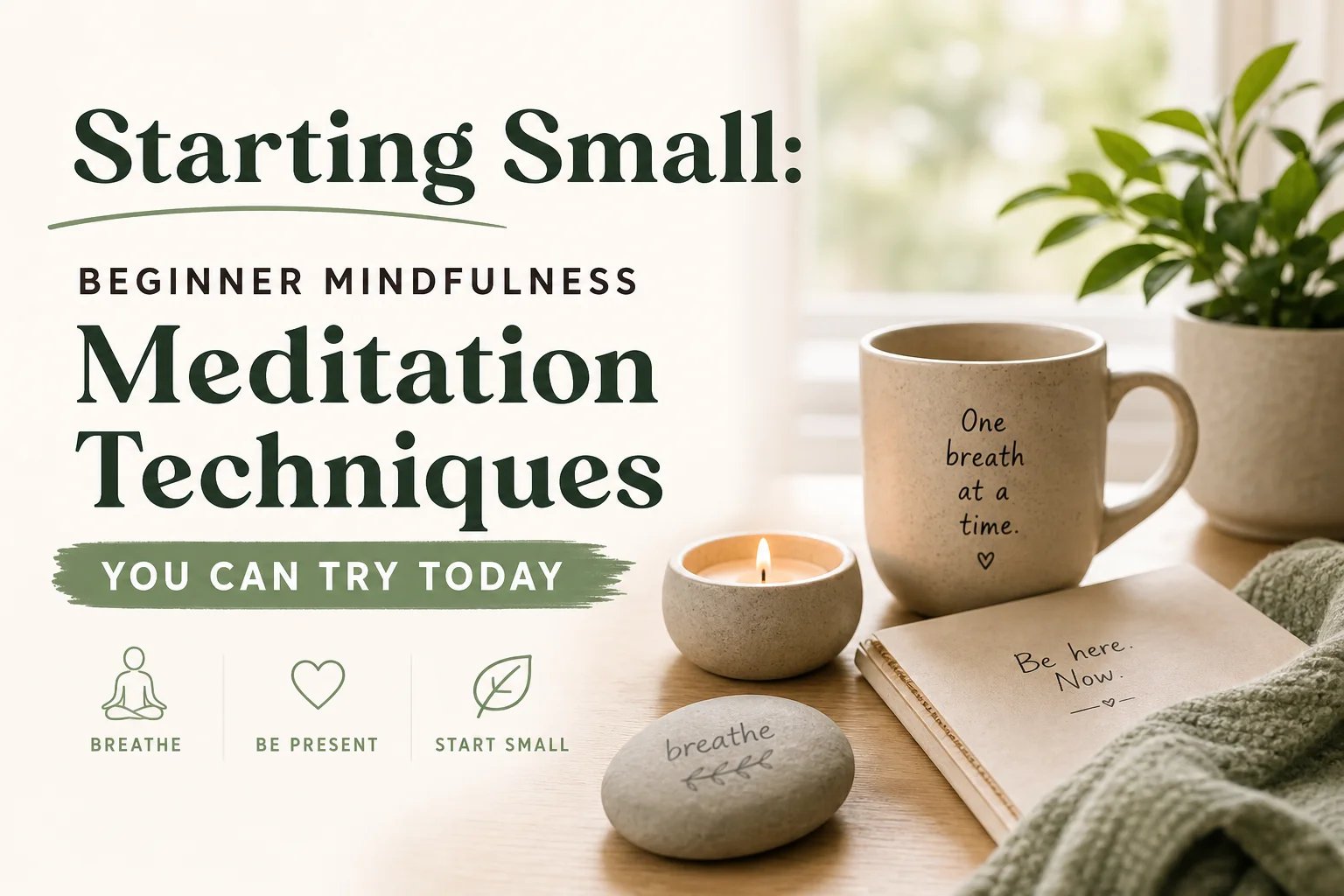
Starting Small: Beginner Mindfulness Meditation Techniques You Can Try Today — The Essential Guide to Calm, Clarity, and Consistency
Introduction: The Smallest Pause Can Change the Whole Day
Most people don’t avoid meditation because they think it is useless. They avoid it because it feels too big.
They imagine sitting perfectly still for an hour, clearing every thought, lighting candles, chanting, or somehow becoming a completely different person overnight. Then life happens: emails arrive, children need attention, deadlines pile up, and the idea of “starting a meditation practice” gets pushed into the same mental drawer as learning a new language or running a marathon.
But mindfulness does not begin with perfection. It begins with one breath.
That is the heart of Starting Small: Beginner Mindfulness Meditation Techniques You Can Try Today. You do not need a silent retreat, expensive cushions, or a perfectly calm mind. You need a willingness to pause for a moment and notice what is already happening.
Mindfulness meditation is the practice of paying attention to the present moment with openness, curiosity, and less judgment. It can help you respond instead of react, notice stress before it takes over, and create a little more space between your thoughts and your choices.
This guide is designed for real people with real schedules. If you are new to meditation, skeptical, busy, restless, or unsure where to begin, this article will show you practical ways to start small and build a meaningful habit.
Throughout this guide, we will explore Starting Small: Beginner Mindfulness Meditation Techniques You Can Try Today, including simple breathing exercises, body scans, mindful walking, everyday awareness practices, and realistic strategies for staying consistent.
What Mindfulness Meditation Really Means
Mindfulness meditation is often misunderstood. Many beginners assume the goal is to stop thinking completely. That misunderstanding alone causes countless people to quit before they truly begin.
The goal is not to empty your mind.
The goal is to notice your experience more clearly.
A mindful moment may include thoughts, emotions, sounds, physical sensations, distractions, and even frustration. Instead of fighting these experiences, you observe them with gentle awareness.
For example, during meditation you might notice:
- “I’m thinking about work.”
- “My shoulders feel tight.”
- “I feel impatient.”
- “I can hear traffic outside.”
- “I just got distracted again.”
Each time you notice, you are practicing mindfulness.
That is why Starting Small: Beginner Mindfulness Meditation Techniques You Can Try Today works so well. It removes the pressure to perform and replaces it with simple observation.
Why Starting Small Works Better Than Starting Perfect
When people begin meditation with unrealistic expectations, they often burn out quickly. They promise themselves they will meditate for 30 minutes every morning, then miss one day and feel like they failed.
Starting small creates momentum.
A one-minute meditation is not “less real” than a 30-minute meditation. It is simply smaller. And small practices are easier to repeat.
The Power of Small Beginnings
| Big, Overwhelming Goal | Small, Sustainable Version |
|---|---|
| Meditate 30 minutes every morning | Take 3 mindful breaths after waking |
| Never get distracted | Notice distraction and gently return |
| Become calm immediately | Practice being present with whatever is there |
| Create the perfect meditation space | Sit anywhere for one minute |
| Practice every day forever | Begin with today |
The philosophy behind Starting Small: Beginner Mindfulness Meditation Techniques You Can Try Today is simple: consistency grows from accessibility.
When the practice feels easy to begin, you are more likely to return to it. When you return often, it becomes part of your life.
The Science-Backed Benefits of Beginner Mindfulness Meditation
Mindfulness meditation has been studied in many contexts, including stress reduction, emotional regulation, attention, workplace performance, chronic pain, and mental well-being.
While meditation is not a magic cure or replacement for medical care, research suggests it can support healthier responses to stress and improve self-awareness.
Common Benefits of Mindfulness Practice
| Benefit | How Mindfulness Helps |
|---|---|
| Reduced stress | Helps you notice stress signals earlier |
| Better focus | Trains attention to return to one point |
| Emotional regulation | Creates space between feeling and reaction |
| Improved sleep support | Encourages relaxation and mental settling |
| Greater self-awareness | Reveals patterns in thoughts and behavior |
| More patience | Builds tolerance for discomfort and uncertainty |
| Better decision-making | Helps reduce impulsive reactions |
One reason Starting Small: Beginner Mindfulness Meditation Techniques You Can Try Today is so valuable is that even brief practices can interrupt automatic stress loops. A few mindful breaths before a meeting, a body scan before sleep, or a moment of awareness during a difficult conversation can change how you respond.
Before You Begin: What You Need and What You Don’t
Let’s clear away the unnecessary pressure.
You do not need:
- A meditation app
- Special clothing
- A silent room
- A perfect posture
- A spiritual belief system
- A completely calm mind
- Thirty minutes of free time
You may find these helpful:
- A chair or cushion
- A timer
- Comfortable clothing
- A quiet-ish space
- A notebook
- A gentle attitude toward yourself
The most important ingredient in Starting Small: Beginner Mindfulness Meditation Techniques You Can Try Today is not discipline. It is friendliness toward your own experience.
If you can sit, breathe, notice, and begin again, you can meditate.
Technique 1: The One-Minute Breathing Practice
This is one of the easiest beginner mindfulness meditation techniques you can try today.
How to Practice
- Sit or stand comfortably.
- Let your shoulders soften.
- Take one slow breath in through your nose.
- Exhale gently through your mouth or nose.
- Notice the next breath without changing it.
- When your mind wanders, softly return to breathing.
- Continue for one minute.
That’s it.
The point is not to breathe perfectly. The point is to know that you are breathing.
This technique is central to Starting Small: Beginner Mindfulness Meditation Techniques You Can Try Today because it proves that mindfulness can fit into ordinary life. You can use it before opening your laptop, answering a text, joining a meeting, or walking into your home after work.
When to Use It
- Before a stressful conversation
- After reading upsetting news
- When transitioning between tasks
- Before eating
- Before bed
- During moments of anxiety
Quick Tip
If one minute feels too long, try three breaths. Three intentional breaths can be enough to shift your nervous system from automatic reaction to conscious awareness.
Technique 2: The Five-Senses Grounding Practice
The five-senses practice is especially useful when your thoughts feel scattered or anxious. It brings attention out of mental loops and into direct experience.
How to Practice
Pause and name:
- 5 things you can see
- 4 things you can feel
- 3 things you can hear
- 2 things you can smell
- 1 thing you can taste
You do not have to say them aloud. Simply noticing is enough.
This is a powerful part of Starting Small: Beginner Mindfulness Meditation Techniques You Can Try Today because it is practical, discreet, and fast. You can do it at your desk, in a car, at the grocery store, or while waiting for an appointment.
Why It Works
Anxiety often pulls attention into imagined futures. The five-senses practice brings attention back to the present moment.
You are not trying to deny your worries. You are reminding your mind and body: “Right now, I am here.”
Technique 3: The Beginner Body Scan
A body scan is a mindfulness practice where you move attention through different parts of the body. It helps you notice tension, fatigue, warmth, pressure, tingling, or numbness without needing to change anything.
Simple 5-Minute Body Scan
| Step | Focus Area | What to Notice |
|---|---|---|
| 1 | Feet | Pressure, temperature, contact with floor |
| 2 | Legs | Heaviness, tightness, relaxation |
| 3 | Hips and lower back | Tension, support, discomfort |
| 4 | Belly and chest | Movement of breath |
| 5 | Shoulders and arms | Tightness, ease, weight |
| 6 | Neck, jaw, face | Clenching, softness, expression |
How to Practice
- Sit or lie down comfortably.
- Bring attention to your feet.
- Slowly move awareness upward.
- Notice sensations without forcing relaxation.
- If you find tension, breathe gently into that area.
- End by noticing the whole body.
A body scan is a key method in Starting Small: Beginner Mindfulness Meditation Techniques You Can Try Today because beginners often find the body easier to observe than thoughts. The body gives you something concrete to notice.
Technique 4: Mindful Walking
If sitting still feels difficult, mindful walking may be your best starting point.
Mindful walking means paying attention to the experience of walking rather than walking while lost in thought.
How to Practice
Walk slowly and notice:
- The lifting of one foot
- The movement through the air
- The placing of the foot
- The shifting of weight
- The rhythm of your steps
- The air on your skin
- Sounds around you
You can practice mindful walking for one minute in a hallway or for ten minutes outdoors.
This variation of Starting Small: Beginner Mindfulness Meditation Techniques You Can Try Today is excellent for people who feel restless, sleepy, or physically tense during seated meditation.
Everyday Mindful Walking Ideas
| Situation | Mindful Walking Cue |
|---|---|
| Walking to your car | Feel your feet touching the ground |
| Walking to a meeting | Notice your breath and posture |
| Walking the dog | Listen to surrounding sounds |
| Walking upstairs | Count each step slowly |
| Walking after lunch | Notice light, air, and body movement |
Mindful walking turns movement into meditation.
Technique 5: The “Name It to Tame It” Emotion Practice
Emotions can feel overwhelming when they remain vague. Mindfulness helps by inviting you to name what is present.
Instead of saying, “I feel terrible,” you might notice:
- “This is frustration.”
- “This is sadness.”
- “This is fear.”
- “This is embarrassment.”
- “This is pressure.”
- “This is disappointment.”
Naming an emotion creates a little distance from it. You are no longer fully swallowed by the feeling. You are observing it.
How to Practice
- Pause.
- Take one breath.
- Ask, “What am I feeling right now?”
- Name the emotion gently.
- Notice where it appears in the body.
- Allow it to be there without immediately fixing it.
This is an important part of Starting Small: Beginner Mindfulness Meditation Techniques You Can Try Today because daily stress is often emotional before it becomes behavioral. If you can notice irritation early, you may avoid snapping at someone. If you can notice anxiety early, you may choose to breathe rather than spiral.
Technique 6: Mindful Eating for Beginners
Mindful eating is a simple way to practice awareness during something you already do every day.
You do not need to eat every meal in silence. Start with the first three bites.
The First-Three-Bites Practice
For the first three bites of a meal or snack, notice:
- Color
- Texture
- Smell
- Temperature
- Taste
- Chewing
- Swallowing
- Satisfaction
This practice supports Starting Small: Beginner Mindfulness Meditation Techniques You Can Try Today because it connects mindfulness with ordinary routines. You do not have to add another task to your day. You simply bring more attention to something already happening.
Benefits of Mindful Eating
| Benefit | Explanation |
|---|---|
| More enjoyment | You actually taste your food |
| Slower eating | Awareness naturally reduces rushing |
| Better hunger awareness | You notice fullness and satisfaction |
| Less automatic snacking | You become aware of urges and habits |
| Greater gratitude | Food becomes an experience, not just fuel |
Mindful eating can be especially helpful for people who rush meals, eat while stressed, or barely remember what they consumed.
Technique 7: The Three-Minute Reset
The three-minute reset is perfect for busy days. It has three parts: arrive, breathe, expand.
Minute 1: Arrive
Ask yourself:
- What thoughts are here?
- What emotions are here?
- What body sensations are here?
No judgment. Just noticing.
Minute 2: Breathe
Bring attention to the breath. Feel the inhale and exhale.
Minute 3: Expand
Open awareness to the whole body and the space around you. Continue breathing.
This technique captures the spirit of Starting Small: Beginner Mindfulness Meditation Techniques You Can Try Today because it is short enough to use during real-life pressure but structured enough to feel grounding.
Use it between meetings, before making a decision, after an argument, or whenever your mind feels overloaded.
Technique 8: Mindfulness of Sound
Sound meditation is helpful because sounds naturally come and go. You do not have to create anything. You simply listen.
How to Practice
- Sit comfortably.
- Close your eyes or soften your gaze.
- Notice the sounds around you.
- Let sounds appear and disappear.
- Avoid labeling sounds as good or bad.
- When thoughts pull you away, return to listening.
You might hear traffic, birds, voices, appliances, wind, or silence between sounds.
Mindfulness of sound is a useful tool in Starting Small: Beginner Mindfulness Meditation Techniques You Can Try Today because it teaches acceptance. Instead of needing perfect quiet, you learn to include sound as part of the practice.
Technique 9: The Loving-Kindness Mini Practice
Mindfulness is not only about attention. It can also include compassion.
Loving-kindness meditation involves silently offering kind phrases to yourself or others.
Beginner Version
Repeat slowly:
- May I be safe.
- May I be healthy.
- May I be peaceful.
- May I meet this moment with kindness.
Then, if you wish, offer the same phrases to someone else:
- May you be safe.
- May you be healthy.
- May you be peaceful.
- May you meet this moment with kindness.
This is a beautiful addition to Starting Small: Beginner Mindfulness Meditation Techniques You Can Try Today because many beginners struggle with harsh self-criticism. Loving-kindness helps soften the inner voice.
You do not need to force warm feelings. Just offer the words gently.
Technique 10: Mindful Transitions
Transitions are the small spaces between activities: waking up, getting into the car, opening your computer, entering your home, starting dinner, or turning off the lights.
Most people rush through transitions unconsciously. Mindfulness turns them into anchors.
Examples of Mindful Transitions
| Transition | Mindful Cue |
|---|---|
| Before checking your phone | Take one breath |
| Before starting work | Feel your feet on the floor |
| Before entering home | Pause at the door and exhale |
| Before eating | Notice the first smell |
| Before sleep | Relax your jaw and shoulders |
| Before responding to a message | Read it once, breathe, then reply |
Mindful transitions are one of the most realistic forms of Starting Small: Beginner Mindfulness Meditation Techniques You Can Try Today because they do not require extra time. They simply ask you to wake up inside the life you already have.
A Simple 7-Day Beginner Mindfulness Plan
If you want a structured way to begin, use this seven-day plan. Each practice is short, realistic, and beginner-friendly.
| Day | Practice | Time Needed | Goal |
|---|---|---|---|
| Day 1 | One-minute breathing | 1 minute | Learn to pause |
| Day 2 | Five-senses grounding | 2 minutes | Connect with the present |
| Day 3 | Body scan | 5 minutes | Notice physical sensations |
| Day 4 | Mindful walking | 5 minutes | Bring awareness into movement |
| Day 5 | Emotion naming | 2 minutes | Recognize feelings early |
| Day 6 | Mindful eating | First 3 bites | Practice during daily life |
| Day 7 | Three-minute reset | 3 minutes | Combine awareness and breathing |
This plan reflects the core idea of Starting Small: Beginner Mindfulness Meditation Techniques You Can Try Today: begin with what is doable, not what is impressive.
Case Study 1: The Overworked Manager Who Started with One Breath
Background
Maria, a project manager at a fast-growing company, felt constantly behind. Her inbox was overflowing, meetings filled her calendar, and she often ended the day with headaches and irritability.
She had tried meditation apps before but quit because 20-minute sessions felt impossible. Eventually, she began with one mindful breath before every meeting.
Practice Used
Maria practiced a simple routine:
- Sit before joining the meeting.
- Feel both feet on the floor.
- Take one slow inhale.
- Exhale fully.
- Ask, “How do I want to show up?”
Results
After two weeks, Maria noticed she interrupted people less often. She felt more prepared and less reactive during tense conversations. She did not become stress-free, but she became more aware of stress before it controlled her.
Analysis
Maria’s experience shows why Starting Small: Beginner Mindfulness Meditation Techniques You Can Try Today is practical for workplace stress. She did not need to overhaul her schedule. By attaching mindfulness to an existing routine, she made the habit easier to maintain.
Case Study 2: The College Student Who Used Five-Senses Grounding for Anxiety
Background
Jamal, a university student, experienced anxiety before exams. His thoughts often spiraled: “What if I fail? What if I forget everything? What if I disappoint my family?”
Traditional seated meditation felt difficult because his mind raced even more when he closed his eyes.
Practice Used
Jamal used the five-senses grounding method before studying and before exams.
He silently named:
- 5 things he could see
- 4 things he could feel
- 3 things he could hear
- 2 things he could smell
- 1 thing he could taste
Results
The practice did not remove all anxiety, but it reduced the intensity. Jamal described it as “getting back into the room instead of being trapped in my head.”
Analysis
This case highlights a key benefit of Starting Small: Beginner Mindfulness Meditation Techniques You Can Try Today: mindfulness can be sensory and active, not just silent and still. For beginners with anxiety, grounding practices may feel more accessible than longer meditation sessions.
Case Study 3: The Parent Who Practiced Mindful Transitions
Background
Lena, a parent of two young children, felt exhausted by the evening routine. She often carried work stress into family time and found herself impatient during dinner, homework, and bedtime.
She believed she had “no time to meditate.”
Practice Used
Lena chose one transition: sitting in the car before entering the house after work.
For 60 seconds, she practiced:
- Turning off the engine
- Feeling her hands in her lap
- Taking three slow breaths
- Naming one thing she was leaving behind from work
- Naming one quality she wanted to bring home, such as patience or warmth
Results
Within a month, Lena reported fewer sharp reactions during the evening. She still had difficult days, but the pause helped her shift roles more consciously.
Analysis
Lena’s story demonstrates how Starting Small: Beginner Mindfulness Meditation Techniques You Can Try Today can support family life. Mindfulness does not require isolation. It can happen in a parked car, at a doorway, or during a single breath before speaking.
Case Study 4: The Retiree Who Rediscovered Presence Through Walking
Background
After retiring, Robert felt restless and disconnected. He had expected retirement to feel peaceful, but instead he felt uncertain and mentally scattered.
Sitting meditation made him uncomfortable, so he tried mindful walking.
Practice Used
Every morning, Robert walked around his neighborhood for ten minutes without headphones.
He noticed:
- The feeling of his shoes on pavement
- The temperature of the air
- The sound of birds
- The movement of his arms
- The pace of his breathing
Results
Robert began to look forward to his walks. He felt more grounded and less caught in repetitive thoughts about the past.
Analysis
Robert’s example shows that Starting Small: Beginner Mindfulness Meditation Techniques You Can Try Today can be adapted to personality, age, and lifestyle. Meditation does not have to look one specific way. For some people, movement is the doorway into stillness.
Common Beginner Mistakes and How to Avoid Them
Mindfulness is simple, but that does not mean it always feels easy. Beginners often run into predictable obstacles.
Mistake 1: Trying to Stop Thoughts
Thoughts are not the enemy. Noticing thoughts is part of meditation.
Try saying, “Thinking is happening,” then return to your anchor.
Mistake 2: Judging Your Practice
You may think, “I’m bad at this.” That thought is another object of awareness.
Notice it. Smile if you can. Begin again.
Mistake 3: Starting Too Big
A 30-minute goal can become intimidating. Start with one to five minutes.
This is the foundation of Starting Small: Beginner Mindfulness Meditation Techniques You Can Try Today.
Mistake 4: Waiting for the Perfect Time
The perfect time rarely arrives. Practice in imperfect conditions.
Mistake 5: Expecting Instant Calm
Mindfulness is not always calming in the moment. Sometimes it reveals how busy or tense you already are. That awareness is still useful.
How to Build a Mindfulness Habit That Lasts
A mindfulness habit grows best when it is specific, small, and connected to daily life.
Use Habit Stacking
Attach meditation to something you already do.
Examples:
- After brushing teeth, take three mindful breaths.
- Before coffee, pause for one minute.
- After closing your laptop, do a body scan.
- Before bed, practice loving-kindness.
- After parking the car, notice your breathing.
Make It Easy
If your practice requires too much effort, you are less likely to repeat it.
Keep the first version almost laughably simple.
Track Gently
You can use a calendar, journal, or app, but do not turn mindfulness into another performance metric.
A simple note is enough:
- “Practiced one minute.”
- “Felt restless.”
- “Returned to breath three times.”
- “Noticed tension.”
- “Paused before reacting.”
Celebrate Returning
The most important moment in meditation is not staying focused. It is coming back after distraction.
Every return is a repetition. Every repetition strengthens the practice.
That is why Starting Small: Beginner Mindfulness Meditation Techniques You Can Try Today emphasizes returning over achieving.
A Beginner Meditation Script You Can Use Today
Here is a short script for a five-minute practice.
You can read it slowly, record it in your own voice, or ask someone to guide you.
Five-Minute Beginner Mindfulness Meditation
Sit comfortably.
Let your hands rest.
Feel your feet on the ground or your body supported by the chair.
Take a slow breath in.
Let it out gently.
Notice where your body touches the surface beneath you.
Allow your shoulders to soften slightly.
Bring attention to your breathing.
You do not need to change the breath.
Just notice the inhale.
Notice the exhale.
If your mind wanders, that is okay.
When you notice thinking, gently return to the breath.
You might silently say, “in” as you inhale and “out” as you exhale.
Now notice your body.
Your face.
Your jaw.
Your shoulders.
Your chest.
Your belly.
Your hands.
Your legs.
Your feet.
Let everything be as it is for this moment.
Take one more slow breath.
Before you finish, ask yourself: “What is one small way I can bring mindfulness into the rest of my day?”
When you are ready, open your eyes or lift your gaze.
This simple script reflects Starting Small: Beginner Mindfulness Meditation Techniques You Can Try Today because it is short, flexible, and easy to repeat.
How Long Should Beginners Meditate?
Beginners often ask, “How long do I need to meditate for it to count?”
The answer: shorter than you think.
Beginner Time Guide
| Experience Level | Suggested Time | Best Practice Type |
|---|---|---|
| Absolute beginner | 1 minute | Breathing or grounding |
| New but curious | 3–5 minutes | Body scan or reset |
| Building consistency | 5–10 minutes | Breath, sound, walking |
| Comfortable beginner | 10–15 minutes | Seated meditation |
| Developing habit | 15+ minutes | Mixed mindfulness practices |
If you are practicing Starting Small: Beginner Mindfulness Meditation Techniques You Can Try Today, begin with a time you can actually keep. Five consistent minutes are more powerful than thirty imaginary ones.
Mindfulness in Real Life: Where to Practice Today
Mindfulness does not have to stay on a cushion. In fact, the real value appears when awareness enters ordinary moments.
Try Mindfulness During:
- Brushing your teeth
- Washing dishes
- Drinking tea or coffee
- Waiting in line
- Listening to someone speak
- Walking to the mailbox
- Folding laundry
- Taking a shower
- Opening your email
- Sitting in traffic
- Preparing for sleep
Everyday mindfulness is a major theme of Starting Small: Beginner Mindfulness Meditation Techniques You Can Try Today. You are not escaping life. You are entering it more fully.
Troubleshooting: What If Meditation Feels Hard?
Meditation may feel uncomfortable at first. That does not mean you are doing it wrong.
If You Feel Restless
Try mindful walking or a shorter session.
If You Feel Sleepy
Sit upright, open your eyes slightly, or practice earlier in the day.
If You Feel Emotional
Pause, open your eyes, feel your feet, and take care of yourself. Mindfulness should be gentle, not forceful.
If You Feel Bored
Notice boredom as a sensation. Where is it in the body? What thoughts come with it?
If You Keep Forgetting
Use reminders. Put a sticky note on your laptop that says “Breathe.” Set a phone alarm labeled “Pause.”
If You Think You’re Bad at It
You are not bad at meditation because your mind wanders. Wandering is what minds do.
The practice is noticing and returning.
That is the entire path of Starting Small: Beginner Mindfulness Meditation Techniques You Can Try Today.
The Difference Between Mindfulness and Relaxation
Mindfulness and relaxation often overlap, but they are not the same.
Relaxation aims to calm the body and mind.
Mindfulness aims to notice what is happening clearly.
Sometimes mindfulness leads to relaxation. Other times, it helps you become aware of tension, sadness, irritation, or fatigue. That awareness can still be beneficial because it gives you information.
Mindfulness vs. Relaxation
| Mindfulness | Relaxation |
|---|---|
| Observes present experience | Seeks calm or ease |
| Includes pleasant and unpleasant states | Focuses on reducing tension |
| Builds awareness | Builds comfort |
| Can be practiced anytime | Often needs quiet conditions |
| Helps you respond consciously | Helps you unwind |
When practicing Starting Small: Beginner Mindfulness Meditation Techniques You Can Try Today, it is helpful to release the demand that every session must feel peaceful. Some sessions will feel calm. Others will feel messy. Both count.
Creating a Simple Mindfulness Space
You do not need a special room, but a consistent space can help.
Your mindfulness space might include:
- A chair
- A cushion
- A blanket
- A candle
- A plant
- A notebook
- Soft lighting
Keep it simple. The space should invite practice, not become another project.
Minimalist Setup
| Item | Purpose |
|---|---|
| Chair or cushion | Supports posture |
| Timer | Removes clock-watching |
| Notebook | Captures reflections |
| Blanket | Adds comfort |
| Small object | Serves as a visual reminder |
A small corner can support Starting Small: Beginner Mindfulness Meditation Techniques You Can Try Today, but remember: the space is optional. Awareness is portable.
How Mindfulness Improves Communication
One underrated benefit of mindfulness is better listening.
Many conversations suffer because people are preparing their reply instead of hearing what is being said. Mindfulness helps you notice that impulse.
Try This During a Conversation
- Feel your feet.
- Notice your breathing.
- Listen without interrupting.
- Notice the urge to defend or fix.
- Pause before responding.
This is mindfulness in action.
When you apply Starting Small: Beginner Mindfulness Meditation Techniques You Can Try Today to communication, you may become less reactive and more present. That can improve relationships at work, home, and in everyday interactions.
Mindfulness for Stressful Workdays
Work stress is one of the most common reasons people explore meditation. Fortunately, mindfulness can be practiced in very short moments throughout the day.
Workday Mindfulness Menu
| Stress Moment | Mindfulness Practice |
|---|---|
| Before checking email | Take three breaths |
| After a difficult message | Feel your feet for 30 seconds |
| Before a presentation | Exhale slowly twice |
| Between meetings | Do a one-minute body scan |
| During conflict | Name the emotion silently |
| End of workday | Practice a transition pause |
This workplace approach to Starting Small: Beginner Mindfulness Meditation Techniques You Can Try Today helps you build emotional steadiness without needing to disappear from your responsibilities.
Mindfulness Before Sleep
Many beginners want to meditate at night because their minds become loud when the world gets quiet.
A bedtime practice should be soft and low-pressure.
Simple Sleep-Friendly Practice
- Lie down.
- Place one hand on your belly.
- Notice the breath moving the body.
- Relax your jaw.
- Relax your shoulders.
- Silently say, “Arriving” on the inhale and “softening” on the exhale.
- If thoughts arise, gently return to the body.
Do not try too hard to sleep. Trying can create tension. Instead, practice resting with awareness.
Bedtime is a natural place for Starting Small: Beginner Mindfulness Meditation Techniques You Can Try Today because even two minutes of quiet awareness can signal to the body that the day is ending.
How to Know If Mindfulness Is Working
Mindfulness progress is subtle. You may not notice dramatic changes at first.
Signs it may be working include:
- You notice stress sooner.
- You pause before reacting.
- You recover faster after frustration.
- You become more aware of body tension.
- You listen more fully.
- You are kinder to yourself.
- You remember to breathe during pressure.
- You notice small moments of beauty.
- You feel less controlled by every thought.
Progress in Starting Small: Beginner Mindfulness Meditation Techniques You Can Try Today is not about becoming a perfectly calm person. It is about becoming more awake to your life.
A Practical Mindfulness Tracker
Use this simple tracker for one week.
| Day | Practice | Duration | What I Noticed |
|---|---|---|---|
| Monday | |||
| Tuesday | |||
| Wednesday | |||
| Thursday | |||
| Friday | |||
| Saturday | |||
| Sunday |
Keep your notes short. The purpose is awareness, not self-judgment.
Examples:
- “Restless but practiced.”
- “Felt calmer after breathing.”
- “Forgot until bedtime.”
- “Noticed tight shoulders.”
- “Paused before replying.”
This tracker supports Starting Small: Beginner Mindfulness Meditation Techniques You Can Try Today by making the habit visible without making it complicated.
Long-Tail Keyword Variations for Contextual Use
If you are exploring this topic further, related long-tail variations include:
- beginner mindfulness meditation techniques you can try today
- starting small with mindfulness meditation
- easy mindfulness practices for beginners
- simple meditation techniques for stress relief
- one-minute mindfulness meditation for beginners
- mindfulness exercises for busy people
- how to start meditating with no experience
- beginner-friendly meditation practices at home
- quick mindfulness techniques for anxiety
- daily mindfulness habits for beginners
These variations naturally support the central theme of Starting Small: Beginner Mindfulness Meditation Techniques You Can Try Today while helping readers find practical, approachable guidance.
Conclusion: Begin with One Breath, Then Begin Again
Mindfulness does not ask you to become someone else. It invites you to meet this moment more honestly.
You do not need perfect silence, endless free time, or a calm mind. You can begin with one breath, one step, one bite, one pause, one moment of noticing.
That is the promise of Starting Small: Beginner Mindfulness Meditation Techniques You Can Try Today. Small practices can create meaningful shifts when repeated with patience and kindness.
Start today. Not someday. Not when life slows down. Not when your mind is finally quiet.
Pause.
Take one breath.
Feel your feet.
Notice where you are.
That is mindfulness.
And it is enough to begin.
FAQs About Starting Small: Beginner Mindfulness Meditation Techniques You Can Try Today
1. How long should I meditate as a beginner?
Start with one to five minutes. The best beginner practice is one you can repeat consistently. Starting Small: Beginner Mindfulness Meditation Techniques You Can Try Today is about building trust with the habit before increasing duration.
2. What if I can’t stop thinking during meditation?
You are not supposed to stop thinking. The practice is noticing when your mind wanders and gently returning to your anchor, such as the breath, body, or sound.
3. Can mindfulness meditation help with anxiety?
Mindfulness may help you notice anxious thoughts and body sensations without becoming completely overwhelmed by them. Grounding practices, breathing, and body scans can be especially helpful. However, if anxiety is severe or persistent, consider support from a qualified mental health professional.
4. Do I need an app to practice mindfulness?
No. Apps can be helpful, but they are not required. You can practice mindfulness by taking three conscious breaths, noticing your senses, walking slowly, or paying attention while eating.
5. Is it better to meditate in the morning or at night?
The best time is the time you will actually practice. Morning meditation can set the tone for the day, while evening meditation can help you unwind. Many beginners succeed by attaching mindfulness to an existing routine.
6. Can I practice mindfulness while walking?
Yes. Mindful walking is an excellent beginner technique. Pay attention to each step, the movement of your body, and the sensations around you. It is a practical part of Starting Small: Beginner Mindfulness Meditation Techniques You Can Try Today.
7. What should I do if meditation makes me uncomfortable?
Try shorter practices, keep your eyes open, focus on external sounds, or practice mindful walking. If meditation brings up intense emotions or distress, stop and seek support from a trained professional.
8. How quickly will I notice benefits?
Some people feel calmer after one session. For others, benefits appear gradually after days or weeks. Look for small signs: pausing before reacting, noticing tension sooner, or returning to the present more easily.
9. Can mindfulness be practiced without sitting still?
Absolutely. You can practice while walking, eating, washing dishes, stretching, listening, or transitioning between tasks. Mindfulness is awareness, not a specific posture.
10. What is the easiest mindfulness technique to try today?
The easiest technique is three mindful breaths. Pause, inhale slowly, exhale gently, and notice the body breathing. It is simple, portable, and perfectly aligned with Starting Small: Beginner Mindfulness Meditation Techniques You Can Try Today.
About the Author