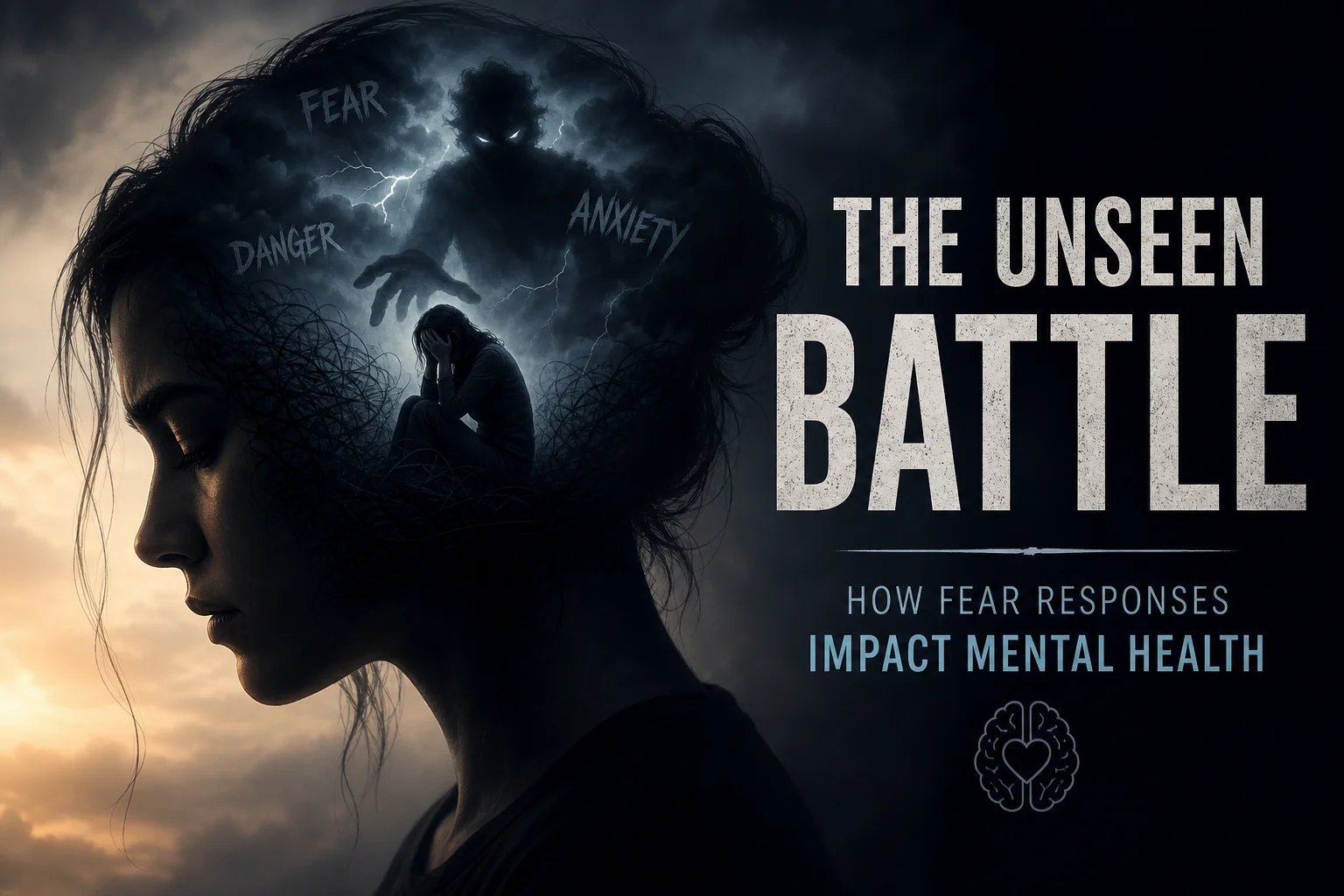
Introduction: The Alarm That Never Seems to Switch Off
Imagine waking up in the morning already braced for danger—your chest tight, your thoughts racing, your body alert before the day has even begun. Nothing obvious is threatening you. There is no fire, no predator, no emergency. Yet inside, your nervous system is acting as if survival is on the line.
This is the hidden reality for millions of people.
The Unseen Battle: How Fear Responses Impact Mental Health is not just a psychological concept; it is a daily lived experience. Fear is meant to protect us. It sharpens attention, prepares muscles to move, and helps us respond quickly when danger appears. But when fear becomes chronic, exaggerated, or disconnected from present reality, it can quietly reshape mental health.
It can influence anxiety, depression, trauma responses, sleep, relationships, decision-making, physical health, and even identity. People may begin to see themselves as “too sensitive,” “broken,” or “weak,” when in truth their brain and body may be stuck in survival mode.
Understanding The Unseen Battle: How Fear Responses Impact Mental Health gives us a powerful advantage. When we can name what is happening in the nervous system, we can stop blaming ourselves and start building healthier responses. This article explores how fear works, why it sometimes becomes harmful, and what real healing can look like.
What Are Fear Responses?
Fear responses are automatic survival reactions designed to protect us from danger. They are not signs of weakness. They are ancient biological systems built into the human nervous system.
When the brain detects a threat, it activates a series of reactions involving the amygdala, hypothalamus, adrenal glands, and autonomic nervous system. Stress hormones such as adrenaline and cortisol surge through the body. Heart rate increases. Breathing changes. Muscles tense. Attention narrows.
This response can save your life in a real emergency.
But The Unseen Battle: How Fear Responses Impact Mental Health begins when the threat system becomes overactive or poorly regulated. The brain may start responding to ordinary stressors—emails, conversations, memories, social situations, uncertainty—as though they are life-threatening.
The Four Main Fear Responses
Most people know “fight or flight,” but fear responses are more complex. There are several survival patterns.
| Fear Response | What It Looks Like | Common Mental Health Link |
|---|---|---|
| Fight | Anger, defensiveness, irritability, control-seeking | Anxiety, trauma, relationship conflict |
| Flight | Avoidance, overworking, restlessness, panic | Panic disorder, generalized anxiety |
| Freeze | Numbness, shutdown, inability to act | Depression, PTSD, dissociation |
| Fawn | People-pleasing, conflict avoidance, self-abandonment | Trauma, low self-worth, codependency |
These responses can appear separately or overlap. Someone may fight at work, freeze at home, and fawn in relationships. This is one reason The Unseen Battle: How Fear Responses Impact Mental Health can be difficult to recognize. It does not always look like fear. Sometimes it looks like perfectionism. Sometimes it looks like procrastination. Sometimes it looks like emotional numbness.
Why Fear Is Necessary—and When It Becomes Harmful
Fear is not the enemy. A healthy fear response helps us avoid danger, set boundaries, and make wise choices. The problem is not fear itself; the problem is fear that does not turn off when danger has passed.
In a regulated nervous system, fear rises and falls. You experience stress, respond to it, and return to baseline. But chronic stress, trauma, unresolved grief, social instability, or repeated emotional threats can keep the fear system activated.
This is central to The Unseen Battle: How Fear Responses Impact Mental Health: the body may keep reacting to past danger as if it is still happening.
Healthy Fear vs. Chronic Fear
| Type of Fear | Example | Nervous System Pattern | Impact |
|---|---|---|---|
| Healthy fear | Stepping back from a speeding car | Temporary activation | Protective and adaptive |
| Anticipatory fear | Worrying before an exam | Short-term stress | Can motivate preparation |
| Chronic fear | Feeling unsafe every day without clear danger | Ongoing activation | Can damage mental and physical health |
| Trauma-based fear | Panic after a reminder of past abuse | Triggered survival response | May cause PTSD symptoms |
| Learned fear | Avoiding all dogs after one bite | Generalized threat response | Can limit life and confidence |
When fear becomes chronic, the brain begins to prioritize survival over growth. Creativity, curiosity, emotional connection, and problem-solving may decline. The body becomes a battlefield, and the mind becomes a watchtower.
That is why The Unseen Battle: How Fear Responses Impact Mental Health deserves serious attention.
The Brain’s Fear Circuit: What Happens Inside
To understand The Unseen Battle: How Fear Responses Impact Mental Health, it helps to know the main brain regions involved.
1. The Amygdala: The Threat Detector
The amygdala scans for danger. It reacts quickly, often before rational thought catches up. In people with anxiety or trauma histories, the amygdala may become extra sensitive.
2. The Prefrontal Cortex: The Wise Decision-Maker
The prefrontal cortex helps with logic, planning, impulse control, and perspective. During intense fear, this area can become less active. That is why it is hard to “just think positive” during panic.
3. The Hippocampus: The Memory Organizer
The hippocampus helps distinguish past from present. Trauma and chronic stress can interfere with this process, making old memories feel immediate and current.
4. The Autonomic Nervous System: The Body’s Survival Engine
This system controls automatic body functions. It includes:
- Sympathetic activation: fight or flight
- Parasympathetic shutdown: freeze or collapse
- Vagal regulation: calm, connection, recovery
When these systems fall out of balance, mental health can suffer.
How Fear Responses Shape Anxiety
Anxiety is one of the clearest examples of The Unseen Battle: How Fear Responses Impact Mental Health. Anxiety often arises when the brain predicts threat, even when there is no immediate danger.
The anxious mind asks:
- What if something goes wrong?
- What if I fail?
- What if they reject me?
- What if I cannot cope?
- What if this feeling never ends?
The body then responds as if those imagined events are already happening.
Fear and Anxiety Cycle
| Stage | What Happens |
|---|---|
| Trigger | A thought, situation, body sensation, or memory appears |
| Threat interpretation | The brain labels it dangerous |
| Physical activation | Heart races, muscles tense, breathing changes |
| Avoidance or safety behavior | Person escapes, checks, reassures, or avoids |
| Short-term relief | Anxiety drops temporarily |
| Long-term reinforcement | Brain learns the trigger was dangerous |
This cycle is why avoidance feels helpful but often strengthens anxiety over time. If someone avoids public speaking, social gatherings, driving, or medical appointments, their world can become smaller.
The Unseen Battle: How Fear Responses Impact Mental Health is especially visible here: the person is not choosing limitation. Their nervous system is trying to protect them, but its protection strategy has become costly.
Fear Responses and Depression: The Shutdown Side of Survival
Depression is often described as sadness, but sometimes it is better understood as shutdown. When the nervous system feels overwhelmed and escape seems impossible, it may move into freeze or collapse.
This form of fear response can look like:
- Low energy
- Emotional numbness
- Loss of interest
- Difficulty making decisions
- Social withdrawal
- Feeling helpless
- Sleeping too much or too little
- A sense of disconnection from life
This is an important part of The Unseen Battle: How Fear Responses Impact Mental Health because not all fear looks intense or dramatic. Sometimes fear looks quiet. Sometimes it looks like someone lying in bed, unable to move forward.
The body may be conserving energy because it perceives the world as unsafe or unwinnable.
Trauma and the Body’s Memory of Fear
Trauma occurs when an experience overwhelms a person’s ability to cope. It may involve violence, neglect, accidents, medical emergencies, emotional abuse, loss, or chronic instability.
A traumatic event can pass, but the body may continue to carry the imprint. This is why The Unseen Battle: How Fear Responses Impact Mental Health is so closely connected to post-traumatic stress.
Common trauma-related fear responses include:
- Hypervigilance
- Flashbacks
- Nightmares
- Startle responses
- Emotional flooding
- Avoidance of reminders
- Dissociation
- Shame and self-blame
- Difficulty trusting others
Trauma can teach the nervous system that safety is temporary, people are dangerous, or emotions are unbearable. Healing often involves helping the brain and body learn that the present is different from the past.
Case Study 1: Maya and the Panic Behind Perfectionism
Maya, a 34-year-old project manager, was known as reliable, organized, and high-achieving. At work, she seemed confident. Privately, she felt constantly terrified of making mistakes. She checked emails repeatedly, stayed late to revise minor details, and felt sick before meetings.
Her fear response was not obvious panic. It looked like excellence.
Over time, Maya developed insomnia, jaw tension, irritability, and episodes of racing heartbeat. She believed she was simply “driven,” but therapy helped her recognize a deeper pattern. Growing up, criticism in her household was unpredictable. Small mistakes led to harsh emotional reactions. Her nervous system had learned that imperfection meant danger.
Analysis
Maya’s story illustrates The Unseen Battle: How Fear Responses Impact Mental Health in high-functioning individuals. Fear does not always lead to avoidance; sometimes it leads to overperformance. Her perfectionism was a flight response—constant movement away from perceived failure.
Her healing involved cognitive behavioral therapy, nervous system regulation, self-compassion practices, and gradual experiments with “good enough” work. As her fear response softened, her productivity became healthier and less punishing.
Case Study 2: Daniel and the Freeze Response After Trauma
Daniel, a 42-year-old emergency responder, began feeling detached from his life after years of exposure to crisis situations. He stopped enjoying hobbies, avoided friends, and felt emotionally numb. His family thought he was depressed, and he agreed—but he also described feeling “not fully here.”
Certain sounds triggered intense body reactions. Sirens caused his stomach to drop. He sometimes froze during arguments, unable to speak.
Daniel was experiencing trauma-related fear responses. His nervous system had adapted to repeated danger by shutting down.
Analysis
Daniel’s experience shows how The Unseen Battle: How Fear Responses Impact Mental Health can affect people in high-stress professions. His freeze response was protective during overwhelming experiences, but it became disruptive in daily life.
Treatment included trauma-focused therapy, grounding techniques, peer support, and gradual reconnection with safe relationships. His progress was not about “forgetting” what happened. It was about helping his body recognize safety again.
Case Study 3: Aisha and the Fawn Response in Relationships
Aisha, 29, described herself as “easygoing,” but she privately felt exhausted. She said yes when she wanted to say no, apologized even when she was not at fault, and avoided conflict at all costs.
In relationships, she became hyper-aware of other people’s moods. If someone seemed upset, she immediately tried to fix it. She feared abandonment and felt responsible for keeping everyone comfortable.
Through counseling, Aisha identified a fawn response. As a child, emotional peace depended on pleasing unpredictable caregivers. Her nervous system learned that safety came from self-silencing.
Analysis
Aisha’s case reveals another side of The Unseen Battle: How Fear Responses Impact Mental Health. Fear can disguise itself as kindness, flexibility, or loyalty. But when people-pleasing becomes survival, it damages identity and emotional wellbeing.
Aisha practiced boundaries, body awareness, and tolerating discomfort when others were disappointed. Over time, she discovered that healthy relationships could survive honesty.
The Physical Cost of Living in Fear
Mental health and physical health are deeply connected. Chronic fear activation affects the whole body.
Common Physical Effects of Chronic Fear
| Body System | Possible Effects |
|---|---|
| Cardiovascular | Increased heart rate, blood pressure changes, chest tightness |
| Digestive | Nausea, stomach pain, IBS-like symptoms, appetite changes |
| Muscular | Tension, headaches, jaw pain, back pain |
| Immune | Increased inflammation, reduced resilience |
| Sleep | Insomnia, nightmares, restless sleep |
| Hormonal | Cortisol disruption, fatigue, mood changes |
| Respiratory | Shallow breathing, breathlessness, panic sensations |
This is why The Unseen Battle: How Fear Responses Impact Mental Health cannot be separated from the body. A person may seek help for stomach pain, headaches, fatigue, or insomnia without realizing fear physiology is part of the picture.
Of course, physical symptoms should always be evaluated by a healthcare professional. But when medical causes are ruled out or stress is a contributing factor, nervous system regulation can become a key part of healing.
Fear Responses in Everyday Life
Not every fear response comes from major trauma. Daily stress can also train the nervous system to remain on alert.
Modern life contains many low-grade threats:
- Financial pressure
- Job insecurity
- Social comparison
- News overload
- Family conflict
- Health worries
- Digital notifications
- Loneliness
- Discrimination or social exclusion
- Uncertainty about the future
The brain does not always distinguish between physical danger and emotional threat. Rejection, shame, humiliation, and instability can activate survival responses.
That is why The Unseen Battle: How Fear Responses Impact Mental Health is relevant even for people who think, “Nothing terrible happened to me.” A nervous system can become overwhelmed by accumulation.
How Fear Changes Relationships
Fear responses do not stay inside one person. They show up in relationships.
One person’s fight response may trigger another person’s freeze response. One partner’s avoidance may intensify the other partner’s anxiety. A parent’s chronic stress may affect a child’s sense of safety.
Relationship Patterns Linked to Fear
| Fear Pattern | Relationship Behavior | Possible Result |
|---|---|---|
| Fight | Criticism, blame, defensiveness | Conflict escalates |
| Flight | Avoiding hard conversations | Problems remain unresolved |
| Freeze | Shutting down emotionally | Partner feels rejected |
| Fawn | People-pleasing, resentment | Loss of authenticity |
| Hypervigilance | Reading into tone or facial expressions | Misunderstandings increase |
Understanding The Unseen Battle: How Fear Responses Impact Mental Health can reduce blame in relationships. Instead of asking, “Why are you acting like this?” we can ask, “What is your nervous system trying to protect you from?”
That question does not excuse harmful behavior, but it opens the door to compassion and change.
Fear, Identity, and Self-Trust
One of the deepest effects of chronic fear is the erosion of self-trust.
People may begin to believe:
- “I cannot handle stress.”
- “Something is wrong with me.”
- “I am too emotional.”
- “I always ruin things.”
- “I am not safe anywhere.”
- “I have to stay in control.”
This internal story can become more damaging than the original fear. Over time, a person’s life may be organized around avoiding discomfort instead of pursuing meaning.
A major goal in healing The Unseen Battle: How Fear Responses Impact Mental Health is rebuilding self-trust. This does not mean never feeling afraid. It means learning, “Fear can be present, and I can still respond wisely.”
The Role of Childhood Experiences
Early environments shape the fear system. Children learn safety through consistent care, emotional attunement, predictable boundaries, and protection.
When childhood environments are chaotic, neglectful, overly critical, abusive, or emotionally unpredictable, the nervous system may become wired for threat detection.
This can create adult patterns such as:
- Fear of conflict
- Fear of abandonment
- Difficulty relaxing
- Chronic guilt
- Over-responsibility
- Sensitivity to criticism
- Trouble identifying needs
- Emotional suppression
- Intense reactions to perceived rejection
This does not mean childhood determines everything. The brain remains capable of change. But understanding early patterns is essential to The Unseen Battle: How Fear Responses Impact Mental Health because it helps explain why certain reactions feel automatic.
The Science of Neuroplasticity: Why Healing Is Possible
The good news is that the nervous system can learn new patterns. Neuroplasticity is the brain’s ability to change through experience, repetition, and intentional practice.
Healing fear responses does not happen by forcing yourself to “calm down.” It happens by repeatedly giving the brain and body new evidence of safety, agency, and connection.
What Helps Rewire Fear Responses?
| Healing Tool | How It Helps |
|---|---|
| Therapy | Builds insight, emotional processing, coping skills |
| Breathwork | Signals safety through the nervous system |
| Grounding | Reorients the brain to the present moment |
| Movement | Discharges stress energy and improves regulation |
| Sleep routines | Restores emotional balance |
| Healthy relationships | Creates corrective emotional experiences |
| Gradual exposure | Reduces avoidance and builds confidence |
| Self-compassion | Lowers shame and supports resilience |
| Mindfulness | Strengthens awareness without immediate reaction |
This is a hopeful part of The Unseen Battle: How Fear Responses Impact Mental Health: fear patterns can be changed. Slowly, consistently, and with support, the alarm system can become less reactive.
Practical Strategies to Regulate Fear Responses
Below are practical tools that can help with fear regulation. They are not replacements for professional care, especially in cases of trauma, severe anxiety, depression, or suicidal thoughts. But they can support everyday mental health.
1. Name the Response
Instead of saying, “I’m falling apart,” try:
- “My fight response is activated.”
- “My body wants to flee.”
- “I’m freezing right now.”
- “I’m fawning because I feel unsafe.”
Naming creates distance. It helps the thinking brain come back online.
2. Use Longer Exhales
Slow breathing with longer exhales can signal safety.
Try:
- Inhale for 4 counts
- Exhale for 6 counts
- Repeat for 2–5 minutes
This can reduce sympathetic activation.
3. Orient to the Present
Look around and name:
- 5 things you see
- 4 things you feel
- 3 things you hear
- 2 things you smell
- 1 thing you taste
This reminds the brain that you are here, now—not back in a past threat.
4. Move the Body
Fear prepares the body for action. Gentle movement can help complete the stress cycle.
Options include:
- Walking
- Stretching
- Shaking out arms and legs
- Dancing
- Yoga
- Strength training
- Slow rocking
Movement is especially helpful in The Unseen Battle: How Fear Responses Impact Mental Health because fear is not only cognitive; it is physiological.
5. Practice Safe Connection
Talk to someone who is steady, kind, and nonjudgmental. Co-regulation—calming through connection—is a powerful human need.
6. Reduce Avoidance Gradually
Avoidance gives short-term relief but long-term fear reinforcement. Start small. If social anxiety makes phone calls terrifying, begin with one brief call. If driving feels scary, sit in the parked car first.
Small wins teach the brain: “I can cope.”
7. Build Predictable Routines
Fear thrives in chaos. Predictable routines create safety signals.
Helpful anchors include:
- Regular wake time
- Balanced meals
- Daily movement
- Screen boundaries
- Wind-down rituals
- Planned rest
8. Challenge Catastrophic Thoughts
Ask:
- What is the evidence?
- Is this a possibility or a probability?
- What would I tell a friend?
- What is one step I can take?
- Have I survived similar feelings before?
This supports the prefrontal cortex and helps balance fear predictions.
When to Seek Professional Help
Professional support is important when fear responses interfere with daily functioning, relationships, work, sleep, or physical health.
Consider reaching out if you experience:
- Frequent panic attacks
- Trauma flashbacks or nightmares
- Persistent avoidance
- Emotional numbness
- Severe anxiety or depression
- Self-harm thoughts
- Substance use to cope
- Difficulty leaving home
- Intense relationship instability
- Feeling unsafe in your own body
Therapies that may help include cognitive behavioral therapy, exposure therapy, EMDR, somatic therapies, acceptance and commitment therapy, dialectical behavior therapy, and trauma-informed counseling.
In urgent situations involving suicidal thoughts or immediate danger, contact emergency services or a crisis hotline in your country.
Seeking help is not surrender. It is strategy. In The Unseen Battle: How Fear Responses Impact Mental Health, support can be the turning point.
Long-Tail Keyword Variations for Contextual SEO
Here are natural variations related to the focus keyword that fit this topic:
- The unseen battle of fear responses and mental health
- How fear responses affect emotional wellbeing
- Fear response and anxiety connection
- Chronic fear and mental health symptoms
- How trauma fear responses impact the brain
- Fight flight freeze fawn and mental health
- Nervous system fear responses and depression
- Healing fear responses for better mental health
- How fear affects relationships and self-worth
- Understanding fear responses in everyday life
These variations help explain The Unseen Battle: How Fear Responses Impact Mental Health from multiple angles without making the content feel repetitive.
A Simple Self-Reflection Chart
Use this chart to notice patterns. It is not a diagnostic tool, but it can build awareness.
| Question | Your Reflection |
|---|---|
| What situations trigger fear in me most often? | |
| Do I usually fight, flee, freeze, or fawn? | |
| What body sensations show up first? | |
| What story does my mind tell during fear? | |
| What helps me feel even 5% safer? | |
| Who can I reach out to for support? | |
| What small step could I practice this week? |
Awareness is a major step in The Unseen Battle: How Fear Responses Impact Mental Health. You cannot change a pattern you cannot see.
Conclusion: Fear Is Not Your Failure
Fear is a survival system, not a character flaw. It is your body’s attempt to protect you. But when fear becomes chronic, exaggerated, or rooted in past pain, it can quietly shape your mental health, relationships, choices, and sense of self.
The Unseen Battle: How Fear Responses Impact Mental Health reminds us that many struggles are not signs of weakness. Anxiety, shutdown, avoidance, people-pleasing, irritability, and emotional numbness may all be survival strategies that once made sense.
The hopeful truth is this: survival patterns can become healing patterns.
With awareness, support, regulation skills, therapy when needed, and compassionate persistence, the nervous system can learn safety again. You do not have to eliminate fear to live well. You can learn to listen to it, understand it, and respond from wisdom rather than alarm.
The battle may be unseen, but healing can become visible—in calmer mornings, steadier relationships, clearer choices, and a growing belief that you are capable of meeting life as it comes.
1. What does “The Unseen Battle: How Fear Responses Impact Mental Health” mean?
It refers to the hidden ways fear responses affect thoughts, emotions, behavior, relationships, and physical wellbeing. Many people struggle with anxiety, avoidance, shutdown, or people-pleasing without realizing these patterns are nervous system survival responses.
2. Can fear responses cause anxiety and depression?
Yes. Chronic fight-or-flight activation can contribute to anxiety, panic, and restlessness. Freeze or shutdown responses can contribute to depression-like symptoms such as numbness, fatigue, withdrawal, and helplessness.
3. What are the main fear responses?
The main fear responses are fight, flight, freeze, and fawn. Fight involves defensiveness or anger. Flight involves escape or avoidance. Freeze involves shutdown or numbness. Fawn involves people-pleasing to stay safe.
4. How do I know if my fear response is unhealthy?
A fear response may be unhealthy if it is constant, disproportionate to the situation, interferes with daily life, damages relationships, causes avoidance, or leaves you feeling trapped in your own body.
5. Can fear responses be healed?
Yes. With repeated experiences of safety, therapy, nervous system regulation, healthy relationships, and gradual exposure to avoided situations, the brain and body can learn new responses.
6. Is trauma always involved in chronic fear responses?
Not always. Trauma can strongly shape fear responses, but chronic stress, unstable environments, social pressure, grief, health scares, or repeated emotional strain can also keep the nervous system on high alert.
7. What is the fastest way to calm a fear response?
A helpful first step is to slow your breathing, especially by lengthening the exhale. Grounding techniques, gentle movement, and naming the response can also help bring the brain back to the present.
8. When should I seek professional help?
Seek professional help if fear responses cause panic attacks, trauma symptoms, severe anxiety, depression, self-harm thoughts, relationship problems, or major disruption in daily life. Support can make recovery safer and more effective.
About the Author


Dr. Leah Howard, Positive Psychology
Dr. Howard is a researcher and advocate for positive psychology, focusing on human strengths, happiness, and well-being. Her writings explore how people can cultivate a positive mindset, improve resilience, and develop emotional intelligence to live fulfilling lives.