A crime scene does not speak in words, but it always tells a story.
The position of a body, the absence of a weapon, the timing of contact, the unnecessary damage, the staged burglary, the oddly careful cleanup, the digital trail left behind after the physical one goes cold—each detail can become a behavioral clue. For decades, investigators have tried to interpret those clues through psychological profiling. But traditional profiling has often been criticized for leaning too heavily on intuition, offender stereotypes, or broad personality assumptions.
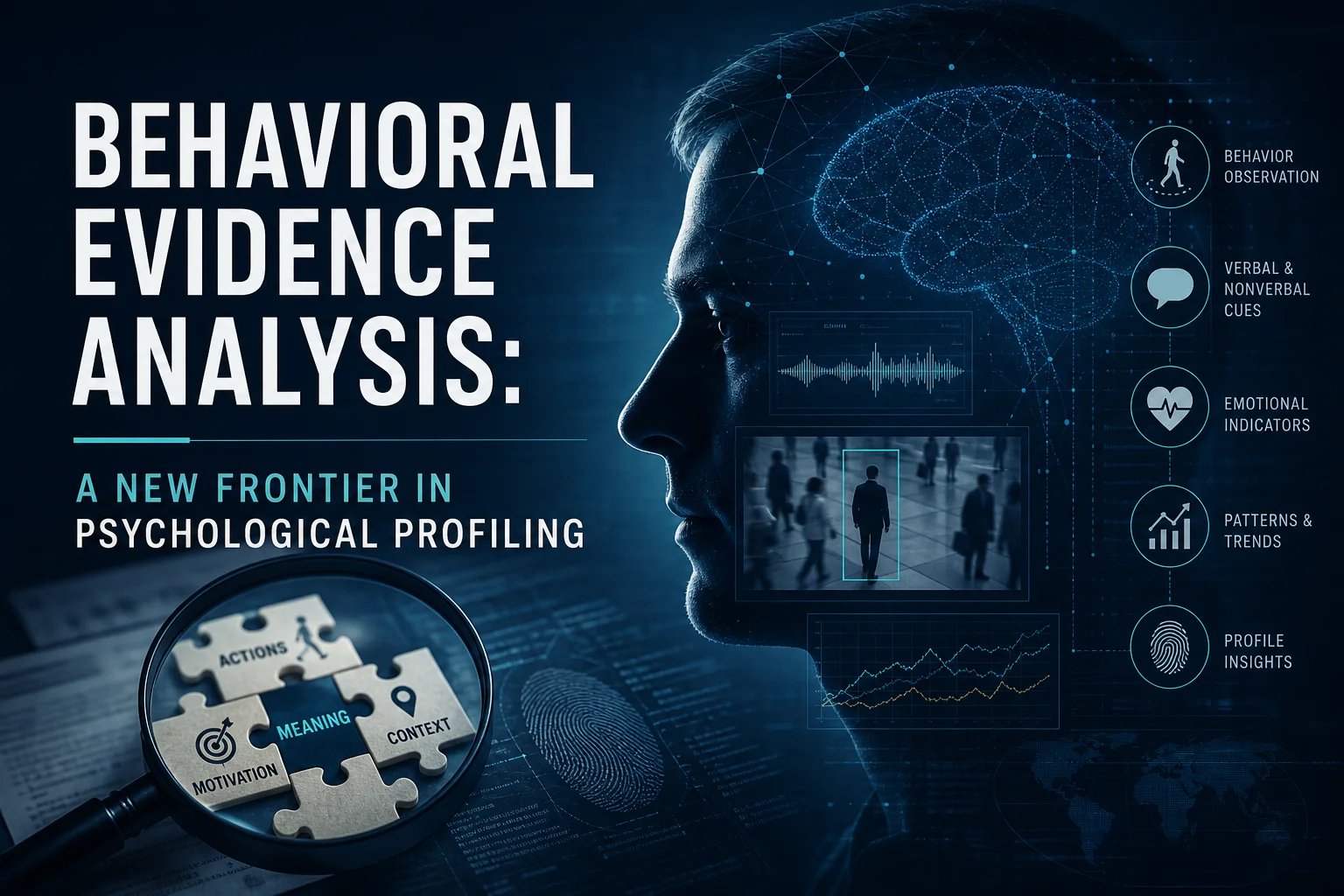
That is where Behavioral Evidence Analysis: A New Frontier in Psychological Profiling enters the conversation.
Rather than beginning with a theory about “what kind of person” commits a crime, Behavioral Evidence Analysis, often shortened to BEA, begins with the evidence. It asks: What can be inferred from the offender’s actions? What behavior is actually supported by the scene, victimology, forensic findings, timeline, and investigative facts? What alternative explanations must be ruled out?
In an age of DNA databases, digital forensics, geolocation data, artificial intelligence, cybercrime, and growing public scrutiny of investigative methods, Behavioral Evidence Analysis: A New Frontier in Psychological Profiling offers something both powerful and necessary: a disciplined, evidence-first approach to understanding criminal behavior.
This article explores how Behavioral Evidence Analysis works, why it matters, how it differs from older profiling methods, and how it is shaping the future of psychological profiling.
What Is Behavioral Evidence Analysis?
Behavioral Evidence Analysis: A New Frontier in Psychological Profiling refers to an investigative approach that interprets criminal behavior by examining physical, forensic, digital, and contextual evidence.
At its core, Behavioral Evidence Analysis focuses on what an offender did, how they did it, when they did it, and what those actions may reveal about their knowledge, planning, motive, risk tolerance, emotional state, and relationship to the victim.
Unlike some traditional offender profiling models, BEA does not begin with broad assumptions such as “serial killers are usually socially isolated” or “organized offenders behave in predictable ways.” Instead, it begins with case-specific evidence.
A BEA-oriented analyst might ask:
- Was the victim specifically targeted or opportunistically selected?
- Did the offender bring tools, use available weapons, or improvise?
- Was the scene controlled, chaotic, staged, or altered?
- What behavior was necessary to complete the crime?
- What behavior was excessive, symbolic, emotional, or unnecessary?
- Did the offender display forensic awareness?
- Does the digital behavior match the physical behavior?
- What evidence contradicts the initial theory?
In this way, Behavioral Evidence Analysis as a new frontier in psychological profiling is less about guessing personality traits and more about reconstructing behavior.
Why Behavioral Evidence Analysis Matters Now
Modern investigations are increasingly complex. Offenders may leave behind physical evidence, but they may also leave digital evidence: search histories, GPS data, deleted messages, cryptocurrency transactions, social media activity, surveillance footage, and device metadata.
At the same time, investigators face pressure to avoid tunnel vision, wrongful accusations, and unsupported conclusions. Public expectations have changed. Courts increasingly demand transparent reasoning. Families of victims want answers grounded in facts, not speculation.
This is one reason Behavioral Evidence Analysis: A New Frontier in Psychological Profiling has become so important. It provides a structured way to bridge behavioral science, forensic science, and investigative reasoning.
Traditional Profiling vs. Behavioral Evidence Analysis
| Feature | Traditional Psychological Profiling | Behavioral Evidence Analysis |
|---|---|---|
| Starting point | Offender type or psychological category | Case-specific evidence |
| Main question | “What kind of person did this?” | “What behavior does the evidence support?” |
| Risk | Stereotyping, overgeneralization | Evidence misinterpretation if poorly applied |
| Strength | Can generate investigative ideas | Can test hypotheses against facts |
| Best use | Broad investigative guidance | Reconstruction, linkage, motive analysis, suspect evaluation |
| Courtroom value | Often limited if speculative | Stronger when tied to evidence and transparent reasoning |
Traditional profiling can still have value, especially when used carefully. But Behavioral Evidence Analysis: A New Frontier in Psychological Profiling brings a more rigorous foundation to the process.
The Core Principles of Behavioral Evidence Analysis
Behavioral Evidence Analysis is not simply “reading a crime scene.” It is a disciplined framework built around several key principles.
1. Evidence Comes Before Theory
In BEA, conclusions must be anchored to observable evidence. Analysts avoid forming a theory first and then selecting facts to support it.
For example, if a scene appears “organized,” that alone does not prove the offender is intelligent, employed, socially skilled, or emotionally controlled. The analyst must ask what specific behaviors suggest planning or control.
Did the offender bring restraints?
Did they disable cameras?
Did they avoid leaving fingerprints?
Did they know the victim’s schedule?
Did they move the body to delay discovery?
The power of Behavioral Evidence Analysis: A New Frontier in Psychological Profiling lies in separating evidence-based inference from assumption.
2. Victimology Is Central
Victimology is the study of the victim’s life, routines, relationships, vulnerabilities, habits, and risk exposure. In BEA, understanding the victim is essential because offender behavior often makes sense only in relation to victim selection.
A victim may be chosen because of:
- Personal relationship
- Accessibility
- Symbolic meaning
- Lifestyle exposure
- Financial motive
- Opportunity
- Fantasy-driven preference
- Retaliation
- Random availability
A strong Behavioral Evidence Analysis does not reduce the victim to a statistic. It reconstructs the victim’s world to understand how offender and victim paths intersected.
3. Behavior Has Context
The same behavior can mean different things in different cases.
For example, overkill may suggest rage, panic, personal connection, intoxication, sadistic motivation, or an inexperienced offender losing control. It cannot be interpreted in isolation.
Similarly, staging a burglary might suggest the offender knew the victim and wanted to redirect suspicion. But it might also be an actual burglary that escalated into violence.
This is why Behavioral Evidence Analysis in psychological profiling depends on context, corroboration, and alternative explanations.
4. Crime Scenes Are Dynamic
Crime scenes are not static snapshots. They are sequences of behavior.
A BEA analyst attempts to reconstruct the crime as a timeline:
- Pre-crime planning
- Victim approach
- Initial contact
- Control method
- Offense behavior
- Post-offense actions
- Escape
- Communication or concealment
- Repetition or escalation
This sequence can reveal whether behavior was planned, reactive, ritualistic, opportunistic, or staged.
5. Alternative Hypotheses Must Be Tested
A major strength of Behavioral Evidence Analysis: A New Frontier in Psychological Profiling is its emphasis on competing explanations.
Instead of saying, “The offender staged the scene,” a careful analyst asks:
- What evidence supports staging?
- What evidence argues against staging?
- Could the scene reflect panic rather than staging?
- Could another person have disturbed the scene?
- Could first responders, family members, or environmental factors explain the disturbance?
- Is there forensic evidence consistent with intentional alteration?
This habit protects investigations from confirmation bias.
The Behavioral Evidence Analysis Process
Although practices vary by analyst and jurisdiction, BEA often follows a structured progression.
Step 1: Collect and Review All Available Evidence
This includes:
- Crime scene photographs
- Autopsy findings
- Police reports
- Witness statements
- Digital records
- Surveillance footage
- Communication logs
- Forensic lab reports
- Victim background information
- Suspect interviews
- Timeline data
The analyst must resist drawing firm conclusions before reviewing the full evidence set.
Step 2: Conduct Victimology
Victimology examines who the victim was and why they may have been targeted or exposed to risk.
Important questions include:
| Victimology Area | Investigative Questions |
|---|---|
| Lifestyle | Where did the victim go? Who did they meet? |
| Relationships | Were there conflicts, intimate partners, debts, disputes? |
| Routine | Did the offender know the victim’s schedule? |
| Risk level | Was the victim in a high-risk location or situation? |
| Digital life | Were there online threats, dating app contacts, harassment? |
| Recent changes | New job, breakup, move, financial conflict, legal issue? |
In Behavioral Evidence Analysis: A New Frontier in Psychological Profiling, victimology is not an afterthought. It is the foundation for understanding offender choice.
Step 3: Reconstruct the Offense
The analyst builds a behavioral timeline:
- How did the offender arrive?
- How did they access the victim?
- What was the first controlling act?
- How long did the offense likely last?
- What did the offender do after the main offense?
- What did they take, leave, destroy, clean, or stage?
This reconstruction helps identify behavioral decisions.
Step 4: Identify Behavioral Themes
Behavioral themes may include:
- Planning
- Anger
- Control
- Sexual motivation
- Financial motive
- Revenge
- Panic
- Concealment
- Experimentation
- Symbolism
- Forensic awareness
- Opportunism
These themes should not become labels too quickly. BEA requires the analyst to connect each theme to specific evidence.
Step 5: Generate Investigative Inferences
Inferences may relate to:
- Relationship between offender and victim
- Level of familiarity with the scene
- Offender risk tolerance
- Possible motive
- Experience or inexperience
- Physical capabilities
- Knowledge of forensic methods
- Likelihood of repeat behavior
- Post-crime behavior
A responsible Behavioral Evidence Analysis does not claim certainty where evidence only supports probability.
Step 6: Review Suspects Against Evidence
BEA can be especially useful in evaluating suspects. Rather than asking whether a suspect “matches a profile,” investigators ask whether the suspect’s known behavior, access, opportunity, and history align with the behavioral evidence.
This is a crucial distinction. Behavioral Evidence Analysis: A New Frontier in Psychological Profiling should never be used to force a suspect into a psychological template.
Key Behavioral Clues Analysts Examine
Not every clue has equal value. Some behaviors are more diagnostic than others, especially when they are unusual, unnecessary, repeated, or connected to offender choice.
Behavioral Evidence Categories
| Category | Examples | Possible Significance |
|---|---|---|
| Approach behavior | Surprise attack, deception, forced entry | Planning, familiarity, confidence |
| Control methods | Restraints, threats, weapon use | Power needs, preparation, victim management |
| Weapon behavior | Brought weapon vs. available weapon | Planning, emotional state, opportunity |
| Body positioning | Concealment, display, care, humiliation | Relationship, shame, message, fantasy |
| Staging | Fake burglary, altered scene, moved items | Redirection, offender-victim link |
| Trophy-taking | Personal items removed | Memory, control, fantasy reinforcement |
| Forensic awareness | Cleaning, gloves, burning evidence | Prior knowledge, planning, media influence |
| Digital behavior | Searches, messages, location data | Intent, preparation, post-crime monitoring |
| Post-offense conduct | Returning to scene, media tracking | Anxiety, pride, curiosity, control |
This table shows why Behavioral Evidence Analysis in psychological profiling is so valuable: it transforms scattered details into structured investigative meaning.
Case Study 1: The BTK Killer and the Value of Behavioral Consistency
Dennis Rader, known as the BTK killer, murdered ten people in Kansas between 1974 and 1991. He gave himself the name “BTK,” meaning “Bind, Torture, Kill,” and communicated with police and media over the years.
While the BTK case predates today’s full integration of digital forensic methods, it remains highly relevant to Behavioral Evidence Analysis: A New Frontier in Psychological Profiling because of the behavioral patterns visible across offenses.
Behavioral Elements
- Victims were selected through stalking and fantasy-driven planning.
- Control was central to the offenses.
- Binding was not merely practical; it was part of the offender’s psychological script.
- Rader communicated with authorities and media, indicating a desire for recognition.
- His later capture involved digital evidence from a floppy disk he sent to police.
BEA-Style Analysis
A Behavioral Evidence Analysis of the BTK crimes would focus less on generic serial killer stereotypes and more on repeated actions: stalking, binding, communication, fantasy rehearsal, and post-offense self-mythologizing.
The offender’s behavior showed a need to control not only victims, but also the public narrative. His communications were not incidental; they were part of the behavioral pattern.
Relevance
The BTK case illustrates how Behavioral Evidence Analysis as a new frontier in psychological profiling can identify behavioral consistency across time. It also shows how physical and digital evidence can converge. Rader’s downfall demonstrates a key modern lesson: offenders who manage physical evidence may still expose themselves through communication and technology.
Case Study 2: The Unabomber and Behavioral-Linguistic Evidence
The Unabomber case involved a series of bombings between 1978 and 1995. Theodore Kaczynski targeted universities, airlines, and individuals connected to modern technology. The case became famous not only for the bombings but also for the manifesto that ultimately helped identify him.
Behavioral Elements
- Devices showed technical skill and experimentation.
- Targets reflected ideological themes.
- The offender maintained distance from victims through mailed or placed bombs.
- Written communication became a central behavioral clue.
- Linguistic patterns in the manifesto helped family members recognize Kaczynski’s ideas and phrasing.
BEA-Style Analysis
From a Behavioral Evidence Analysis perspective, the Unabomber case shows how behavior includes more than physical acts. Writing is behavior. Target selection is behavior. Construction methods are behavior. The decision to publish a manifesto is behavior.
The bombs reflected planning, technical competence, and ideological motivation. The writings helped connect the crimes to a worldview.
Relevance
This case demonstrates why Behavioral Evidence Analysis: A New Frontier in Psychological Profiling must include linguistic and symbolic evidence. In modern investigations, emails, social media posts, manifestos, forum activity, and search histories may reveal behavioral patterns as important as fingerprints.
Case Study 3: The Golden State Killer and the Evolution of Evidence-Based Profiling
The Golden State Killer, later identified as Joseph James DeAngelo, committed burglaries, sexual assaults, and murders in California during the 1970s and 1980s. He was identified decades later through investigative genetic genealogy.
Behavioral Elements
- Extensive pre-offense surveillance
- Escalation from burglary to sexual assault and murder
- Use of bindings and threats
- Familiarity with neighborhoods
- Attacks often involved couples
- Post-offense phone calls in some cases
- High level of risk tolerance
BEA-Style Analysis
A Behavioral Evidence Analysis would examine the offender’s progression over time. The shift from burglary to sexual violence to homicide could suggest increasing confidence, fantasy escalation, or changing risk appetite.
The offender’s ability to enter homes, control victims, and escape suggested preparation and environmental awareness. His background as a former police officer became highly relevant after identification, but BEA would not require that assumption in advance. It would simply note behaviors consistent with surveillance skill and possible knowledge of police response.
Relevance
The Golden State Killer case reveals a powerful lesson for Behavioral Evidence Analysis in modern psychological profiling: behavioral patterns can remain valuable even when forensic technology changes. Decades later, DNA solved the identity question, but behavioral evidence helped link crimes, understand escalation, and preserve the significance of the series.
Case Study 4: The Disappearance of a Digital-Age Victim
Consider a realistic composite case based on patterns seen in contemporary investigations.
A young professional disappears after leaving work. Her phone last pings near her apartment, but her car is found miles away. Her social media accounts show activity after her disappearance, including messages claiming she “needed space.” Her apartment shows no forced entry. A few items are missing, but valuables remain untouched.
Behavioral Evidence
- No forced entry suggests known access, deception, or voluntary entry.
- Social media activity after disappearance may indicate staging or coercion.
- Car relocation suggests effort to mislead.
- Missing personal items may be staged to imply voluntary departure.
- Valuables left behind weaken a robbery theory.
- Phone location data contradicts the later online activity.
BEA-Style Analysis
In a case like this, Behavioral Evidence Analysis: A New Frontier in Psychological Profiling helps investigators separate appearance from behavior. The scene may be designed to suggest voluntary disappearance, but the behavioral sequence tells a different story.
The offender appears to understand the victim’s routines and digital habits. The post-disappearance messages may be an attempt to control the narrative and delay reporting.
Relevance
This composite case highlights the modern frontier of BEA: digital staging. Today, offenders may not only move bodies or rearrange rooms; they may send texts, alter profiles, delete messages, or use devices to create false timelines. Behavioral Evidence Analysis must now examine both physical and digital scenes as one connected behavioral environment.
The Role of Digital Evidence in Behavioral Evidence Analysis
Modern criminal behavior increasingly leaves digital traces. That makes Behavioral Evidence Analysis: A New Frontier in Psychological Profiling more relevant than ever.
Digital evidence can reveal:
- Planning searches
- Victim surveillance
- Online grooming
- Threat escalation
- Financial motive
- Post-crime monitoring
- Attempts to destroy evidence
- False alibis
- Communication patterns
- Location history
Digital Behavior and Investigative Meaning
| Digital Evidence | Behavioral Question | Possible Interpretation |
|---|---|---|
| Search history | What did the person prepare for? | Intent, curiosity, planning |
| Location data | Where did they go and when? | Opportunity, contradiction, stalking |
| Deleted messages | What was removed? | Concealment, panic, relevance |
| Social media posts | What image were they projecting? | Alibi creation, manipulation |
| Device shutdown | Why did tracking stop? | Conscious avoidance, coincidence |
| Password changes | Who controlled access? | Staging, coercion, concealment |
| Online purchases | What tools were acquired? | Preparation, fantasy, logistics |
Digital behavior must be handled carefully. A suspicious search does not prove guilt. A deleted message may have innocent explanations. But when digital evidence aligns with physical evidence, BEA becomes far more powerful.
Behavioral Evidence Analysis and Crime Scene Staging
Staging occurs when an offender deliberately alters a crime scene to mislead investigators. It is one of the most important areas where Behavioral Evidence Analysis in psychological profiling can provide value.
Common staging scenarios include:
- Making a homicide look like suicide
- Making a targeted killing look like robbery
- Making an assault look like an accident
- Making a disappearance look voluntary
- Moving a body to obscure location
- Planting or removing items
- Creating false digital activity
Signs That May Suggest Staging
| Possible Staging Indicator | Why It Matters |
|---|---|
| Valuables left behind in “burglary” | Robbery motive may be false |
| Excessive disorder but little missing | Scene may be theatrically disturbed |
| Suicide method inconsistent with injuries | Physical evidence may contradict narrative |
| Forced entry from inside | Entry story may be fabricated |
| Victim behavior inconsistent with disappearance | Voluntary absence may be unlikely |
| Digital messages unlike victim’s style | Possible impersonation |
| Cleanup in specific areas only | Offender may know where evidence exists |
Staging is often personal. Many staged scenes are created by offenders who have some relationship to the victim and need to redirect attention. However, that is not a rule. BEA requires analysts to evaluate each case on its own evidence.
Behavioral Evidence Analysis and Linkage Analysis
Linkage analysis asks whether multiple crimes may have been committed by the same offender. This is another area where Behavioral Evidence Analysis: A New Frontier in Psychological Profiling can be extremely useful.
Analysts look for behavioral similarity across cases, especially behaviors that are:
- Unusual
- Repeated
- Unnecessary to complete the crime
- Symbolic
- Risky
- Consistent across time
- Connected to offender preference
However, linkage analysis must distinguish between modus operandi and signature behavior.
Modus Operandi vs. Signature
| Concept | Meaning | Example |
|---|---|---|
| Modus operandi | Practical method used to commit crime | Wearing gloves, entering through window |
| Signature behavior | Behavior that fulfills psychological or emotional need | Specific posing, ritualistic communication |
| Staging | Behavior intended to mislead | Fake burglary, false suicide note |
| Trophy-taking | Removing item for later psychological use | Jewelry, clothing, photos |
Modus operandi can change as offenders learn. Signature behavior tends to be more stable because it is connected to internal needs or fantasies.
This distinction is central to Behavioral Evidence Analysis as a new frontier in psychological profiling.
The Psychology Behind Behavioral Evidence
BEA does not require analysts to diagnose offenders. In fact, responsible analysts avoid making unsupported clinical claims. But behavioral evidence can reveal psychological processes.
Possible psychological dimensions include:
- Control
- Fear
- Anger
- Shame
- Fantasy
- Jealousy
- Revenge
- Greed
- Excitement
- Panic
- Sadism
- Attachment
- Avoidance
- Narcissistic injury
For example, an offender who covers a victim’s face may be expressing shame, remorse, depersonalization, or an inability to confront the victim. But the meaning depends on context. Was the victim known? Was the covering practical? Was it part of cleanup? Was the body otherwise displayed?
This is why Behavioral Evidence Analysis: A New Frontier in Psychological Profiling is strongest when it resists simplistic symbolism.
Common Mistakes in Psychological Profiling That BEA Helps Avoid
Traditional profiling has sometimes suffered from avoidable errors. BEA helps reduce these risks.
Mistake 1: Overreliance on Offender Typologies
Labels like “organized,” “disorganized,” “power-control,” or “mission-oriented” can be useful shorthand, but they can also oversimplify.
A real offender may plan carefully, panic unexpectedly, stage poorly, and behave impulsively later. Human behavior is mixed.
Mistake 2: Confirmation Bias
Investigators may favor evidence that supports their preferred suspect. BEA encourages analysts to test competing hypotheses.
Mistake 3: Ignoring Victimology
Without victimology, investigators may misunderstand why the offender chose the victim.
Mistake 4: Confusing Possibility With Probability
A behavior might have several meanings. BEA requires analysts to rank explanations based on evidence.
Mistake 5: Treating Profiles as Proof
A profile is not evidence of guilt. Behavioral Evidence Analysis in psychological profiling should support investigation, not replace forensic proof.
Ethical Issues in Behavioral Evidence Analysis
Because profiling can influence investigations, reputations, and legal outcomes, ethics matter deeply.
Behavioral Evidence Analysis: A New Frontier in Psychological Profiling must be practiced with caution, humility, and transparency.
Key Ethical Standards
| Ethical Principle | Practical Meaning |
|---|---|
| Evidence-based reasoning | Conclusions must be tied to facts |
| Transparency | Analysts should explain how they reached conclusions |
| Avoiding bias | Race, class, gender, or mental illness stereotypes must not drive analysis |
| Respect for victims | Victimology must not become victim-blaming |
| Probabilistic language | Avoid unsupported certainty |
| Peer review | Complex cases benefit from independent review |
| Legal caution | Profiles should not be treated as standalone proof |
BEA should never become a tool for discriminatory profiling. The focus is behavior evidenced in the case, not demographic assumptions.
Behavioral Evidence Analysis in Court
Can Behavioral Evidence Analysis be used in court? Sometimes, but its admissibility depends on jurisdiction, expert qualifications, methodology, and relevance.
Courts may be skeptical of speculative psychological profiling. However, BEA can be more defensible when it explains behavioral reconstruction based on evidence.
For example, an expert might testify about:
- Whether a scene is consistent with staging
- Whether offender behavior suggests familiarity with the victim
- Whether multiple crimes share distinctive behavioral features
- Whether the evidence supports or contradicts a suicide narrative
- Whether certain actions indicate planning
The key is that Behavioral Evidence Analysis: A New Frontier in Psychological Profiling must be presented as evidence-based interpretation, not mystical insight.
How BEA Supports Investigators Without Replacing Them
BEA is not a magic formula. It does not “solve” cases by itself. Instead, it supports investigative work by helping teams:
- Prioritize leads
- Re-examine assumptions
- Identify contradictions
- Understand victim-offender interaction
- Detect staging
- Link related offenses
- Prepare interview strategies
- Evaluate suspect behavior
- Develop search priorities
- Clarify timelines
A good Behavioral Evidence Analysis works like a disciplined second lens. It sharpens focus without pretending to see everything.
Practical Applications Beyond Homicide
Although BEA is often associated with homicide and serial crime, its principles can apply more broadly.
1. Sexual Assault Investigations
BEA may help examine approach behavior, control methods, victim selection, escalation, and post-assault contact.
2. Missing Persons Cases
It can help distinguish voluntary absence, coercion, staged disappearance, accident, suicide, or homicide.
3. Arson
Fire-setting behavior may reveal motive, target familiarity, concealment efforts, revenge, financial incentive, or excitement.
4. Cybercrime
Digital offender behavior can reveal planning, target selection, manipulation style, and risk tolerance.
5. Threat Assessment
BEA principles help evaluate whether threats are impulsive, performative, escalating, targeted, or operationalized.
6. Workplace Violence
Behavioral evidence can clarify grievance development, leakage, planning behavior, and triggering events.
These applications show why Behavioral Evidence Analysis: A New Frontier in Psychological Profiling is increasingly relevant across investigative fields.
A Simple BEA Framework for Investigative Thinking
The following framework can help readers understand how Behavioral Evidence Analysis organizes complex evidence.
| BEA Question | Purpose |
|---|---|
| What happened? | Establish facts before interpretation |
| Who was the victim? | Understand exposure, risk, relationships |
| Why this victim? | Explore targeting or opportunity |
| Why this location? | Examine access, familiarity, symbolism |
| Why this method? | Assess planning, emotion, skill |
| What was necessary? | Separate practical acts from expressive behavior |
| What was unnecessary? | Identify possible signature, staging, or emotion |
| What changed after the crime? | Detect concealment, communication, escalation |
| What contradicts the theory? | Reduce confirmation bias |
| What evidence is missing? | Guide further investigation |
This table captures the essence of Behavioral Evidence Analysis in psychological profiling: disciplined curiosity.
The Future of Behavioral Evidence Analysis
The future of Behavioral Evidence Analysis: A New Frontier in Psychological Profiling will likely be shaped by technology, interdisciplinary collaboration, and stronger scientific standards.
Artificial Intelligence and Pattern Recognition
AI may help identify patterns across large datasets, such as similar crime scene behaviors, travel routes, communication patterns, or online activity. However, AI cannot replace human judgment. Algorithms can detect correlations, but they cannot always understand context.
The best future is not AI versus BEA. It is AI-assisted Behavioral Evidence Analysis guided by trained experts.
Digital-Physical Crime Scene Integration
Investigators increasingly need to treat phones, vehicles, smart homes, social platforms, and financial apps as extensions of the crime scene.
A future BEA report may include:
- Physical scene reconstruction
- Device activity timeline
- Geolocation mapping
- Communication analysis
- Behavioral comparison across platforms
- Post-offense monitoring behavior
Better Research and Validation
For BEA to mature, it needs continued research. Which behavioral indicators are most reliable? Which are often misinterpreted? How accurate are analysts under blind conditions? What training reduces bias?
The future of Behavioral Evidence Analysis as a new frontier in psychological profiling depends not only on compelling cases, but also on scientific accountability.
Suggested Long-Tail Keywords and Contextual Variations
For SEO and topical depth, useful variations include:
- Behavioral Evidence Analysis in criminal profiling
- evidence-based psychological profiling
- Behavioral Evidence Analysis techniques
- crime scene behavior analysis
- offender behavior reconstruction
- forensic behavioral analysis
- behavioral evidence in investigations
- psychological profiling based on evidence
- BEA in forensic psychology
- Behavioral Evidence Analysis case studies
- crime scene staging analysis
- victimology in Behavioral Evidence Analysis
- digital evidence and behavioral profiling
- investigative psychology and BEA
- offender profiling evidence-based methods
These variations support the main keyword, Behavioral Evidence Analysis: A New Frontier in Psychological Profiling, while keeping the content natural and reader-friendly.
Benefits and Limitations of Behavioral Evidence Analysis
Like any investigative method, BEA has strengths and limitations.
Benefits
| Benefit | Why It Matters |
|---|---|
| Evidence-focused | Reduces speculation |
| Case-specific | Avoids generic offender stereotypes |
| Flexible | Applies to physical and digital evidence |
| Useful for cold cases | Helps re-evaluate old assumptions |
| Supports linkage | Identifies behavioral patterns across crimes |
| Encourages critical thinking | Tests competing hypotheses |
Limitations
| Limitation | Risk |
|---|---|
| Depends on evidence quality | Poor documentation weakens analysis |
| Requires expertise | Misinterpretation can mislead investigations |
| Not proof of guilt | Must be supported by forensic and legal evidence |
| Context-sensitive | Same behavior may have multiple meanings |
| Bias still possible | Analysts must actively guard against it |
The best use of Behavioral Evidence Analysis: A New Frontier in Psychological Profiling is as part of a broader investigative strategy—not as a standalone answer.
How Investigators Can Apply BEA More Effectively
For professionals, students, or true-crime researchers interested in Behavioral Evidence Analysis, several practical habits are essential.
1. Separate Observation From Interpretation
Observation: The victim’s purse was missing.
Interpretation: The offender may have staged a robbery.
Those are not the same thing. Always separate what is known from what is inferred.
2. Ask What the Offender Needed to Do
Some actions are practical. Others are expressive. Identifying the difference can reveal motive or psychological significance.
3. Build a Timeline
A timeline exposes contradictions and helps identify planning, opportunity, and post-crime behavior.
4. Use Victimology Carefully
Victimology should never blame the victim. Its purpose is to understand access, risk, relationships, and offender choice.
5. Challenge the Favorite Theory
Ask: “What evidence would prove this theory wrong?”
That one question can prevent major investigative errors.
6. Revisit the Evidence as New Facts Emerge
BEA is iterative. New forensic results, interviews, or digital records may change the behavioral interpretation.
These habits reflect the real promise of Behavioral Evidence Analysis in psychological profiling: better reasoning, not better guessing.
Why Behavioral Evidence Analysis Captivates the Public
There is a reason people are fascinated by profiling. We want to understand the hidden logic behind extreme behavior. We want to know how investigators see patterns where others see chaos.
But the public often receives a dramatized version of profiling: the brilliant profiler walks into a room, notices one strange detail, and instantly describes the offender.
Reality is slower, harder, and more disciplined.
Behavioral Evidence Analysis: A New Frontier in Psychological Profiling is compelling precisely because it respects complexity. It does not promise supernatural insight. It shows how careful reasoning can turn fragments of evidence into meaningful investigative direction.
That is more impressive than fiction because it is grounded in reality.
Conclusion: The Promise of Behavioral Evidence Analysis
Behavioral Evidence Analysis: A New Frontier in Psychological Profiling represents a powerful shift in how investigators, forensic professionals, and behavioral experts understand crime.
Its greatest strength is its discipline. It starts with evidence. It prioritizes victimology. It reconstructs behavior. It tests alternatives. It resists stereotypes. It integrates physical and digital clues. It treats offender behavior not as a mystery to be guessed, but as a sequence to be analyzed.
The future of psychological profiling will not belong to intuition alone. It will belong to methods that are transparent, evidence-based, ethical, and adaptable.
For investigators, the takeaway is clear: let the evidence lead.
For students, the lesson is equally important: behavior has meaning, but only when interpreted carefully.
For the public, the inspiration is simple: truth often hides in details, and disciplined curiosity can bring it into the light.
In that sense, Behavioral Evidence Analysis: A New Frontier in Psychological Profiling is more than an investigative method. It is a mindset—one that values facts over assumptions, questions over shortcuts, and justice over easy answers.
1. What is Behavioral Evidence Analysis?
Behavioral Evidence Analysis is an evidence-based approach to psychological profiling that interprets offender behavior through crime scene facts, victimology, forensic findings, timelines, and contextual evidence. It focuses on what the offender did rather than relying on broad personality stereotypes.
2. How is Behavioral Evidence Analysis different from traditional profiling?
Traditional profiling often begins with offender categories or behavioral typologies. Behavioral Evidence Analysis begins with case-specific evidence. It asks what conclusions are supported by the facts and what alternative explanations must be considered.
3. Can Behavioral Evidence Analysis identify a criminal?
Not by itself. BEA can help narrow investigative focus, evaluate suspects, detect staging, or link crimes, but it does not prove identity. Physical evidence, digital records, witness testimony, and legal standards remain essential.
4. Is Behavioral Evidence Analysis used only in murder cases?
No. Behavioral Evidence Analysis can be useful in homicide, sexual assault, missing persons cases, arson, cybercrime, threat assessment, workplace violence, and cold case reviews.
5. What role does victimology play in BEA?
Victimology is central. By studying the victim’s routines, relationships, risks, and recent life events, analysts can better understand why the victim was targeted or how the offender gained access.
6. Can Behavioral Evidence Analysis be wrong?
Yes. Any interpretive method can be wrong if evidence is incomplete, contaminated, misunderstood, or affected by bias. That is why BEA emphasizes alternative hypotheses, transparency, and evidence-based reasoning.
7. Does BEA involve diagnosing offenders?
Usually, no. Behavioral Evidence Analysis may explore psychological themes such as control, anger, fear, or planning, but responsible analysts avoid unsupported clinical diagnoses.
8. Why is Behavioral Evidence Analysis important in the digital age?
Because modern offenders often leave digital behavior behind: searches, messages, GPS data, deleted files, online threats, and social media activity. BEA helps integrate digital and physical evidence into a coherent behavioral timeline.
About the Author


The PsyForU Editorial Collective is the research and editorial team of PsyForU Research International. The collective prepares educational, psychological, mental-health-awareness, inclusion, neurodiversity, and research-methodology content for students, parents, educators, researchers, and general readers. PsyForU content is intended for awareness, education, and capacity-building and should not be treated as clinical diagnosis, therapy, medical advice, legal advice, or emergency mental-health support.